2027 Cheapest Nutrition and Dietetics Online Degree Programs

Co-Founder and Chief Data Scientist
Earning a degree in nutrition and dietetics can unlock various rewarding careers, from guiding patients in clinical settings to empowering individuals as a wellness consultant. Yet, the road to becoming a registered dietitian or qualified nutrition professional can be paved with a major obstacle: cost. Many aspiring students worry about finding affordable educational options that deliver high-quality instruction.
In this article, I will guide you through the cheapest online nutrition and dietetics degree programs for 2024, providing solutions that align with your budget and career aspirations.
What are the benefits of getting a degree from the cheapest nutrition and dietetics online degree programs?
- A degree in nutrition and dietetics allows you to work as a nutritionist, dietitian, food service manager, or health educator.
- According to 2025 data, the average annual salary for nutritionists and dietitians in the US is $73,850.
- Earning this degree online provides the flexibility to balance your studies with work or personal commitments, making education more accessible.
What can I expect from the cheapest nutrition and dietetics online degree programs?
Accredited programs in nutrition and dietetics ensure that the curriculum meets industry standards, preparing graduates for certification exams and professional practice.
- Prospective students can expect comprehensive coursework covering essential topics in nutrition, dietetics, and health sciences. These programs typically include courses such as human anatomy, food science, and medical nutrition therapy.
- Students will also engage in practical experiences, including virtual labs and internships, to gain hands-on skills necessary for the profession.
- Tuition costs for nutrition and dietetics programs wildly vary, from $100 to more than $1,000 per credit.
- Nutrition and dietetics programs typically take up to four years of full-time study to complete.
- Additionally, students will benefit from access to online resources, academic support, and networking opportunities with peers and professionals in the field.
Where can I work with a degree from the cheapest nutrition and dietetics online degree programs?
Graduates with a degree from the cheapest nutrition and dietetics online programs can work in various settings. Hospitals and clinics employ dietitians to develop and manage nutritional programs for patients. Public health organizations and government agencies often hire nutritionists to promote healthy eating habits and design community health programs.
Additionally, schools and educational institutions need professionals to create nutritious meal plans for students. Corporate wellness programs and fitness centers also seek experts to advise on healthy lifestyles and diet plans. Some graduates may choose to work in food service management, overseeing meal preparation and ensuring nutritional standards are met.
Freelance opportunities are also available, allowing professionals to offer personalized nutrition counseling and consulting services.
How much can I make with a degree from the cheapest nutrition and dietetics online degree programs?
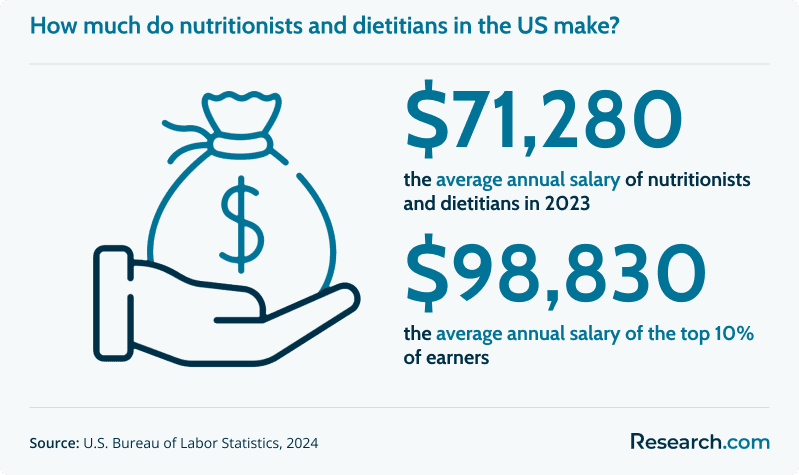
The average annual salary for nutritionists and dietitians in the US is $73,850 as of 2025. Those in the top 10% of the field can earn an average of $98,830 annually.
Graduates with a degree from the cheapest nutrition and dietetics online programs can expect to earn competitive salaries. Employment opportunities in general medical and surgical hospitals offer an average salary of $73,670. Outpatient care centers provide higher compensation, averaging $80,190 annually. Other industries, such as special food services and nursing care facilities, offer salaries around $68,440 and $67,820, respectively.
The highest-paying industries, including merchant wholesalers and scientific research services, offer salaries ranging from $82,960 to $93,990, reflecting the diverse opportunities and earning potential in this field.
- 10 Cheapest Nutrition and Dietetics Online Degree Programs for 2025 Best Programs
- How long does it take to complete the cheapest nutrition and dietetics online degree programs? Completion Time
- How does the cheapest nutrition and dietetics online degree programs compare to an on-campus program? How does the cheapest nutrition and dietetics online degree programs compare to an on-campus program?
- What is the average cost of the cheapest nutrition and dietetics online degree programs? Average Cost
- What are the financial aid options for students enrolling in the cheapest nutrition and dietetics online degree programs? Financial Aid
- What are the prerequisites for enrolling in the cheapest nutrition and dietetics online degree programs? Requirements
- What courses are typically in the cheapest nutrition and dietetics online degree programs? What courses are typically in the cheapest nutrition and dietetics online degree programs?
- What types of specializations are available in the cheapest nutrition and dietetics online degree programs? What types of specializations are available in the cheapest nutrition and dietetics online degree programs?
- How does holistic nutrition specialization affect career outcomes? How does holistic nutrition specialization affect career outcomes?
- How can online certifications complement your nutrition and dietetics degree? How can online certifications complement your nutrition and dietetics degree?
- What challenges do students face in online nutrition and dietetics programs? What challenges do students face in online nutrition and dietetics programs?
- How do nutrition and dietetics programs compare to other affordable online healthcare degrees? How do nutrition and dietetics programs compare to other affordable online healthcare degrees?
- How do online nutrition and dietetics programs support career and professional development? How do online nutrition and dietetics programs support career and professional development?
- How do you choose the cheapest nutrition and dietetics online degree programs? How do you choose the cheapest nutrition and dietetics online degree programs?
- What career paths are available for graduates of the cheapest nutrition and dietetics online degree programs? What career paths are available for graduates of the cheapest nutrition and dietetics online degree programs?
- What is the job market for graduates with a degree from the cheapest nutrition and dietetics online degree programs? Job Market
- What are the daily responsibilities of a nutritionist? What are the daily responsibilities of a nutritionist?
- What can you do with a degree in nutritional science? What can you do with a degree in nutritional science?
- What advanced certifications can boost my interdisciplinary expertise? What advanced certifications can boost my interdisciplinary expertise?
- How can combining nutrition and pharmacy studies enhance your career prospects? How can combining nutrition and pharmacy studies enhance your career prospects?
10 Cheapest Online Nutrition and Dietetics Degree Programs for 2027
Choosing an online nutrition or dietetics degree is not just a tuition decision. Students also need to know whether a program supports their career goal, whether it is properly accredited, how much flexibility it offers, and whether it can help them move toward roles in dietetics, nutrition education, wellness, public health, food service, or graduate study.
This guide is for students comparing affordable online bachelor’s programs in nutrition, dietetics, food and nutrition, nutritional science, and applied nutrition. It explains the cheapest programs on our list, how online study compares with campus learning, what these degrees usually cost, what courses and specializations to expect, and how to avoid choosing a low-cost program that does not match your professional plans.
Quick answer: What is the cheapest online nutrition and dietetics degree?
Among the programs listed here, Brigham Young University-Idaho has the lowest published cost per credit at $194 for in-state students and $388 for out-of-state students. However, the “cheapest” program is not always the best fit. Students who want to become registered dietitians should pay close attention to ACEND accreditation, supervised practice requirements, graduate study expectations, and state rules before enrolling.
How we ranked these affordable online nutrition and dietetics programs
This list was built using Research.com’s ranking methodology, with affordability as the central selection factor. To support transparency, we reviewed information from sources such as the IPEDS database, Peterson's database, the College Scorecard database, and the National Center for Education Statistics.
Because online tuition, fees, program formats, and professional requirements can change, students should confirm current costs, accreditation status, transfer policies, and career eligibility directly with each school before applying.
| Rank | School and program | Required credits | Cost per credit | Accreditation listed |
| 1 | Brigham Young University-Idaho BS in Nutritional Science | 120 | $194 (in-state); $388 (out-of-state) | Northwest Commission on Colleges and Universities (NWCCU) |
| 2 | Purdue Global University BS in Nutrition | 120 | $371 | Higher Learning Commission (HLC); National Association of Nutrition Professionals (NANP) |
| 3 | The University of Alabama Online BS in Food and Nutrition | 120 | $385 | Academy of Nutrition and Dietetics |
| 4 | Kansas State University Online Bachelor’s in Dietetics | 120 | $468 | Accreditation Council of Education in Nutrition and Dietetics (ACEND) |
| 5 | University of Northern Colorado Online BS in Dietetics | 120 | $484 | Accreditation Council of Education in Nutrition and Dietetics (ACEND) |
| 6 | Huntington University of Health Sciences Online BS in Nutrition | 120 | $496 | Accreditation Council of Education in Nutrition and Dietetics (ACEND) |
| 7 | Weber State University Online BS in Nutrition Education | 120 | $506.03 (in-state); $1,495.12 (out-of-state) | Northwest Commission on Colleges and Universities (NWCCU) |
| 8 | University of Arizona Online BS in Nutritional Sciences | 120 | $525 | Accreditation Council for Education in Nutrition and Dietetics (ACEND) |
| 9 | Eastern Michigan University Online BS in Dietetics | 120 | $637 | Higher Learning Commission |
| 10 | Arizona State University Online BS in Applied Nutrition and Health | 120 | $713 | Higher Learning Commission |
1. Brigham Young University-Idaho BS in Nutritional Science
Brigham Young University-Idaho offers an online Bachelor of Science in Nutritional Science for students who want a science-centered foundation in food, nutrients, metabolism, and health. The program is best suited for learners interested in nutrition-related work, research preparation, wellness roles, or future study. Students considering clinical dietetics should verify what additional education, supervised practice, or credentialing steps are required for their intended career.
- Program length: 4 years
- Required credits to graduate: 120
- Cost per credit: $194 (in-state); $388 (out-of-state)
- Accreditation: Northwest Commission on Colleges and Universities (NWCCU)
2. Purdue Global University BS in Nutrition
Purdue Global University provides an online Bachelor of Science in Nutrition that covers nutrition across the lifespan, metabolism, dietary choices, and pharmacology-related concepts. Students who want a broader wellness-oriented degree may also be interested in the holistic nutrition option, which allows them to study nutrition through a complementary health lens.
- Program length: 4 years
- Required credits to graduate: 120
- Cost per credit: $371
- Accreditation: Higher Learning Commission (HLC); National Association of Nutrition Professionals (NANP)
3. The University of Alabama Online BS in Food and Nutrition
The University of Alabama offers an online Bachelor of Science in Food and Nutrition designed for students who want to study nutrition science along with food systems, culture, business, and food service concepts. This program may fit learners interested in nutrition education, food policy, culinary nutrition, food service management, or related professional pathways.
- Program length: 4 years
- Required credits to graduate: 120
- Cost per credit: $385
- Accreditation: Academy of Nutrition and Dietetics
4. Kansas State University Online Bachelor’s in Dietetics
Kansas State University offers an online bachelor’s in dietetics with coursework in public health nutrition, dietetics careers, counseling strategies, financial management in dietetics, food service systems, and medical nutrition therapy. Students who want a dietetics-focused program should ask how the curriculum connects to supervised practice, graduate study, and eligibility for future dietitian credentialing steps.
- Program length: 4 years
- Required credits to graduate: 120
- Cost per credit: $468
- Accreditation: Accreditation Council of Education in Nutrition and Dietetics (ACEND)
5. University of Northern Colorado Online BS in Dietetics
The University of Northern Colorado offers an online BS in Dietetics degree completion pathway accredited by the Accreditation Commission for Dietetics and Nutrition. The program can be completed in just 18 months, making it especially relevant for transfer students who already have substantial college credit. Students should confirm how many credits they can transfer and what additional supervised practice requirements may apply after graduation.
- Program length: 4 years
- Required credits to graduate: 120
- Cost per credit: $484
- Accreditation: Accreditation Council of Education in Nutrition and Dietetics (ACEND)
6. Huntington University of Health Sciences Online BS in Nutrition
Huntington University of Health Sciences offers an online Bachelor of Science in Nutrition with coursework that introduces students to nutrition science, food systems, medical terminology, and healthy eating behaviors. The program may be appropriate for students pursuing nutrition education, wellness, food service, or entry-level nutrition-related work.
- Program length: 4 years
- Required credits to graduate: 120
- Cost per credit: $496
- Accreditation: Accreditation Council of Education in Nutrition and Dietetics (ACEND)
7. Weber State University Online BS in Nutrition Education
Weber State University offers an online Bachelor of Science in Nutrition Education through the Moyes College of Education and the Department of Exercise and Nutrition Sciences. The program emphasizes nutrition communication, behavior change, and health education. Students can choose between integrative nutrition and sports nutrition, making it a practical option for learners interested in community wellness, corporate wellness, public health education, or performance-focused nutrition support.
- Program length: 4 years
- Tracks/concentrations: Integrative Nutrition; Sports Nutrition
- Required credits to graduate: 120
- Cost per credit: $506.03 (in-state); $1,495.12 (out-of-state)
- Accreditation: Northwest Commission on Colleges and Universities (NWCCU)
8. University of Arizona Online BS in Nutritional Sciences
The University of Arizona offers an online BS in Nutritional Sciences through the College of Agriculture & Life Sciences. Students may focus on nutrition or dietetics while completing coursework such as nutrition and the life cycle, fundamentals of food science, and food service organization and management. This program can fit students who want a stronger science base with flexibility to pursue different nutrition-related paths.
- Program length: 4 years
- Required credits to graduate: 120
- Cost per credit: $525
- Accreditation: Accreditation Council for Education in Nutrition and Dietetics (ACEND)
9. Eastern Michigan University Online BS in Dietetics
Eastern Michigan University offers an online Bachelor of Science in Dietetics through the College of Health and Human Services. The curriculum is built around areas such as clinical dietetic practice, medical nutrition therapy, and food service management. Students planning to work in clinical settings should confirm the supervised practice and credentialing steps needed after completing the degree.
- Program length: 4 years
- Required credits to graduate: 120
- Cost per credit: $637
- Accreditation: Higher Learning Commission
10. Arizona State University Online BS in Applied Nutrition and Health
Arizona State University offers an online BS in Applied Nutrition and Health that combines nutrition fundamentals with communication, leadership, culture, sustainability, food safety, food policy, and community engagement. The degree may appeal to students who want to apply nutrition knowledge in wellness, community education, food systems, or health promotion settings.
- Program length: 4 years
- Required credits to graduate: 120
- Cost per credit: $713
- Accreditation: Higher Learning Commission
Students comparing low-cost online degrees outside nutrition may also want to review related Research.com guides, including affordable online bachelor’s programs in journalism and online bachelor’s programs in social work.
How long does it take to finish an affordable online nutrition and dietetics degree?
Most online bachelor’s programs in nutrition and dietetics are designed to take about four years for full-time students. The timeline can be shorter for students who transfer previous college credits, enroll year-round, or enter a degree completion program. Part-time students usually need longer because they take fewer credits each term.
Online master’s programs in nutrition and dietetics often require two to three years of full-time study. Students who work full time, need supervised practice placement, or take courses part time should expect the timeline to vary by program design and personal schedule.
| Student situation | Likely timeline | What to check before enrolling |
| First-time bachelor’s student | About 4 years | General education requirements, lab expectations, and course sequencing |
| Transfer student | Potentially shorter than 4 years | Transfer credit limits, minimum credits required at the institution, and prerequisite gaps |
| Degree completion student | May be faster if prior credits apply | Whether the program accepts completed science, nutrition, and general education credits |
| Part-time student | Longer than full-time study | Maximum completion time, course availability, and financial aid enrollment rules |
If speed is a major factor, students can compare nutrition-related options with the best accelerated degree programs to see whether an accelerated format is available in their intended major.
Students exploring broader healthcare administration or management tracks may also compare these programs with the cheapest online healthcare administration degree options to determine whether a clinical, wellness, food systems, or administrative path fits their goals better.
Online vs. on-campus nutrition and dietetics programs: Which format is better?
Online and campus-based nutrition programs can both provide rigorous coursework in food science, nutrient metabolism, nutrition assessment, medical nutrition therapy, and community nutrition. The better choice depends on your schedule, learning style, access to local fieldwork sites, and career goals.
Online programs are often stronger for students who need flexibility because of work, caregiving, military service, or location. Campus programs may be stronger for students who prefer face-to-face instruction, immediate access to labs, and more in-person interaction with faculty and classmates.
| Factor | Online nutrition degree | On-campus nutrition degree |
| Schedule flexibility | Usually better for working adults and students with family responsibilities | More structured class times and campus-based routines |
| Hands-on learning | May use virtual labs, local placements, or short in-person requirements | Often provides direct access to campus labs, kitchens, and clinical partners |
| Networking | Depends heavily on online discussions, virtual events, and local fieldwork | More frequent informal contact with classmates, faculty, and campus organizations |
| Cost considerations | May reduce commuting or relocation costs, but fees still matter | May involve housing, commuting, parking, or campus fees |
| Best for | Self-directed learners who need location flexibility | Students who want in-person learning and more structured support |
The same decision logic applies to other healthcare-related degrees, including affordable MHA programs, where the right format depends on cost, schedule, networking needs, and career direction.
How online programs handle labs, internships, and fieldwork
Nutrition is applied science, so students should not choose an online program based on convenience alone. Strong programs explain how learners complete labs, projects, practical assignments, internships, or supervised experiences. Some courses may use virtual simulations or home-based assignments, while others may require approved local sites.
Students interested in clinical dietetics should be especially careful. Online coursework alone may not satisfy all supervised practice, credentialing, or state requirements. Before enrolling, ask the program where students complete field experiences, who approves sites, whether placements are guaranteed, and how the school supports students who live outside the institution’s home state.
For a broader comparison of online options, students can also review accredited online nutrition schools and compare program design, accreditation, practical learning expectations, and career outcomes.
How much do the cheapest online nutrition and dietetics programs cost?
The average cost per credit for the cheapest online nutrition and dietetics degree programs is approximately $510 for in-state students and $620 for out-of-state students. Published tuition varies widely by school, residency status, transfer credit, and whether online students pay additional technology or program fees.
In this list, the lowest cost per credit is around $370 for both in-state and out-of-state students, while higher-cost options may charge up to $710 per credit for in-state students and $1,500 per credit for out-of-state students. Students should calculate total cost, not just tuition, before deciding.
| Cost factor | Why it matters | Question to ask |
| Tuition per credit | This is the starting point for comparing affordability. | Is the online tuition rate different for in-state and out-of-state students? |
| Transfer credits | Accepted credits can reduce both time and total tuition. | How many credits can I transfer, and which major prerequisites still remain? |
| Fees | Technology, lab, course, graduation, or distance learning fees can raise the real price. | What mandatory fees apply to online students? |
| Books and materials | Science and nutrition courses may require textbooks, software, or lab-related materials. | Are digital materials included, or are they billed separately? |
| Fieldwork expenses | Practical requirements may involve travel, background checks, uniforms, or placement costs. | Will I need to pay additional costs for internships, labs, or supervised experiences? |
Return on investment depends on the career path a student enters after graduation. The average annual salary of nutritionists and dietitians in 2025 is at $73,850, while the top 10% of earners have a salary of around $98,830. Those figures should be treated as labor-market benchmarks, not guarantees for any individual graduate.
 Salary of nutritionists and dietitian" width="799" height="475" loading="lazy">
Financial aid options for online nutrition and dietetics students
Low tuition can help, but most students should still build a full funding plan. Financial aid availability depends on the school, enrollment status, citizenship or residency eligibility, academic progress, and whether the program qualifies for aid.
- Federal aid: Eligible students can submit the Free Application for Federal Student Aid (FAFSA) to be considered for federal grants, loans, and work-study opportunities.
- Scholarships: Colleges, professional associations, community organizations, and private donors may offer awards for students studying nutrition, dietetics, food science, public health, or healthcare.
- State aid: Some students may qualify for state grants, scholarships, or loan assistance programs, depending on residency and field of study.
- Employer tuition assistance: Working students should ask whether their employer offers reimbursement or tuition support. This can also help students later pursue related programs such as an affordable online public health degree.
- Military and veteran benefits: Active-duty service members, veterans, and eligible dependents may be able to use tuition assistance, GI Bill benefits, or related education benefits.
Students should apply early, compare net price rather than sticker price, and ask whether scholarships renew automatically or require a minimum GPA, full-time enrollment, or separate applications each year.
Admission requirements for affordable online nutrition and dietetics programs
Admission requirements vary by school, but most online bachelor’s programs expect applicants to demonstrate college readiness and, in some cases, preparation in science coursework. Transfer and degree completion programs may have stricter prerequisite rules than first-year admission pathways.
- High school diploma or equivalent: Most bachelor’s programs require a high school diploma or GED equivalent.
- Science preparation: Some programs expect prior coursework in biology, chemistry, anatomy and physiology, or related sciences.
- Minimum GPA: Many programs set a minimum GPA, typically ranging from 2.0 to 3.0 on a 4.0 scale.
- Letters of recommendation: Some schools ask for references from teachers, supervisors, or professionals who can speak to the applicant’s academic or professional readiness.
- Personal statement: Applicants may need to explain why they want to study nutrition or dietetics and how the degree connects to their career plans.
- Resume or CV: Some programs request a summary of education, work experience, volunteer service, healthcare exposure, or food service experience.
Students planning to become dietitians should ask admissions advisors a more specific question: “Does this program meet the academic requirements I need for my intended credentialing pathway, or will I need additional coursework after graduation?”
Common courses in online nutrition and dietetics degree programs
Affordable online nutrition and dietetics programs usually combine biological science, food science, counseling, public health, and applied nutrition. Course titles differ by school, but students can expect a mix of foundational and career-focused classes.
- Introduction to nutrition: Students learn core concepts such as macronutrients, micronutrients, energy balance, dietary guidelines, and the role of food in health.
- Food science: Coursework examines the physical and chemical properties of food, preparation methods, safety, preservation, and ingredient function.
- Medical nutrition therapy: Students study how nutrition is used to support prevention or management of conditions such as diabetes, heart disease, gastrointestinal disorders, and related health concerns.
- Community nutrition: This area focuses on nutrition education, food access, culture, socioeconomic factors, and public health interventions. Students interested in community-facing work may also compare this path with social-service training such as MSW accelerated programs.
- Nutritional assessment: Students learn how to evaluate nutritional status using dietary, clinical, biochemical, and body measurement data.
Students should review the full course sequence before enrolling. A program with lower tuition may still be a poor match if it lacks the science prerequisites, supervised experiences, or advanced coursework needed for the student’s target career.
Specializations available in affordable online nutrition and dietetics programs
Specializations help students align their degree with a specific career setting. Not every program offers formal concentrations, but many allow electives or focused coursework in one of the following areas.
| Specialization | What it emphasizes | Best fit for students interested in |
| Clinical nutrition | Nutrition therapy for people with acute or chronic medical conditions | Hospitals, clinics, long-term care, and future dietetics preparation |
| Public health nutrition | Community programs, food access, prevention, and population health | Government agencies, nonprofits, schools, and community health programs |
| Sports nutrition | Fueling, recovery, performance, hydration, and active lifestyles | Athletics, fitness centers, performance coaching, and wellness organizations |
| Pediatric nutrition | Nutrition needs of infants, children, and adolescents | Family health, pediatric programs, schools, and child-focused services |
| Gerontological nutrition | Nutrition concerns related to aging, chronic disease, frailty, and malnutrition | Senior care, long-term care, community aging programs, and clinical support |
Specialization can improve focus, but it does not replace credentialing or supervised practice where those are required. In 2025, the industry with the highest level of employment for nutritionists and dietitians was general medical and surgical hospitals at 20,220.
How can a holistic nutrition focus affect career options?
A holistic nutrition specialization combines nutrition science with lifestyle-oriented wellness approaches. It may be useful for students interested in wellness centers, integrative health settings, coaching, private practice support roles, or consumer health education. However, students should distinguish between wellness-oriented credentials and regulated dietetics credentials, because job titles and legal scope of practice can vary by state.
Students considering this niche should compare curriculum, certification options, and employer expectations. For more detail on earnings and role expectations, review Research.com’s guide to holistic nutritionist salary.
How online certifications can strengthen a nutrition degree
Online certifications can help graduates build targeted skills beyond a bachelor’s curriculum. Depending on the student’s goals, certificates may focus on sports nutrition, holistic wellness, clinical topics, coaching, food safety, or community health education.
Certifications are most useful when they support a clear career plan. Before paying for one, students should ask whether employers recognize it, whether it requires continuing education, whether it overlaps with their degree coursework, and whether it is appropriate for their state’s rules on nutrition practice. Students can compare options through Research.com’s guide to nutrition courses online.
Challenges students should expect in online nutrition and dietetics programs
Online nutrition programs are flexible, but they are not effortless. Students need strong time management, comfort with digital tools, and the discipline to complete science-heavy coursework without the structure of daily campus attendance.
- Limited in-person contact: Online students may need to be more intentional about building relationships with faculty, classmates, and mentors.
- Technology demands: Courses may require reliable internet, video conferencing, learning management systems, virtual labs, or specialized software.
- Science course difficulty: Chemistry, anatomy, physiology, metabolism, and medical nutrition therapy can be challenging in an online format.
- Practical training logistics: Students may need to locate approved fieldwork, internship, or supervised practice sites near where they live.
- Self-paced pressure: Asynchronous courses can be convenient, but missed deadlines can accumulate quickly.
Students who want additional exposure to online healthcare learning environments may also explore online medical billing and coding courses to understand how technology-based healthcare education is structured in another field.
Nutrition and dietetics vs. other affordable online healthcare degrees
Nutrition and dietetics programs focus on food, nutrient metabolism, health promotion, dietary assessment, prevention, and nutrition counseling. Other healthcare degrees may lead toward administration, pharmacy, medical assisting, billing and coding, public health, or clinical support roles.
| Degree area | Main focus | Students may choose it if they want to |
| Nutrition and dietetics | Dietary patterns, food science, medical nutrition therapy, and wellness | Work in nutrition education, dietetics-related settings, wellness, food service, or public health nutrition |
| Healthcare administration | Healthcare operations, finance, policy, and leadership | Manage healthcare teams, programs, facilities, or administrative systems |
| Public health | Population health, prevention, epidemiology, and community programs | Address health issues at the community or systems level |
| Pharmacy | Medication use, pharmacology, therapeutics, and patient safety | Pursue medication-centered healthcare roles through pathways such as accredited online PharmD programs |
The right choice depends on whether a student wants to work directly with food and nutrition behavior, manage healthcare services, study population health, or pursue medication-focused clinical training.
Career and professional development support in online nutrition programs
Good online nutrition and dietetics programs do more than deliver courses. They help students prepare for internships, graduate study, credentialing steps, and the job market. Career support can be especially important for online learners who are not physically present on campus.
- Academic advising: Helps students sequence science, nutrition, and general education requirements correctly.
- Career coaching: Supports resume writing, interview preparation, job search strategy, and employer research.
- Internship or fieldwork guidance: Helps students understand site requirements, documentation, and approval processes.
- Professional networking: May include virtual career fairs, alumni connections, mentoring, and student organizations.
- Credential planning: Helps students understand whether additional education, exams, supervised practice, or state requirements may apply.
Students comparing faster healthcare workforce routes can also review medical assistant accelerated programs, which may be more appropriate for those who want a shorter path into patient-facing healthcare support.
How to choose the best low-cost online nutrition and dietetics program
The cheapest program is only a smart choice if it fits your goals. A student who wants general wellness work may need a different program than a student aiming for dietetics, graduate school, public health nutrition, or food service management.
| Selection factor | Why it matters | What to verify |
| Accreditation | Accreditation affects transfer, financial aid, employer trust, and professional preparation. | Confirm institutional accreditation and, when relevant, programmatic accreditation through the Accreditation Council for Education in Nutrition and Dietetics (ACEND). |
| Career alignment | Nutrition, dietetics, wellness, and food service roles can have different requirements. | Ask which jobs graduates commonly pursue and what additional steps are needed. |
| Curriculum | Course content determines whether the degree prepares you for science-based, counseling, community, or management roles. | Review courses in food science, medical nutrition therapy, counseling, community nutrition, and assessment. |
| Faculty experience | Instructors with field experience can connect theory with real-world practice. | Look for advanced degrees, professional credentials, research, and industry backgrounds. |
| Flexibility | Online formats vary widely. | Ask whether courses are asynchronous, synchronous, accelerated, or tied to specific login times. |
| Total cost | Tuition alone does not show the full price. | Compare fees, books, technology costs, fieldwork expenses, and transfer credit value. |
| Student support | Online learners need accessible help. | Check advising, tutoring, library access, career services, technical support, and internship support. |
Common mistakes to avoid
- Choosing based only on tuition: A low cost per credit can become expensive if few transfer credits apply or extra fees are high.
- Ignoring accreditation: Accreditation can affect financial aid, transfer options, graduate admission, and professional recognition.
- Assuming online means fully remote: Some programs may still require labs, fieldwork, supervised practice, or local placements.
- Confusing nutrition and dietetics requirements: Not every nutrition degree leads to the same credentialing options.
- Skipping state-specific research: Nutrition practice rules can vary, so students should confirm local requirements before enrolling.
- Relying only on rankings: Rankings help with discovery, but the best program depends on fit, cost, accreditation, and career path.
Students exploring lower-cost allied health pathways outside nutrition may also compare the cheapest medical assistant programs.
Career paths for graduates of affordable online nutrition and dietetics programs
Graduates can pursue roles across healthcare, wellness, food service, public health, education, and the food industry. Some roles may require additional credentials, supervised practice, graduate education, licensure, or employer-specific qualifications.
| Career path | Typical responsibilities | Important considerations |
| Clinical dietitian or nutritionist | Assess nutritional needs, support care plans, and provide nutrition guidance in hospitals, clinics, or long-term care settings | Clinical roles may require specific credentialing, supervised practice, or state authorization. |
| Community nutritionist | Design education programs, support disease-prevention initiatives, and teach healthy eating in community settings | Strong communication skills matter. Students creating public-facing materials may benefit from complementary skills such as those taught in online graphic design courses. |
| Sports nutritionist | Help athletes and active clients align eating patterns with training, recovery, and performance goals | Employers may prefer candidates with specialized sports nutrition coursework or certification. |
| Food service manager | Oversee meal planning, preparation, safety, staffing, budgeting, and service operations | Students interested in leadership may later compare business programs such as a 6 month MBA. |
| Wellness coach | Support clients with nutrition habits, lifestyle change, goal setting, and accountability | Scope of practice, credential expectations, and title usage can vary by employer and state. |
In 2025, the highest-paying industry for dietitians and nutritionists was the merchant wholesaling industry at 96,520.
What is the job market like for nutrition and dietetics graduates?
The job market for nutrition and dietetics graduates spans healthcare, public health, education, food service, wellness, and private-sector food industries. Demand can differ by region, credential level, specialization, and whether the role is clinical, community-based, management-focused, or wellness-oriented.
Students should evaluate the job market locally before enrolling. Search job postings in your area, note which credentials employers request, and compare entry-level qualifications with the program’s curriculum. If most target jobs require a registered dietitian credential, graduate education, supervised practice, or state licensure, an affordable bachelor’s degree may be only one step in a longer pathway.
What does a nutritionist do each day?
Daily work depends on the setting, but nutrition professionals often combine assessment, education, planning, documentation, and follow-up support. A hospital-based role looks different from a community wellness role, and a sports nutrition role differs from food service management.
- Client consultations and assessments: Nutrition professionals review eating habits, health goals, lifestyle factors, and relevant medical history. Students researching this role can learn more through Research.com’s guide on how to become a nutritionist.
- Meal planning and nutrition recommendations: They may create food plans or nutrition strategies based on health needs, cultural preferences, budget, and personal goals.
- Nutrition education and counseling: They explain food labels, portion sizes, balanced meals, behavior change strategies, and the relationship between nutrition and long-term health.
- Progress monitoring: They track results, adjust plans, document client progress, and provide accountability over time.
What can you do with a nutritional science degree?
A nutritional science degree can support work in wellness, nutrition education, food systems, public health, research support, food safety, product development, or preparation for graduate study. Some graduates work with individuals or groups to improve nutrition habits, while others support research, community programs, or food industry initiatives.
Students who want a deeper look at roles, graduate pathways, and career planning can read Research.com’s guide, What can you do with a nutritional science degree?.
What advanced certifications can expand interdisciplinary expertise?
Nutrition intersects with public health, medicine, behavioral science, food systems, and pharmacy. Students who want broader healthcare knowledge may consider advanced or complementary training that helps them understand how nutrition relates to medication use, chronic disease management, and patient care coordination.
For students comparing medication-focused healthcare pathways, Research.com’s guide to top PharmD online programs can help clarify how pharmacy education differs from and may complement nutrition training.
What graduates say about online nutrition and dietetics programs
- Aisha: "I expected online science courses to feel disconnected, but the program surprised me. Faculty were responsive, the virtual lab assignments were well organized, and group discussions helped me learn from classmates in different parts of the country. By graduation, I felt ready to talk with clients about healthier food choices with more confidence."
- Ella: "The online format made it possible for me to keep working and still study nutrition seriously. I could complete lectures around my schedule, join discussions after work, and stay involved with my family. That flexibility helped me move into nutrition consulting without putting the rest of my life on hold."
- Sydney: "As a single parent, I needed a program that would not require me to commute every day. The coursework was demanding, but the online resources, advising, and structured assignments helped me keep going. I graduated with the skills to support people who want practical, personalized nutrition guidance."
How can combining nutrition and pharmacy studies support career growth?
Nutrition and pharmacy both connect to patient care, chronic disease management, and health outcomes. Professionals who understand both food-based interventions and medication-related considerations may be better prepared to collaborate with broader healthcare teams, especially in settings where patients manage complex conditions.
Students interested in this interdisciplinary direction can compare pharmacy pathways such as the fastest online PharmD programs to decide whether adding pharmacy-focused education aligns with their long-term goals.
Key Insights
- The lowest listed cost per credit is $194 for in-state students at Brigham Young University-Idaho, but the best program depends on accreditation, transfer credit, career goals, and total cost.
- Most online bachelor’s programs in nutrition and dietetics require 120 credits and take about 4 years for full-time students.
- Students who want to become dietitians should verify ACEND accreditation, supervised practice expectations, graduate study requirements, and state rules before enrolling.
- Online programs can be academically comparable to campus programs, but students must confirm how labs, internships, fieldwork, and practical training are completed.
- The average cost per credit among the cheapest programs is approximately $510 for in-state students and $620 for out-of-state students, but fees and transfer policies can change the real cost.
- The average annual salary of nutritionists and dietitians in 2025 is at $73,850, with the top 10% of earners at around $98,830; individual outcomes depend on credentials, experience, location, industry, and role.
- A nutrition degree can lead to wellness, community health, food service, public health, and clinical-adjacent roles, but some career paths require additional education or credentials.
References:
- Statista. (2024, March 24). Opinions on most important health issues facing America adults. Statista.
- Statista. (2024, February 7). Obesity in the United States. Retrieved June 7, 2024, from Statista.
- U.S. Bureau of Labor Statistics. (2024). Dietitians and nutritionists. Retrieved June 7, 2024, from BLS.
- U.S. Bureau of Labor Statistics. (2024). Occupational employment and wages. Dietitians and nutritionists. Retrieved June 7, 2024, from BLS.
Other Things You Should Know About the Cheapest Nutrition and Dietetics Online Degree Programs
No. To become a registered dietitian nutritionist, the degree must be from a program accredited by the Accreditation Council for Education in Nutrition and Dietetics, and supervised practice now requires at least 1,000 hours completed through an ACEND-accredited pathway before the CDR exam.
Yes, financial aid options for Nutrition and Dietetics online degree programs in 2027 include federal student loans, grants, and scholarships. Eligibility for these options often depends on the student's enrollment status and financial need, as assessed by the FAFSA form.
Most affordable Nutrition and Dietetics online programs in 2027 require applicants to have a high school diploma or equivalent. Some may also request prerequisite coursework in science subjects like biology or chemistry, ensuring students have foundational knowledge before commencing the degree.