
2027 Best Online Master's in Nutrition Programs with No GRE Required

Co-Founder and Chief Data Scientist
Hitting a professional and financial ceiling is a common frustration for many skilled nutrition professionals. While earning a master's degree can boost your salary potential by 20%, the thought of taking the GRE and pausing your career is a major roadblock. Fortunately, there is a direct path forward. Accredited universities now offer the online master's in nutrition no GRE required, designed for working professionals ready to advance without unnecessary hurdles.
To help you find the right fit, our career planning experts, with over 10 years of experience, have created this comprehensive guide. We'll walk you through everything you need to know to make a confident decision about your future.
What are the benefits of a no-GRE master's in nutrition?
- It unlocks the advanced roles and greater autonomy that require a Registered Dietitian Nutritionist (RDN) credential.
- You can expect a significant salary increase, with master's degree holders earning up to 20% more than those with only a bachelor's.
- The flexible online format allows you to continue working while you earn your degree, accelerating your career without pausing your life.
What can I expect from an online program?
You can expect a rigorous, high-quality education. The most important factor is accreditation from the Accreditation Council for Education in Nutrition and Dietetics (ACEND). For any ACEND-accredited program, the curriculum, assignments, and academic standards are identical to their on-campus counterparts. The degree you earn holds the same exact value with employers.
The main difference is the delivery format. Online learning offers the flexibility to study on your schedule, which is a major advantage for working professionals. However, this format requires a high degree of self-discipline and time management to succeed without the structure of in-person classes. You are in control of your own progress.
Where can I work with a master's in nutrition?
A master's degree opens up a much wider range of career opportunities beyond the traditional hospital setting. While clinical dietetics remains a core path, graduates are in high demand across many sectors. You can build a career in corporate wellness programs, sports nutrition organizations, and public health agencies.
Many graduates also go into private practice, where they have the autonomy to build their own client base. New opportunities are also growing quickly in telehealth and digital health platforms, allowing you to provide expert nutritional counseling from anywhere.
How much can I earn with a master's in nutrition?
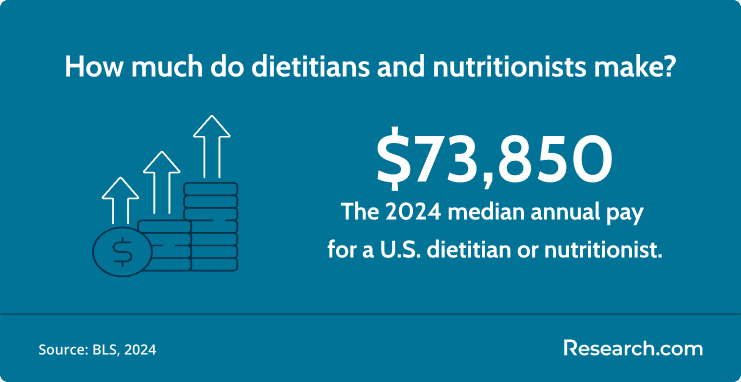
You can expect to earn a strong, competitive salary. According to the U.S. Bureau of Labor Statistics, the median pay for dietitians and nutritionists is $73,850 per year.
Earning your master's degree and the RDN credential is the key to unlocking that potential. It positions you for higher-paying roles, especially in specialized areas or in private practice where your earning potential can be even greater. This degree is the new standard for the profession and a direct investment in your long-term financial growth.
- List of the Best Online Master's in Nutrition Programs with No GRE Required for 2027 List of Programs
- How long does it take to complete an online master's in nutrition program with no GRE required? Completion Time
- How does an online master's in nutrition with no GRE required program compare to an on-campus program? How does an online master's in nutrition with no GRE required program compare to an on-campus program?
- What is the average cost of an online master's in nutrition program with no GRE required? Program Cost
- What are the financial aid options for students enrolling in an online master's in nutrition program with no GRE required? Financial Aid
- What are the prerequisites for enrolling in an online master's in nutrition program with no GRE required? What are the prerequisites for enrolling in an online master's in nutrition program with no GRE required?
- What courses are typically in an online master's in nutrition program with no GRE required? What courses are typically in an online master's in nutrition program with no GRE required?
- What types of specializations are available in an online master's in nutrition program with no GRE required? Specializations
- How to Choose the Best Online Master's in Nutrition Program with No GRE Required How to Choose the Best Online Master's in Nutrition Program with No GRE Required
- What career paths are available for graduates of an online master's in nutrition programs? Career Paths
- What is the job market for graduates of an online master's in nutrition programs? Job Market
Best Online Master’s in Nutrition Programs with No GRE Required for 2027
Choosing an online master’s in nutrition without the GRE is not just about avoiding a standardized test. For many students, it is a practical decision about entering or advancing in nutrition, dietetics, wellness, public health, or healthcare while managing work, family, cost, and credential requirements. The right program can help you build advanced nutrition expertise, qualify for specialized roles, or move toward the Registered Dietitian Nutritionist credential if the program meets the appropriate accreditation and supervised practice standards.
This guide is designed for students comparing no-GRE online master’s in nutrition programs and trying to answer the questions that matter most: Which schools offer strong options? How long will the degree take? What does it cost? Will an online degree be respected? Does the program help with RDN eligibility? And how can you avoid choosing a program that does not support your career goal?
Research.com’s ranking process uses data from sources such as the IPEDS database, Peterson's database, the College Scorecard database, and The National Center for Education Statistics. These sources help evaluate programs using transparent information on institutions, costs, student outcomes, and academic quality. You can review additional details on the ranking process on Research.com’s methodology page.
Quick Answer: Is an Online Master’s in Nutrition with No GRE Worth Considering?
Yes, an online master’s in nutrition with no GRE required can be worth considering if the program is accredited, fits your budget, and aligns with your career goal. Students who want to become Registered Dietitian Nutritionists should pay especially close attention to Accreditation Council for Education in Nutrition and Dietetics requirements, because not every nutrition master’s degree automatically qualifies graduates for the RDN pathway. For working adults, the no-GRE online format can reduce admissions barriers while still offering graduate-level training in nutrition science, public health nutrition, medical nutrition therapy, wellness programming, or research.
| Decision Factor | What to Look For | Why It Matters |
| Accreditation | Institutional accreditation and, when needed, ACEND accreditation | Accreditation affects degree recognition, aid eligibility, and RDN preparation. |
| Career goal | Clinical dietetics, public health, sports nutrition, wellness, research, or private practice | Different programs prepare students for different professional outcomes. |
| Total cost | Tuition, fees, practicum costs, books, and travel for any required in-person components | The lowest tuition is not always the best value if the program does not support your target career. |
| Format | Fully online, hybrid, synchronous, asynchronous, full-time, or part-time | The delivery model determines whether the program fits your schedule. |
| Admissions requirements | No GRE, prerequisite science courses, GPA expectations, recommendations, resume, and statement of purpose | No GRE does not mean open admission; programs still evaluate readiness for graduate work. |
1. University of North Dakota – M.S. in Nutrition
The University of North Dakota offers an online M.S. in Nutrition built for professionals who want to deepen their preparation in nutrition education, counseling, and research. The program emphasizes nutrition science, biochemical foundations, and the use of educational strategies to support varied populations.
- Program Length: 2 years
- Required Credits to Graduate: 30
- Estimated Total Tuition: $23,751.30
- Accreditation: Higher Learning Commission (HLC)
2. Johnson & Wales University – Master’s in Nutrition
Johnson & Wales University provides a practice-oriented master’s program that expands students’ understanding of nutrition science and wellness planning. The curriculum can support career interests in athletics, health promotion, nutrition education, and community-based wellness work.
- Program Length: 2 years
- Required Credits to Graduate: 30
- Cost per Credit: $842
- Accreditation: New England Commission of Higher Education (NECHE)
3. American University – MS in Nutrition Education
American University focuses on the connection between nutrition science, behavior change, and effective health communication. Students learn how to develop, deliver, and evaluate nutrition education programs for individuals, groups, and communities.
- Program Length: 2 years
- Required Credits to Graduate: 30
- Cost per Credit: $1,300
- Accreditation: Middle States Commission on Higher Education (MSCHE)
4. Logan University – Master of Science in Applied Nutrition and Dietetics
Logan University offers a hybrid pathway that combines online coursework with in-person supervised practice for students pursuing Registered Dietitian Nutritionist preparation. Its competency-based design focuses on applied nutrition and dietetics skills used in healthcare and chronic disease prevention.
- Program Length: 2 years
- Required Credits to Graduate: 42
- Cost per Credit: $700
- Accreditation: Accreditation Council for Education in Nutrition and Dietetics (ACEND)
5. Simmons University – MS in Nutrition and Health Promotion
Simmons University lets students shape the degree around either research or entrepreneurship. Depending on the chosen focus, students complete a thesis or business plan while studying nutrition science, health behavior, and strategies for promoting healthier choices.
- Program Length: 2-4 years
- Concentrations: Research; and Entrepreneurship
- Required Credits to Graduate: 30
- Cost per Credit: $1,315
- Accreditation: Accreditation Council for Education in Nutrition and Dietetics (ACEND)
6. Texas Tech University – Master of Science in Nutrition and Dietetics
Texas Tech University offers a nutrition and dietetics master’s program that may appeal to students preparing for health-related careers in medicine, physical therapy, physician assistant practice, or other clinical fields. Its coursework emphasizes applied nutrition knowledge that can complement advanced healthcare training.
- Program Length: ~1 year
- Concentrations: Nutrition and Healthy Weight; Nutrition and Sports; and Nutrition in the Lifecycle
- Required Credits to Graduate: 31
- Estimated Total Tuition: $24,800
- Accreditation: Texas Higher Education Coordinating Board (THECB)
7. The University of Texas at Austin – Master of Science in Nutritional Sciences
The University of Texas at Austin delivers a fully online nutritional sciences degree with a strong science foundation and options for academic focus. Students can choose a track in health promotion and disease prevention or biochemical and functional nutrition.
- Program Length: 1-2 years
- Concentrations: Health Promotion & Disease Prevention; and Biochemical & Functional Nutrition
- Required Credits to Graduate: 30
- Estimated Total Tuition: $22,500
- Accreditation: Southern Association of Colleges and Schools (SACS)
8. University of Georgia – Master of Science in Nutritional Sciences, Community Nutrition
The University of Georgia offers an online community nutrition-focused master’s program for professionals who want to strengthen their ability to design and deliver nutrition education and interventions. The program may be completed in as little as one year, making it a strong option for students seeking a faster format.
- Program Length: 12–16 months
- Required Credits to Graduate: 30
- Cost per Credit: $645
- Accreditation: Southern Association of Colleges and Schools Commission on Colleges (SACSCOC)
9. Wayne State University – MS in Nutrition
Wayne State University offers a thesis-based nutrition master’s program centered on independent research. Students complete and defend a research project, which can be especially useful for those interested in doctoral study, laboratory work, academic research, or evidence-based nutrition practice.
- Program Length: 1.5-2 years
- Required Credits to Graduate: 32
- Estimated In-State Tuition: $25,684
- Accreditation: Higher Learning Commission (HLC)
10. North Carolina Central University – MS in Nutritional Sciences
North Carolina Central University offers an online nutritional sciences program with several concentration options. Students can focus their graduate work on a specific population or practice area and may have the option to apply internship experience toward course credit.
- Program Length: ~2 years
- Concentrations: Community Nutrition Educator; Gerontological Nutrition; Obesity and Weight Management; Pediatric Nutrition; and Sports Dietetics
- Required Credits to Graduate: 36
- Estimated In-State Tuition: $16,200
- Accreditation: Southern Association of Colleges and Schools Commission on Colleges (SACSCOC)
Program Comparison: No-GRE Online Master’s in Nutrition Options
| School | Degree | Length | Credits | Listed Cost | Accreditation Listed |
| University of North Dakota | M.S. in Nutrition | 2 years | 30 | $23,751.30 estimated total tuition | Higher Learning Commission (HLC) |
| Johnson & Wales University | Master’s in Nutrition | 2 years | 30 | $842 per credit | New England Commission of Higher Education (NECHE) |
| American University | MS in Nutrition Education | 2 years | 30 | $1,300 per credit | Middle States Commission on Higher Education (MSCHE) |
| Logan University | Master of Science in Applied Nutrition and Dietetics | 2 years | 42 | $700 per credit | Accreditation Council for Education in Nutrition and Dietetics (ACEND) |
| Simmons University | MS in Nutrition and Health Promotion | 2-4 years | 30 | $1,315 per credit | Accreditation Council for Education in Nutrition and Dietetics (ACEND) |
| Texas Tech University | Master of Science in Nutrition and Dietetics | ~1 year | 31 | $24,800 estimated total tuition | Texas Higher Education Coordinating Board (THECB) |
| The University of Texas at Austin | Master of Science in Nutritional Sciences | 1-2 years | 30 | $22,500 estimated total tuition | Southern Association of Colleges and Schools (SACS) |
| University of Georgia | Master of Science in Nutritional Sciences, Community Nutrition | 12–16 months | 30 | $645 per credit | Southern Association of Colleges and Schools Commission on Colleges (SACSCOC) |
| Wayne State University | MS in Nutrition | 1.5-2 years | 32 | $25,684 estimated in-state tuition | Higher Learning Commission (HLC) |
| North Carolina Central University | MS in Nutritional Sciences | ~2 years | 36 | $16,200 estimated in-state tuition | Southern Association of Colleges and Schools Commission on Colleges (SACSCOC) |
How Long Does It Take to Complete an Online Master’s in Nutrition with No GRE Required?
Most online master’s in nutrition programs take about two years for full-time students, but the actual timeline depends on the program structure, credit load, prerequisites, and whether supervised practice is included. Some programs are designed for faster completion, while others offer part-time pacing for working adults.
Students looking for the shortest master's degree in nutrition online should compare more than speed. A shorter program may be useful if you already meet prerequisites and do not need an RDN-qualifying supervised practice pathway. If you need clinical preparation, a longer program may be the better investment.
Factors That Can Shorten or Extend Your Timeline
- Full-time vs. part-time enrollment: Full-time study can shorten the calendar time, while part-time study may be more realistic for students with jobs or caregiving responsibilities.
- Prerequisite courses: Students without prior coursework in biology, chemistry, anatomy, physiology, or nutrition may need additional classes before starting graduate-level requirements.
- Supervised practice: Programs that include RDN preparation may require fieldwork, rotations, or in-person experiences that affect scheduling.
- Thesis or capstone: Research-focused programs may take longer if the thesis process requires data collection, faculty review, and defense.
- Transfer or prior learning policies: Some schools may allow limited transfer credit, while others require all graduate credits to be completed in residence.
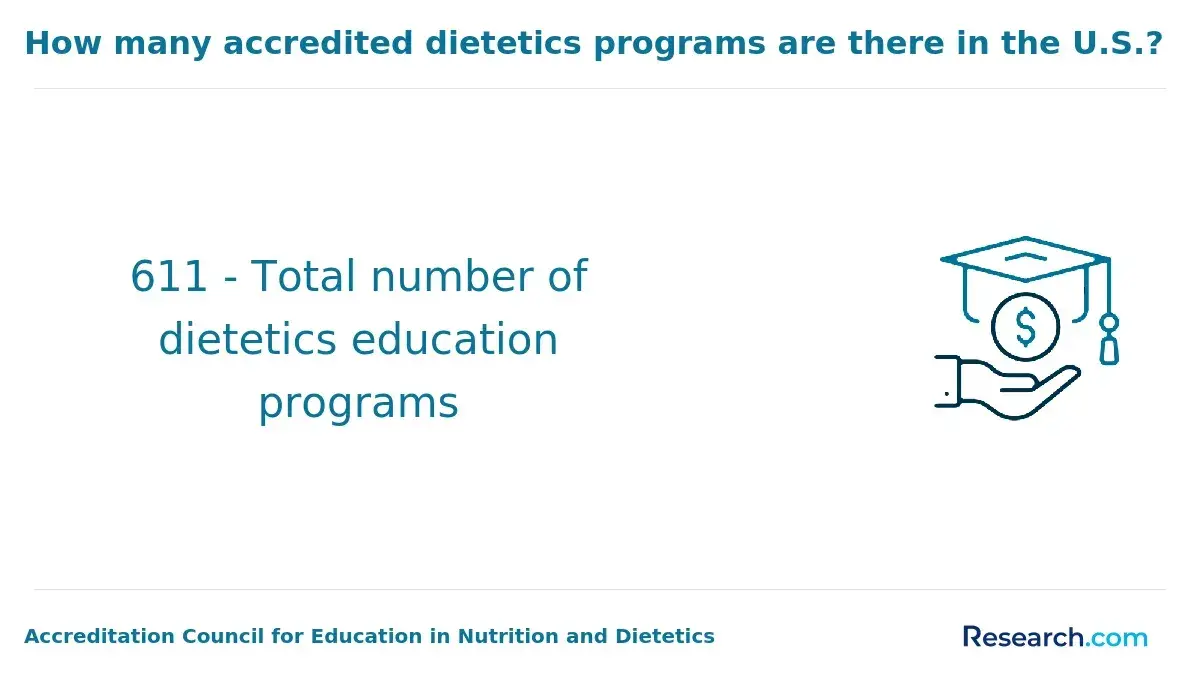
This pathway is common among established professionals. Data cited in the original analysis show a workforce of over 107,000 dietitians and nutritionists with an average age of 42.3, which means many students enter graduate study after gaining work experience rather than immediately after a bachelor’s degree.
Online vs. On-Campus Master’s in Nutrition: What Changes and What Does Not?
An accredited online master’s in nutrition can carry the same academic credibility as a campus-based program when the curriculum, faculty standards, assessment methods, and accreditation are comparable. The key difference is delivery. Online programs typically use learning platforms, recorded or live lectures, discussion boards, virtual advising, and remote assignments, while campus programs rely more heavily on in-person instruction and local networking.
However, students should not assume every online nutrition degree leads to the same outcome. A general nutrition master’s degree, a nutrition education degree, and an ACEND-aligned dietetics program can serve different purposes. If your goal is the RDN credential, you must confirm whether the program meets the educational and supervised practice requirements for that pathway.
Online and Campus Programs Compared
| Feature | Online Master’s in Nutrition | On-Campus Master’s in Nutrition |
| Schedule flexibility | Often better for working adults, especially if courses are asynchronous | May require fixed class times and regular campus attendance |
| Relocation | Usually not required unless the program includes in-person components | Often requires living near campus or commuting |
| Networking | Requires more intentional effort through faculty, peers, professional groups, and field placements | May offer easier access to campus events, labs, and local professional contacts |
| Clinical or supervised practice | May be arranged locally or through hybrid requirements, depending on the program | May be tied to campus-affiliated sites or regional partners |
| Degree credibility | Depends on accreditation, curriculum quality, and institutional reputation | Also depends on accreditation, curriculum quality, and institutional reputation |
Accreditation Matters More Than Course Format
For students pursuing dietetics, the most important question is whether the program is recognized by the Accreditation Council for Education in Nutrition and Dietetics. ACEND standards apply to qualifying programs regardless of whether coursework is online, hybrid, or campus-based. If a program is not aligned with your credential or licensure goal, its convenience will not compensate for that gap.
What Is the Average Cost of an Online Master’s in Nutrition with No GRE Required?
Based on the program analysis provided, average total tuition for an online master’s in nutrition is around $26,500 for in-state students and just under $28,000 for out-of-state students. Listed tuition among the reviewed programs ranges from $16,200 to nearly $40,000, so students should compare total program price rather than relying only on per-credit tuition.
Cost should be evaluated alongside career fit. The median salary cited for dietitians and nutritionists is $73,850 per year, but individual earnings vary by role, credential status, location, experience, employer, and specialization. A program that supports RDN eligibility or a specific professional niche may offer stronger long-term value than a cheaper program that does not match your intended career.
Costs Students Often Overlook
- University fees: Online programs may charge technology, registration, student service, or graduation fees.
- Books and materials: Nutrition science courses may require textbooks, software, lab kits, or subscriptions.
- Travel: Hybrid programs or supervised practice components can require travel to campus or clinical sites.
- Prerequisite courses: Students changing fields may need undergraduate science or nutrition courses before admission or enrollment.
- Credentialing expenses: Exam preparation, professional memberships, and licensure-related costs may apply after graduation.
Students who want a less intensive or more accessible pathway may also compare easiest nutrition degree programs. These programs may offer structured coursework and more approachable admissions requirements, but students should still verify whether the degree supports clinical, community, wellness, or dietetics goals.
What Financial Aid Options Are Available for No-GRE Online Master’s in Nutrition Students?
Students enrolled in accredited online graduate programs may qualify for many of the same financial aid options available to campus-based students. The starting point for U.S. students is the FAFSA, which is used to determine eligibility for federal student aid.
- Federal loans: Graduate students commonly use federal loans to finance part of their education.
- Scholarships and grants: Universities, professional associations, foundations, and community organizations may offer funding that does not have to be repaid.
- Employer tuition reimbursement: Healthcare systems, wellness companies, schools, and public agencies may help employees pay for job-related graduate education.
- Private loans: Banks and private lenders may offer education loans, but students should compare terms carefully and usually review federal options first.
- Payment plans: Some universities allow students to spread tuition payments across the term instead of paying all at once.
How to Reduce Out-of-Pocket Cost
- Ask the program for the full cost of attendance, not just tuition.
- Complete the FAFSA early and check school-specific aid deadlines.
- Contact your employer’s HR department about tuition reimbursement or professional development funding.
- Ask whether prerequisite courses can be completed affordably at another accredited institution.
- Compare public and private universities, but do not choose solely by price if credential eligibility is important.
Students comparing healthcare pathways may also look at flexible admissions models in related fields, such as nursing schools that don't require TEAS. The common lesson is that test-optional admissions can improve access, but applicants still need to verify prerequisites, accreditation, clinical requirements, and career outcomes.
What Are the Prerequisites for an Online Master’s in Nutrition with No GRE Required?
No-GRE nutrition master’s programs remove the standardized test requirement, but they still evaluate academic readiness. Most programs expect a bachelor’s degree from an accredited institution, transcripts, a competitive GPA, recommendation letters, a resume, and a statement explaining the applicant’s goals. Many also expect previous coursework in science, nutrition, or health-related subjects.
Common prerequisite areas include biology, chemistry, anatomy, physiology, statistics, and introductory nutrition. Students without these courses may still be considered, but they may need to complete prerequisites before starting the full graduate curriculum. Applicants seeking a faster route should review accelerated nutrition degree online options only after confirming that the speed will not interfere with credential or supervised practice requirements.
How to Strengthen Your Application Without the GRE
- Use your statement of purpose strategically: Explain why nutrition, why this program, and how your past experience prepares you for graduate study.
- Choose recommenders who know your work: Faculty, supervisors, clinicians, or public health professionals can speak to your readiness better than generic references.
- Highlight relevant experience: Healthcare, fitness, food service, community education, research, coaching, or wellness work can strengthen your application.
- Address academic weaknesses directly: If your GPA or science background is weaker, explain what you have done to prepare for graduate-level coursework.
- Confirm prerequisites before applying: Missing prerequisite courses can delay admission or graduation.
What Courses Are Usually Included in an Online Master’s in Nutrition Program?
Graduate nutrition programs move beyond introductory diet and wellness topics into advanced science, research interpretation, public health practice, and applied nutrition strategy. In an ACEND-accredited program, coursework is typically designed to support the competencies needed for dietetics practice, although specific course titles vary by school.
| Course Area | What Students Learn | Why It Matters |
| Advanced Human Nutrition | Nutrient metabolism, physiology, and nutrition needs across life stages | Builds the scientific foundation for evidence-based nutrition guidance |
| Medical Nutrition Therapy | Nutrition assessment and intervention for conditions such as diabetes and cardiovascular disease | Essential for clinical and healthcare-based roles |
| Research Methods | Study design, evidence evaluation, data interpretation, and scholarly writing | Helps professionals distinguish credible evidence from weak claims |
| Public Health Nutrition | Community assessment, program planning, policy, and population-level interventions | Prepares students for work in agencies, nonprofits, schools, and public health programs |
| Nutrition Counseling or Education | Behavior change, communication methods, and client or group education techniques | Supports effective practice with individuals and communities |
Why Evidence-Based Training Is Becoming More Important
Nutrition professionals increasingly work in settings where misinformation, chronic disease, food access problems, and prevention-focused care intersect. The need for skilled intervention is clear in public health data, including the cited figure that 3.4% of U.S. children under five are affected by stunting. Graduate coursework can help students learn to design responsible, evidence-based programs rather than relying on trends or unverified wellness claims.
Nutrition work may also overlap with school wellness, youth fitness, and community health initiatives. In those settings, graduates may collaborate with professionals from programs such as the fastest online physical education degree to support broader health promotion goals.
What Specializations Are Available in Online Master’s in Nutrition Programs?
Specializations help students connect graduate nutrition training to a specific career direction. Some programs build concentrations directly into the degree, while others offer electives, capstones, thesis topics, or field experiences that allow students to develop expertise. Students pursuing dietetics may also specialize after becoming an RDN through board certification or focused professional experience.
Common Specialization Areas
- Clinical dietetics: Focuses on nutrition care in hospitals, outpatient clinics, long-term care, and disease management settings.
- Sports nutrition: Supports athletes and active populations through nutrition strategies related to performance, recovery, and body composition.
- Public health nutrition: Emphasizes population health, food access, policy, education, and community interventions.
- Nutrition education: Prepares graduates to teach, communicate, and design behavior-change programs.
- Food systems or management: Applies nutrition knowledge to food service, organizational leadership, and program operations.
- Research: Prepares students for thesis work, doctoral study, academic settings, or evidence-based program evaluation.
The original analysis notes that earning a master’s degree can boost earning potential by 20%. Students should interpret that carefully: a degree may improve access to advanced roles, but actual salary depends on credential status, specialization, employer, geography, and experience.
Specialization and Credential Stacking
A practical career strategy is to combine a graduate degree with the right credential and focused experience. For example, a student interested in athletic performance might pursue RDN eligibility and later work toward becoming a Board Certified Specialist in Sports Dietetics (CSSD). In that setting, nutrition professionals may collaborate with graduates of the best online exercise science programs to support athletes and active clients.
How to Choose the Best Online Master’s in Nutrition Program with No GRE Required
The best no-GRE online master’s in nutrition program is the one that matches your career goal, meets the right accreditation standards, fits your schedule, and offers a cost structure you can realistically manage. Rankings can help you build a shortlist, but they should not replace your own review of accreditation, curriculum, supervised practice, faculty support, and graduate outcomes.
Step-by-Step Program Selection Checklist
- Define your end goal: Decide whether you want RDN eligibility, a public health role, a wellness career, research preparation, sports nutrition training, or general nutrition expertise.
- Verify accreditation: Check institutional accreditation and, if you need the RDN pathway, confirm ACEND status directly with the program or accreditor.
- Compare curriculum requirements: Look at core courses, electives, capstone or thesis options, and supervised practice expectations.
- Calculate total cost: Include tuition, fees, prerequisite courses, travel, fieldwork costs, books, and credentialing expenses.
- Review online format: Ask whether classes are live, recorded, self-paced, or cohort-based.
- Ask about student support: Advising, career services, field placement help, faculty access, and technical support matter more in online programs.
- Confirm state requirements: If you plan to practice in a licensed profession, ask whether the program meets requirements in your state.
Why Accreditation Is Non-Negotiable for RDN-Focused Students
If your goal is to become a Registered Dietitian Nutritionist, accreditation is not a minor detail. It determines whether your academic pathway supports the credentialing process. Students should avoid assuming that every nutrition master’s degree is designed for dietetics practice. Some programs are excellent for health promotion, research, or education but are not structured as an RDN pathway.
- It affects exam eligibility: Students pursuing the RDN credential need a qualifying educational pathway before sitting for the credentialing exam.
- It can affect licensure: Many states connect nutrition or dietetics licensure to RDN status or equivalent preparation.
- It signals professional alignment: Accreditation helps show that a program’s curriculum, faculty, and learning outcomes meet recognized standards.
Students often compare no-GRE nutrition programs with other flexible graduate options, including no GRE online MS library science programs. The shared advantage is admissions accessibility, but the key difference is that nutrition and dietetics may involve credentialing and licensure considerations that require extra verification.
Questions to Ask Before Enrolling
| Question | Why You Should Ask |
| Is the program ACEND-accredited or otherwise aligned with my credential goal? | This determines whether the degree supports the RDN pathway if that is your objective. |
| Are any campus visits, labs, rotations, or supervised practice hours required? | Online coursework does not always mean the entire program is remote. |
| What prerequisites must I complete before starting? | Missing science requirements can add time and cost. |
| What is the total program cost, including fees? | Per-credit tuition can underestimate the real cost of attendance. |
| How are online students supported? | Advising, placement support, and faculty access can affect completion and career preparation. |
| What outcomes do graduates typically pursue? | Graduate outcomes help show whether the program aligns with your intended career path. |
What Career Paths Are Available After an Online Master’s in Nutrition?
Graduates of online master’s in nutrition programs may work in clinical care, public health, community education, corporate wellness, sports nutrition, research, food systems, health coaching, or private practice. Career options depend heavily on whether the graduate also holds the RDN credential, has supervised practice experience, and meets any state licensure requirements.
Hospitals remain a major employment setting for dietitians, but nutrition careers are broader than inpatient care. The original analysis notes that about 12% of dietitians are self-employed, which reflects the possibility of private practice, consulting, telehealth counseling, or entrepreneurship for qualified professionals.
Career Paths by Goal
| Career Direction | Typical Work Settings | Credential Considerations |
| Clinical dietitian or nutritionist | Hospitals, outpatient clinics, long-term care, specialty practices | Often requires RDN credential and may require state licensure |
| Community nutrition educator | Public health departments, nonprofits, schools, extension programs | Requirements vary by employer and role |
| Corporate wellness specialist | Employers, wellness vendors, insurance-related programs | RDN may strengthen credibility, but requirements vary |
| Sports nutrition professional | Athletic organizations, fitness centers, universities, private practice | RDN plus specialty experience or certification may be beneficial |
| Nutrition researcher | Universities, labs, healthcare systems, industry, policy organizations | Thesis, research methods training, or doctoral study may be important |
| Private practice owner | Independent consulting, telehealth, local or niche practice | Licensure, business skills, and appropriate credentialing are important |
Corporate Wellness and Fitness Roles
Preventive health has increased employer interest in wellness programming, nutrition counseling, and lifestyle-related risk reduction. In these roles, nutrition professionals may design employee programs, lead workshops, provide one-on-one guidance, or evaluate wellness outcomes. They may also work with exercise professionals, including graduates of the fastest online exercise science degree, to build broader workplace health strategies.
What Is the Job Market for Graduates of Online Master’s in Nutrition Programs?
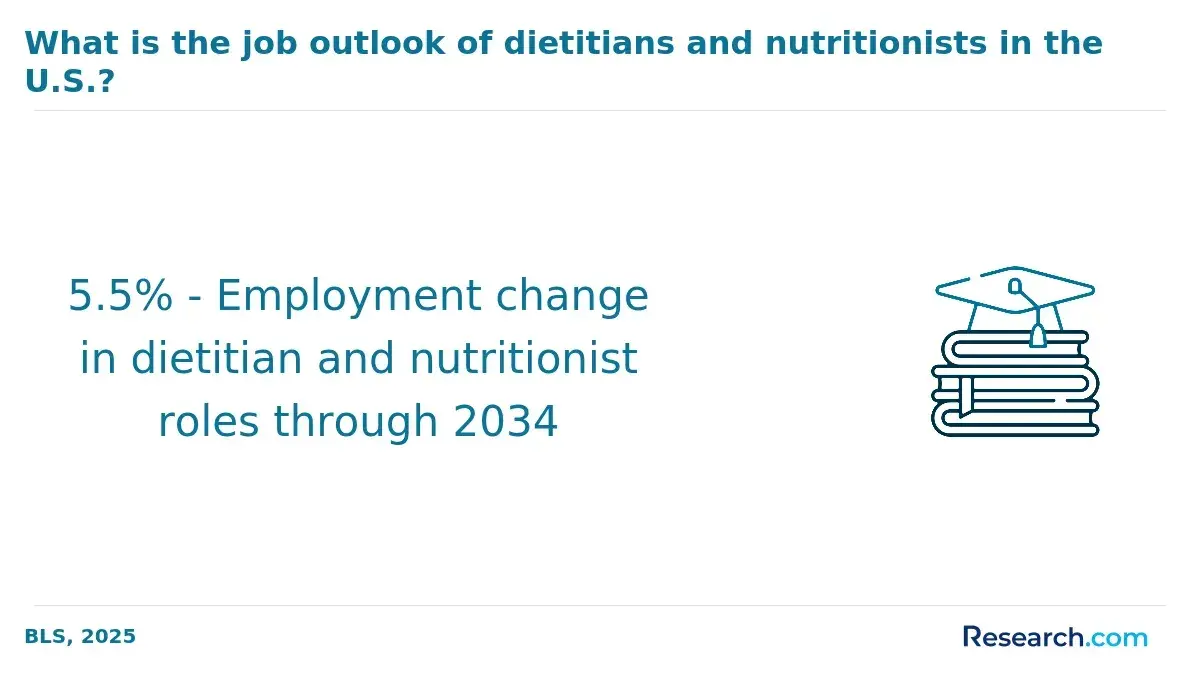
The labor market for dietitians and nutritionists is projected to grow, according to the cited U.S. Bureau of Labor Statistics data. Employment for dietitians and nutritionists is expected to grow by 6% over the next decade, with approximately 6,200 job openings each year. The cited comparison notes that this 6% growth rate is double the 3% average for all U.S. occupations.
This outlook is connected to several forces: greater attention to chronic disease prevention, aging populations, interest in food as part of healthcare, and broader demand for nutrition guidance in clinical and community settings. The graduate degree requirement also raises the importance of selecting a program that aligns with professional standards.
How AI and Technology Are Affecting Nutrition Careers
Nutrition professionals are increasingly expected to use digital tools, telehealth platforms, electronic health records, food tracking apps, and data-informed counseling methods. AI may help with administrative tasks, meal pattern analysis, education materials, or research review, but it does not replace the clinical judgment, ethical responsibility, counseling skill, and individualized assessment provided by qualified professionals.
The strongest graduates will likely be those who can combine nutrition science with communication, cultural competence, data literacy, and responsible use of technology. Similar shifts are happening across healthcare education, where programs such as FNP and PMHNP dual degree online options reflect demand for advanced, interdisciplinary patient care skills.
Common Mistakes to Avoid When Choosing a No-GRE Online Master’s in Nutrition
- Assuming no GRE means easy admission: Programs may still require strong transcripts, prerequisites, recommendations, and relevant experience.
- Ignoring ACEND accreditation: Students pursuing the RDN credential must confirm that the program supports that pathway.
- Comparing only tuition: Fees, prerequisites, travel, supervised practice, and credentialing costs can change the real price.
- Choosing speed over fit: A fast program is not helpful if it does not meet licensure, credentialing, or career requirements.
- Overlooking state rules: Nutrition and dietetics practice requirements vary, so students should check the state where they plan to work.
- Relying only on rankings: Rankings are useful starting points, but your decision should also include curriculum, support services, outcomes, and schedule fit.
- Assuming online means fully remote: Some online or hybrid programs require in-person labs, campus visits, rotations, or supervised practice placements.
Graduate Perspectives on No-GRE Online Master’s in Nutrition Programs
- : "I had reached a point where staying in the same position was no longer enough, but I could not step away from full-time work to return to campus. The online master’s program gave me a realistic route to the credential I needed, and after finishing the degree I moved into a senior dietitian role with a meaningful salary increase. — Trell"
- : "My background was in nursing, so I was concerned about changing fields. The program helped me see that my science and patient-care experience were strengths, not obstacles. Studying online let me make the transition without leaving my job, and I now work in a role that is much more focused on prevention. — Jean"
- : "With two children at home, commuting to campus was not realistic. The online format made the degree possible because I could study at night and complete assignments on weekends. It was demanding, but it allowed me to pursue a goal I thought I would have to delay for years. — Vangie"
Key Insights
- No GRE is helpful, but accreditation is decisive: A test-optional admissions policy improves access, but students pursuing the RDN credential must verify ACEND alignment and supervised practice requirements.
- Most programs take around two years: Faster options exist, including programs listed at ~1 year or 12–16 months, but timeline should be weighed against prerequisites, fieldwork, and career goals.
- Cost varies widely: The reviewed programs range from $16,200 to nearly $40,000, with average total tuition around $26,500 for in-state students and just under $28,000 for out-of-state students.
- Online and campus degrees can be equally credible: Employers and licensing bodies care more about accreditation, curriculum quality, and credential readiness than whether lectures were completed online.
- Career outcomes depend on credentials: A master’s in nutrition can support roles in clinical dietetics, public health, corporate wellness, sports nutrition, research, and private practice, but some roles require the RDN credential or state licensure.
- The job outlook is favorable: Cited BLS data project 6% employment growth for dietitians and nutritionists over the next decade, with about 6,200 openings each year.
- The best choice is goal-specific: Students should select a program based on whether it supports their intended career, not simply because it is online, affordable, fast, or GRE-free.
References:
- Data USA. (n.d.). Dietitians & nutritionists. Retrieved September 15, 2025, from https://datausa.io/profile/soc/dietitians-nutritionists
- Global Nutrition Report. (n.d.). United States of America: Nutrition profile. Retrieved September 15, 2025, from https://globalnutritionreport.org/resources/nutrition-profiles/north-america/northern-america/united-states-america/
- National Center for Education Statistics. (2024, May). Annual earnings of young adults. Retrieved September 15, 2025, from https://nces.ed.gov/programs/coe/indicator/cba/annual-earnings
- U.S. Bureau of Labor Statistics. (2024, September 4). Dietitians and nutritionists. Occupational Outlook Handbook. Retrieved September 15, 2025, from https://www.bls.gov/ooh/healthcare/dietitians-and-nutritionists.htm
Other Things You Should Know About Online Master's in Nutrition Program with No GRE Required
Yes, many programs accept up to 6–12 transfer credits if the courses were graduate-level, earned from a regionally accredited institution, and completed with a grade of B or higher. Some programs also require the credits to fit the curriculum and be approved before enrollment.
In 2026, online Master's in Nutrition programs typically require a bachelor's degree, transcripts, letters of recommendation, and a statement of purpose. Some programs may also ask for relevant work experience or prerequisite coursework in nutrition or related fields, ensuring applicants have foundational knowledge before starting the program.


