2027 Most Affordable Online Construction Management Degree Programs

Co-Founder and Chief Data Scientist
Students aspiring to have a career overseeing large-scale construction projects dream big. The construction industry offers several opportunities for graduates with a blend of technical skills, managerial acumen, and strategic planning. However, the cost of higher education can be a significant barrier.
Discovering affordable online construction management degree programs can turn that dream into reality. A degree in this discipline helps you build the expertise to manage complex projects, lead diverse teams, and contribute to sustainable infrastructure developments. With the right programs, you can achieve your career goals without the strains of the financial burden.
In this guide, I suggest a short list of the top-rated programs known for their affordability and excellence in preparing students in the construction industry. Moreover, I discuss the program costs, financial aid options, expected courses or specializations, and job outlook to help aspiring professionals make more informed decisions about pursuing this program and career.
What are the benefits of getting an online degree in construction management?
- Online construction management degrees typically reduce commuting, housing, and on-campus expenses, making higher education more affordable without compromising quality.
- Construction management online courses are multi-disciplinary, incorporating lessons in business, engineering, architecture, law, and environmental science. These provide students with a well-rounded education that prepares them for various challenges.
- A degree in construction management opens up opportunities for higher-level positions such as project manager, construction executive, and cost estimator. These jobs can yield an average annual salary between $60,000 and $98,000 or more.
What can I expect from an online construction management program?
An online construction management degree program offers a flexible and convenient learning environment that allows students to balance their education with personal and professional responsibilities. Here are other things that you can expect in these programs:
- Simulations and collaborative projects
- Live virtual classes or real-time discussions
- Asynchronous coursework through online learning platforms
- Connections through online forums, group projects, and virtual events
- Access to digital resources, including e-books, journals, and industry software tools
Where can I work with a construction management degree?
Graduates of construction management programs often find employment as project managers in various settings. After scrutinizing industry databases, I’ve compiled a short list of the places where you can work with a construction degree:
- Consulting firms
- Facility management
- Government agencies
- Educational institutions
- Non-profit organizations
- Construction companies
- Real estate development agencies
- Engineering and architectural firms
Moreover, according to the U.S. Bureau of Labor Statistics (BLS, 2024a), 39% of construction managers were self-employed. Other employers of construction managers included specialty trade contractors (16%), nonresidential (15%) and residential (11%) building construction, and heavy and civil engineering construction (7%).
How much can I make with an online construction management degree?
The BLS (2024b) reports that construction managers generally make $116,960 each year, but wages range between $64,480 and $172,040.
Meanwhile, a novice manager with under one year of experience typically earns about $62,000 whereas a seasoned manager with over 20 years of experience can earn $98,000 or higher (PayScale, 2024).
Keep in mind that apart from the level of experience, salary figures are affected by several factors, including educational attainment, industry or sector, employer type, and location.
- 2027 List of the Most Affordable Online Construction Management Degree Programs Affordable Programs
- How long does it take to complete an online construction management program? Completion Time
- How does an online construction management program compare to an on-campus program? Online vs. Traditional
- What is the average cost of an online construction management program? Cost
- What are the financial aid options for students enrolling in an online construction management program? Financial Aid
- What factors affect the total cost of an online construction management degree? What factors affect the total cost of an online construction management degree?
- What are the prerequisites for enrolling in an online construction management program? Prerequisites
- What courses are typically in an online construction management program? What courses are typically in an online construction management program?
- What types of specializations are available in online construction management programs? What types of specializations are available in online construction management programs?
- What challenges do students face in online construction management programs? What challenges do students face in online construction management programs?
- Are accelerated online construction management programs right for me? Are accelerated online construction management programs right for me?
- What is the return on investment for an online construction management degree? What is the return on investment for an online construction management degree?
- What student support services are offered in online construction management programs? What student support services are offered in online construction management programs?
- Are accreditation and industry affiliations critical for program success? Are accreditation and industry affiliations critical for program success?
- How to choose the best online construction management program? How to choose the best online construction management program?
- How Project Management Skills Are Integrated Into Online Construction Management Programs How Project Management Skills Are Integrated Into Online Construction Management Programs
- How do online construction management programs foster professional networking and career advancement? How do online construction management programs foster professional networking and career advancement?
- What career paths are available for graduates of online construction management programs? Career Paths
- What is the job market for graduates with an online construction management degree? What is the job market for graduates with an online construction management degree?
- What future trends are shaping online construction management programs? What future trends are shaping online construction management programs?
- How Do Online Construction Management Programs Offer Hands-On Practical Experience? How Do Online Construction Management Programs Offer Hands-On Practical Experience?
2027 Most Affordable Online Construction Management Degree Programs
Choosing an online construction management degree is usually a cost-and-career decision, not just an academic one. You need a program that fits your budget, teaches job-ready construction and project management skills, and carries the right accreditation for employers, transfer pathways, or graduate study.
This guide is for prospective students comparing affordable online construction management programs at the associate, bachelor’s, and master’s levels. It explains program costs, timelines, admissions requirements, online versus campus trade-offs, financial aid options, common courses, specializations, career paths, and the labor market for construction management graduates.
You will also find a ranked list of affordable online programs, practical questions to ask schools, and decision points to help you avoid choosing a program based only on tuition.
Quick Answer: What Is the Most Affordable Path to an Online Construction Management Degree?
The lowest-cost route is usually an associate degree at a community college, followed by transfer into a bachelor’s completion program if you need a four-year credential. Lansing Community College lists a $120 cost per billable hour for its online AAS in Construction Management, while bachelor’s programs in this list range from $351 to $456 per credit at Indiana State University, $416.59 per credit at Online at Southern Mississippi, and $370 per credit at National University. Graduate students considering an online master’s can compare Louisiana State University Online’s $814 per credit MS in Construction Management.
Cost should not be the only filter. Students should also check accreditation, internship or field experience requirements, transfer credit policies, construction software access, student support, and whether the program aligns with their target role.
How We Ranked These Online Construction Management Programs
Because affordability matters only when paired with academic quality, this ranking considers both cost and program credibility. Research.com compiled this list using our ranking methodology and information from the Integrated Postsecondary Education Data System, Peterson’s database and its Distance Learning Licensed Data Set, College Scorecard, and the National Center for Education Statistics.
Use this ranking as a starting point, not a final answer. Program costs, online delivery formats, fees, and admissions requirements can change, so students should confirm details directly with each school before applying.
Affordable Online Construction Management Programs Compared
| Rank | School | Degree | Program Length | Cost | Required Credits | Accreditation |
| 1 | Indiana State University | Online BS in Construction Management | Four years | $351 per credit for in-state students; $456 per credit for out-of-state students | 120 | American Council for Construction Education (ACCE); Higher Learning Commission (HLC) |
| 2 | Lansing Community College | Online AAS in Construction Management | Two years | $120 per billable hour | 64 | ACCE; HLC |
| 3 | Online at Southern Mississippi | BS in Construction Management | Two to four years | $416.59 per credit | 120 | ACCE; Southern Association of Colleges and Schools of Commission on Colleges (SACSCOC) |
| 4 | Louisiana State University Online | MS in Construction Management | Two to three years | $814 per credit | 30–36 | ACCE; SACSCOC |
| 5 | National University | BS in Construction Management | Four years | $370 per credit | 180 | Western Association of Schools and Colleges (WASC) |
1. Indiana State University
Indiana State University offers an online BS in Construction Management designed for students who want a management-centered construction education with technical depth. Courses include Sustainable Design and Construction, Soils Laboratory, and Environmental Control Systems. The program also addresses how construction affects communities and the environment, which can help students prepare for supervisory and leadership responsibilities. Most coursework is delivered online, and students are not required to attend classes on campus.
- Program length: Four years
- Track or concentration: Construction Management
- Cost per credit: $351 for in-state students; $456 for out-of-state students
- Credits required: 120
- Accreditation: American Council for Construction Education (ACCE); Higher Learning Commission (HLC)
2. Lansing Community College
Lansing Community College provides an online AAS in Construction Management for students seeking an affordable entry point into construction supervision or management. The curriculum is aligned with Associate Constructor Level I exam expectations from the American Institute of Construction and covers core areas such as estimating, scheduling, project management, and construction technology. The college also maintains 2+2 pathway partnerships with selected universities, which can help associate degree graduates continue toward a bachelor’s degree.
- Program length: Two years
- Track or concentration: Construction Management
- Cost per billable hour: $120
- Credits required: 64
- Accreditation: ACCE; HLC
3. Online at Southern Mississippi
The Online at the University of Southern Mississippi BS in Construction Management includes coursework in Statics and Strengths of Materials, Building Information Modeling, Materials and Methods of Construction, and related construction topics. Students also complete a 300-hour internship with a construction company during the summer, giving them exposure to active job sites and practical workplace expectations. Faculty also support students who participate in national competitions organized by professional associations.
- Program length: Two to four years
- Track or concentration: Construction Management
- Cost per credit: $416.59
- Credits required: 120
- Accreditation: ACCE; Southern Association of Colleges and Schools of Commission on Colleges (SACSCOC)
4. Louisiana State University Online
Louisiana State University Online offers an MS in Construction Management for working professionals and graduates who want advanced preparation for leadership roles. The program is one of only five ACCE-accredited graduate programs and includes courses such as Research Methods in Construction Management, Human Factors & Leadership in Construction Management, and Disaster Resilient Construction. Students complete online coursework and gain technical, leadership, and interpersonal skills relevant to construction management practice. Graduates are prepared to take the Associate Constructor Level 1 Exam.
- Program length: Two to three years
- Track or concentration: Professional Track, non-thesis master
- Cost per credit: $814
- Credits required: 30–36
- Accreditation: ACCE; SACSCOC
5. National University
National University offers a BS in Construction Management online and on campus. The curriculum emphasizes applied construction knowledge, modern surveying methods, technical tools used to solve engineering-related problems, and building mechanical and electrical systems. Developed with input from industry leaders, the program aims to prepare students for construction management careers, lifelong learning, teamwork, ethical decision-making, leadership, and social responsibility.
- Program length: Four years
- Track or concentration: Construction Management
- Cost per credit: $370
- Credits required: 180
- Accreditation: Western Association of Schools and Colleges (WASC)
What Graduates Say About Online Construction Management Programs
- Jaden: "Studying construction management online worked well with my schedule. I could complete coursework from home, avoid commuting, and still cover the technical and general education subjects I needed. The virtual lab activities were especially useful because they gave me a more applied learning experience."
- Sam: "The online format gave me the flexibility I needed without making the program feel easy. The courses were demanding, but the resources were organized clearly, and instructors were available through virtual office hours. I have been able to use several of the skills from the program in my work."
- Joshua: "I was unsure about enrolling online at first, but the format helped me manage school around my other responsibilities. Working with classmates from different backgrounds also made the experience stronger. The practical assignments helped me build skills I could connect to real construction work."
What Is an Online Construction Management Degree?
An online construction management degree prepares students to plan, coordinate, budget, supervise, and close construction projects. Unlike a general business degree, it focuses on construction-specific work such as estimating, contracts, building systems, materials, safety, scheduling, site logistics, and compliance.
Students typically study both technical and managerial subjects. The technical side may include construction methods, materials, building codes, environmental systems, soils, and BIM. The management side may include project planning, leadership, budgeting, risk management, contracts, and communication with owners, architects, engineers, subcontractors, suppliers, and inspectors.
This degree can be a good fit for students who want to move into construction supervision, estimating, project coordination, facilities management, or advanced construction leadership. It may not be the best choice for students who want a purely design-focused architecture path, a licensed engineering role, or a hands-on trade program without management coursework.
Which Construction Management Degree Level Should You Choose?
| Degree Level | Best For | Typical Time to Complete | Decision Point |
| Associate degree | Students seeking a lower-cost entry point or a transfer pathway | Two years | Choose this if affordability and transfer flexibility are priorities. |
| Bachelor’s degree | Students preparing for broader construction management, estimating, and project roles | Four years | Choose this if you want a standard undergraduate credential for management-track roles. |
| Master’s degree | Professionals seeking advanced leadership, technical, or specialized preparation | Two to three years | Choose this if you already hold a bachelor’s degree and want graduate-level advancement. |
| Doctorate | Students pursuing research, senior academic, or high-level leadership goals | Two to six years | Choose this only if your career goal truly requires doctoral-level study. |
How Long Does an Online Construction Management Program Take?
Completion time depends on the degree level and enrollment pace. An associate degree from a community or technical college usually takes two years. A bachelor’s degree generally requires four years of full-time study. A master’s in construction management often takes two to three years. Doctorate programs can take two to six years.
Some schools offer an accelerated online business degree with a construction management concentration or a combined bachelor’s-to-master’s structure that can be completed within five years. Other schools use bridge or transfer pathways that help associate degree graduates finish a bachelor’s degree in just two years.
Time to completion also depends on whether you study full time or part time, how many transfer credits you bring, whether required courses are offered every term, and whether the program includes an internship, practicum, or summer field component.
Online vs. On-Campus Construction Management Programs
Online construction management programs can be a strong option for working adults, students far from campus, military learners, and people balancing school with family or job responsibilities. Before enrolling, verify accreditation and understand how nationally accredited online colleges and universities differ from other accreditation categories.
| Factor | Online Program | On-Campus Program |
| Schedule | Often more flexible, especially when coursework is asynchronous | More structured with set class times and campus attendance |
| Learning environment | Uses learning platforms, video lectures, virtual labs, digital documents, and online discussion tools | Uses classrooms, physical labs, campus equipment, and in-person instruction |
| Interaction | Requires students to be proactive in discussion boards, group projects, and virtual meetings | Provides easier access to immediate in-person feedback and informal conversations |
| Networking | May include virtual career fairs, online mentoring, and remote collaboration | May offer easier access to clubs, campus events, jobsite visits, and local employer visits |
| Resources | May include digital libraries, software, virtual simulations, and remote technical support | May provide direct access to physical libraries, simulation spaces, labs, and campus facilities |
| Cost considerations | Can reduce commuting and relocation expenses but may include online learning or technology fees | May add transportation, housing, parking, and campus-based costs |
| Best fit | Self-directed learners who can manage deadlines independently | Students who learn best through in-person structure and face-to-face support |
What Is the Average Cost of an Online Construction Management Program?
Construction management tuition varies widely by school type, residency status, degree level, and credit load. Undergraduate construction management programs cost $10,610 in-state and $25,162 out-of-state. Graduate schools charge residents $11,117 and nonresidents $26,762 (College Tuition Compare, 2024).
NCES (2023) reported that tuition and fees for the 2022–2023 academic year were $4,027 at public two-year institutions and $9,834 at public four-year colleges and universities. Private nonprofit four-year institutions charged $40,713, while private for-profit schools charged $18,241. From 2021 to 2022, most public graduate schools charged $12,596 for tuition and fees, while private institutions published costs of $29,931.
Students should budget beyond tuition. Online learners may pay for digital resources, remote learning fees, technical support fees, construction software, project management tools, textbooks, safety training, and other required materials. The most accurate estimate will come from each school’s official cost of attendance page.
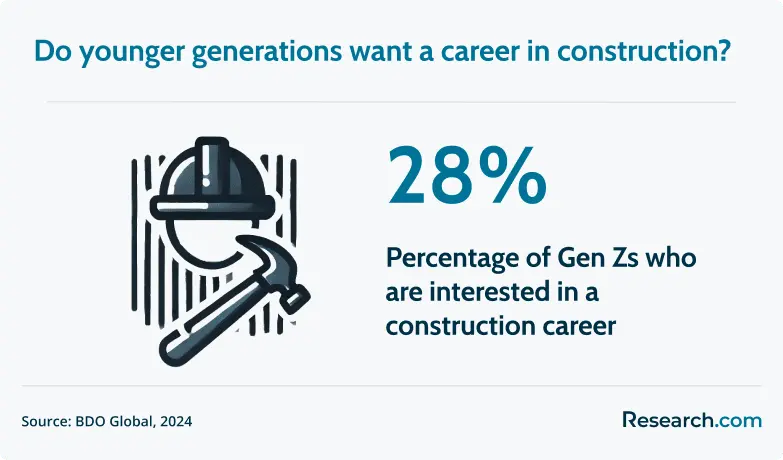
Affordability matters because the construction workforce continues to face talent challenges. A BDO Global survey (2023) found that only 28% of Gen Zs indicated interest in a construction career, placing construction eighth among eleven sectors in popularity. The Associated General Contractors of America and Autodesk (2023) also reported that this makes it difficult for many companies to hire construction-related positions, including salaried roles.
For students, this means a well-chosen construction management degree can offer access to an industry looking for prepared talent. For schools and employers, it highlights the need for stronger recruitment, better training pathways, and clearer messaging about construction careers.
Financial Aid Options for Online Construction Management Students
Even lower-cost online programs can be expensive once fees, books, software, and time away from work are included. Students should complete the appropriate financial aid steps early and compare total net cost, not just advertised tuition.
- Federal, state, and private loans: Borrowed funds can cover part or all of the cost of attendance, but repayment terms and interest rates vary.
- Grants and scholarships: These awards may be need-based or merit-based and are offered by governments, schools, employers, and private organizations. They usually do not require repayment.
- Work-study programs: Eligible students may qualify for part-time work that helps pay education expenses.
- Tuition reimbursement: Some construction employers help pay for job-related education after employees meet company requirements.
- Military and veterans benefits: Veterans, active-duty service members, and in some cases eligible family members may qualify for education benefits.
Construction management students can also research industry-specific scholarships, including:
- American Society of Professional Estimators Foundation Scholarship: For undergraduate students majoring or minoring in a construction-related field.
- National Association of Women in Construction (NAWIC) Founders’ Scholarship: For women in undergraduate or trade school programs connected to construction.
- Dupree Construction Education Fund Scholarship: For graduate students planning to teach construction management in higher education.
- Associated General Contractors (AGC) Education and Research Foundation Scholarship: For undergraduate and graduate students in construction management or construction-related engineering programs.
What Affects the Total Cost of an Online Construction Management Degree?
The cheapest tuition rate does not always produce the lowest final cost. A program with generous transfer credit, fewer fees, employer partnerships, or included software may cost less overall than a school with a lower advertised per-credit price.
| Cost Factor | Why It Matters | What to Ask |
| Tuition structure | Schools may charge per credit, per billable hour, per term, or by residency status. | Is the published rate the full online rate, and does it differ for in-state and out-of-state students? |
| Required credits | More credits can increase total tuition even when the per-credit rate looks affordable. | How many credits are required after transfer evaluation? |
| Technology and online fees | Remote learning fees can add to the final bill. | Are online course fees, technology fees, or platform fees charged every term? |
| Software and materials | Programs may require AutoCAD, project management tools, estimating software, or Microsoft Office tools. | Are software licenses included, discounted, or purchased separately? |
| Certifications and safety training | OSHA safety training, PMP preparation, or other credentials may involve separate costs. | Which certifications are embedded in the curriculum, and which are optional expenses? |
| Transfer credits | Accepted prior credits can reduce both time and cost. | How many credits can I transfer, and are there limits on technical or older coursework? |
Students comparing bachelor’s options can review online bachelor’s degrees in construction management to better understand program structures and cost differences.
Admissions Requirements for Online Construction Management Programs
Admissions standards vary by school and degree level, but most programs ask applicants to prove academic readiness and, in some cases, relevant work experience. Common requirements include:
- High school diploma or GED for undergraduate applicants
- Bachelor’s degree in construction management, engineering, architecture, business, or a related field for graduate applicants
- Official transcripts
- Minimum GPA of 2.5+ for undergraduate admission or 3.0+ for graduate admission
- SAT/ACT scores for undergraduate applicants or GRE/GMAT scores for graduate applicants
- Letters of recommendation
- Personal essay or statement of purpose
- Work experience, depending on the program
- Resume or CV, depending on the program
- English proficiency for foreign students
Applicants without a construction-related background may need to complete foundation courses in construction management, business, economics, mathematics, or physics. Online learners should also confirm computer requirements, internet standards, webcam or video conferencing expectations, and required software before classes begin.
Common Courses in an Online Construction Management Program
Construction management curricula usually combine general education, business, technical construction, and project leadership courses. Common subjects include:
- Construction Methods and Materials: Building materials, construction processes, and how different methods apply to project types.
- Construction Planning and Scheduling: Project timelines, sequencing, critical path analysis, and schedule control.
- Construction Project Management: Leadership, communication, risk management, and project delivery principles for construction settings.
- Sustainable Construction Practices: Environmentally responsible building methods, sustainable materials, and green project strategies.
- Construction Safety and Risk Management: Site safety, hazard prevention, risk planning, and regulatory compliance.
- Construction Law and Contracts: Contracts, claims, regulations, legal responsibilities, and dispute prevention.
- Ethics in Construction: Professional responsibility, ethical decision-making, client information, and accountability in construction work.
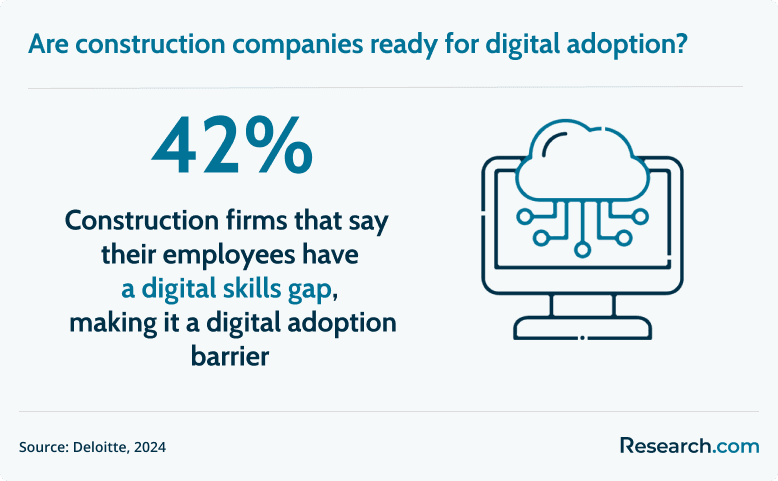
Technology courses are becoming more important as construction firms adopt digital tools. A Deloitte survey (2024) found that 42% of construction companies cite a digital skills gap among employees as a barrier to adoption. Programs that include BIM, estimating software, scheduling tools, and data-informed project management may better prepare students for technology-enabled construction environments.
Construction Management Specializations to Consider
Many bachelor’s programs introduce specialization areas through electives, while graduate programs may allow deeper study. Students can also add certificates or related graduate training. For example, online MBA leadership programs may complement a construction management background for students targeting people-management or executive roles.
- Sustainability and Green Building: Focuses on sustainable practices, environmental responsibility, and green building principles.
- Real Estate Development: Connects construction management with real estate finance, development planning, and property management.
- Residential Construction: Covers homebuilding and remodeling, including single-family homes, duplexes, and multi-family properties.
- Heavy Construction: Prepares students for infrastructure work such as highways, bridges, dams, and tunnels.
- Transportation Management: Addresses logistics, project coordination, regulatory standards, and movement of people and goods.
- Cost Estimation: Emphasizes budgeting, cost forecasting, financial planning, and resource allocation.
Specialization choice should match the type of employer and project environment you want. According to BLS (2024b), the nonresidential building construction sector has the highest employment level for construction managers, with 79,800 employed. The chart below shows other top sectors.
Challenges Students Face in Online Construction Management Programs
Online construction management programs are flexible, but they are not automatically easier. Students must manage deadlines, group projects, software assignments, and technical coursework without the daily structure of a campus classroom.
- Self-management: Asynchronous courses require disciplined scheduling and consistent weekly progress.
- Limited in-person networking: Students may need to be more intentional about connecting with faculty, classmates, and employers.
- Technology demands: Reliable internet, current hardware, and construction software access can affect performance.
- Hands-on learning gaps: Students should look for internships, field experiences, simulations, or employer-based projects.
- Group coordination: Virtual project teams require clear communication and dependable participation.
Students who want a lower-intensity starting point can compare the easiest construction management programs, while remembering that “easier” should never mean unaccredited or disconnected from career goals.
Are Accelerated Online Construction Management Programs Worth Considering?
Accelerated programs can help motivated students finish sooner, but they compress assignments, exams, projects, and discussions into a tighter schedule. They are best for students with strong time management skills, relevant background knowledge, and enough weekly availability to keep up.
| Accelerated Format May Fit If You... | It May Not Fit If You... |
| Can dedicate consistent weekly study time | Work unpredictable hours or have limited study time |
| Already understand construction basics | Need extra time to build technical foundations |
| Want to enter or advance in the workforce sooner | Prefer slower pacing, extended faculty access, and more networking time |
| Are comfortable with overlapping deadlines | Struggle with fast-moving online courses |
Students comparing shorter pathways can explore a 2-year construction management degree online and ask whether the faster pace affects internship access, software training, or transfer credit options.
What Is the ROI of an Online Construction Management Degree?
Return on investment depends on what you pay, how long you study, how much debt you take on, and whether the credential helps you qualify for roles that match your goals. A lower tuition program with strong accreditation, transferable credits, and career support can produce better value than a more expensive program with weak employer connections.
When estimating ROI, compare tuition, fees, books, software, lost work time, loan costs, certifications, and expected career progression. Do not assume a degree guarantees a specific salary. Outcomes vary by location, experience, employer, jobsite responsibility, and the broader construction market.
Some students may improve long-term value by combining construction management with complementary credentials. For example, those considering graduate-level options can compare the cheapest easiest master's degree options only if they align with real career objectives.
Student Support Services to Look For
Online students should not have to navigate a construction management program alone. Strong support services can make a major difference in retention, job preparation, and graduation speed.
- Academic advising: Helps students map degree requirements, electives, transfer credits, and graduation timelines.
- Technical support: Assists with learning platforms, video tools, software access, and login issues.
- Career services: May provide resume reviews, interview preparation, internship leads, and employer connections.
- Virtual library access: Supports research, codes, standards, and technical assignments.
- Mentoring: Connects students with faculty, alumni, or industry professionals.
- Online collaboration tools: Support group projects and construction-style team communication.
Students who want a quicker route to completion can also compare a fast track program, but should verify that student support is still available during compressed terms.
Why Accreditation and Industry Affiliations Matter
Accreditation helps students identify programs that meet recognized quality standards. In construction management, ACCE accreditation is especially relevant because it focuses on construction education. Some related programs may also be evaluated by the Accreditation Board for Engineering and Technology (ABET), depending on their structure.
Institutional accreditation also matters for federal financial aid, credit transfer, graduate admission, and employer recognition. Industry affiliations can add value through internships, guest lectures, mentorship, competitions, association events, and employer networking.
Students considering a shorter academic pathway can review accelerated associate degrees online, but they should still confirm accreditation, transferability, and whether the credential supports their construction management goals.
How to Choose the Best Online Construction Management Program
The best program is the one that fits your career target, budget, learning style, and timeline. Use the questions below before applying.
- Verify accreditation. Check institutional accreditation and, when relevant, ACCE recognition. Confirm details through official accreditor and school pages.
- Compare total cost, not tuition alone. Include fees, software, books, certification costs, travel, internships, and lost work time.
- Review the curriculum. Look for estimating, scheduling, contracts, safety, BIM, project management, sustainability, and field-based learning.
- Ask about transfer credits. Prior coursework can shorten the degree and reduce cost, but policies vary.
- Check online format details. Ask whether courses are asynchronous, synchronous, hybrid, or require campus visits.
- Confirm practical experience. Look for internships, practicums, jobsite visits, simulations, capstones, or employer-based projects.
- Evaluate faculty experience. Construction management benefits from instructors with industry knowledge and current practice experience.
- Assess career support. Ask about employer relationships, internship placement, alumni outcomes, and construction-specific advising.
- Match the program to your goal. A residential construction student may need different electives than someone targeting heavy construction, estimating, or sustainability.
Common Mistakes When Choosing an Online Construction Management Degree
| Mistake | Why It Can Hurt You | Better Approach |
| Choosing only the cheapest tuition | Fees, extra credits, poor transfer policies, or weak support can raise total cost. | Compare full cost of attendance and graduation requirements. |
| Ignoring accreditation | Credits may not transfer, and employers or graduate schools may question the credential. | Confirm institutional accreditation and relevant programmatic accreditation. |
| Assuming online means self-paced | Many online courses still have weekly deadlines, group projects, and fixed exam windows. | Ask for a sample course schedule before enrolling. |
| Overlooking internships or field experience | Construction employers often value applied experience. | Choose programs with internships, capstones, simulations, or employer projects. |
| Forgetting software costs | Construction software and technical tools can add expenses. | Ask which tools are required and whether licenses are included. |
| Relying only on rankings | A ranked program may not fit your state, schedule, specialization, or transfer needs. | Use rankings as a shortlist, then verify fit with your goals. |
How Project Management Skills Are Built Into Online Construction Management Programs
Construction managers need more than technical building knowledge. They must coordinate people, budgets, schedules, risk, contracts, and quality across complex projects. Online construction management programs often integrate project management skills throughout the curriculum so students can connect classroom work to real project conditions.
Project Planning and Scheduling
Students learn how to organize construction phases, create schedules, sequence activities, assign resources, and manage timeline risks. Programs may introduce scheduling tools such as Microsoft Project or Primavera.
- Key skills: Timeline development, resource allocation, critical path analysis, and risk planning.
Cost Estimation and Budget Management
Courses in estimating and budgeting teach students how to project labor, materials, equipment, and subcontractor costs. Students also learn how budgets are monitored and adjusted over a project lifecycle.
- Key skills: Budget forecasting, cost control, financial reporting, and contract negotiation.
Leadership and Communication
Construction managers coordinate owners, architects, engineers, subcontractors, inspectors, vendors, and field teams. Online programs often include communication, conflict resolution, negotiation, and leadership assignments.
- Key skills: Team management, stakeholder communication, decision-making, and conflict resolution.
Risk, Safety, and Quality Management
Construction work involves safety requirements, project risk, quality expectations, and regulatory obligations. Students learn how to identify risk, support safer jobsite practices, and maintain quality standards.
- Key skills: Risk assessment, safety planning, compliance management, and quality control.
Connection to Project Management Credentials
Some construction management programs align coursework with project management frameworks, including standards associated with the Project Management Institute. Students who want a broader project management credential can also compare the easiest project management degree options, provided the program supports their construction career goals.
Networking and Career Advancement in Online Construction Management Programs
Online programs can support professional networking, but students usually need to participate actively. Useful networking features include virtual career fairs, online mentoring, employer webinars, alumni panels, industry association events, and discussion-based project work that mirrors construction team collaboration.
Students should ask whether the school has relationships with local, regional, or national construction employers. They should also check whether internship support is available for online students living outside the school’s home state. Learners comparing lower-cost undergraduate options may also review cheap bachelor degree online pathways as part of their broader affordability research.
Career Paths for Online Construction Management Graduates
Graduates may qualify for several construction-related management, coordination, and specialist roles. Actual opportunities depend on degree level, experience, location, licensure or certification requirements, and employer expectations.
- Construction Project Managers: Coordinate project scope, budget, schedule, quality, and stakeholder communication.
- Estimator/Quantity Surveyors: Prepare cost estimates, bids, proposals, and budget projections based on labor, materials, equipment, and project scope.
- Construction Consultants: Advise construction firms, developers, agencies, or owners on project strategy, risk, cost, and delivery.
- Facilities Managers: Oversee building operations, maintenance, efficiency, and lifecycle performance.
- Building Inspectors: Review projects for compliance with building codes, zoning rules, and safety standards.
- Real Estate Developers: Coordinate projects from concept through completion with architects, contractors, investors, and other partners.
- Construction Company CEOs: Lead organizational strategy and operations, sometimes supported by advanced leadership study such as online PhD programs organizational leadership.
- Environmental Sustainability Specialists: Help integrate green building principles and sustainable practices into construction projects.
The chart below compares average annual salaries for the construction-related management roles discussed above.
If construction management does not match your interests, schedule, or long-term goals, you can compare other affordable online program options. Related alternatives include the cheapest online MBA in business analytics, the cheapest online MBA in entrepreneurship, cheap online RN to FNP degrees, and an affordable online MBA in information systems.
Job Market for Online Construction Management Degree Graduates
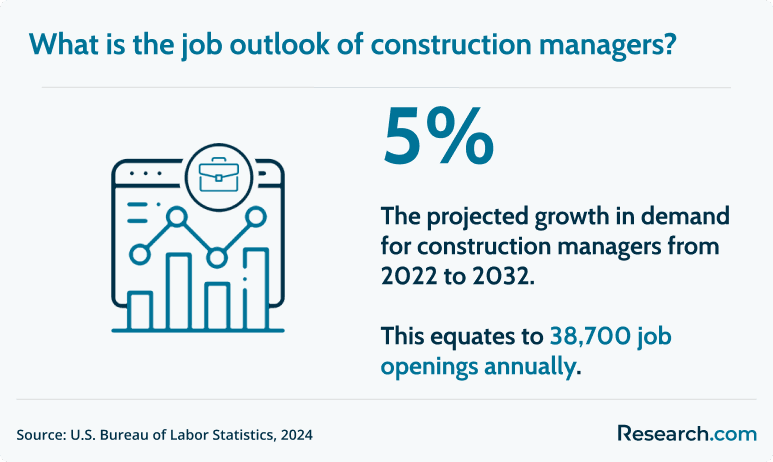
The construction management labor market is supported by ongoing demand for people who can supervise projects, control costs, coordinate teams, and use construction technology. BLS (2024a) projects that employment opportunities for construction managers will grow by 5% from 2022 to 2032, with about 38,700 job openings each year.
Demand is influenced by infrastructure work, urban development, building retrofits, energy efficiency upgrades, sustainability goals, and increasingly complex project delivery methods. Graduates who can combine construction fundamentals with digital tools, scheduling systems, estimating platforms, BIM, and communication skills may be better positioned for roles that require both technical and managerial judgment.
Still, job outcomes are not automatic. Employers may prioritize experience, local market knowledge, safety training, internships, certifications, and the ability to communicate effectively with field and office teams.
Future Trends Shaping Online Construction Management Programs
Construction management education is adapting as employers use more digital tools, pursue greener building practices, and look for managers who can handle complex project data. Students comparing programs should look for curricula that address these shifts without sacrificing core construction fundamentals.
- Artificial intelligence and automation: AI tools are being used in areas such as planning, cost estimation, document review, and site monitoring. Students should understand both the benefits and limits of these tools.
- Green and sustainable construction: Sustainable materials, energy-efficient design, green building practices, and LEED-related preparation are increasingly relevant to construction project planning.
- Building Information Modeling and digital collaboration: BIM and related digital tools support coordination, accuracy, clash detection, scheduling, and project communication.
- Safety and risk technology: Wearables, drones, and digital monitoring tools are changing how firms assess jobsite risk and document safety conditions.
- Cybersecurity awareness: As more project data, plans, budgets, and jobsite systems move online, construction managers need a basic understanding of data protection and secure collaboration.
How Online Construction Management Programs Provide Hands-On Experience
Online programs use several methods to make technical learning more practical. These may include virtual simulations, digital project walkthroughs, remote field assignments, employer-based projects, internships, collaborative capstones, and construction software exercises.
Students should ask how hands-on requirements work for online learners in their location. Some programs allow students to complete internships with local employers, while others may require approved field activities or summer experiences. Learners interested in a shorter undergraduate route can compare accelerated bachelors programs, but should make sure the faster schedule still includes meaningful applied learning.
Questions to Ask Before You Apply
- Is the institution accredited, and is the construction management program ACCE-accredited?
- What is the total cost after fees, software, books, and required materials?
- How many of my prior credits will transfer?
- Are courses asynchronous, live online, hybrid, or self-paced?
- Does the program require campus visits, internships, summer fieldwork, or proctored exams?
- Which construction software tools are used in the curriculum?
- Does the school help online students find internships near where they live?
- What career services are available specifically for construction management students?
- Are certifications, exam preparation, or safety training included?
- What types of employers hire graduates from the program?
Key Insights
- The most affordable option is often a community college associate degree followed by a transfer pathway, especially for students who eventually need a bachelor’s credential.
- Programmatic accreditation matters in construction management. ACCE accreditation can signal that the curriculum meets construction education standards, while institutional accreditation affects aid, transfer, and graduate study options.
- Do not compare programs by tuition alone. Required credits, online fees, software, internships, transfer policies, and certification costs can change the real price.
- Online construction management works best for self-directed students who can manage deadlines, software assignments, and virtual teamwork without daily in-person structure.
- Career preparation should include applied experience. Look for internships, capstones, simulations, field assignments, BIM exposure, estimating practice, and scheduling tools.
- The job market remains favorable according to BLS (2024a), with 5% projected growth from 2022 to 2032 and about 38,700 openings annually, but individual outcomes depend on experience, location, skills, and employer needs.
- Technology is reshaping the field. Programs that address BIM, digital project management, sustainability, safety technology, and AI-informed workflows may offer stronger preparation for modern construction environments.
References
- BDO Global. (2023). Overcoming the talent crisis: Repositioning the construction industry as an employer of choice for Gen Z. BDO Global Construction Survey Report 2023. https://go.bdo.global/pdf.html?file=BDOGlobalConstructionSectorSurveyReport-TheFutureWorkforce-30-05-2023.pdf
- College Tuition Compare. (2024). Construction management program 2024 tuition. Retrieved July 3, 2024, from https://www.collegetuitioncompare.com/majors/52.2001/construction-management
- National Center for Education Statistics. (2023). Digest of Education Statistics. https://nces.ed.gov/programs/digest/2023menu_tables.asp
- PayScale. (2024, June 16). Average construction manager salary. Retrieved July 3, 2024, from https://www.payscale.com/research/US/Job=Construction_Manager/Salary
- Research and Markets. (2024, February). Construction global market report 2024. https://www.researchandmarkets.com/report/construction
- U.S. Bureau of Labor Statistics. (2024a, April 17). Construction managers. Occupational Outlook Handbook. https://www.bls.gov/ooh/management/construction-managers.htm
- U.S. Bureau of Labor Statistics. (2024b, April 3). Occupational employment and wages, May 2023 - Construction managers. Occupational Employment and Wage Statistics. https://www.bls.gov/oes/current/oes119021.htm
Other Things You Should Know About Online Construction Management Degree Programs
Many online construction management programs accept up to 60 transfer credits toward a bachelor’s degree, but some cap upper-division transfers at 30 credits. Schools usually require official transcripts and a minimum 2.0 GPA for transfer evaluation before enrollment.
In 2027, affordable online construction management degree programs generally require a high school diploma or equivalent for undergraduate studies. Some programs may ask for standardized test scores or letters of recommendation. For graduate programs, a bachelor's degree in a related field is typically required, along with professional experience in construction. Verify specifics directly with each institution.
Affordable online construction management degree programs in 2027 typically take two to four years to complete, depending on whether you're studying part-time or full-time. Some programs may offer accelerated tracks for quicker completion.