
2027 Easiest Construction Management Degree Programs

Co-Founder and Chief Data Scientist
Choosing an “easy” construction management degree is usually not about finding a program with weak standards. It is about finding a program that is manageable, clearly structured, flexible, affordable, well supported, and aligned with the kind of construction career you want. This matters because construction managers are expected to understand budgets, contracts, safety, scheduling, technology, sustainability, and people management—not just jobsite basics.
This guide explains what to expect from a construction management degree, how online and campus programs compare, what programs may be more student-friendly, how much the degree can cost, and how to evaluate whether it is worth the investment. It is designed for high school graduates, working tradespeople, military learners, career changers, and construction professionals who want to move into project leadership.
Quick Answer: Is an Online Construction Management Degree Worth Considering?
An online construction management degree can be a practical option if you need flexibility, already work in construction, or want to avoid relocation and some campus-related costs. A bachelor’s degree commonly takes about 4 years full-time, while an associate degree typically takes 2 years and a master’s degree often takes 1-2 years. Graduates may pursue roles such as construction manager, estimator, project engineer, scheduler, facilities manager, superintendent, safety manager, or building inspector.
- Online programs can help students continue working while completing coursework in construction methods, estimating, scheduling, contracts, safety, and project management.
- Students may save on commuting, housing, and some campus fees, but they should still budget for books, software, technology fees, lab requirements, safety equipment, and certification costs.
- Reported salary outcomes vary widely. Entry-level positions typically start around $55,000 per year, while experienced professionals in higher positions may earn more than $160,000 annually.
What can I expect from a construction management degree?
A construction management degree teaches students how to coordinate building projects from planning through closeout. The coursework usually combines technical construction knowledge with business, leadership, legal, safety, and financial training. Students learn how to read plans, estimate costs, schedule work, manage subcontractors, reduce risk, document progress, and keep projects aligned with contracts and regulations.
Most programs include a mix of lectures, software-based assignments, case studies, estimating exercises, group projects, internships, site visits, or capstone projects. Online programs may deliver the classroom portion virtually, but strong programs still try to connect students with applied work through local internships, simulations, employer partnerships, or project-based assignments.
Who is a construction management degree best for?
| Student profile | Why the degree may fit | What to check before enrolling |
| High school graduates | A bachelor’s program can provide a direct path into entry-level project coordination, estimating, safety, or field supervision roles. | Look for internships, career placement support, construction labs, and accreditation. |
| Working tradespeople | The degree can help translate field experience into management, estimating, scheduling, or superintendent opportunities. | Ask whether the school accepts transfer credits, prior learning, military training, or professional experience. |
| Career changers | Construction management offers a structured way to enter a technical field without starting only through apprenticeship or field labor. | Make sure the program includes enough applied construction coursework, not only general business classes. |
| Current construction professionals | A degree can support advancement into project manager, operations, safety, facilities, or executive roles. | Compare online, part-time, accelerated, and employer-funded options. |
Where can I work with an online construction management degree?
Construction management graduates may work across residential, commercial, industrial, infrastructure, government, consulting, real estate development, facilities, and specialty contracting environments. The right setting depends on your interests: residential work may involve housing and community development, while heavy civil construction may involve roads, bridges, tunnels, utilities, and public infrastructure.
Common employers include general contractors, subcontractors, engineering firms, architecture and design-build companies, real estate developers, government agencies, facility owners, energy companies, and construction consulting firms. Online graduates can compete for many of the same roles as campus graduates when the program is accredited, the curriculum is rigorous, and the student builds hands-on experience.
How much can I make with an online construction management degree?
Earnings depend on location, sector, experience, project size, certifications, and whether a role is field-based, office-based, or executive-level. Entry-level positions typically start around $55,000 per year. According to recent data cited in the original article, the median annual wage for construction managers was approximately $104,900 in May 2023, with top earners making over $160,000 annually. Another cited figure places the median annual wage for construction managers at around $98,890.
These figures should be treated as benchmarks, not guarantees. A degree can improve access to management-track roles, but salary outcomes still depend on your work history, market conditions, technical skills, leadership ability, and willingness to take on complex projects.
- 2027 List of Student-Friendly Construction Management Degree Programs
- How long does it take to complete a construction management degree program?
- How does an online construction management degree compare to an on-campus program?
- What is the average cost of a construction management degree program?
- What are the financial aid options for students enrolling in a construction management degree program?
- What are the prerequisites for enrolling in a construction management degree program?
- What courses are typically in a construction management degree program?
- What types of specializations are available in construction management degree programs?
- Is a construction management degree a sound long-term investment?
- Can I earn a construction management degree faster without lowering quality?
- How does a construction management degree compare with an MBA for strategic leadership?
- What emerging technologies are shaping construction management education?
- Can additional certifications boost my construction management career?
- What advanced education options can complement a construction management degree?
- Can combining construction management with business studies accelerate career growth?
- Can an accelerated MBA complement a construction management degree?
- How do construction management programs prepare graduates for industry disruptions?
- How does one choose the best construction management degree program?
- How can financial expertise improve construction management outcomes?
- What career paths are available for graduates of construction management degree programs?
- What is the job market for graduates with a construction management degree?
- Can a construction management degree support entrepreneurial success?
- Common mistakes to avoid when choosing a construction management program
- Key Insights
2027 List of Easiest Construction Management Degree Programs
The programs below are best understood as student-friendly options, not programs that are academically effortless. Construction management requires technical competence, professional judgment, and accountability. A program may feel easier to complete when it offers flexible delivery, clear degree requirements, applied coursework, reasonable credit loads, accessible faculty, and support for internships or working adults.
How do we rank schools?
Because a degree is a major financial and professional decision, Research.com evaluates programs using transparent information from established education data sources. These include the IPEDS database, Peterson's database and its Distance Learning Licensed Data Set, the College Scorecard database, and the National Center for Education Statistics. Students should still verify current tuition, accreditation, online availability, and graduation requirements directly with each school before applying.
| School | Degree focus | Credits or length | Listed tuition information | Accreditation listed |
| Appalachian State University | Building Sciences with Construction Management concentration | 122 credits; 4 years | Approximately $7,324 in-state; $22,474 out-of-state | Accreditation Board for Engineering and Technology (ABET) |
| Boise State University | Construction Management | 120-123 credits; 4 years | Approximately $8,060 in-state; $24,980 out-of-state | American Council for Construction Education (ACCE) |
| Everglades University | Construction Management | 123 credits; typically 4 years full-time | $800 per credit hour for undergraduate programs | Southern Association of Colleges and Schools Commission on Colleges (SACSCOC) |
| Indiana State University | Construction Management | 120 credits; approximately four years full-time | $9,598 in-state; $20,160 out-of-state annually | American Council for Construction Education (ACCE) |
| National University | Construction Management | 180 quarter units | Approximately $13,320 per year | WSCUC (Western Association of Schools and Colleges) |
| Park University | Construction Management | 120 credit hours | $463 per credit hour | Higher Learning Commission (HLC) |
| University of Minnesota | Construction Management | 120 credits; approximately four years full-time | $582.65 per credit for in-state students | ACCE (American Council for Construction Education) |
| University of Southern Mississippi | Construction Management | 120 credits; four years full-time | Approximately $366 per credit hour in-state; $504 out-of-state | ACCE (American Council for Construction Education) |
1. Appalachian State University
The Bachelor of Science in Building Sciences with a concentration in Construction Management at Appalachian State University combines construction project leadership, sustainable building concepts, and construction technology. Students study topics such as estimating, scheduling, safety, and building systems while applying classroom knowledge through labs and projects. The program may appeal to students who want a construction management pathway grounded in building science.
- Program Length: 4 years
- Tracks/Concentrations: Building Sciences with a focus on Construction Management
- Tuition Cost: Approximately $7,324 (in-state), $22,474 (out-of-state)
- Required Credits to Graduate: 122 credits
- Accreditation: Accreditation Board for Engineering and Technology (ABET)
2. Boise State University
Boise State University offers a Bachelor of Science in Construction Management that blends construction science, project planning, business fundamentals, materials, law, and cost estimating. Students can build practical skills through projects and internships, making the program useful for learners who want a conventional construction management bachelor’s curriculum with industry-facing preparation.
- Program Length: 4 years
- Tracks/Concentrations: No additional concentrations offered
- Tuition Cost: Approximately $8,060 (in-state), $24,980 (out-of-state)
- Required Credits to Graduate: 120-123 credits
- Accreditation: American Council for Construction Education (ACCE)
3. Everglades University
Everglades University offers a bachelor’s program in Construction Management that covers project management, construction law, estimating, and sustainable construction practices. The curriculum is intended to prepare students to coordinate commercial, infrastructure, and other construction projects while developing leadership and applied problem-solving skills.
- Program Length: Typically 4 years for full-time students.
- Tracks/Concentrations: General Construction Management, Sustainable Construction.
- Tuition Cost: $800 per credit hour for undergraduate programs, with some additional fees for lab and technology.
- Required Credits to Graduate: 123 credits.
- Accreditation: Southern Association of Colleges and Schools Commission on Colleges (SACSCOC)
4. Indiana State University
Indiana State University provides a Bachelor of Science in Construction Management focused on managing projects from concept through completion. Students study cost control, scheduling, safety, resource planning, architectural graphics, materials, environmental systems, and project delivery. Its structure may be especially relevant for learners comparing online and campus-based study options.
- Program Length: Approximately four years for full-time students.
- Tracks/Concentrations: General construction management, with various electives in related fields
- Tuition Cost: $9,598 (in-state), $20,160 (out-of-state) annually
- Required Credits to Graduate: 120 credits
- Accreditation: American Council for Construction Education (ACCE)
5. National University
National University offers a Bachelor of Science in Construction Management that emphasizes communication, engineering basics, estimating, project planning, surveying, sustainability, safety standards, and legal issues. The program is designed for students seeking preparation for roles such as project manager, construction executive, or other leadership-oriented construction positions.
- Program Length: 180 quarter units
- Tracks/Concentrations: Core topics in construction planning, materials, safety, and green technology
- Tuition: Approximately $13,320 per year
- Required Credits to Graduate: 180 quarter units
- Accreditation: WSCUC (Western Association of Schools and Colleges)
6. Park University
Park University offers a Bachelor of Science in Construction Management that covers technical, managerial, and strategic construction topics. Students work with construction methods, materials, project management, safety, and sustainability concepts. The program may fit learners who want a broad curriculum with practical exposure to tools and standards used in the field.
- Program Length: 120 credit hours
- Tracks/Concentrations: Includes construction methods, materials, project management, and safety
- Tuition: $463 per credit hour
- Required Credits to Graduate: 120 credit hours
- Accreditation: Higher Learning Commission (HLC)
7. University of Minnesota
The University of Minnesota offers a Bachelor of Applied Science in Construction Management through its College of Continuing and Professional Studies. The program includes project design, sustainability, budgeting, internships, and a capstone project. Students interested in green building, facility management, and employer-connected applied learning may find the structure appealing.
- Program Length: Approximately four years full-time
- Tracks/Concentrations: Facility Management, Construction Science, and Sustainability
- Tuition Cost: $582.65 per credit for in-state students; similar rates apply for international students taking courses online
- Required Credits to Graduate: 120 credits
- Accreditation: ACCE (American Council for Construction Education)
8. University of Southern Mississippi
The University of Southern Mississippi offers a bachelor’s degree in Construction Management through its School of Construction and Design. Students study project management, safety, quality assurance, construction materials, scheduling, and site management. Internships and lab-based learning can help students connect technical coursework to real construction environments.
- Program Length: Four years full-time
- Tracks/Concentrations: General Construction Management
- Tuition Cost: Approximately $366 per credit hour for in-state; $504 for out-of-state
- Required Credits to Graduate: 120 credits
- Accreditation: ACCE (American Council for Construction Education)
How long does it take to complete a construction management degree program?
The time required depends on the credential level, transfer credits, enrollment pace, and whether the school offers accelerated terms. A full-time bachelor’s degree is commonly designed around 4 years. An associate degree typically takes 2 years full-time and may support entry-level construction office, estimating assistant, or field support roles. Master’s programs usually take 1-2 years and are often built for professionals seeking advancement.
| Degree level | Typical full-time timeline | Best for | Possible limitation |
| Associate degree | Typically takes 2 years full-time | Students seeking a faster, lower-cost entry point into construction-related roles | May not be enough for some management-track positions |
| Bachelor’s degree | Around 4 years for a full-time student | Students seeking broad preparation for project management, estimating, scheduling, safety, or supervision | Higher total cost and longer time commitment |
| Master’s degree | Usually 1-2 years, depending on the program’s pace | Professionals who already have a bachelor’s degree and want advanced management or technical specialization | May require prior academic or industry experience |
| Accelerated bachelor’s pathway | Some schools offer 3-year programs | Motivated students who can handle condensed coursework | Less schedule flexibility and a heavier workload |
| Combined bachelor’s/master’s pathway | Enables completion in 5 years | Students who want graduate-level preparation without applying separately later | Requires early planning and sustained academic performance |
| Part-time study | Often taking 5-7 years for completion | Working adults, parents, and students balancing school with jobsite responsibilities | Longer time before graduation and possible changes in tuition or requirements |
How does an online construction management degree compare to an on-campus program?
Online and on-campus construction management programs can lead to similar academic credentials, but the learning experience differs. Online programs are often better for students who need flexible scheduling, live far from campus, or want to keep working. Campus programs may provide easier access to labs, faculty, classmates, student competitions, construction site visits, and local employer events.
| Factor | Online construction management degree | On-campus construction management degree |
| Schedule | Often asynchronous or built for working adults | Usually follows a fixed weekly class schedule |
| Hands-on learning | May use simulations, local internships, virtual projects, or arranged site experiences | May offer direct access to labs, equipment, campus facilities, and in-person demonstrations |
| Networking | Depends on virtual events, group projects, faculty access, and local internships | Often stronger for in-person recruiting, classmates, clubs, and regional employer connections |
| Cost considerations | May reduce commuting, housing, and some campus-related expenses | May include housing, transportation, and campus fees, depending on the student’s situation |
| Best fit | Working professionals, adult learners, military learners, and students outside commuting range | Students who want structured routines, face-to-face learning, and campus-based resources |
Residential construction spending in the United States experienced a slight decrease in 2023, reaching $840 billion, after peaking at $880 billion in 2022 and $859 billion in 2021. The trend is projected to rebound in 2024, with an estimated spending of $870 billion, as shown below.
What is the average cost of a construction management degree program?
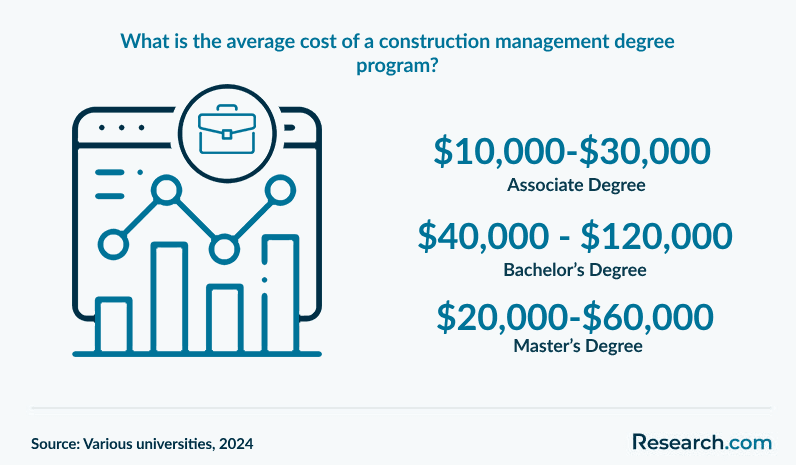
Construction management degree costs vary by school type, residency status, delivery format, credit requirements, and fees. Associate degrees typically cost between $10,000 and $30,000 in tuition. Bachelor’s programs can range from $40,000 to $120,000 at public and private institutions. Master’s programs in construction management usually fall between $20,000 and $60,000.
| Cost category | Amount stated | What it usually includes |
| Associate degree tuition | $10,000 - $30,000 on average | Lower-division coursework, general education, and introductory construction classes |
| Bachelor’s degree tuition | $40,000 - $120,000 | General education, major courses, electives, and upper-level construction management training |
| Master’s degree tuition | $20,000 - $60,000 | Advanced construction management, leadership, research, or specialized coursework |
| Materials and supplies | $1,000 - $3,000 | Books, software, safety equipment, technology tools, and course materials |
These are shown in the graphic below.
Online programs may cost less overall if they reduce housing, transportation, and campus-based expenses. However, “online” does not automatically mean inexpensive. Students should compare total cost of attendance, not only tuition. The cost of an online bachelor’s degree in construction management can also differ by transfer policy, term length, technology fees, and whether students pay in-state or out-of-state rates.
Cost questions to ask before enrolling
- Is tuition charged per credit, per term, or per academic year?
- Are online students charged separate technology or distance learning fees?
- Will I need paid software for estimating, scheduling, BIM, or project management coursework?
- Does the program require in-person labs, field experiences, travel, or safety equipment?
- How many of my transfer credits will count toward the construction management major?
- What is the total estimated cost through graduation, not just the first year?
What are the financial aid options for students enrolling in a construction management degree program?
Students can use several types of financial aid to reduce upfront education costs. Federal aid begins with the Free Application for Federal Student Aid (FAFSA), which can determine eligibility for loans, grants, work-study, and other aid. Some students may also qualify for state grants, institutional scholarships, industry scholarships, employer tuition assistance, veterans benefits, or payment plans.
| Aid option | How it may help | Important caution |
| FAFSA-based federal aid | Can provide access to loans, grants, and work-study opportunities | Loans must be repaid, so compare debt with realistic salary expectations |
| Pell Grants | Need-based financial assistance for eligible undergraduate students | Eligibility depends on federal rules and personal financial circumstances |
| Academic scholarships | May reduce tuition for students with strong academic records | Some awards require minimum GPA or full-time enrollment |
| Construction-specific scholarships | May be offered by construction firms, trade groups, or industry associations | Application deadlines and eligibility rules vary |
| Employer tuition assistance | Can help working construction professionals pay for school | Some employers require continued service after graduation |
| Work-study | Provides part-time employment for eligible students | Availability depends on the school and funding |
Students already employed in construction should ask their employer whether tuition reimbursement applies to accredited online programs, part-time enrollment, or job-related certifications. A lower-cost program can help, but the best financial strategy is usually a combination of aid, transfer credits, employer support, and careful borrowing.
What are the prerequisites for enrolling in a construction management degree program?
Admission requirements depend on the degree level and school. Associate and bachelor’s programs generally require a high school diploma or equivalent. Some undergraduate programs may expect preparation in math, science, drafting, computer applications, or technical coursework. Graduate programs usually require a bachelor’s degree, and some may prefer or require professional construction experience.
| Program level | Common prerequisite | Helpful preparation |
| Associate degree | High school diploma or equivalent | Algebra, technical drawing, construction basics, computer skills |
| Bachelor’s degree | High school diploma or equivalent; some programs may request SAT/ACT scores | Math, physics, drafting, business, communication, and field exposure |
| Master’s degree | Bachelor’s degree; some programs may request GRE scores | Construction experience, project management exposure, engineering or business background |
Students who want a shorter credential before pursuing a bachelor’s may compare associate options, including the best associate degree in 6 months online, but they should confirm whether credits will transfer into a construction management bachelor’s program. Learners with contractor, transportation, procurement, or military operations experience may also want to compare related logistics career path options.
What courses are typically in a construction management degree program?
Construction management curricula are built around the knowledge needed to plan, price, coordinate, and deliver construction projects safely and legally. Strong programs teach both field awareness and office-based project controls.
| Course area | What students learn | Why it matters in the field |
| Project Management | Planning, scheduling, budgeting, resource allocation, and project tracking | Construction managers must keep work moving while managing cost, scope, quality, and deadlines |
| Construction Materials and Methods | Building materials, assemblies, equipment, and common construction techniques | Managers need to understand how work is actually performed |
| Cost Estimation and Budgeting | Quantity takeoffs, pricing, bid preparation, and budget control | Accurate estimating affects profitability and project feasibility |
| Construction Safety and Risk Management | Hazard identification, safety planning, risk assessment, and compliance | Safety affects workers, liability, schedules, and legal exposure |
| Building Codes and Regulatory Compliance | Codes, zoning, permitting, inspections, and standards | Projects must satisfy legal and jurisdictional requirements |
| Construction Law and Contracts | Contract types, claims, disputes, liability, and documentation | Managers regularly work with owners, subcontractors, change orders, and risk allocation |
| Blueprint Reading and Construction Drawings | Interpretation of architectural, structural, civil, mechanical, and electrical drawings | Plan reading is essential for coordination and field communication |
| Construction Technology and Innovation | BIM, drones, robotics, data tools, and project management software | Digital tools increasingly shape estimating, coordination, inspections, and reporting |
| Leadership and Human Resources in Construction | Team leadership, communication, conflict resolution, and workforce coordination | Construction managers succeed through people as much as technical knowledge |
What types of specializations are available in construction management degree programs?
Specializations help students target a specific corner of the construction industry. Before choosing one, compare course descriptions, internship options, faculty expertise, software requirements, and employer connections. A specialization is most valuable when it supports a clear career goal.
- Project Management: Focuses on planning, budgets, staffing, timelines, risk, and overall project delivery.
- Green Building and Sustainability: Covers sustainable design, energy-efficient systems, sustainable materials, and environmental requirements.
- Real Estate Development: Connects construction planning with site selection, permitting, market analysis, financing, and property value.
- Safety Management: Emphasizes occupational safety, health requirements, risk control, inspections, and safety leadership.
- Construction Technology: Explores BIM, drones, robotics, digital modeling, and technology-driven project coordination.
- Heavy Civil Construction: Prepares students for infrastructure work involving roads, bridges, tunnels, utilities, logistics, and heavy equipment coordination.
- Cost Estimation and Financial Management: Develops budgeting, forecasting, estimating, cash flow, cost control, and profitability skills.
- Quality Assurance and Quality Control: Trains students to inspect work, document quality, manage corrective actions, and maintain specifications.
- Residential Construction Management: Focuses on housing projects, residential codes, zoning, customer coordination, and housing materials.
- Infrastructure and Urban Development: Prepares students for community planning, utilities, public works, and sustainable urban growth.
Students comparing specialization options can review curricula from affordable related programs, such as affordable online project management degrees, to see how project leadership coursework differs from construction-specific training.
Total construction spending in the United States has been steadily increasing in recent years. In 2021, it reached $1.73 trillion, followed by $1.79 trillion in 2022 and $1.98 trillion in 2023. The trend is projected to continue, with an estimated $2.13 trillion in construction spending for 2024, as shown below.
Is a construction management degree a sound long-term investment?
A construction management degree can be a strong long-term investment when it helps you qualify for roles with better responsibility, higher compensation potential, or advancement into project leadership. The return depends on total program cost, prior experience, location, internships, accreditation, debt level, and whether the curriculum matches employer expectations.
Students focused on return on investment should compare both quality and price. For example, reviewing the cheapest online construction management degree options may help identify programs with lower tuition, but affordability should not be the only factor. A low-cost program that lacks accreditation, practical learning, or employer recognition may be less valuable than a moderately priced program with strong placement support.
When the degree is more likely to be worth it
- You want to move from field labor or trade work into management, estimating, safety, or scheduling.
- You choose an accredited program with applied coursework and internship opportunities.
- You can transfer credits or use employer tuition assistance to lower costs.
- You are willing to learn construction software, contracts, budgeting, and leadership—not only jobsite operations.
- Your target employers prefer or require a bachelor’s degree for management-track roles.
When a different path may make more sense
- You want to work primarily in a skilled trade and do not need management training yet.
- You already have substantial management experience and only need a certification.
- The program would require heavy debt without improving your realistic career options.
- You need licensure in a related profession and the program does not meet those requirements.
Can I earn a construction management degree faster without lowering quality?
Yes, but speed should not come at the expense of accreditation, internships, software training, or core construction competencies. Accelerated options can work well for disciplined students who can handle compressed terms and heavier workloads. They are less ideal for learners who need extra time for math, technical drawing, estimating, or field experience.
Students who want a shorter timeline can compare the fastest online construction management degree pathways. Look for programs that still cover estimating, scheduling, safety, contracts, materials, building codes, and capstone or internship requirements.
Ways to finish faster
- Transfer approved credits from community college or prior college work.
- Choose an accelerated term format if you can manage the workload.
- Enroll year-round when summer or additional sessions are available.
- Ask whether military, professional, or prior learning credits are accepted.
- Consider a combined bachelor’s/master’s option if graduate study is part of your plan.
How does a construction management degree compare with an MBA for strategic leadership?
A construction management degree is specialized. It teaches how construction projects are planned, estimated, staffed, scheduled, documented, and delivered. An MBA is broader. It focuses on organizational strategy, finance, leadership, operations, marketing, and decision-making across industries.
| Option | Primary focus | Best for | Potential gap |
| Construction management degree | Construction methods, project delivery, contracts, estimating, scheduling, and safety | Students aiming for construction project, field, estimating, safety, or operations roles | May offer less depth in corporate finance, strategy, and executive leadership |
| MBA | Business strategy, leadership, finance, operations, marketing, and organizational management | Professionals seeking executive, ownership, or cross-functional business leadership roles | May not provide enough construction-specific technical training |
| Both credentials | Technical construction leadership plus business strategy | Professionals targeting senior management, ownership, development, or operations leadership | Requires more time and money, so ROI should be carefully evaluated |
Professionals who already have construction expertise and want broader business skills may compare options such as a least expensive MBA online. The best choice depends on whether your next role requires construction-specific technical depth, executive business training, or both.
What emerging technologies are shaping construction management education?
Construction management programs increasingly incorporate digital tools because employers expect graduates to work with data, drawings, models, schedules, and reports across multiple platforms. Common areas include Building Information Modeling, project management software, data analytics, drone-supported site documentation, sustainability tools, and virtual simulations.
These technologies can improve coordination, reduce errors, support safety planning, and make project information more visible to owners, contractors, and field teams. Students who want to move into senior roles may also benefit from strategic business training through options such as MBA online programs, especially if they plan to lead teams, divisions, or construction companies.
Can additional certifications boost my construction management career?
Certifications can strengthen a construction management résumé when they match the role you want. They do not replace a degree or work experience, but they can demonstrate commitment to safety, sustainability, project management, or professional standards. Examples cited include Project Management Professional (PMP), LEED Accreditation, OSHA Certification, and Certified Construction Manager (CCM).
| Certification area | Why it may help | Best aligned roles |
| Project Management Professional (PMP) | Signals formal project management knowledge and leadership discipline | Project manager, project controls, operations management |
| LEED Accreditation | Supports work on green building and sustainable construction projects | Sustainability consultant, project manager, development manager |
| OSHA Certification | Demonstrates safety awareness and compliance preparation | Safety manager, superintendent, field supervisor |
| Certified Construction Manager (CCM) | Validates construction management knowledge and professional practice | Construction manager, senior project manager, program manager |
Professionals seeking management acceleration may also compare business credentials, including shortest online MBA programs, but certifications and degrees should be selected based on career goals rather than collected randomly.
What additional advanced education options can complement a construction management degree?
Advanced education can be useful for construction professionals who want to move beyond project execution into operations leadership, ownership, consulting, development, finance, or executive decision-making. Options may include specialized graduate certificates, master’s degrees in construction management, MBAs, finance programs, real estate development coursework, or doctoral-level business study.
Professionals interested in senior strategy, research, or executive consulting may review alternatives such as cheap online DBA programs. However, advanced degrees are most valuable when they solve a specific career problem, such as qualifying for executive leadership, building financial expertise, or preparing for teaching or consulting.
Can combining construction management with business studies accelerate career growth?
Combining construction management with business coursework can help professionals move from project execution into broader leadership. Construction projects are business operations with budgets, contracts, procurement, risk, marketing, staffing, and client relationships. Business training can strengthen decision-making in those areas.
Students who want both technical and business preparation may consider options such as an accelerated business administration degree. This combination may be useful for aspiring project executives, construction entrepreneurs, real estate developers, operations managers, or company leaders.
Can an accelerated MBA complement a construction management degree?
An accelerated MBA can complement a construction management background if you already have technical construction knowledge and want concentrated business training. MBA coursework in finance, operations, leadership, analytics, and marketing can help construction professionals understand margins, growth strategy, organizational structure, and client development.
For professionals who want to add business training quickly, an MBA in 6 months may be worth exploring. Before enrolling, confirm workload intensity, accreditation, employer recognition, total cost, and whether the curriculum fits your leadership goals.
How do construction management degree programs equip graduates to navigate industry disruptions?
Construction projects are vulnerable to labor shortages, material price changes, supply chain delays, weather events, regulatory changes, safety incidents, and financing challenges. Strong construction management programs prepare students to handle uncertainty through risk assessment, scheduling strategy, contract documentation, cost control, scenario planning, and communication.
Programs that use real-world case studies, simulations, construction software, and capstone projects can help students practice decision-making before they face major problems on an actual project. Professionals who want executive-level crisis and strategy training may also compare options such as a cheap online MBA executive program.
How does one choose the best construction management degree program?
The best construction management program is the one that fits your career goal, budget, schedule, learning style, and employer expectations. Rankings can help narrow the list, but they should not replace your own evaluation. Accreditation, curriculum, practical experience, cost, transfer credit, faculty background, and career outcomes matter more than a program’s marketing language.
| Selection factor | What to look for | Why it matters |
| Accreditation | Institutional accreditation and, when relevant, construction-related program accreditation | Accreditation affects quality assurance, credit transfer, financial aid eligibility, and employer confidence |
| Curriculum | Estimating, scheduling, contracts, safety, building codes, project controls, materials, and technology | A construction management degree should teach more than general business management |
| Format | Online, hybrid, campus, synchronous, asynchronous, part-time, or accelerated study | The format must match your work schedule and learning needs |
| Applied experience | Internships, labs, capstones, site visits, employer projects, or simulations | Construction employers value practical readiness |
| Faculty | Instructors with construction, engineering, project management, safety, or industry leadership experience | Experienced faculty can connect theory to real project problems |
| Career support | Internship placement, employer connections, résumé help, job boards, and alumni networks | Career services can improve access to entry-level and advancement opportunities |
| Total cost | Tuition, fees, books, software, equipment, travel, and time away from work | The lowest advertised tuition may not be the lowest total cost |
Questions to ask admissions or program advisors
- Is the program fully online, or are any campus visits required?
- What construction software will I learn?
- Does the program help online students find internships near where they live?
- How many credits are required, and how many transfer credits can be accepted?
- What percentage of major courses are taught by faculty with construction industry experience?
- Does the program prepare students for certifications such as OSHA, LEED, PMP, or CCM?
- What career services are available to online students?
- Can I see a full cost estimate through graduation?
How can financial expertise improve construction management outcomes?
Financial skill is a major advantage in construction management because poor budgeting, weak forecasting, change order disputes, and cash flow problems can damage even well-built projects. Managers who understand financial analysis can evaluate bids, track margins, manage risk, communicate with owners, and make better resource decisions.
Construction professionals who want deeper finance training may explore the fastest online degree in finance as a complementary option. This may be especially useful for estimators, project controls specialists, development managers, owners, and executives.
What career paths are available for graduates of construction management degree programs?
Construction management graduates can pursue careers in project delivery, estimating, safety, quality, scheduling, facilities, real estate development, and sustainability. Some roles are more field-based, while others are office-based or hybrid. The strongest candidates usually combine technical knowledge, communication skills, software competence, and jobsite awareness.
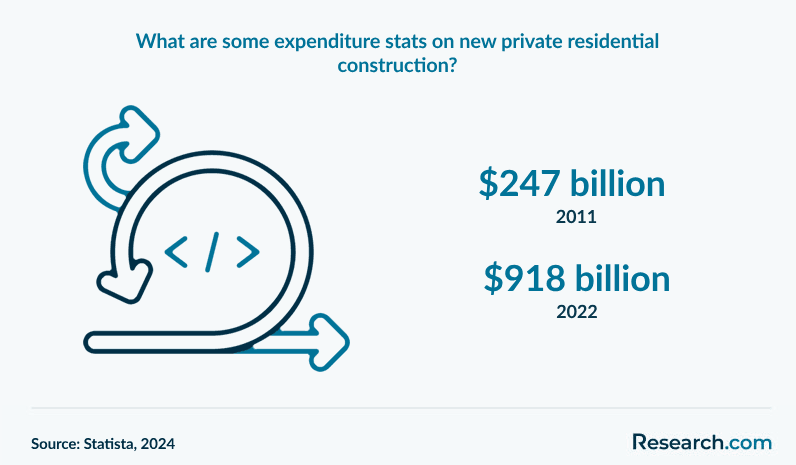
Expenditure on new private residential construction increased dramatically from 247 billion U.S. dollars in 2011 to 918 billion U.S. dollars in 2022. With rising construction costs and sustained high demand for housing, it is likely that spending will need to keep rising. These are shown in the graphic below.
| Career path | Main responsibilities | Skills that matter |
| Construction Manager | Coordinate projects from planning through completion, including schedules, budgets, teams, and resources | Leadership, scheduling, cost control, contracts, communication |
| Project Estimator | Prepare cost projections, quantity takeoffs, bid documents, and budget assumptions | Estimating software, plan reading, math, market awareness |
| Site Engineer | Support technical field operations, coordinate drawings, and help resolve site issues | Engineering fundamentals, documentation, quality control |
| Safety Manager | Develop and enforce safety procedures, inspect sites, and manage compliance | Risk assessment, OSHA knowledge, training, documentation |
| Field Engineer | Provide technical support on site and coordinate with construction teams | Problem-solving, plan interpretation, communication |
| Construction Scheduler | Create and monitor project timelines, coordinate subcontractor activities, and adjust schedules | Scheduling software, sequencing, communication, delay analysis |
| Quality Control Manager | Inspect work, confirm specifications, document deficiencies, and coordinate corrections | Detail orientation, codes, documentation, technical knowledge |
| Project Controls Specialist | Track cost, schedule, progress, and performance metrics | Analytics, reporting, cost control, scheduling, procurement awareness |
| Facilities Manager | Oversee building operations, maintenance, repairs, and post-construction performance | Operations, budgeting, vendor management, building systems |
| Building Inspector | Inspect construction for code, safety, zoning, and permit compliance | Codes, inspection procedures, documentation, attention to detail |
| Sustainability Consultant | Advise on efficient systems, sustainable materials, and green building practices | Sustainability standards, energy efficiency, communication |
| Construction Superintendent | Manage daily jobsite operations, coordinate trades, and maintain productivity and safety | Field leadership, sequencing, safety, communication |
| Real Estate Development Manager | Coordinate site selection, permitting, budgeting, financing, and project delivery | Finance, market analysis, construction knowledge, negotiation |
Students interested in project controls, procurement, or materials movement may also want to compare cheap online supply chain management degree programs, especially if they prefer logistics-heavy construction roles.
What is the job market for graduates with a construction management degree?
The construction management job market is supported by ongoing activity in residential, commercial, infrastructure, and non-building construction. The Bureau of Labor Statistics (BLS) projects a 8% job growth in construction management roles by 2031, reflecting the continued need for professionals who can manage development and infrastructure projects.
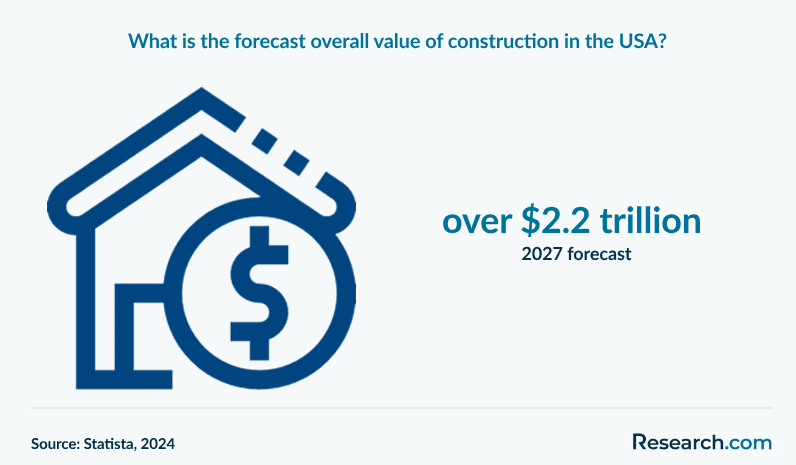
By 2027, the overall value of construction put in place in the United States, including residential, non-residential, and non-building segments, is forecast to reach over 2.2 trillion U.S. dollars. The market size of the U.S. construction sector was valued at nearly two trillion U.S. dollars in 2023, and it is expected to keep rising in the next couple of years, as shown in the graphic below.
Several trends affect demand for construction management graduates:
- Labor shortages: The construction industry continues to face a shortage of skilled workers, increasing the need for managers who can coordinate teams, subcontractors, schedules, and resources.
- Digital construction tools: Employers increasingly value professionals who can use Building Information Modeling, scheduling platforms, estimating software, and project management systems.
- Green building: Sustainability requirements are creating demand for professionals familiar with energy-efficient materials, sustainable construction, and LEED-certified construction.
- Modular and off-site construction: Prefabrication and modular methods require managers who understand factory coordination, transportation, sequencing, and on-site assembly.
- Regional growth: Construction demand and pay vary by location, sector, and project type, so students should research their target region before choosing a program.
Construction managers with finance knowledge may have an advantage in estimating, development, and executive roles. Students considering that direction can compare a finance degree online as a second credential or complementary academic path.
Can a construction management degree support entrepreneurial success?
A construction management degree can help future entrepreneurs understand project planning, estimating, contracts, safety, staffing, scheduling, and risk. These skills are directly relevant to starting a construction firm, subcontracting business, consulting practice, inspection service, development company, or project management consultancy.
However, entrepreneurship also requires sales, licensing awareness, insurance, financing, accounting, legal guidance, and market positioning. Students who want to compare construction entrepreneurship with broader business ownership paths can review what jobs can you get with a business entrepreneurship degree.
Common mistakes to avoid when choosing a construction management program
| Mistake | Why it can hurt you | Better approach |
| Choosing a program only because it sounds easy | Weak preparation can limit job readiness and employer confidence | Look for manageable structure, not low standards |
| Ignoring accreditation | Accreditation can affect credit transfer, financial aid, and employer recognition | Verify institutional and programmatic accreditation before applying |
| Comparing only tuition | Fees, software, books, equipment, and travel can raise total cost | Ask for a complete cost estimate through graduation |
| Assuming online means hands-off or self-paced | Some online programs have deadlines, group work, live sessions, or field requirements | Review the academic calendar, course format, and attendance rules |
| Skipping internships or field experience | Construction employers often value applied experience | Choose a program with internships, capstones, labs, or employer-connected projects |
| Overlooking software training | Modern construction management relies on digital tools | Ask which estimating, scheduling, BIM, and project platforms are included |
| Assuming salary outcomes are guaranteed | Pay depends on region, sector, experience, certifications, and performance | Use salary data as a planning benchmark, not a promise |
| Relying only on rankings | A highly ranked program may not fit your budget, schedule, or career goal | Use rankings as one input alongside accreditation, cost, curriculum, and support |
Key Insights
- An “easy” construction management degree should mean student-friendly, flexible, and well supported—not academically weak.
- Construction management associate degrees typically cost between $10,000 and $30,000. Bachelor’s degrees can range from $40,000 to $120,000, and master’s degrees typically cost between $20,000 and $60,000.
- A full-time bachelor’s degree commonly takes about 4 years, while an associate degree typically takes 2 years and a master’s degree usually takes 1-2 years.
- Entry-level positions typically start around $55,000 per year, while experienced professionals can earn significantly more; for example, the median annual wage for construction managers was approximately $104,900 in May 2023, with top earners making over $160,000 annually.
- The median annual wage for construction managers is also cited at around $98,890, with potential for higher earnings in certain sectors or locations.
- The market size of the U.S. construction sector was valued at nearly two trillion U.S. dollars in 2023, and it is expected to keep rising in the next couple of years.
- By 2027, the overall value of construction put in place in the United States, including residential, non-residential, and non-building construction, is forecast to reach over 2.2 trillion U.S. dollars.
- Spending on new private residential construction rose from 247 billion U.S. dollars in 2011 to 918 billion U.S. dollars in 2022.
- Total construction spending in the United States reached $1.73 trillion in 2021, $1.79 trillion in 2022, and $1.98 trillion in 2023, with an estimated $2.13 trillion in construction spending for 2024.
- The best program choice depends on accreditation, total cost, transfer credit, hands-on learning, faculty experience, software training, career support, and your target construction role.
References:
- American General Contractors of America. (2024). Construction data. American General Contractors of America.
- Bureau of Labor Statistics. (2023). Construction and extraction occupations. Bureau of Labor Statistics.
- Statista. (2024-a). Construction industry in the U.S. - statistics & facts. Statista.
- Statista. (2024b). Construction market in the U.S. Statista.
- Statista. (2024c). U.S. residential construction. Statista.
- TST-Europe. (2024). Construction industry statistics in the US in 2024. TST-Europe.
Other Things You Should Know About Online Construction Management Degrees
Yes. Many construction management bachelor’s programs accept up to 60 transfer credits from regionally accredited colleges, letting students finish the major’s upper-division courses after transfer. Programs usually still require core construction classes, math, and scheduling coursework before graduation.
Yes, many construction management degree programs in 2027 do not require previous construction experience. These programs often focus on foundational skills and knowledge, making them accessible to students from various backgrounds without prior experience in the field.





