
2027 How to Become a Forensic Scientist in Maryland

Co-Founder and Chief Data Scientist
Maryland can be a strong place to build a forensic science career, but the path is not as simple as earning “a forensics degree” and applying to a crime lab. Employers usually expect a science-heavy academic background, careful documentation habits, comfort with court-facing work, and the ability to handle sensitive evidence under strict quality standards. The field is also competitive, so students need to make early decisions about degree level, laboratory experience, specialization, and professional certification.
This guide explains how to become a forensic scientist in Maryland, including the degrees that fit different roles, how long training can take, what education may cost, which specializations are common, and how forensic science is used in the state’s legal system. It also covers salary expectations, career paths, technologies changing the profession, ethical responsibilities, and practical steps for choosing a program or preparing for employment.
Quick Answer: How Do You Become a Forensic Scientist in Maryland?
- Most Maryland forensic science roles require at least a bachelor’s degree in forensic science, biology, chemistry, or a closely related laboratory science. Some specialized or advancement-oriented positions may prefer a master’s degree or higher.
- Internships, laboratory assistant work, undergraduate research, and evidence-handling experience can make a major difference because forensic employers look for applicants who understand both science and chain-of-custody procedures.
- Certification is not always legally required in Maryland, but credentials from organizations such as the American Board of Criminalistics (ABC) or participation in professional networks connected to the American Academy of Forensic Sciences (AAFS) can strengthen credibility.
- The average salary for forensic scientists in Maryland is approximately $70,000 per year, with entry-level positions starting around $50,000 and experienced or supervisory professionals earning upwards of $90,000 annually. Actual pay depends on location, employer, specialization, and experience.
- National demand for forensic science professionals is projected to increase by 14% from 2020 to 2030 according to the U.S. Bureau of Labor Statistics, and Maryland’s job outlook is shaped by public-sector crime laboratories, law enforcement agencies, medical examiner work, and growing use of forensic evidence in investigations.
- What degree do you need to become a forensic scientist in Maryland?
- How long does it take to complete a forensic science degree program in Maryland?
- What are the costs associated with a forensic science education in Maryland?
- How do you get certified as a forensic scientist in Maryland?
- What are the different specializations within forensic science in Maryland?
- What are the key skills and techniques used by forensic scientists in Maryland?
- What are the job duties of a forensic scientist in Maryland?
- What are the different career paths for forensic scientists in Maryland?
- How can forensic scientists manage occupational stress and maintain work-life balance in Maryland?
- What are the continuing education and professional development opportunities for forensic scientists in Maryland?
- How do Maryland forensic laboratories maintain accreditation and ethical practices?
- Can forensic scientists leverage their skills for adjacent investigative careers in Maryland?
- What is the job market and salary potential for forensic scientists in Maryland?
- What are the implications of evolving legal and regulatory frameworks for forensic science in Maryland?
- How can legal expertise boost forensic investigations in Maryland?
- How is forensic science used in the legal system in Maryland?
- How can forensic scientists benefit from collaborating with criminal psychologists in Maryland?
- Can integrating behavioral analysis improve forensic investigations in Maryland?
- What are the newest technologies in forensic science in Maryland?
What degree do you need to become a forensic scientist in Maryland?
For most forensic scientist jobs in Maryland, the practical minimum is a bachelor’s degree in forensic science, chemistry, biology, biochemistry, or another closely related laboratory science. The best degree choice depends on the type of evidence you want to analyze. DNA roles usually favor biology or molecular biology coursework, drug chemistry roles require strong chemistry preparation, and toxicology positions may expect substantial training in analytical chemistry and biological systems.
A forensic science major can be useful when it includes rigorous lab science rather than only criminal justice courses. Employers often care less about the title of the degree and more about whether you have completed the scientific coursework needed to perform valid, defensible analysis. Courses in organic chemistry, genetics, statistics, instrumental analysis, microscopy, quality assurance, and criminal procedure can all support forensic work.
Maryland students may consider programs and pathways such as:
- Towson University: The Bachelor of Science in Forensic Science includes science coursework, criminalistics content, and laboratory experience designed for students interested in evidence analysis.
- University of Maryland, Baltimore County (UMBC): The Bachelor of Science in Biological Sciences with a concentration in Forensic Science connects biological science training with forensic applications.
- Johns Hopkins University: The Master of Science in Forensic Science can fit students who want graduate-level preparation in areas such as forensic DNA analysis or other advanced forensic topics.
Students comparing programs should look beyond the program name. Ask whether the curriculum includes advanced laboratory work, instrumentation, internship support, faculty with forensic experience, and preparation for the type of laboratory position you want. If you are still comparing academic options, Research.com’s guide to forensic science degrees can help you evaluate programs more systematically.
| Education option | Best fit | Limitations to consider |
| Associate degree | Students seeking an affordable start, transfer pathway, or support role in a laboratory setting | May not meet the minimum requirement for many forensic scientist positions |
| Bachelor’s in forensic science | Students who want a direct forensic curriculum with lab work and criminal justice context | Quality varies; make sure the program is science-intensive |
| Bachelor’s in chemistry or biology | Students targeting DNA, toxicology, drug chemistry, or other technical lab roles | May require electives, internships, or graduate study to build forensic-specific knowledge |
| Master’s in forensic science | Students seeking specialization, advancement, or stronger preparation for competitive roles | Adds cost and time; not always necessary for entry-level employment |
How long does it take to complete a forensic science degree program in Maryland?
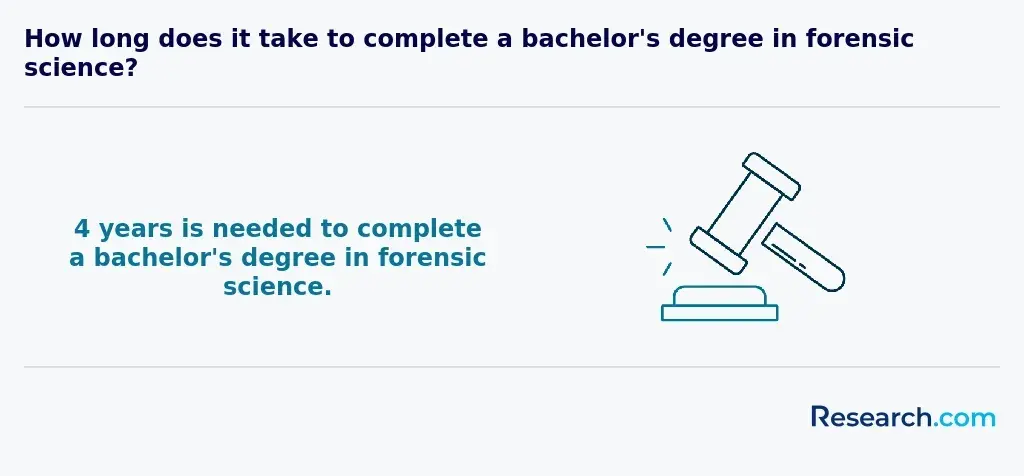
The time required depends on the credential you pursue and whether you study full time, part time, online, or through a transfer pathway. A forensic science associate degree generally takes about 2 years, while a bachelor’s degree generally takes about 4 years. A master’s degree in forensic science usually takes 1-2 years after a bachelor’s degree. Certificate programs may take a few months to a year, depending on the subject and intensity.
- Forensic science associate degree: Approximately 2 years.
- Forensic science bachelor’s degree: Approximately 4 years.
- Master’s degree in forensic science: Typically 1-2 years after completing a bachelor’s degree.
- Certification programs: Often a few months to a year, depending on the discipline and provider.
Plan for more than classroom time. Competitive applicants often build experience through internships, research projects, laboratory assistant roles, or agency-based training. If a position requires background checks, internal training, competency testing, or an external certification exam, the full timeline from student to independent forensic analyst can extend beyond graduation.
What are the costs associated with a forensic science education in Maryland?
Forensic science education in Maryland can range from $10,000 to $40,000 per year, depending on the institution type, residency status, and program level. Tuition is only one part of the total cost. Students should also budget for mandatory fees, textbooks, lab supplies, transportation, housing, food, and personal expenses.
Public universities may be more affordable for Maryland residents. For example, public university tuition can be around $10,000 for in-state students and approximately $30,000 for out-of-state students. Private institutions may charge upwards of $40,000 annually. Lab fees may range from $200 to $1,000 per semester, while textbooks and lab supplies can add another $1,000 to $2,000 per year. Living costs can be significant, especially in Baltimore, areas near Washington, D.C., or other high-cost regions, and may exceed $15,000 annually.
| Cost category | What to check before enrolling |
| Tuition | Compare in-state, out-of-state, private, online, and part-time rates. |
| Fees | Ask about laboratory, technology, graduation, and course-specific fees. |
| Books and supplies | Budget for textbooks, lab manuals, safety equipment, and software when required. |
| Housing and transportation | Consider commuting costs, parking, public transit, and proximity to internship sites. |
| Opportunity cost | Part-time work, unpaid internships, and graduate study can affect total affordability. |
| Financial aid | Review grants, scholarships, assistantships, employer tuition support, and loan terms. |
Do not choose a program by tuition alone. A lower-cost program that lacks relevant lab coursework or internship access may not support your target job, while a higher-cost program without strong employment outcomes may also be a poor investment. Ask admissions offices for graduation rates, internship placement support, transfer credit policies, and examples of employers that hire recent graduates.
How do you get certified as a forensic scientist in Maryland?
Maryland does not require one universal state license for all forensic scientists, but certification can improve professional credibility and may be preferred by employers or required for certain laboratory roles. The usual pathway starts with a relevant science degree, followed by supervised laboratory experience, competency training, and, when appropriate, certification through a recognized professional body.
Commonly recognized organizations include the American Board of Criminalistics (ABC) and professional networks associated with the American Academy of Forensic Sciences (AAFS). Certification requirements vary by discipline, so applicants should confirm eligibility rules, education requirements, experience requirements, examination topics, renewal cycles, and continuing education obligations directly with the certifying organization.
Maryland forensic roles may also involve fingerprinting, background checks, security procedures, and careful screening because employees often handle sensitive evidence and case information. Fees for exams, applications, study materials, and background checks can total several hundred dollars, depending on the credential and process.
| Step | What it means in practice |
| Earn a science-based degree | Complete a bachelor’s program in forensic science, chemistry, biology, or a related field. |
| Build laboratory experience | Use internships, research, or lab assistant roles to practice documentation, testing, and quality control. |
| Choose a forensic discipline | Match certification goals to your area, such as criminalistics, DNA, toxicology, or firearms analysis. |
| Prepare for the exam | Review the certifying body’s exam content, eligibility rules, and documentation requirements. |
| Maintain the credential | Complete renewal requirements, continuing education, and ethics or competency expectations. |
What are the different specializations within forensic science in Maryland?
Forensic science is not one job. It is a collection of technical disciplines that apply scientific methods to legal questions. In Maryland, career options may involve state agencies, local law enforcement laboratories, medical examiner work, private-sector analysis, federal-adjacent opportunities, or specialized investigative units.
- Forensic DNA analysis: DNA analysts examine biological evidence to help identify contributors, exclude individuals, or support case reconstruction. This path usually requires strong biology, genetics, molecular biology, and statistics preparation.
- Forensic chemistry: Forensic chemists may analyze suspected controlled substances, fire debris, trace materials, or unknown substances using validated analytical methods.
- Toxicology: Toxicologists test biological samples for drugs, alcohol, poisons, or other substances that may be relevant to criminal, medical examiner, or impaired-driving cases.
- Firearms and toolmark examination: Specialists evaluate firearms, bullets, cartridge cases, toolmarks, and related evidence. They may also conduct serial number restoration or gunshot residue-related work, depending on the laboratory.
- Latent print examination: Analysts compare fingerprints, palm prints, and other friction ridge evidence while following strict documentation and verification practices.
- Digital forensics: Digital forensic specialists recover, preserve, and analyze data from computers, mobile devices, networks, and other electronic sources.
- Forensic pathology: Forensic pathologists are physicians who determine cause and manner of death through autopsies, medical records, scene information, and laboratory findings.
- Forensic accounting: Forensic accountants examine financial records in fraud, embezzlement, money laundering, and other financial crime investigations.
- Forensic anthropology: Anthropologists assist with human remains identification and interpretation, especially when remains are skeletal, decomposed, burned, or otherwise difficult to identify.
The best specialization depends on your strengths. Students who enjoy molecular biology may fit DNA work. Those who prefer instrumentation and chemical analysis may prefer toxicology or drug chemistry. Students interested in computers and investigations may consider digital forensics. Those interested in death investigation should understand that forensic pathology requires medical school and advanced physician training.
What are the key skills and techniques used by forensic scientists in Maryland?
Forensic scientists need technical accuracy, scientific judgment, and the discipline to document every step. A result is useful only if it is reliable, reproducible, and explainable in a legal setting. Maryland employers may train new hires on agency-specific procedures, but applicants should already demonstrate strong scientific fundamentals and professional maturity.
- Analytical reasoning: Forensic scientists must interpret complex evidence without jumping beyond what the data support.
- Attention to detail: Small errors in labeling, measurement, contamination control, or documentation can affect evidence integrity.
- Written communication: Reports must be clear, precise, and understandable to investigators, attorneys, judges, and sometimes juries.
- Oral communication: Analysts may need to explain technical findings in court without overstating certainty.
- Scientific skepticism: Good forensic practice requires recognizing limitations, alternative explanations, and sources of uncertainty.
- Ethical judgment: Forensic scientists must remain neutral, even when case facts are emotionally difficult or public pressure is high.
- Laboratory discipline: Evidence handling, contamination prevention, calibration, validation, and quality control are central to the job.
Common techniques include DNA analysis, toxicology testing, chromatography, mass spectrometry, microscopy, ballistics analysis, fingerprint comparison, trace evidence examination, and digital evidence recovery. The exact tools depend on the laboratory unit and the type of evidence being analyzed.
What are the job duties of a forensic scientist in Maryland?
Forensic scientists in Maryland analyze evidence and produce findings that can support investigations, prosecutions, defense review, and court proceedings. Their daily work may take place in a crime laboratory, medical examiner environment, police department, regional laboratory, or specialized investigative unit.
Typical responsibilities include receiving and preserving evidence, performing laboratory tests, following standard operating procedures, validating or using analytical methods, maintaining accurate notes, preparing technical reports, reviewing case files, communicating with investigators, and testifying as an expert witness when needed. Some roles involve direct crime scene response, while others are primarily laboratory-based.
Common job titles include forensic scientist, forensic chemist, forensic biologist, crime laboratory technician, crime scene analyst, digital forensic examiner, toxicologist, and fingerprint examiner. Students exploring broader justice-related pathways can also review the best jobs with a criminal justice degree to compare forensic work with law enforcement, corrections, legal support, and investigative careers.
| Duty | Why it matters |
| Evidence receipt and documentation | Protects chain of custody and helps ensure evidence can be used in court. |
| Laboratory analysis | Uses scientific methods to identify substances, compare samples, or interpret physical evidence. |
| Quality control | Reduces error risk through calibration, validation, peer review, and procedural compliance. |
| Report writing | Creates an official record of methods, findings, limitations, and conclusions. |
| Court testimony | Explains scientific findings to legal professionals and fact-finders. |
| Continuing training | Keeps analysts current as technologies, standards, and legal expectations evolve. |
What are the different career paths for forensic scientists in Maryland?
Maryland forensic science careers can start with technician-level or entry-level analyst roles and progress into senior analyst, supervisory, specialist, quality assurance, training, or expert witness responsibilities. Some professionals remain laboratory specialists for their entire careers, while others move into management, policy, legal consulting, digital investigations, or adjacent investigative fields.
Entry-level positions such as Crime Laboratory Technician I or Forensic Scientist I often require a bachelor’s degree in a relevant scientific discipline. These roles may involve evidence preparation, routine testing, documentation, and supervised casework. Salaries for these positions generally range from $40,000 to $60,000 annually, depending on experience and duties.
Mid-level roles such as Forensic Scientist II or Crime Laboratory Technician Supervisor usually require demonstrated competence, casework experience, and stronger independent judgment. These professionals may handle more complex cases, mentor junior staff, help review reports, or support quality initiatives. Mid-level forensic scientists can expect to earn between $60,000 and $80,000 per year.
Advanced roles may include senior forensic scientist, technical leader, laboratory supervisor, forensic pathologist, medical examiner, or specialized expert. Some of these roles require graduate education, medical training, extensive experience, or discipline-specific certification. Senior positions can exceed $100,000 annually, especially when the role includes supervision, specialized expertise, or advanced professional responsibility.
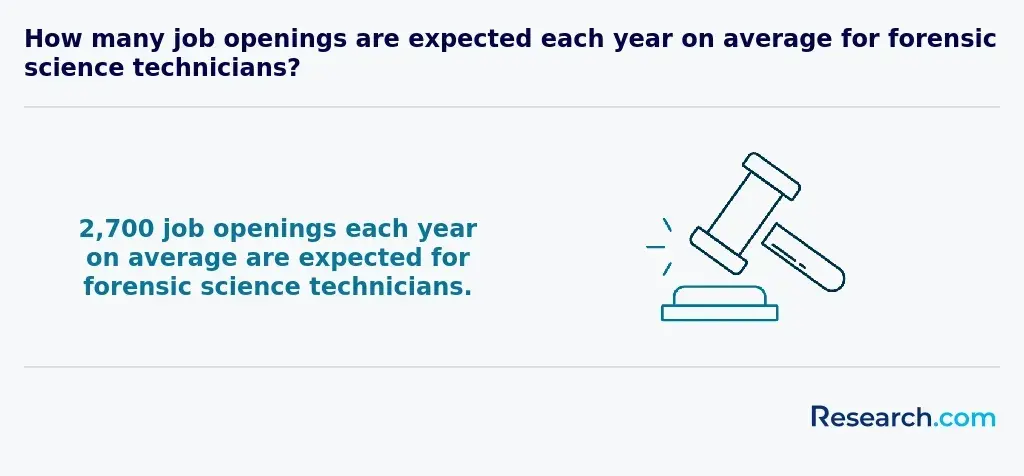
The job market for forensic scientists in Maryland is described as robust, with a projected growth rate of 26 percent for forensic science technicians from 2022 to 2032. Students who need flexible academic options may want to compare online forensic science colleges, while confirming that any online program includes adequate science labs, internship planning, and employer-recognized coursework.
How can forensic scientists manage occupational stress and maintain work-life balance in Maryland?
Forensic work can be emotionally demanding. Analysts may handle violent crime evidence, child exploitation materials, death investigations, courtroom pressure, large backlogs, and strict deadlines. Stress can also come from the need to be exact: one documentation error or unsupported conclusion can affect a case.
Practical stress-management strategies include structured case review routines, regular breaks during difficult evidence work, peer consultation, clear boundaries between work and personal time, access to employee assistance programs, and training on secondary trauma. Supervisors can help by monitoring workloads, encouraging documentation quality over speed, and creating a culture where analysts can ask questions without fear.
Forensic professionals who want to understand helping professions and workplace stress from another angle may find value in reviewing the pros of being psychologist, especially when thinking about resilience, ethical practice, and long-term professional sustainability.
What are the continuing education and professional development opportunities for forensic scientists in Maryland?
Continuing education is essential because forensic science changes through new technologies, court decisions, accreditation expectations, and evolving scientific standards. Maryland professionals may pursue workshops, conferences, laboratory trainings, graduate certificates, professional association events, and discipline-specific certification renewal courses.
Useful training topics include DNA interpretation, validation studies, digital evidence tools, courtroom testimony, statistics, quality assurance, ethics, contamination prevention, forensic report writing, and legal updates. Professional development is not only about promotion; it helps analysts avoid outdated methods and maintain confidence in their findings.
Some forensic professionals also benefit from interdisciplinary training in counseling, trauma, or human services, especially when their work involves victims, families, or emotionally difficult case material. Research.com’s guide to LPC requirements in Maryland can provide context on another regulated profession where ethics, documentation, and continuing education are central.
How do Maryland forensic laboratories maintain accreditation and ethical practices?
Forensic laboratories maintain credibility through documented procedures, internal quality controls, external audits, proficiency testing, evidence security, technical review, administrative review, and continuing training. Accreditation is important because forensic results may influence arrests, plea decisions, trials, appeals, and public trust.
Ethical practice requires neutrality. A forensic scientist is not an advocate for the police, prosecution, or defense. The analyst’s role is to evaluate evidence accurately, disclose limitations, avoid overstating conclusions, and report results that are supported by validated methods.
Maryland forensic professionals also operate within broader public-service expectations. Those interested in ethical frameworks across helping and justice-related professions may compare forensic responsibilities with the training discussed in Research.com’s guide on what degree do you need to be a social worker in Maryland.
Can forensic scientists leverage their skills for adjacent investigative careers in Maryland?
Yes. Forensic scientists build transferable skills in evidence evaluation, documentation, pattern recognition, data interpretation, report writing, and testimony preparation. Those skills can support careers in compliance, fraud investigation, digital investigations, quality assurance, laboratory management, risk analysis, insurance investigation, and forensic accounting.
Forensic accounting can be a strong adjacent path for people who like investigation but prefer financial records over biological, chemical, or physical evidence. It requires different technical preparation, but the core habits are familiar: follow the evidence, document conclusions, and communicate findings clearly. If this path interests you, Research.com’s guide on how to become an accountant in Maryland explains the accounting side of that transition.
What is the job market and salary potential for forensic scientists in Maryland?
The job market for forensic scientists in Maryland is shaped by public-sector laboratories, local and state law enforcement agencies, medical examiner work, legal demand for forensic evidence, and the growing role of digital and DNA evidence. The projected growth rate is 13.6% over the next decade, signaling continued need for qualified professionals.
Pay varies by employer, location, experience, and specialty. The average salary for forensic scientists in Maryland is approximately $70,000 per year. Entry-level positions may start around $50,000, while experienced forensic scientists, supervisors, or professionals in specialized fields can earn upwards of $90,000 annually. Earlier career bands also show entry-level roles generally ranging from $40,000 to $60,000 annually and mid-level roles between $60,000 and $80,000 per year.
Urban areas such as Baltimore and Annapolis may offer different compensation than rural areas because of agency budgets, cost of living, case volume, and specialization needs. Benefits can also matter. Many forensic science roles are in government settings, where health insurance, retirement plans, paid time off, and public-sector stability may add value beyond salary.
Specialization can influence earning potential and competitiveness. DNA analysis, toxicology, digital forensics, forensic chemistry, and supervisory quality roles may require additional training but can improve advancement options. Students interested in behavioral science intersections may also compare forensic laboratory careers with forensic psychology schools in Maryland.
Forensic scientists can find employment in a variety of settings, but government agencies remain a major employer. Most forensic scientist work in the government.
What are the implications of evolving legal and regulatory frameworks for forensic science in Maryland?
Forensic science does not operate separately from the law. Changes in evidence rules, privacy requirements, discovery obligations, laboratory standards, and admissibility expectations can affect how analysts collect, store, test, interpret, and report evidence. A method that is scientifically useful must also be legally defensible.
Maryland forensic scientists should stay current on courtroom expectations, chain-of-custody requirements, data retention policies, expert testimony standards, and discipline-specific guidance. Digital evidence, DNA databases, emerging genetic technologies, and AI-supported workflows raise especially important questions about privacy, bias, transparency, and explainability.
Interdisciplinary awareness can help forensic professionals communicate more effectively with investigators, attorneys, psychologists, and victim-service professionals. For example, students interested in the human behavior side of investigations can explore the best psychology schools in Maryland to understand related academic pathways.
How can legal expertise boost forensic investigations in Maryland?
Legal knowledge helps forensic scientists understand why documentation, chain of custody, discovery compliance, and neutral reporting are so important. Analysts do not need to become attorneys, but they should understand how their reports may be challenged in court and how evidence handling can affect admissibility.
Collaboration with legal professionals can improve case preparation, clarify what questions the evidence can answer, and prevent overstatement of results. Legal support roles also show how evidence moves through the justice system after laboratory analysis. Readers interested in that side of the process can review Research.com’s guide on how to become a paralegal in Maryland.
How is forensic science used in the legal system in Maryland?
Forensic science supports Maryland’s legal system by helping investigators and courts evaluate physical, biological, chemical, digital, and trace evidence. Scientific findings can link a person to a scene, exclude a suspect, identify a substance, reconstruct an event, support a cause-of-death determination, or reveal information stored on electronic devices.
Forensic work is especially important in firearms cases, toxicology matters, DNA-related investigations, controlled substance cases, fingerprint comparisons, and digital evidence reviews. Analysts may perform ballistics examinations, restore serial numbers, test for gunshot residue, analyze DNA on recovered items, examine fingerprints, or interpret trace materials.
The value of forensic science depends on careful limits. Evidence does not “speak for itself.” It must be collected properly, analyzed using reliable methods, reviewed for quality, reported accurately, and explained in a way that judges and juries can understand. Strong forensic practice can support justice, while weak documentation or overstated conclusions can damage trust.
How can forensic scientists benefit from collaborating with criminal psychologists in Maryland?
Collaboration with criminal psychologists can help forensic scientists understand behavioral context, offender patterns, victimology considerations, and investigative decision-making. The forensic scientist remains responsible for the physical or digital evidence, but behavioral expertise can help teams ask better questions and interpret case context more carefully.
This collaboration may be useful in serial offenses, threat assessment, child exploitation cases, violent crime analysis, and cases where behavioral patterns intersect with physical evidence. Professionals interested in this interdisciplinary area can review Research.com’s guide on how to become a criminal psychologist in Maryland.
Can integrating behavioral analysis improve forensic investigations in Maryland?
Behavioral analysis can improve investigations when it is used as a complement to evidence, not as a replacement for it. Forensic scientists should avoid drawing psychological conclusions outside their expertise, but they can benefit from working with behavioral specialists who help interpret patterns, motives, risk factors, and investigative leads.
Training in behavioral science may improve communication across multidisciplinary teams, particularly in cases involving repeated behaviors, complex victim-offender dynamics, or developmental and behavioral evidence. Readers interested in behavior-focused career pathways can explore how to become a BCBA in Maryland.
What are the newest technologies in forensic science in Maryland?
Forensic science is becoming more technology-driven, and Maryland professionals need to keep pace with tools that affect evidence analysis, data review, and laboratory workflows. New technologies can improve speed and sensitivity, but they also create challenges around validation, privacy, bias, quality assurance, and courtroom explanation.
- Next-generation sequencing (NGS): This DNA analysis approach can examine complex or limited DNA samples in more detailed ways than traditional methods.
- Rapid DNA analysis: Rapid systems can process DNA samples quickly, sometimes producing results within hours and supporting faster investigative decisions.
- AI-driven forensic workflows: Artificial intelligence can help review large datasets, identify patterns, and support efficiency, but results must be explainable and validated.
- 3D genomics: Three-dimensional visualization of genetic information may help scientists interpret complex biological evidence.
- Mobile DNA platforms: Field-based DNA tools can support urgent investigations when rapid information is needed.
- Digital forensics tools: These tools help recover and analyze information from phones, computers, networks, and other electronic sources.
- Automated fingerprint identification systems (AFIS): Improved systems can speed fingerprint searches and comparisons across large databases.
Technology does not eliminate the need for human judgment. Analysts must understand validation data, error risks, limitations, and ethical issues before relying on new systems. Students who want a broader view of investigative careers can use Research.com’s guide to criminology degrees and careers as a starting point.
| Abilities essential to the job | How the ability supports forensic work |
| Flexibility of Closure | Helps analysts recognize a known pattern, object, word, figure, or sound when it is hidden among distracting information. |
| Inductive Reasoning | Supports the ability to connect separate pieces of information and form reasonable conclusions from related or seemingly unrelated evidence. |
| Near Vision | Allows close inspection of small details, markings, materials, prints, and other evidence viewed within a short distance. |
| Oral Comprehension | Helps forensic professionals understand instructions, testimony, case discussions, and information shared verbally. |
| Oral Expression | Supports clear explanation of technical findings during meetings, training, and courtroom testimony. |
Common Mistakes to Avoid When Preparing for a Forensic Science Career in Maryland
- Choosing a program based only on the word “forensic” in the title: Make sure the curriculum includes rigorous biology, chemistry, statistics, and lab methods.
- Ignoring internships until senior year: Evidence-handling and laboratory experience can be decisive in a competitive job market.
- Assuming online coursework is always enough: Many forensic roles require hands-on lab competence, so confirm how laboratory requirements are completed.
- Overlooking background checks: Forensic work often requires trustworthiness, clean documentation habits, and eligibility to handle sensitive evidence.
- Focusing only on salary: Consider benefits, location, workload, specialization, advancement paths, and emotional demands.
- Confusing forensic science with crime scene investigation: Some roles are laboratory-based, while others involve scene response. Clarify which path you want.
- Underestimating courtroom communication: Analysts must explain findings clearly and stay within the limits of the evidence.
- Neglecting continuing education: Forensic standards, technologies, and legal expectations change, so long-term learning is part of the job.
Questions to Ask Before Choosing a Maryland Forensic Science Program
- Does the program include advanced laboratory coursework in chemistry, biology, instrumentation, or DNA-related methods?
- Are internships, research placements, or crime laboratory connections available?
- Do graduates work in forensic laboratories, law enforcement agencies, medical examiner offices, or related scientific roles?
- Does the program prepare students for a specific specialization such as DNA, toxicology, digital forensics, or forensic chemistry?
- Are faculty members experienced in forensic science, laboratory research, criminalistics, or expert testimony?
- How much will the full program cost after tuition, fees, supplies, transportation, and living expenses?
- Can transfer credits reduce time to completion?
- Does the school provide career advising for government applications, background checks, and laboratory hiring processes?
- Will the program support graduate school admission if advanced study becomes necessary?
Key Insights
- A bachelor’s degree in forensic science, biology, chemistry, or a related laboratory science is the usual starting point for forensic scientist roles in Maryland.
- The strongest applicants combine science coursework with hands-on lab experience, internships, careful documentation skills, and an understanding of legal evidence standards.
- Education timelines vary: an associate degree takes about 2 years, a bachelor’s degree about 4 years, and a master’s degree typically 1-2 years after the bachelor’s.
- Program costs can range from $10,000 to $40,000 per year, before adding fees, books, lab supplies, housing, and transportation.
- Certification is not a single statewide requirement for all Maryland forensic scientists, but recognized credentials can improve credibility and support advancement.
- Specialization matters. DNA, toxicology, digital forensics, forensic chemistry, firearms, latent prints, forensic pathology, and forensic accounting require different academic preparation.
- Forensic science careers can be rewarding, but they require emotional resilience, ethical discipline, continuing education, and the ability to explain science clearly in legal settings.
- Before enrolling, students should verify laboratory rigor, internship access, cost, transfer policies, and alignment with their target forensic role.
Related Articles for Nearby States
- 2027 How to Become a Forensic Scientist in Virginia
- 2027 How to Become a Forensic Scientist in West Virginia
- 2027 How to Become a Forensic Scientist in Pennsylvania
- 2027 How to Become a Forensic Scientist in Delaware
- 2027 How to Become a Forensic Scientist in New Jersey
- 2027 How to Become a Forensic Scientist in New York
- 2027 How to Become a Forensic Scientist in Ohio
- 2027 How to Become a Forensic Scientist in North Carolina
- 2027 How to Become a Forensic Scientist in Kentucky
- 2027 How to Become a Forensic Scientist in Connecticut
References:
- Allcriminaljusticeschools.com (31 Dec 2021). Salary and benefits in forensic science. allcriminaljusticeschools.com
- Baltimorepolice.org (N.D.). Forensic Science Careers, Internships and Tours. baltimorepolice.org
- Health.maryland.gov (N.D.). Forensic Investigators. health.maryland.gov
- Jocelyn Blore (14 Nov 2024). Forensics Colleges in Maryland. forensicscolleges.com
- Mdsp.maryland.gov (18 Mar 2023). 2023 FSD Annual Report. mdsp.maryland.gov
- Sciepublish.com (23 Aug 2024). Emerging Technologies in Forensic DNA Analysis. sciepublish.com
- Stevenson.edu (N.D.). Exploring the Forensic Science Career Path and Why You Should Obtain Your Master’s Degree in Forensic Science Online. stevenson.edu
- Umaryland.edu (09 Sep 2024). Law School Launches Nation's First Forensic Defense Clinic. umaryland.edu
Other Things You Should Know About Becoming a Forensic Scientist in Maryland
The Maryland State Police Forensic Sciences Division is the main state employer for forensic scientists. It operates the state laboratory system and hires analysts in areas such as biology, chemistry, toxicology, trace evidence, and firearms examination for crime labs serving Maryland law enforcement.
In 2027, forensic scientists in Maryland can pursue certifications like the American Board of Criminalistics (ABC) Certification or Forensic Science Assessment Test (FSAT). These certifications enhance credibility and are recognized by forensic agencies across the state.


