2027 How to Become a Conservation Officer

Co-Founder and Chief Data Scientist
If you want a law enforcement career that puts you outdoors instead of behind a desk, becoming a conservation officer may be a strong fit. Conservation officers—often called wildlife officers, fish and game wardens, or conservation police officers—enforce hunting, fishing, boating, wildlife, and natural resource laws while helping protect public lands and people who use them.
This guide explains what conservation officers do, how to qualify, what education and academy training may be required, how long the process can take, what it may cost, and whether the career is worth pursuing in 2027. It is designed for students, career changers, veterans, outdoor professionals, and anyone comparing conservation law enforcement with related paths in criminal justice, biology, environmental science, parks, or natural resources.
Quick answer: Is becoming a conservation officer a good career path?
Becoming a conservation officer can be a worthwhile career if you want public-service work that combines law enforcement, environmental protection, outdoor patrol, emergency response, and community education. It is not an easy field to enter: hiring is competitive, physical standards are strict, and some states require significant college education before you can apply. However, officers can earn stable government benefits, receive paid academy training after hiring, and build long-term careers in field enforcement, investigations, K-9 work, supervision, or federal service.
| Decision factor | What to know before applying |
| Typical pay | The average salary for conservation officers is about $52,580 per year, while BLS data for fish and game wardens reports an average of $61,120 per year. |
| Education | Requirements vary sharply by state, from a high school diploma or GED to 60 college credits, an associate degree, or a bachelor’s degree. |
| Training | Most successful candidates complete a police academy, agency-specific wildlife enforcement training, field training, and a probationary period. |
| Competitiveness | The field is small, and employment is expected to decline by about 5% from 2023 to 2028, so applicants need strong preparation. |
| Best fit | This career suits people who can handle irregular hours, remote patrols, physical demands, public contact, and high-responsibility enforcement work. |
What are the main benefits of becoming a conservation officer?
- You can earn a median annual salary of $52,580 while working in a role centered on wildlife protection, public safety, and natural resource enforcement.
- You may benefit from recurring openings as experienced officers retire, although competition for each position can remain strong.
- You can pursue advancement into roles such as K-9 handler, investigator, supervisor, training officer, specialized patrol officer, or federal wildlife enforcement professional.
- Conservation officer role overview
- Daily duties and responsibilities
- Step-by-step path for 2027
- Skills and experience employers value
- Licenses, certifications, and credentials
- Education requirements by pathway
- Timeline to become fully qualified
- Cost of preparation and training
- Future trends affecting the career
- Field challenges to expect
- Advanced education for career growth
- Urban planning skills and conservation work
- Work-life balance in conservation enforcement
- Specialized education for greater impact
- Graduate options for advancement
- Salary and compensation
- Career paths and promotion options
- Is this career worth it?
What is a conservation officer?
A conservation officer is a sworn law enforcement professional who protects wildlife, fisheries, natural resources, and public lands. Depending on the state or agency, the same role may be called fish and game warden, wildlife officer, conservation police officer, game warden, or natural resources officer.
Unlike park interpreters or wildlife biologists, conservation officers have police authority within their jurisdiction. They may issue citations, make arrests, conduct investigations, carry firearms, respond to emergencies, and testify in court. Their cases often involve hunting and fishing violations, boating safety, poaching, illegal dumping, trespassing, habitat damage, and public safety incidents in remote outdoor areas.
Many candidates prepare through criminal justice, environmental science, wildlife management, biology, forestry, or natural resource programs. If you need a flexible route into law enforcement coursework, an affordable online option such as one of the most affordable online criminal justice degree programs may help you build relevant academic preparation, provided the program meets the requirements of the agency where you plan to apply.
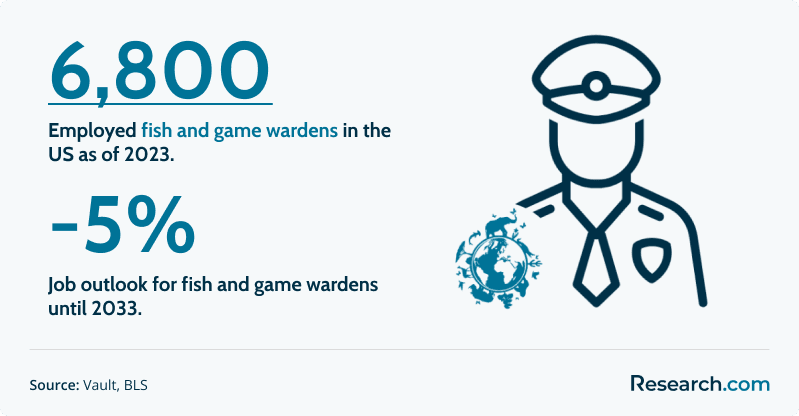
This occupation is also relatively small. The U.S. Department of Labor reports about 6,800 fish and game wardens employed across the United States. About 250 are special agents with the U.S. Fish & Wildlife Service, which is the largest single employer in the field, and others work through the Department of the Interior, including the National Park Service. Employment is expected to decline by about 5% from 2023 to 2028, which means applicants should treat the hiring process as competitive at the local, state, and federal levels.
What do conservation officers do?
Conservation officers combine outdoor policing, natural resource protection, emergency response, public education, and investigative work. Their days can vary widely by season. Opening weekend of hunting season, boating holidays, wildfire conditions, fishing tournaments, storms, or search-and-rescue calls can all change the workload.
| Responsibility | What it can involve in the field |
| Wildlife and fisheries enforcement | Checking licenses, inspecting harvested game, enforcing bag limits, monitoring fishing activity, and investigating suspected poaching. |
| General law enforcement | Handling trespassing complaints, traffic issues on public lands, intoxicated boaters, armed contacts, disorderly conduct, and public safety calls. |
| Search and rescue | Locating missing hikers, boaters, hunters, or campers in remote terrain, often in poor weather or low-visibility conditions. |
| Public education | Teaching hunter safety, boating safety, conservation practices, and outdoor ethics to residents, visitors, schools, and community groups. |
| Environmental investigations | Responding to illegal dumping, habitat destruction, protected species cases, pollution complaints, and suspicious wildlife deaths. |
Because some cases involve injured animals, carcasses, disease concerns, or protected species, conservation officers may coordinate with veterinarians, wildlife rehabilitators, biologists, or professionals trained through veterinary technician programs.
How do I become a conservation officer for 2027?
The route to becoming a conservation officer depends on the state agency, but most candidates move through the same broad sequence: eligibility screening, education or experience preparation, testing, background investigation, academy training, field training, and probation. Before you invest in a degree or training program, review the hiring page for the exact agency where you want to work.
1. Confirm the basic eligibility rules
Most agencies require U.S. citizenship, a valid driver’s license, a clean criminal record, and the ability to pass medical, physical, psychological, and background checks. Felony convictions are generally disqualifying. Minimum age requirements differ. Indiana and Michigan require candidates to be 21 by academy graduation, while Florida accepts applicants as young as 18 if they are 19 by the time they are hired.
2. Choose an education path that matches your target state
Education requirements are not standardized nationally. Florida and Michigan may accept a high school diploma or GED as the minimum. California requires 60 semester units of college credit. Illinois requires an associate degree or 60 hours of college coursework unless the applicant qualifies through military service. Texas requires a four-year degree in any field, with no exception for prior law enforcement or military experience.
| Education level | When this route may make sense | Important caution |
| High school diploma or GED | You are applying in a state that accepts it and you have strong outdoor, military, public safety, or volunteer experience. | This may limit where you can apply and may make you less competitive against degree-holding applicants. |
| Associate degree or 60 credits | You want a lower-cost academic route and plan to apply in states that accept partial college completion. | Check whether credits must be from an accredited institution and whether certain subjects are preferred. |
| Bachelor’s degree | You want the widest eligibility across states, including states such as Texas that require a four-year degree. | Cost can be much higher, so compare tuition, transfer credit, online options, and agency requirements before enrolling. |
Relevant majors include criminal justice, biology, environmental science, forestry, wildlife management, natural resource management, and related social science fields. If you are interested in community outreach, human behavior, and conflict resolution, it can also be useful to understand what a sociology degree can be used for in public-facing roles.
3. Apply and pass the hiring tests
The selection process usually includes written testing, physical fitness assessments, interviews, background checks, psychological evaluations, and sometimes polygraph examinations. New York uses a statewide civil service exam, and Michigan uses an entry-level law enforcement test. Indiana’s physical requirements include 24 sit-ups in one minute, 21 push-ups, a 300m run in under 82 seconds, and a 1.5-mile run in under 19 minutes. Illinois and Florida also require swimming ability, including swimming 100–150 yards and treading water.
4. Complete academy training
Once hired, you usually enter training as a cadet, recruit, or trainee. Florida requires a 22-week basic law enforcement academy, 10 weeks of FWC-specific instruction, and a 16-week field training phase. New York uses a 26-week paramilitary-style academy. Texas requires all recruits to attend the 30-week Texas Game Warden Academy, even if they have prior certifications, because lateral hires are not accepted. Minnesota offers a 6-month path for non-certified candidates. Illinois sends recruits to a 14–16 week general police academy followed by a separate 12-week Conservation Police Academy.
Training typically covers criminal law, constitutional law, wildlife law, boating regulations, firearms, defensive tactics, emergency vehicle operations, boat handling, ATV operation, report writing, survival skills, evidence collection, and wildlife identification. Many academies are residential and physically demanding.
5. Finish field training and probation
After academy graduation, new officers work under a Field Training Officer. This phase turns classroom instruction into real-world patrol judgment. Florida’s field training phase lasts 16 weeks. After field training, officers usually complete a probationary period that may last around one year before they are fully cleared for independent work.
What skills and experiences are important for conservation officers to have?
Strong conservation officers are not only outdoors-oriented. They also need judgment, restraint, legal knowledge, communication skills, physical stamina, and the ability to work alone in unpredictable settings. Agencies look for applicants who can enforce laws fairly while still building trust with hunters, anglers, landowners, visitors, and local communities.
Core skills and experience areas
- Physical readiness and outdoor competence: Officers may hike long distances, swim, operate boats, use ATVs, drive in poor conditions, and work in heat, cold, rain, snow, or darkness.
- Wildlife and natural resource knowledge: Understanding species, habitats, seasons, conservation rules, and ecological impacts helps officers make better enforcement and education decisions.
- Law enforcement ability: Officers must learn patrol methods, investigative procedures, constitutional rules, evidence handling, report writing, firearms, and defensive tactics.
- Communication and de-escalation: Much of the job involves explaining rules, calming tense situations, interviewing witnesses, and making decisions during emotionally charged encounters.
- Integrity and independent judgment: Many officers work alone in remote areas, so agencies place heavy emphasis on honesty, maturity, reliability, and sound decision-making.
- Relevant preparation: Military service, internships, reserve law enforcement work, park service roles, wildlife agency volunteering, hunting and fishing experience, or community leadership can strengthen an application.
Because officers frequently interact with people under stress, knowledge of behavior, decision-making, trauma, and conflict can be useful. Students who want that background may benefit from learning about different psychology degree paths and careers, even if they ultimately major in criminal justice or environmental science.
The chart below shows the most commonly listed conservation officer resume skills based on 2025 Zippia data. The percentages indicate how often each skill appears, which can help applicants identify areas to develop before applying.
What licenses and certifications do I need as a conservation officer?
The required credentials for conservation officers are usually earned after hiring, not before. However, applicants should understand the certification process because it determines whether they can legally serve as sworn officers. If you are comparing this role with broader natural resource careers, it may also help to review how to become a conservationist and how conservation law enforcement differs from non-sworn conservation work.
| Credential | Required or optional? | Why it matters |
| POST or state peace officer certification | Required | Confirms that you completed a state-approved law enforcement academy and can serve as a sworn officer. |
| Firearms qualification | Required | Officers must qualify with issued firearms and maintain proficiency through recurring standards. |
| Valid driver’s license | Required | Patrol work requires driving agency vehicles, and some roles may also involve boats, ATVs, motorcycles, or specialty vehicles. |
| First aid and CPR | Required in most agencies | Officers often respond before other help arrives, especially in remote parks, waterways, forests, and wildlife areas. |
| Boating or water safety training | Commonly required | Marine patrol, boating enforcement, and water rescue duties require safe operation and survival skills. |
| Advanced instructor, K-9, FTO, or investigative credentials | Optional or promotional | These credentials can support specialized assignments, leadership roles, or higher-level responsibilities. |
What are the educational requirements to become a conservation officer?
There is no single national education standard for conservation officers. Some states allow applicants to start with a high school diploma or GED, while others require college credits, an associate degree, or a bachelor’s degree. According to Zippia, 75% of conservation officers hold a bachelor’s degree and another 13% hold an associate degree.
Common majors include criminal justice, biology, environmental science, wildlife management, forestry, and natural resources. Criminal justice is especially common, with 22% of officers having studied that field. If you are comparing law enforcement-focused majors, it is worth considering whether a criminology degree is a good fit for conservation enforcement, investigations, and public safety work.
A bachelor’s degree can make you eligible for more agencies and may improve competitiveness, but it is not always the lowest-cost or fastest route. Military experience, public safety work, park employment, or wildlife agency volunteering may also matter, depending on the state. The safest strategy is to identify target agencies first, then choose the least expensive accredited education path that satisfies their posted requirements.
How to choose the right major
| Major or field | Best for applicants who want to emphasize | Potential limitation |
| Criminal justice or criminology | Law enforcement procedures, investigations, public safety, courts, and policing. | May need additional coursework or experience in wildlife, ecology, or natural resources. |
| Biology or wildlife biology | Species identification, ecosystems, animal behavior, habitat, and conservation science. | May not provide as much direct law enforcement preparation. |
| Environmental science | Environmental regulation, resource management, pollution issues, and ecological systems. | Career goals should be matched carefully with agency hiring standards. |
| Forestry or natural resource management | Land use, public lands, habitat, outdoor operations, and resource stewardship. | Some programs may be less focused on criminal law and enforcement procedures. |
The chart below summarizes common education levels and majors among conservation officers based on Zippia resume analysis as of 2025.
How long does it take to become a conservation officer?
It usually takes 3 to 5 years to become a fully qualified conservation officer, although the timeline depends heavily on your education route and the hiring cycle in your state. A bachelor’s degree typically takes about four years. An associate degree or 60-credit pathway may take about two years if accepted by your target agency.
The hiring process can add another 3 to 9 months because agencies must schedule written exams, physical tests, interviews, medical exams, psychological evaluations, polygraphs, and background investigations. After hiring, academy and agency-specific training commonly lasts 6 to 12 months before independent patrol. Florida’s full training process takes about 8 months, while Michigan’s academy lasts 26 weeks and is followed by a field probationary period.
| Stage | Typical time commitment | What to do during this stage |
| Education preparation | About 2 to 4 years | Complete the minimum required education while building outdoor, volunteer, or public safety experience. |
| Application and screening | About 3 to 9 months | Prepare for written exams, physical fitness tests, interviews, background checks, and agency-specific requirements. |
| Academy and specialized training | About 6 to 12 months | Complete law enforcement instruction, wildlife enforcement training, firearms, defensive tactics, and operational skills. |
| Field training and probation | Several months to around one year | Work under supervision, learn your assigned patrol area, and demonstrate sound independent judgment. |
If your main interest is wildlife research rather than enforcement, compare this route with how to become a biologist, which usually places more emphasis on science, data collection, laboratory work, and ecosystem analysis.
How much does it cost to become a conservation officer?
The cost to prepare for this career can range from $15,000 to over $100,000, mainly because education costs vary so widely. Once hired, the academy phase is often paid by the agency, and recruits are usually paid during training.
An associate degree at a public in-state community college costs about $17,439 total when tuition and basic living expenses are included. A bachelor’s degree at a public university can cost around $108,584 for in-state students or up to $182,832 for out-of-state students, including accommodations, textbooks, and supplies. Tuition alone for common majors ranges from $21,677 per year for criminal justice to $34,121 per year for environmental science.
Students trying to lower costs should compare community college transfer routes, in-state public universities, scholarships, military education benefits, and accredited online programs. A lower-cost option such as an affordable online criminal justice degree may help reduce tuition if the credits and degree are accepted by the agency where you plan to apply.
| Cost category | What applicants should expect | Cost-saving strategy |
| College tuition and fees | This is usually the largest expense, especially for four-year degrees. | Start at a community college, stay in state, compare online tuition, and confirm transfer policies. |
| Books, supplies, and living expenses | These can significantly increase total education costs beyond tuition alone. | Use used materials, live at home when possible, and compare total cost of attendance rather than tuition only. |
| Application and testing fees | Entry exam fees may be $30–$50, and applicants may also pay for travel or document costs. | Apply strategically to agencies where you meet all stated requirements. |
| Academy training | Law enforcement academy tuition, lodging, uniforms, and supplies are often agency-paid after hiring. | Ask whether training is fully paid and whether recruits receive salary during the academy. |
| Personal gear | Some applicants may buy boots, fitness gear, or basic field items, although most official gear is issued. | Wait for the agency’s equipment list before purchasing expensive items. |
Florida pays trainees $52,500/year, and Michigan covers academy-related costs. These agency-paid training structures can make the post-hire portion of the career path more affordable than the education stage.
The chart below compares average annual undergraduate tuition for Criminal Justice, Biology, and Environmental Science during the 2023–2024 academic year.
What future trends could impact my role as a conservation officer?
Conservation officers are increasingly affected by technology, climate-related enforcement issues, changing recreation patterns, and public expectations around transparency and accountability. Drones, remote cameras, GPS mapping, electronic licensing systems, mobile reporting tools, real-time databases, and sensor-based monitoring can make patrol and investigations more effective, but they also require officers to keep updating technical skills.
Environmental policy changes may also expand the kinds of cases officers encounter, especially around habitat protection, invasive species, water quality, wildfire risk, land-use conflicts, and community-based conservation. Officers who want a broader policy and resource-management perspective may find it helpful to explore a career path in sustainability as a complementary area of knowledge.
What challenges do conservation officers face in the field?
The job can be physically and emotionally demanding. Officers may patrol alone, work nights and weekends, respond to emergencies in remote areas, deal with armed individuals, investigate animal deaths, and make enforcement decisions in isolated settings where backup may be far away. Weather, terrain, fatigue, and seasonal workload spikes add to the difficulty.
Another challenge is balancing enforcement with education. A good officer must know when to teach, when to warn, when to cite, and when to arrest. As environmental regulations and field technologies change, continuing education becomes important. Officers interested in deeper scientific expertise may compare their role with how to become an environmental scientist, especially if they want to move toward research, assessment, or environmental policy work later.
Should I pursue advanced education to enhance my career as a conservation officer?
Advanced education is not required for most entry-level conservation officer jobs, but it can be valuable for officers who want to move into leadership, policy, investigations, training, administration, environmental consulting, or specialized natural resource roles. A master’s degree may be most useful after you have field experience and a clear promotion goal.
Before enrolling, compare the cost of graduate school with the promotional requirements in your agency. Some agencies reward experience, certifications, and supervisory performance more than graduate credentials. Others may value advanced study in environmental policy, public administration, criminal justice, sustainability, or environmental science. If flexibility and cost are major concerns, you can compare options such as the most affordable online master's programs in environmental science.
How can urban planning skills enhance my conservation officer career?
Urban planning knowledge can help conservation officers understand how development, zoning, transportation, stormwater systems, recreation access, and habitat fragmentation affect natural resources. This is especially useful for officers working near fast-growing communities, waterways, park systems, wetlands, or urban-wildlife conflict zones.
Planning skills can also improve collaboration with city departments, county officials, parks agencies, land trusts, and developers. If your long-term interests include land-use policy or environmental review, studying options such as the most affordable online master’s programs in urban planning may help you connect conservation enforcement with community planning.
How do I maintain work-life balance as a conservation officer?
Work-life balance can be difficult because wildlife enforcement does not follow a standard business schedule. Hunting seasons, fishing seasons, boating weekends, holidays, emergency calls, court dates, and special operations can all disrupt personal plans. New officers should expect nights, weekends, and irregular shifts, especially early in their careers.
Practical strategies include building strong family communication, using scheduled leave when possible, maintaining physical fitness, seeking peer support, using agency counseling or resilience resources when needed, and setting boundaries during off-duty time. If you want to continue education while working shifts, flexible programs such as the best online environmental science degree programs may be easier to manage than traditional campus schedules.
Can additional specialized education improve my impact as a conservation officer?
Specialized education can help if it directly supports your assignment or career goal. Useful areas may include environmental law, wildlife forensics, GIS, data analysis, public administration, emergency management, water resources, environmental technology, or sustainable resource management.
For officers who handle pollution, infrastructure, waterway, or land-disturbance cases, technical knowledge in environmental systems may be helpful. Programs such as affordable online environmental engineering degrees can provide a more technical foundation, although applicants should compare prerequisites, math requirements, and career relevance before enrolling.
What advanced education options can drive career advancement?
Graduate education can support advancement when it aligns with the next role you want. Public administration can help with budgeting and leadership. Criminal justice can support command, investigations, policy, or training. Environmental science can deepen technical decision-making. Sustainability programs can prepare officers for broader resource management, planning, and organizational strategy roles.
If your goal is to work beyond patrol in sustainability policy or agency leadership, an affordable master’s degree in sustainability may be worth comparing with environmental policy, public administration, or criminal justice options. Choose based on promotion criteria, tuition, schedule flexibility, accreditation, and whether the degree adds skills your agency actually values.
How much can I make as a conservation officer?
The average salary for conservation officers in the United States is about $52,580 per year, based on Zippia data compiled in 2025. Actual pay depends on state, agency, union contract, step system, rank, overtime, specialty assignment, and years of service. Entry-level officers often start between $41,000 and $55,000, while experienced officers in higher-paying states can earn well over $90,000.
BLS data for fish and game wardens, a closely related federal occupational category, reports an average annual salary of $61,120. State government fish and game wardens average $61,620, while local government roles average $51,810.
Some states pay much more than others. Minnesota conservation officers have a median salary of about $94,000, and California fish and game wardens average $89,020. Washington averages $82,320, and New York averages $76,060. Florida has historically paid less than some high-paying states, but recent increases brought entry-level salaries to $52,500.
Salary is only part of the compensation picture. Government benefits may include health insurance, retirement contributions or pensions, paid training, overtime eligibility, salary steps, longevity pay, equipment, paid leave, and promotional increases. These benefits can make the total package more competitive than the base salary suggests.
What are the career paths for conservation officers?
Conservation officers can build long-term careers in field patrol or move into specialized, supervisory, investigative, administrative, or federal roles. The best path depends on performance, agency structure, seniority, training, and whether you want to stay in the field or move into leadership.
| Career path | What the role involves | Who it fits best |
| Field officer progression | Advancing from entry-level officer to higher officer classifications while continuing patrol and enforcement work. | Officers who enjoy direct public contact, outdoor work, and independent patrol. |
| Specialized assignment | K-9, boating enforcement, investigations, training, firearms instruction, wildlife crime, or search-and-rescue duties. | Officers who want deeper expertise without leaving operational work. |
| Supervision | Roles such as Sergeant, Lieutenant, Captain, Major, or Chief, depending on the agency’s rank structure. | Officers who want to lead teams, manage incidents, mentor staff, and shape enforcement priorities. |
| Federal transition | Moving into agencies such as the U.S. Fish & Wildlife Service or the National Park Service. | Experienced officers who want broader jurisdiction, federal investigations, or national resource protection work. |
| Administrative or policy leadership | Managing budgets, regions, programs, strategy, training, community partnerships, or conservation initiatives. | Officers who want to influence agency direction beyond day-to-day patrol. |
Promotions can bring meaningful pay increases. Texas game wardens, for example, can earn up to $98,000 after 20 years of service, with higher compensation possible in leadership positions. Officers planning for executive-level roles may eventually consider graduate study in public administration, criminal justice, environmental policy, or sustainability. Those interested in broader organizational leadership can also review how to become a director of sustainability.
Many conservation officers retire after 20–30 years with pension eligibility and later work in training, consulting, parks, security, education, outdoor recreation, conservation nonprofits, or part-time natural resource roles.
Is a conservation officer career worth it?
A conservation officer career is worth it for people who want meaningful outdoor law enforcement work and are prepared for competition, physical demands, irregular hours, and public safety risks. It may not be the best fit if your main goal is high income, predictable scheduling, office-based environmental policy, or scientific research.
The upfront cost can be significant because education may range from about $17,000 for an associate degree to over $100,000 for a bachelor’s degree at a public university. However, academy training, uniforms, equipment, and required certifications are often covered once you are hired, and many recruits receive salary during training. Starting pay often falls around $50,000–$55,000/year in many agencies.
The average salary of about $52,580/year should be evaluated alongside regional cost of living, benefits, pension eligibility, overtime, promotional potential, and personal lifestyle. The U.S. cost of living averages about $1,174/month for a single person without rent, so location matters. A salary that feels comfortable in one region may feel tight in another.
If you are also researching how to become a fish and game warden, the process, training, and job duties are closely related. In many states, the titles are effectively different names for similar conservation law enforcement work.
| This career may be worth it if... | You may want another path if... |
| You want sworn law enforcement authority with an environmental mission. | You prefer lab research, classroom teaching, or policy work without patrol duties. |
| You are comfortable working outdoors in difficult weather and terrain. | You need a highly predictable schedule or do not want emergency callouts. |
| You can meet physical fitness, swimming, firearms, and background standards. | You are not interested in police academy training or armed enforcement. |
| You value government benefits, pension potential, and long-term public service. | Your priority is maximizing salary quickly in a large, fast-growing occupation. |
The image below shows typical costs that U.S. residents may incur.

Common mistakes to avoid when preparing for this career
| Mistake | Why it can hurt you | Better approach |
| Choosing a degree before checking state requirements | You may pay for credits that do not meet the agency’s eligibility rules. | Start with the hiring pages for your preferred state agencies, then choose a program. |
| Assuming every state has the same standards | One state may accept a GED, while another may require 60 credits or a bachelor’s degree. | Build a state-by-state comparison if you are willing to relocate. |
| Ignoring physical and swimming standards until late in the process | Applicants can fail even if they meet education requirements. | Train for running, push-ups, sit-ups, swimming, hiking, and load-bearing field activity early. |
| Focusing only on tuition | Living expenses, books, fees, travel, and lost work time can change the real cost. | Compare total cost of attendance and ask about transfer credits and financial aid. |
| Relying only on a degree | Agencies also value judgment, outdoor experience, communication, integrity, and service. | Volunteer, intern, work seasonal parks jobs, gain public safety exposure, and build references. |
| Assuming salary outcomes are guaranteed | Pay varies by state, rank, overtime, budget, union contract, and cost of living. | Review official salary schedules and ask about benefits, steps, overtime, and pension rules. |
Questions to ask before applying
- Does my target agency require a bachelor’s degree, associate degree, college credits, military experience, or only a high school diploma or GED?
- Will my online or transfer credits be accepted by the agency?
- What physical fitness, swimming, medical, vision, and hearing standards must I meet?
- Is academy training paid, and will I receive salary while attending?
- Where could I be assigned after graduation, and do I have to relocate?
- What are the starting salary, salary steps, overtime rules, pension terms, and health benefits?
- How often does the agency hire, and how many applicants typically compete for each academy class?
- What disqualifies applicants during background checks, polygraphs, or psychological exams?
- Which volunteer, internship, or seasonal jobs would make me more competitive?
References:
- Bureau of Labor Statistics (BLS). Fish and Game Wardens occupational data.
- California Department of Fish and Wildlife. Wildlife Officer qualifications.
- College Tuition Compare. Biology and biological sciences tuition data.
- College Tuition Compare. Criminal justice and police science tuition data.
- College Tuition Compare. Environmental science tuition data.
- EducationData.org. Average cost of college.
- EducationData.org. Private versus public college tuition.
- Florida Fish and Wildlife Conservation Commission (FWC). Law enforcement minimum qualifications.
- Florida Fish and Wildlife Conservation Commission (FWC). Officer salary information.
- Illinois Department of Natural Resources. Conservation police officer career opportunities.
- Indiana Department of Natural Resources. Becoming an Indiana conservation officer.
- Michigan Department of Natural Resources. Conservation officer hiring FAQs.
- Minnesota Department of Natural Resources. Enforcement careers.
- Numbeo. Cost of living in the United States.
- Texas Parks and Wildlife Department. Game warden requirements.
- Zippia. Conservation officer jobs and career data.
Key Insights
- Conservation officers are sworn law enforcement professionals who protect wildlife, enforce outdoor recreation laws, investigate violations, and respond to emergencies on public lands and waterways.
- The career is competitive because the field is small: about 6,800 fish and game wardens are employed across the United States, and employment is expected to decline by about 5% from 2023 to 2028.
- Education requirements depend on the state. Florida and Michigan may accept a high school diploma or GED, California requires 60 semester units, Illinois requires an associate degree or 60 hours of coursework unless an exception applies, and Texas requires a bachelor’s degree.
- The typical path takes 3 to 5 years when education, hiring, academy training, field training, and probation are included.
- Preparation costs range from about $15,000 to over $100,000, mostly because of college expenses; after hiring, many agencies pay for academy training and pay recruits during training.
- Salary varies widely by location and agency. Conservation officers average about $52,580 per year, while BLS fish and game warden data reports an average of $61,120 per year.
- The career is most worthwhile for people who want outdoor public service, can meet law enforcement standards, and value mission, benefits, and long-term stability more than a predictable schedule or rapid salary growth.
Other Things You Should Know About Becoming a Conservation Officer
Most state conservation officer jobs require applicants to be at least 21 years old by the time they are appointed or begin academy training. Some agencies also require a valid driver’s license and U.S. citizenship or lawful work authorization. Application rules are set by each state’s fish and wildlife agency.
Candidates must pass a physical fitness test that includes endurance and strength exercises. Requirements might vary by state but typically involve running, swimming, and demonstrating overall physical capability to perform duties in wildlife areas.