
2027 How to Become a Fish and Game Warden

Co-Founder and Chief Data Scientist
Becoming a fish and game warden is a law enforcement career decision, not just an outdoor job. Candidates must be ready for academy training, physical testing, background investigations, firearms responsibilities, conservation law, emergency response, and long shifts in remote environments. According to the US Bureau of Labor Statistics (BLS), there were 6,290 employed fish and game wardens as of May 2023, making this a small and competitive occupation. This guide explains how to become a fish and game warden for 2027, what the job actually involves, which degrees and training paths are most useful, how salaries and state hiring rules differ, and how to decide whether this career fits your goals.
Quick Answer: How do you become a fish and game warden?
Most candidates become fish and game wardens by meeting state eligibility rules, earning a bachelor’s degree in a field such as criminal justice, wildlife management, environmental science, or natural resources management, passing a competitive hiring process, completing law enforcement academy training, and finishing supervised field training. Requirements vary by state, so applicants should verify age, residency, education, physical fitness, background, and certification rules with the agency where they plan to apply.
Key Things You Should Know Before Choosing This Career
- Many states prefer or require a bachelor’s degree in criminal justice, wildlife management, environmental science, or a closely related field, followed by law enforcement academy training.
- Fish and game wardens combine police work with conservation duties: they patrol public lands and waterways, investigate violations, enforce hunting and fishing laws, educate the public, and respond to emergencies.
- The occupation is projected to decline by 5% from 2023 to 2033, but retirements, transfers, and state-specific staffing needs can still create openings.
- Steps to become a fish and game warden for 2027
- What fish and game wardens do every day
- Education requirements and best majors for game wardens
- Training, academy requirements, and certifications
- Fish and game warden salary and job outlook
- How hiring rules vary by state
- Risks, challenges, and realities of the job
- Sustainability responsibilities in conservation enforcement
- Career advancement options for fish and game wardens
- How affordable online environmental science education can support advancement
- Fish and game wardens compared with other law enforcement careers
- Best states and cities for fish and game warden jobs
- Technology used in wildlife law enforcement
- Work-life balance and mental well-being
- How wardens keep up with changing wildlife laws
Steps to become a fish and game warden for 2027
The path to becoming a fish and game warden usually follows the same general sequence: confirm eligibility, complete the right education, build relevant experience, apply through a state or federal agency, pass screening, finish academy training, and complete field training. The details matter because each agency sets its own standards.
1. Confirm the minimum eligibility requirements
Most agencies expect applicants to be US citizens, at least 21 years old, and licensed drivers. Because wardens are sworn law enforcement officers, agencies also review criminal history, driving records, drug use history, financial responsibility, and overall suitability for public safety work. Some states may also require residency or set specific physical fitness benchmarks.
2. Choose an education path that matches agency requirements
A bachelor’s degree is often the strongest preparation, especially in criminal justice, environmental science, wildlife management, or natural resources management. Some agencies may consider an associate degree when paired with military, law enforcement, or conservation experience. Candidates who need a shorter academic starting point can compare options such as the best associate degree in 6 months online, but they should confirm whether that credential will satisfy the agency where they intend to apply.
3. Build field experience before applying
Competitive applicants usually have more than classroom knowledge. Useful experience can come from park ranger work, wildlife agency internships, seasonal conservation jobs, boating safety programs, public lands volunteering, military service, or law enforcement support roles. Familiarity with hunting, fishing, boating, navigation, and outdoor safety can also help during interviews and field training.
4. Prepare for the selection process
Hiring commonly includes a written exam, physical fitness test, oral interview, background investigation, medical screening, and psychological evaluation. Some agencies also use a polygraph exam. Candidates should treat the process like a long-term application campaign rather than a single job interview because openings may be limited and timelines can be lengthy.
5. Complete academy and field training
After being hired, recruits attend law enforcement academy training or a wildlife officer academy, depending on the state. Training covers firearms, defensive tactics, search and rescue, boating enforcement, wildlife law, evidence handling, report writing, vehicle operations, and public safety procedures. New wardens then complete supervised field training before they work independently.
| Stage | What to do | Why it matters |
| Eligibility check | Review age, citizenship, license, background, residency, and fitness standards. | Disqualifying issues can end an application before education or experience is considered. |
| Education | Earn a degree in a relevant field or verify accepted alternatives. | Many agencies screen applicants based on degree level and subject area. |
| Experience | Gain conservation, public safety, outdoor, military, or agency experience. | Practical experience helps show readiness for remote, high-responsibility work. |
| Application and testing | Prepare for written, physical, interview, medical, psychological, and background steps. | The process is competitive and can remove candidates at several stages. |
| Academy and field training | Complete formal law enforcement instruction and supervised patrol training. | Wardens must be certified and capable of handling both enforcement and emergency duties. |
What does a fish and game warden do?
Fish and game wardens enforce laws designed to protect wildlife, fisheries, habitats, and public outdoor spaces. Their work can include checking hunting and fishing licenses, investigating poaching, inspecting boats, responding to wildlife complaints, documenting evidence, testifying in court, and patrolling forests, lakes, rivers, coastlines, and public lands.
At the federal level, similar roles may be called Federal Wildlife Officers and can be connected to agencies such as the US Fish and Wildlife Service. Federal duties may include wildlife trafficking investigations, refuge law enforcement, environmental crime response, and coordination with state, tribal, and local agencies.
The job also has a strong public education component. Wardens explain regulations to hunters, anglers, boaters, landowners, and visitors so that people understand legal limits, safety rules, and conservation responsibilities. Like professionals in logistics careers, wardens often coordinate across agencies, jurisdictions, schedules, equipment needs, and complex regulations.
Emergency response is another major part of the role. Wardens may search for missing hikers, rescue stranded boaters, assist during floods or wildfires, and respond to accidents in remote locations. The hands-on nature of the job can appeal to people who are also considering public-service-oriented trade school career paths, although game warden roles typically require law enforcement certification and more conservation-specific preparation.
Typical responsibilities of fish and game wardens
- Patrol hunting, fishing, boating, and wildlife areas by vehicle, boat, aircraft, ATV, or on foot.
- Check licenses, permits, equipment, bag limits, protected species rules, and boating safety compliance.
- Investigate poaching, illegal dumping, habitat damage, wildlife trafficking, and other environmental violations.
- Collect evidence, write reports, issue citations, make arrests when authorized, and testify in court.
- Support search-and-rescue missions, accident response, disaster response, and public safety operations.
- Educate the public about hunting, fishing, boating, conservation, and outdoor safety laws.
What are the education requirements for fish and game wardens?
Education requirements depend on the agency, but a bachelor’s degree is often the safest choice for applicants who want to remain competitive. The best major is usually one that prepares you for both sides of the job: sworn law enforcement and natural resource protection.
- Criminal Justice – A strong option for candidates who want a foundation in law, courts, investigations, policing, ethics, and public safety procedure.
- Wildlife Management – Useful for applicants who want deeper knowledge of species management, habitat conservation, population monitoring, and wildlife policy.
- Environmental Science – Valuable for understanding ecosystems, pollution, environmental regulation, sustainability, and human impacts on natural resources.
- Natural Resources Management – A practical fit for candidates interested in balancing enforcement, public use, land management, and conservation planning.
Students who are still comparing public service paths should think carefully about whether they want sworn law enforcement authority, community services work, or environmental policy roles. For example, people drawn to human services rather than outdoor enforcement may want to compare related options such as the easiest BSW online degrees.
According to Zippia, 34% of game wardens major in criminal justice, with wildlife management and environmental science also appearing among common degree choices. The chart below shows the distribution of majors reported for fish and game wardens.
Which degree is best for a future fish and game warden?
| Degree area | Best for | Potential limitation |
| Criminal justice | Applicants who want strong preparation for enforcement, investigations, court procedures, and public safety work. | May need added coursework or experience in ecology, wildlife, or natural resources. |
| Wildlife management | Candidates who want to understand species, habitats, conservation methods, and biological fieldwork. | May need extra preparation for criminal procedure, evidence handling, and police academy expectations. |
| Environmental science | Students interested in ecosystems, environmental regulation, sustainability, and scientific monitoring. | May be less focused on patrol operations and law enforcement unless electives are chosen carefully. |
| Natural resources management | Applicants who want a broad land, water, recreation, and conservation management foundation. | Course content varies widely by school, so students should verify law enforcement and wildlife relevance. |
What training and certifications do fish and game wardens need?
Hiring is only the beginning. New wardens must complete academy instruction and prove they can apply law enforcement authority safely in outdoor settings. This training is specialized because the job may involve armed suspects, boats, wildlife evidence, wilderness navigation, and emergencies far from immediate backup. Candidates comparing long-term environmental leadership roles may also find it helpful to review what is expected for related paths such as becoming a chief sustainability officer, but game warden training is much more enforcement-focused.
- Firearms and defensive tactics – Wardens are armed officers and must show safe, accurate, and legally appropriate use of force.
- Boating and water rescue – Many agencies patrol lakes, rivers, coastlines, and wetlands, so water operations are often central to the job.
- Wildlife law enforcement – Recruits learn how to interpret, document, and enforce hunting, fishing, trapping, boating, and conservation regulations.
- Search and rescue operations – Wardens need practical skills for finding missing people, coordinating with other responders, and operating in remote environments.
Depending on the assignment, agencies may also require or prefer additional credentials.
- Emergency medical training, first aid, or EMT preparation for incidents involving injuries in isolated areas.
- Diving certification for officers assigned to underwater recovery, evidence searches, or aquatic investigations.
- K-9 training for wardens who work with dogs trained for detection, tracking, or search-and-rescue missions.
According to Zippia, important fish and game warden skills for 2027 include patrolling, law enforcement, and public safety. The chart below summarizes the distribution of key skills identified for professionals in this occupation.
Skills that help candidates stand out
| Skill area | How it is used on the job | How to build it before applying |
| Outdoor judgment | Operating safely in remote areas, harsh weather, waterways, and rough terrain. | Gain experience with hiking, boating, navigation, hunting, fishing, or public lands work. |
| Communication | Explaining laws, de-escalating conflicts, interviewing witnesses, and writing reports. | Take public speaking, writing, conflict resolution, or criminal justice courses. |
| Physical readiness | Completing patrol duties, rescues, evidence searches, and academy fitness requirements. | Train consistently for endurance, strength, mobility, and job-specific physical tests. |
| Legal reasoning | Understanding probable cause, evidence, citations, arrests, and court testimony. | Study criminal justice, constitutional law, wildlife law, and investigative procedure. |
| Conservation knowledge | Recognizing species, habitats, seasons, limits, ecological risks, and resource impacts. | Complete coursework or volunteer work in wildlife, fisheries, environmental science, or land management. |
What are the salary and job outlook for fish and game wardens?
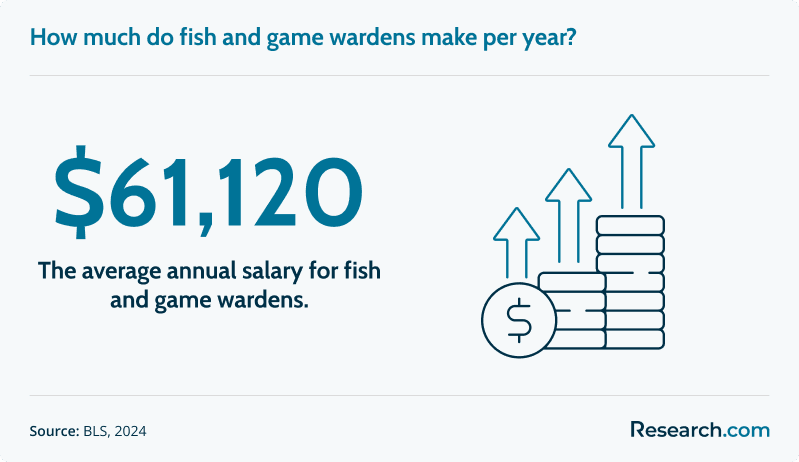
The BLS reports a mean annual wage of $61,120 for fish and game wardens. Actual pay can differ by state, agency, experience level, union or civil service rules, overtime opportunities, and whether the role is state or federal. Federal wildlife enforcement jobs may offer different pay structures than state positions.
The job outlook from 2023 to 2033 shows a projected 5% decline, so applicants should expect competition. That does not mean hiring stops entirely. Agencies still need to replace people who retire, transfer, or move into supervisory and specialized roles, and states with major coastlines, forests, deserts, parks, wetlands, or hunting and fishing activity may continue to post openings. As with other mission-driven public service fields, including addiction recovery careers, job stability and earnings depend heavily on employer funding, location, credentials, and experience.
For applicants who are primarily motivated by conservation, the salary should be weighed against the demands of shift work, remote response, law enforcement risk, and relocation possibilities. For applicants who are primarily motivated by income, comparing state pay tables before choosing where to apply is essential.
Is becoming a fish and game warden worth it?
This career can be worth it for people who want a sworn law enforcement role centered on wildlife, public lands, waterways, and conservation. It may not be the right fit for candidates who want predictable office hours, frequent backup, urban policing, or a career path with a rapidly expanding job market.
| It may be a good fit if you... | You may want another path if you... |
| Want law enforcement authority and outdoor fieldwork. | Prefer office-based environmental policy or research work. |
| Can handle remote patrols, physical demands, and unpredictable calls. | Need a highly predictable schedule or location. |
| Care about wildlife protection, boating safety, hunting and fishing laws, and public education. | Want a broader policing role focused mainly on urban or suburban crime response. |
| Are willing to relocate or apply across multiple agencies. | Plan to apply to only one agency in a highly competitive state. |
How do state requirements and hiring processes differ?
Game warden hiring is state-specific. One state may require a bachelor’s degree, while another may accept an associate degree plus relevant experience. One agency may run its own wildlife academy, while another may send recruits through a standard police academy before specialized conservation training. Applicants should never assume that requirements in one state apply everywhere.
Education rules are not identical
Some states accept associate-level education when combined with law enforcement, military, or natural resources experience. Others expect a bachelor’s degree in a related field. While criminal justice, wildlife management, and environmental science are the most direct choices, other majors can still build relevant skills if paired with the right experience. For example, a history degree online can strengthen research, writing, and document analysis, but candidates would likely need additional law enforcement or conservation preparation.
Testing and screening can be more demanding in some states
Most agencies use written testing, fitness screening, interviews, medical review, and background checks. Some also require psychological evaluations, polygraph exams, swim tests, or state-specific civil service procedures. Large states or highly desirable agencies may have more applicants, more testing stages, and longer hiring timelines.
Academy models vary
Some states train recruits in dedicated fish and game warden academies. Others require a general police academy first, followed by wildlife enforcement field training. Texas and Florida have dedicated fish and game warden academies, while states like New York and Washington integrate training into broader law enforcement programs.
| Requirement area | What may vary by state | Question to ask before applying |
| Education | Associate degree, bachelor’s degree, experience substitution, or specific major requirements. | Does this agency require a degree, and which majors qualify? |
| Residency | Some agencies may prefer or require state residency. | Must I live in the state before applying or only after being hired? |
| Physical standards | Fitness tests, swim tests, medical standards, and academy requirements. | What exact test events and passing scores are used? |
| Training model | General police academy, conservation academy, or a combination. | Where is training held, how long is it, and is housing provided? |
| Assignment location | New wardens may be placed where staffing needs are greatest. | Can I choose my region, or must I accept assignment anywhere in the state? |
What are the biggest challenges and risks of being a fish and game warden?
The job is meaningful, but it is not easy. Fish and game wardens may work alone, encounter armed people, respond at night, operate in severe weather, and make decisions in remote areas where help is not nearby. These realities are part of why candidates should research the role as carefully as they research compensation, including related conservation roles such as those discussed in this conservationist salary and career guide.
Encounters with armed suspects
Wardens often contact hunters, anglers, and suspected poachers who may legally or illegally possess firearms. Strong communication, tactical awareness, de-escalation, and officer safety training are essential.
Remote and unpredictable work conditions
Unlike many urban police roles, game wardens may patrol isolated forests, deserts, wetlands, coastlines, and waterways. Extreme heat, cold, storms, darkness, rugged terrain, and limited radio coverage can make routine calls more complicated.
Emergency response duties
Wardens may be dispatched to boating accidents, missing persons cases, wildlife conflicts, natural disasters, and injuries in outdoor recreation areas. These calls can be physically and emotionally demanding, especially when response times are long or conditions are hazardous.
Common mistakes aspiring fish and game wardens make
| Mistake | Why it can hurt your application | Better approach |
| Choosing a degree without checking agency rules. | The program may not meet minimum education requirements. | Review job postings and speak with agency recruiters before enrolling. |
| Focusing only on wildlife coursework. | The role is also a sworn law enforcement job. | Balance conservation classes with criminal justice, writing, and public safety preparation. |
| Waiting until the application opens to train physically. | Fitness tests and academy demands can eliminate otherwise qualified candidates. | Start conditioning months before applying. |
| Applying to only one state. | Openings are limited and hiring can be highly competitive. | Compare multiple agencies if relocation is realistic. |
| Ignoring background standards. | Driving history, criminal history, substance use, and honesty issues may disqualify applicants. | Read disqualification rules early and be truthful throughout the process. |
How do fish and game wardens integrate sustainability into their daily roles?
Sustainability is built into conservation enforcement. Wardens help protect habitats, prevent overharvesting, enforce seasons and limits, respond to pollution or habitat damage, and educate the public about responsible outdoor recreation. Their work supports long-term wildlife and fisheries management by making sure rules are followed in the field, not just written in policy documents. Professionals who want a broader view of environmental work can also compare related sustainability careers.
What are the career growth and advancement opportunities for fish and game wardens?
Advancement usually comes through experience, performance, additional training, leadership ability, and willingness to take specialized assignments. A conservation officer career guide can help candidates compare similar titles and understand how wildlife enforcement careers are structured.
Promotion through rank
Many state agencies use rank structures similar to other law enforcement organizations. A new warden may advance into supervisory, regional, or command roles over time.
- Senior Game Warden – Supports complex field operations and helps train less experienced officers.
- Lieutenant or Captain – Supervises regional enforcement teams, schedules, investigations, and operational priorities.
- Chief Warden – Leads statewide enforcement programs, policy implementation, staffing, and agency strategy.
Specialized assignments
Experienced wardens may qualify for units that require advanced training or a strong record in the field.
- K-9 Units – Use trained dogs for detection, tracking, evidence searches, or search-and-rescue support.
- Forensic Wildlife Investigation – Apply evidence collection and forensic methods to poaching, trafficking, and illegal take cases.
- Search and Rescue Teams – Focus on locating missing people, rescuing stranded boaters, and supporting disaster operations.
Movement into federal or related agencies
Some wardens later pursue federal, park, homeland security, or environmental enforcement roles. Potential employers can include:
- US Fish and Wildlife Service
- National Park Service
- Department of Homeland Security, particularly for roles connected to environmental or border-related enforcement
What role does affordable online environmental science education play in advancing a fish and game warden career?
Online environmental science education can help working wardens and aspiring applicants deepen their understanding of ecosystems, data collection, environmental regulation, sustainability, and resource management. It is most useful when it complements, rather than replaces, required law enforcement training. Candidates looking for cost-conscious academic options can compare programs such as the cheapest online environmental science degree while checking whether the program is accredited and relevant to agency requirements.
When an online environmental science degree makes sense
- You need flexibility because you are working, serving in the military, or preparing for a career change.
- You want stronger technical knowledge in ecology, environmental monitoring, conservation policy, or regulatory compliance.
- You already have law enforcement experience but need a degree to qualify for certain agencies or promotions.
- You plan to move later into environmental science, conservation planning, or agency leadership.
Questions to ask before enrolling
- Is the institution accredited by a recognized accrediting body?
- Does the curriculum include ecology, wildlife, environmental regulation, field methods, or GIS-related coursework?
- Will the credits transfer if I later pursue a bachelor’s or graduate degree?
- Does the program meet the education standards of the agencies where I want to apply?
- What is the full cost after fees, books, technology charges, and travel requirements, if any?
How does a fish and game warden’s job compare to other law enforcement careers?
Fish and game wardens, police officers, sheriffs, and state troopers all enforce laws and protect the public, but their settings, priorities, and daily calls are different. Wardens work at the intersection of conservation, outdoor recreation, wildlife protection, and public safety.
| Career | Main setting | Primary focus | Distinct challenges |
| Police officer | Urban, suburban, or municipal areas. | General law enforcement, crime response, traffic, and public safety. | High call volume, violent crime risk, traffic incidents, and community conflict. |
| State trooper | Highways, state roads, and statewide patrol areas. | Traffic enforcement, crash response, statewide law enforcement support. | Roadside danger, vehicle pursuits, long patrol areas, and emergency response. |
| Fish and game warden | Forests, lakes, rivers, coastlines, parks, deserts, wetlands, and public lands. | Wildlife laws, hunting and fishing rules, boating safety, conservation enforcement, and outdoor public safety. | Remote patrols, armed contacts, dangerous terrain, weather, wildlife, and delayed backup. |
The best fit depends on what kind of enforcement work you want. If you want general policing, a municipal or state police role may make more sense. If you want a specialized role combining law, science, and field investigation, fish and game enforcement may be a stronger match. Students interested in other science-heavy justice careers can also explore how to become a forensic anthropologist.
Where are the best cities and states to work as a fish and game warden?
The best location depends on what you value most: more positions, higher pay, preferred environment, cost of living, promotion potential, or willingness to relocate. The states below have the largest employment numbers for fish and game wardens.
| State | Employment | Annual Mean Wage |
| Florida | 700 | $31,010 |
| New York | 390 | $76,060 |
| Tennessee | 370 | $72,200 |
| California | 280 | $89,020 |
| Arizona | 260 | $48,260 |
Applicants who prioritize pay should compare salary by state as well as cost of living, overtime rules, pension systems, and assignment locations. The highest-paying states listed are:
| State | Annual Mean Wage | Employment |
| California | $89,020 | 280 |
| Minnesota | $88,280 | 140 |
| Washington | $82,320 | 100 |
| New York | $76,060 | 390 |
| North Dakota | $75,720 | 30 |
California and Minnesota show the highest annual mean wages in the data provided, while Florida has the highest employment level at 700. A high wage does not automatically mean the best opportunity for every applicant, and a state with more positions may still have lower average pay.
How can an affordable online degree in environmental engineering enhance enforcement and conservation strategies?
Environmental engineering coursework can be useful for wardens who want stronger technical knowledge in water quality, pollution control, infrastructure impacts, data analysis, and environmental monitoring. It is not the standard entry route for most game warden positions, but it can support specialized work involving habitat damage, contamination, restoration projects, or interagency environmental investigations. Professionals considering this technical direction can review options such as an affordable online degree in environmental engineering.
What should you ask current fish and game wardens before applying?
Before committing to this career, speak with working wardens, recruiters, or agency representatives. Ask practical questions that reveal the daily reality of the job, not just the mission statement.
- How often do new wardens work nights, weekends, holidays, or emergency callouts?
- Are new hires assigned statewide, or can they request a region?
- What parts of academy training are most difficult for recruits?
- How much time is spent on patrol, paperwork, court, education, and emergency response?
- What background issues most often disqualify applicants?
- What experience would make an applicant more competitive?
- How does the agency support mental health, peer support, and family life?
How do fish and game wardens utilize modern technology to enhance enforcement and conservation?
Modern wildlife enforcement increasingly relies on digital tools. Wardens and agencies may use GPS mapping, drones where authorized, remote cameras, mobile data systems, body-worn cameras, electronic reporting, and real-time communications to improve patrol planning, document evidence, and respond faster. Technology does not replace field judgment, but it can help officers identify patterns, monitor high-risk areas, and coordinate across agencies. Candidates who want more science-focused environmental work can also explore how to become an environmental scientist.
Technology trends affecting the role
- Better mapping and location tools help wardens plan patrols across large or difficult terrain.
- Digital evidence systems improve documentation for citations, arrests, and court cases.
- Remote monitoring can help agencies detect illegal activity or environmental changes in areas that are hard to patrol continuously.
- Data-informed enforcement can support smarter allocation of limited staffing and equipment.
How do fish and game wardens manage work-life balance and mental well-being?
Work-life balance can be difficult because wardens may work irregular hours, cover large patrol areas, respond to emergencies, and spend time in high-stress situations. The role can also involve isolation, traumatic incidents, dangerous contacts, and long periods away from family during peak hunting, fishing, boating, or disaster seasons.
Healthy coping strategies may include peer support, agency mental health resources, fitness routines, strong family communication, structured time off, and early help-seeking when stress accumulates. Continuing education can also create long-term flexibility. For example, someone who wants to move from field enforcement into planning or public administration could compare options such as an online degree in urban planning.
Practical ways to protect long-term well-being
- Ask agencies about shift schedules, on-call expectations, overtime, and seasonal workload before accepting an offer.
- Build physical conditioning habits before academy training and maintain them after field assignment.
- Use peer support, counseling, or employee assistance resources early rather than waiting for burnout.
- Talk with family or household members about relocation, holidays, callouts, and safety risks.
- Develop interests and friendships outside the job to reduce identity-based stress.
How do fish and game wardens stay updated on evolving wildlife policies and regulations?
Wildlife law changes as species needs, conservation priorities, court decisions, public land rules, and agency policies change. Wardens stay current through in-service training, legal updates, agency briefings, professional conferences, scientific publications, and coordination with prosecutors, biologists, and other enforcement partners. Advanced academic study can also help wardens who want to move into policy, research, or leadership; one option to compare is the best online environmental science masters programs.
How to prepare for changing regulations as a candidate
- Read current hunting, fishing, trapping, and boating regulations for the states where you may apply.
- Follow state wildlife agency announcements and commission meeting updates.
- Practice reading legal and policy language carefully, because small wording changes can affect enforcement.
- Build report-writing skills so you can explain facts, evidence, and legal reasoning clearly.
- Stay informed about conservation issues affecting your region, such as habitat loss, invasive species, water quality, and species recovery.
Key Insights
- Fish and game warden jobs are competitive because the occupation is small: the BLS reported 6,290 employed fish and game wardens as of May 2023.
- The usual path includes meeting state eligibility rules, earning a relevant degree, passing a law enforcement hiring process, completing academy training, and finishing field training.
- The BLS mean annual wage for fish and game wardens is $61,120, but pay varies substantially by state, agency, seniority, and funding.
- California has the highest annual mean wage listed at $89,020, while Florida has the highest employment level listed at 700.
- According to Zippia, 34% of game wardens major in criminal justice; wildlife management and environmental science are also common academic routes.
- The projected 5% decline from 2023 to 2033 means applicants should strengthen their competitiveness through relevant education, physical readiness, field experience, and flexibility about where they apply.
- This career is best suited for people who want both law enforcement authority and conservation work. It is less suitable for candidates seeking predictable schedules, office-based environmental work, or a fast-growing occupation.
References:
- BLS. (2024, April 3). Fish and game wardens. BLS.
- BLS. (2024, August 29). Police and detectives. BLS.
- Zippia. (2025, January 8). Best Colleges and Degrees for Game Wardens. Zippia.
- Zippa. (2025, January 8). Game Warden Demographics and Statistics [2025]: Number of game wardens in the US. Zippia.
- Zippia. (2025, January 8). Game Warden skills for your resume and career. Zippia.
Other Things You Should Know About Becoming a Fish and Game Warden
In 2027, aspiring fish and game wardens typically need a bachelor's degree in fields like wildlife management, environmental science, or criminal justice. Some states might have specific degree requirements, but relevant experience and a passion for conservation can enhance your application.
To apply as a fish and game warden in 2027, you must typically be a U.S. citizen and a resident of the state where you apply. Some states require at least six months of residency before applying, ensuring you are familiar with local wildlife and regulations.
Most agencies require a full criminal history check, fingerprinting, and a review of driving records before hiring a fish and game warden. Applicants may also undergo a polygraph, drug screening, and a psychological evaluation, with final clearance handled by the state wildlife agency or game commission.
To become a fish and game warden in 2027, candidates generally need to pass a physical fitness assessment. This may include endurance tests like running, swimming, and strength evaluations to ensure candidates are fit to perform duties related to wildlife law enforcement and field operations.


