2027 Easiest BSW Online Programs to Get Into

Co-Founder and Chief Data Scientist
Choosing an online Bachelor of Social Work program is not just about finding a school that will admit you. You also need a program that is accredited, affordable, realistic for your schedule, and able to place you in supervised fieldwork near where you live. For students who want a more accessible path into social work, the “easiest” online BSW programs are usually those with clear admissions requirements, transfer-friendly policies, flexible course delivery, and strong student support.
This guide explains what to expect from an online BSW, how online and campus-based programs differ, what costs and financial aid to review, and how to evaluate programs before enrolling. It is designed for first-time college students, transfer students, working adults, parents, and career changers who want a practical route into entry-level social work roles or future graduate study.
Quick Answer: What Are the Easiest Online BSW Programs to Get Into?
The easiest online BSW programs to get into are typically accredited programs with straightforward undergraduate admissions, flexible online course formats, transfer credit options, and no unnecessary barriers such as mandatory campus attendance or standardized test requirements. However, easy admission should never be the only deciding factor. For social work, CSWE accreditation, field placement support, state licensure alignment, total cost, and graduation requirements matter more than admission simplicity alone.
A good online BSW should help you build the academic foundation, ethical judgment, communication skills, and supervised practice experience needed for generalist social work. If you plan to pursue advanced standing in an MSW program later, choosing a CSWE-accredited BSW is especially important.
What are the benefits of getting an online degree in BSW?
- Career access in human services: A BSW can prepare graduates for roles such as case manager, social work assistant, child welfare advocate, and mental health support specialist. These jobs often involve helping individuals and families navigate poverty, addiction, housing instability, family conflict, and access to services.
- A pathway to graduate-level social work: Students who want clinical, school, healthcare, or supervisory social work roles often use the BSW as the first step toward a Master of Social Work. A strong undergraduate foundation can make the transition to an MSW more efficient, especially when advanced standing options are available.
- Flexible study for adults and remote learners: Online BSW programs can make social work education more accessible for students who work, care for family, live far from campus, or need a schedule that does not require daily commuting.
- Salary potential in a service-focused field: Graduates can pursue paid roles across social service agencies, nonprofits, schools, healthcare organizations, and government programs. According to the U.S. Bureau of Labor Statistics, the median annual wage for social workers is approximately $51,000, with higher earning potential possible in specialized areas or after earning an advanced degree.
What can I expect from an online BSW?
An online Bachelor of Social Work introduces students to social work values, human behavior, social welfare systems, policy, research, and direct practice skills. Although coursework is delivered remotely, reputable programs still require structured learning, regular assignments, faculty interaction, and supervised field education.
Most programs combine online classes with field placements arranged in approved agencies, often near the student’s local community. This matters because social work cannot be learned only through lectures. Students need supervised practice with real clients, organizations, policies, documentation systems, and ethical decision-making.
By graduation, students should understand generalist social work practice, including assessment, client engagement, advocacy, case planning, referral coordination, and professional ethics. A BSW can prepare graduates for entry-level social service work or continued study in an MSW program.
| What You Will Study | Why It Matters | What to Check Before Enrolling |
| Human behavior and development | Helps students understand how individuals and families function across life stages and social environments. | Look for courses that connect theory to practice examples. |
| Social welfare policy | Prepares students to understand how laws, benefits, and public systems affect clients. | Ask whether the curriculum covers current policy issues and advocacy skills. |
| Practice methods | Builds skills in interviewing, assessment, intervention planning, and documentation. | Review whether practice courses include simulations, role play, or supervised skill development. |
| Research methods | Teaches students how to evaluate programs, interpret evidence, and use data responsibly. | Check whether research is taught in an applied social work context. |
| Field education | Provides supervised experience in real social service settings. | Confirm how the school helps online students secure approved placements. |
Where can I work with an online BSW?
An online BSW can lead to work in settings that serve individuals, families, groups, and communities. Common employers include social service agencies, public schools, hospitals, community health organizations, mental health clinics, nonprofit organizations, child welfare agencies, public housing programs, and local or state government departments.
Graduates may also work in correctional facilities, substance abuse treatment centers, community outreach programs, domestic violence organizations, senior services, and family support agencies. Typical job titles include case manager, social work assistant, family support specialist, community outreach worker, mental health advocate, and client services coordinator.
How much can I make with an online BSW?
Earnings for online BSW graduates vary by state, employer, job title, experience, and whether the role requires licensure or graduate education. According to the U.S. Bureau of Labor Statistics, the median annual wage for social workers is approximately $51,000, although some entry-level roles such as social work assistant or case management positions may pay less.
Roles in healthcare, child and family services, and specialized agencies may offer higher wages, and some positions can exceed $60,000 per year. Earning an MSW, obtaining licensure, building field experience, or moving into supervisory and clinical roles can also improve long-term earning potential. Salary outcomes are not guaranteed, so students should review local labor market data before choosing a program.
- 2027 List of Easiest BSW Online Programs to Get Into
- How long does it take to complete an online BSW program?
- How does an online BSW compare to an on-campus program?
- What is the average cost of an online BSW program?
- What are the financial aid options for students enrolling in an online BSW program?
- What are the prerequisites for enrolling in an online BSW program?
- What courses are typically in an online BSW program?
- What types of specializations are available in online BSW programs?
- Should I Consider an Online MSW After My BSW?
- How can I assess the affordability and quality of an online BSW program?
- What distinguishes an online BSW from an online MSW?
- How can I further enhance my qualifications after completing an online BSW?
- Can additional certifications enhance your online BSW degree?
- How do you choose the best online BSW program?
- What are the licensure and certification options for online BSW graduates?
- What career paths are available for graduates of online BSW programs?
- What is the job market for graduates with an online BSW?
- Can an Online BSW Program Pave the Way for Doctoral Opportunities?
- How do student support services enhance your online BSW experience?
- Is Accreditation Critical for Your Online BSW Program?
- What challenges might you encounter in an online BSW program?
- What is the social worker vs psychologist difference?
- How can an online BSW accelerate advanced studies?
2027 List of Easiest BSW Online Programs to Get Into
How do we rank schools?
Selecting a BSW program affects your time, budget, field placement experience, and future eligibility for graduate study or licensure. Research.com ranks programs to help students compare options using a data-informed approach rather than relying only on advertising claims or name recognition.
This ranking uses a transparent methodology built from sources such as the Integrated Postsecondary Education Data System (IPEDS), Peterson's databases including the Distance Learning Licensed Data Set, and the College Scorecard database from the National Center for Education Statistics. These sources help compare programs across factors that matter to online learners, including institutional data, distance learning availability, and student outcomes.
| School | Credits | Cost per Credit | Program Length | Accreditation |
| Lewis-Clark State College | 120 credits | $375 for online tuition | Approximately 4 years for full-time students | Council on Social Work Education |
| Eastern Kentucky University | 120 credits | $421 | 4 years (full-time) | Council on Social Work Education |
| Western Kentucky University | 120 credits | $463 | Typically 4 years | Council on Social Work Education |
| National Louis University | 120 credits | $430 | 4 years full-time | Council on Social Work Education |
| East Central University | 124 credits | $289 | 4 years | Council on Social Work Education |
| Maryville University | 128 credits | $500 | Approximately 4 years | Council on Social Work Education |
| Northwestern State University of Louisiana | 120 credits | $375 | 4 years | Council on Social Work Education |
| Portland State University | 180 quarter credits | $393 | 4 years | Council on Social Work Education |
| Troy University | 120 credits | $388 | Typically 4 years | Council on Social Work Education |
| Fort Hays State University | 120 credits | $226 | 4 years full-time | Council on Social Work Education |
1. Lewis-Clark State College
Lewis-Clark State College offers an online Bachelor of Social Work program for students preparing for generalist social work practice or future graduate study. Established in 2015, the program combines asynchronous and synchronous online learning and places a strong emphasis on field education. Its rural-focused curriculum may appeal to students interested in serving smaller communities and underserved regions.
- Program Length: Approximately 4 years for full-time students.
- Tracks/Concentrations: No specific tracks mentioned.
- Cost per Credit: $375 for online tuition.
- Required Credits to Graduate: 120 credits.
- Accreditation: Council on Social Work Education
2. Eastern Kentucky University
Eastern Kentucky University provides an online Bachelor of Social Work for students interested in advocacy, community work, and social justice. Launched in 2017, the program is built for working adults and nontraditional learners. Coursework is delivered fully online with no campus requirement, and students can take specialized courses connected to areas such as child welfare and mental health services.
- Program Length: 4 years (full-time).
- Tracks/Concentrations: Generalist practice with a focus on rural communities.
- Cost per Credit: $421.
- Required Credits to Graduate: 120 credits.
- Accreditation: Council on Social Work Education
3. Western Kentucky University
Western Kentucky University offers an online BSW with a practical curriculum that includes virtual simulations and supervised field placements. Introduced in 2018, the program is designed for students who need to balance school with work, caregiving, or other responsibilities. Asynchronous courses provide scheduling flexibility, while electives allow students to explore areas such as substance abuse counseling or healthcare social work.
- Program Length: Typically 4 years.
- Tracks/Concentrations: Generalist social work.
- Cost per Credit: $463.
- Required Credits to Graduate: 120 credits
- Accreditation: Council on Social Work Education
4. National Louis University
National Louis University offers an online Bachelor of Social Work established in 2020 for students who want to support diverse client populations. The program is structured for career changers and students from underserved communities. Primarily asynchronous online coursework is paired with local field internships, and students may study topics connected to mental health and child welfare.
- Program Length: 4 years full-time.
- Tracks/Concentrations: Generalist social work practice.
- Cost per Credit: $430.
- Required Credits to Graduate: 120 credits.
- Accreditation: Council on Social Work Education
5. East Central University
East Central University provides an online BSW that began in 2016 and emphasizes service to rural and underserved populations. The program is suitable for working adults because it combines asynchronous coursework with scheduled virtual meetings. Students complete local fieldwork and can use electives to explore areas such as child welfare and gerontology.
- Program Length: 4 years
- Tracks/Concentrations: Emphasis on community and global perspectives
- Cost per Credit: $289
- Required Credits to Graduate: 124 credits
- Accreditation: Council on Social Work Education
6. Maryville University
Maryville University offers an online Bachelor of Social Work launched in 2019 for students who want to work in varied community settings. The program is fully online and uses flexible scheduling for working professionals. Students engage with video lectures, interactive assignments, and fieldwork, with areas of study that include healthcare social work and trauma-informed care.
- Program Length: Approximately 4 years.
- Tracks/Concentrations: Focus on social justice and advocacy.
- Cost per Credit: $500.
- Required Credits to Graduate: 128 credits
- Accreditation: Council on Social Work Education
7. Northwestern State University of Louisiana
Northwestern State University of Louisiana offers an online BSW that began in 2018 for students seeking broad preparation in social work. Asynchronous learning gives students more control over when they complete coursework. The curriculum includes specialized content in substance abuse and community development, along with field placements that connect online learning to practice settings.
- Program Length: 4 years
- Tracks/Concentrations: Generalist social work practice
- Cost per Credit: $375
- Required Credits to Graduate: 120 credits
- Accreditation: Council on Social Work Education
8. Portland State University
Portland State University offers an online Bachelor of Social Work established in 2016 for students interested in both urban and rural practice. The program serves nontraditional learners through a hybrid model that includes online classes and occasional in-person fieldwork seminars. Students may explore areas such as community leadership and child and family services.
- Program Length: 4 years
- Tracks/Concentrations: Advanced standing options for those with prior experience.
- Cost per Credit: $393.
- Required Credits to Graduate: 180 quarter credits.
- Accreditation: Council on Social Work Education
9. Troy University
Troy University offers an online Bachelor of Social Work launched in 2015 for students in rural areas and those managing work or family responsibilities. The program is delivered fully online through asynchronous courses and focuses on generalist social work practice. Electives may include military social work and crisis intervention.
- Program Length: Typically 4 years
- Tracks/Concentrations: Generalist practice
- Cost per Credit: $388
- Required Credits to Graduate: 120 credits
- Accreditation: Council on Social Work Education
10. Fort Hays State University
Fort Hays State University offers an online BSW that began in 2017 and is designed for students interested in rural and underserved communities. The fully online format supports working adults who need scheduling flexibility. Coursework covers areas such as family services and substance abuse, while local field placements give students supervised practice experience.
- Program Length: 4 years full-time
- Tracks/Concentrations: Generalist practice
- Cost per Credit: $226
- Required Credits to Graduate: 120 credits
- Accreditation: Council on Social Work Education
How long does it take to complete an online BSW program?
A full-time online Bachelor of Social Work usually takes four years to complete. The actual timeline depends on transfer credits, course load, term structure, field placement scheduling, and whether the student attends full time or part time.
- Transfer credits: Students with prior college coursework may shorten the time to graduation if the program accepts those credits toward degree requirements.
- Course intensity: Some students can move faster by taking heavier course loads or enrolling during summer terms, but this can be difficult while working or completing field hours.
- Part-time enrollment: Students who take fewer classes per term usually need more than four years, but the lighter pace may be more manageable.
- Field placement timing: Internships or practicum requirements may limit how quickly students can finish because placements must be approved, supervised, and completed over set time periods.
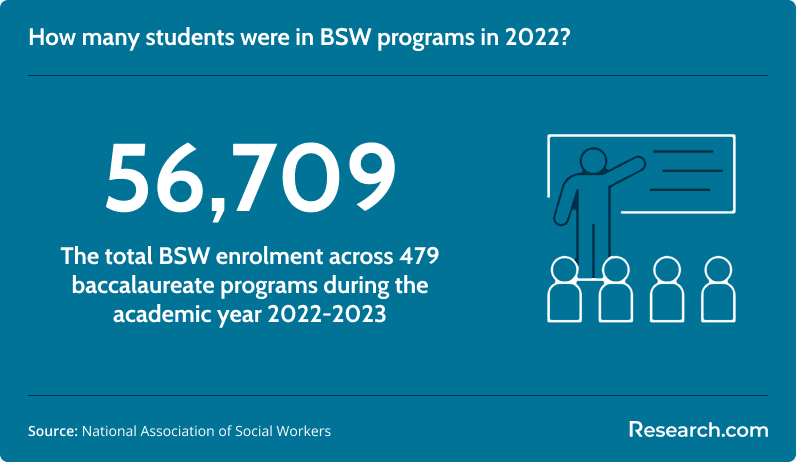
In the academic year 2022-2023, total BSW enrollment was 56,709 across 479 baccalaureate programs. Because field education is central to social work training, online students should ask early how placements are arranged and whether placement availability could affect graduation timing.
A BSW can also serve as a foundation for adjacent helping professions. Some graduates later pursue counseling-related graduate study, including master’s or doctoral programs. Students comparing long-term options may ask, “Is online PhD in counseling cheap?” The answer depends on the institution, location, aid package, delivery format, and total program requirements.
How does an online BSW compare to an on-campus program?
Online and campus-based BSW programs usually cover similar academic content and must meet comparable accreditation expectations when they are CSWE-accredited. Both formats generally require coursework in practice, policy, research, ethics, and field education. The main differences are how students attend class, interact with peers and faculty, and manage their weekly schedules.
Online programs are often better for students who need location flexibility or who cannot attend classes at fixed campus times. Campus programs may be a better fit for students who learn best through face-to-face discussion, want frequent in-person networking, or prefer a structured weekly classroom routine.
Among social work majors in 2022, 76.5% studied full-time while 19.8% were enrolled part-time. This shows that many students still follow a full-time path, but online delivery can make part-time study more feasible for learners with work and family responsibilities.
| Factor | Online BSW | On-Campus BSW |
| Best for | Working adults, rural students, caregivers, and learners who need schedule flexibility. | Students who want in-person classes, campus resources, and regular face-to-face interaction. |
| Class format | Often asynchronous, synchronous, or a blend of both through a learning platform. | Usually scheduled in classrooms at set times. |
| Field education | Typically completed in approved agencies near the student when possible. | Often arranged through campus partnerships in the surrounding region. |
| Peer interaction | Discussion boards, group projects, video meetings, and virtual advising. | Classroom discussion, campus events, study groups, and in-person faculty access. |
| Main challenge | Requires strong time management and comfort with online communication tools. | Requires commuting, fixed scheduling, and proximity to campus. |
What is the average cost of an online BSW program?
Online social work degrees can be among the more accessible undergraduate options, and students comparing costs may also review broader lists of cheap online degrees. Still, BSW program prices vary widely. A full online BSW may cost between $27,000 and $75,000 for the entire program.
The advertised tuition rate does not always show the real cost. Students should compare tuition, online fees, field placement expenses, books, technology needs, background check costs, graduation fees, and travel required for any in-person components.
| Cost Factor | Why It Changes the Price | Question to Ask |
| Public vs. private school | Public institutions often charge lower tuition than private colleges. | Is the listed rate different for online students? |
| Residency status | Some public universities charge out-of-state students more than in-state students. | Do online learners pay a flat rate or residency-based tuition? |
| Transfer credits | Accepted credits can reduce the number of courses you must pay for. | How many credits can I transfer into the BSW? |
| Program length | Accelerated study can reduce time in school but may increase short-term workload. | Will a faster pace affect my ability to complete fieldwork? |
| Fees and placement costs | Online platforms, background checks, insurance, and travel can add expenses. | What fees are not included in tuition? |
What are the financial aid options for students enrolling in an online BSW program?
Affordability matters because social work is a mission-driven field, but students should still avoid taking on more debt than necessary. Based on the Council on Social Work Education Data, the total median debt of social work graduate students in 2019 was $45,000. To manage costs, students can compare affordable online colleges, complete the FAFSA when eligible, and ask each school for a full aid estimate before enrolling.
Federal Aid
- Federal Pell Grant: Need-based grant aid for eligible undergraduate students with significant financial need.
- Federal Direct Loans: Federal student loans available to qualifying students, with borrowing limits and repayment obligations.
- Work-Study: Part-time employment that can help students pay education-related expenses when available through the school.
State Aid
- State grants and scholarships: Some states provide financial aid for residents, and certain programs may prioritize students entering high-need fields such as social work.
Institutional Aid
- Scholarships: Colleges may offer awards based on academic performance, financial need, transfer status, service background, or program-specific criteria.
- Tuition waivers or employer reimbursement: Some employers help workers pay for degree programs that relate to their current or future role.
Private Aid
- Private scholarships: Nonprofit organizations, foundations, professional associations, and community groups may offer scholarships for social work students.
What are the prerequisites for enrolling in an online BSW program?
Admission requirements vary by institution, but many online BSW programs are designed to be accessible to first-time undergraduate students and transfer students. Some states have an urgent need for social workers, but admission to a BSW program still depends on school policies and program capacity.
- High school diploma or GED: Most undergraduate programs require proof of secondary school completion or an equivalent credential.
- Minimum GPA: Many programs set a minimum GPA, commonly around a 2.5 or 3.0.
- Letters of recommendation: Programs may request references from teachers, supervisors, advisors, or others who can discuss your readiness for social work education.
- Personal statement or essay: Applicants may need to explain their interest in social work, career goals, relevant experience, and reasons for choosing online study.
- Background check: Some programs require screening before field education because agencies work with vulnerable populations.
What courses are typically in an online BSW program?
Online BSW programs usually combine general education, social work foundations, practice courses, policy analysis, research training, and field education. Students comparing college majors often look at workload, career fit, and long-term advancement. For example, learners comparing social work with business-related options may ask whether is human resources an easy degree, but the better question is which field matches their strengths, values, and career goals.
In 2021-2022, a total of 17,972 baccalaureate degrees were conferred. Online BSW coursework is designed to build the knowledge and applied skills students need for entry-level service roles and graduate study.
- Social Work Theory: Introduces frameworks such as systems theory, ecological theory, and psychodynamic theory that help explain client needs and social environments.
- Social Work Practice: Focuses on assessment, engagement, intervention, evaluation, documentation, and professional communication.
- Human Behavior in the Social Environment: Examines biological, psychological, cultural, family, community, and social factors that influence development across the lifespan.
- Social Welfare Policy: Studies the history and current structure of social programs, poverty policy, inequality, advocacy, and social justice issues.
- Research Methods: Teaches students how to interpret evidence, evaluate programs, and use data ethically in social work contexts.
- Field Education: Places students in supervised social work settings such as schools, hospitals, nonprofit agencies, community programs, and public service organizations.
Some students pair social work interests with related systems-based fields. For example, an easiest criminal justice degree may interest students who want to work at the intersection of rehabilitation, corrections, family services, and community safety.
What types of specializations are available in online BSW programs?
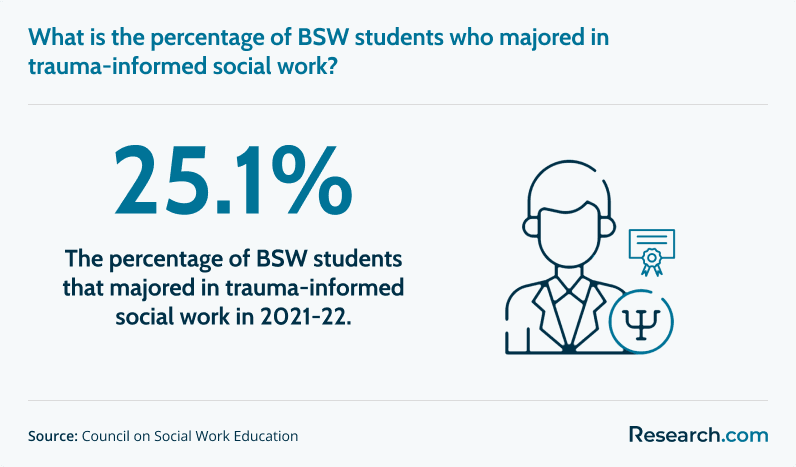
Most BSW programs are generalist by design, meaning they prepare students to work with individuals, families, groups, organizations, and communities. Some programs also offer electives, certificates, or informal focus areas. Trauma-informed social work had the largest total enrollment in 2021-22 at 25.1%.
- Child Welfare: Covers services for children and families, including safety, foster care, abuse, neglect, adoption, and family preservation.
- Gerontology: Focuses on older adults, aging services, elder abuse, long-term care, caregiver support, and end-of-life issues.
- Mental Health: Introduces services for people experiencing mental health conditions, including case management, support planning, and referral coordination.
- Substance Abuse: Examines addiction prevention, treatment systems, recovery support, and community resources. Students interested in this area may also compare an online addiction counseling degree.
- Criminal Justice: Connects social work with corrections, probation, parole, reentry programs, diversion, and rehabilitation services.
- Community Organizing: Prepares students for advocacy, grassroots organizing, policy work, community development, and social change efforts.
Not every online BSW offers formal specializations. If a school does not list concentrations, students can still build focused experience through electives, volunteer work, field placements, research projects, and post-degree certificates.
Should I Consider an Online MSW After My BSW?
An MSW can be a strong next step if you want advanced practice, clinical preparation, leadership roles, or specialized work in areas such as schools, healthcare, mental health, policy, or administration. A BSW introduces generalist practice, while an MSW expands training in evidence-based interventions, advanced assessment, supervision, program development, and research-informed practice. Students planning graduate study should compare CSWE accredited online MSW programs to ensure the program meets professional expectations.
How can I assess the affordability and quality of an online BSW program?
Do not judge affordability by tuition alone. A lower-cost program may become expensive if it has high fees, poor transfer policies, limited advising, or weak field placement support. A higher-cost program may offer better value if it provides strong academic support, efficient degree planning, and reliable placement coordination. Students seeking lower-cost options can compare the cheapest online social work degree programs while still checking accreditation and outcomes.
| Quality Factor | Why It Matters | Red Flag |
| CSWE accreditation | Supports academic credibility and may affect licensure or MSW advanced standing eligibility. | The school is vague about accreditation or lists only institutional accreditation for the BSW. |
| Field placement support | Online students need help finding approved local agencies and supervisors. | The program expects students to secure placements without meaningful guidance. |
| Transparent pricing | Students need to know the full cost before borrowing or committing. | Fees, placement costs, or residency tuition rules are unclear. |
| Student support | Advising, tutoring, technology help, and career services affect completion. | Support is limited to email only or is not designed for online learners. |
| Licensure alignment | Requirements vary by state and role. | The school promises licensure without explaining state-specific conditions. |
What distinguishes an online BSW from an online MSW?
An online BSW is an undergraduate degree that prepares students for entry-level generalist social work and related human service roles. An online MSW is a graduate degree designed for advanced practice, leadership, specialization, and in many cases preparation for clinical licensure pathways. Students who already know they want graduate-level practice should compare cheap online MSW programs after confirming that their BSW background supports admission or advanced standing.
| Category | Online BSW | Online MSW |
| Degree level | Undergraduate bachelor’s degree | Graduate master’s degree |
| Main purpose | Generalist foundation for entry-level social work and human services | Advanced practice, specialization, supervision, policy, or clinical preparation |
| Typical career stage | Students entering the field or changing careers | Students seeking higher responsibility, clinical pathways, or leadership |
| Field education | Introductory supervised practice | Advanced supervised practice with more specialized expectations |
| Best for | Students starting a social work career | Students who want to expand scope, credentials, and advancement options |
How can I further enhance my qualifications after completing an online BSW?
After earning an online BSW, graduates can strengthen their qualifications through work experience, licensure where applicable, specialized certificates, an MSW, or doctoral study. The right option depends on career goals. Students interested in research, teaching, senior leadership, or advanced program development may eventually compare an online doctorate in social work with practice-focused and research-focused alternatives.
Can additional certifications enhance your online BSW degree?
Additional certifications can help BSW graduates demonstrate focused skills, especially when they align with the populations or systems they want to serve. Options may involve child welfare, school services, behavioral health, substance abuse, case management, or behavior analysis. For example, students interested in behavioral interventions may review BCBA programs online, while remembering that certification pathways may require specific coursework, supervised experience, exams, or graduate-level study.
How do you choose the best online BSW program?
The best online BSW program is the one that fits your career goals, budget, location, schedule, and state requirements. A program that is easy to enter but weak in accreditation, fieldwork, or support can create problems later. Use the checklist below before applying.
- Verify accreditation: Confirm that the BSW is accredited by the Council on Social Work Education. General institutional accreditation matters too, and students comparing school types may review nationally accredited online schools, but social work programmatic accreditation is especially important.
- Review the curriculum: Make sure the program covers practice, policy, research, ethics, diversity, human behavior, and field education. If you have a specific interest, check whether electives or certificates support that area.
- Ask about fieldwork: Field education is not optional in reputable BSW preparation. Ask how placements are approved, who finds the site, whether evening or weekend options exist, and what happens if no local placement is available.
- Test the online platform: Look for clear course navigation, reliable technology, accessible faculty, and responsive technical support.
- Compare flexibility carefully: “Online” does not always mean self-paced. Some courses may require live attendance, group meetings, or scheduled field hours.
- Calculate total cost: Include tuition, fees, books, technology, background checks, travel, and lost work hours during field placement.
- Check career and licensure guidance: The school should explain how the degree supports entry-level employment and what additional steps may be required for licensure or advanced practice.
Common mistakes to avoid when choosing an online BSW
| Mistake | Why It Can Hurt You | Better Approach |
| Choosing only because admission looks easy | Low barriers do not guarantee program quality, support, or career preparation. | Prioritize accreditation, field placement structure, and student outcomes. |
| Ignoring CSWE accreditation | Non-accredited programs may limit MSW advanced standing or licensure-related options. | Confirm accreditation directly before applying. |
| Looking only at tuition | Fees, travel, books, and placement expenses can change the total price. | Request a full cost estimate from the school. |
| Assuming online means fully flexible | Some programs include live sessions, strict deadlines, and daytime fieldwork. | Ask for a sample schedule and field placement timeline. |
| Relying only on rankings | A highly ranked program may not fit your state, budget, or schedule. | Use rankings as a starting point, then compare fit and requirements. |
| Forgetting state requirements | Social work licensure rules vary by state and role. | Contact your state board or licensing authority before enrolling. |
What are the licensure and certification options for online BSW graduates?
Licensure and certification rules for BSW graduates depend on the state and job function. Some states offer bachelor’s-level social work licenses, while others reserve licensure for MSW-level or clinical practice. Requirements may include an accredited degree, supervised experience, exams, background checks, continuing education, and application fees.
Students considering clinical social work should understand the difference between a degree and a license. An MSW is an academic credential; an LCSW is a state-regulated license that usually requires graduate education, supervised clinical hours, and an exam. Comparing MSW vs LCSW pathways can help students plan the sequence from undergraduate study to advanced practice.
What career paths are available for graduates of online BSW programs?
If you are asking, What careers can I get with a social work degree?, the answer depends on your state, employer, field placement experience, and whether the role requires licensure or graduate study. Many BSW graduates begin in direct service roles, while others move toward program coordination, advocacy, policy, or graduate education.
Some roles require an MSW or additional credentials. Students who want to move more quickly into graduate preparation may compare accelerated MSW programs after completing a qualified BSW.
Direct Practice
- Case Manager: Coordinates services, referrals, benefits, and care plans for individuals or families.
- Child Welfare Social Worker: Supports children and families involved in protection, placement, reunification, or family services. Among baccalaureate students in 2022-23, 11.9% completed child welfare certificate programs.
- School Social Worker: Helps students and families address attendance, behavior, mental health, family stress, and access to community support.
- Medical Social Worker: Assists patients and families with care coordination, discharge planning, resources, and healthcare system navigation.
- Mental Health Social Worker: Supports individuals with mental health needs through case management, referrals, crisis support, and service coordination.
- Substance Abuse Counselor: Works with people affected by addiction, recovery needs, relapse prevention, and treatment planning.
Administration and Policy
- Program Coordinator: Manages service delivery, schedules, client records, outreach, or operations within a social service program.
- Policy Analyst: Studies social policies, program rules, and community needs to inform recommendations.
- Grant Writer: Develops proposals and funding requests for social programs and nonprofit initiatives.
- Program Evaluator: Reviews whether social programs are achieving their intended outcomes.
Advocacy and Community Organizing
- Community Organizer: Helps residents, organizations, and stakeholders work together on local social issues.
- Advocacy Specialist: Supports policy, awareness, and systems change for vulnerable or underserved populations.
What is the job market for graduates with an online BSW?
The job market for BSW graduates is shaped by demand for social services, mental health support, child and family services, aging-related care, substance abuse treatment, housing assistance, and community-based programs. The outlook can be favorable, but opportunities differ by region, specialization, employer funding, and licensure requirements.
- Aging population: Older adults may need support with healthcare, long-term care, benefits, caregiver stress, and social isolation.
- Mental health awareness: More attention to mental health needs can increase demand for support workers, case managers, and social service professionals.
- Economic and social challenges: Poverty, homelessness, addiction, family instability, and inequality continue to create demand for community and human service roles.
- Multiple employment settings: BSW graduates can pursue work in nonprofits, schools, hospitals, agencies, residential programs, correctional systems, and public service organizations.
Competition can still be strong for desirable roles, especially in areas with many graduates or limited agency funding. The Bureau of Labor Statistics reports strong demand for social workers, but students should review local job postings and state requirements before choosing a specialization.
Can an Online BSW Program Pave the Way for Doctoral Opportunities?
An online BSW can be the first academic step toward doctoral study, but it is not usually the final credential needed for admission to advanced doctoral programs. Many students complete an MSW or another relevant graduate degree before pursuing research, teaching, high-level practice, or doctoral-level clinical pathways. Students considering psychology-oriented doctoral study should compare program expectations carefully, including field requirements, accreditation, and licensure alignment. For clinical psychology options, reviewing online APA-accredited PsyD programs can help clarify how psychology doctoral paths differ from social work doctoral paths.
How do student support services enhance your online BSW experience?
Support services can determine whether an online BSW feels manageable or isolating. Strong programs provide academic advising, technology help, writing support, tutoring, library access, career services, disability accommodations, and field placement coordination. Online learners should also look for faculty access, peer networking, virtual office hours, and clear communication about deadlines.
Students who later want to move into workplace behavior, leadership, or organizational systems may explore graduate options such as an affordable online organizational psychology masters program, but they should first make sure their BSW program provides the support needed to complete the bachelor’s degree successfully.
Is Accreditation Critical for Your Online BSW Program?
Yes. Accreditation is one of the most important factors when choosing an online BSW. CSWE accreditation indicates that the program has been reviewed against social work education standards and includes required academic and field components. It can also affect eligibility for MSW advanced standing, employer recognition, and licensure-related pathways depending on state rules.
Students should verify accreditation through official sources rather than relying only on marketing language. This is especially important for those planning to enter graduate study, including MSW online programs, where the quality and accreditation status of the BSW may influence admissions options.
What challenges might you encounter in an online BSW program?
Online BSW programs are flexible, but they are not effortless. Students must manage deadlines, participate in online discussions, complete readings, coordinate field placements, and communicate professionally through digital tools. The biggest challenge for many online learners is balancing coursework with work, caregiving, and required field hours.
- Time management: Online courses require consistent weekly effort, even when lectures are asynchronous.
- Field placement logistics: Students may need daytime availability, transportation, background checks, and agency approval.
- Emotional demands: Social work courses and placements can involve trauma, poverty, family conflict, crisis, and ethical dilemmas.
- Technology requirements: Reliable internet, video conferencing access, and comfort with learning platforms are essential.
- Licensure uncertainty: Students must confirm whether their program supports the requirements in the state where they plan to work.
For students targeting school-based roles, additional credentials or state-specific requirements may apply. Reviewing guidance on school social worker certification can help clarify the steps beyond the BSW.
What is the social worker vs psychologist difference?
Social workers and psychologists can both support people facing mental health, family, behavioral, or social challenges, but their training and professional focus are different. Social work emphasizes client advocacy, case management, resource connection, social systems, policy, and community-based intervention. Psychology places more emphasis on assessment, diagnosis, psychological testing, therapy models, and behavioral research, depending on the role and credentials.
Students deciding between these paths should compare scope of practice, graduate education requirements, licensure rules, and day-to-day work settings. A detailed comparison of the social worker vs psychologist difference can help clarify which profession better matches your goals.
How can an online BSW accelerate advanced studies?
A strong online BSW can make graduate study more efficient by giving students a foundation in social work theory, ethics, practice skills, policy, research, and field education. Students who complete a CSWE-accredited BSW may be better positioned for MSW programs, including advanced standing pathways where available.
Some BSW graduates also consider adjacent graduate paths in counseling, psychology, public administration, nonprofit leadership, or behavioral health. Students interested in clinical or research-oriented psychology may compare options such as an affordable online masters in clinical psychology, while keeping in mind that psychology and social work lead to different licensure and career pathways.
Key Insights
- The easiest online BSW program to get into is not automatically the best choice. Prioritize CSWE accreditation, field placement support, state alignment, total cost, and student services.
- In 2021-2022, a total of 17,972 baccalaureate degrees were conferred, showing that BSW education remains a major pathway into social work and human services.
- Trauma-informed social work had the largest total enrollment in 2021-22 at 25.1%, reflecting strong student interest in practice that responds to trauma and client safety.
- Based on the Council on Social Work Education Data, the total median debt of social work graduate students in 2019 was $45,000, so students should compare aid packages and avoid borrowing more than necessary.
- Among baccalaureate students in 2022-23, 11.9% completed child welfare certificate programs, making child and family services a common area of focused preparation.
- In the academic year 2022-2023, the total BSW enrollment was 56,709 across 479 baccalaureate programs.
- Among social work majors in 2022, 76.5% studied full-time while 19.8% were enrolled part-time, so students should choose a pace that realistically fits their work and field placement obligations.
- $58,380 is the 2023 median pay of social workers based on Bureau of Labor Statistics Data, but salaries vary by role, state, employer, experience, and licensure level.
Here’s What Graduates Have to Say About Their Online BSW Programs
-
: "
My online BSW gave me enough flexibility to keep working and stay present for my family. I could access lectures and assignments on my schedule, but I still felt connected through faculty feedback and class discussions. Alex
"
-
: "
The online format helped me learn from home without giving up structure. Videos, readings, discussion boards, and interactive tools made the material easier to apply to real social work situations. Emily
"
-
: "
I was unsure whether an online degree would feel rigorous enough, but the program challenged me academically and prepared me for fieldwork. It let me move toward a social work career without putting the rest of my life on hold. Noah
"
References:
- Bureau of Labor Statistics. (n.d.). Projected employment growth for community and social service occupations.
- Bureau of Labor Statistics. (n.d.). Social workers: Occupational outlook handbook.
- Council on Social Work Education. (2021). Spring 2021 pulse survey.
- Council on Social Work Education. (2022). 2022–2023 summary of the U.S. annual survey of social work programs.
- National Association of Social Workers. (2024). Social work salaries.
Other Things You Should Know About the Easiest BSW Online Programs to Get Into
Yes. The easiest BSW online programs should be accredited by the Council on Social Work Education, or CSWE, because that accreditation is required for most state licensure paths and for later MSW admission. Programs without CSWE accreditation usually do not meet professional social work standards.
The easiest BSW online programs in 2027 typically require a high school diploma or GED, a minimum GPA of 2.0, and completion of an application form. Some programs may also request a personal statement or letters of recommendation for admission.
In 2027, programs like Walden University, Liberty University, and Capella University are known for high acceptance rates among online BSW degrees. These universities often evaluate candidates based on a holistic review, focusing on past academic performance and personal achievements rather than standardized test scores.