
2027 How To Become a Deputy Sheriff

Co-Founder and Chief Data Scientist
Becoming a deputy sheriff is not a single-application career move. You have to meet eligibility rules, pass several screenings, complete law enforcement training, and prove that you can handle the physical, legal, and emotional demands of county policing. The process can feel confusing because sheriff’s offices set their own hiring timelines, fitness standards, academy requirements, and disqualification rules.
This guide explains how to become a deputy sheriff for 2027, including the usual education options, academy and field training steps, physical fitness expectations, hiring competitiveness, salary factors, advancement routes, and long-term career challenges. It is written for applicants comparing law enforcement careers, students considering criminal justice programs, military veterans planning a transition, and working adults deciding whether this path is worth the time and preparation.
Quick Answer: How Do You Become a Deputy Sheriff?
To become a deputy sheriff, you generally need to meet minimum age and citizenship requirements, hold a high school diploma or GED, have a valid driver’s license, pass a written exam, complete a physical ability test, clear a detailed background investigation, graduate from a law enforcement academy, finish field training, and take the oath of office. A college degree is not always required, but criminal justice education, military experience, prior public safety work, and specialized certifications can make an applicant more competitive.
- Main path: Apply to a sheriff’s office, pass screening, complete academy training, and finish supervised field training.
- Typical time commitment: The process can take one to five years depending on whether you complete college first and how long the hiring cycle takes.
- Fitness expectations: Applicants are commonly tested on running, sprinting, push-ups, sit-ups, obstacle navigation, and rescue-style dummy drags.
- Key job skills: Patrol judgment, public safety response, inmate transport, report writing, de-escalation, legal procedure, and defensive tactics matter most.
- Hiring reality: The process is selective. 70% of local police, federal police, and sheriff's offices report that recruitment has become more difficult in recent years, but individual openings can still draw strong applicant pools.
- What steps do you need to follow to become a deputy sheriff for 2027?
- How much time does it take to qualify as a deputy sheriff?
- What fitness tests do deputy sheriff applicants usually face?
- Which skills help deputy sheriffs perform well?
- How selective is deputy sheriff hiring?
- What does a deputy sheriff actually do each day?
- How much do deputy sheriffs earn for 2027?
- What mental health support exists for deputy sheriffs?
- Where can a deputy sheriff advance after patrol?
- What legal and ethical standards must deputy sheriffs follow?
- How does forensic training help deputy sheriffs investigate cases?
- What are the hardest parts of deputy sheriff work?
- Can deputy sheriffs move into federal law enforcement?
- How does ongoing training improve legal and ethical compliance?
- How is the deputy sheriff role likely to evolve?
- Why is community engagement important in sheriff’s work?
- Which academic programs can strengthen investigative skills?
What are the steps to becoming a deputy sheriff for 2027?
The deputy sheriff path usually moves from eligibility screening to testing, academy training, field training, and appointment. Requirements differ by county and state, so applicants should always confirm the standards listed by the specific sheriff’s office where they plan to apply.
- Confirm that you meet the minimum qualifications: Most agencies require applicants to be at least 18 or 21 years old, hold a high school diploma or GED, be a US citizen, carry a valid driver’s license, and pass a criminal history review. Some departments also review driving records, financial responsibility, employment history, and personal references.
- Decide whether college strengthens your application: A degree is not always mandatory, but coursework in criminal justice, psychology, public administration, forensic science, or emergency management can help you understand policing systems and compete for promotion later. Working adults often consider a flexible online criminal justice degree when they need to study while maintaining employment.
- Prepare for the written entrance exam: The written test may evaluate reading comprehension, reasoning, memory, report-writing judgment, situational awareness, and basic law enforcement concepts. Practice exams can help you identify weak areas before test day.
- Pass the physical ability test: Sheriff’s departments commonly measure stamina, strength, agility, and task-based movement. Train before you apply rather than waiting until you receive a test date.
- Complete interviews and background screening: Candidates may go through oral boards, command interviews, background investigations, medical exams, psychological evaluations, and drug testing. Honesty matters. Inconsistencies can be more damaging than an issue that was disclosed accurately.
- Graduate from the law enforcement academy: Recruits study criminal law, constitutional procedure, firearms safety, defensive tactics, emergency driving, patrol operations, ethics, report writing, arrest procedures, and crisis response.
- Finish field training: After academy graduation, new deputies typically work with experienced field training officers. This stage tests whether you can apply classroom learning in real calls, jail assignments, court settings, traffic stops, and community interactions.
- Take the oath and begin assigned duties: Once training is complete, deputies are sworn in and assigned to roles such as patrol, corrections, court security, inmate transport, or civil process service.
| Path option | When it makes sense | Trade-off to consider |
| Apply after high school or GED | Best for applicants who already meet the minimum requirements and want the fastest entry route. | You may have less academic preparation than candidates with college coursework or military experience. |
| Earn an associate or bachelor’s degree first | Useful if you want stronger long-term promotion potential or are not yet old enough to apply. | It adds time and cost before you begin earning as a deputy. |
| Build experience in public safety first | Helpful for applicants coming from corrections, dispatch, EMS, security, or the military. | Related experience does not guarantee selection, and you still must pass every hiring stage. |
| Use education while working | Practical for adult learners who need income while preparing for law enforcement. | You must verify accreditation, transfer policies, and scheduling flexibility before enrolling. |
How long does it take to become a deputy sheriff?
The shortest route can take about a year if you already satisfy the basic eligibility rules and are hired quickly. Applicants who complete college before applying may spend up to five years preparing. Those who need flexible scheduling sometimes compare accredited self-paced online colleges to reduce scheduling conflicts while they work, train, or serve in related roles.
| Stage | Estimated time | What happens during this stage |
| Eligibility preparation | 0–1 year | You meet age, citizenship, driver’s license, education, and background standards before applying. |
| Optional college education | 0–4 years | An associate degree generally takes two years, while a bachelor’s degree generally takes four years. |
| Hiring process | 1–6 months | You complete written testing, physical testing, interviews, records checks, medical review, and psychological screening. |
| Law enforcement academy | 3–6 months | You complete formal instruction in legal, tactical, operational, and physical training areas. |
| Field training | 3–6 months | You work under supervision before being cleared for independent duties. |
The biggest timing variable is the hiring process. Some departments move quickly when they have funded vacancies, while others schedule testing and academy seats around county budgets, state training calendars, and background investigator availability.
What physical fitness standards do deputy sheriffs have to meet?
Deputy sheriffs must be physically capable of controlling unsafe scenes, pursuing suspects, moving quickly under stress, wearing duty gear, and helping injured people. Fitness requirements vary by agency, but many sheriff’s offices use tests similar to the physical demands of law enforcement used across public safety hiring.
| Fitness area | Common test format | Why it matters on the job |
| Cardiovascular endurance | A timed 1.5-mile run, often with passing times in the 12 to 15 minutes range. | Deputies may need sustained stamina during foot pursuits, searches, crowd control, or long emergency scenes. |
| Sprint ability | A short run, often 300 meters. | Explosive speed can matter during sudden pursuits or rapid response situations. |
| Upper-body strength | Push-ups completed within one minute, often between 20 and 30. | Strength helps with defensive tactics, suspect control, and equipment handling. |
| Core endurance | Sit-ups completed within one minute, commonly 25 to 40. | Core strength supports balance, injury prevention, and physical control techniques. |
| Agility | Obstacle courses with barriers, stairs, turns, or simulated field tasks. | Deputies must move safely through unpredictable environments. |
| Rescue strength | Dragging a 150–180-pound dummy for a set distance. | This simulates removing an injured or unconscious person from danger. |
Do not treat the fitness test as a one-time hurdle. A deputy sheriff’s physical condition affects safety, confidence, stress tolerance, and long-term career durability. The safest approach is to build a training plan before applying, with running, strength work, mobility training, and recovery built into the week.
What skills do you need to be a successful deputy sheriff?
Deputy sheriffs need a mix of judgment, communication, legal knowledge, physical readiness, and emotional control. According to 2025 data from Zippia, 24.67% of deputies developed skills in patrol, 6.92% in public safety, and 5.98% in transporting inmates. Those skill areas reflect how much of the job centers on visible community presence, emergency response, and safe custody operations.
- Patrol awareness: Deputies must read environments quickly, identify suspicious behavior, respond to calls, and make lawful decisions with incomplete information.
- Public safety response: The role can involve accidents, domestic violence calls, missing persons, natural disasters, medical emergencies, and threats to life or property.
- Inmate transport and custody control: Deputies assigned to jails, courts, or transport units must maintain security while protecting the rights and safety of people in custody.
- Communication and de-escalation: Clear instructions, calm body language, active listening, and cultural awareness can prevent situations from becoming more dangerous.
- Defensive tactics and firearms competence: Deputies need disciplined weapons handling, safe force decision-making, and confidence in close-contact defensive skills.
- Legal procedure and documentation: Reports, evidence handling, arrests, searches, citations, and court testimony must follow legal standards. Weak documentation can damage a case.
- Ethical judgment: Deputies exercise government authority. Integrity, fairness, restraint, and accountability are not optional traits; they are core job requirements.
Specialized training can help candidates and working deputies build these abilities. Depending on department needs, valuable options may include crisis intervention, emergency vehicle operations, advanced firearms, field training officer preparation, interview techniques, or evidence handling. Some professionals also compare career-focused certifications that can improve earning potential when planning advancement.
The chart below shows the top specific skills for deputy sheriffs identified by Zippia in 2025.
How competitive is the hiring process for deputy sheriffs?
Deputy sheriff hiring is competitive because agencies must screen for judgment, integrity, physical ability, emotional stability, and legal suitability. The BLS projects 4% job growth for police and sheriff’s patrol officers from 2023 to 2033, which points to stable demand rather than rapid expansion. At the same time, departments may face recruitment difficulties while still rejecting applicants who do not meet standards.
- Applicant volume can be high: A county may receive many applications for a small hiring class, especially if the agency offers strong benefits, retirement options, or specialized units.
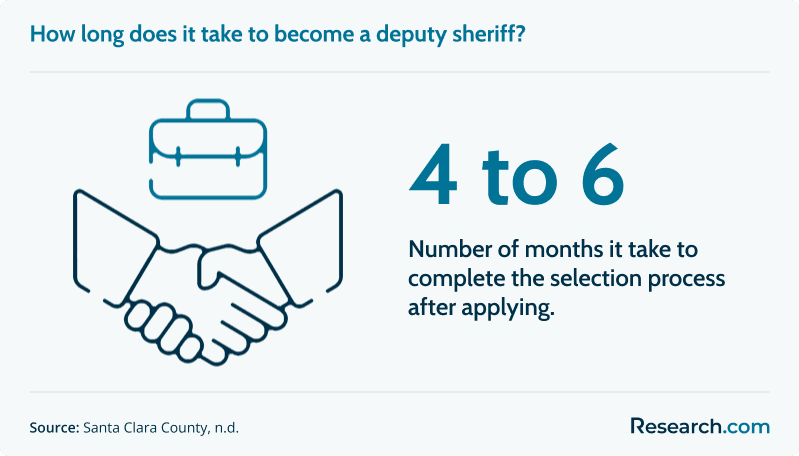
- The screening process is lengthy: Selection often takes four to six months because agencies must complete exams, interviews, background checks, and evaluations.
- Background standards are strict: Criminal conduct, dishonesty, poor driving history, serious financial problems, or past workplace misconduct may remove a candidate from consideration.
- Medical and psychological reviews matter: Departments need to confirm that candidates can handle the physical and mental demands of law enforcement work.
- Experienced applicants may have an advantage: Prior military service, corrections work, dispatch experience, security work, or another law enforcement role can make a resume stronger.
Applicants who are still comparing enforcement-related careers may also review the career outlook for bounty hunters to understand how different public safety and legal-support roles compare.
| Common applicant mistake | Better approach |
| Applying before reading the department’s disqualification rules. | Review hiring standards before spending time and money on testing. |
| Training only after receiving a physical test date. | Start conditioning months before the application window opens. |
| Assuming a college degree replaces academy training. | Use education to strengthen your application, but expect to complete required law enforcement training. |
| Minimizing past mistakes during the background investigation. | Be accurate, consistent, and transparent when asked about employment, finances, driving, or conduct history. |
| Choosing a school based only on tuition. | Check accreditation, transfer credit rules, scheduling options, and relevance to law enforcement goals. |
What does a deputy sheriff do daily?
A deputy sheriff’s day depends heavily on assignment. Some deputies patrol county roads and neighborhoods, while others work in jails, courthouses, civil process, inmate transport, investigations, school resource roles, or specialized units. Court-related assignments often overlap with judicial operations described in a court clerk career guide.
- Patrol assigned areas: Deputies monitor communities, rural roads, businesses, schools, and public spaces to deter crime and respond quickly when calls come in.
- Respond to service calls: Calls may involve domestic disputes, burglaries, traffic crashes, welfare checks, alarms, disturbances, or violent incidents.
- Make arrests when legally justified: Deputies may detain suspects, explain rights when required, search within legal limits, and transport individuals to jail.
- Enforce traffic laws: Traffic duties can include citations, DUI investigations, crash response, road closures, and assistance to stranded motorists.
- Serve court and civil documents: Deputies may deliver summonses, subpoenas, eviction notices, protection orders, and other legal paperwork.
- Transport inmates securely: Transport assignments require constant awareness when moving people between detention facilities, courts, hospitals, or other approved locations.
- Support investigations: Depending on training and assignment, deputies may preserve scenes, gather evidence, interview witnesses, and assist detectives.
- Provide courtroom security: Court deputies protect judges, attorneys, jurors, defendants, witnesses, staff, and members of the public.
The job mixes routine tasks with unpredictable emergencies. A quiet shift can change in seconds, so deputies need patience, situational awareness, and the ability to move from service-oriented communication to emergency action when needed.
What is the average salary of a deputy sheriff for 2027?
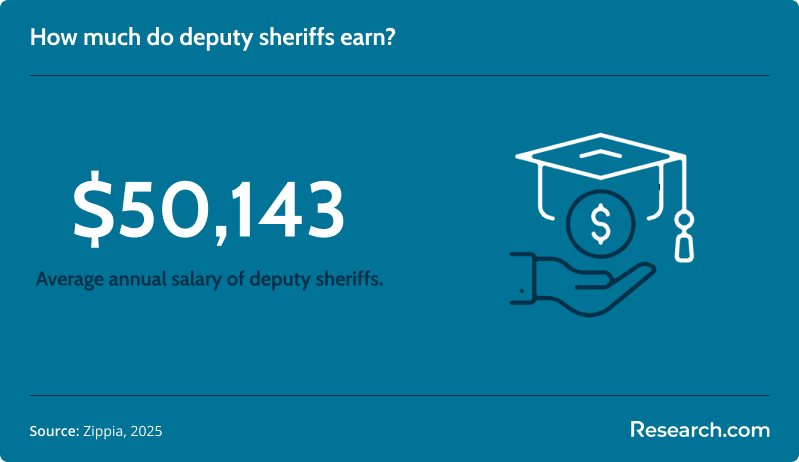
According to Zippia, the average deputy sheriff salary in 2025 is $50,143 per year. Zippia also reports that salaries have increased by 10% in the last five years. Actual pay can differ widely because county budgets, union agreements, overtime rules, cost of living, seniority systems, and specialized assignments vary by location.
| Salary factor | How it can affect earnings |
| Location | Large metropolitan areas and higher-cost regions often pay more than smaller or rural counties. |
| Experience | Entry-level deputies usually start lower on the pay scale and move up with time in service. |
| Education and credentials | Degrees, academy performance, instructor credentials, or specialized training may support promotion or specialty assignments. |
| Overtime and shift pay | Extra shifts, holidays, nights, court time, and emergency deployments can increase annual income. |
| Rank and assignment | Supervisors, detectives, SWAT members, K9 handlers, and senior deputies may earn more than standard patrol deputies. |
Salary should not be the only financial factor you review. Benefits, retirement plans, health insurance, tuition assistance, overtime expectations, commute costs, and pension vesting rules can change the value of an offer. If you are considering related legal careers outside sworn law enforcement, a criminal law paralegal career guide can help you compare legal-sector work with different risk levels and education requirements.
What mental health resources are available for deputy sheriffs?
Deputy sheriffs are exposed to trauma, conflict, injury, death, public criticism, rotating shifts, and high-pressure decision-making. Because of this, many agencies use mental health supports such as confidential counseling, employee assistance programs, peer support teams, chaplain services, critical incident debriefings, wellness checks, and resilience training.
Applicants should ask about these resources before accepting a position. A department’s wellness culture can affect retention, family life, job satisfaction, and long-term health. Compensation matters, but it should be considered alongside workload, staffing levels, support systems, and career risk. For broader context on pay across the field, compare related roles in this overview of higher-paying criminal justice careers.
What are the career advancement opportunities for deputy sheriffs?
Deputy sheriffs can move into supervisory, investigative, tactical, administrative, training, and leadership roles. Advancement usually depends on experience, performance evaluations, written promotional exams, interviews, education, disciplinary history, and department vacancies.
- Corporal or sergeant: These front-line supervisors guide deputies, review reports, manage scenes, and help run daily operations.
- Detective or investigator: Deputies assigned to investigations work cases more deeply, interview victims and witnesses, coordinate evidence, and prepare files for prosecution.
- Lieutenant or captain: Higher-ranking officers may oversee divisions, budgets, training, policy implementation, personnel decisions, and strategic planning.
- SWAT or K9 unit: Specialized assignments require advanced screening and training but can offer challenging tactical or detection-focused work.
- Sheriff: In many jurisdictions, the sheriff is an elected official who leads the county law enforcement agency.
- Federal law enforcement: Some deputies later pursue agencies such as the FBI, DEA, or U.S. Marshals, especially if they build investigative, firearms, task force, or leadership experience.
Education can matter more as deputies compete for leadership positions. Many working law enforcement professionals look for programs that fit shift schedules, such as the best online degree programs for working adults, while continuing to gain field experience.
The chart below summarizes the most common degree levels for deputy sheriffs reported by Zippia in 2025.
What are the legal and ethical responsibilities of deputy sheriffs?
Deputy sheriffs operate under constitutional limits, state law, county policy, court rulings, and department procedures. Their decisions can affect a person’s liberty, safety, property, reputation, and access to due process. That makes legal compliance and ethical conduct central to the job.
- Lawful arrests and searches: Deputies must understand probable cause, reasonable suspicion, warrants, consent, and exceptions recognized by law.
- Appropriate use of force: Force decisions must follow legal standards, department policy, training, and the facts known at the time.
- Evidence integrity: Mishandled evidence can weaken or destroy a case, so documentation and chain of custody are critical.
- Neutral enforcement: Deputies must avoid bias, favoritism, retaliation, and selective enforcement.
- Accurate reporting: Reports should be factual, complete, timely, and free from exaggeration or omission.
- Accountability: Deputies may face internal discipline, civil liability, criminal investigation, or loss of certification for serious misconduct.
Formal education can help deputies understand criminal law, courts, corrections, policing ethics, and public administration. For those comparing academic options, online bachelor’s degrees in criminal justice can provide a structured way to study these topics while preparing for advancement.
How can specialized forensic training enhance a deputy sheriff's investigative performance?
Forensic training helps deputies recognize, protect, document, and interpret evidence more effectively. Even deputies who are not full-time detectives may be first on scene, which means their early decisions can shape the quality of an investigation.
- Better scene preservation: Deputies learn how to limit contamination, protect evidence, and control access.
- More accurate documentation: Training improves note-taking, photography awareness, evidence labeling, and report detail.
- Stronger collaboration with investigators: Deputies who understand forensic procedures can communicate more effectively with detectives, crime scene technicians, and prosecutors.
- Improved courtroom readiness: Evidence-related decisions may later be questioned in court, so deputies must be able to explain what they did and why.
Deputies interested in evidence-focused work can explore academic options such as a forensic science online degree to build technical knowledge that complements field experience.
What are the biggest challenges of being a deputy sheriff?
Deputy sheriff work can be rewarding, but applicants should understand the difficult parts before entering the profession. The challenges are not limited to physical danger; they also include emotional strain, public accountability, complex legal decisions, and disruption to personal life.
- Risk of violence and injury: Deputies may respond to armed suspects, domestic violence, pursuits, assaults, and unpredictable emergencies.
- Shift work and fatigue: Nights, weekends, holidays, mandatory overtime, and rotating schedules can affect sleep, health, and family routines.
- Emotional exposure: Fatal crashes, child abuse cases, suicides, violent crime, and repeated conflict can contribute to burnout or PTSD.
- Ongoing physical demands: Deputies need to maintain fitness over time, not only for academy graduation or entry testing.
- Training requirements: Promotions and special assignments often require continuing education, certifications, or advanced instruction. Cost-conscious students may compare the cheapest online colleges that accept FAFSA when planning education around public safety careers.
- Legal pressure: Split-second decisions may later be reviewed by supervisors, courts, attorneys, the media, and the public.
- Community scrutiny: Body cameras, social media, public records requests, and news coverage have increased visibility into law enforcement decisions.
Questions to Ask Before Applying
- Does this sheriff’s office assign new deputies to patrol, jail, court security, or rotating duties?
- What are the exact fitness standards, and when are they tested?
- How long does the background investigation usually take?
- Does the agency pay recruits during academy training?
- What wellness, peer support, and counseling resources are available?
- How are overtime, shift bidding, and mandatory call-ins handled?
- What education incentives, tuition reimbursement, or promotional points are available?
- What are the department’s recent retention and staffing patterns?
Can deputy sheriffs transition to federal law enforcement roles effectively?
Deputy sheriff experience can provide a strong foundation for federal law enforcement, especially when a deputy has built skills in investigations, report writing, warrants, courtroom testimony, firearms, surveillance, task force work, or emergency response. However, federal agencies have their own hiring rules, medical and fitness standards, background requirements, age policies, education preferences, and academy programs.
A deputy planning this move should study federal qualifications early, build a clean performance record, seek investigative assignments when possible, and network through joint task forces or interagency training. Reviewing role-specific guides, such as ICE agent requirements, can help local law enforcement professionals understand how federal expectations differ from county-level policing.
How can deputy sheriffs enhance legal and ethical compliance through continuous training?
Laws, court interpretations, technology, evidence practices, and department policies change over time. Continuous training helps deputies keep decisions current, reduce liability, and improve public trust. Strong programs use scenario-based exercises, policy refreshers, legal updates, supervisor feedback, body-camera review, and ethics discussions rather than relying only on annual lectures.
Deputies who want deeper knowledge of legal procedure may also study adjacent legal fields. For example, affordable ABA certified online paralegal programs can expose learners to litigation processes, legal research, documentation standards, and court systems that relate to law enforcement work.
How will the role of deputy sheriffs change in the future?
The deputy sheriff role is changing as agencies respond to technology, staffing pressure, public expectations, mental health calls, cybercrime, and evolving accountability standards. Similar shifts are visible across other enforcement careers, including the DEA agent career path.
- More technology in daily operations: Deputies will increasingly use law enforcement technologies such as body cameras, drones, records systems, digital evidence tools, and AI-supported analysis. These tools can improve documentation but also require training, policy controls, and privacy awareness.
- Greater emphasis on community policing: Sheriff’s offices are placing more value on trust-building, outreach, problem-solving, and communication with residents.
- Expanded mental health response: Deputies are likely to encounter more calls requiring crisis intervention, de-escalation, and coordination with behavioral health professionals.
- More cybercrime exposure: Fraud, identity theft, online harassment, and digital evidence issues may require deputies to understand basic cyber investigations even outside specialized units.
- Recruitment and education shifts: Because many departments face hiring challenges, agencies may adjust incentives, training pipelines, tuition support, or applicant outreach strategies.
The deputies best positioned for future opportunity will be those who keep learning, adapt to new tools, communicate well with the public, and maintain sound legal judgment under pressure.
What role does community engagement play in effective law enforcement?
Community engagement helps deputies prevent crime, gather information, reduce tension, and improve cooperation during emergencies. For sheriff’s offices that cover large rural areas, small towns, and unincorporated communities, trust can determine whether residents report suspicious activity, cooperate with investigations, or seek help before a conflict escalates.
- Relationship-building: Deputies who attend local meetings, school events, and community programs become familiar faces rather than strangers who appear only during crises.
- Problem-solving: Community input can reveal patterns such as repeat disturbance locations, traffic concerns, elder safety issues, or youth-related problems.
- De-escalation support: Familiarity with local culture, families, and neighborhood dynamics can help deputies communicate more effectively.
- Career flexibility: Professionals who enjoy research, prevention, policy, or social analysis may also compare jobs with a criminology degree as complementary pathways within the justice field.
What specialized academic programs can enhance a deputy sheriff's investigative skills?
Deputies who want to move into investigations, crime scene work, digital evidence, or supervisory roles may benefit from academic programs that go beyond basic academy training. Useful areas of study can include forensic science, criminal justice, criminology, cybersecurity, psychology, public administration, emergency management, and legal studies.
For investigation-focused deputies, forensic science programs can strengthen understanding of evidence collection, lab processes, crime scene documentation, and expert testimony. Students comparing campus-based options can review schools listed among top forensic science colleges to understand how program structure, labs, faculty expertise, and hands-on training differ.
Here’s What Graduates Have to Say About Becoming a Deputy Sheriff
-
: "
No two shifts have felt the same. I have handled patrol calls, helped people in crisis, and made decisions that had immediate consequences. The academy pushed me hard, but the responsibility of protecting the community made the effort worthwhile. —Javier
"
-
: "
I learned quickly that this work is not only about arrests. I have supported victims, calmed dangerous situations, and worked with young people who needed guidance. The badge comes with authority, but it also comes with a responsibility to serve people well. —Naomi
"
-
: "
I wanted steady work, benefits, and a path forward. Starting in patrol gave me the foundation, and now I am working toward specialized assignments and leadership. The career rewards preparation and consistency. —Darius
"
Key Insights
- The deputy sheriff path is structured but local: Most candidates complete eligibility screening, exams, academy training, field training, and appointment, but exact requirements vary by sheriff’s office and state.
- Preparation matters before you apply: Fitness, written test practice, clean documentation, and honest background disclosures can determine whether you move forward in the process.
- Education is optional in some agencies but useful long term: A degree may not be required for entry-level roles, but it can support promotions, specialized assignments, and transitions to related criminal justice careers.
- The job is demanding beyond patrol work: Deputies may handle jail duties, court security, inmate transport, civil papers, investigations, emergencies, and community engagement.
- Pay depends on more than the base salary: The 2025 average deputy sheriff salary is $50,143, but location, overtime, benefits, seniority, specialized units, and retirement plans all affect the real value of the career.
- Hiring is selective even during recruitment challenges: 70% of agencies report hiring difficulties, yet applicants still face written exams, physical tests, background investigations, medical reviews, psychological evaluations, and interviews.
- Future-ready deputies keep learning: Technology, mental health response, cybercrime, community policing, and accountability expectations are reshaping what strong deputy sheriffs need to know.
References:
- Bureau of Labor Statistics (BLS). (2024). Police and Detectives. Occupational Outlook Handbook. BLS.
- International Association of Chiefs of Police (IACP). (2024). The State of Recruitment & Retention: A Continuing Crisis for Policing. IACP.
- Public Safety Testing. (2025). Law Enforcement Officer - Written Test Requirements. Candidates. Public Safety Testing.
- Santa Clara County. (n.d.). Hiring process. Deputy Sheriff. Santa Clara County.
- Zippia. (2025a). Deputy Sheriff Salary. Zippia.
- Zippia. (2025b). Job Outlook for Deputy Sheriffs in the United States. Zippia.
- Zippia. (2025c). What is a Deputy Sheriff and How to Become One. Zippia.
Other Things You Should Know About Becoming a Deputy Sheriff
Yes. Most sheriff’s offices require a thorough background investigation, and many also use a polygraph examination before hiring. Applicants must usually have no felony convictions, a valid driver’s license, and a clean or limited disciplinary history, with final standards set by the local agency and state POST rules.
Aspiring deputy sheriffs in 2027 must meet specific physical fitness standards, including passing an agility test, a timed 1.5-mile run, and strength evaluations such as push-ups and sit-ups. These requirements ensure candidates are fit for the demands of law enforcement duties.


