2027 How to Become a Criminal Investigator

Co-Founder and Chief Data Scientist
Becoming a criminal investigator is a career decision that usually requires more than an interest in solving crimes. Investigators must understand criminal law, gather evidence correctly, interview people under difficult circumstances, write court-ready reports, and make decisions that can affect victims, suspects, and entire communities. The work matters because crime remains a serious public concern: according to the Federal Bureau of Investigation, there are 380.7 violent crimes and 1,954.4 property crimes per 100,000 people.
This guide explains how to become a criminal investigator for 2027, what the job actually involves, which degrees and training routes are most useful, how salaries and job outlook compare, and what questions to ask before committing to this path. It is written for students, career changers, police officers considering detective work, and professionals interested in investigative roles in law enforcement, corporate security, fraud, cybercrime, or forensic support.
Quick answer: How do you become a criminal investigator?
Most criminal investigators start by earning a high school diploma or GED, completing college coursework or a degree in criminal justice or a related field, graduating from a police academy, working as a police officer, and then applying for detective or investigator assignments after gaining field experience. Federal and specialized roles often prefer or require a bachelor’s degree, advanced training, a clean background, strong report-writing skills, and expertise in areas such as financial crime, cybercrime, forensics, or surveillance.
Key Things You Should Know About Becoming a Criminal Investigator for 2027
- Criminal investigators collect facts, evaluate evidence, interview people connected to a case, and help build legally sound investigations.
- 59% of criminal investigators in the United States earned a bachelor's degree, 21% have an associate degree, 11% finished a master's degree, and 4% earned a high school diploma.
- The skills most often found on the resumes of criminal investigators in the United States are investigative reports (13.1%), resourcefulness (10.6%), firearms (10.5%), treasury (8.6%), investigative techniques (7.6%), IRS (6.2%), and financial crimes (5.6%).
- The employment of detectives and criminal investigators is anticipated to increase by 2% from 2023 to 2033.
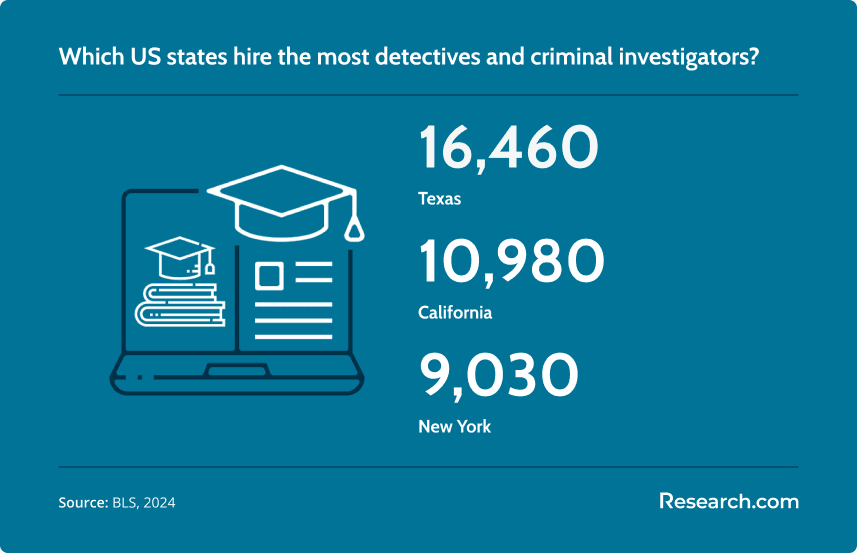
- Texas boasts the highest employment level of detectives and criminal investigators with 16,460, followed by California (10,980), New York (9,030), Florida (6,010), and Arizona (5,250).
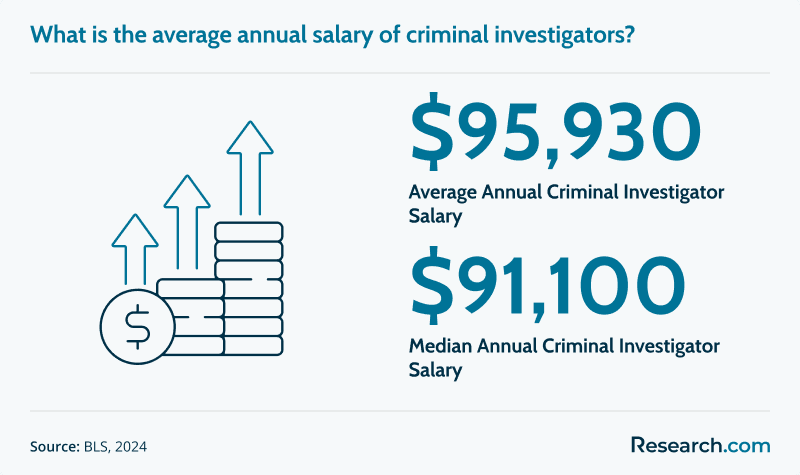
- Detectives and criminal investigators take home an average annual salary of $95,930 and a median annual salary of $91,100.
- What does a criminal investigator do?
- How does one become a criminal investigator for 2027?
- What are the degrees needed to become a criminal investigator for 2027?
- What kind of police training do criminal investigators need?
- What are the top skills required for a criminal investigator for 2027?
- What certifications are recommended for aspiring criminal investigators?
- What are the career paths of aspiring criminal investigators?
- How do behavioral science insights enhance criminal investigations?
- What are the emerging trends impacting criminal investigations?
- How do criminal investigators manage job-related stress and mental health challenges?
- What are the career advancement opportunities for criminal investigators?
- Can accelerated college programs boost your investigative career?
- What is the job outlook of criminal investigators?
- How can I finance my education and training as a criminal investigator?
- How Can Online Education Enhance a Criminal Investigator’s Career?
- What is the average salary of criminal investigators?
- What are the biggest challenges of being a criminal investigator?
- Can advanced academic research enhance investigative strategies?
- How do criminal investigators address ethical dilemmas in the field?
- How do criminal investigators manage media relations and public communication?
- How do criminal investigators maintain the chain of custody for evidence?
What does a criminal investigator do?
A criminal investigator, often called a detective in local law enforcement, examines suspected crimes and develops evidence that can support arrests, prosecution, or case closure. The role is different from general patrol work because investigators usually handle follow-up casework, detailed documentation, interviews, surveillance, evidence review, and coordination with prosecutors or specialized units.
Criminal investigators may work on violent crime, property crime, fraud, homicide, narcotics, organized crime, cybercrime, public corruption, missing persons, or financial investigations. Their daily work depends on the agency, jurisdiction, case type, and level of specialization.
| Core duty | What it involves | Why it matters |
| Evidence collection and review | Locating physical, digital, financial, testimonial, and forensic evidence; coordinating with crime labs or technical specialists | Evidence must be reliable, admissible, and connected to the facts of the case |
| Interviews and interrogations | Speaking with victims, witnesses, suspects, informants, and experts while following legal procedures | Statements can reveal timelines, motives, inconsistencies, and new leads |
| Surveillance and field investigation | Observing locations, tracking suspect activity, reviewing footage, and documenting behavior | Fieldwork can confirm or disprove investigative theories |
| Reports and case files | Writing summaries, organizing evidence, preparing affidavits, and documenting every major investigative step | Clear records support prosecution, court testimony, and agency accountability |
| Agency and prosecutor coordination | Working with patrol officers, forensic teams, federal partners, attorneys, and task forces | Complex cases often require multiple departments and specialized expertise |
| Crime analysis and prevention | Reviewing patterns, locations, methods, and repeat offenders | Investigative findings can help agencies prevent future offenses |
The need for skilled investigators is clear when looking at unresolved violent crime. According to the Justice Center, in 2022, 77% of rape cases, 74% of robbery cases, 59% of aggravated assault cases, and 47% of homicide cases were left unsolved. The job requires technical competence, patience, ethics, and the ability to work with people during some of the most difficult moments of their lives. Readers interested in people-centered roles outside policing can also compare this path with how to become a family counselor, which focuses more on counseling, conflict resolution, and behavioral support than criminal casework.
How does one become a criminal investigator for 2027?
The most common route is progressive: finish basic education, meet law enforcement hiring standards, complete police training, gain officer experience, and then move into investigative assignments. Some specialized investigators enter through federal, military, forensic, private security, accounting, or cybercrime backgrounds, but most public-sector criminal investigators still build their careers through law enforcement experience.
1. Finish high school or earn a GED
A high school diploma or GED is the baseline credential for most law enforcement hiring processes. Students should build strong reading, writing, communication, technology, and physical fitness habits early because these skills are used throughout academy training and investigative work.
2. Choose a relevant college pathway
A degree is not always required for every local agency, but it can make a candidate more competitive and may be expected for federal or specialized roles. Common majors include criminal justice, criminology, forensic science, psychology, sociology, cybersecurity, accounting, and public administration. Students who need flexibility can compare programs such as an online criminal justice degree. Those interested in property crime, fraud, zoning issues, or real estate-related investigations may also find it useful to review where can you get an online master’s in real estate.
3. Meet agency hiring requirements
Law enforcement hiring commonly includes written testing, physical ability assessments, interviews, psychological screening, medical review, drug testing, background investigation, and checks of criminal, employment, financial, and driving history. Standards differ by agency, so applicants should read requirements carefully before applying.
4. Complete police academy training
Police academy training prepares recruits for patrol duties, legal procedures, report writing, emergency response, firearms safety, defensive tactics, ethics, and community interaction. This stage is where many future investigators learn how legal mistakes can affect the outcome of a case.
5. Gain law enforcement experience
Most detectives first work as police officers. Patrol experience teaches candidates how to respond to incidents, secure scenes, write reports, testify, handle conflict, and identify probable cause. Agencies often expect several years of successful service before considering officers for investigative units.
6. Apply for investigator, detective, or specialized unit openings
After building a strong record, candidates can apply for internal detective assignments, criminal investigator openings, task force roles, or specialized units. Selection may involve interviews, performance reviews, written exercises, case analysis, oral boards, or promotional exams.
7. Complete specialized investigator training
New investigators often receive advanced instruction in interviewing, surveillance, search warrants, evidence handling, crime scene documentation, case management, financial analysis, cyber investigations, homicide investigation, narcotics, or victim-centered interviewing.
8. Consider optional certifications
Professional certifications can be useful when they match the role. For example, fraud, legal investigation, digital forensics, and financial crime credentials may support advancement into specialized positions. Students comparing unrelated majors should be cautious about choosing a program only because it sounds easier; for example, is kinesiology an easy major may be a useful question for health-focused students, but it is not a direct substitute for criminal justice, forensic, cyber, or investigative preparation.
9. Keep training throughout your career
Investigative work changes as technology, law, criminal tactics, and evidence standards evolve. Successful investigators continue learning through agency training, professional associations, court updates, advanced degrees, and specialized short courses.
| Stage | Typical goal | Decision point |
| High school or GED | Meet minimum eligibility | Build writing, fitness, and technology skills early |
| College coursework or degree | Strengthen competitiveness and knowledge | Choose a major connected to your preferred investigative field |
| Police academy | Qualify for sworn law enforcement work | Confirm that you meet physical, legal, and background standards |
| Officer experience | Develop field judgment and credibility | Seek assignments that build report-writing and casework experience |
| Investigator application | Move into detective or criminal investigator work | Prepare for exams, interviews, and case-analysis exercises |
| Specialization | Build expertise in fraud, cybercrime, homicide, forensics, or other areas | Select certifications and training based on actual job requirements |
Common mistakes to avoid when preparing for this career
- Choosing a degree without checking agency requirements: Federal, state, local, and private-sector employers may value different majors and credentials.
- Underestimating report writing: Investigators who cannot write clearly may struggle even if they are strong in the field.
- Ignoring background standards: Poor financial history, drug use, dishonesty, or repeated legal issues can affect eligibility.
- Focusing only on salary: Work schedules, trauma exposure, safety risks, and promotion rules matter just as much.
- Assuming all online programs are equal: Accreditation, transfer credit, faculty expertise, and employer recognition should be checked before enrolling.
- Waiting too long to specialize: Cybercrime, financial crime, forensics, and digital evidence skills can set candidates apart.
What are the degrees needed to become a criminal investigator for 2027?
The minimum education requirement can be a high school diploma or GED, but many candidates pursue college because investigative work requires strong writing, legal knowledge, analytical reasoning, and familiarity with criminal procedure. A bachelor’s degree is especially valuable for competitive agencies, federal positions, and specialized assignments.
| Education level | Best fit | Limitations |
| High school diploma or GED | Applicants meeting the basic requirement for some police officer roles | May not be enough for competitive investigator or federal roles |
| Associate degree | Students seeking lower-cost preparation in criminal justice, criminology, or related fields | May need to be followed by a bachelor’s degree for advancement |
| Bachelor’s degree | Candidates targeting detective, federal, forensic, cybercrime, or analytical roles | Requires more time and financial planning than shorter credentials |
| Master’s degree | Professionals pursuing leadership, policy, forensic psychology, cybercrime, or advanced investigative specialization | Usually not necessary for entry-level law enforcement work |
- High school diploma or GED: This is the starting point for most law enforcement careers and establishes basic eligibility for additional training.
- Associate degree: A two-year program can introduce criminal justice systems, policing, corrections, courts, ethics, and basic investigative concepts.
- Bachelor’s degree: Four-year study in criminal justice, criminology, forensic science, psychology, cybersecurity, accounting, or a related area can help candidates qualify for more competitive roles and understand complex investigations.
- Master’s degree: Graduate education can support advancement into supervision, research, federal work, forensic psychology, cybercrime, financial investigations, criminal profiling, or some of the highest-paying criminal justice jobs.
According to 2025 data from Zippia, 59% of criminal investigators in the United States earned a bachelor's degree, 21% have an associate degree, 11% finished a master's degree, and 4% earned a high school diploma.
What kind of police training do criminal investigators need?
Criminal investigators need both foundational police training and advanced investigative instruction. The academy prepares officers for lawful, safe, and ethical fieldwork; later training develops the skills needed to manage complex cases and courtroom-ready evidence.
Police academy training
Police academy curricula vary, but they generally cover the skills needed for entry-level sworn law enforcement work.
- Law and procedure: Recruits study criminal law, constitutional rules, arrest authority, search and seizure, and courtroom expectations.
- Physical readiness: Training prepares officers for the physical demands of emergency response and field operations.
- Firearms and defensive tactics: Recruits learn safe weapons handling, use-of-force principles, defensive skills, and de-escalation concepts.
- Emergency response: Training includes traffic stops, domestic incidents, crisis response, first aid, and scene control.
- Report writing: Officers learn to document incidents in a way that supervisors, prosecutors, defense attorneys, and judges can review.
Specialized investigator training
After academy training and field experience, investigators often take courses focused on case development and specialized crime types.
- Criminal Investigator Training Program (CITP): Offered by FLETC, this program covers investigative methods such as evidence handling, witness interviewing, surveillance, undercover activity, and practical case exercises.
- Agency-based investigator schools: Departments may provide training in homicide, narcotics, financial crime, child exploitation, cybercrime, organized crime, or cold case investigation.
- Legal update training: Investigators must keep up with court rulings, privacy laws, evidence rules, and interview standards.
- Technology and digital evidence training: Modern cases often require knowledge of mobile devices, cloud data, social media, surveillance systems, and financial records.
On-the-job training
Many investigators learn under senior detectives or specialized units. This apprenticeship-style experience helps them apply legal rules, manage witnesses, organize evidence, prepare warrants, and build cases that can withstand scrutiny.
Continuing education
Ongoing training is not optional in practice. Criminal tactics, forensic tools, data sources, and privacy rules change, so investigators must update their methods throughout their careers.
What are the top skills required for a criminal investigator for 2027?
Criminal investigation is a blend of legal knowledge, human judgment, technical skill, and disciplined documentation. The best investigators are not simply “good at solving puzzles”; they are careful, ethical, patient, and able to explain their work clearly in writing and in court.
| Skill | How investigators use it | How to build it |
| Analytical thinking | Connects evidence, timelines, statements, and patterns | Study case analysis, criminology, statistics, or intelligence analysis |
| Interviewing | Obtains reliable information from victims, witnesses, and suspects | Train in trauma-informed interviewing, active listening, and legal interrogation standards |
| Writing | Creates reports, affidavits, case summaries, and courtroom documentation | Practice concise factual writing and review sample investigative reports |
| Legal knowledge | Protects constitutional rights and evidence admissibility | Study criminal procedure, evidence rules, and agency policies |
| Technology literacy | Supports digital evidence review, database searches, and online investigations | Learn digital forensics basics, cybersecurity fundamentals, and records research |
| Ethics and objectivity | Prevents bias, misconduct, and improper conclusions | Use evidence-based decision-making and seek supervisory review on difficult cases |
- Critical thinking: Investigators must evaluate competing explanations and avoid jumping to conclusions before evidence supports them.
- Problem-solving: Cases often involve missing information, reluctant witnesses, conflicting accounts, or incomplete evidence.
- Attention to detail: Small errors in dates, names, evidence labels, or statements can weaken a case.
- Observation: Investigators need to notice behavior, scene details, environmental clues, and inconsistencies.
- Interviewing and interrogation: Effective questioning must be lawful, strategic, and adapted to the person being interviewed.
- Communication: Investigators brief supervisors, coordinate with prosecutors, testify in court, and explain findings to other agencies.
- Interpersonal judgment: Building rapport can be essential when working with victims, families, witnesses, informants, and community members.
- Knowledge of law and procedure: Investigators must understand search warrants, probable cause, Miranda issues, evidence rules, and chain of custody.
- Crime scene awareness: Even when forensic specialists process a scene, investigators must know how to secure and preserve evidence.
- Forensic literacy: Understanding DNA, fingerprints, toxicology, ballistics, and behavioral evidence helps investigators work effectively with experts. Those interested in the psychological side of crime may compare forensic psychology master's programs online.
- Technology skills: Digital records, location data, social media, databases, and surveillance footage are increasingly central to investigations.
- Integrity: Credibility is one of an investigator’s most important professional assets.
- Resilience: Investigators must function under pressure, after setbacks, and while handling distressing material.
- Impartiality: A fair investigation follows evidence rather than assumptions, public pressure, or personal beliefs.
According to Zippia, the skills most often found on the resumes of criminal investigators in the United States are investigative reports (13.1%), resourcefulness (10.6%), firearms (10.5%), treasury (8.6%), investigative techniques (7.6%), IRS (6.2%), and financial crimes (5.6%).
What certifications are recommended for aspiring criminal investigators?
Certifications are not a substitute for law enforcement experience, academy training, or agency authority. They can, however, help investigators demonstrate specialized knowledge, especially in fraud, legal investigation, private investigation, corporate security, and advanced casework. Before paying for any credential, verify whether your target employer recognizes it.
| Certification | Best for | Career value |
| Certified Criminal Investigator (CCI) | Investigators seeking broad knowledge of criminal investigation and forensic concepts | Can support foundational professional development |
| Certified Criminal Justice Specialist (CCJS) | Professionals working around criminal justice procedures and compliance-heavy settings | May be useful in financial institutions and justice-related roles |
| Certified Fraud Examiner (CFE) | Fraud, financial crime, forensic accounting, and corporate investigations | Strong fit for investigators targeting financial misconduct cases |
| Professional Certified Investigator (PCI) | Corporate security, private investigation, surveillance, and case management | Useful for non-sworn and private-sector investigative roles |
| Certified Legal Investigator (CLI) | Experienced investigators working closely with attorneys | Supports legal case preparation and litigation-focused investigations |
| Certified Professional Criminal Investigator (CPCI) | Investigators focused on complex crimes, cybercrime, organized crime, human trafficking, or terrorism | May help signal advanced specialization |
- Certified Criminal Investigator (CCI): The CCI is granted by the American College of Forensic Examiners Institute (ACFEI) and focuses on investigative methods, forensic principles, crime scene issues, evidence handling, and interviewing.
- Certified Criminal Justice Specialist (CCJS): This credential emphasizes criminal justice operations, legal frameworks, and procedural knowledge, particularly for professionals working with regulated or financial environments.
- Certified Fraud Examiner (CFE): This certification is widely associated with fraud prevention, detection, deterrence, and investigation.
- Professional Certified Investigator (PCI): This credential is commonly aligned with corporate, legal, and private-sector investigations involving surveillance, interviews, and case management.
- Certified Legal Investigator (CLI): The CLI is intended for experienced investigators who support attorneys, litigation teams, and courtroom preparation.
- Certified Professional Criminal Investigator (CPCI): This certification focuses on advanced and emerging crimes, including cybercrime, terrorism, organized criminal activity, and complex investigative methods.
What are the career paths of aspiring criminal investigators?
Criminal investigation skills can lead to several careers inside and outside traditional policing. The right path depends on whether you want sworn authority, private-sector flexibility, forensic specialization, technology-focused work, financial crime expertise, or legal support responsibilities. Students interested in offender behavior and assessment may also compare related criminal psychology jobs.
| Career path | Typical work | Best fit for |
| Local or state detective | Investigates crimes such as assault, burglary, robbery, homicide, and missing persons | Police officers seeking promotion into investigative assignments |
| Federal criminal investigator | Works on cases involving national security, interstate crime, drug trafficking, cybercrime, or terrorism | Candidates with strong education, clean backgrounds, and specialized skills |
| Private investigator | Handles background checks, fraud inquiries, missing persons, surveillance, and civil matters | Professionals who want investigative work outside public law enforcement |
| Corporate or financial investigator | Reviews fraud, compliance violations, internal theft, and financial misconduct | People with accounting, finance, compliance, or fraud examination skills |
| Crime scene or forensic investigator | Documents scenes and collects or analyzes physical evidence | Detail-oriented candidates interested in science and evidence handling |
| Cybercrime investigator | Investigates hacking, online fraud, identity theft, digital evidence, and network-related crimes | Technology-focused candidates with cybersecurity or digital forensics training |
| Legal investigator | Assists attorneys with witness interviews, records, facts, and trial preparation | Investigators interested in litigation support and legal strategy |
| Training or instruction | Teaches investigative methods at academies, colleges, or training centers | Experienced investigators who want to mentor others |
- Law enforcement agencies: Many investigators begin in patrol, then move into detective work after proving their judgment, reliability, and casework ability.
- Federal law enforcement: Federal investigators may handle drug trafficking, cybercrime, terrorism, public corruption, organized crime, or interstate offenses.
- Private investigation: Private investigators may work for individuals, insurers, law firms, corporations, or investigation agencies.
- Corporate and financial investigations: These roles focus on fraud, embezzlement, compliance failures, insider threats, and financial records.
- Crime scene and forensic investigation: Specialists collect, preserve, and interpret physical evidence in coordination with law enforcement and labs.
- Legal and judicial support: Investigators in legal settings help attorneys locate facts, interview witnesses, and prepare cases.
- Cybercrime investigation: Digital investigations are increasingly important because criminal activity often leaves electronic traces. Candidates considering this route may also review cyber security jobs salary information.
- Security and loss prevention: These investigators help companies reduce theft, fraud, workplace misconduct, and asset loss.
- Teaching and training: Experienced investigators may become academy instructors, college faculty, or professional trainers.
- International investigations: Some professionals work with global partners on trafficking, smuggling, organized crime, or corporate investigations across borders.
How do behavioral science insights enhance criminal investigations?
Behavioral science can help investigators understand decision-making, victim and witness behavior, communication patterns, escalation risk, and possible motives. It should not be used to stereotype people or replace evidence. Instead, psychology and sociology can support better interviews, fairer assessments, and more thoughtful investigative strategies. Readers comparing the two disciplines can review sociology vs psychology.
What are the emerging trends impacting criminal investigations?
Several changes are reshaping investigative work. Digital evidence is now common in many cases. AI-powered analytics, social media intelligence, geolocation data, surveillance systems, and advanced digital forensics can help investigators identify leads faster, but they also raise privacy, bias, and admissibility concerns. Cybercrime continues to create demand for investigators who understand networks, devices, online fraud, and data preservation. Legal standards are also evolving as courts review how agencies collect, store, and analyze digital information. Students comparing related fields can explore careers in criminology.
How do criminal investigators manage job-related stress and mental health challenges?
Investigators may be exposed to violence, death, child abuse, grieving families, hostile interviews, public pressure, and irregular schedules. Agencies increasingly use peer support, counseling access, supervisor check-ins, resilience training, and critical incident debriefing to reduce burnout and trauma-related harm. Individual investigators can also protect their long-term health by setting recovery routines, using available mental health resources early, maintaining physical fitness, and seeking training in leadership and stress management. Some professionals also pursue advanced education, including options such as a one year online masters, when it aligns with their career goals and schedule.
What are the career advancement opportunities for criminal investigators?
Advancement can mean promotion, specialization, leadership, or movement into a different sector. Experienced investigators may become senior detectives, sergeants, lieutenants, task force leaders, federal agents, fraud managers, forensic supervisors, intelligence analysts, training officers, or consultants. Higher education and specialized credentials may help, but promotion also depends on agency rules, performance history, leadership ability, exams, interviews, and available openings. Those considering graduate education for leadership or compensation reasons can compare options related to a highest paying masters degree.
Can accelerated college programs boost your investigative career?
Accelerated programs can help working adults finish credentials faster, but speed should not be the only factor. For investigative careers, program quality, accreditation, transfer policies, faculty experience, writing expectations, and relevance to law enforcement or forensic work matter more than a short timeline. Accredited accelerated college programs may be useful for officers or career changers who already have credits and need a structured way to complete a bachelor’s degree while working.
What is the job outlook of criminal investigators?
According to the United States Bureau of Labor Statistics (BLS), the employment of detectives and criminal investigators is anticipated to increase by 2% from 2023 to 2033. This is a bit slower than the national average of 4%. However, the number of annual job openings in that same period for police and detectives is about 63,000, which is notable.
Indeed shows that there are over 1,000 openings for criminal investigators in the United States, excluding openings for other jobs that aspirants may enter given their skills and qualifications. As of 2023, there are around 113,400 detectives and criminal investigators in the country. The number will increase to 116,000 by 2033.
Texas boasts the highest employment level of detectives and criminal investigators with 16,460, followed by California (10,980), New York (9,030), Florida (6,010), and Arizona (5,250).
How can I finance my education and training as a criminal investigator?
Education costs can affect whether this career path is realistic, especially for students pursuing college before entering law enforcement. Start by comparing total program cost, not just tuition. Include fees, books, technology, commuting, academy costs, uniforms, testing fees, and lost income if you reduce work hours.
- Submit the FAFSA when eligible: Federal aid may help with accredited degree programs.
- Look for law enforcement scholarships: Some associations, agencies, unions, and community foundations support criminal justice students.
- Ask about employer tuition support: Some agencies reimburse coursework related to public safety, leadership, or job advancement.
- Use transfer credits strategically: Community college credits can reduce the cost of a bachelor’s degree if they transfer cleanly.
- Choose accredited programs: Accreditation affects financial aid eligibility, transfer options, and employer confidence.
- Compare online and campus formats: Online study can reduce commuting costs, but students should verify quality and support services.
Students seeking lower-cost online options can review FAFSA-approved online certificate programs and compare whether the institutions, credentials, and courses match their investigative career goals.
How Can Online Education Enhance a Criminal Investigator’s Career?
Online education can be valuable for officers and investigators who need to study while working shifts. It can help professionals build knowledge in criminal justice, forensic psychology, cybersecurity, fraud examination, public administration, leadership, and legal procedure without leaving their current role. The best online programs are structured, accredited, writing-intensive, and relevant to actual job requirements.
| Online learning can help with | What to check before enrolling |
| Completing a bachelor’s degree while working | Regional accreditation, transfer credit rules, and course delivery format |
| Building cybercrime or digital evidence skills | Hands-on labs, software access, faculty expertise, and employer recognition |
| Preparing for promotion | Leadership, ethics, public administration, and policy coursework |
| Reducing education costs | Total tuition, fees, textbooks, financial aid eligibility, and employer reimbursement |
Working adults comparing affordability can also examine options from the least expensive online college resources, while still verifying accreditation and program fit.
What is the average salary of criminal investigators?
According to the BLS, detectives and criminal investigators take home an average annual salary of $95,930 and a median annual salary of $91,100. Both figures are nearly double the national average of $48,060 and are comparable to the average forensic psychology salary. Salary should still be evaluated carefully because earnings vary by agency, location, overtime policy, experience, union contracts, education, specialization, and whether the role is local, state, federal, or private-sector.
Those who want even higher salaries can find opportunities in industries that offer the highest average annual salaries, like the federal government ($121,770) and postal service ($111,930). Meanwhile, the states that hand out the highest average annual salaries for detectives and criminal investigators are Alaska ($121,770), Hawaii ($121,000), Maryland ($119,900), New York ($118,350), and California ($115,910).
| Salary factor | Why it matters |
| Agency type | Federal, state, local, postal, and private employers may have different pay structures |
| Location | Higher pay states may also have higher housing, taxes, commuting, or insurance costs |
| Specialization | Cybercrime, financial crime, forensic, and federal roles may require additional training |
| Overtime and shift policies | Total earnings can depend on call-outs, court appearances, emergencies, and extra duty |
| Promotion path | Supervisory ranks can change compensation, responsibilities, and work-life balance |
What are the biggest challenges of being a criminal investigator?
Criminal investigation can be meaningful, but it is not an easy career. Candidates should understand the pressures before entering the field because the job can affect health, family life, personal safety, and public reputation.
- Emotional strain: Investigators may handle homicide, abuse, sexual assault, severe injury, and grieving families.
- Long and unpredictable hours: Leads, warrants, court dates, emergencies, and interviews may not fit a standard schedule.
- Uncooperative people: Witnesses may be afraid, victims may be traumatized, and suspects may mislead or refuse to talk.
- Legal and ethical pressure: A single procedural error can weaken a case or violate someone’s rights.
- Public scrutiny: High-profile investigations can attract media attention, political pressure, and community criticism.
- Changing criminal methods: Technology, encryption, online platforms, financial tools, and organized networks require constant learning.
- Safety risks: Surveillance, arrests, undercover work, and violent suspects can place investigators in dangerous situations.
- Evidence and documentation demands: Every item, statement, photo, report, and transfer may be reviewed in court.
Questions to ask yourself before choosing this career
- Am I prepared to work with traumatic facts and distressed people regularly?
- Can I write clear, factual, detailed reports under pressure?
- Am I comfortable having my decisions reviewed by supervisors, attorneys, judges, and the public?
- Do I meet the physical, legal, ethical, and background standards for law enforcement?
- Which specialization fits my strengths: violent crime, cybercrime, fraud, forensics, intelligence, or legal support?
- Will the schedule, risk level, and emotional demands work for my family and long-term health?
Can advanced academic research enhance investigative strategies?
Advanced academic research can help experienced investigators evaluate evidence-based practices, crime patterns, forensic methods, and technology with greater rigor. Doctoral-level study is not required for most investigator roles, but it may fit professionals moving into research, policy, university teaching, forensic leadership, or high-level analytical work. Candidates considering doctoral education should compare time commitment, accreditation, dissertation expectations, and career relevance, including programs described as having the shortest PhD duration.
How do criminal investigators address ethical dilemmas in the field?
Ethical dilemmas arise when investigators face public pressure, incomplete evidence, confidential sources, privacy concerns, conflicts of interest, or emotionally charged cases. The safest approach is to follow law, policy, documentation standards, supervisory review, and evidence rather than assumptions. Investigators must protect constitutional rights, avoid coercive practices, disclose conflicts, preserve evidence honestly, and remain open to facts that challenge their initial theory. Students exploring fast education routes should remember that online degrees still need to provide serious training in ethics, law, and professional judgment if they are meant to support public safety careers.
What do criminal investigators often value about their work?
Many investigators describe the career as demanding but purposeful. They often value helping victims and families, finding answers in difficult cases, working with skilled teams, and contributing to public safety. At the same time, experienced professionals commonly note that the job requires emotional endurance, humility, patience, and a willingness to document every step carefully. The rewarding parts of the career are closely tied to the difficult parts: real cases involve real people, serious harm, and serious consequences.
How do criminal investigators manage media relations and public communication?
Investigators may work on cases that attract news coverage, social media attention, or community concern. Public communication is usually coordinated through supervisors and public information officers so that the agency can provide accurate updates without exposing sensitive evidence, identifying protected victims, harming witness cooperation, or compromising investigative tactics. Strong media practices include clear briefing rules, careful language, avoidance of speculation, and fast correction of misinformation when appropriate. Students thinking broadly about undergraduate options can review What is the easiest bachelor's degree?, but public-facing investigative work requires much more than simply choosing an easy major.
How do criminal investigators maintain the chain of custody for evidence?
Chain of custody is the documented history of who collected, handled, stored, transferred, tested, and presented evidence. Investigators maintain it by labeling evidence correctly, recording dates and times, using secure storage, limiting access, documenting transfers, and following agency and lab procedures. If the chain of custody is weak, attorneys may challenge whether evidence was contaminated, altered, misplaced, or connected to the correct case. Training in forensic processes, documentation, and evidence law is therefore essential. Professionals seeking additional graduate study may compare options such as the shortest masters degree programs, but evidence-handling competence must be built through rigorous, practical training as well as coursework.
Key Insights
- Most criminal investigators build their careers through law enforcement experience, but education in criminal justice, forensic science, psychology, cybersecurity, accounting, or related fields can improve competitiveness.
- A bachelor’s degree is common among criminal investigators: 59% of criminal investigators in the United States earned a bachelor's degree.
- The career requires more than curiosity. Strong writing, legal knowledge, ethical judgment, interviewing ability, evidence handling, and resilience are essential.
- Job growth is modest: employment of detectives and criminal investigators is anticipated to increase by 2% from 2023 to 2033.
- Pay can be strong, with an average annual salary of $95,930 and a median annual salary of $91,100, but compensation varies by employer, state, specialization, overtime, and promotion structure.
- Technology is changing the field. Digital evidence, cybercrime, AI-supported analysis, and privacy concerns make continuous training increasingly important.
- Before choosing this path, evaluate accreditation, agency requirements, background standards, mental health demands, physical risk, schedule expectations, and long-term advancement options.
References
- BLS (2024, April 3). 33-3021 Detectives and Criminal Investigators. BLS
- BLS (2024, August 29). Police and Detectives. BLS
- Gramlich, J. (2024, April 24). What the data says about crime in the U.S. Pew Research Center
- Justice Center (2022). The Accountability Gap: Unsolved Violent Crime in the United States. Justice Center
- Zippia (2025, January 8). Criminal Investigator Education Requirements. Zippia
- Zippia (2025, January 8). Criminal Investigator skills for your resume and career. Zippia
Other Things You Need to Know About Becoming a Criminal Investigator
Many agencies use a polygraph during the background investigation for criminal investigator jobs, but it is not required everywhere. Applicants usually must also pass a written exam, medical screening, psychological evaluation, and an intensive background check before final appointment.
Aspiring criminal investigators in 2027 typically need a bachelor's degree in criminal justice, forensic science, or a related field. Specialized courses in criminology and forensic investigation are advantageous. Certification in crime scene analysis may also enhance career prospects.