
2027 How to Become a Family Counselor

Co-Founder and Chief Data Scientist
Becoming a family counselor is a long-term professional path for people who want to help couples, parents, children, and extended families work through conflict, emotional distress, behavioral concerns, grief, addiction, trauma, and major life transitions. The role matters because many families seek practical support before problems become legal, educational, medical, or safety issues. Cited research reports that about 70–80% of families who received counseling experienced positive effects, and the American Association for Marriage and Family Therapy states that more than 98% of clients rated therapy as “good” or “excellent.”
This guide explains how to become a family counselor, what the work involves, which degrees and licenses are typically required, how long the process takes, what family counselors earn, and how to decide whether this career path fits your goals. It also compares related behavioral health options, highlights common mistakes, and outlines practical steps for choosing education, supervision, specialization, and career-growth opportunities.
Quick answer: How do you become a family counselor?
To become a licensed family counselor or marriage and family therapist, you typically complete a bachelor’s degree, earn a master’s degree in marriage and family therapy, counseling, clinical mental health counseling, psychology, or a related field, complete 2,000 to 4,000 hours of supervised clinical experience, pass a state-recognized licensure exam, and apply for state licensure. The full process usually takes 7–10 years, depending on whether you study full time, how quickly you complete supervised hours, and your state’s licensing rules.
Key facts about becoming a family counselor
- Family counselors work with individuals, couples, parents, children, and family systems to address emotional, behavioral, and relationship problems.
- Based on 2025 Zippia data, 56% of family counselors in the United States have a bachelor’s degree, 32% have a master’s degree, 7% have an associate degree, and 2% have a doctorate degree.
- The typical path to licensure takes 7–10 years.
- Employment of marriage and family therapists is projected to grow 16% from 2023 to 2033.
- Marriage and family therapists in the United States earn an average annual salary of $68,730.
- The highest-paying states by average annual salary are New Jersey ($92,120), Maryland ($87,090), Utah ($83,980), Virginia ($76,480), and Alaska ($74,420).
- What does a family counselor do?
- How does one become a family counselor?
- What types of degrees should one take to become a family counselor?
- How long does it take to become a licensed family counselor?
- What are the most effective counseling techniques for families?
- What skills are needed to be a successful family counselor?
- What are the different specializations of family counselors?
- How can family counselors integrate behavioral analysis into their practice?
- How does family counseling compare with other behavioral health careers?
- What is the job outlook of family counselors?
- How can cost-effective online PsyD programs boost your family counseling career?
- What ethical and legal challenges do family counselors face?
- How can family counselors manage burnout and ensure self-care?
- Can cross-specialization in substance abuse counseling enhance family counseling outcomes?
- How can family counselors effectively integrate telehealth into their practice?
- Are online psychology degrees respected in family counseling?
- What is the average salary of family counselors?
- What are the biggest challenges faced by new family counselors?
- What strategies can enhance professional growth for family counselors?
- Are advanced academic credentials essential for career advancement?
What does a family counselor do?
A family counselor helps clients understand and change relationship patterns that contribute to conflict, distress, or unhealthy behavior. Unlike a counselor who focuses only on one person’s symptoms, a family counselor often looks at how communication, roles, boundaries, stress, parenting practices, trauma, addiction, and cultural expectations affect the entire family system.
Family counselors may work in private practice, community mental health centers, hospitals, schools, nonprofit agencies, residential treatment programs, religious organizations, or government offices. Strong writing, listening, and verbal communication are central to the work; students who want to strengthen these abilities may also compare communication-heavy academic options such as the best online English degree programs.
Core responsibilities of family counselors
- Assessing client needs: Family counselors conduct interviews, gather family histories, observe interaction patterns, and identify emotional, behavioral, relational, or mental health concerns that may be affecting the family.
- Providing therapy sessions: They lead individual, couple, parent-child, and whole-family sessions designed to reduce conflict, improve communication, and support healthier decision-making.
- Creating treatment plans: Counselors set therapy goals, select appropriate interventions, monitor progress, and revise treatment plans when a family’s needs change.
- Supporting group work: Some counselors facilitate parent groups, grief groups, addiction-related family groups, or programs for families facing similar stressors.
- Coordinating resources: When clients need services beyond counseling, family counselors may refer them to physicians, psychiatrists, social workers, schools, domestic violence programs, addiction services, or community agencies.
- Teaching coping and communication skills: They help clients practice emotional regulation, problem solving, boundary setting, conflict resolution, parenting strategies, and stress-management tools.
- Maintaining ethical documentation: Counselors keep records, protect confidentiality, obtain informed consent, and comply with state and professional standards.
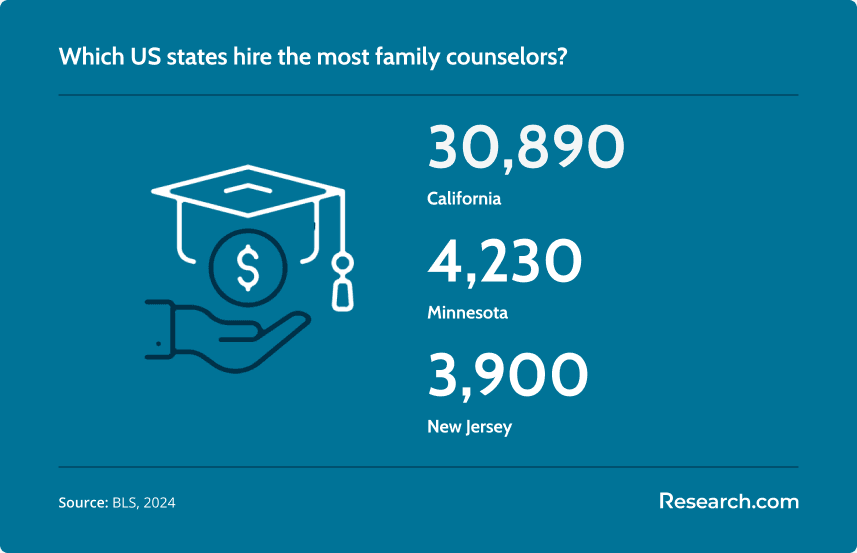
The chart below shows the US states that hire the most family counselors.
How does one become a family counselor?
The family counseling career path combines formal education, supervised clinical practice, licensure, and continuing education. A bachelor’s degree may qualify someone for certain support or entry-level counseling-related roles, but independent clinical practice generally requires a graduate degree and state licensure.
| Step | What you do | Why it matters |
| Bachelor’s degree | Complete an undergraduate program in psychology, counseling, social work, human services, sociology, or a related area. | This builds foundational knowledge of human development, behavior, mental health, family systems, and communication. |
| Master’s degree | Earn a graduate degree in marriage and family therapy, clinical mental health counseling, counseling psychology, or a closely related field. | This is the typical academic requirement for licensure and provides supervised clinical training. |
| Supervised clinical experience | Complete 2,000 to 4,000 hours of post-master’s supervised practice under a qualified licensed professional. | Supervision helps new clinicians apply theory safely, improve documentation, handle ethical issues, and develop sound judgment. |
| Licensure exam | Pass the national MFT exam administered by AMFTRB and any additional state-specific exam if required. | Passing an approved exam demonstrates readiness to practice within professional standards. |
| State licensure | Apply for the license required in your state, such as LMFT or LPC, depending on your training and scope of practice. | Licensure is usually required to practice independently and bill for many clinical services. |
| Continuing education | Complete ongoing professional development to maintain your license. | Continuing education keeps counselors current on ethics, law, telehealth, trauma, cultural competence, and evidence-based methods. |
Students comparing graduate costs may want to review the cheapest MFT programs. Those considering family-law-informed advocacy, mediation, or legal-adjacent counseling work can also explore what is the easiest law degree to get, although a law degree is not a substitute for clinical counseling licensure.
Optional professional involvement through organizations such as AAMFT can help counselors access training, ethical guidance, networking, and specialty resources. Certification is not the same as state licensure, so candidates should always verify requirements with their state licensing board.
What types of degrees should one take to become a family counselor?
The degree you choose should match the level of responsibility you want. A bachelor’s degree can prepare you for graduate study or some entry-level human services work. A master’s degree is the key credential for licensure as a family counselor or marriage and family therapist. A doctorate is optional and is usually pursued by professionals aiming for advanced clinical leadership, teaching, research, supervision, or highly specialized practice.
| Degree level | Common majors or programs | Best for | Licensure impact |
| Bachelor’s degree | Psychology, social work, counseling, human services, sociology, substance abuse counseling | Students preparing for graduate school or entry-level support roles | Usually not enough for independent family counseling licensure |
| Master’s degree | Marriage and family therapy, counseling psychology, clinical mental health counseling | Future licensed counselors, therapists, and clinical practitioners | Typically required for licensure |
| Doctoral degree | Ph.D. or Psy.D. in counseling, psychology, or marriage and family therapy | Clinicians interested in research, teaching, supervision, leadership, or advanced practice | Optional for most family counseling roles, but useful for some advanced goals |
Bachelor’s degree options
A bachelor’s degree introduces students to human behavior, family development, social systems, communication, mental health, and ethics. Common undergraduate paths include:
- Psychology: Focuses on behavior, cognition, lifespan development, personality, and mental health.
- Social work: Emphasizes case management, advocacy, community resources, family support, and social-service systems.
- Counseling or human services: Introduces basic helping skills, crisis response, client interviewing, and service coordination.
- Sociology: Examines social structures, relationships, inequality, culture, and family systems.
- Substance abuse counseling: Helps students understand addiction, recovery, relapse prevention, and the family impact of substance use. A cheap bachelor's degree in substance abuse counseling online may fit students who want an addiction-focused entry point.
Students who are also interested in healthcare administration, nonprofit leadership, or public-sector management may compare M.P.A. vs. M.B.A. differences. These degrees serve different career goals and do not replace clinical counseling education.
Master’s degree options
A master’s degree is the central academic requirement for most licensed family counseling careers. The strongest option depends on your state’s licensure rules and the client population you want to serve.
- Marriage and family therapy: The most direct route for students who want systemic training focused on couples, families, relational patterns, and family-based treatment.
- Counseling psychology: Offers broader clinical training and may include family, assessment, and psychotherapy coursework.
- Clinical mental health counseling: Prepares students to address a wide range of mental health issues, with possible family or couples-focused electives and internships.
Students comparing mental and physical health career paths may also look at what are the easiest radiology programs to get into, but radiology and counseling lead to very different licensure, workplace, and day-to-day responsibilities.
Doctoral degree options
A Ph.D. or Psy.D. is not required for most family counseling jobs. It can be valuable for professionals who want to teach, publish research, supervise clinicians, direct programs, consult, or provide advanced clinical services. Before enrolling, compare the cost, accreditation, clinical training expectations, and whether the doctorate supports the exact role you want.
Based on 2025 data from Zippia, regarding family counselor and marriage and family therapist education level, 56% of family counselors in the United States have a bachelor’s degree, 32% have a master’s degree, 7% have an associate degree, and 2% have a doctorate degree.
How long does it take to become a licensed family counselor?
The usual timeline is 7–10 years. Students asking how long does it take to be a therapist should understand that the answer depends on degree pace, internship availability, state supervision rules, and exam timing.
| Stage | Typical time or requirement | What can extend the timeline? |
| Bachelor’s degree | 4 years | Part-time enrollment, changing majors, transferring credits, or working while studying |
| Master’s degree | 2–3 years | Limited practicum placements, part-time study, thesis requirements, or program sequencing |
| Post-master’s supervised experience | 2,000 to 4,000 hours | Part-time clinical work, difficulty finding an approved supervisor, or state-specific hour categories |
| Exam and licensure application | A few months | Exam retakes, incomplete documentation, background checks, or board review delays |
The fastest realistic path is to choose a licensure-aligned graduate program early, complete required clinical placements on schedule, understand your state’s supervised-hour categories, keep documentation organized, and prepare for the licensure exam before your hours are complete. Shortcuts that skip accreditation, supervision, or board requirements can delay licensure rather than speed it up.
What are the most effective counseling techniques for families?
Family counselors select techniques based on the family’s goals, safety concerns, culture, age of clients, presenting problems, and diagnosis when applicable. No single method works for every household. Effective counselors match the intervention to the problem, explain the approach clearly, and adjust when the family is not progressing.
| Technique | When it is commonly used | Main focus |
| Functional Family Therapy (FFT) | Families with children or adolescents experiencing emotional or behavioral concerns | Improving communication, reducing conflict, and teaching practical behavior-management strategies across 8–30 weekly sessions |
| Multisystemic Therapy (MST) | Youth behavior problems influenced by school, peer, home, or community factors | Changing the systems around the child, not only the child’s behavior in isolation |
| Transgenerational Therapy (TGT) | Families repeating patterns across generations | Understanding how past family responses, trauma, roles, and expectations affect current relationships |
| Brief Strategic Family Therapy (BSFT) | Youth symptoms connected to family interaction patterns | Changing dysfunctional relational patterns through a time-limited 12–16 session model |
| Structural Therapy | Families with unclear roles, weak boundaries, or unbalanced authority patterns | Reshaping family organization, hierarchy, and boundaries so members interact more effectively |
Other approaches may include cognitive behavioral therapy, solution-focused therapy, trauma-focused interventions, psychoeducation, parenting skills training, motivational interviewing, and safety planning. The best technique is the one that fits the client’s needs, is within the counselor’s competence, and is supported by appropriate training and supervision.
What skills are needed to be a successful family counselor?
Family counseling requires clinical skill, emotional steadiness, ethical discipline, and the ability to manage several people’s perspectives at once. A counselor may need to calm a conflict, protect a child’s voice, validate a parent’s fear, identify risk, and keep the session productive—all within the same hour.
- Clear communication: Counselors must explain difficult ideas in plain language, ask useful questions, summarize accurately, and help family members speak to one another more constructively.
- Empathy and compassion: Clients are more likely to participate honestly when they feel respected rather than blamed.
- Active listening: Effective counselors track tone, body language, silence, contradiction, and emotional shifts, not just spoken words.
- Problem solving: Families often arrive with layered problems. Counselors help them prioritize what can be changed first.
- Conflict resolution: The work often involves de-escalating arguments, identifying patterns, and teaching healthier ways to disagree.
- Cultural competence: Family expectations vary by culture, religion, generation, immigration experience, socioeconomic status, and identity. Counselors need humility and skill when adapting interventions.
- Patience and emotional stability: Change can be slow, and sessions can be intense. Counselors must stay grounded.
- Analytical thinking: Strong clinicians notice recurring patterns, test assumptions, and use theory to guide treatment rather than relying on advice-giving.
- Ethical judgment: Confidentiality, consent, mandated reporting, documentation, and boundaries require careful decision-making.
- Flexibility: Families change over time, so treatment must adjust to new information, crises, goals, and readiness.
According to Zippia, the most common skills found on family counselor resumes in the United States are social work (22.3%), community resources (12.7%), proof of concept (7.2%), family support (5.1%), and family therapy (4.7%).
What are the different specializations of family counselors?
Specialization helps family counselors serve specific client needs more effectively. Some professionals remain broad generalists, while others build focused expertise through supervised experience, continuing education, certification, or advanced coursework.
| Specialization | Typical client concerns | Who may fit this path? |
| Marriage and couples counseling | Communication breakdowns, infidelity, premarital concerns, separation, divorce, emotional distance | Counselors interested in adult relationships, conflict repair, and relational commitment decisions |
| Child and adolescent therapy | Anxiety, depression, ADHD, trauma, school issues, developmental concerns, family transitions | Professionals who enjoy working with youth and coordinating with parents, schools, and caregivers |
| Substance abuse and addiction counseling | Substance use, relapse, codependency, enabling, family stress related to addiction | Counselors who want to address addiction as both an individual and family-system issue |
| Trauma and PTSD counseling | Abuse, violence, accidents, disasters, traumatic loss, post-traumatic stress symptoms | Clinicians prepared for careful pacing, safety planning, and trauma-informed methods |
| Grief and loss counseling | Bereavement, relationship loss, career loss, family role changes | Counselors who can sit with painful emotions and help families rebuild meaning |
| Family transitions | Divorce, remarriage, blended families, adoption, relocation, caregiving changes | Professionals who like helping families adapt roles, routines, expectations, and boundaries |
| Geriatric counseling | Retirement, caregiving, illness, end-of-life planning, older-adult family concerns | Counselors interested in aging, caregiver stress, medical-family communication, and later-life adjustment |
Students who want to focus more heavily on addiction, behavior, or mental health foundations can compare a cheap online psychology degree with counseling-specific programs before committing to a graduate path.
How can family counselors integrate behavioral analysis into their practice?
Behavioral analysis can strengthen family counseling when a client’s presenting concern involves observable behavior patterns, reinforcement, routines, or skill deficits. This is especially relevant in work with children, adolescents, developmental differences, and behavior plans that require consistent follow-through at home.
Family counselors do not need to become behavior analysts to use behavior-informed thinking, but they must stay within their training and scope. Advanced applied behavior analysis training can help clinicians assess behavior more systematically, design practical interventions, and collaborate with families using measurable goals. Counselors who want deeper preparation in this area can explore online BCBA masters programs.
How does family counseling compare with other behavioral health careers?
Family counseling overlaps with several behavioral health careers, but the focus is distinct. Family counselors are trained to understand symptoms and conflict within relationships and systems. Applied behavior analysis, social work, mental health counseling, psychology, and substance abuse counseling may share communication and assessment skills, yet each path has different licensure rules, client populations, and intervention models.
| Career area | Primary focus | Decision point for students |
| Family counseling or marriage and family therapy | Relationships, family systems, couples, parenting, and communication patterns | Choose this if you want systemic clinical work with couples and families. |
| Applied behavior analysis | Behavior assessment, reinforcement, skill-building, and targeted behavior change | Choose this if you prefer structured behavior intervention and measurable behavior plans. |
| Clinical mental health counseling | Individual and group mental health treatment across a broad range of concerns | Choose this if you want a wider mental health counseling scope with possible family work. |
| Substance abuse counseling | Addiction, recovery, relapse prevention, and family impact of substance use | Choose this if addiction treatment is your main professional focus. |
Compensation, advancement, and certification requirements vary by role and state. Students comparing behavioral analysis with family counseling can review the applied behavior analyst salary report as one point of comparison.
What is the job outlook of family counselors?
According to the United States Bureau of Labor Statistics, employment of marriage and family therapists is projected to grow 16% from 2023 to 2033. That is higher than the national average of 4% and above the job outlook for forensic psychologist professionals. The number of MFTs is expected to rise from 76,000 in 2023 to 88,200 by 2033.
The BLS also reports about 7,500 job openings each year over the same period. Indeed currently lists over 42,000 jobs for family counselors, showing that openings appear across varied employers and locations. Job boards fluctuate, so candidates should use them as a snapshot rather than a guaranteed count of available roles.
The state employing the most marriage and family therapists is California with 30,890, followed by Minnesota (4,230), New Jersey (3,900), Pennsylvania (2,640), and Tennessee (2,130).
How can cost-effective online PsyD programs boost your family counseling career?
A PsyD can support career advancement for family counselors who want advanced clinical training, leadership opportunities, teaching roles, supervision responsibilities, or specialized practice. It is not required for most licensed family counseling roles, so the decision should be based on career goals rather than credential pressure.
Cost-effective online PsyD options may appeal to working professionals because they can offer flexibility while allowing clinicians to continue practicing. However, candidates should evaluate accreditation, clinical placement requirements, faculty expertise, state licensure implications, and total program cost before enrolling. Professionals comparing doctoral affordability can review the cheapest APA accredited PsyD programs.
What ethical and legal challenges do family counselors face?
Family counseling creates ethical complexity because the counselor may be working with several related clients at once. Confidentiality, informed consent, records access, minor consent, mandated reporting, safety planning, and conflicts of interest must be handled carefully from the first session.
- Confidentiality within the family: Counselors must explain how private disclosures will be handled when multiple family members participate.
- Informed consent: Clients need to understand the counselor’s role, treatment approach, fees, telehealth policies, risks, benefits, and limits of confidentiality.
- Mandated reporting: Suspected abuse, neglect, or safety threats may require reporting under state law.
- Dual relationships: Counselors should avoid relationships that impair judgment, create favoritism, or harm clients.
- Documentation: Notes must be accurate, professional, timely, and compliant with legal and ethical standards.
- Scope of practice: Counselors should not provide services beyond their training, license, supervision, or competence.
Students who want a faster route to foundational psychology coursework may compare an accelerated psychology degree online, but ethical competence ultimately requires graduate-level clinical training, supervision, and continuing education.
How can family counselors manage burnout and ensure self-care?
Family counselors regularly hear stories involving conflict, trauma, grief, addiction, betrayal, crisis, and fear. Without boundaries and support, the emotional load can lead to burnout, compassion fatigue, or reduced clinical effectiveness.
- Use supervision or consultation regularly, especially for high-risk or emotionally complex cases.
- Set realistic caseload limits and avoid scheduling too many intense sessions back to back.
- Maintain clear work-life boundaries for email, documentation, crisis coverage, and telehealth.
- Build recovery routines that include sleep, movement, social connection, reflection, and time away from clinical responsibility.
- Seek personal therapy or professional support when client work begins affecting your well-being.
- Continue training in trauma, ethics, documentation, and crisis response to reduce uncertainty and stress.
Some professionals broaden their perspective by studying adjacent areas such as an online master's degree in forensic psychology, particularly if they work near legal, correctional, trauma, or assessment-related systems.
Can cross-specialization in substance abuse counseling enhance family counseling outcomes?
Yes, substance abuse training can improve family counseling when addiction affects communication, trust, parenting, finances, safety, or emotional stability. Addiction rarely affects only one person. It can reshape roles, routines, boundaries, and expectations across the household.
Cross-specialization helps counselors recognize relapse patterns, codependency, enabling, withdrawal stress, recovery planning, and the impact of substance use on children and partners. Students or practitioners who want addiction-specific academic preparation can explore a bachelor's degree in substance abuse counseling. Scope still matters: counselors should follow state rules and seek supervision or referral when addiction severity requires specialized treatment beyond their competence.
How can family counselors effectively integrate telehealth into their practice?
Telehealth can make family counseling more accessible for clients with transportation barriers, busy schedules, rural locations, caregiving responsibilities, or separated family members. It also changes the clinical environment, so counselors need policies that protect privacy, safety, and treatment quality.
- Use secure platforms appropriate for healthcare communication and confidentiality expectations.
- Confirm each participant’s location at the start of the session in case emergency support is needed.
- Explain who may be present off camera and how privacy will be protected at home.
- Adapt interventions for screen-based communication, including turn-taking, emotion tracking, and conflict de-escalation.
- Clarify rules for recording, messaging, late arrivals, crisis situations, and technology failures.
- Verify state practice rules if clients are located across state lines.
Clinicians who want graduate-level preparation that includes virtual therapy considerations can compare MFT master's programs online.
Are online psychology degrees respected in family counseling?
Online psychology and counseling-related degrees can be respected when they come from properly accredited institutions and meet the academic and clinical expectations required for the student’s goals. Employers and licensing boards generally care more about accreditation, curriculum, supervised clinical training, faculty qualifications, and licensure alignment than whether lectures were delivered online or on campus.
The main risk is assuming that any online degree will qualify you for counseling licensure. Before enrolling, verify institutional accreditation, programmatic expectations, practicum or internship requirements, state board approval, transfer-credit policies, and whether graduates are eligible for the license you want. Students comparing online options can review guidance on what is the best way to get an online psychology degree.
What is the average salary of family counselors?
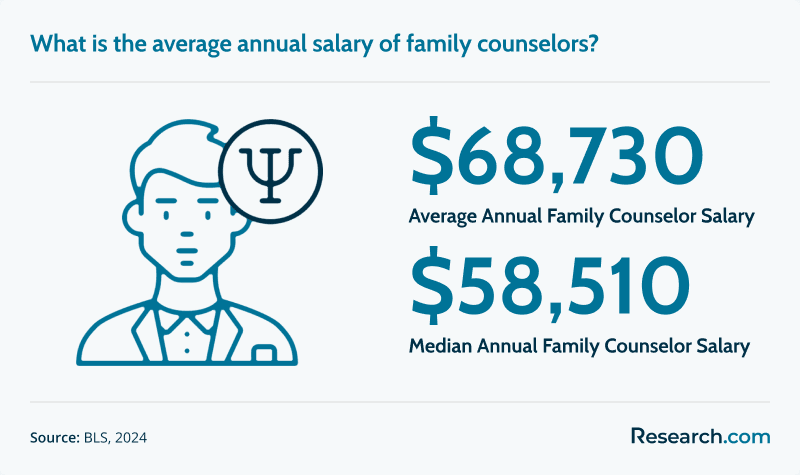
Marriage and family therapists in the United States earn an average annual salary of $68,730 and a median annual salary of $58,510. Both figures are above the collective median annual salary of all US jobs, which is $48,060. Actual pay depends on state, employer, license level, years of experience, clinical specialization, caseload, and whether the counselor works in private practice or an organization.
| Highest-paying industries for MFTs | Average annual salary |
| Home healthcare services | $122,120 |
| Elementary and secondary schools | $89,000 |
| State government offices | $84,770 |
| Religious organizations | $81,600 |
| Local government offices | $80,930 |
| Highest-paying states | Average annual salary |
| New Jersey | $92,120 |
| Maryland | $87,090 |
| Utah | $83,980 |
| Virginia | $76,480 |
| Alaska | $74,420 |
The chart below provides additional salary context for marriage and family therapists.
What are the biggest challenges faced by new family counselors?
New family counselors often find that the hardest part is not remembering theories; it is applying them calmly with real families in distress. Early-career clinicians must build confidence while managing documentation, ethics, scheduling, supervision, client resistance, and emotionally charged sessions.
| Common mistake or challenge | Why it creates problems | Better approach |
| Choosing a program without checking licensure alignment | A degree that does not meet state requirements can delay or prevent licensure. | Ask the program and state board whether the curriculum supports the license you plan to pursue. |
| Focusing only on tuition | Fees, travel, residency requirements, books, supervision costs, and lost work hours can change the real cost. | Compare total cost, clinical placement support, graduation requirements, and licensure outcomes. |
| Assuming all online programs meet clinical requirements | Online coursework may still require in-person practicum, internship, or state-specific supervision. | Confirm field-placement expectations before enrolling. |
| Taking client conflict personally | Family sessions can include blame, anger, silence, and resistance. | Use supervision, stay grounded in the treatment plan, and maintain clear boundaries. |
| Trying to fix everything at once | Families may present several problems in one session, which can overwhelm the process. | Prioritize safety, define short-term goals, and address patterns step by step. |
| Neglecting documentation | Poor records can create ethical, legal, billing, and continuity-of-care issues. | Document promptly and professionally according to agency, state, and ethical standards. |
| Ignoring burnout signs | Emotional overload can reduce empathy, focus, and clinical judgment. | Set caseload boundaries, seek consultation, and build sustainable self-care routines. |
- Building trust: Families may arrive skeptical, defensive, or exhausted from repeated conflict. Trust develops through consistency, neutrality, and respect.
- Managing emotional boundaries: Counselors must show compassion without becoming absorbed by the family’s crisis.
- Understanding complex family dynamics: Culture, trauma, history, roles, finances, parenting, and mental health can all shape the presenting issue.
- Developing treatment plans: New counselors must learn to translate broad problems into measurable, realistic goals.
- Working with resistance: Some family members attend only because another person insisted. Motivational skill is essential.
- Protecting work-life balance: A sustainable career requires boundaries around availability, caseload, and emotional recovery.
- Handling ethics and law: Confidentiality, consent, mandated reporting, and minors in therapy require careful attention.
What strategies can enhance professional growth for family counselors?
Professional growth in family counseling depends on deliberate skill-building, not just years in practice. Strong clinicians continue learning, seek feedback, specialize thoughtfully, and build a network that supports ethical and effective work.
- Choose continuing education that fits your caseload, such as trauma, couples therapy, addiction, telehealth, child therapy, ethics, or cultural competence.
- Seek supervision or consultation even after independent licensure, especially for complex cases.
- Join professional associations to access training, policy updates, research, and peer networks.
- Develop a specialization only after confirming client demand, training quality, and scope-of-practice rules.
- Track outcomes and client feedback to refine your clinical approach.
- Learn practice-management skills if you plan to enter private practice.
Professionals looking for structured career guidance can explore the fastest way to become a counselor, while still verifying every requirement with their own state board.
Are advanced academic credentials essential for career advancement?
Advanced academic credentials can help, but they are not automatically necessary. For many family counselors, the most important credential is the correct master’s degree plus state licensure. Additional degrees become more useful when they support a specific goal, such as teaching, supervision, research, program leadership, psychological assessment, or a specialized clinical niche.
A doctorate may be worth considering if the expected career benefits justify the time, cost, and clinical requirements. Working professionals who need flexibility can compare online PsyD programs accredited, but they should carefully review accreditation, residency expectations, internship requirements, and whether the program supports their state and career objectives.
Questions to ask before choosing a family counseling program
- Does this program meet the educational requirements for the license I want in my state?
- Is the institution properly accredited?
- Does the curriculum include marriage and family therapy, ethics, assessment, cultural competence, diagnosis, and supervised clinical training?
- How does the program help students secure practicum or internship placements?
- What are the total costs beyond tuition?
- Can I complete the program while working?
- What are the graduation, exam, and licensure-support resources?
- Will the degree transfer well if I move to another state?
- Are online students offered the same advising, clinical-placement support, and faculty access as campus students?
- Does the program prepare me for the client population I want to serve?
Key Insights
- Family counseling is a clinical career focused on relationships, communication patterns, emotional health, and family systems—not just individual symptoms.
- The standard path to licensed practice usually requires a bachelor’s degree, a master’s degree, 2,000 to 4,000 supervised clinical hours, a licensing exam, and state licensure.
- The full timeline is commonly 7–10 years, with supervised experience and state requirements creating the most variation.
- A master’s degree is the key credential for licensure; a doctorate is optional and should be tied to clear goals such as leadership, teaching, supervision, research, or advanced specialization.
- Employment of marriage and family therapists is projected to grow 16% from 2023 to 2033, with about 7,500 openings each year over that period.
- Marriage and family therapists earn an average annual salary of $68,730 and a median annual salary of $58,510, but pay varies by state, setting, experience, and specialization.
- Before enrolling in any program, verify accreditation, licensure alignment, clinical placement requirements, total cost, and state board rules.
- New counselors should prioritize supervision, ethical documentation, boundaries, and burnout prevention as much as clinical technique.
References:
- AAMFT. About Marriage and Family Therapists. AAMFT
- BLS (2024, April 3). 21-1013 Marriage and Family Therapists. BLS
- BLS (2024, August 29). Marriage and Family Therapists. BLS
- Moriel Mental Health Center (2024, June 19). What is the Success Rate of Family Therapy? Moriel Mental Health Center
- Zippia (2025, January 8). Family Counselor Education Requirements. Zippia
- Zippia (2025, January 8). Family Counselor skills for your resume and career. Zippia
Other Things You Should Know About Becoming a Family Counselor
Yes. Most states require 2,000 to 4,000 supervised post-master’s clinical hours before LPC, LMFT, or similar licensure. These hours must usually be completed under an approved supervisor and documented for the state board that issues the license.
To become a family counselor in 2027, typically, a master's degree in marriage and family therapy, counseling, or a related field is required. In addition, supervised clinical experience and passing relevant licensure exams are necessary for obtaining state licensure.


