
2027 BCBA and ABA Salary by State

Co-Founder and Chief Data Scientist
Choosing a career in behavior analysis often comes down to two practical questions: how much can you earn, and which credential or location gives you the strongest return on your training? Board Certified Behavior Analysts (BCBAs) and Applied Behavior Analysis (ABA) professionals work with individuals who need behavior support, including people with autism, developmental disabilities, learning challenges, and behavioral health needs. Because services are used in schools, clinics, homes, hospitals, and community programs, salary can vary sharply by credential, state, city, industry, and experience level.
This guide explains BCBA and ABA salary by state, typical pay ranges, the highest-paying locations, industries with stronger compensation, and the factors that can raise or limit your earnings. It is designed for students comparing programs, current ABA professionals considering BCBA certification, and behavior analysts deciding whether to relocate, specialize, negotiate, or pursue additional education.
Quick answer: What should you know about BCBA and ABA salaries?
BCBAs generally earn more than ABA professionals because the BCBA credential requires advanced education, supervised fieldwork, and certification. ZipRecruiter reports an average BCBA salary of $89,075 per year, while the average ABA salary is $73,532. Location matters: Alaska has the highest reported state average for behavior analysts at $99,394, and San Francisco, CA, leads among cities at $93,846. Demand also remains a major salary driver, with the Behavior Analyst Certification Board (BACB) reporting that demand for professionals with BCBA or BCBA-D certifications has increased every year since 2010, including a 14% increase in 2023 alone.
Why become a BCBA or ABA professional?
- Meaningful work across multiple settings: ABA and BCBA professionals support clients in therapy centers, schools, healthcare programs, homes, community agencies, and behavioral service organizations.
- Competitive earning potential: Reported averages show BCBAs earning $89,075 per year and ABA professionals earning $73,532, with compensation depending heavily on credential level, location, and employer type.
- Flexible education options: Online and hybrid programs can make it easier for working adults to complete coursework while managing family, employment, and supervised experience requirements.
- Clearer advancement path than many helping professions: Certification can move professionals from technician or direct-service roles into assessment, supervision, program design, consulting, and leadership positions.
- What are the average and typical salary ranges for BCBAs and ABAs in 2026?
- Which cities and states offer the highest salaries for BCBAs and ABAs?
- What factors influence BCBA and ABA salaries?
- How do BCBA and ABA salaries compare to similar professions?
- Which industries offer the best salaries?
- How does demand affect BCBA and ABA salaries?
- How does the career path to become a BCBA influence long-term earning potential?
- What alternative career paths can optimize long-term earning potential?
- Are affordable online BCBA programs a viable pathway to career advancement?
- What additional learning opportunities can enhance career growth for BCBAs and ABAs?
- Is pursuing an advanced clinical degree beneficial for behavior analysts?
- Can an accelerated psychology degree online program enhance career advancement?
- What emerging trends are shaping the future of behavior analysis careers?
- How can BCBAs and ABAs effectively negotiate their salaries?
- What certifications or qualifications boost BCBA and ABA salaries?
- How can BCBAs and ABAs increase their salaries?
- Can integrating forensic psychology boost career advancement for behavior analysts?
- Is pursuing a combined masters and PsyD program beneficial for expanding career opportunities?
- What complementary online education pathways can broaden career opportunities?
- Will BCBA and ABA salaries continue to grow?
What are the average and typical salary ranges for BCBAs and ABAs in 2026?
Reported salary averages differ by source because job titles, geographic samples, employer types, and data collection methods are not identical. ZipRecruiter places the average BCBA salary at $89,075 per year, with reported salaries ranging from $47,500 to $149,000. Zippia reports a lower BCBA average of $73,616 and a typical range of $51,000 to $105,000.
For ABA roles, ZipRecruiter lists an average annual salary of $73,532, with a range from $38,000 to $117,500. The wide spread shows why it is important to look beyond national averages. A new ABA professional in a school-based role may see very different compensation from an experienced BCBA supervising clinical teams in a high-cost metro area.
| Role or source | Reported average salary | Reported range | How to interpret it |
| BCBA, ZipRecruiter | $89,075 | $47,500 to $149,000 | Useful for understanding broad national pay variation across employers and regions. |
| BCBA, Zippia | $73,616 | $51,000 to $105,000 | Shows a lower average and narrower range, which may better reflect different job-title sampling. |
| ABA, ZipRecruiter | $73,532 | $38,000 to $117,500 | Includes ABA roles that may differ in scope, supervision level, and certification requirements. |
The main takeaway is that the BCBA degree and certification pathway can support higher earnings because BCBAs are typically responsible for assessment, treatment planning, supervision, documentation, and clinical decision-making. Still, salary is not automatic. Employers usually weigh your certification status, supervised experience, specialty area, caseload complexity, and local demand.
Which cities and states offer the highest salaries for BCBAs and ABAs?
Location is one of the strongest salary variables for behavior analysts. ZipRecruiter reports San Francisco, CA, as the highest-paying city for behavior analysts, with an average annual salary of $93,846. Zippia reports Alaska as the highest-paying state, with an average salary of $99,394.
Other high-paying cities include New Haven, CT, at $89,883 and New York, NY, at $89,412, according to ZipRecruiter. Among states, Connecticut follows Alaska at $89,701, while California reports an average of $89,178, based on Zippia data.
| High-paying location | Reported average salary | Source noted in article | What to consider before relocating |
| Alaska | $99,394 | Zippia | Strong pay may reflect demand and cost-of-living factors; review job availability, travel requirements, and service settings. |
| Connecticut | $89,701 | Zippia | Compare school, clinic, and healthcare roles because compensation may differ by employer type. |
| California | $89,178 | Zippia | High demand can support pay, but housing and commuting costs may affect real take-home value. |
| San Francisco, CA | $93,846 | ZipRecruiter | Metro salaries can look attractive, but cost of living should be part of any salary decision. |
| New Haven, CT | $89,883 | ZipRecruiter | Evaluate whether roles are clinical, school-based, supervisory, or consulting-focused. |
| New York, NY | $89,412 | ZipRecruiter | Licensure, commuting, and workload expectations can affect the overall value of an offer. |
Higher salaries often appear in areas with stronger demand, higher living costs, and broader funding for ABA services. Before moving for pay alone, compare local licensing rules, employer caseload expectations, billable-hour requirements, benefits, supervision duties, and the cost of housing, transportation, childcare, and taxes.
What factors influence BCBA and ABA salaries?
Salary is closely tied to the training, credentialing, and supervised practice involved in how to become a behavior analyst. Two professionals with the same job title can earn very different salaries if one has advanced certification, leadership duties, a high-demand specialty, or a role in a better-funded industry.
The largest salary drivers for BCBA and ABA professionals are credential level, geography, employer type, demand, specialization, and experience. ZipRecruiter reports BCBAs at an average of $89,075 compared with $73,532 for ABA professionals, illustrating the value employers place on advanced scope and certification.
Geography can raise or lower pay significantly. Alaska reports the highest state average at $99,394, while San Francisco leads cities at $93,846. Regions such as California and New York may offer stronger salaries, but the higher pay should be weighed against living costs and workload expectations.
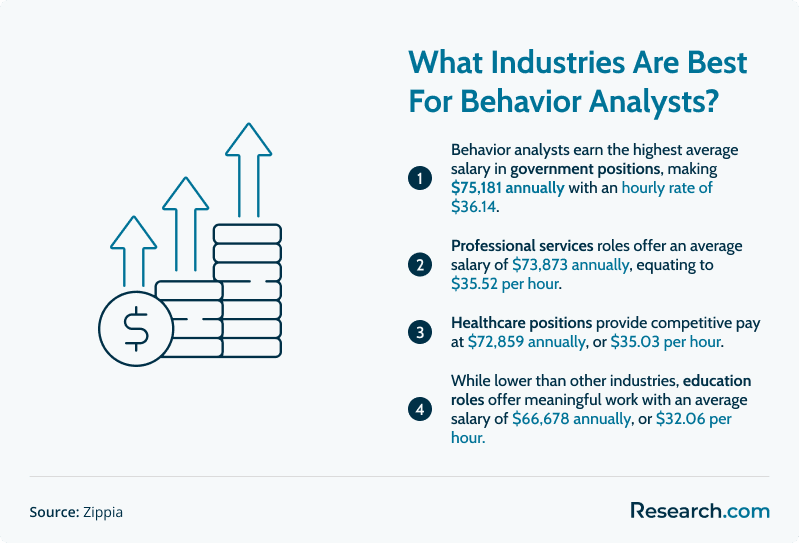
Industry also matters. Zippia reports that behavior analysts in government roles earn an average of $75,181, followed by professional services at $73,873 and healthcare at $72,859. Education settings can offer stable and meaningful roles, but they may pay less than government, professional services, or healthcare employers because of budget structures and funding limits.
| Salary factor | Why it matters | Practical decision |
| Certification level | BCBA and BCBA-D credentials typically signal advanced responsibility and independent clinical decision-making. | If you are already in ABA, compare the cost and time of certification against the salary difference in your region. |
| State and city | Pay often rises in high-demand or high-cost areas. | Use local salary data, not only national averages, before accepting an offer. |
| Industry | Government, professional services, and healthcare report stronger averages than many education roles. | Look beyond job title and compare funding model, benefits, caseload, and advancement options. |
| Experience | Supervision, assessment, team leadership, and program design can increase value to employers. | Track outcomes, supervision hours, training duties, and measurable contributions for promotion discussions. |
| Specialization | Areas such as autism intervention, complex behavior support, or organizational consulting may command stronger offers. | Choose continuing education that matches employer demand, not just personal interest. |
Experience and specialty focus can make a major difference over time. BCBAs who move into senior clinical, supervisory, program director, consulting, or specialized intervention roles may have more leverage than professionals who remain only in entry-level direct-service positions.
How do BCBA and ABA salaries compare to similar professions?
BCBA and ABA salaries are competitive among several helping and behavioral health roles, largely because the field requires specialized training in assessment, intervention design, data collection, behavior support, and ethics. Zippia reports an average salary of $89,075 for BCBAs and $73,532 for ABA professionals.
When compared with related career paths, reported averages show the following:
- Therapists earn an average of $55,943, which is below the reported average for both BCBAs and ABA professionals.
- Social workers earn an average salary of $50,102, also lower than the listed BCBA and ABA averages.
- Job counselors report an average of $49,977.
- Psychologists average $97,803, which is higher than the reported BCBA average.
- ABA and BCBA vs RBT salaries differ substantially; RBTs earn an average of $42,702 per year.
| Role | Reported average salary | How it compares |
| Psychologist | $97,803 | Higher than the reported BCBA average, but usually requires a different and often longer clinical education path. |
| BCBA | $89,075 | Strong earning potential for a specialized certification-based behavior analysis role. |
| ABA professional | $73,532 | Competitive compared with several related helping professions, though duties and credentials vary. |
| Therapist | $55,943 | Lower than the listed BCBA and ABA averages. |
| Social worker | $50,102 | Lower than the listed BCBA and ABA averages. |
| Job counselor | $49,977 | Lower than the listed BCBA and ABA averages. |
| RBT | $42,702 | Often an entry-level or technician role under supervision, with lower pay than BCBA roles. |
The average BCBA salary of $89,075 is also higher than pay in some adjacent child and family support roles, including the compensation discussed in our child life specialist salary career guide. The best comparison, however, depends on required education, licensure, work setting, emotional demands, and long-term advancement options.
Which industries offer the best salaries?
Industry selection can shape both salary and day-to-day work. Zippia reports government as the highest-paying industry for behavior analysts, with an average salary of $75,181. Professional services follows at $73,873, while healthcare reports $72,859.
Education roles can be deeply rewarding because behavior analysts may support students, teachers, families, and school teams. However, school-based compensation may be lower than pay in government, healthcare, or professional services because salary schedules and public funding rules often limit flexibility.
| Industry | Reported average salary | Best fit for professionals who want |
| Government | $75,181 | Public-sector stability, systems-level work, compliance responsibilities, and program oversight. |
| Professional services | $73,873 | Consulting, corporate training, organizational behavior work, or cross-functional projects. |
| Healthcare | $72,859 | Clinical collaboration, patient-centered care, interdisciplinary teams, and treatment planning. |
| Education | Often below healthcare and professional services | School-based intervention, student support, teacher collaboration, and predictable academic calendars. |
Behavior analysts interested in consulting, workplace behavior, training systems, or performance improvement may find that an organizational psychology degree complements their ABA background, especially in professional services environments.
If salary growth is a priority, compare industries carefully rather than assuming all BCBA or ABA jobs pay the same. A lower base salary may still be worthwhile if the role offers strong benefits, manageable caseloads, paid supervision, professional development, loan repayment support, or a clear promotion ladder.
How does demand affect BCBA and ABA salaries?
Demand is one reason behavior analysis salaries remain competitive. The Behavior Analyst Certification Board reports that demand for professionals with BCBA or BCBA-D certifications has grown every year since 2010, with a 14% increase in 2023 alone. When employers compete for a limited supply of qualified professionals, salary offers, signing incentives, supervision opportunities, and advancement paths can improve.
Demand is not evenly distributed. California, Massachusetts, and Texas are identified as high-demand areas, while Alaska and San Francisco, CA, stand out in reported salary averages. A strong local market can help job seekers negotiate, but it can also bring heavier caseloads, more documentation, travel requirements, or productivity expectations.
Several forces support demand for behavior analysts: broader recognition of ABA as an evidence-based practice, service needs among individuals with autism spectrum disorder, and policies or funding structures that require or reimburse ABA services in healthcare and education settings. These conditions can improve job prospects, but they do not guarantee a particular salary for every graduate or certification holder.
If you want a related career focused on mental and behavioral health but not specifically ABA, review our guide on how to become a behavioral health counselor.
How does the career path to become a BCBA influence long-term earning potential?
The path to BCBA certification can affect your income because it determines when you become eligible for higher-scope roles. A board certified behavior analyst BCBA typically completes graduate-level coursework, supervised fieldwork, and a certification exam before moving into roles involving assessment, intervention planning, staff supervision, parent training, and program evaluation.
The earlier you plan the sequence, the easier it is to avoid delays. Students should verify that coursework aligns with current certification requirements, confirm supervision availability before enrolling, and understand whether their state has additional licensure rules. Professionals who strategically use fieldwork to build expertise in high-demand settings may be better positioned for clinical lead, supervisor, program manager, or director roles later.
| Career stage | Typical focus | How it can affect earning potential |
| Entry-level ABA or RBT work | Direct client support, data collection, skill acquisition programs, and behavior plan implementation. | Builds practical experience but usually has lower pay than BCBA-level work. |
| Graduate education and supervised fieldwork | Advanced behavior analysis coursework, ethics, assessment, supervision, and applied practice. | Creates eligibility for credentialed roles with broader responsibility. |
| BCBA certification | Assessment, treatment design, supervision, documentation, and clinical decision-making. | Can improve access to higher-paying clinical and leadership roles. |
| Advanced specialization or leadership | Program direction, consulting, training systems, complex cases, or interdisciplinary services. | May strengthen negotiation leverage and long-term advancement. |
What alternative career paths can optimize long-term earning potential?
Not every behavior analyst stays in direct clinical service. Some move into research, policy, university teaching, program evaluation, leadership, organizational consulting, insurance review, or government advisory work. These paths can appeal to professionals who want broader systems impact or less direct caseload responsibility.
Advanced interdisciplinary education may also expand options. For example, APA accredited PsyD programs can support clinical psychology pathways, though they involve different training, accreditation, and licensure considerations than BCBA certification. Before choosing this route, compare the time commitment, tuition, supervised clinical requirements, licensure outcomes, and the specific roles you want after graduation.
Are affordable online BCBA programs a viable pathway to career advancement?
Affordable online BCBA programs can be a practical option for working adults, especially those who cannot relocate or attend classes on a fixed campus schedule. Online study may reduce commuting time and make it easier to continue earning income while completing coursework.
However, affordability should never be the only filter. Students should confirm that the program supports current BCBA coursework expectations, offers transparent fieldwork guidance, provides access to qualified faculty, and fits state licensure rules where they plan to practice. A low-cost program that does not align with certification or licensure goals can become expensive if it delays eligibility.
Students comparing flexible options can start with Research.com’s guide to BCBA programs online, then contact schools directly to verify requirements, tuition, fees, fieldwork support, and certification outcomes.
What additional learning opportunities can enhance career growth for BCBAs and ABAs?
Continuing education is not just a compliance task; it can shape your career direction. BCBAs and ABA professionals can strengthen their value through training in supervision, functional behavior assessment, severe behavior, early intervention, parent coaching, school consultation, trauma-informed practice, ethics, telehealth, data systems, and leadership.
Short courses, workshops, conferences, peer consultation, and specialized certificates can help professionals adapt to changing service models. For those considering broader mental health careers, learning how to become a counselor can clarify how counseling roles differ from behavior analysis in education, licensure, clinical scope, and daily responsibilities.
Is pursuing an advanced clinical degree beneficial for behavior analysts?
An advanced clinical degree can be useful for behavior analysts who want to expand into psychological assessment, clinical research, integrated behavioral health, or leadership roles that require broader mental health training. It is not necessary for every BCBA, and it may not be the fastest path to higher earnings if your goal is only to advance within ABA service delivery.
Programs such as online PsyD programs may appeal to professionals who want doctoral-level clinical training. Before enrolling, compare accreditation, state licensure eligibility, practicum or internship requirements, time to completion, total cost, and whether the degree supports the exact career outcome you want.
Can an accelerated psychology degree online program enhance career advancement?
An accelerated psychology degree online can help some ABA professionals move faster through prerequisite or advanced coursework, especially if they are planning a transition into graduate study, research, clinical training, or leadership. The advantage is speed and flexibility; the risk is choosing a program that moves quickly but does not meet your certification, transfer, or licensure needs.
If you are considering this route, review curriculum depth, faculty support, credit transfer policies, and whether the degree aligns with your intended next step. Research.com’s guide to an accelerated psychology degree online can help you compare flexible psychology pathways that may complement behavior analysis training.
What emerging trends are shaping the future of behavior analysis careers?
Behavior analysis careers are being shaped by service delivery changes, technology, and employer expectations. Telehealth and remote consultation have expanded access in some settings, while digital data collection tools can make progress monitoring and reporting more efficient. Employers increasingly value professionals who can interpret data, train teams, coordinate care, communicate with families, and document outcomes clearly.
Interdisciplinary collaboration is also becoming more important. BCBAs may work with teachers, speech-language pathologists, occupational therapists, physicians, social workers, psychologists, and caregivers. This makes communication, ethics, cultural responsiveness, and care coordination essential career skills, not optional extras.
Students preparing for the field should compare curriculum, supervised experience support, faculty expertise, and applied training quality when evaluating the best ABA programs. A strong program should help students build practical, data-informed, ethically grounded skills that remain useful as service models evolve.
How can BCBAs and ABAs effectively negotiate their salaries?
Salary negotiation works best when you bring evidence, not just expectations. Before discussing compensation, gather local salary data, review the employer’s caseload requirements, document your certifications, list supervision or training responsibilities, and quantify your contributions when possible. Examples include improving documentation systems, reducing staff turnover, mentoring RBTs, expanding services, or improving treatment-plan quality.
Professionals can strengthen their position by showing relevant continuing education, advanced training, or interdisciplinary knowledge. For example, those interested in child and adolescent development may find useful context in Research.com’s guide on how to become a child psychologist, though that pathway involves different training and credentialing from BCBA practice.
| Negotiation step | What to prepare | Why it helps |
| Research local pay | State, city, employer, and industry salary benchmarks. | Prevents relying only on national averages that may not match your market. |
| Clarify workload | Caseload size, billable hours, travel, supervision duties, and documentation expectations. | A higher salary may not be better if workload is unsustainable. |
| Show measurable value | Training delivered, cases supervised, programs improved, or outcomes documented. | Connects your request to employer priorities. |
| Negotiate total compensation | Benefits, paid CEUs, supervision support, flexible scheduling, mileage, bonuses, or promotion timeline. | Improves the offer even when base salary is fixed. |
| Ask for a review date | A written timeline for compensation review after added responsibilities. | Creates a path for future increases if the employer cannot adjust pay immediately. |
Can integrating forensic psychology boost career advancement for behavior analysts?
Forensic psychology can broaden a behavior analyst’s perspective when work intersects with legal systems, corrections, child welfare, competency-related questions, risk assessment, or behavioral research. It may be especially relevant for professionals who want to consult in justice-related, investigative, or policy settings.
This path is not required for most ABA roles, so it should be chosen strategically. If your long-term goals involve criminal justice, behavioral assessment in legal contexts, or interdisciplinary forensic work, explore options such as affordable forensic psychology master's programs online and verify how the degree fits your intended role.
Is pursuing a combined masters and PsyD program beneficial for expanding career opportunities?
A combined graduate pathway can make sense for behavior analysts who want to expand beyond ABA into advanced clinical psychology training, research, assessment, or leadership. Programs such as combined masters and PsyD programs may provide a structured route into doctoral-level preparation.
The decision should be based on career fit rather than prestige alone. Compare total cost, accreditation, licensure eligibility, clinical training requirements, dissertation or research expectations, internship demands, and how much additional time the program adds. For some professionals, targeted BCBA specialization or leadership training may offer a faster return; for others, a clinical doctorate may open roles that BCBA certification alone does not.
What complementary online education pathways can broaden career opportunities?
Behavior analysts who want broader mental health knowledge may consider online programs in counseling-related or family systems fields. These programs can add perspective on relationships, family dynamics, treatment coordination, and mental health service delivery, though they do not replace BCBA certification or state-specific licensure requirements.
For example, MFT online programs may interest professionals who want training in marriage and family therapy concepts. Before enrolling, confirm whether the program meets licensure requirements in your state, includes required clinical hours, and supports the population and setting where you want to work.
What certifications or qualifications boost BCBA and ABA salaries?
Credentials can improve earning potential when they match employer needs and expand your scope of responsibility. The most relevant certifications and qualifications include:
- Board Certified Behavior Analyst (BCBA): Often the key credential for independent behavior assessment, intervention design, and supervision roles.
- Board Certified Behavior Analyst-Doctoral (BCBA-D): A doctoral designation that may support advanced academic, research, or leadership roles.
- Registered Behavior Technician (RBT): Common entry-level credential for direct-service work under supervision.
- Specialized training: Focused education in autism intervention, severe behavior, supervision, ethics, school consultation, telehealth, or organizational behavior can strengthen job mobility.
For students who need flexibility while completing prerequisite education, an online behavioral psychology degree may help build a foundation for future behavior analysis training. Always verify whether a degree or course sequence satisfies your certification and state requirements before enrolling.
How can BCBAs and ABAs increase their salaries?
BCBAs and ABA professionals can improve salary prospects by making targeted moves rather than waiting for automatic raises. The strongest strategies usually combine credential advancement, local market research, specialization, and documented performance.
- Earn advanced credentials: Moving from direct-service ABA roles into BCBA-level work can improve access to higher-paying responsibilities.
- Develop in-demand specialties: Build expertise in areas employers struggle to staff, such as complex behavior, supervision, early intervention, or school consultation.
- Compare high-paying locations carefully: Alaska, Connecticut, California, San Francisco, New Haven, and New York show strong reported salaries, but cost of living matters.
- Target stronger-paying industries: Government, professional services, and healthcare report higher averages than many education settings.
- Move into leadership: Clinical supervisor, program manager, director, consultant, and training roles may offer more compensation leverage.
- Keep learning: Continuing education can support better outcomes, broader responsibilities, and stronger negotiation arguments.
Advanced education, including pathways discussed in Research.com’s Master of Arts in Human Behavior Psychology guide, may support leadership opportunities depending on the employer and role. Certification can also influence pay, as shown in the chart below.
Common mistakes to avoid when evaluating BCBA and ABA salary
- Using only national averages: Salary changes by state, city, industry, and employer. Local data is more useful for job decisions.
- Ignoring cost of living: A higher salary in San Francisco, CA, or New York, NY, may not stretch as far after housing, transportation, and taxes.
- Choosing a program without checking requirements: Confirm certification alignment, supervised experience expectations, and state licensure rules before enrolling.
- Focusing only on tuition: Fees, fieldwork delays, lost income, travel, exam costs, and supervision access can affect total cost.
- Assuming online programs are automatically acceptable: Online coursework can be convenient, but it must match your credentialing and licensure goals.
- Overlooking total compensation: Benefits, paid continuing education, flexible scheduling, supervision support, and promotion timelines can change the value of an offer.
- Assuming salaries are guaranteed: Published averages are benchmarks, not promises. Your actual pay depends on credentials, experience, location, and employer budget.
Questions to ask before choosing a BCBA or ABA career path
- Do I want direct client service, supervision, consulting, research, teaching, or leadership?
- What credential is required for the jobs I want in my state?
- Will my chosen program meet current certification and licensure expectations?
- How much supervised experience will I need, and where will I complete it?
- Which industries in my area pay best for behavior analysts?
- What is the real cost of the program after tuition, fees, books, exam costs, and time away from work?
- Would relocating improve my net income after cost-of-living changes?
- What skills or specialties would make me more competitive in my local market?
Will BCBA and ABA salaries continue to grow?
BCBA and ABA salaries may continue to rise in markets where demand outpaces the supply of qualified professionals. Similar to compensation trends discussed in our organizational psychology salary career coverage, pay depends on demand, specialization, employer funding, and the broader labor market. The BACB reports that demand for BCBA and BCBA-D professionals has grown every year since 2010, including a 14% increase in 2023 alone.
Expanded insurance coverage, legislative mandates, and continued use of ABA services for individuals with autism spectrum disorder have supported demand. High-demand regions such as California, Alaska, and Texas may continue to offer stronger opportunities, but salary growth is not uniform. Professionals should monitor local job postings, state rules, reimbursement trends, and employer expectations rather than assuming every market will grow at the same pace.
What graduates say about BCBA and ABA degrees
- “Earning my BCBA certification changed my career direction. In Alaska, where demand is strong, I’m earning an average of $99,394 annually. The financial stability matters, but so does the impact I can have with clients.” Lisa
- “After finishing my ABA program and taking a role in California, I started at a competitive salary of $89,178. The field is active here, and I see room to grow while doing work that helps families.” Mark
- “Online BCBA coursework helped me manage family responsibilities while moving toward my career goals. As a BCBA in Texas, I earn $79,787 annually and work with colleagues who understand the value of strong behavior analysis training.” Jenna
Key Insights
- BCBAs typically earn more than ABA professionals because the BCBA credential supports higher-level responsibilities such as assessment, program design, supervision, and clinical decision-making.
- Reported salary averages vary: ZipRecruiter lists BCBAs at $89,075 and ABA professionals at $73,532, while Zippia reports a BCBA average of $73,616.
- Location can significantly affect earnings. Alaska reports the highest state average at $99,394, while San Francisco, CA, leads cities at $93,846.
- Government roles report the highest industry average for behavior analysts at $75,181, followed by professional services at $73,873 and healthcare at $72,859.
- Demand remains a major career advantage. BACB data shows demand for BCBA and BCBA-D professionals has increased every year since 2010, including a 14% increase in 2023 alone.
- The best salary strategy is not simply “get certified.” Stronger results usually come from combining certification, supervised experience, specialization, industry selection, local salary research, and negotiation.
- Online and affordable programs can be worthwhile, but only if they align with certification, supervision, accreditation, and state licensure requirements.
- Salary data should guide decisions, not replace them. Always compare cost of living, caseload, benefits, workload, advancement potential, and total program cost before committing to a job or degree.
References:
- Behavior Analyst Certification Board (BACB). (2024). US Employment Demand for Behavior Analysts: 2010–2023. Behavior Analyst Certification Board. BACB
- Behavior Analyst Certification Board (BACB). (2025). BACB Certificant Data. Behavior Analyst Certification Board. BACB
- Zippia. (2025). 4 Best Behavior Analyst Certifications in 2025. Zippia.
- Zippia. (2025). 10 Best Cities for Behavior Analysts in 2025. Zippia.
- Zippia. (2025). 10 Best States for Behavior Analysts in 2025. Zippia.
- ZipRecruiter. (2025). ABA Therapist Salary in the United States. ZipRecruiter.
- Zippia. (2025). ABA Therapist Statistics, Demographics, & Facts. Zippia.
- Zippia. (2025). Behavior Analysis Careers. Zippia. Zippia
- Zippia. (2025). Behavior Analyst Demographics and Statistics [2025]. Zippia
- Zippia. (2025). Behavior Analyst Education Requirements: Degrees, Majors, Colleges. Zippia.
- Zippia. (2025). Behavior Analyst Job Outlook and Growth in the US [2025]. Zippia.
- Zippia. (2025). Behavior Analyst Salary (January 2025). Zippia.
- Zippia. (2025). Behavior Analysts Compared with Similar Career Paths. Zippia.
- Zippia. (2025). How to Become a Behavior Analyst: What It Is and Career Path. Zippia
- ZipRecruiter. (2025). Salary: Applied Behavior Analyst (Jan, 2025). ZipRecruiter
- ZipRecruiter. (2025). Salary: Board Certified Behavioral Analyst (Jan, 2025). ZipRecruiter
- Yellow Bus ABA. (2024). The Rate of Job Growth for BCBAs. Yellow Bus ABA
Other Things You Should Know About BCBA and ABA Salaries
State licensure is set by each state’s behavior analyst licensing board or psychology board, not by BACB. Many states require BCBA certification, an application, fingerprinting, and a fee, before legal practice is allowed. Salary reports should be checked against the state where the license is held.
In 2027, top paying states for BCBAs and ABAs include California, New York, and Massachusetts. These states offer competitive salaries due to high demand and cost of living. It's important to consider these factors when evaluating job opportunities.


