2027 Industrial-Organizational Psychology Careers: Guide to Career Paths, Options & Salary

Co-Founder and Chief Data Scientist
Industrial-organizational psychology is the psychology of work: how people are hired, trained, managed, motivated, evaluated, and supported inside organizations. For psychology graduates who want to apply behavioral science outside of clinical practice, I/O psychology can lead to roles in consulting, human resources, talent analytics, organizational development, employee assessment, leadership training, and workplace research.
This guide is for students, career changers, and psychology graduates deciding whether an industrial-organizational psychology career is practical, financially worthwhile, and aligned with their strengths. You will learn what I/O psychologists do, which degrees open which doors, what salaries and career paths look like, how licensing and certification work, and how to choose a graduate program without relying only on rankings or marketing claims. The U.S. Bureau of Labor Statistics indicates that there were 5,600 industrial-organizational psychologists employed in the US.
Quick Answer: Is Industrial-Organizational Psychology a Good Career Path?
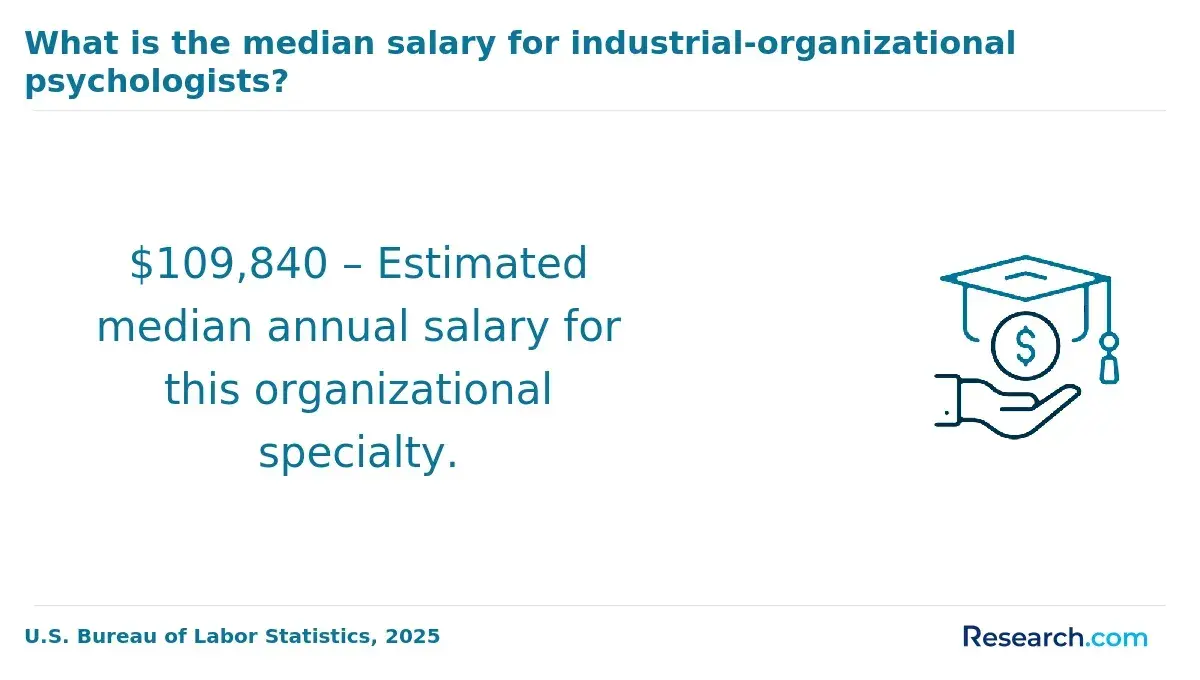
Industrial-organizational psychology can be a strong career path for people who enjoy human behavior, business problems, research, data analysis, and workplace improvement. The field is most accessible at the professional psychologist level with a graduate degree, but related roles in recruiting, training, HR, compensation, people analytics, and organizational development may be available earlier with an associate’s or bachelor’s degree. The U.S. Bureau of Labor Statistics reports that psychologists can expect 12,900 new job openings each year until 2034, with a 6% employment growth rate for psychologists through 2034. I-O psychologists in the U.S. earned a median annual salary of $109,840.
Key Benefits of Starting an Industrial-Organizational Psychology Career
- Workplace impact: I/O psychologists help organizations solve practical problems such as poor engagement, ineffective hiring, weak leadership pipelines, employee conflict, turnover, and training gaps.
- Business relevance: Companies with engaged employees are 23% more profitable than others, which helps explain why employers value professionals who understand motivation, performance, and organizational behavior.
- Transferable career options: I/O psychology skills apply to consulting, HR, training, analytics, management, research, and academia.
- Graduate-level earning potential: I-O psychologists in the U.S. earned a median annual salary of $109,840, although pay varies by role, industry, location, experience, and degree level.
- Multiple work settings: Many I-O psychologists work as consultants, while others work in research, company management, government, education, and internal corporate roles.
- Why an I/O psychology career may be worth pursuing
- Career outlook, industries, and demand
- Skills employers expect from I/O psychology professionals
- How to enter the field by degree level
- How to move into higher-level I/O psychology roles
- Alternative careers for I/O psychology graduates
- Professional development resources
- Workplace trends affecting I/O psychologists for 2027
- Accreditation and curriculum quality
- Online master’s degrees in I/O psychology
- Behavior analysis certification and I/O psychology
- How to compare graduate programs
- Forensic psychology as an adjacent specialty
- Factors that influence I/O psychology salary
- Ethical responsibilities in I/O psychology
- Mentorship and networking
- Doctoral study and career advancement
- Ways to accelerate your path
- Common mistakes to avoid
- Key Insights
What Graduates Say About I/O Psychology Careers
-
: "
"I/O psychology gave me a way to connect my interest in human behavior with business decisions. My coursework built my research and data skills, but the most valuable experience was applying those tools to hiring and training projects during an internship. As an I-O consultant, I now help employers build healthier workplaces while supporting organizational performance." - Russ
"
-
: "
"Workplace relationships always interested me, and I/O psychology helped me understand them through concepts such as team dynamics, conflict resolution, and employee wellness. Learning how to design interventions was especially useful. In my role as an internal communications specialist, I use that background to reduce communication gaps and strengthen collaboration." - Anders
"
-
: "
"The field appealed to me because it treats workplace issues as questions that can be studied, measured, and improved. I learned about motivation, leadership, organizational behavior, surveys, and evidence-based decision-making. As an HR analyst, I rely on those skills to recommend ways to improve engagement and culture." - Dara
"
Why Pursue a Career in Industrial-Organizational Psychology?
Industrial-organizational psychology is worth considering if you want to use psychology in business, government, education, consulting, or nonprofit settings rather than in a traditional therapy role. I/O psychologists study how people behave at work and use that knowledge to improve hiring systems, leadership programs, performance reviews, employee well-being, team effectiveness, and organizational change.
The field can also be financially competitive. Data from the U.S. Bureau of Labor Statistics indicates that I-O psychologists earn a mean wage of $109,840 annually. Psychologists can also expect 12,900 new job openings each year until 2034. These figures do not guarantee individual earnings or employment, but they show why many psychology students investigate I/O psychology when comparing graduate and career options.
Demand is tied to organizational needs that are unlikely to disappear: selecting qualified employees, retaining talent, reducing conflict, developing leaders, improving productivity, supporting well-being, and making people decisions with better evidence. Employers increasingly expect HR and organizational leaders to justify decisions with data, which makes research literacy and analytics valuable.
This path is especially suitable for students who like psychology but also enjoy business strategy, data interpretation, communication, and systems thinking. It may be less suitable for someone who wants a primarily clinical, one-on-one counseling career or who strongly dislikes statistics, measurement, and organizational politics.
What Is the Career Outlook for Industrial-Organizational Psychology Graduates?
A realistic career plan in industrial-organizational psychology should account for both the official psychologist occupation and the broader set of related workplace roles. In my research, I found that there will be a 6% employment growth rate for psychologists through 2034. However, many people trained in I/O psychology do not hold the job title “industrial-organizational psychologist.” They may work as HR managers, talent consultants, training leaders, compensation analysts, organizational development specialists, or people analytics professionals.
I-O psychologists can work in education, research and development, government, private companies, and consulting firms. One of the top-paying industries for them is the Management of Companies and Enterprises, where they can earn an average of $142,210 annually.
If you are still asking, “Which degree should I do?” psychology can be a strong fit if you are genuinely interested in behavior, research, motivation, and workplace systems. Students comparing psychology paths may also explore a masters in educational psychology if they are more interested in learning, assessment, and educational settings. Those who need flexible study options can review a psychology degree online Texas guide when comparing online programs by location and delivery format.
Where I/O Psychology Skills Are Used
| Work Setting | Typical Problems I/O Professionals Help Solve | Common Role Types |
| Corporate HR departments | Hiring quality, retention, performance management, employee relations, benefits, and workforce planning | HR generalist, HR manager, talent analyst, training specialist |
| Consulting firms | Assessment design, leadership development, organizational change, employee surveys, and selection systems | I/O consultant, organizational development consultant, assessment specialist |
| Government agencies | Selection procedures, job analysis, training evaluation, compliance, and employee engagement | Personnel psychologist, workforce analyst, training evaluator |
| Research and education | Workplace behavior research, teaching, testing methods, and applied organizational studies | Researcher, postsecondary teacher, academic program specialist |
What Skills Do You Need for a Career in Industrial-Organizational Psychology?
Students who complete a traditional or online bachelor’s degree in psychology can begin building the foundation for I/O-related careers. To become competitive, they need more than a general interest in people. Employers often look for a mix of psychology knowledge, business judgment, communication ability, and analytical skill.
Core Skills for I/O Psychology and Related Workplace Roles
- Program design: I/O professionals may create training programs, onboarding systems, leadership development plans, employee engagement initiatives, or policy interventions. Strong program design means connecting a workplace problem to clear learning goals, activities, measures, and outcomes.
- Performance evaluation: A business psychologist or I/O-trained professional may help assess performance, productivity, competencies, and promotion readiness. This requires understanding how to build fair evaluation criteria and how to interpret results without overclaiming what the data shows.
- Negotiation and persuasion: I/O work often involves competing interests among executives, managers, employees, unions, legal teams, and HR leaders. Professionals must explain evidence clearly, build trust, and help groups reach practical agreements.
- Data analysis and interpretation: I/O psychology is evidence-based. Professionals may work with colleagues who completed data analytics degrees, but they still need to understand surveys, assessment results, workforce metrics, and research limitations.
- Communication: A technically correct analysis is not enough. I/O professionals must translate findings into recommendations that non-specialists can use.
- Ethical judgment: Hiring tests, employee surveys, performance ratings, and organizational research can affect people’s jobs and reputations. Ethical decision-making is central to credible practice.
Many of these skills begin at the undergraduate level and deepen through internships, research projects, applied graduate coursework, and supervised professional experience. The chart below indicates the most common majors of I-O psychologists in the US.
How Do You Start a Career in Industrial-Organizational Psychology?
There is no single entry point into this field. Some students begin with general psychology coursework, some enter through HR, and others move into I/O psychology after experience in business, training, analytics, or management. A formal psychologist role usually requires advanced graduate training and licensure where applicable, but related roles may be available earlier.
If you are not ready for graduate school, an online associate’s degree in psychology, bachelor’s program, certificate, internship, or HR role can help you test your interest before committing to a master’s or doctorate.
Entry Options by Education Level
| Education Level | What It Can Help You Do | Best Fit For | Important Limitation |
| Certificate or associate’s degree | Build introductory skills for support roles in recruiting, payroll, training coordination, or administration | Students who want a low-risk starting point or faster entry into office-based work | Usually not enough to practice as an I/O psychologist |
| Bachelor’s degree | Qualify for many HR, training, recruiting, benefits, and analyst-adjacent roles | Students who want broad career flexibility before graduate school | May limit access to advanced consulting, research, or psychologist-level positions |
| Master’s degree | Prepare for higher-level applied roles in HR, organizational development, people analytics, and consulting | Professionals seeking specialized I/O training without necessarily pursuing academia | Licensure rules and job title eligibility vary by state and employer |
| Doctorate | Support advanced research, academic, consulting, and licensed psychologist pathways | Students targeting high-level practice, research leadership, or university teaching | Requires a larger time and cost commitment |
What Can I Do With an Associate’s Degree in Industrial-Organizational Psychology?
Recruiting Assistant
Recruiting assistants support the hiring process by posting jobs, reviewing applicant materials, coordinating interviews, helping screen qualifications, and communicating with candidates. Most work in office settings, though they may also help with job fairs or campus recruiting events.
Median salary: $49,440
Payroll Assistant
Payroll assistants, sometimes called payroll clerks, help ensure employees are paid accurately and on schedule. Duties may include organizing time sheets, reviewing invoices, processing payroll records, and coordinating with accounting or benefits staff.
Median salary: $55,290
Training Coordinator
Training coordinators help schedule, organize, and track employee development activities. They may work with training specialists, instructional designers, and managers to identify skill needs and support learning plans for teams.
Median salary: $59,633
What Can I Do With a Bachelor’s Degree in Industrial-Organizational Psychology?
Bachelor’s programs in industrial-organizational psychology are more common than they once were, especially at larger colleges and universities. Students comparing options may review the best colleges for psychology in Texas and similar state-based resources. Many jobs that psychology graduates can do are connected to HR, training, business operations, and employee support.
Human Resources Generalist
Human resources generalists handle a broad mix of personnel tasks, including recruiting, employee records, payroll coordination, benefits administration, onboarding, employee relations, and compliance support. This role is common in small and medium-sized organizations where HR teams cover multiple functions.
Median salary: $72,910
Benefits Administrator
Benefits administrators manage employee benefit programs and help workers understand options such as insurance coverage. They communicate with employees, vendors, and insurance agencies to support enrollment and benefits operations.
Median salary: $77,020
Training Specialist
Training specialists deliver and support employee learning programs. They may help design training manuals, learning modules, onboarding materials, and skill-building sessions that improve employee knowledge and performance.
Median salary: $65,850
Can You Get an Industrial-Organizational Psychology Job With Only a Certificate?
A certificate alone is not usually enough to practice independently as an I/O psychologist. Professional psychologist roles generally require advanced education and, where applicable, state licensure. However, a certificate can be useful if it builds specific workplace skills, such as HR analytics, survey design, employee relations, training design, project management, or behavior analysis.
Certificates are most helpful when paired with a degree, relevant experience, or a clear career goal. For example, a psychology graduate may use a certificate to strengthen qualifications for recruiting, training coordination, HR assistant, or data-supported people operations roles.
How Can You Advance Your Career in Industrial-Organizational Psychology?
Advancement usually comes from a combination of graduate education, applied experience, technical skill, professional credibility, and a portfolio of measurable work. Students considering graduate study can compare programs at institutions such as the best psychology schools in Florida or review the best organizational psychology programs to understand typical coursework and specialization options.
The table below shows how I/O-related roles can progress across HR, business operations, and training and development pathways. Salaries vary by employer, location, industry, credentials, and experience.
| Career Stage | Human Resources Path | Business Operations Path | Training and Development Path |
| Main Focus | Attracting, selecting, supporting, and retaining employees | Improving business processes, productivity, and organizational performance | Identifying skill gaps and building employee learning systems |
| Entry Level Jobs | Recruiting Assistant ($49,440) | Payroll Assistant ($55,290) | Training Coordinator ($59,633) |
| Junior Management Level Jobs | Human Resources Generalist ($72,910) | Benefits Administrator ($77,020) | Training Specialist ($65,850) |
| Middle Management Jobs | Human Resources Manager ($140,030) | Compensation and Benefits Manager ($140,360) | Instructional Designer ($74,720) |
| Senior Management Jobs | Human Resources Director ($122,483) | Chief Operating Officer ($206,420) | Learning and Development Manager ($106,248) |
What Can I Do With a Master’s in Industrial-Organizational Psychology?
Human Resources Manager
You do not always need a human resources degree to become a human resources manager, but you do need strong knowledge of employment processes, compliance, leadership, and workforce planning. HR managers oversee recruiting, hiring, employee relations, benefit programs, administrative systems, and strategic planning with executives.
Median salary: $140,030
Compensation and Benefits Manager
Compensation and benefits managers design and oversee pay structures, incentives, insurance benefits, retirement plans, and reward systems. I/O training can be useful because compensation decisions affect motivation, retention, equity, and organizational culture.
Median salary: $140,360
Instructional Designer
Instructional designers create courses, training systems, learning materials, and assessments for employees, students, or professional learners. They use learning theory, performance analysis, and evaluation methods to design programs that support measurable skill development.
Median salary: $74,720
What Kind of Job Can I Get With a Doctorate in Industrial-Organizational Psychology?
Human Resources Director
Human resources directors shape high-level employee policies, talent strategy, workforce planning, and organizational practices. They may supervise HR managers, recruiters, generalists, and specialists. This path can also interest graduates of human resource degree online programs who later add advanced psychology or organizational leadership training.
Median salary: $122,483
Chief Operating Officer
A chief operating officer reports to the chief executive officer and oversees day-to-day operations. While CEOs typically focus on long-term strategy, COOs lead implementation, performance systems, process improvement, and operational execution. Professionals with psychology training and a bachelor of business administration online background may combine people expertise with business operations knowledge.
Median salary: $206,420
Learning and Development Manager
Learning and development managers lead training teams, identify organizational learning needs, manage training budgets, oversee content development, and evaluate whether programs improve performance before and after training.
Median salary: $106,248
Which Certification Is Best for Industrial-Organizational Psychology?
Licensing requirements for psychologists differ by state. In general, the path to becoming a licensed psychologist involves earning a doctorate in psychology, completing supervised hours, and passing the Examination for Professional Practice in Psychology (EPPP). Students should confirm requirements with the state board where they intend to practice.
Licensed I-O psychologists may be able to practice in another state for around 60 days per year. They will need permission from the Society for Industrial and Organizational Psychology (SIOP) to practice in several states for over two months.
Beyond licensure, I/O psychologists may pursue board certification through the American Board of Organizational and Business Consulting Psychology (ABOBCP). As part of the American Board of Professional Psychology, this credential signals advanced competence in applying psychology to organizations, including business contexts.
Certification is typically more important in clinical and hospital settings than in most corporate roles. Still, it can strengthen credibility for consulting, expert work, executive advising, or specialized organizational practice.
What Are the Alternative Career Options for Industrial-Organizational Psychology Graduates?
I/O psychology training can lead beyond the formal psychologist title. Graduates can apply their knowledge in manufacturing, technology, marketing, government, commercial enterprises, education, consulting, and nonprofit organizations. In large companies, they may work in talent acquisition, employee experience, compensation, organizational development, learning and development, or workforce analytics.
If you like workplace behavior but do not want to become a licensed psychologist, these alternatives may offer a practical route into related work.
Related Career Options
- Marketing associate: Marketing can be one of the best online degrees to get a job for students interested in customers, persuasion, and consumer behavior. Psychology training can support market research, audience analysis, and messaging strategy.
- Database administrator: Database administrators maintain, organize, and protect data systems. I/O psychology graduates with strong analytics skills may find their data interpretation background useful, especially in organizations that track workforce, training, or employee experience data.
- Postsecondary teacher: Postsecondary teachers instruct college and university students, conduct research, publish scholarship, and stay current with developments in psychology and workplace science.
- Career counselor: Career counselors help clients evaluate strengths, interests, skills, and employment options. They may use assessments, labor market information, and education planning to support career transitions.
- Training and development specialist: These professionals design and deliver employee learning programs. I/O psychology knowledge is especially useful for needs assessments, training evaluation, motivation, and skill transfer.
- Company consultant: Consultants advise organizations on performance, structure, compensation, culture, change management, leadership, and employee systems. I/O training can help consultants ground recommendations in evidence rather than assumptions.
What Are the Best Professional Development Resources for Industrial-Organizational Psychologists?
Professional development matters because workplace science changes quickly and employers expect current, practical expertise. I/O psychology professionals can stay competitive by joining professional associations, attending conferences, completing continuing education, participating in webinars, reading applied research, and building peer networks. For a more detailed roadmap, Research.com provides guidance on how to become an industrial organizational psychologist.
Professional Development Priorities
- Research literacy: Stay current on selection, assessment, leadership, employee well-being, and organizational behavior research.
- Applied analytics: Build comfort with survey design, data visualization, workforce metrics, and evidence-based recommendations.
- Consulting skills: Practice stakeholder interviews, proposal writing, facilitation, project scoping, and executive communication.
- Ethics and compliance: Keep up with privacy expectations, fair hiring practices, assessment validity, and responsible data use.
- Industry knowledge: Learn the business model, workforce constraints, and regulatory environment of the industries you serve.
What Emerging Trends Should Industrial-Organizational Psychologists Be Aware of for 2027?
I/O psychologists should track workplace trends because they influence hiring, leadership, training, culture, and employee support. The most important trends are not just “new topics”; they change the kinds of problems organizations ask I/O professionals to solve.
Hybrid and Remote Work Models
- Workplace flexibility: Hybrid and remote arrangements create new questions about engagement, collaboration, fairness, performance measurement, and work-life boundaries. I/O psychologists can help organizations design policies that are both flexible and operationally realistic.
- Virtual leadership development: Remote teams require managers who can communicate clearly, build trust at a distance, resolve conflict online, and support accountability without excessive monitoring.
Employee Well-Being and Burnout Prevention
- Mental health initiatives: Organizations are paying closer attention to burnout, stress, workload, and psychological safety. I/O psychologists can help evaluate whether well-being programs are evidence-based and whether they address root causes rather than only symptoms.
- Work-life balance: Policies around workload, flexibility, time off, and manager expectations can affect retention and performance. I/O professionals can help measure whether policies are working as intended.
Data-Driven People Decisions
- People analytics: Employers increasingly use data to guide recruiting, retention, performance, and employee experience decisions. I/O psychologists bring measurement expertise that can help organizations avoid weak conclusions and biased interpretations.
- Predictive analytics: Workforce models may help identify patterns in turnover, engagement, or skill demand. I/O professionals should understand both the value and the limitations of prediction in human systems.
Diversity, Equity, and Inclusion
- Inclusive hiring practices: I/O psychologists can help employers design fairer selection systems, evaluate assessment tools, and reduce unnecessary barriers in hiring.
- Measuring DEI outcomes: DEI work should be assessed through credible measures such as employee experience, retention, promotion patterns, and team outcomes rather than slogans alone.
How Does Accreditation and Curriculum Quality Affect Career Success in I/O Psychology?
Accreditation and curriculum quality matter because graduate training is the foundation for advanced I/O psychology practice. A strong program should teach research methods, statistics, psychometrics, job analysis, personnel selection, organizational behavior, leadership, ethics, consulting, and applied project work. It should also make clear whether the degree supports licensure, applied consulting, doctoral study, or HR and organizational development roles.
Do not judge a program only by convenience or name recognition. Review faculty expertise, research opportunities, internship or practicum options, alumni outcomes, and whether coursework reflects current workplace issues. Students comparing advanced psychology pathways may also examine the best PsyD programs to understand how program quality, applied training, and credential structure can differ across psychology fields.
Why Choose an Online Master’s Degree in I/O Psychology?
An online master’s degree in I/O psychology can make sense for working adults, career changers, parents, military-affiliated students, or anyone who cannot relocate for graduate school. Since many I/O psychology careers require a master’s degree or higher, affordability and flexibility are major decision factors. Students looking for lower-cost options can compare the cheapest online master's degree in psychology programs while also checking quality and fit.
When an Online Program Makes Sense
- You need flexibility: Online programs may allow students to keep working while studying, especially if courses are asynchronous or offered in the evening.
- You want access beyond your region: Online delivery can make specialized I/O psychology coursework available to students who do not live near a suitable campus program.
- You are managing cost: Online study may reduce relocation and commuting expenses, though tuition, fees, books, technology, and practicum costs still need to be reviewed carefully.
What to Check Before Enrolling Online
- Accredited curricula: Confirm institutional accreditation and review whether the curriculum aligns with recognized professional expectations, including guidance from organizations such as the American Psychological Association (APA) or the Society for Industrial and Organizational Psychology (SIOP).
- Specialization options: Look for courses in organizational behavior, personnel selection, leadership development, research methods, statistics, and consulting.
- Applied experience: Ask whether the program includes projects, internships, employer partnerships, capstone work, or practicum-style experiences.
- Financial aid options: Compare scholarships, grants, employer tuition assistance, payment plans, and total program cost rather than tuition alone.
Can Certification in Behavior Analysis Enhance My I/O Psychology Career?
Behavior analysis certification can complement I/O psychology when your work involves behavior change, performance improvement, training design, coaching, or program evaluation. It may be especially relevant for professionals who design interventions and need stronger tools for measuring behavior before and after workplace changes. Students exploring this credential path can compare affordable online BCBA degree programs.
This option is not necessary for every I/O psychology career. It is most useful when it directly supports your target role, such as organizational behavior management, training evaluation, performance consulting, or behavior-based safety work. Before enrolling, confirm certification requirements, supervision expectations, and whether the credential is recognized in the work settings you want to enter.
What Should I Consider When Choosing a Graduate Program in I/O Psychology?
Choosing a graduate program should be a structured decision, not a reaction to a ranking, advertisement, or short application deadline. The right program depends on your goal: consulting, HR leadership, people analytics, doctoral study, teaching, research, or psychologist licensure where applicable. Students comparing psychology specialties may also review affordable forensic psychology master's programs online to understand how career goals affect program selection across fields.
Questions to Ask Before Choosing a Program
| Decision Factor | Questions to Ask | Why It Matters |
| Accreditation | Is the institution accredited? Does the program meet expectations for your intended career or licensure path? | Accreditation affects credibility, transferability, financial aid eligibility, and employer trust. |
| Curriculum | Does the program cover statistics, research methods, job analysis, selection, assessment, organizational behavior, and ethics? | I/O psychology relies on evidence, measurement, and applied workplace science. |
| Applied learning | Are internships, capstones, consulting projects, or employer partnerships available? | Applied experience helps students convert theory into job-ready skills. |
| Faculty expertise | Do faculty members publish, consult, or work in areas related to your goals? | Faculty interests can shape mentorship, research opportunities, and professional networks. |
| Cost and aid | What is the total cost after fees, books, travel, technology, and lost work time? | The lowest tuition is not always the lowest total cost, and debt should be weighed against likely career outcomes. |
| Career support | Does the school provide internship help, alumni connections, resume support, and employer contacts? | I/O psychology careers often depend on applied projects and professional networking. |
Are Forensic Psychologists in Demand?
Some students compare I/O psychology with other applied psychology specialties, including forensic psychology. These fields serve different systems: I/O psychology focuses on workplaces and organizations, while forensic psychology connects psychology with legal and investigative settings. If you are weighing alternatives, Research.com provides a career guide addressing whether are forensic psychologists in demand.
The best choice depends on the problems you want to solve. Choose I/O psychology if you are more interested in hiring, leadership, training, employee well-being, and organizational performance. Consider forensic psychology if your stronger interest is law, courts, correctional settings, evaluations, or investigative contexts.
What Determines the Salary of Industrial-Organizational Psychologists?
I/O psychology salary is shaped by several factors: education level, years of experience, industry, employer size, geographic market, specialization, consulting revenue, leadership responsibility, and credentials. Professionals with a master’s or doctorate in psychology may qualify for more advanced roles than those with only undergraduate training, but degree level alone does not guarantee a specific salary.
Salary Factors to Compare
- Industry: Management of Companies and Enterprises is one of the top-paying industries for I/O psychologists, with an average of $142,210 annually.
- Role type: Internal HR roles, consulting roles, academic positions, executive leadership, and analytics jobs can have different compensation structures.
- Experience: Professionals who can lead projects, manage stakeholders, and show measurable results often have stronger earning potential.
- Credentials: Licensure and board certification may improve credibility for certain roles, especially consulting or psychologist-level work.
- Location and employer: Salary can vary significantly depending on local labor markets, company size, sector, and budget.
What Are the Ethical Considerations for I/O Psychologists?
Ethics are central to I/O psychology because workplace recommendations can influence hiring, promotion, pay, discipline, training access, and employee privacy. Students pursuing an affordable online master's in organizational psychology should expect ethics to appear throughout the curriculum, not only in a single course.
Core Ethical Responsibilities
- Confidentiality: Employee survey responses, assessment results, personnel records, and interview data must be protected carefully.
- Informed consent: People participating in assessments, research, surveys, or interventions should understand what is being collected, why it is collected, and how it will be used.
- Avoiding conflicts of interest: I/O professionals must remain objective, especially when paid by leadership while studying employee concerns.
- Fair and non-discriminatory practices: Selection, assessment, training, and promotion systems should be evaluated for fairness and bias.
- Responsible data use: Workforce data should not be interpreted beyond its quality, purpose, or limitations.
- Responsibility to society: Ethical I/O work considers employee well-being and organizational effectiveness rather than treating people only as productivity inputs.
How Can Mentorship and Networking Enhance Career Progression in I/O Psychology?
Mentorship and networking can be especially valuable in I/O psychology because many opportunities are project-based, consulting-oriented, or tied to specialized workplace problems. A mentor can help you choose coursework, prepare for internships, understand licensure questions, evaluate job offers, and avoid common career mistakes. Networking can expose you to roles that may not use the title “I/O psychologist” but still require I/O skills.
Graduate students who want a faster academic route may compare an accelerated psychology degree online with traditional programs, but speed should not replace applied learning, supervision, or career support. Strong professional connections are often built through internships, research teams, conferences, consulting projects, alumni networks, and professional associations.
What Are the Career Benefits of Earning a Doctorate in I/O Psychology?
A doctorate can deepen your research expertise, improve your credibility for advanced consulting, support university teaching, and expand eligibility for psychologist licensure where applicable. It may also help professionals lead complex assessment projects, publish research, advise executives, or develop evidence-based organizational interventions. Students exploring advanced online options can review psychology PhD online programs.
A doctorate is not the right choice for everyone. It usually requires a larger investment of time, money, and research commitment than a master’s degree. It is most worth considering if your goals require advanced research training, academic work, high-level consulting, or licensed psychologist status.
How to Accelerate Your Path to a Career in Industrial-Organizational Psychology
If you want to enter the field efficiently, focus on reducing unnecessary delays rather than skipping important preparation. A fast track psychology degree may help some students complete foundational coursework sooner, especially if they already have transfer credits or a clear graduate-school plan.
Practical Steps to Move Faster Without Cutting Corners
- Clarify your target role: Decide whether you want HR, consulting, analytics, training, research, or psychologist-level practice.
- Choose relevant coursework early: Prioritize statistics, research methods, organizational psychology, testing and measurement, business communication, and data analysis.
- Build experience before graduation: Seek internships in HR, recruiting, training, employee engagement, workforce analytics, or organizational development.
- Create a portfolio: Save examples of surveys, training plans, data dashboards, research posters, literature reviews, and applied projects when permitted.
- Compare graduate programs carefully: Look for applied projects, faculty expertise, career services, alumni outcomes, and curriculum fit.
- Use professional networks: Attend webinars, join associations, contact alumni, and ask professionals how they entered their roles.
Common Mistakes to Avoid When Planning an I/O Psychology Career
| Mistake | Why It Can Hurt You | Better Approach |
| Choosing a program without checking accreditation | It can affect financial aid, transfer credits, employer recognition, and licensure planning. | Verify institutional accreditation and ask how the program supports your specific career goal. |
| Assuming every psychology degree leads to an I/O psychologist role | Formal psychologist roles often require graduate training and may require licensure. | Map degree level to realistic job titles before enrolling. |
| Focusing only on tuition | Fees, books, technology, travel, lost work time, and delayed earnings can change the true cost. | Compare total cost and likely career fit, not just price per credit. |
| Ignoring applied experience | I/O employers often want evidence that you can solve workplace problems, not just discuss theory. | Prioritize internships, capstones, consulting projects, research assistantships, and portfolio work. |
| Avoiding statistics and research methods | I/O psychology depends heavily on measurement, data, and evidence-based decision-making. | Build confidence with analytics, survey methods, and interpretation. |
| Assuming online programs automatically meet licensure needs | Licensure requirements vary by state and may not be the main goal of every online program. | Contact state boards and program advisors before enrolling. |
| Relying only on rankings | A highly ranked program may not match your schedule, budget, specialization, or career goal. | Use rankings as one input, then compare curriculum, outcomes, faculty, cost, and applied learning. |
References:
- Springboard Blog. (2024, January 31). Workforce Skills Gap Trends 2024: Survey Report. Springboard Blog.
- U.S. Bureau of Labor Statistics. (2025). Occupational Outlook Handbook: Psychologists. BLS.
- Zippia. (2025). Industrial/organizational psychologist education requirements. Zippia.
- ZipRecruiter. (2024). Training Coordinator Salary. ZipRecruiter.
Key Insights
- Industrial-organizational psychology is best for people who want to apply psychology to work, leadership, hiring, training, employee well-being, and organizational performance.
- A graduate degree is usually needed for advanced I/O psychology practice, but related roles in HR, training, recruiting, benefits, analytics, and organizational development may be available earlier.
- The field rewards a blend of behavioral science, statistics, communication, ethics, business understanding, and applied problem-solving.
- Salary varies by role, employer, industry, location, degree level, experience, and credentials. I-O psychologists in the U.S. earned a median annual salary of $109,840, while Management of Companies and Enterprises offers an average of $142,210 annually.
- Online and accelerated programs can be useful, but only if they are accredited, career-aligned, and strong in applied learning, research methods, and faculty support.
- Before choosing a program, ask whether it supports your specific goal: HR leadership, consulting, people analytics, research, academia, or licensed psychologist practice.
- The biggest mistakes are skipping accreditation checks, underestimating the importance of data skills, assuming all psychology programs lead to the same jobs, and choosing a school based only on cost or rankings.
Other Things You Should Know About Industrial-Organizational Psychology Careers
To pursue a career in industrial-organizational psychology in 2027, a master's degree in I-O psychology or a related field is essential. Many roles may also require a doctorate. Coursework typically includes statistics, research methods, and organizational behavior.
In 2027, industrial-organizational psychologists can pursue diverse career paths. Common roles include HR specialist, organizational consultant, talent development manager, and research analyst. These professionals apply psychological principles to improve workplace productivity, employee satisfaction, and organizational performance across various industries.
The most recognized credentials are the SHRM-CP, SHRM-SCP, and HRCI’s PHR or SPHR for HR-focused roles, plus the Society for Industrial and Organizational Psychology’s professional resources and conference training. Many employers also value advanced statistics, assessment, and consulting certifications tied to survey design and analytics.