
2027 Maine Psychology Licensure Requirements – How to Become a Psychologist in Maine

Co-Founder and Chief Data Scientist
Becoming a psychologist in Maine is a long, regulated path, and the biggest decisions usually come before you ever submit a license application: which degree to pursue, whether a program supports Maine’s supervised-experience rules, and whether the local job market fits your goals. Maine had a 635,460-person workforce in 2024, yet only 690 employed psychologists, making the profession relatively small in the state. That does not mean the field is inactive. Maine’s universities, school systems, health providers, rural communities, and professional organizations continue to create opportunities for well-prepared psychology professionals.
This guide explains Maine psychology licensure requirements in practical terms. You will learn the education path, license types, supervised experience expectations, exam requirements, renewal rules, salary context, program options, and decision factors that matter before choosing a school. It is designed for students comparing psychology programs, master’s-level clinicians exploring supervised practice, out-of-state psychologists considering Maine, and professionals deciding whether doctoral licensure is worth the investment.
Psychology education should do more than teach theory. A strong program should help students understand assessment, ethics, research methods, intervention, human development, and the core goals of psychology while also preparing them for the legal and clinical standards required for practice in Maine.
Maine Psychology Licensure Requirements Table of Contents
- Overview of the Psychology Industry in Maine
- Educational Requirements for Psychologists in Maine
- Maine Licensure Application and Renewal Process
- List of Top Psychology Programs in Maine for 2027
- How to Choose the Right Psychology Program in Maine
- Can accelerated programs fast-track your licensure in Maine?
- What additional certifications can enhance your credibility in Maine?
- What distinguishes forensic psychology from criminal psychology in Maine?
- Could pursuing an LPC license complement your psychology career in Maine?
- How can interdisciplinary collaboration enhance your mental health practice in Maine?
- Why choose school psychology as your specialization in Maine?
- Exploring Online PsyD Programs: A Flexible Pathway to Licensure in Maine
- What are the best strategies for preparing for Maine's psychology licensure exams?
- How can you effectively manage a private psychology practice in Maine?
- What are the current trends in psychology practice in Maine?
- What specialized practice areas can further diversify your psychology career in Maine?
- How can you become a successful criminal psychologist in Maine?
Quick Answer: How do you become a licensed psychologist in Maine?
To become a fully licensed psychologist in Maine, you generally need a doctoral degree in psychology, supervised professional experience, a passing score on the Examination for Professional Practice in Psychology (EPPP), and completion of Maine’s jurisprudence examination. Maine also offers other license categories, including provisional, temporary, and licensed psychological examiner options, depending on your education level, supervision status, and whether you are already licensed in another jurisdiction.
The most important early decision is choosing a program that matches your intended license. Students who want independent doctoral-level practice should focus on accredited doctoral training, supervised experience pathways, internship support, and exam preparation. Students interested in school settings, counseling-related work, behavior analysis, or substance abuse services may want to compare psychology licensure with adjacent credentials before committing to a doctoral route.
Overview of the Psychology Industry in Maine
Maine’s psychology workforce is small but important. As of May 2024, 690 psychologists were employed in the state. That figure should shape expectations: Maine may offer meaningful work in clinical, school, community, forensic, and private practice settings, but it is not a large-volume labor market compared with states that have bigger metropolitan areas.
Projections Central estimates that only 30 total jobs will be created through 2030, with about 100 average annual openings for psychologist positions over the same period. Because Maine has a limited number of practicing psychologists, many openings are likely tied to replacement needs rather than rapid expansion. Students considering doctoral psychology degree options and related careers should weigh both opportunity and competition by location, specialty, and practice setting.
| Factor | What it means for aspiring psychologists in Maine |
| Small psychology workforce | With 690 psychologists employed in 2024, professional networks may be tighter, and local reputation can matter. |
| Rural access needs | Some communities may need providers who can deliver telehealth, travel, or coordinate with schools and primary care. |
| Limited projected growth | Projected demand is modest, so students should build strong internship, assessment, and specialty experience. |
| Research and university presence | Academic programs and psychology departments can support research training, clinical preparation, and professional development. |
Psychologist Occupation Salary Expectations
Salary can vary sharply by specialty, employer, city, credentials, and whether a psychologist works in clinical care, schools, government, research, consulting, or private practice. Available salary information cited for Maine shows an annual average salary of $96,712 for psychologists, which is 15% below the national average. Clinical psychologists are reported at about $209,436 per year. In 2026, the highest-paying cities identified in the source material are Bangor, Scarborough, and Augusta.
Use salary figures as planning benchmarks, not guarantees. Before choosing a program, compare likely debt, years in training, internship or postdoctoral pay, relocation requirements, and the type of practice you want. A doctoral psychology pathway can lead to strong earnings, but it also requires years of education and supervised practice before independent licensure.
Educational Requirements for Psychologists in Maine
Maine generally requires a doctoral degree for full psychologist licensure. The degree should come from a program accredited by the American Psychological Association (APA) or Canadian Psychological Association (CPA), approved by the National Association of School Psychologists (NASAP), or otherwise recognized as providing equivalent professional psychology training.
Most students begin with a bachelor’s degree. A psychology major is helpful because it builds the academic foundation needed for graduate study, but related majors may also work if the student completes enough psychology, statistics, research methods, and human behavior coursework. Students aiming for doctoral admission should plan early for research experience, strong faculty recommendations, clinical exposure, and competitive graduate applications.
| Education level | Typical purpose | Licensure relevance in Maine |
| Bachelor’s degree | Builds the foundation for graduate study in psychology or related fields. | Not enough for independent psychologist licensure, but important for doctoral admission. |
| Master’s degree in psychology | May support supervised master’s-level practice or preparation for doctoral study. | Can qualify candidates to pursue the licensed psychological examiner pathway if other requirements are met. |
| Ph.D. in psychology | Emphasizes research, clinical science, teaching, and applied practice depending on program design. | Common route to licensed psychologist status when the program meets Maine requirements. |
| PsyD in psychology | Often emphasizes clinical training and applied professional practice. | Can lead to psychologist licensure when accreditation, internship, supervision, and exam requirements are satisfied. |
Maine also has a psychological examiner license for individuals with a master’s degree in psychology. This license allows master’s-level practice under the supervision of a fully licensed psychologist. The Maine Board of Examiners of Psychologists provides information on the different licenses available through the state.
Types of Licenses: Maine Psychology Licensure Requirements
- Licensed Psychologist: This is the full doctoral-level license for professionals who hold a Ph.D. or PsyD in psychology and meet Maine’s education, experience, examination, and application standards.
- Provisional Psychologist: This status is typically used by doctoral graduates who are completing supervised practice before full licensure. Also referred to as conditional psychologists, these professionals may provide limited psychological services under the supervision of a licensed Maine psychologist, including diagnosis, assessment, and treatment of mental, emotional, and psychological disorders or concerns. Applicants must have a doctoral degree from an accredited institution and at least two years of experience in psychology.
- Temporary Psychologist: A temporary psychologist license is commonly used by psychologists who are licensed elsewhere and need short-term authorization to practice in Maine. Applicants must enter into a supervision agreement with a licensed Maine psychologist. Like the conditional psychologist license, this license is not renewable.
- Licensed Psychological Examiner: This license allows supervised psychological practice for individuals with graduate-level training below the doctoral level. To qualify, applicants need a master’s degree showing broad training in psychology from an accredited institution. They must also earn a passing score of 65% on the National Board Exam-Examination for Professional Practice in Psychology (EPPP) and pass the Maine Jurisprudence Exam.
Maine may also allow licensure by endorsement for psychologists licensed from other US jurisdictions. However, endorsement applicants should expect state-specific review and are usually required to pass Maine’s jurisprudence examination.
Internship Experience
Supervised experience is a central part of Maine psychology licensure. Psychologists seeking licensure in Maine must complete two years, or 3,000 hours, of supervised experience. One year, or 1,500 hours, is earned through the predoctoral internship within a Board-approved doctoral program.
School psychology has its own internship expectations. School psychologists must complete a supervised internship for academic credit totaling at least 1,200 hours, including at least 600 hours in a school setting. This may be completed full-time over one academic year or part-time across two consecutive academic years.
Because supervision rules can be detailed and may differ by license type, applicants should verify the current Board language before counting hours. This is especially important if you trained out of state, completed a nontraditional program format, or are trying to combine predoctoral, postdoctoral, school-based, or supervised examiner experience.
Maine Licensure Application and Renewal Process
Maine’s psychology licensing process is designed to protect the public by ensuring that psychologists have appropriate education, supervised training, examination performance, and knowledge of state rules. The process is demanding, so students should begin documenting coursework, internships, supervision, and exam readiness well before applying.
How to Become a Licensed Psychologist: Maine Psychology Licensure Requirements
- Complete a bachelor’s degree: Start with an undergraduate degree in psychology or a related discipline. Prioritize courses in statistics, research methods, abnormal psychology, developmental psychology, biological bases of behavior, and ethics if you plan to apply to doctoral programs.
- Earn a doctoral degree: Full psychologist licensure requires a Ph.D. or PsyD in psychology from an accredited institution. Doctoral study commonly takes four to six years and includes advanced coursework, research, assessment training, practica, and internship preparation.
- Complete supervised experience: After doctoral training, candidates must document supervised professional experience. Maine source material describes a minimum of two years, equivalent to 3,600 hours of postdoctoral supervised practice, for this step. Because this figure appears alongside the 3,000-hour supervised-experience requirement described above, applicants should confirm the exact current requirement with the Maine Board before applying.
- Pass the EPPP: The Examination for Professional Practice in Psychology is the national licensing exam. Maine requires a passing score of 70% for psychologist licensure eligibility.
- Submit the licensure application: Apply to the Maine Board of Examiners of Psychologists with required documentation, including official transcripts, supervised experience verification, and EPPP results.
- Pass Maine’s jurisprudence examination: After Board review and approval, Maine sends the jurisprudence exam by certified mail. Applicants have 20 days to complete and return it.
- Renew and maintain the license: Licensure requires ongoing compliance. Renewal applications are due in the licensee’s expiration year on April 30th. Psychologists must complete 40 hours of continuing education during the 24 months before the April 30 deadline, including three hours in ethics and three hours in supervision for psychologists who supervise others.
| Licensure step | What to prepare | Common mistake to avoid |
| Degree planning | Accreditation status, doctoral fit, faculty expertise, practicum access. | Choosing a program before confirming it supports Maine licensure. |
| Internship and supervision | Hour logs, supervisor credentials, internship approval, setting documentation. | Waiting until graduation to organize supervision records. |
| EPPP | Study schedule, practice questions, content review, exam authorization. | Underestimating the time needed for national exam preparation. |
| Jurisprudence exam | Maine laws, Board rules, ethics, scope of practice, reporting obligations. | Assuming national exam knowledge is enough for state law questions. |
| Renewal | Continuing education records, ethics hours, supervision hours if applicable. | Missing the April 30 renewal timing or CE documentation. |
List of Top Psychology Programs in Maine for 2027
The following programs can help students begin or continue the path toward psychology practice in Maine. Research.com considered factors such as faculty expertise, research opportunities, student support, program relevance, and outcomes when identifying these options. Students should still verify accreditation, licensure alignment, internship placement support, and current tuition directly with each school before enrolling.
1. University of Maine (On-Campus Ph.D. in Clinical Psychology)
The University of Maine offers an on-campus Ph.D. in Clinical Psychology focused on scientific training, evidence-based practice, psychological assessment, intervention, and the reduction of mental health distress and disparities. The program is designed around the connection between research and clinical work, which is important for students who want to meet Maine psychology licensure requirements and practice as competent doctoral-level psychologists.
- Program Length: 8 years (max)
- Required Credits to Graduate: 60
- Tuition Cost: $12,984.00 (in-state); $38,952.00 (out-of-state)
- Accreditation: American Psychological Association (APA)
2. University of Maine (On-Campus Ph.D. in Psychological Sciences with a Concentration in Cognitive and Biological Psychology)
The University of Maine also provides a Ph.D. in Psychological Sciences with a concentration in Cognitive and Biological Psychology. Students study areas such as perception, creativity, decision-making, aging, and behavioral neuroscience while building advanced research skills through laboratory participation. Students comparing this option should evaluate how the research-focused curriculum connects to their intended practice, academic, or applied career goals. For broader career planning, it can also help to review what you can do with a clinical psychology degree after graduation.
- Program Length: 8 years (max)
- Required Credits to Graduate: 60
- Tuition Cost: $12,984.00 (in-state); $38,952.00 (out-of-state)
- Accreditation: American Psychological Association (APA)
3. University of Southern Maine (Blended PsyD in School Psychology )
The University of Southern Maine offers a blended PsyD in School Psychology. The full-time pathway can be completed in five years, with longer part-time options available. Many in-person classes are scheduled on weekday evenings, which can help working professionals continue employment while pursuing doctoral training. The program prepares students for Maine psychology licensure requirements and national credentialing for school psychologists. It is the only school psychologist program in Maine and reports a 100% job placement rate for graduates.
- Program Length: 5 years (full-time)
- Required Credits to Graduate: 109
- Cost per Credit: $445
- Accreditation: Council for the Accreditation of Educator Preparation (CAEP)
4. Bowdoin College (On-Campus BA in Psychology)
Bowdoin College offers an on-campus BA in Psychology that can prepare students for graduate-level study in clinical, developmental, educational, and related psychology areas. Courses include educational psychology, infant and child development, psychopathology, political psychology, and other topics that help students build the academic base needed for advanced training. Students interested in working with children may also compare graduate options connected to child psychology programs.
- Program Length: 4 years
- Required Credits to Graduate: 120
- Tuition Cost: $32,152
- Accreditation: New England Commission of Higher Education (NECHE)
5. Bates College (On-Campus Bachelors in Psychology)
Bates College in Lewiston offers an on-campus bachelor’s program in psychology rooted in scientific inquiry and liberal arts learning. Courses include Introduction to Neuroscience, Principles of Psychology, and the multidisciplinary course Searching for the Good Life. The department has connections with Education, Neuroscience, and Sociology, giving students multiple ways to explore human behavior before graduate school. Psychology majors should use advising resources to understand Maine licensure expectations early, especially if doctoral study is the long-term goal.
- Program Length: 4 years
- Required Credits to Graduate: ~120
- Cost per Credit: $63,478.00
- Accreditation: New England Commission of Higher Education (NECHE)
How to Choose the Right Psychology Program in Maine
The right psychology program depends on your target license, preferred work setting, budget, timeline, and tolerance for doctoral training. A student who wants independent clinical practice needs a very different pathway from someone who wants to work in schools, become a counselor, pursue behavior analysis, or use psychology training in research or criminal justice.
Start with accreditation and licensure fit. For doctoral psychologist licensure, confirm whether the program is APA-accredited or otherwise recognized by Maine as equivalent. For school psychology, confirm whether the program prepares students for school-based credentialing and internship expectations. For undergraduate programs, focus on research access, advising, graduate-school placement, and prerequisite coursework.
Students comparing institutions can use Research.com’s guide to the best colleges for psychology in Maine as a starting point, but rankings should not replace direct program review. Ask each school how it supports internship placement, supervision documentation, EPPP preparation, transfer credits, assistantships, and career advising.
| Question to ask | Why it matters |
| Is the program accredited in a way Maine recognizes? | Accreditation can affect licensure eligibility, internship options, and employer confidence. |
| Does the curriculum match my specialty? | Clinical, school, forensic, cognitive, and counseling-adjacent paths require different training. |
| How are practica and internships arranged? | Supervised hours are essential, and placement support can reduce delays. |
| What is the total cost, not just tuition? | Fees, commuting, relocation, lost wages, books, exam prep, and unpaid training time affect ROI. |
| What are graduates doing now? | Outcomes reveal whether the program leads to the jobs, licenses, or graduate placements you want. |
| Does the program support online or blended learners? | Flexible formats can help working students, but licensure-related fieldwork still requires planning. |
What unique challenges do psychologists face in Maine?
Psychologists in Maine may find deeply meaningful work, but practice conditions can differ from larger, more urban states. Geography, rural access, seasonal patterns, and provider distribution can all shape day-to-day practice.
- Access gaps in rural communities: Some rural areas have fewer local mental health professionals, so psychologists may rely on telehealth, outreach, school partnerships, or travel to reach clients.
- Heavier caseload pressure in underserved areas: When fewer providers are available, clinicians may face higher demand. Sustainable scheduling, referral networks, and clear boundaries become especially important.
- Seasonal mental health concerns: Maine’s long winters and limited daylight can make seasonal affective symptoms clinically relevant. Psychologists may benefit from familiarity with assessment and treatment options, including light therapy when appropriate.
- Varied socioeconomic needs: Clients may differ widely in insurance access, transportation, financial stress, cultural views of mental health, and ability to attend regular appointments.
Can accelerated programs fast-track your licensure in Maine?
Accelerated psychology programs may shorten part of the academic journey, but they do not remove Maine’s licensure requirements. Doctoral-level licensure still depends on approved education, supervised experience, exams, and Board review. An accelerated bachelor’s or graduate pathway can be useful if it is accredited, academically rigorous, and aligned with your next step.
Students considering an accelerated psychology degree online should ask whether credits will transfer into graduate study, whether the program includes research methods and statistics, and whether faculty can provide strong recommendations. Speed is only helpful if the credential remains respected and usable for licensure or doctoral admission.
What additional certifications can enhance your credibility in Maine?
Additional credentials can help psychologists and psychology-trained professionals serve more specific populations. For example, Board Certified Behavior Analyst training may be relevant for professionals working with behavioral intervention, developmental disabilities, autism services, schools, or applied behavior settings. This credential is separate from psychologist licensure, so candidates should compare scope of practice, supervision requirements, and career goals before investing.
If behavioral intervention is a serious interest, review the steps for how to become a BCBA in Maine. The best credential choice is the one that expands your competence in a setting where you actually want to practice.
What distinguishes forensic psychology from criminal psychology in Maine?
Forensic psychology and criminal psychology overlap, but they are not identical. Forensic psychology applies psychological knowledge to legal questions. Work may involve competency evaluations, expert testimony, risk assessments, custody-related issues, correctional settings, or treatment planning in legal contexts. Criminal psychology focuses more directly on criminal behavior, offender patterns, investigative analysis, and psychological factors related to crime.
Students should decide whether they want a role tied to courts and evaluations, a research-oriented role studying offending behavior, or a broader clinical practice that includes justice-involved clients. A detailed comparison is available in this guide to the criminal psychology vs forensic psychology difference.
Could pursuing an LPC license complement your psychology career in Maine?
The Licensed Professional Counselor pathway can be a practical alternative or complement to psychology training. It typically centers on counseling practice, client support, community mental health, and therapy services rather than doctoral-level psychological assessment or independent psychologist licensure. For some students, the LPC route may be more direct than a Ph.D. or PsyD; for others, it can add counseling-focused expertise to a broader mental health career.
If you are unsure whether you need psychologist licensure or a counseling credential, compare timelines, costs, supervised experience requirements, scope of practice, and desired work settings. Research.com’s guide on how to become an LPC in Maine can help you evaluate that option.
How can interdisciplinary collaboration enhance your mental health practice in Maine?
Effective mental health care often requires collaboration. Psychologists may work with physicians, school counselors, social workers, substance abuse counselors, occupational therapists, attorneys, educators, and community agencies. In Maine, collaboration can be especially valuable when clients live in rural areas, have complex social needs, or require coordinated support across health, education, and legal systems.
Understanding adjacent professions helps psychologists make better referrals and communicate more clearly with care teams. For example, knowing what degree do you need to be a social worker in Maine can clarify when a client may benefit from case management, benefits navigation, family support, or community-resource coordination.
Why choose school psychology as your specialization in Maine?
School psychology is a strong fit for professionals who want to support children and adolescents through assessment, intervention, consultation, and collaboration with educators and families. In Maine, school psychologists may help identify learning challenges, address behavioral concerns, support mental health initiatives, and guide student support planning.
This specialization is different from general clinical practice because the work is embedded in educational systems. If you want to work at the intersection of psychology, child development, special education, and family collaboration, review the training path for how to become a school psychologist in Maine.
Exploring Online PsyD Programs: A Flexible Pathway to Licensure in Maine
Online and blended PsyD programs can help students pursue doctoral psychology training while balancing work, caregiving, or location constraints. However, online coursework does not eliminate in-person clinical requirements. Students must still complete practica, internships, supervised experience, and licensure exams that meet Maine’s standards.
Advantages of Online PsyD Programs
- Flexible coursework: Online delivery can make lectures, assignments, and discussions easier to manage for students who cannot relocate or attend daytime classes.
- Potential licensure alignment: Some programs are designed with licensure preparation in mind, but students must confirm accreditation and Maine eligibility before enrolling.
- Lower relocation and commuting burden: Online programs may reduce travel or moving costs, though students should still budget for clinical placements, residencies, technology, and exam preparation.
Top Accredited Online PsyD Programs
Students comparing online PsyD programs accredited should look beyond convenience. Ask where students complete clinical training, whether the program is APA-accredited, how internship applications are supported, and whether graduates have successfully pursued licensure in states with requirements similar to Maine’s.
What are the best strategies for preparing for Maine's psychology licensure exams?
Exam preparation should begin before the application deadline. The EPPP tests broad professional psychology knowledge, while Maine’s jurisprudence exam focuses on state-specific laws, rules, ethics, and professional responsibilities. A strong plan includes content review, practice questions, legal-rule study, supervision discussions, and a calendar that leaves time for retakes or administrative delays if needed.
- Build a written study schedule: Divide EPPP domains into weekly targets and reserve time for full-length practice tests.
- Study Maine-specific rules separately: Do not assume national ethics knowledge fully covers state law.
- Use supervision wisely: Ask supervisors to discuss case examples involving consent, documentation, mandated reporting, telehealth, and professional boundaries.
- Protect your exam timeline: Application review, certified mail, and the 20-day jurisprudence return window require organization.
Professionals who are comparing counseling and psychology pathways may also find it useful to explore the shortest path to become a counselor in Maine, especially if they want a faster counseling-focused route into mental health practice.
How can you effectively manage a private psychology practice in Maine?
Running a private psychology practice requires clinical competence and business discipline. Psychologists must manage scheduling, billing, documentation, privacy compliance, informed consent, insurance participation, emergency protocols, referrals, and continuing education. In Maine, telehealth can also be a major part of practice planning, especially when serving rural clients.
Clinicians who hire staff, supervise trainees, or collaborate with counselors should understand how other mental health licenses operate. Reviewing Maine LPC license requirements can help psychologists structure referrals, supervision boundaries, and multidisciplinary practice policies more carefully.
| Private practice area | Practical action |
| Compliance | Keep written policies for consent, records, confidentiality, mandated reporting, and telehealth. |
| Billing | Decide whether to accept insurance, private pay, sliding-scale fees, or a mixed model. |
| Referral network | Build relationships with physicians, schools, hospitals, attorneys, counselors, and social service agencies. |
| Technology | Use secure tools for scheduling, documentation, telehealth, and client communication. |
| Burnout prevention | Set caseload limits, consultation routines, and emergency coverage procedures. |
What are the current trends in psychology practice in Maine?
Several trends are shaping psychology practice in Maine. Telehealth remains important because it can improve access for clients who face long travel distances, limited transportation, or provider shortages. Psychologists using telepsychology must still follow professional standards for privacy, informed consent, emergency planning, and practicing within their competence.
Interest in psychology-law careers is also visible among students exploring forensic psychology masters programs. These programs may be useful for roles connected to criminal justice, victim services, legal systems, corrections, or further doctoral study, but a master’s degree alone does not automatically qualify someone for independent psychologist licensure.
School-based mental health is another major area of attention. Students, families, and districts continue to need support for anxiety, stress, behavior, learning challenges, and crisis response. This makes school psychology and child-focused mental health training especially relevant for students who want to work with youth.
Technology is also changing day-to-day practice. Psychologists may use electronic health records, telehealth platforms, digital assessment tools, and documentation aids. These tools can improve efficiency, but they also raise questions about privacy, accuracy, bias, informed consent, and professional judgment. AI-assisted tools should support, not replace, competent clinical decision-making.
What specialized practice areas can further diversify your psychology career in Maine?
Specialization can help psychology professionals serve specific community needs and build a clearer professional identity. Addiction and substance abuse counseling is one example. Additional training in this area can support work in community agencies, integrated care, private practice collaboration, public health programs, and treatment teams serving clients with substance use concerns.
Psychologists do not need every credential available. The better strategy is to identify the client population and setting you want, then pursue training that improves your competence for that work. If addiction services are part of your plan, review the requirements for how to become a substance abuse counselor in Maine.
How can you become a successful criminal psychologist in Maine?
Criminal psychology requires more than an interest in crime. Professionals need strong training in behavior, assessment, research, ethics, legal systems, trauma, risk factors, and rehabilitation. Practical exposure matters, so students should look for coursework, practica, internships, or research opportunities connected to corrections, courts, law enforcement collaboration, offender treatment, or victim services.
Networking is also important. Criminal psychology careers may involve attorneys, forensic evaluators, correctional administrators, treatment teams, researchers, and public agencies. Students who want this niche should review the professional path for how to become a criminal psychologist in Maine and compare it with forensic psychology, clinical psychology, and counseling alternatives.
What other careers in the psychology field are available in Maine?
Licensed psychologist is not the only mental health path available in Maine. Depending on your education level and career goals, you may consider counseling, social work, school psychology, behavior analysis, substance abuse counseling, marriage and family therapy, research, human services, or applied roles in education and criminal justice.
Marriage and Family Therapy is one option for professionals who want to work with couples, families, and relational systems. If that path interests you, compare the requirements for an MFT license in Maine with psychology, counseling, and social work routes before deciding which graduate degree to pursue.
Is it worth it to be a licensed psychologist in Maine?
Becoming a licensed psychologist in Maine can be worth it for people who want doctoral-level expertise, independent clinical authority, assessment skills, and the ability to serve clients with complex psychological needs. It is also a demanding route. Students should understand how long it takes to get a psychology degree, how supervised experience works, and how much income they may forgo during graduate training.
The strongest candidates are usually those who are committed to both the science and practice of psychology. If your goal is direct therapy as quickly as possible, a counseling, social work, or MFT pathway may be more efficient. If your goal is psychological assessment, doctoral-level clinical practice, academic work, or advanced specialization, psychologist licensure may be the better long-term investment.
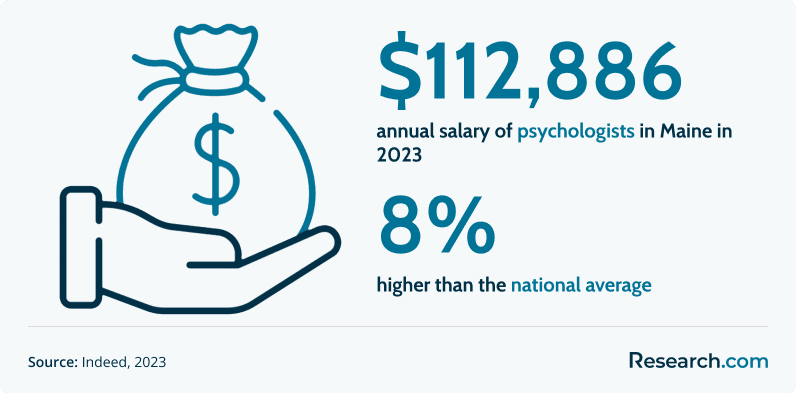
Financially, Maine salary sources present a mixed picture. One cited figure reports psychologists in the state earning 8% higher than the national average (Indeed, 2023a), while clinical psychologists are reported at 53% higher than the national mean (Indeed, 2023b). Other salary figures in this guide cite different averages, including $96,712 for psychologists and $209,436 for clinical psychologists. Treat these numbers as source-specific estimates and verify current salary data by role, employer, city, and specialty before making a financial decision.
Common Mistakes to Avoid
- Choosing a program based only on reputation: A well-known school is not automatically the best fit for your license, specialty, budget, or internship needs.
- Ignoring accreditation: Licensure problems often begin when students enroll before confirming that the program meets state requirements.
- Focusing only on tuition: Total cost includes fees, housing, commuting, books, exam prep, unpaid training time, and lost wages.
- Assuming online means easier: Online doctoral coursework can be flexible, but clinical placements, internships, and supervision still require serious planning.
- Waiting to document supervised hours: Keep records from the start, including dates, settings, supervisor credentials, and duties.
- Relying on salary averages as guarantees: Earnings depend on specialty, city, experience, employer, payer mix, and whether you work in private practice.
Key Insights
- Maine has a small psychologist workforce: The state had 690 employed psychologists in a 635,460-person workforce in 2024, so students should research local demand by region and specialty.
- Doctoral training is the standard route to full licensure: A Ph.D. or PsyD, supervised experience, EPPP performance, and Maine’s jurisprudence exam are central to becoming a licensed psychologist.
- License type matters: Maine offers Licensed Psychologist, Provisional Psychologist, Temporary Psychologist, and Licensed Psychological Examiner pathways, each with different education and supervision implications.
- Supervised experience must be planned early: Maine references two years or 3,000 hours of supervised experience, including 1,500 hours through a predoctoral internship, and school psychology internships require at least 1,200 hours with 600 hours in a school setting.
- Program choice should be licensure-driven: Accreditation, internship support, faculty fit, specialty training, and graduate outcomes are more important than rankings alone.
- Salary data should be interpreted carefully: Cited Maine figures include $96,712 for psychologists, $209,436 for clinical psychologists, $112,886 for psychologists, and $172,037 for clinical psychologists, showing why applicants should verify current data for their specific role.
- Alternative credentials may fit some goals better: LPC, MFT, BCBA, school psychology, social work, and substance abuse counseling pathways may be more appropriate depending on the type of work you want to do.
Related Articles for Nearby States
- 2027 New Hampshire Psychology Licensure Requirements – How to Become a Psychologist in New Hampshire
- 2027 Massachusetts Psychology Licensure Requirements – How to Become a Psychologist in Massachusetts
- 2027 Vermont Psychology Licensure Requirements – How to Become a Psychologist in Vermont
- 2027 Connecticut Psychology Licensure Requirements – How to Become a Psychologist in Connecticut
- 2027 Rhode Island Psychlogy Licensure Requirements – How to Become a Psychologist in Rhode Island
- 2027 New York Psychology Licensure Requirements – How to Become a Psychologist in New York
- 2027 New Jersey Psychology Licenure Requirements – How to Become a Psychologist in New Jersey
- 2027 Pennsylvania Psychology Licensure Requirements – How to Become a Psychologist in Pennsylvania
- 2027 Delaware Psychology Licensure Requirements – How to Become a Psychologist in Delaware
- 2027 Maryland Psychology Licensure Requirements – How to Become a Psychologist in Maryland
References:
- AMN Healthcare. (2025). Psychologist Salary Guide 2025. AMN Healthcare
- IBISWorld. (2025). Maine State economic profile. Retrieved from IBISWorld
- Indeed. (2026). Psychologist salary in Maine. Retrieved from Indeed.
- Indeed. (2026). Clinical psychologist salary in Maine. Retrieved from Indeed.
- U.S. Bureau of Labor Statistics. (2024). Occupational Employment and Wage Statistics Area: Maine. Retrieved from BLS.
- U.S. Bureau of Labor Statistics. (2025). Psychologists. BLS
Other Things You Should Know About The Maine Psychology Licensure Requirements
To obtain a psychology license in Maine in 2027, you must pass the Examination for Professional Practice in Psychology (EPPP) and a Maine jurisprudence exam. The EPPP assesses core areas of psychology, while the jurisprudence exam covers Maine-specific laws and regulations related to practicing psychology.
Yes, psychologists in Maine are required to complete 40 hours of continuing education every two years to maintain their licensure, according to the Maine Board of Examiners of Psychologists. These hours must include three hours of ethics training or education.
The Maine Board of Examiners of Psychologists regulates psychology licensure in Maine. It reviews applications, sets education and supervision standards, approves the required examination process, and handles license renewal and discipline under Maine’s psychologist licensing rules.
You need to complete 3,000 hours of supervised experience, with 1,500 hours acquired during your predoctoral internship and the remaining 1,500 hours during postdoctoral supervised practice.
Yes, Maine allows licensure by endorsement for psychologists licensed in other U.S. jurisdictions, provided they meet Maine’s licensure requirements and pass the state jurisprudence examination.
To become a licensed psychologist in Maine in 2027, you must earn a doctoral degree in psychology from an accredited program. This often includes completing coursework in core psychological areas, research, and clinical training, followed by a dissertation.


