
2027 Where Can You Get Licensed with a Master's in Psychology?

Co-Founder and Chief Data Scientist
Pursuing a master’s degree in psychology opens the door to a deeper understanding of human behavior, mental health, and the scientific principles that shape human thoughts and actions. It equips you with the advanced knowledge and skills needed to make meaningful contributions in clinical practice, research, education, and organizational settings. Knowing where you can get licensed with a master’s in psychology is important because licensing rules aren’t the same everywhere. While some states allow you to become licensed as a psychological associate or counselor, others require a doctoral degree for full psychologist licensure.
In this article, you will know where you can get licensed with a master’s in psychology so you can understand the distinctions and plan your education and career path strategically, ensuring that your degree aligns with your state’s specific licensing requirements.
What are the benefits of pursuing a Master’s in Psychology?
- Expanded Career Opportunities: A master’s degree qualifies you for roles such as mental health counselor, school psychologist, or industrial-organizational consultant, which aren’t accessible with only a bachelor’s.
- Higher Earning Potential: Graduates often command higher salaries than those with undergraduate degrees, especially in clinical, counseling, or managerial positions.
- Pathway to Licensure or Doctoral Study: Many states require at least a master’s for professional licensure, and it also serves as a stepping stone toward a Ph.D. or Psy.D.
- Specialized Expertise: Students can focus on areas like clinical psychology, forensic psychology, or educational psychology, gaining in-depth knowledge tailored to their career goals.
- Enhanced Research and Analytical Skills: The program strengthens critical thinking, research design, and data interpretation abilities—skills valuable in both academic and professional settings.
What can you do with a Master’s in Psychology?
A master’s in psychology offers versatile career paths that extend beyond traditional counseling roles. Graduates can apply their knowledge of human behavior, research, and mental processes in a variety of professional settings—from healthcare and education to business and research. Whether you want to work directly with clients or in applied or academic environments, this degree provides the foundation for many rewarding opportunities.
Career paths you can pursue include:
- Licensed Counselor or Therapist: With proper licensure, you can work as a mental health counselor, marriage and family therapist, or substance abuse counselor.
- School or Educational Psychologist: Support students’ emotional, behavioral, and academic well-being in schools or educational organizations.
- Industrial-Organizational (I/O) Specialist: Apply psychological principles to improve workplace productivity, hiring practices, and employee satisfaction.
- Forensic or Correctional Psychologist: Use psychological insights within the criminal justice system to assess behavior, aid investigations, or support rehabilitation programs.
- Researcher or Data Analyst: Conduct studies and analyze behavioral data in universities, government agencies, or private research firms to inform policies and improve interventions.
Where can you work with a Master’s in Psychology?
With a master’s degree in psychology, you can work in a wide range of settings where understanding human behavior is essential. Here are some common workplaces and roles:
Mental Health and Clinical Settings
- Hospitals and mental health clinics
- Private therapy or counseling practices
- Rehabilitation centers
- Community mental health programs
Educational Institutions
- Schools (as school psychologists, guidance counselors, or academic advisors)
- Colleges and universities (as research or student support staff)
- Educational testing and assessment centers
Research and Academic Settings
- University psychology departments
- Government research agencies
- Private or nonprofit research organizations
Corporate and Organizational Environments
- Human resources departments
- Organizational development or training divisions
- Market research and consumer behavior analysis
- Employee wellness and performance programs
Public Service and Nonprofit Sectors
- Social service agencies
- Community outreach or advocacy programs
- Crisis intervention and support organizations
A master’s in psychology offers flexibility—allowing you to work in roles that focus on helping individuals, advancing research, or improving organizations and communities.
How much can you earn with a Master’s in Psychology?
Earning potential for professionals with a master’s degree in psychology varies depending on factors such as location, specialization, experience, and work setting. Generally, a master’s-level psychologist or mental health professional earns a comfortable income, with opportunities for growth as they gain experience or pursue licensure.
- Mental Health/Substance Abuse Counselors: The median annual wage for substance abuse, behavioral disorder, and mental health counselors was $59,190 in May 2024, according to the U.S. Bureau of Labor Statistics.
- Clinical, Counseling, & School Psychologists: These roles often require more than just a master’s, depending on licensure rules, but the BLS reports a median annual wage of $95,830 for clinical and counseling psychologists and $86,930 for school psychologists.
- Industrial-Organizational Psychologists (I/O Psychologists): These roles tend to pay higher due to demand in business settings. The median annual wage for I/O psychologists is $109,840.
- Licensed Marriage & Family Therapists: In May 2024, the median annual wage was $63,780 for marriage and family therapists.
- Master’s-level Psychologist (General / MA-level roles): According to Salary.com (August 2025 data), someone titled “Psychologist – M.A.” earns on average $95,323/year, with a typical range spanning from ~ $75,592 to ~$108,641.
In general, those who work in private practice, corporate consulting, or specialized clinical roles tend to earn higher salaries than those in public or nonprofit sectors. Additionally, obtaining state licensure or pursuing further education (such as a doctorate) can significantly increase earning potential.
- What kinds of licenses are available at the master’s level in psychology? Kinds of Licenses
- Which states offer master’s level licensing in psychology? License by State
- How long does it take to complete a Master’s in Psychology? How long does it take to complete a Master’s in Psychology?
- What are the admission requirements for a Master’s in Psychology? Requirements
- What courses are included in a Master’s in Psychology program? What courses are included in a Master’s in Psychology program?
- How much do Master’s in Psychology programs typically cost in the U.S.? Cost
- What financial aid options are available for those pursuing a Master’s in Psychology? Financial Aid
- What specializations are available in a master's degree in psychology? What specializations are available in a master's degree in psychology?
- What is the job outlook for graduates of a Master’s in Psychology program? Job Outlook
- What skills can you develop by pursuing a Master’s in Psychology? What skills can you develop by pursuing a Master’s in Psychology?
- How do you choose an accredited Master’s in Psychology program? How do you choose an accredited Master’s in Psychology program?
Choosing a master’s in psychology is not just an academic decision. It can determine whether you qualify for licensure, what kind of clients or populations you can serve, whether you need supervision, and whether a doctoral degree will eventually be necessary. The difficult part is that master’s-level psychology licensing is not uniform across the United States. One state may allow a master’s-trained professional to practice in a limited or supervised capacity, while another may reserve psychology licensure almost entirely for doctoral-level graduates.
This guide explains the major master’s-level psychology licenses, which states recognize them, how long programs take, what they cost, what you study, and how to evaluate whether a master’s in psychology is the right step for your career. It is designed for students comparing graduate psychology programs, career changers considering mental health work, and master’s graduates trying to understand licensure and job options.
Quick Answer: Can You Become Licensed With a Master’s in Psychology?
Yes, but only in certain roles and states. Many states offer master’s-level pathways in school psychology, psychological associate roles, psychological examiner roles, or supervised psychology practice. However, independent licensure as a psychologist usually requires a doctoral degree. Before enrolling, students should verify their state’s rules, the program’s accreditation, required supervised hours, exam requirements, and whether the degree leads to the exact license they want.
| Decision point | What it means for students |
| You want to work as a school psychologist | A master’s or specialist-level pathway may be enough in many states, depending on state certification requirements. |
| You want independent clinical practice as a psychologist | A doctorate is usually required, even if a master’s degree helps you qualify for supervised or associate-level roles first. |
| You want counseling or therapy licensure | A counseling, clinical mental health counseling, marriage and family therapy, or social work degree may sometimes be a more direct licensure route than a general psychology master’s. |
| You want research, HR, or applied behavioral roles | A master’s in psychology can be useful even when state psychology licensure is not required. |
What master’s-level psychology licenses are available?
Master’s-level psychology credentials differ by state, professional title, and scope of practice. Some titles are designed for school settings, some allow supervised clinical or assessment work, and others support limited psychological services under a doctoral psychologist or agency. The license title alone does not tell you how much independence you will have, so you must read the state board’s scope-of-practice rules carefully.
Common master’s-level psychology-related licenses and credentials in the United States include:
- Licensed Psychological Associate (LPA)
- Licensed Psychological Practitioner (LPP)
- Licensed Specialist in School Psychology (LSSP)
- Master’s Limited License
- Psychological Assistant
- Psychological Examiner
- Psychological Technician
- Psychologist Associate – Supervised
- Psychologist – Master
- Registered Psychological Assistant
- School Psychologist
These credentials can lead to very different work arrangements. In some jurisdictions, master’s-level professionals may conduct assessments, deliver interventions, or provide therapy within a defined scope. In others, the credential is tied to schools, public agencies, or supervised practice. Students should identify the license they want before choosing a program because the wrong concentration, missing practicum hours, or lack of required coursework can delay or prevent licensure.
| License or credential type | Typical setting | Common limitation to check |
| School Psychologist or Licensed Specialist in School Psychology | K-12 schools, educational agencies, student support services | May be limited to school settings rather than private clinical practice. |
| Psychological Associate or Registered Psychological Associate | Clinics, hospitals, agencies, supervised practice settings | May require supervision by a licensed doctoral psychologist. |
| Psychological Examiner or Psychological Technician | Assessment-focused roles, agencies, schools, clinical support settings | May restrict diagnosis, treatment planning, or independent practice. |
| Master’s Limited Psychologist or Master-level Psychologist | State-specific psychology practice roles | Scope of practice depends heavily on state law and board rules. |
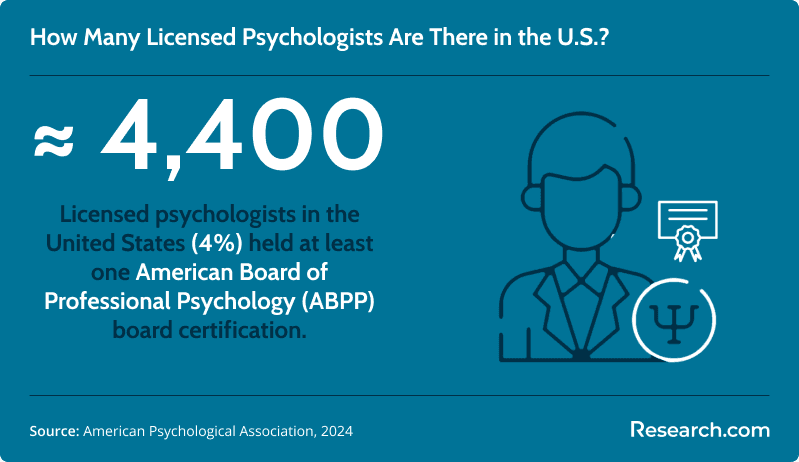
The image below shows the estimated number of licensed psychologists who held at least one American Board of Professional Psychology (ABPP) certification. ABPP is the main U.S. organization for specialty board certification in psychology, with 15 specialty boards and two subspecialty boards.
Which states recognize master’s-level psychology licensing?
Psychology licensing is controlled at the state level, so the same degree can lead to different outcomes depending on where you plan to work. The table below lists states that offer some form of master’s-level psychology-related license, credential, or school psychology pathway, along with the title used in that state.
| State or jurisdiction | Master’s-level psychology-related title listed |
| Alabama | Psychological Technician; School Psychologist |
| Alaska | Licensed Psychological Associate; School Psychologist |
| Arizona | School Psychologist |
| Arkansas | Psychological Examiner |
| California | Registered Psychological Associate; Licensed Educational Psychologist |
| Colorado | Psychological Associate |
| Connecticut | School Psychologist |
| Delaware | School Psychologist |
| District of Columbia | School Psychologist; Psychological Associate |
| Florida | School Psychologist |
| Georgia | Non-Renewable School Psychologist |
| Hawaii | Psychological Associate |
| Idaho | School Psychologist |
| Illinois | School Psychologist |
| Indiana | School Psychologist |
| Iowa | School Psychologist |
| Kansas | School Psychologist; Psychological Associate |
| Kentucky | Licensed Psychological Associate; School Psychologist |
| Louisiana | School Psychologist (Standard Certificate Level B) |
| Maine | Psychological Examiner |
| Maryland | School Psychologist; Psychology Associate |
| Massachusetts | School Psychologist |
| Michigan | Master’s Limited Psychologist License; School Psychologist |
| Minnesota | School Psychologist |
| Montana | School Psychologist |
| Nebraska | Psychological Assistant; School Psychologist |
| Nevada | Psychological Assistant; School Psychologist |
| New Hampshire | School Psychologist |
| New Jersey | School Psychologist |
| New Mexico | School Psychologist; Psychological Associate |
| New York | School Psychologist |
| North Dakota | School Psychologist |
| Ohio | School Psychologist |
| Oklahoma | School Psychologist |
| Oregon | Psychologist Associate – Supervised or Independent |
| Pennsylvania | School Psychologist |
| Rhode Island | School Psychologist |
| South Carolina | School Psychologist I |
| South Dakota | School Psychological Examiner Endorsement |
| Tennessee | Psychological Assistant |
| Texas | Licensed Specialist in School Psychology; Licensed Psychological Associate |
| Utah | School Psychologist |
| Vermont | Master-level Psychologist |
| Virginia | School Psychologist |
| Washington | School Psychologist |
| West Virginia | Psychologist; School Psychologist |
| Wyoming | School Psychologist |
The pattern is clear: school psychology is the most common master’s-level route. Students who want a broader clinical psychology role should be especially cautious because many states still require a doctoral degree for independent psychologist licensure. If your state offers only limited or school-based credentials, an on-campus or affordable online master’s in psychology may still be valuable, but it may function as preparation for supervised work, school certification, counseling-adjacent roles, or future doctoral study.
Students comparing helping professions sometimes look at adjacent education and disability-support programs, such as an MSD degree in special education, because both fields involve assessment, intervention planning, and support for people with learning, developmental, emotional, or behavioral needs. The better choice depends on whether you want to work primarily through psychological services, education systems, disability support, or school-based intervention.
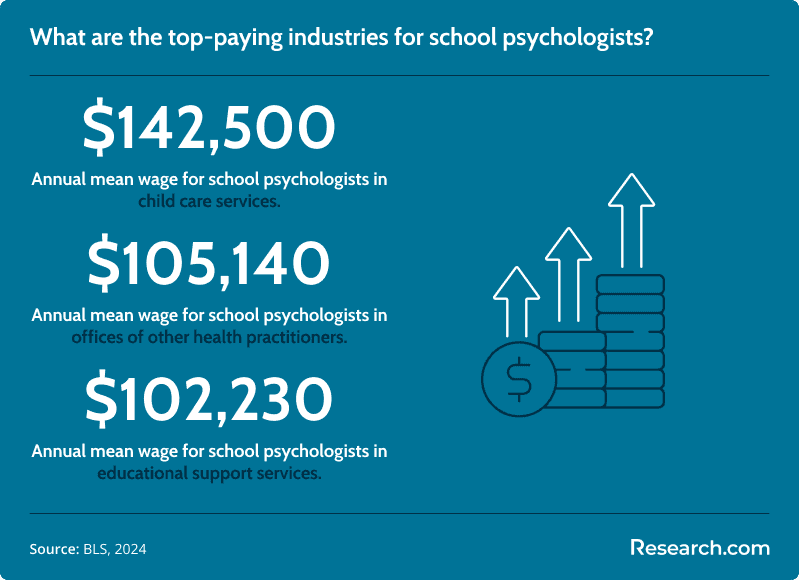
Because so many master’s-level credentials are tied to school psychology, salary and employment patterns for school psychologists are especially relevant when evaluating this pathway.
How long does a master’s in psychology take?
Most master’s in psychology programs take 2 to 3 years for full-time students, but the timeline depends on enrollment status, program format, fieldwork requirements, and whether the degree includes a thesis, capstone, practicum, or internship.
| Enrollment option | Typical completion time | Best fit |
| Full-time study | Usually 2 years | Students who can prioritize graduate school and complete coursework, practicum, and a thesis or capstone on a traditional schedule. |
| Part-time study | Often 3 to 5 years | Working adults, caregivers, and students who need a slower course load. |
| Online or accelerated format | Some programs can be completed in as little as 18 months | Students who can handle an intensive pace and want a shorter timeline through an accelerated psychology master’s program. |
Research-oriented programs may take longer if the thesis process extends beyond the coursework sequence. Clinical, counseling, school psychology, and assessment-focused programs may also require supervised placements that depend on site availability. If licensure is your goal, do not choose the shortest program automatically; choose the program that meets your state’s coursework, practicum, internship, and supervision requirements.
What are the admission requirements for a master’s in psychology?
Admissions standards vary, but most programs evaluate academic preparation, writing ability, research or field experience, and fit with the program’s faculty or specialization. Competitive programs may expect stronger preparation in statistics, research methods, and core psychology coursework.
| Requirement | What applicants should prepare |
| Bachelor’s degree | A completed undergraduate degree from an accredited institution, often in psychology or a related field. Applicants from other majors may need prerequisite courses. |
| Minimum GPA | Many programs look for a minimum undergraduate GPA, frequently around 3.0 on a 4.0 scale, and may review grades in psychology and research courses. |
| Prerequisite coursework | Common prerequisites include introductory psychology, statistics, research methods, developmental psychology, social psychology, or abnormal psychology. |
| Official transcripts | Transcripts from every college or university attended, including any previous graduate coursework. |
| Letters of recommendation | Usually 2 to 3 letters from professors, research supervisors, field supervisors, or employers who can assess your readiness for graduate study. |
| Statement of purpose | An essay explaining your academic background, career goals, research interests, reasons for choosing the program, and intended licensure or professional path. |
| Resume or CV | A summary of education, work experience, research, internships, volunteer roles, presentations, publications, or relevant certifications. |
| Standardized tests | Some programs require GRE scores, some make them optional, and others no longer use them. A psychology subject GRE may be requested in limited cases. |
| Research or practical experience | Prior research assistantships, behavioral health work, crisis line service, school experience, or clinical support roles can strengthen an application. |
| Writing sample | Some programs request an academic paper, thesis excerpt, or research-based writing sample. |
| Interview | Select programs use interviews to assess communication skills, maturity, professional goals, and fit with faculty or practicum expectations. |
Applicants planning to move into administrative, organizational, or leadership roles after graduate study may also compare traditional degrees with alternative graduate formats. A guide to executive master’s vs. master’s degrees can help clarify which structure fits a long-term leadership plan, although psychology licensure programs usually require specific professional and supervised training components.
What courses are included in a master’s in psychology?
A master’s in psychology typically combines psychological theory, research design, statistics, ethics, assessment, and applied practice. The exact curriculum depends on whether the program emphasizes research, clinical preparation, counseling, school psychology, industrial-organizational psychology, forensic psychology, or another concentration.
Students comparing campus-based and online psychology master’s programs should look beyond course titles and confirm whether the curriculum meets licensure, certification, or doctoral-preparation goals.
| Course area | What students learn |
| Foundations of Psychology | Major theories, historical developments, and current issues in psychological science and practice. |
| Research Methods in Psychology | Experimental design, qualitative and quantitative research, data collection, validity, and ethical research procedures. |
| Statistics for Behavioral Sciences | Data analysis methods used in psychology, including regression, ANOVA, and statistical software. |
| Ethics and Professional Issues | Confidentiality, informed consent, boundaries, professional responsibility, documentation, and ethical decision-making. |
| Psychological Assessment | Testing principles, cognitive and personality assessment, behavioral measures, scoring, interpretation, and reporting. |
| Human Development | Cognitive, emotional, social, and behavioral development from infancy through adulthood. |
| Cognitive Psychology | Attention, memory, perception, learning, problem-solving, and decision-making. |
| Social Psychology | How groups, culture, relationships, social influence, and context shape behavior. |
| Biopsychology or Neuropsychology | Brain-behavior relationships, nervous system function, hormones, and biological influences on behavior. |
How much does a master’s in psychology cost in the U.S.?
The price of a master’s in psychology depends on the institution, residency status, delivery format, program length, fees, and living expenses. Tuition alone does not show the full cost, especially for students who must complete unpaid fieldwork or reduce work hours during practicum or internship terms.
| Program type | Typical tuition range stated | Cost considerations |
| Public university, in-state | About $8,000 to $20,000 per year for tuition | Often the lowest tuition option for residents, but fees, commuting, and fieldwork costs still matter. |
| Public university, out-of-state | About $15,000 to $30,000+ per year for tuition | Nonresident tuition can narrow the cost gap between public and private options. |
| Private university | About $20,000 to $50,000+ per year in tuition | Costs may be higher for elite, highly specialized, or clinically intensive programs. |
Students should also budget for technology fees, student service fees, lab or practicum supervision fees, books, testing materials, transportation, background checks, liability insurance, and living expenses. Housing, food, and transportation can vary sharply by location and may become a major part of the total cost of attendance.
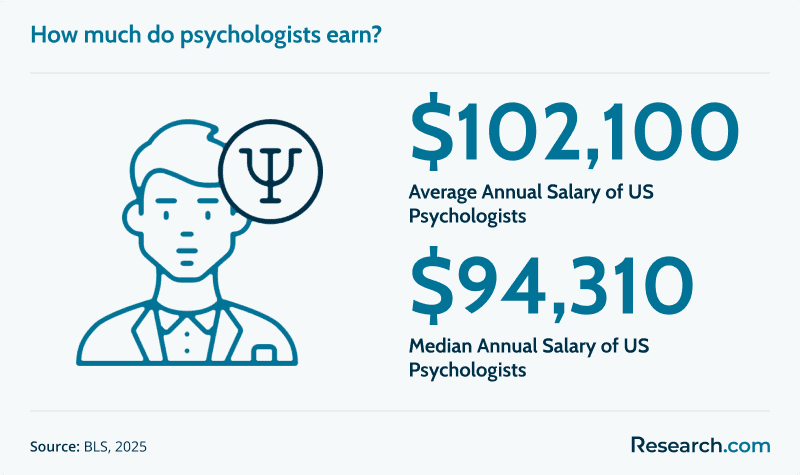
The image below shows average earnings for licensed psychologists in the U.S. It also illustrates why some students use the master’s degree as one step toward doctoral study and the highest-paying psychology careers. That said, return on investment is not guaranteed and depends on licensure, location, debt, specialization, employer type, and whether the student eventually earns a doctorate.
Students trying to lower total debt can compare public options, in-state tuition, employer support, assistantships, and mission-driven institutions. Some may also review affordable HBCU programs in psychology or related fields as part of a broader cost comparison.
What financial aid options are available for master’s in psychology students?
Graduate psychology students can use several funding sources, but availability varies by school and program type. Research-focused programs may offer more assistantships, while professionally oriented online programs may rely more heavily on loans, employer tuition assistance, or scholarships.
| Funding option | How it works | What to ask before relying on it |
| Scholarships | Merit-based or criteria-based awards from schools, professional associations, nonprofits, or private donors that do not need repayment. | Is the award renewable, and does it apply to graduate psychology students in your specialization? |
| Grants | Need-based funding from federal, state, institutional, or private sources that generally does not require repayment. | Are graduate students eligible, and is the grant tied to enrollment level? |
| Graduate assistantships or fellowships | Teaching, research, or administrative roles that may provide a stipend and/or tuition remission. | How many hours are required, and will the workload fit with practicum or internship demands? |
| Federal student loans | Graduate students who complete the FAFSA may qualify for federal loans with standardized borrower protections. | What will your total debt be at graduation, and what salary range is realistic for your intended role? |
| Loan forgiveness or repayment assistance | Programs may support graduates working in public service, nonprofit, or underserved settings if specific rules are met. | Which employer types qualify, and what documentation is required? |
| Work-study or part-time employment | Campus or department-based work can help cover living expenses or smaller educational costs. | Will work hours interfere with coursework, clinical training, or research obligations? |
| Employer tuition reimbursement | Employers may cover part or all of tuition when the degree supports the employee’s current or future role. | Is there a grade requirement, annual cap, repayment clause, or required work commitment after graduation? |
One practical way to assess affordability is to compare psychology with other credential-driven fields where certification, licensure, and salary potential affect repayment capacity. For example, Research.com’s discussion of whether CISSP certification can increase salary is from a different industry, but it illustrates a useful principle: credentials only improve ROI when they are recognized by employers and connected to clear career opportunities.
What specializations are available in a master’s in psychology?
Your specialization matters because it shapes your coursework, fieldwork, licensure eligibility, job settings, and long-term advancement options. A general psychology degree may be useful for research, administration, or doctoral preparation, but students seeking a regulated clinical, counseling, or school role should choose a program designed for that credential.
| Specialization | Primary focus | Potential career direction |
| Clinical Psychology | Assessment, diagnosis, intervention, and evidence-based treatment of mental health conditions. | Supervised clinical roles, doctoral preparation, or related mental health work depending on state rules. |
| Counseling Psychology | Emotional, relational, social, career, and life-adjustment concerns with an emphasis on well-being and coping. | Counseling-related roles, therapy pathways where the degree meets state requirements, or human services work. |
| Industrial-Organizational Psychology | Workplace behavior, hiring, training, leadership, motivation, employee assessment, and performance. | HR analytics, organizational consulting, talent development, or workforce research. |
| Forensic Psychology | The intersection of psychology, law, courts, corrections, and public safety. | Correctional settings, victim services, court-related support roles, or doctoral preparation. |
| School Psychology | Student learning, behavior, assessment, intervention, consultation, and school-based mental health support. | School psychologist or related educational services credential, depending on state requirements. |
| Health Psychology | Connections among behavior, mental health, illness, prevention, wellness, and healthcare systems. | Healthcare support, wellness programs, rehabilitation settings, or research roles. |
| Developmental Psychology | Behavioral, cognitive, social, and emotional change across the lifespan. | Education, research, child and family services, aging services, or program development. |
Some universities also offer focused study in neuropsychology, sports psychology, community psychology, applied behavior analysis, or trauma-informed practice. Before choosing a concentration, ask whether it leads to a license, prepares you for a specific workforce need, or mainly strengthens your application for doctoral study. For a broader career comparison, review what you can do with a master’s degree in psychology by specialization and setting.
What is the job outlook for master’s in psychology graduates?
The employment outlook depends on specialization, licensure, state rules, and whether the role is considered psychology, counseling, school services, social services, or organizational work. Demand is strongest where graduates qualify for clearly defined roles, especially in mental health counseling, behavioral health, marriage and family therapy, school-based services, and community support.
According to the U.S. Bureau of Labor Statistics, employment for substance abuse, behavioral disorder, and mental health counselors is projected to grow by around 17% from 2024 to 2034, which is much faster than the average for all occupations. Marriage and family therapists are projected to grow by 13% from 2024 to 2034. Clinical, counseling, and school psychology roles also remain relevant, although the required degree level and independence vary by state and employer.
Several factors are influencing demand: more people are seeking mental health services, schools are paying closer attention to student mental health and learning needs, and healthcare and community agencies need professionals who can support behavioral health, assessment, intervention, and care coordination. At the same time, graduates without licensure, field experience, or a clear specialization may face more limited job options.
| Occupation | Projected Employment Growth (2024-2034) | Projected Employment (2024-2034) | Median Annual Salary |
| Industrial-organizational psychologists | 6% | 300 | $109,840 |
| Clinical and counseling psychologists | 11% | 8,500 | $95,830 |
| School psychologists | 1% | 500 | $86,930 |
| School and career counselors and advisors | 4% | 13,300 | $65,140 |
| Marriage and family therapists | 13% | 9,800 | $63,780 |
| Rehabilitation counselors | 1% | 1,300 | $46,110 |
| Substance abuse, behavioral disorder, and mental health counselors | 17% | 81,000 | $59,190 |
What skills do students build in a master’s in psychology?
A psychology master’s can develop skills that transfer across clinical, educational, research, nonprofit, healthcare, human resources, and consulting environments. Some of the advantages and disadvantages of working as a psychologist also connect to these skills: the work can be meaningful and intellectually engaging, but it requires emotional resilience, ethical discipline, and ongoing professional development.
- Research and analysis: Students learn to design studies, evaluate evidence, interpret data, and apply findings to practical questions.
- Critical thinking: Graduate training emphasizes careful reasoning, bias recognition, and evidence-based decision-making.
- Communication: Students practice professional writing, case documentation, presentations, interviewing, and clear explanation of complex behavioral concepts.
- Ethical judgment: Programs cover confidentiality, informed consent, boundaries, cultural humility, documentation, and professional responsibility.
- Assessment and evaluation: Students may learn testing principles, behavioral observation, scoring, interpretation, and report writing.
- Counseling and intervention skills: Clinical and counseling-oriented programs may teach active listening, empathy, crisis response, treatment planning, and therapeutic techniques.
- Cultural competence: Students examine how identity, culture, socioeconomic context, disability, trauma, and systems affect behavior and care.
- Problem-solving: Psychology training helps students connect behavior, environment, development, cognition, and emotion when designing interventions.
- Collaboration and leadership: Group projects, fieldwork, research teams, and interdisciplinary placements build teamwork and coordination skills.
How do you choose an accredited master’s in psychology program?
Accreditation and licensure alignment should come before convenience, speed, or brand recognition. A program can be legitimate academically but still fail to meet a specific state’s professional licensing requirements. Students should verify institutional accreditation, program-level recognition where relevant, state board approval, supervised training requirements, and graduate outcomes before enrolling.
| What to verify | Why it matters | Question to ask the school |
| Institutional accreditation | Accreditation affects credit transfer, financial aid eligibility, employer acceptance, and graduate school options. | Which recognized accreditor accredits the institution? |
| Licensure alignment | State boards may require specific coursework, practicum hours, exams, and supervision. | Does this program meet requirements for my intended license in my state? |
| Field placement support | Clinical, school, and assessment pathways often depend on supervised practicum or internship access. | Does the program place students, approve student-found sites, or require students to secure their own placements? |
| Faculty expertise | Faculty background can affect research mentoring, clinical preparation, and specialization depth. | Who teaches and supervises students in my intended concentration? |
| Graduate outcomes | Employment, licensure pass rates, doctoral placement, and completion rates help evaluate program value. | What outcomes do graduates achieve in this specialization? |
| Total cost | Tuition is only one part of the investment; fees, travel, unpaid fieldwork, and delayed earnings also matter. | What is the full estimated cost of attendance through graduation? |
| Online student support | Online programs vary widely in advising, placement support, research access, and faculty availability. | What support is available for online students in my state? |
Students comparing psychology with behavioral analysis pathways may also review affordability-focused resources such as the most affordable online BCBA programs. This can be useful when deciding whether psychology, counseling, school psychology, applied behavior analysis, or another behavioral health route best fits your licensure and career goals.
Is a master’s in psychology worth it?
A master’s in psychology can be worth it when the degree is aligned with a specific license, job role, doctoral plan, or applied specialization. It is less likely to pay off when students choose a general program without checking state requirements, field placement access, or realistic employment outcomes.
| A master’s in psychology may be a strong fit if... | You may want another path if... |
| You want school psychology, psychological associate, assessment, research, organizational, or supervised mental health roles. | You want fully independent psychologist licensure in a state that requires a doctorate. |
| Your chosen program meets the exact requirements for your intended credential. | The program cannot confirm licensure alignment for your state. |
| You are comfortable with supervised practice, additional exams, or future doctoral study if needed. | You need the fastest route to independent therapy practice and a counseling, MFT, or social work degree would be more direct. |
| You have compared total cost, debt, expected salary, and fieldwork requirements. | You are choosing mainly because the program is convenient, short, or heavily advertised. |
Current trends affecting master’s-level psychology careers
- Mental health demand remains high: Counseling, behavioral health, and school support roles continue to be important as individuals, families, schools, and communities seek more accessible services.
- Licensure rules remain state-specific: Mobility can be challenging because a degree that supports one state credential may not satisfy another state’s requirements.
- Telehealth and hybrid service delivery are now common: Graduates may need comfort with digital platforms, remote documentation, privacy rules, and virtual communication.
- Employers value applied experience: Practicum, internship, assessment experience, crisis work, research involvement, and supervised client contact can separate candidates from graduates with only classroom training.
- AI is changing support tasks, not replacing professional judgment: AI tools may assist with scheduling, documentation drafts, literature searches, and data organization, but ethical care, assessment interpretation, diagnosis, and intervention require trained human oversight.
Common mistakes to avoid
- Choosing a program before checking licensure rules: Always start with the state board or education agency requirements for the license you want.
- Assuming all psychology master’s degrees lead to therapy licensure: Some programs are research-focused, general, or doctoral-preparation programs rather than licensure programs.
- Looking only at tuition: Fees, living expenses, unpaid fieldwork, travel, books, testing materials, and lost work hours can change affordability.
- Ignoring online program restrictions: An online program may not be authorized for field placements or licensure preparation in every state.
- Relying only on rankings: Rankings can be useful, but licensure fit, cost, placement support, and outcomes matter more.
- Assuming salaries are guaranteed: Pay varies by state, employer, license, experience, specialization, and whether a doctoral degree is required.
- Overlooking supervision requirements: A credential may allow practice only under supervision, which can affect independence, duties, and income.
Questions to ask before enrolling
- Which exact license or credential does this program prepare students for?
- Does the program meet requirements in the state where I plan to work?
- How many practicum, internship, or supervised field hours are included?
- Who is responsible for finding field placements?
- What percentage of graduates complete the program, gain employment, or continue to doctoral study?
- What exams or post-graduate supervised hours are required after graduation?
- What is the full cost of attendance, including fees and fieldwork-related costs?
- Can credits transfer into a doctoral program if I decide to continue?
- Are online students eligible for the same advising, research, and placement support as campus students?
- What happens if I move to another state after graduation?
Here’s What Master’s in Psychology Graduates Say About Their Careers
- Alexis: "My master’s in psychology changed the direction of my work. I moved from a case management role into licensed therapy, where I now meet with clients and support them through mental health challenges. The degree gave me both the required preparation and the confidence to take on more direct clinical responsibility."
- Jordan : "Graduate study helped me understand behavior, communication, and empathy in a much deeper way. The courses on cognition and human development changed how I relate to clients, colleagues, and community members. Working in counseling and outreach now feels purposeful because I can see the impact of that training every day."
- Taylor : "My psychology master’s gave me the research foundation I needed for university-based work. I built skills in data analysis, study design, and critical evaluation, and those skills now support my role as a research coordinator. The experience also helped me decide that I may pursue a Ph.D. later.”"
References
- American Psychological Association. (2024). CWS data tool: Degrees in Psychology. APA.
- Online Masters Degrees. (n.d.). The Psychology License Map: A State-by-State Guide. OMD.
- Salary.com. (2025, October 1). Psychology-M.A. Salary in the United States. Salary.com.
- United States Bureau or Labor Statistics. (2025). Occupational Employment and Wage Statistics Query System. BLS.
- United States Bureau of Labor Statistics. (2024, April 3). Occupational Employment and Wages | 19-3034 School Psychologists. BLS.
- United States Bureau of Labor Statistics. (2025, August 28). Occupation Outlook Handbook | Marriage and Family Therapists. BLS.
- United States Bureau of Labor Statistics. (2025, August 28). Occupation Outlook Handbook | Psychologists. BLS.
- United States Bureau of Labor Statistics. (2025, August 28). Occupation Outlook Handbook | Rehabilitation Counselors. BLS.
- United States Bureau of Labor Statistics. (2025, August 28). Occupation Outlook Handbook | School and Career Counselors and Advisors. BLS.
- United States Bureau of Labor Statistics. (2025, August 28). Occupation Outlook Handbook | Substance Abuse, Behavioral Disorder, and Mental Health Counselors. BLS.
Key Insights
- A master’s in psychology can lead to licensure in some states, but independent psychologist licensure usually requires a doctoral degree.
- School psychology is the most widely available master’s-level psychology pathway across states.
- License titles such as psychological associate, psychological examiner, psychological technician, and master-level psychologist have different scopes of practice, supervision rules, and work settings.
- Most master’s programs take 2 to 3 years full time, while part-time study can take 3 to 5 years and some accelerated online options may take as little as 18 months.
- Cost varies widely: public in-state tuition is about $8,000 to $20,000 per year, public out-of-state tuition is about $15,000 to $30,000+ per year, and private university tuition is about $20,000 to $50,000+ per year.
- The strongest program choice is the one that matches your state’s licensing rules, includes required fieldwork, provides placement support, and leads to a realistic job or doctoral pathway.
- Do not enroll based only on speed, tuition, or convenience. Verify accreditation, licensure alignment, supervision requirements, total cost, and graduate outcomes first.
Other Things You Should Know About Where You Can Get Licensed With a Master's in Psychology
In 2027, obtaining a psychology license with a master's degree typically involves completing a master's program, obtaining supervised clinical experience, and passing a licensure examination specific to the state where you intend to practice. Requirements may vary by state, so it is essential to check the local licensing board’s specific criteria.
Several state boards license master’s-level practitioners under titles such as psychological associate, psychological assistant, or limited license psychologist. Examples include California’s Board of Psychology, Oregon’s Board of Psychology, and North Carolina’s Psychology Board, each with supervised hours, exam, and registration requirements.


