
2027 Easiest Kinesiology Degree Programs

Co-Founder and Chief Data Scientist
Choosing an “easy” kinesiology degree usually does not mean choosing a program with light science requirements. Kinesiology still involves anatomy, physiology, biomechanics, exercise testing, research methods, and applied practice. For most students, the easier path is the one with flexible scheduling, generous transfer credit policies, clear degree requirements, online or hybrid options, strong advising, and practical experiences that fit their career goals.
This guide is for students comparing accessible kinesiology programs, working adults who need a flexible route into exercise science or health-related careers, and future professionals deciding whether kinesiology is the right academic path. You will learn what kinesiology programs cover, how long they take, what they cost, which careers they may support, how online and campus formats compare, and how to avoid choosing a program that looks convenient but does not meet your long-term goals.
Quick Answer: What Is the Easiest Kinesiology Degree Path?
The easiest kinesiology degree path is typically a regionally accredited bachelor’s program that accepts transfer credits, offers online or flexible courses, has clearly defined concentration options, and includes local internship or hands-on learning opportunities. A bachelor’s degree is commonly the minimum education expected for many kinesiology-related roles, while advanced clinical careers such as physical therapy, occupational therapy, athletic training, or research usually require graduate education, certification, licensure, or both.
| Student Goal | Best-Fit Kinesiology Option | Why It May Be Easier |
| Finish a bachelor’s degree while working | Online or hybrid BS in Kinesiology | Flexible scheduling, fewer campus visits, and easier work-school balance |
| Use previous college credits | Transfer-friendly bachelor’s program | Can reduce duplicated coursework and shorten time to graduation |
| Prepare for athletic training | Combined BS/MS or 3+2 pathway | Creates a structured route from undergraduate study into graduate preparation |
| Enter fitness, wellness, or coaching | Bachelor’s with exercise science, health, fitness, or coaching concentration | Aligns coursework with entry-level applied roles and industry certifications |
| Prepare for physical therapy or occupational therapy | Kinesiology degree with pre-health advising | Helps students complete prerequisite science courses for graduate applications |
Why Get a Degree in Kinesiology?
- A kinesiology degree can support several career directions, including fitness training, exercise physiology, coaching, rehabilitation support, wellness programming, and preparation for graduate study in physical therapy, occupational therapy, sports psychology, or related health fields.
- Salary outcomes vary widely by role, location, credentials, and experience. Zippia reports that kinesiologists earn a median salary of approximately $54,000 per year, while higher earners can reach $100,000 or more.
- Online kinesiology programs can be useful for students who need to continue working, care for family, or study from a location far from campus. The best online programs still require applied learning, labs, internships, or supervised fieldwork when those experiences are necessary for career preparation.
What Can I Expect From a Kinesiology Degree?
A kinesiology degree studies human movement and how physical activity affects health, performance, injury prevention, and recovery. Students learn how muscles, bones, joints, nerves, energy systems, behavior, nutrition, and training principles interact during movement and exercise.
Most programs combine classroom learning with applied work. You may complete science courses, movement analysis labs, fitness assessments, research projects, internships, or field placements. Strong programs help students connect theory to real situations such as designing exercise programs, evaluating movement patterns, supporting injury prevention, or promoting healthy behavior across different populations.
| Program Component | What You Usually Learn | Why It Matters |
| Foundational sciences | Anatomy, physiology, chemistry, biology, and statistics | Builds the scientific base needed for exercise science and healthcare-related graduate programs |
| Movement science | Biomechanics, motor learning, exercise physiology, and movement assessment | Helps students understand how the body moves and adapts to training or rehabilitation |
| Applied health and performance | Exercise prescription, strength training, sport performance, nutrition, and wellness | Prepares students for fitness, wellness, coaching, and performance-related roles |
| Experiential learning | Labs, internships, clinical observation, or community-based projects | Gives students practical experience and professional contacts before graduation |
| Specialized electives | Sports medicine, rehabilitation science, public health, coaching, or pre-health coursework | Allows students to match the degree to a specific career or graduate-school plan |
Where Can I Work With a Kinesiology Degree?
Kinesiology graduates work in healthcare, fitness, wellness, education, sports, recreation, research, and community health settings. Some roles are available with a bachelor’s degree and relevant certifications, while clinical or licensed careers often require graduate school and state-specific credentials.
Common workplaces include hospitals, rehabilitation clinics, sports medicine practices, fitness centers, school athletic departments, university research labs, wellness centers, corporate wellness programs, community health organizations, government agencies, and military or tactical performance environments.
| Work Setting | Possible Roles | Important Note |
| Healthcare and rehabilitation | Exercise physiologist, rehabilitation aide, physical therapy aide, clinical wellness support | Advanced clinical roles may require a graduate degree and licensure |
| Fitness and wellness | Personal trainer, fitness program manager, health coach, wellness coordinator | Industry certifications can improve employability |
| Sports and athletics | Coach, strength and conditioning assistant, athletic performance support | Athletic training has specific accredited education and certification requirements |
| Education and community programs | Physical activity coordinator, recreation specialist, youth sports coach | Teaching roles may require state educator licensure |
| Research and academia | Research assistant, lab coordinator, graduate researcher | Research careers usually require graduate-level study |
How Much Can I Make With a Kinesiology Degree?
Pay in kinesiology depends heavily on job title, state, employer, experience, specialization, and whether the role requires additional certification or graduate education. Zippia reports an average hourly rate for kinesiologists of approximately $26.37.
Reported earnings vary substantially. Zippia lists top earners at about $104,000 annually, while lower-end earners may make around $28,000. Entry-level positions typically begin around $28,829 per year, with reported growth to about $43,094 within five years of graduation.
Role selection matters. ZipRecruiter’s 2025 salary data shows Fitness Program Managers earning $107,460 annually, while massage therapist interns make $71,679. These figures should be used as comparison points rather than guaranteed outcomes because employers define job titles differently.
Location also affects earning potential. Zippia lists the following top five states for average annual kinesiologist salaries:
- Massachusetts - $83,878
- Alaska - $82,952
- California - $79,737
- Connecticut - $75,416
- New Jersey - $73,644
Students seeking higher long-term earnings should compare undergraduate kinesiology options with the education required for advanced roles such as physical therapy, occupational therapy, athletic training, clinical exercise physiology, sports performance leadership, or healthcare management.
- Easiest kinesiology degree programs for 2027
- How long kinesiology programs usually take
- Online vs. on-campus kinesiology degrees
- Typical kinesiology degree costs
- Financial aid options for kinesiology students
- Kinesiology admission prerequisites
- Common kinesiology courses
- Accreditation and licensing considerations
- How to balance affordability and quality
- Whether kinesiology is worth the investment
- Technology trends in kinesiology education
- Certifications and licensure steps to review
- Networking for kinesiology careers
- Online support services and interactive tools
- Advanced degrees in kinesiology
- Accelerating your kinesiology education
- Kinesiology specializations
- Interdisciplinary collaboration
- How to choose a kinesiology program
- Career paths for kinesiology graduates
- Kinesiology job market outlook
- Skills needed for kinesiology careers
List of Easiest Kinesiology Degree Programs for 2027
How We Evaluated Programs
Kinesiology is not a shortcut degree. Students still need to master human movement, exercise science, health promotion, injury prevention, and applied assessment. For this list, “easy” refers to programs that may be more accessible because they offer flexible formats, higher acceptance opportunities, accelerated pathways, transfer-friendly policies, practical support, or clearer scheduling options.
Our research process used credible education data sources, including the College Scorecard database, the IPEDS database, the National Center for Education Statistics, and Peterson’s database, including its Distance Learning Licensed Data Set. You can also review the full Research.com ranking methodology.
| School | Program | Why It May Be Accessible | Credits | Accreditation |
| East Central University | Online Bachelor of Science in Kinesiology | 100% online delivery, 8-week sessions, hands-on training, and up to 90 transfer credits | 120 credits | Higher Learning Commission (HLC) |
| Grand View University | BS in Kinesiology + MS in Athletic Training 3+2 Program | Structured route allowing qualified students to earn a BS after year 4 and a master’s after year 5 | 155 credits | Commission on Accreditation of Athletic Training Education (CAATE) |
| Lewis-Clark State College | Bachelor’s in Kinesiology | Small classes, hands-on learning, five emphasis areas, and a kinesiology minor option | 120-128 credits | Northwest Commission on Colleges and Universities (NWCCU) |
| Adams State University | Bachelor of Science in Kinesiology | Practical learning focus, laboratories, performance testing equipment, and a five-year bachelor + master’s option | 125-129 credits | Higher Learning Commission (HLC) |
| Montana State University | BS in Kinesiology | Flexible curriculum, smaller class sizes, labs, internships, and practical preparation | 120 credits | Northwest Commission on Colleges and Universities (NWCCU) |
1. East Central University Online Bachelor’s in Kinesiology
East Central University is a public university in Ada, Oklahoma. Its 100% online Bachelor of Science in Kinesiology uses 8-week sessions and includes hands-on training. The program may be especially useful for transfer students because ECU accepts up to 90 transfer credits and has partnerships with several local community colleges. Coursework includes areas such as sports nutrition, first aid, care and prevention of athletic injuries, and psychology of sports.
- Program length: Approximately four years
- Track/concentration: BS in Kinesiology
- Cost per credit: $321.80 per credit for residents and $638.80 per credit for non-residents.
- Credits required: 120 credits (accepts up to 90 transfer credits)
- Accreditation: Higher Learning Commission (HLC)
2. Grand View University Master’s in Athletic Training 3+2 Program
Grand View University is a private nonprofit institution in Des Moines, Iowa, affiliated with the Evangelical Lutheran Church in America. Its 3+2 pathway allows BS Kinesiology students to apply to the Master of Science in Athletic Training during their third year. Students who qualify can complete the bachelor’s degree after year 4 and the master’s degree after year 5. Graduates of the pathway are eligible to sit for the national certification test for athletic trainers.
- Program length: Five years
- Track/concentration: BS in Kinesiology + MS in Athletic Training
- Cost per credit: GV provides an estimate of $35,476 per semester in tuition for full-time undergraduate students; graduate tuition for the MS in Athletic Training program is $595 per credit hour
- Credits required: 155 credits (100 credit hours for the undergraduate program and 55 credit hours for the graduate degree)
- Accreditation: Commission on Accreditation of Athletic Training Education (CAATE)
3. Lewis-Clark State College Bachelor’s in Kinesiology
Lewis-Clark State College is a public college in Lewiston, Idaho, founded in 1893. Its bachelor’s program in kinesiology offers five emphasis areas and may appeal to students who want a smaller learning environment, personalized instruction, and applied learning. The school also offers kinesiology as a minor.
- Program length: Approximately four years
- Tracks/concentrations:
- Coaching
- Exercise Science and Health Occupations
- Health and Fitness
- Secondary Education
- Sport Studies
- Cost per credit: $389 per credit for part-time students (1-9 credits), $3,805 fixed rate tuition for part-time learners (10-11 credits) and full-time enrollees (12-19 credits)
- Credits required: 120-128 credits
- Accreditation: Northwest Commission on Colleges and Universities (NWCCU)
4. Adams State University Bachelor’s in Kinesiology
Adams State University is a public university in Alamosa, Colorado. Its Bachelor of Science in Kinesiology emphasizes student experience, applied learning, performance testing equipment, and laboratory-based preparation. ASU reports that 99% of its kinesiology graduates are employed within 90 days after graduating. Students can pursue the BS track, a kinesiology minor, or a five-year bachelor + master’s option.
- Program length: Four Years
- Tracks/concentrations:
- Exercise Science
- Sports and Exercise Studies
- Sport and Recreation Management
- Cost per credit: $371 per credit for Colorado residents and $760 for non-residents
- Credits required: 125-129 credits
- Accreditation: Higher Learning Commission (HLC)
5. Montana State University Bachelor’s in Kinesiology
Montana State University is the largest university in Montana. Its BS in Kinesiology includes a flexible curriculum, hands-on labs, internship opportunities, smaller class sizes, and applied preparation in human movement and performance. The program can be a practical fit for students who want faculty support and experiential learning while preparing for certifications, graduate school, or entry-level roles.
- Program length: Approximately four years
- Tracks/concentrations:
- Exercise Science
- Health and Fitness
- Cost per credit: MSU provides a quote of $4,230 in tuition and fees per semester for residents and $16,444 for non-residents
- Credits required: 120 credits
- Accreditation: Northwest Commission on Colleges and Universities (NWCCU)
What Students Often Value in Kinesiology Programs
- Flexible online delivery can make the degree more manageable for students balancing coursework with employment, family responsibilities, or commuting limits.
- Applied learning matters because kinesiology is a movement-based field; students should look for labs, internships, simulations, field experiences, or local placements.
- Programs with active advising can help students select the right prerequisites for graduate school, certifications, or immediate employment.
Key Findings
- Accessible kinesiology programs often combine flexible scheduling, transfer credit acceptance, accelerated options, and practical support rather than reducing academic rigor.
- A bachelor’s degree in kinesiology commonly takes four years, while graduate study may add two to six years depending on the degree type, specialization, and research requirements.
- A bachelor’s degree is often the baseline credential for many kinesiology-related jobs, but licensed clinical careers usually require additional graduate education or certification.
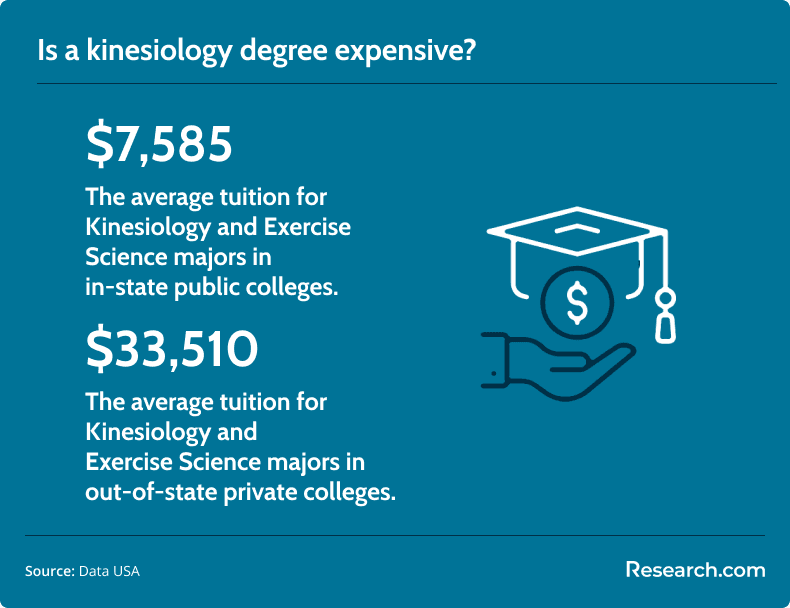
- Data USA reports median tuition of $7,585 for a kinesiology degree at an in-state public institution, while a kinesiology degree from a private out-of-state school can cost as much as $33,510.
- Kinesiology students may use scholarships, grants, federal aid, institutional aid, work-study, private loans, and profession-specific awards to reduce out-of-pocket costs.
- The US Bureau of Labor Statistics projects a 9% growth in jobs for exercise physiologists from 2024 to 2024, driven by attention to health, wellness, and fitness across several industries.
How Long Does It Take to Complete a Kinesiology Program?
The completion timeline depends on degree level, enrollment status, transfer credits, and whether the program offers accelerated sessions or part-time pacing.
| Degree Level | Typical Full-Time Timeline | Best For | Important Consideration |
| Bachelor’s degree | Four years | Students seeking entry-level roles or preparation for graduate study | Transfer credits and summer courses may shorten the timeline |
| Master’s degree | Two years | Students pursuing advanced roles, specialization, or research preparation | Part-time and online formats may take three or more years |
| Doctoral degree | Four to six years | Students interested in research, academia, or advanced expertise | Research requirements and dissertation timelines can extend completion |
Online programs may give students more control over pacing, but the fastest option is not always the best option. Students who need lab, clinical, or graduate-school prerequisites should confirm that online coursework satisfies those requirements before enrolling.
Students interested in similar movement-science pathways may compare kinesiology with affordable online exercise science programs. If a student mainly wants a broad, flexible major with fewer applied science requirements, unrelated alternatives such as the easiest mathematics degree programs or easier library science degree pathways may be worth comparing for workload, career fit, and prerequisites.
Using Zippia data, the chart below shows the degree levels most commonly reported among kinesiologists.
How Does an Online Kinesiology Degree Compare to an On-Campus Program?
An online kinesiology degree can be a strong choice for students who need schedule flexibility, live far from campus, or want to continue working while enrolled. High-quality online programs use tools such as virtual labs, discussion boards, video demonstrations, remote advising, and locally arranged internships to support applied learning.
Campus-based programs may offer easier access to movement labs, fitness testing equipment, face-to-face faculty interaction, athletic facilities, and local clinical partnerships. For students who learn best through direct supervision or want frequent hands-on practice, campus study can be valuable.
| Factor | Online Kinesiology Degree | On-Campus Kinesiology Degree |
| Flexibility | Usually stronger for working adults and students with fixed schedules | Less flexible but may offer more structured routines |
| Hands-on learning | May use virtual labs and local placements | Often easier access to labs, equipment, and faculty supervision |
| Networking | Depends on online engagement, internship sites, and virtual career services | Often stronger through campus events, athletics, labs, and peer interaction |
| Cost factors | May reduce relocation and commuting costs | May include housing, transportation, and campus fees |
| Best fit | Self-directed students who need flexibility | Students who want in-person coaching, lab access, and campus community |
Students comparing flexible majors should understand the difference between applied science programs and broad interdisciplinary degrees. Kinesiology usually requires more anatomy, physiology, and lab-based work than many liberal studies degree programs.
What Is the Average Cost of a Kinesiology Degree Program?
Kinesiology degree costs vary by school type, residency status, delivery format, program fees, and living expenses. Data USA reports median tuition of $7,585 for a kinesiology degree at an in-state public institution. A kinesiology degree from a private out-of-state school can cost as much as $33,510.
Tuition models also differ. Lewis-Clark State College charges a per-credit rate for part-time students taking fewer than 10 credits per semester, while students enrolled in 10 to 19 credits per semester pay a fixed rate that can create savings.
Tuition is only one part of the cost. Grand View University lists additional charges for its master’s kinesiology-related program, including a technology fee ($90 per semester), athlete wellness fee ($75 per semester), parking fee ($44 per semester), online course fee ($32 per credit hour), and graduation fee ($100).
Montana State University estimates undergraduate living expenses per semester at $7,000 for food and housing, $725 for books and supplies, and $2,013 for miscellaneous fees. Its estimated total cost of attendance is $13,968 per semester for Montana residents and $26,382 for non-residents.
| Cost Category | Why It Matters | Question to Ask |
| Tuition | The largest direct academic expense | Is tuition charged per credit, per semester, or by enrollment band? |
| Fees | Can include technology, lab, online course, graduation, parking, or wellness fees | Are all mandatory fees included in the published cost estimate? |
| Books and supplies | Science and lab courses may require materials or equipment | Are digital resources included or billed separately? |
| Housing and transportation | Can significantly change total cost for campus students | Can online study reduce commuting or relocation costs? |
| Internship or clinical costs | May include background checks, immunizations, travel, uniforms, or placement fees | Who arranges and pays for fieldwork requirements? |
Working adults should compare total cost, flexibility, and transfer policies. Research.com also maintains resources on affordable online colleges for working adults.
What Financial Aid Options Are Available for Kinesiology Students?
Kinesiology students may qualify for federal, state, institutional, private, and professional financial aid. The best strategy is to complete the FAFSA early, ask each school about department-specific awards, and search for scholarships tied to exercise science, athletic training, physical education, strength and conditioning, sports medicine, and health promotion.
Students focused mainly on affordability should compare several fields before committing. For example, a student who is more interested in technology than movement science may want to compare kinesiology costs with options such as the cheapest online cybersecurity associate degree.
Kinesiology-Related Scholarships and Grants to Research
- National Strength and Conditioning Association (NCSA) Scholarships: Students pursuing strength and conditioning careers can apply for NCSA Foundation scholarships. Several awards provide $2,000 that may support tuition, education expenses, or professional growth.
- Society of Health and Physical Educators (SHAPE) America Scholarships: SHAPE America offers funding for students in health and physical education. Undergraduate and graduate scholarships range from $1,000 to $1,750, and recipients may also receive one or up to three years of free SHAPE America membership.
- American College of Sports Medicine (ACSM) Awards and Grants: The ACSM Foundation provides more than $150,000 in research grants and scholarships each year for members who are doctoral students, clinicians, and early career researchers in exercise science and sports medicine.
- Markus Paul Memorial Scholarship: Created by the New York Giants to honor Markus Paul, who coached in the National Football League (NFL) for 23 years, this scholarship awards $5,000 each year to a qualified Black American Student pursuing a coaching career in strength and conditioning.
- Institutional scholarships: Schools may offer awards for specific student groups or academic pathways. East Central University, for example, helps Native American students pursue Tribal grants and also offers scholarships for African American students, transfer students from two-year colleges, and incoming freshmen from smaller school systems in Oklahoma.
Other Ways to Pay for a Kinesiology Degree
- Federal and state aid: The FAFSA can help students access grants such as the Federal Pell Grant and federal loans such as subsidized or unsubsidized Direct Loans. Some states also provide resident grants or scholarships.
- Work-study: Eligible students may earn money through federal or institutional work-study, sometimes in roles connected to athletics, recreation, wellness, or campus health.
- Private loans: Private education loans may cover remaining costs, but they often have higher interest rates and fewer protections than federal loans.
- Institutional aid: Colleges may provide scholarships, tuition discounts, fellowships, assistantships, waivers, or military benefits.
Even students attending accredited nonprofit online universities should compare net price, not just published tuition. Applying early is especially important after the revamped FAFSA issues in 2024, because late aid applications can limit award availability.
The 2024 Trends in College Pricing and Student Aid report from College Board Research reports that average grant aid for undergraduates in 2023-2024 was $11,610, while graduate students received $10,750 on average. The chart below shows the average amount of several types of aid for full-time equivalent undergraduate students in the same period.
What Are the Prerequisites for Enrolling in a Kinesiology Degree Program?
Admission requirements differ by institution, but kinesiology applicants should expect science and math preparation to matter. Bachelor’s programs usually require a high school diploma or equivalent, transcripts, and completion of college-preparatory coursework.
- Strong preparation in biology, chemistry, algebra, and general science is useful for success in anatomy, physiology, biomechanics, and exercise physiology.
- Some programs require minimum grades in foundational courses such as college algebra, general chemistry, human anatomy, or introductory exercise science before students can formally enter the major.
- Programs may require students to maintain a minimum GPA. Some institutions expect a cumulative GPA of 3.0 or higher for admission into the major or for progression through upper-division requirements.
- CPR/First Aid certification may be required before field placements, labs, coaching assignments, or internship experiences.
- Graduate kinesiology programs may require prerequisite coursework, relevant experience in healthcare, sports, fitness, or research, and a background in exercise science or a related field. Students comparing short graduate formats can also review one-year online master’s programs to understand how intensive timelines work.
Before applying, ask the department for a prerequisite checklist, GPA rules, internship requirements, and graduate-school advising options. This is especially important if you plan to use kinesiology as a pre-physical therapy, pre-occupational therapy, or athletic training pathway.
What Courses Are Typically Included in a Kinesiology Degree Program?
Kinesiology curricula blend science, movement analysis, health promotion, and applied training. Course names vary, but most programs include several of the following subjects.
| Course Area | What It Covers | Career Relevance |
| Anatomy and Physiology | Body systems, structure, function, and how the body responds to physical activity | Essential for rehabilitation, fitness assessment, and graduate health programs |
| Biomechanics | Forces, motion, joint mechanics, and movement efficiency | Useful in sport performance, injury prevention, and movement analysis |
| Exercise Physiology | Cardiovascular, muscular, metabolic, and respiratory responses to exercise | Supports exercise testing, prescription, and clinical wellness roles |
| Motor Learning and Control | How the nervous system coordinates movement and how skills are acquired | Useful for coaching, rehabilitation, and skill development |
| Kinesiology in Rehabilitation | Therapeutic exercise, injury recovery, and movement-based intervention concepts | Helpful for students considering rehabilitation careers |
| Sports Psychology | Motivation, confidence, mental skills, and performance behavior | Supports coaching, athlete development, and performance support |
| Nutrition for Exercise and Sport | Fueling, recovery, body composition, and performance nutrition principles | Useful in fitness, wellness, and athletic performance settings |
| Health and Fitness Assessment | Testing strength, endurance, flexibility, body composition, and fitness levels | Prepares students for client assessment and exercise programming |
| Exercise Prescription | Designing safe programs for different goals, abilities, and health conditions | Directly relevant to training, wellness, and clinical exercise roles |
| Research Methods in Kinesiology | Study design, data collection, analysis, and interpretation | Important for evidence-based practice and graduate study |
Internships, labs, practicums, or clinical observation may be required. Students should verify how each program delivers hands-on learning, especially in online formats.
Are Accreditation and Licensing Requirements Important for a Kinesiology Degree?
Yes. Accreditation is one of the first things to verify before enrolling. Regional institutional accreditation helps ensure that credits, financial aid eligibility, transfer options, and graduate-school recognition are more likely to be accepted. For specialized fields, programmatic accreditation may also matter. Athletic training, for example, has specific accredited education requirements through CAATE.
Licensing requirements depend on the career. A kinesiology bachelor’s degree alone does not license someone as a physical therapist, occupational therapist, athletic trainer, dietitian, teacher, or psychologist. If your target career is regulated, confirm the exact state and professional requirements before choosing a program. Students comparing flexible options can review online kinesiology degree programs, but should still verify whether each program meets their intended credentialing pathway.
How Do You Balance Affordability and Quality in a Kinesiology Program?
The lowest tuition is not always the best value. A cheaper program can become expensive if credits do not transfer, required courses are unavailable, internships are weak, or the degree does not satisfy graduate-school prerequisites. Start by comparing accreditation, total cost, transfer policy, course sequencing, faculty support, internships, student outcomes, and career advising.
Students who need a broader affordability search can compare kinesiology options with Research.com’s guide to the cheapest online colleges. When comparing schools, ask for the net price after aid, not just the advertised tuition rate.
| Quality Check | Why It Matters | Red Flag |
| Accreditation | Affects aid, credit transfer, and graduate-school recognition | The school cannot clearly identify its accreditor |
| Internship support | Kinesiology is applied and experience-based | Students must find placements with little guidance |
| Prerequisite alignment | Important for PT, OT, AT, and other graduate programs | Required science courses are missing or only offered irregularly |
| Transfer policy | Can shorten time and lower cost | Credits are evaluated only after enrollment |
| Career outcomes | Shows how graduates use the degree | No available data on placement, internships, or alumni pathways |
Is a Kinesiology Degree a Sound Investment?
A kinesiology degree can be worth it when the program matches a clear career plan. It is strongest for students who want to work in fitness, wellness, coaching, health promotion, rehabilitation support, sports performance, or graduate health professions. It may be a weaker fit for students seeking a licensed clinical career but unwilling to complete additional education.
To estimate return on investment, compare total program cost with realistic salary ranges for your target job, required certifications, graduate-school costs, and local employer demand. If your main goal is fast entry into college-level credentials, compare kinesiology with shorter alternatives such as an online associate degree in 6 months, but remember that associate-level credentials may not support the same health or performance career pathways.
How Are Emerging Technologies Shaping Kinesiology Education?
Kinesiology programs increasingly use technology to teach movement assessment, performance tracking, remote coaching, and rehabilitation concepts. Motion capture, wearable sensors, video analysis, virtual simulation, telehealth tools, and fitness data platforms can help students analyze movement and monitor training or recovery more precisely.
Technology does not replace foundational science or hands-on practice. Instead, it changes what employers may expect graduates to understand: data interpretation, remote communication, evidence-based programming, and ethical handling of health and performance information. Students who want faster completion options can compare kinesiology pathways with broader fast-track bachelor degree programs.
What Additional Certifications and Licensure Steps Should I Consider?
A kinesiology degree is often the academic foundation, not the final credential. Depending on your career goal, you may need certifications in personal training, strength and conditioning, corrective exercise, health coaching, group fitness, clinical exercise physiology, CPR/First Aid, or athletic training.
Credentials such as Certified Strength and Conditioning Specialist (CSCS) can strengthen a resume for sports performance roles, but eligibility, exam requirements, renewal rules, and employer recognition vary. Before paying for a certification, ask whether employers in your target area request it and whether your degree program prepares you for the exam.
Working adults who need to combine education with credential preparation may also compare accelerated online bachelor’s degrees to understand how flexible degree completion works.
How Can Professional Networking Accelerate My Kinesiology Career?
Networking can help students find internships, mentors, job leads, research opportunities, and certification guidance. Useful networking channels include faculty labs, campus recreation centers, athletic departments, rehabilitation clinics, professional associations, conferences, webinars, alumni groups, and local fitness or wellness organizations.
Students should not wait until senior year. Start by asking faculty which local employers regularly host interns, which certifications align with your goals, and which alumni are working in your target field. If you are comparing education choices by earning potential, Research.com’s guide to online degrees that pay well can provide a broader comparison point.
How Do Online Support Services and Interactive Tools Enhance Kinesiology Programs?
Online kinesiology programs are stronger when they include more than recorded lectures. Look for live or responsive advising, tutoring, career services, internship coordination, virtual lab tools, peer discussion, faculty office hours, library access, and clear technology support.
Interactive tools can help students practice movement analysis, review exercise demonstrations, complete assessments, and collaborate with classmates. However, students should confirm how any required in-person labs, practicums, or field placements are handled. Cost-conscious online learners can also review cheapest online schools that accept FAFSA.
Should I Pursue an Advanced Degree to Advance My Kinesiology Career?
An advanced degree can be valuable if your target role requires it or if you want deeper specialization. Physical therapy, occupational therapy, athletic training, higher education teaching, advanced research, and many clinical or leadership roles often require graduate-level preparation.
Before enrolling, compare the added tuition, time, prerequisites, licensing requirements, and expected career outcomes. Graduate study can increase options, but it should be tied to a specific professional plan. Students comparing graduate-level payoff can also review high-paying master’s degrees for context across fields.
How Can I Accelerate My Kinesiology Education and Career?
You may be able to finish faster by using transfer credits, summer courses, 8-week sessions, prior learning credit, articulation agreements, dual enrollment, or combined bachelor’s/master’s pathways. The right acceleration strategy depends on whether you need graduate-school prerequisites, internship hours, certification preparation, or lab-based coursework.
Do not accelerate at the cost of missing required sciences or applied experience. Students exploring shorter credential routes can compare options such as the fastest accelerated associate degrees, but bachelor’s-level kinesiology careers and graduate health pathways generally require more extensive preparation.
What Types of Specializations Are Available in Kinesiology Degree Programs?
Kinesiology concentrations help students align coursework with career goals. The right specialization should match the work setting you want, the certifications you may need, and any future graduate program prerequisites.
- Exercise Science: Focuses on how physical activity affects the body and prepares students to design exercise programs for athletes, older adults, clients with health goals, or people managing chronic conditions.
- Sports Medicine: Emphasizes injury prevention, rehabilitation concepts, sports physiology, and biomechanics related to athletic performance.
- Strength and Conditioning: Prepares students to support athlete development through resistance training, conditioning, nutrition principles, and injury prevention.
- Rehabilitation Science: Uses movement science to support recovery from injuries, surgeries, disability, or functional limitations.
- Sports Psychology: Connects movement science with motivation, mental conditioning, performance barriers, and athlete behavior. Students considering this field should research how to become a sports psychologist because licensure and graduate education requirements vary.
- Fitness and Wellness: Centers on physical activity, lifestyle behavior, health coaching, and community or workplace wellness programming.
- Clinical Exercise Physiology: Applies exercise testing and programming to individuals with chronic conditions such as diabetes, heart disease, or obesity.
- Occupational Therapy Preparation: Provides movement-science coursework that may support future occupational therapy graduate applications.
- Public Health and Wellness: Uses physical activity and health promotion strategies to improve community-level outcomes.
- Pediatric Exercise Science: Focuses on movement, fitness, and health concerns affecting children and adolescents.
How Can Interdisciplinary Collaboration Boost My Kinesiology Career?
Kinesiology overlaps with nutrition, psychology, public health, biomechanics, data science, medicine, rehabilitation, education, and sport management. Students who learn to collaborate across disciplines may be better prepared for real workplaces where movement, behavior, health conditions, training, and recovery are connected.
Interdisciplinary skills can also support graduate study and research. Students interested in advanced academic pathways may compare kinesiology research preparation with short online doctoral programs, while confirming that any doctoral option fits their professional goals.
How to Choose the Best Kinesiology Degree Program
The best kinesiology program is the one that fits your career goal, budget, learning style, timeline, and credential requirements. Rankings can help you build a shortlist, but they should not replace careful program-level questions.
| Decision Factor | What to Check | Why It Matters |
| Accreditation | Institutional accreditation and any required programmatic accreditation | Affects transfer, aid, graduate school, and licensure pathways |
| Specialization | Exercise science, wellness, coaching, rehabilitation, pre-health, or athletic training alignment | Keeps coursework connected to your career plan |
| Faculty expertise | Faculty backgrounds, research areas, certifications, and industry experience | Improves mentoring and academic fit |
| Program format | Online, hybrid, campus, accelerated, part-time, or full-time | Determines whether the program fits your schedule |
| Hands-on opportunities | Labs, internships, field placements, clinics, performance testing, or research | Builds practical skills and employer connections |
| Career support | Resume help, job boards, alumni network, graduate-school advising, and certification guidance | Helps turn the degree into a career pathway |
| Total cost | Tuition, fees, books, housing, travel, clinical costs, and lost work time | Shows the real financial commitment |
| Outcomes | Graduation rates, employment information, graduate-school placement, and alumni roles | Provides evidence of program effectiveness |
Also review curriculum currency. Kinesiology is affected by changing practices in sport science, exercise physiology, physical education, technology, and health promotion. Research on trends in sports, exercise science, physical education, and sports can help students understand how the field continues to evolve.
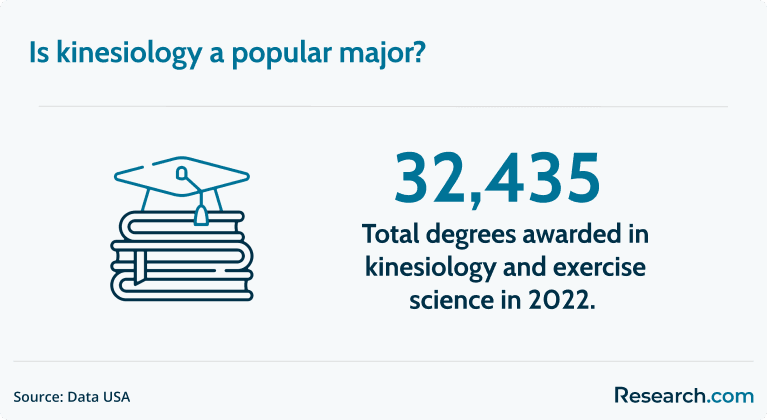
Data USA reports that 32,435 total degrees were awarded in kinesiology and exercise science. It also shows the highest growth in degree awards in these counties:
- Washington County in Maryland - 800% growth
- Mobile County in Alabama - 650% growth
- Woodbury County in Iowa - 650% growth
What Career Paths Are Available for Kinesiology Graduates?
Kinesiology graduates can pursue roles in healthcare support, fitness, wellness, sports, rehabilitation, education, public health, and research. Requirements vary, so students should map each target role to the education, certification, and licensure it requires.
- Physical Therapist: Helps patients restore movement, manage pain, and recover from injury or illness. This career requires graduate education and licensure beyond a kinesiology bachelor’s degree.
- Athletic Trainer: Prevents, evaluates, and treats sports-related injuries. Athletic training has specific accredited education and certification requirements.
- Fitness Trainer or Personal Trainer: Designs and supervises exercise programs for clients in gyms, wellness centers, corporate programs, or private practice.
- Sports Coach: Develops athletes, teaches skills, manages training, and prepares teams for competition in school, college, recreational, or professional environments.
- Rehabilitation Specialist: Supports recovery from injury, surgery, or health conditions in hospitals, outpatient centers, or rehabilitation clinics.
- Sports Nutritionist or Dietitian: Advises athletes on fueling, recovery, performance, and health. Students interested in nutrition careers can compare online nutrition bachelor’s degrees.
- Kinesiologist: Applies movement science to improve performance, reduce injury risk, and support recovery or health goals.
- Health and Wellness Coach: Helps clients improve lifestyle habits through exercise, nutrition awareness, behavior change, and wellness planning.
- Researcher or Academic Professional: Studies exercise science, rehabilitation, performance, or health behavior, often after graduate study.
- Public Health Specialist: Supports community programs that promote physical activity, disease prevention, and wellness.
- Sports Management Professional: Works in operations, events, marketing, or program administration for sport and fitness organizations.
What Is the Job Market for Graduates With a Kinesiology Degree?
The kinesiology job market is broad rather than tied to a single occupation. Zippia projects a 17% growth in jobs for kinesiologists by 2028. Demand is influenced by health and wellness trends, aging populations, sports participation, rehabilitation needs, public health initiatives, and technology used in fitness and performance tracking.
- Health and wellness: Precedence Research reports that the global health and wellness market was worth $5.862 trillion in 2024 and is predicted to reach about $9.363 trillion by 2033.
- Aging population: The World Health Organization reports that one in six people in the world will be aged 60 years or over by 2030, which supports demand for mobility, rehabilitation, and healthy aging services.
- Sports industry: Statista projects a 3.98% compound annual growth rate (CAGR) for the global sports market in 2025-2029, with expected market value of $137.80 billion by 2029 and most revenue predicted to come from the United States.
- Healthcare and rehabilitation: Hospitals, outpatient clinics, rehabilitation centers, and wellness programs use exercise and movement expertise to support prevention, recovery, and chronic condition management.
- Research and academia: Universities, research institutions, and private organizations continue to need professionals trained in exercise science, rehabilitation, and sports medicine research.
- Public health: Community organizations and public agencies use kinesiology knowledge to encourage physical activity and improve population health.
- Technology: Wearables, remote coaching, telemedicine, and fitness analytics create new opportunities in performance monitoring, injury prevention, and digital wellness services.
Using O*NET OnLine data, the chart below presents projected employment growth for several kinesiology-related occupations.
What Essential Skills Are Needed to Succeed in Kinesiology?
Kinesiology professionals need both science-based knowledge and strong people skills. The field often involves explaining movement, motivating clients or patients, interpreting assessment results, and adapting plans to individual goals or limitations.
| Skill | Why It Matters | How to Build It |
| Scientific reasoning | Helps interpret anatomy, physiology, biomechanics, and exercise responses | Take lab courses seriously and practice evidence-based decision-making |
| Communication | Needed to explain exercises, risks, progress, and goals clearly | Practice coaching, presentations, and client education |
| Data interpretation | Useful for fitness testing, movement analysis, and wearable technology | Work with assessment tools, statistics, and performance data |
| Problem-solving | Helps adapt programs when clients have pain, limitations, or changing goals | Use case studies, internships, and supervised practice |
| Professionalism | Employers value reliability, ethics, documentation, and teamwork | Use internships and fieldwork to build workplace habits |
Students comparing flexible academic options can also review accredited easy online degree programs, but kinesiology students should expect meaningful science and applied learning requirements.
Common Mistakes to Avoid When Choosing a Kinesiology Program
- Assuming “online” means no hands-on work: Quality kinesiology programs often require labs, internships, assessments, or field experiences even when coursework is online.
- Ignoring accreditation: Enrolling in a program without recognized accreditation can create problems with financial aid, transfer credits, graduate school, or employer recognition.
- Choosing only by tuition: Fees, books, living expenses, internship costs, and delayed graduation can make a low-tuition program more expensive than expected.
- Not checking graduate-school prerequisites: Pre-PT, pre-OT, athletic training, and other health pathways often require specific science courses.
- Assuming a bachelor’s degree leads directly to licensed clinical roles: Many clinical careers require graduate education, exams, supervised practice, or state licensure.
- Skipping career advising: Students who wait until graduation to plan certifications, internships, or graduate applications may have fewer options.
- Relying only on rankings: Rankings can help with discovery, but program fit depends on cost, curriculum, format, outcomes, and career alignment.
Questions to Ask Before Enrolling
- Is the institution regionally accredited, and does my intended career require programmatic accreditation?
- How many transfer credits can I apply, and will the school evaluate them before I commit?
- Are labs, internships, or clinical observations required, and can I complete them near where I live?
- Does the program prepare students for certifications relevant to fitness, strength and conditioning, clinical exercise, coaching, or athletic training?
- What percentage of graduates enter jobs, graduate school, or certification pathways related to kinesiology?
- What is the total cost after tuition, fees, books, housing, transportation, and aid?
- Who advises students planning for physical therapy, occupational therapy, athletic training, or graduate school?
- How often are required courses offered, and could course availability delay graduation?
References
- Grand View University (n.d.). Graduate Tuition & Fees 2025-26. https://www.grandview.edu/admissions/tuition/graduate
- Lewis Clark State College (n.d.). Tuition and Fee Schedule. https://www.lcsc.edu/student-accounts/tuition-and-fees
- Ma, J. et al. (2024). Trends in College Pricing and Student Aid 2024. College Board. https://research.collegeboard.org/media/pdf/Trends-in-College-Pricing-and-Student-Aid-2024-ADA.pdf
- Montana State University (n.d.). Expenses. https://catalog.montana.edu/expenses
- O*NET OnLine (n.d.). O*NET OnLine Help. https://www.onetonline.org Data Retrieved on January 14, 2025
- Precedence Research (September 2024). Health and Wellness Market Size, Share, and Trends 2024 to 2033. https://www.precedenceresearch.com/health-and-wellness-market
- Statista (n.d.). Sports - Worldwide. https://www.statista.com/outlook/amo/sports/worldwide
- World Health Organization (October 2024). Ageing and health. https://www.who.int/news-room/fact-sheets/detail/ageing-and-health
- Zippia (2025). Kinesiologist salary. https://www.zippia.com/salaries/kinesiologist
- Zippia (n.d.). Job Outlook for Kinesiologists in the United States. https://www.zippia.com/kinesiologist-jobs/trends
- ZipRecruiter (2025). Kinesiologist Salary. https://www.ziprecruiter.com/Salaries/Kinesiologist-Salary
Key Insights
- The easiest kinesiology degree is usually the most flexible and well-supported option, not the least demanding one. Look for transfer-friendly policies, clear course sequencing, online or hybrid access, and strong advising.
- A bachelor’s degree can open doors in fitness, wellness, coaching, exercise science, and rehabilitation support, but licensed clinical careers typically require graduate education and additional credentials.
- Cost comparisons should include tuition, fees, housing, books, internship expenses, and time to completion. Published tuition alone does not show the full investment.
- Accreditation is nonnegotiable. It affects financial aid, credit transfer, graduate-school eligibility, and professional recognition.
- Online kinesiology programs can work well for self-directed students, but they should still provide credible applied learning through labs, simulations, internships, or local field placements.
- Students should choose a specialization based on a specific career target, such as exercise science, strength and conditioning, rehabilitation science, clinical exercise physiology, wellness, coaching, or pre-health preparation.
- Before enrolling, verify whether the program meets the prerequisites for your next step, especially if you plan to pursue physical therapy, occupational therapy, athletic training, sports psychology, or another regulated profession.
Other Things You Need to Know About Kinesiology Degrees
Yes. Most accredited kinesiology programs require at least one laboratory science sequence, such as anatomy and physiology, biology, or chemistry. Many bachelor’s programs also expect 120 total credits, with core classes in exercise physiology, biomechanics, and statistics before graduation.
The easiest kinesiology degree programs in 2027 typically require a high school diploma or GED, with coursework in biology and physical education preferred. Some programs may also require a minimum GPA and standardized test scores for admission.


