2027 How To Become a DEA Agent

Co-Founder and Chief Data Scientist
Becoming a DEA Special Agent is a competitive federal law enforcement path for people who want to investigate drug trafficking, controlled-substance violations, diversion schemes, and transnational criminal networks. The decision is serious: the work can involve surveillance, arrests, firearms, undercover operations, courtroom testimony, relocation, long hours, and a detailed background investigation. It is also a career that requires discipline before you ever apply.
This guide explains how to become a DEA agent in 2027, including eligibility rules, education and experience options, the hiring process, training, day-to-day responsibilities, salary information, job outlook, technology trends, and career advancement. It is designed for students, military members, current law enforcement officers, and career changers who want a realistic view of what the path requires.
Quick Answer: How Do You Become a DEA Agent?
To become a DEA Special Agent, you generally need to be a U.S. citizen, meet age and fitness requirements, hold a valid U.S. driver’s license, qualify for a Top Secret security clearance, complete the DEA application and selection process, and graduate from the 18-week Basic Agent Training program at the DEA Academy in Quantico, Virginia. A bachelor’s degree in criminal justice, law enforcement, or a related area can strengthen your application, although relevant law enforcement, military, investigative, or federal experience may also matter.
Key Things You Should Know About Becoming a DEA Agent
- Eligibility comes first. DEA applicants must meet citizenship, age, driver’s license, medical, physical fitness, relocation, and security clearance requirements before they can move through the process.
- The process is lengthy and selective. The hiring timeline can take up to 12 months and may include written testing, a physical fitness test, medical review, drug screening, a polygraph, psychological evaluation, and a detailed background investigation.
- The work is investigative and operational. DEA agents build cases, conduct surveillance, work undercover, arrest suspects, seize assets, prepare evidence, and coordinate with local, state, federal, and international partners.
- Pay and demand vary by role and location. DEA agents earn an average annual salary of $62,702, with higher averages in some locations such as San Francisco, California, where the average is $73,874 per year.
- Technology is changing the career. Cyber investigations, digital forensics, forensic science, darknet markets, cryptocurrency activity, and synthetic drugs are reshaping the skills DEA agents need.
- What are the steps to becoming a DEA agent in 2027?
- How long does it take to become a DEA agent?
- What does the DEA Special Agent entrance exam consist of?
- What are the core responsibilities of a DEA Special Agent?
- What are the key skills for DEA agents?
- What are the ethical standards for DEA agents?
- How does the DEA utilize technology in investigations?
- What community outreach programs does the DEA offer?
- How does further education investment enhance a DEA career?
- How can DEA agents advance their careers?
- What specialized certifications and training can boost my DEA career?
- What challenges do DEA agents commonly face in high-stress environments?
- Can supplementary legal certifications further enhance a DEA agent's investigative skills?
- What benefits and support systems are provided to DEA agents?
- What is the job outlook for DEA agents?
- How much do DEA agents make in 2027?
- What are the future trends in DEA careers?
- How Do DEA Agents Stay Updated on Evolving Legal Standards?
What are the steps to becoming a DEA agent in 2027?
The path to becoming a DEA agent is not a single application form followed by training. It is a staged federal hiring process that screens for legal eligibility, judgment, physical readiness, psychological fitness, integrity, and long-term suitability for sensitive law enforcement work. Candidates who prepare early usually have a stronger chance of avoiding delays.
Step 1: Confirm that you meet the basic eligibility rules
Before investing time in the application, check whether you satisfy the core requirements. DEA Special Agent applicants must be U.S. citizens, usually between 21 and 36 years old at the time of application, and hold a valid U.S. driver’s license. The DEA may provide age waivers for veterans and retired federal law enforcement personnel. Applicants must also be in strong physical condition, meet vision and hearing standards, be willing to relocate anywhere in the United States, and qualify for a Top Secret security clearance.
Step 2: Build the right educational foundation
A bachelor’s degree in criminal justice, law enforcement, or a related field is a common preparation route. Coursework in constitutional law, criminal procedure, criminology, psychology, statistics, forensic science, cybersecurity, finance, or foreign languages can also be useful because DEA investigations often involve complex evidence, financial records, digital activity, and cross-jurisdictional coordination. Candidates interested in financial investigations may also benefit from understanding investigative accounting roles, including information related to forensic accounting salary paths.
Step 3: Gain experience that proves investigative readiness
DEA applicants can strengthen their profiles through law enforcement, military, intelligence, security, public safety, forensic, legal, or investigative experience. Military applicants transitioning into civilian law enforcement may also consider academic options through top military friendly colleges, especially if they need to complete a degree while using prior training and benefits.
Step 4: Contact a DEA recruitment office
The DEA recruitment process usually begins by connecting with a recruitment office through the agency’s official website. A recruitment coordinator can explain current openings, applicant intake steps, documents, testing expectations, and any location-specific instructions.
Step 5: Submit a complete application
Applicants typically apply through the DEA website or USAJobs.gov when positions are open. Review the announcement carefully before submitting materials. Missing documents, unclear eligibility, incomplete employment history, or inconsistent information can slow the process or remove an applicant from consideration.
Step 6: Complete the selection process
The DEA hiring process is designed to determine whether the applicant can safely and ethically perform federal investigative work. It may include the following components:
| Selection component | What it evaluates | How to prepare |
| Written examination | Reasoning, judgment, reading comprehension, and problem-solving ability | Practice timed analytical questions and review report-writing basics |
| Physical fitness test | Strength, endurance, agility, and operational readiness | Train consistently before applying rather than waiting for a test date |
| Medical examination | Health, physical standards, and ability to perform essential duties | Address medical documentation needs early and follow agency instructions |
| Drug screening | Compliance with DEA drug-use standards | Be accurate, consistent, and transparent during all disclosures |
| Polygraph examination | Truthfulness about prior conduct, disclosures, and background information | Review your history carefully and avoid minimizing important facts |
| Background investigation | Criminal history, finances, employment, references, and personal conduct | Prepare accurate addresses, employment dates, references, and records |
| Psychological evaluation | Emotional stability, judgment, stress tolerance, and suitability | Understand the demands of the role and answer honestly |
Because DEA work can involve danger, pressure, and sensitive decision-making, psychological resilience matters. The evaluation helps determine whether a candidate can manage stress, ambiguity, conflict, and responsibility. Readers interested in mental health assessment and resilience-related work can compare this with broader information about health psychologist salary trends.
Step 7: Complete Basic Agent Training
Selected candidates attend the 18-week Basic Agent Training program at the DEA Academy in Quantico, Virginia. Training includes firearms, defensive tactics, physical conditioning, legal instruction, investigative techniques, report writing, and operational preparation for field assignments.
Step 8: Report to your first field office
After graduation, new DEA agents are assigned to field offices across the United States. Early career agents should expect to keep learning through supervised fieldwork, agency training, casework, court preparation, and collaboration with other law enforcement partners.
Meanwhile, the chart below shows the most common DEA agent degree levels:
How long does it take to become a DEA agent?
Becoming a DEA agent often takes one to two years, depending on the applicant’s education, experience, fitness level, background investigation, and hiring-cycle timing. The DEA application and hiring phase alone can take up to 12 months. That is shorter than some intelligence-community hiring timelines, such as the CIA hiring process, which can take several years.
The timeline can stretch if an applicant needs more time to meet fitness standards, gather records, clarify employment or financial history, or resolve inconsistencies in background information. DEA review of prior drug use is also careful and case-specific, so applicants should expect detailed questions and should avoid inaccurate or incomplete disclosures.
| Stage | Typical purpose | What can slow it down |
| Pre-application preparation | Meeting education, fitness, and experience expectations | Incomplete degree, limited experience, or weak fitness baseline |
| Application and screening | Confirming eligibility and documents | Missing records or unclear qualifications |
| Testing and interviews | Assessing judgment, communication, physical ability, and suitability | Failed fitness test, rescheduling, or insufficient preparation |
| Background and security review | Evaluating trustworthiness and clearance eligibility | Complex finances, travel history, prior conduct, or inconsistent disclosures |
| Academy training | Preparing candidates for DEA field work | Injury, academic difficulty, or failure to meet training standards |
What does the DEA Special Agent entrance exam consist of?
The DEA Special Agent entrance exam and assessment process is intended to measure whether an applicant has the reasoning, judgment, communication, and decision-making ability needed for federal criminal investigations. Exact testing formats can change by hiring announcement, so applicants should always follow current DEA instructions from their recruitment coordinator.
In general, candidates should be ready for assessments that test written communication, analytical thinking, reading comprehension, situational judgment, attention to detail, memory, and the ability to make sound decisions under pressure. Because DEA agents regularly prepare reports, interpret evidence, interview people, and testify in court, strong writing and verbal communication skills are not optional.
How to prepare for the entrance assessment
- Practice timed reading and reasoning questions. DEA work requires fast but careful interpretation of facts.
- Improve report-writing clarity. Use direct language, organize facts chronologically, and separate observations from conclusions.
- Train for the physical fitness test early. Do not wait until you receive a testing date to begin conditioning.
- Review your background information. Dates, addresses, employment records, and disclosures should be accurate and consistent.
- Prepare for structured interviews. Be ready to discuss judgment, teamwork, conflict, ethics, and stressful situations.
What are the core responsibilities of a DEA Special Agent?
DEA Special Agents enforce federal controlled-substance laws and investigate organizations and individuals involved in illegal drug activity. Their work combines intelligence gathering, field operations, interagency coordination, evidence handling, and courtroom support.
- Investigating criminal networks: Agents collect evidence, identify trafficking routes, track supply chains, and work to disrupt or dismantle drug trafficking organizations.
- Conducting surveillance and undercover work: Agents may observe suspects, document activity, infiltrate criminal groups, and gather admissible evidence through covert methods.
- Arresting suspects: DEA agents help identify, locate, apprehend, and arrest people involved in controlled-substance violations. This overlaps in a limited way with some bounty hunter job requirements, although DEA agents operate under federal law enforcement authority and agency procedures.
- Seizing drugs, money, and assets: Agents confiscate contraband and proceeds connected to trafficking to weaken the financial structure of criminal organizations.
- Working with partner agencies: DEA investigations often involve local police, state agencies, federal law enforcement, prosecutors, and international partners.
- Preparing evidence for prosecution: Agents write reports, document chain of custody, coordinate with prosecutors, and may testify in court.
- Supporting prevention efforts: Agents and DEA personnel may take part in community education initiatives that address drug misuse and public safety risks.
What are the key skills for DEA agents?
DEA agents need more than physical courage. The strongest candidates combine investigative discipline, communication, ethical judgment, technical adaptability, and emotional control.
| Skill | Why it matters in DEA work | How candidates can develop it |
| Attention to detail | Small errors can weaken investigations, reports, warrants, or testimony | Practice evidence documentation, note-taking, and report review |
| Written and verbal communication | Agents interview people, brief teams, write case reports, and testify | Take writing-heavy courses and seek feedback on clarity |
| Problem-solving | Investigations shift quickly and often involve incomplete information | Study criminal procedure, case analysis, and scenario-based decision-making |
| Physical fitness | Field operations may require endurance, strength, and quick response | Build a long-term conditioning plan before applying |
| Teamwork | DEA cases usually involve partners across agencies and jurisdictions | Gain experience in collaborative public safety, military, or investigative settings |
| Integrity | Agents handle sensitive information, evidence, and high-stakes decisions | Maintain clean records, disclose honestly, and understand ethical obligations |
| Adaptability | Agents may relocate, change assignments, or respond to emerging threats | Build comfort with change, travel, and unfamiliar environments |
| Observation and memory | Surveillance, interviews, and undercover work require accurate recall | Practice structured observation and immediate documentation |
What are the ethical standards for DEA agents?
DEA agents are held to strict ethical expectations because their work involves arrests, searches, informants, evidence, surveillance, firearms, and public trust. Ethical lapses can damage prosecutions, endanger colleagues, and undermine confidence in federal law enforcement.
- Integrity: Agents must act honestly and avoid conduct that creates real or perceived misconduct.
- Accountability: DEA personnel are responsible to the agency, the law, the courts, and the public.
- Respect and compassion: Professional treatment of the public helps preserve legitimacy and cooperation.
- Rule of law: Agents must follow the Constitution, federal statutes, agency policy, and court requirements.
- Professional conduct: Behavior on and off duty can affect clearance, credibility, and suitability for the role.
- Leadership and courage: Agents are expected to make difficult decisions without abandoning legal or ethical standards.
- Diversity and excellence: DEA work requires effective service across different communities, cultures, and environments.
How does the DEA utilize technology in investigations?
Modern drug enforcement increasingly depends on technology. Trafficking activity can involve encrypted messaging, social media, cryptocurrency, darknet markets, synthetic substances, mobile devices, logistics networks, and digital evidence. DEA agents therefore need to understand both field operations and technology-supported investigations.
Portable narcotics identification devices
Handheld tools such as the TruNarc analyzer can help identify substances at a scene. These devices use Raman spectroscopy and updated spectral libraries to support faster drug identification, reduce laboratory bottlenecks, and help move investigations forward. As synthetic drugs become more complex, agents with stronger science backgrounds may better understand drug composition and testing limits; one academic option for science-focused professionals is exploring biotechnology master's programs online.
Digital forensic intelligence
DEA investigations may involve phones, computers, cloud accounts, location data, communications records, and financial transactions. Tools such as Cellebrite Pathfinder and Oxygen use AI-supported analysis and data visualization to help investigators connect people, places, events, and devices.
Social media monitoring
Drug activity can appear on platforms such as Snapchat, Instagram, and TikTok. Monitoring public and legally obtained digital information can help investigators identify trafficking patterns, suspected sellers, and emerging drug trends.
What community outreach programs does the DEA offer?
The DEA’s community outreach work supports prevention and demand reduction. While Special Agents focus heavily on enforcement, the agency also provides education and prevention resources for schools, families, community groups, and partner organizations.
- Drug information resources: The DEA creates brochures, fact sheets, guides, and other educational materials on illicit drug use, prescription drug misuse, and current drug threats.
- Prevention partnerships: The agency works with federal agencies, prevention organizations, community coalitions, civic organizations, and school districts to share drug trend information and prevention strategies.
- Public awareness campaigns: DEA campaigns often focus on youth, parents, caregivers, and educators, with messaging shaped by research on prevention.
- Demand Reduction Coordinators: These coordinators help communities use DEA expertise in intelligence and enforcement to strengthen local prevention efforts in urban, suburban, and rural areas.
- Educational support: The DEA supports drug education in K-12 schools, colleges, and universities by sharing information about emerging threats and drug trends. Working professionals who want to continue education while keeping their jobs can compare online degrees for working adults as one flexible option.
How does further education investment enhance a DEA career?
Additional education can help aspiring and current DEA agents build expertise for specialized assignments. Graduate study, certificates, and short training programs may strengthen knowledge in cybercrime, forensic science, intelligence analysis, leadership, law, financial investigations, or policy. The best choice depends on the agent’s target role, schedule, tuition budget, and whether the credential adds skills the agency can actually use.
Cost matters. Candidates comparing criminal justice programs should look beyond sticker price and evaluate tuition, fees, transfer credit, military benefits, employer support, and time to completion. Researching criminal justice degree cost options can help applicants weigh near-term expenses against possible long-term career value.
| Education option | When it may make sense | Decision caution |
| Bachelor’s degree | Useful for applicants who need a formal academic foundation for federal law enforcement | Choose an accredited program and avoid unnecessary debt |
| Master’s degree | Helpful for candidates pursuing leadership, policy, analysis, or specialized investigative work | Do not assume a graduate degree guarantees selection or promotion |
| Legal studies or paralegal certificate | Useful for improving legal research, documentation, and court-process knowledge | Confirm that the curriculum is relevant to investigative work |
| Cybersecurity or digital forensics training | Valuable for cases involving devices, online markets, cryptocurrency, or digital communications | Hands-on technical practice matters more than program branding alone |
| Forensic science coursework | Relevant for drug identification, lab coordination, evidence handling, and scientific testimony | Understand the difference between field identification and laboratory confirmation |
How can DEA agents advance their careers?
DEA career advancement usually depends on performance, experience, training, mobility, leadership potential, and mission needs. Agents may move into specialized areas such as cyber investigations, undercover operations, intelligence-supported cases, international work, training, supervision, or management. Additional education can help, but it should complement proven field performance rather than replace it.
Agents considering graduate study should compare the cost, time commitment, and career relevance of each program. Those interested in senior criminal justice roles can also review career paths associated with the highest paying jobs with a master's in criminal justice to better understand how advanced credentials may support broader law enforcement careers.
What specialized certifications and training can boost my DEA career?
Specialized training can make an agent more effective in complex cases. The most useful credentials are those that build practical skills in areas such as cyber investigations, digital forensics, intelligence analysis, financial crime, forensic science, legal procedure, leadership, or crisis response.
Legal education may also strengthen case preparation and interagency work. Accredited legal studies programs online can help professionals build stronger knowledge of regulatory interpretation, legal research, evidence issues, and compliance. However, agents should choose programs based on curriculum quality, accreditation, cost, and relevance to their assignment goals.
Common mistakes when choosing extra credentials
- Choosing a program only because it sounds prestigious. A credential should teach skills that apply to investigations, evidence, leadership, or analysis.
- Ignoring accreditation. Accreditation can affect transferability, employer recognition, and financial aid eligibility.
- Taking on debt without a plan. A degree or certificate should fit a realistic career strategy.
- Assuming a certificate guarantees advancement. DEA promotions and assignments depend on more than coursework.
- Overlooking schedule demands. Agents working irregular hours may need flexible or part-time study options.
What challenges do DEA agents commonly face in high-stress environments?
DEA agents may work unpredictable schedules, face dangerous field conditions, manage confidential sources, review disturbing evidence, testify in court, and make decisions that affect prosecutions and public safety. The job can also involve frequent travel or relocation, family strain, and long investigations with uncertain outcomes.
Legal complexity is another challenge. Agents need to understand search and seizure rules, evidence handling, warrants, informant procedures, privacy issues, and changing drug laws. Some professionals strengthen their legal foundation through options such as the cheapest paralegal certificate online, especially if they want additional structure in legal research and documentation.
Practical ways to manage the pressure
- Build a fitness routine before and after academy training.
- Use mentorship from experienced agents and supervisors.
- Keep accurate case notes to reduce legal and administrative problems.
- Maintain support systems outside work where appropriate.
- Use counseling, wellness, and peer-support resources when needed.
- Continue training in law, technology, evidence, and threat trends.
Can supplementary legal certifications further enhance a DEA agent's investigative skills?
DEA training covers legal procedure and investigative methods, but additional legal education can sharpen skills in research, documentation, evidence organization, court preparation, and prosecutor coordination. An accelerated paralegal certificate may be useful for professionals who want a structured way to study legal writing, case organization, document management, and litigation support.
This type of credential is not a substitute for DEA training or field judgment. It is best viewed as a supplement for agents or applicants who want to better understand how investigations become prosecutable cases.
What benefits and support systems are provided to DEA agents?
DEA agents receive federal employment benefits intended to support long-term service and personal well-being. These may include health and dental insurance, federal retirement programs, paid leave, training opportunities, counseling resources, wellness support, and career development systems. Benefits are important because the role can involve stress, risk, irregular schedules, and sustained physical and mental demands.
Applicants should review current DEA and federal employment materials for benefit details, eligibility, and updates. For a broader overview of preparation and eligibility, readers can also review Research.com’s guide to DEA requirements.
What is the job outlook for DEA agents?
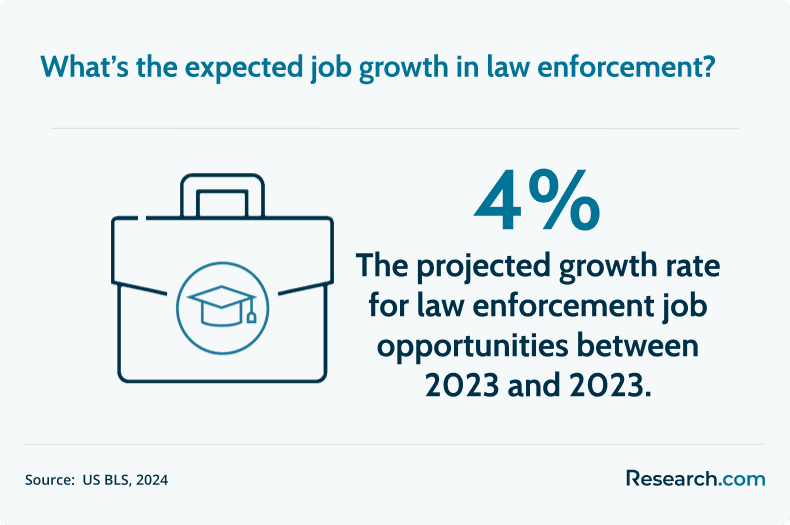
The career outlook for DEA agents is steady but competitive. The Bureau of Labor Statistics projects a 4% increase in detective and criminal investigator roles, including DEA agents, from 2023 to 2033. That rate matches the average for all occupations. Demand is supported by ongoing federal efforts to investigate drug trafficking, controlled-substance violations, diversion schemes, and related criminal activity.
Competition can still be strong because DEA Special Agent roles are selective and require fitness, background suitability, investigative aptitude, and willingness to relocate. Candidates with strong academics, relevant experience, clean disclosures, technical skills, and sustained physical preparation may be better positioned.
Meanwhile, the chart below shows the largest employers of police and detectives:
How much do DEA agents make in 2027?
DEA agent compensation varies by experience, education, location, federal pay rules, locality adjustments, and assignment. The national average annual salary is $62,702. In San Francisco, California, the average is $73,874 per year. The highest-paid DEA agents can earn up to $83,000 annually, or $39.90 per hour, while the lowest-paid agents may earn around $14.66 per hour.
Applicants should treat salary figures as estimates rather than guarantees. Federal law enforcement pay can differ by grade, step, locality, availability pay, overtime rules, and current agency policy. If you are comparing public service careers outside law enforcement, it may be useful to note that a flight nurse salary can also vary widely by location and experience, with some flight nurses earning over $70,000 annually.
The chart below shows the top five best-paying related drug enforcement administration agent jobs in the U.S.
What are the future trends in DEA careers?
DEA careers are being reshaped by digital crime, synthetic drugs, data analysis, forensic science, and international trafficking networks. Future agents will likely need stronger technical literacy in addition to traditional investigative skills.
Greater need for forensic science support
The U.S. Bureau of Labor Statistics projects a 14% increase in demand for forensic science technicians between 2023-2033, much faster than average. Forensic science supports drug enforcement through evidence testing, laboratory analysis, toxicology-related work, and expert interpretation.
- Forensic evidence is becoming more central to criminal investigations.
- Technology continues to improve laboratory and field analysis.
- More funding for forensic laboratories can increase support capacity.
More emphasis on cyber investigations
Darknet markets, encrypted communications, online payments, and cryptocurrency transactions have expanded the technical side of drug enforcement. The UNODC estimates the annual value of major dark web drug markets at approximately $315 million, underscoring why cyber skills matter in modern drug investigations.
Cybercrime investment
- An $8 million enhancement was requested for Investigative Technology and Cyber Support to help field divisions pursue cyber investigations.
- The enhancement includes cyber coordinators, tools, and analytical support in the field and at Headquarters.
Budget and staffing context
- The FY 2023 budget request for DEA totaled $3,105 million, a 6.3% increase over the FY 2022 President's Budget.
- The DEA's direct authorized positions for FY 2023 increased to 7,118, including an addition of 134 positions over the FY 2022 President's Budget.
How Do DEA Agents Stay Updated on Evolving Legal Standards?
DEA agents must keep pace with changes in statutes, regulations, court rulings, evidence requirements, privacy rules, and agency policy. Ongoing legal education helps agents make better field decisions, preserve evidence properly, work effectively with prosecutors, and avoid mistakes that could weaken a case.
Training may include internal agency instruction, workshops, online courses, legal briefings, supervisor guidance, and case-specific updates. Agents who want a deeper foundation in legal research and procedure may consider credentials through the best paralegal certificate programs, particularly if they want additional structure in legal writing and case documentation.
Questions to Ask Before Pursuing a DEA Agent Career
- Am I willing to relocate anywhere in the United States?
- Can I meet physical fitness standards and maintain that level over time?
- Is my background information accurate, complete, and consistent?
- Do I understand the personal stress and safety risks of federal drug enforcement?
- Do I have the writing, judgment, and communication skills needed for court-ready investigations?
- Would additional education or experience make my application stronger before I apply?
- Am I prepared for a hiring process that may take up to 12 months?
Here’s What Graduates Have to Say about Becoming a DEA Agent
The job asks a lot from you, but the mission matters. I have helped break apart drug networks, and that work brings a strong sense of purpose. The training gave me a solid foundation, and the support among agents has been one of the most valuable parts of the career. - Frederick
What I value most is the variety. One assignment may involve investigations, while another may require coordination with international partners. The technology side and changing drug trends mean you are always learning. It takes commitment, but the work is meaningful. - Sebastian
I chose this path because I wanted to contribute to safer communities. The process of becoming an agent is demanding, but the agency gives you training and tools to do the job. Knowing that the work supports public safety keeps me motivated. - Estefan
Key Insights
- DEA Special Agent applicants must meet strict eligibility, fitness, background, and security clearance standards before training begins.
- The hiring process can take up to 12 months, and preparation should start well before an application opens.
- A bachelor’s degree in criminal justice, law enforcement, or a related field can help, but relevant investigative, military, public safety, or technical experience may also strengthen a candidate.
- The DEA employs approximately 10,000 personnel across 241 domestic and 93 foreign offices, making it a major federal law enforcement agency with domestic and international reach.
- DEA work is not only field-based; agents also need report-writing, legal knowledge, courtroom readiness, technology awareness, and ethical judgment.
- The Bureau of Labor Statistics projects 4% growth for detective and criminal investigator roles, including DEA agents, from 2023 to 2033.
- The national average annual salary for DEA agents is $62,702, while the San Francisco, California, average is $73,874 per year.
- Cyber investigations and digital forensics are becoming more important as darknet drug markets, estimated by the United Nations Office on Drugs and Crime (UNODC) at $315 million annually, continue to affect drug enforcement.
- Further education can be valuable when it builds practical skills in law, cyber investigations, forensic science, intelligence, leadership, or financial crime—but no degree or certificate guarantees selection or promotion.
References:
- Bureau of Labor Statistics, U.S. Department of Labor. (2024). Forensic science technicians. Occupational Outlook Handbook. https://www.bls.gov/ooh/life-physical-and-social-science/forensic-science-technicians.htm
- Bureau of Labor Statistics, U.S. Department of Labor. (n.d.). Police and detectives. Occupational Outlook Handbook. https://www.bls.gov/ooh/protective-service/police-and-detectives.htm
- United Nations Office on Drugs and Crime. (n.d.). Global Overview: Drug Demand Drug Supply. https://www.unodc.org/res/wdr2021/field/WDR21_Booklet_2.pdf
- United States. Department of Justice. (2022, March 31). Drug Enforcement Administration (DEA). https://www.justice.gov/d9/pages/attachments/2022/03/31/dea_fy_23_bud_sum_3.31.22_228-30.pdf
- United States. Drug Enforcement Administration. (n.d.). Community Outreach. https://www.dea.gov/education-prevention/community-outreach
- United States. Drug Enforcement Administration. (n.d.). DEA United States Drug Enforcement Administration. https://www.dea.gov
- Zippia. (2025, January 8). What is a drug enforcement agent and how to become one. https://www.zippia.com/drug-enforcement-agent-jobs
- ZipRecruiter. (2025). Drug Enforcement Administration Agent Dea Agent Salary. https://www.ziprecruiter.com/Salaries/Drug-Enforcement-Administration-Agent-Dea-Agent-Salary#Yearly
Other Things You Should Know About Becoming a DEA Agent
To become a DEA agent in 2027, recruits must complete the Basic Agent Training Program, which lasts around 18 weeks. This program is intensive, covering areas like firearms proficiency, tactical training, legal instruction, drug recognition, and surveillance techniques. Trainees must meet all physical and academic standards to graduate.
In 2027, aspiring DEA agents must meet specific physical requirements, including a timed 2-mile run, push-ups, and sit-ups. The exact scores required for passage may change, but demonstrating strong physical fitness remains a critical component for acceptance into the DEA training program.