
2027 CIA Agent Qualifications and Job Requirements

Co-Founder and Chief Data Scientist
Searching for how to become a CIA “agent” can be confusing because the CIA does not use that phrase as one universal job title. People often use it to describe many CIA careers, including operations officers, analysts, cyber specialists, language professionals, scientists, engineers, security staff, finance professionals, auditors, and mission support personnel.
This guide is for students, veterans, career changers, and working professionals who are deciding whether a CIA career is realistic, worthwhile, and aligned with their strengths. You will learn the major CIA agent requirements, education options, hiring stages, possible disqualifiers, costs, salary benchmarks, relocation expectations, disability accommodations, veteran pathways, and the questions to ask before you apply.
Quick answer: What are the benefits of becoming a CIA agent?
- Zippia lists the average CIA agent salary at $49,714 per year, but actual pay depends on the specific role, experience, education, clearance requirements, location, and technical specialization.
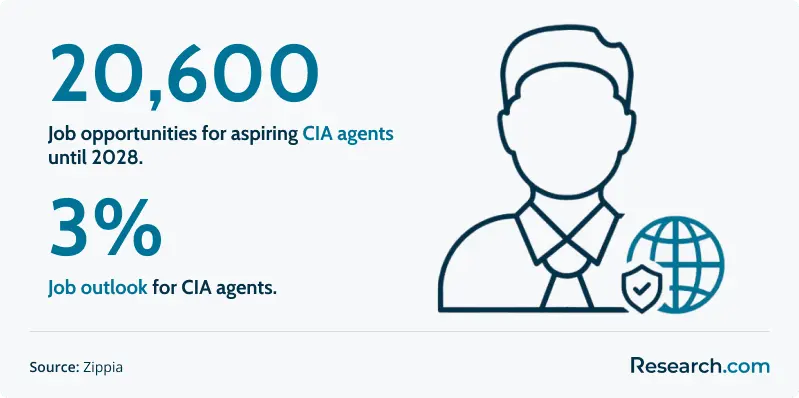
- Zippia projects 3% growth from 2018 to 2028 and estimates about 20,600 job openings nationwide; however, the federal government does not publicly release exact CIA hiring demand.
- A CIA career can lead to work in intelligence analysis, operations, cybersecurity, foreign languages, economics, science and technology, security, auditing, finance, and mission support.
- This path may be a strong fit for people who value national security, public service, complex problem-solving, discretion, and long-term federal benefits more than salary alone.
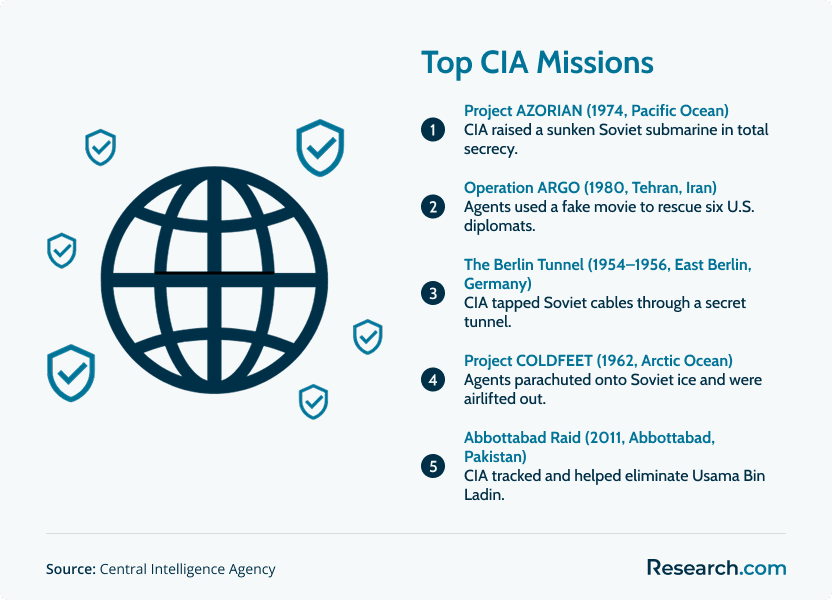
CIA agent qualifications and job requirements for 2026
CIA hiring is built to identify candidates who can be trusted with sensitive national security responsibilities. The Agency looks for judgment, integrity, discretion, emotional stability, and the ability to follow strict rules. Meeting the minimum qualifications only makes you eligible to be considered; it does not guarantee an interview, clearance, or job offer.
Most applicants should expect a detailed review of their background, conduct, finances, personal history, health, psychological suitability, and ability to protect classified information. For that reason, preparation matters long before you submit an application.
Basic CIA eligibility requirements
- You must be a U.S. citizen; dual-national U.S. citizens may still be eligible.
- You must be at least 18 years old.
- Most positions require you to relocate to, or be willing to work in, the Washington, DC area.
- You must meet Selective Service registration requirements if they apply to you.
- You must be able to pass a background investigation, polygraph exam, medical review, and psychological evaluation.
- You must keep the application process private and avoid public discussion of your candidacy.
Education and experience that can strengthen an application
The CIA does not recruit from one single major. Competitive applicants usually bring education or professional experience that connects to a mission need. Relevant fields can include criminal justice, criminology, international relations, political science, economics, foreign languages, computer science, cybersecurity, engineering, mathematics, social sciences, accounting, finance, and regional studies.
| Academic or professional background | Possible CIA fit | Why it may help |
| Criminal justice or criminology | Security, investigations, analysis, and counterintelligence support | Develops knowledge of legal systems, investigative reasoning, public safety, and ethics. |
| International relations or political science | Intelligence analysis, policy support, and regional specialization | Builds the ability to interpret governments, conflicts, institutions, and global events. |
| Foreign languages | Operations, translation, analysis, and overseas support | Language skills can be especially useful when combined with cultural fluency and mature judgment. |
| Cybersecurity or information technology | Cyber operations, digital forensics, information security, and technical mission support | Supports intelligence work involving networks, systems, data, cyber threats, and digital evidence. |
| Mathematics or quantitative fields | Cryptography, analytics, modeling, and technical analysis | Provides training in structured problem-solving, pattern detection, and complex analysis. |
If you are exploring career options with a mathematics degree, CIA-related opportunities may include analytics, cryptography, modeling, cyber operations, and technical intelligence. A math degree is usually stronger when paired with excellent writing, communication skills, and experience that applies quantitative thinking to real problems.
Core traits the CIA looks for
- Strong writing skills and the ability to brief information clearly.
- Sound analysis when facts are incomplete or uncertain.
- Honesty, dependability, and loyalty to the United States.
- Emotional steadiness under pressure.
- Respect for classified information, rules, and operational security.
- Adaptability in unfamiliar, ambiguous, or high-stakes situations.
Is there demand for CIA agents?
Zippia reports 3% projected growth between 2018 and 2028 and estimates approximately 20,600 job openings. That figure can help applicants understand the broader labor-market context, but it should not be read as an official CIA workforce projection because the Agency does not publicly publish exact hiring demand by mission area, clearance level, or job family.
Applicants are likely to be more competitive when their skills align with national security needs such as foreign languages, intelligence analysis, cybersecurity, data analysis, security, and specialized regional knowledge. The visual below presents the Zippia demand estimate.
What is the CIA hiring process like, and how long does it take?
The CIA hiring process is intentionally long because the Agency must evaluate more than your resume. It must assess your qualifications, truthfulness, judgment, personal history, discretion, health, psychological suitability, and eligibility for access to classified information.
Applicants should plan for a process that may take several months to a year, depending on the role, the complexity of the background investigation, clearance review timing, and Agency hiring needs. Research.com’s full guide on becoming a CIA officer explains the career path in greater depth, but the usual sequence includes these steps.
- Online application: You submit your application through MyLINK and must be physically located in the United States when you apply.
- Initial screening: If your background appears to match a hiring need, the Agency may contact you privately with next steps.
- Interviews: Interviewers may evaluate your education, experience, motivation, communication skills, decision-making, and fit with the mission.
- Background investigation: Investigators may speak with employers, neighbors, friends, and other people who can address your reliability and character.
- Polygraph exam: The polygraph helps assess whether your statements are truthful and consistent across forms, interviews, and investigations.
- Medical and psychological evaluations: These reviews help determine whether you can meet the physical and mental demands of the position.
- Final clearance and suitability review: Many CIA roles require a Top Secret security clearance before employment can start.
The official CIA hiring process guidance stresses discretion. Applicants should avoid posting about their application, respond quickly to Agency communications, and follow all instructions precisely.
| Hiring stage | What is being evaluated | Mistake to avoid |
| Application | Eligibility, education, experience, skills, and match with the posted vacancy | Sending a broad resume that does not show how your background fits the role. |
| Interviews | Professional maturity, judgment, communication, motivation, and mission fit | Romanticizing intelligence work instead of showing seriousness and public-service motivation. |
| Background review | Honesty, loyalty, finances, conduct, associations, reliability, and judgment | Concealing problems rather than reporting required information accurately. |
| Polygraph | Consistency and truthfulness | Changing answers, minimizing facts, or leaving out relevant history. |
| Medical and psychological screening | Ability to perform the duties safely and reliably | Assuming that every health condition automatically ends your chances. |
What could disqualify me from becoming a CIA agent?
The biggest risk for many applicants is not an imperfect past; it is dishonesty about that past. CIA work depends on trust. If you omit important information, misstate facts, or provide inconsistent answers, the Agency may stop considering you even if you meet the basic qualifications.
Some CIA roles have similarities with broader criminal justice administration careers, but the intelligence environment applies a more intensive suitability and clearance review than many local, state, or private-sector positions.
Potential disqualifiers
- Recent or ongoing illegal drug use, including marijuana use within 90 days of applying.
- Criminal behavior or a repeated pattern of dishonesty.
- Excessive alcohol use or alcohol-related incidents.
- Failure to reply promptly to Agency communications.
- Discussing or posting about the CIA application process on social media.
- Concerns about divided loyalty or allegiance to the United States.
- Contradictory statements on forms, during interviews, in the background investigation, or during the polygraph.
How to reduce avoidable risk
- Study the vacancy announcement before applying so you understand the role and requirements.
- Answer required questions accurately instead of trying to predict the “perfect” response.
- Keep your application private, including online and in casual conversations.
- Maintain professional behavior at school, work, in public, and on social media.
- Organize records related to education, jobs, addresses, foreign contacts, travel, legal issues, and finances.
How much does it cost to become a CIA agent?
There is no CIA application fee. The largest expense is usually education and career preparation. A typical route may involve $25,000 to over $40,000 in education-related costs, depending on your school, major, residency status, degree level, and whether you later pursue graduate study.
Average undergraduate tuition cited for common CIA-related fields includes about $24,931 for criminal justice, $32,561 for criminology, $35,361 for economics, and up to $39,798 for international relations. Graduate programs may cost from $18,720 to over $32,000. Other possible expenses include textbooks, language courses, test preparation, cybersecurity training, professional certifications, and relocation.
If you are interested in behavioral analysis, homeland security, investigations, or law enforcement-adjacent roles, you may be comparing whether a criminology degree is a worthwhile option. It can be relevant, but it is not the only route. The stronger question is whether the program develops writing, research, evidence-based reasoning, ethics, and practical skills that transfer beyond one employer.
| Cost category | What to evaluate | Ways to manage the expense |
| Undergraduate tuition | Total cost can vary widely by major, institution type, and in-state or out-of-state status. | Compare net price, transfer credit rules, scholarships, public in-state options, and completion time. |
| Graduate school | A master’s degree can help for specialized roles, but it is not required for every CIA career. | Enroll only if the degree supports a specific target role, promotion path, or backup career. |
| Certifications | Cybersecurity, analytics, language, or security credentials may improve your profile for certain jobs. | Focus on credentials requested in job postings or widely respected in the field. |
| Language training | Language proficiency is more valuable when paired with cultural, regional, or geopolitical expertise. | Use college courses, tutoring, immersion, and proficiency testing strategically. |
| Relocation | Many CIA positions require moving to the Washington, DC area. | Plan early for moving costs, rent deposits, transportation, and higher metro-area expenses. |
The chart below compares average tuition costs for several undergraduate majors often considered by CIA applicants.
How much can I make as a CIA agent?
There is no single official salary for a “CIA agent” because the phrase covers many job types. Zippia estimates the average CIA agent salary at $49,714 per year, or about $23.90 per hour. Actual compensation may differ based on job title, federal pay structure, education, experience, location, clearance needs, and technical expertise.
Applicants comparing intelligence work with related careers should look at multiple benchmarks. Detectives and criminal investigators earn a median salary of $91,100, while information security analysts earn around $120,360 annually. These occupations are not the same as CIA roles, but they are useful comparisons for people weighing investigative, public safety, and cybersecurity paths.
Education can influence advancement, particularly in technical, leadership, and management roles. For example, graduate-level technology or business training may support careers in systems management, cybersecurity, or mission technology. If you are weighing public-sector and private-sector technology options, reviewing MBA information technology salary outcomes can help you compare possible returns.
| Career benchmark | Salary figure used in this guide | How to read the number |
| CIA agent estimate | $49,714 per year | This is a Zippia estimate, not an official CIA salary for all roles. |
| Detectives and criminal investigators | $91,100 median salary | This provides a law enforcement benchmark for investigative careers. |
| Information security analysts | $120,360 annually | This provides a cybersecurity benchmark relevant to some technical intelligence careers. |
The following chart compares estimated CIA agent pay with related occupations in cybersecurity, law enforcement, economics, and political science.
Do CIA agents have to relocate or travel?
In many cases, yes. Most CIA positions are located in the Washington, DC area, so applicants usually need to live nearby or be willing to move. Some roles may also involve domestic travel, overseas assignments, embassy coordination, work with military or government partners, or service in sensitive locations.
This lifestyle can be appealing if you want mission-driven work, international exposure, cultural complexity, and challenging assignments. It can be difficult if you have caregiving responsibilities, a partner’s career to consider, school-age children, or strong location preferences. If you are comparing global career options outside intelligence, Research.com’s guide to international business careers can help you evaluate travel-heavy alternatives.
| Relocation or travel issue | Why it matters | Question to ask before applying |
| Washington, DC work base | Many jobs require access to headquarters or nearby Agency facilities. | Can I afford and adjust to living in the DC area? |
| Overseas assignments | Some roles may involve international work or overseas support. | Am I prepared to live and work in unfamiliar environments? |
| Discretion requirements | You may be limited in what you can share about your job. | Can I accept privacy limits with friends, family, and online networks? |
| Household impact | Moves and travel can affect partners, children, caregiving, and routines. | Does this career fit my family’s long-term needs? |
How can advanced education and specialized programs improve CIA career prospects?
Advanced education can help when it produces skills the CIA can use directly. Valuable graduate study or certificates may build expertise in analysis, cybersecurity, data interpretation, foreign languages, regional studies, economics, engineering, finance, writing, leadership, or technical systems.
The key is relevance. A graduate credential is most useful when it clearly supports the CIA job family you want. Not every accelerated or specialized program improves intelligence career readiness. Healthcare bridge pathways such as ASN to NP programs and accelerated NP programs are designed for nursing advancement, not typical CIA preparation. They may illustrate how fast-track education works, but they should not be treated as direct routes into intelligence analysis, operations, or cybersecurity.
How should candidates choose an education pathway for CIA readiness?
Begin with the job family you want, then select education and experience that build the required capabilities. A cyber-focused applicant should prioritize computer science, cybersecurity, digital forensics, systems administration, or information technology. An aspiring analyst should develop research, writing, statistics, language ability, and regional expertise. A candidate interested in operations should focus on judgment, adaptability, communication, cultural understanding, and discretion.
| If your goal is... | Strong preparation may include... | Preparation that may be less useful |
| Cyber or technical work | Cybersecurity, computer science, information technology, engineering, mathematics, and digital forensics | Programs that do not develop real technical capability. |
| Intelligence analysis | International relations, economics, political science, statistics, foreign language study, and regional studies | Programs with limited research, writing, or evidence-based analysis training. |
| Security or investigations | Criminal justice, criminology, psychology, law, compliance, military service, or law enforcement experience | Programs that emphasize theory without applied ethics, judgment, or practical reasoning. |
| Mission support | Finance, accounting, logistics, business, human resources, auditing, and project management | Credentials that do not connect to a posted role or operational need. |
Can accelerated academic pathways enhance CIA career readiness?
Accelerated education can be useful if it helps you gain credible, verifiable skills in less time. Speed alone is not an advantage. CIA applicants should evaluate the curriculum, accreditation, faculty quality, assessment standards, and relevance to the intended role before assuming an accelerated online program will make them more competitive.
Programs such as fast track RN to BSN online programs, online direct entry MSN programs for non-nurses, affordable PMHNP online programs, easy RN to BSN programs, accelerated BSN programs, and the easiest accelerated BSN nursing program are healthcare-focused pathways. They may be useful if you are comparing accelerated degree formats, but they are not standard preparation for CIA intelligence careers unless a specific medical, healthcare, or support position calls for that background.
Questions to ask before choosing a degree or certificate
- Does this program connect to a specific CIA job posting or job family?
- Is the school properly accredited?
- Will the coursework build writing, analysis, technical, language, leadership, or regional expertise?
- Does the program include internships, research, labs, applied projects, or language immersion?
- What will the program cost after grants, scholarships, transfer credits, fees, and living expenses?
- Will this credential remain valuable if I am not selected by the CIA?
How can CIA agents manage the mental and emotional challenges of the job?
Intelligence work can involve secrecy, sensitive information, uncertain facts, high-pressure decisions, and exposure to difficult world events. Before applying, candidates should consider whether they can protect their well-being while maintaining ethical conduct, accuracy, and professional performance.
Good preparation includes building healthy routines, managing stress, staying physically well, developing support systems where appropriate, and understanding that resilience is a workplace skill. Mental health support should not be viewed as a weakness. The central question is whether an applicant can safely and reliably perform the responsibilities of the role.
What are the opportunities for career advancement at the CIA?
CIA advancement can come through technical specialization, leadership, advanced training, lateral movement, overseas experience, management roles, or deeper expertise in a mission area. Growth depends on performance, Agency needs, security eligibility, role type, and the ability to operate responsibly in sensitive environments.
Some employees may begin in analysis, language, cybersecurity, security, finance, auditing, logistics, science and technology, or mission support and later move into more senior or specialized positions. Others may build long-term careers as experts in a narrow area because that depth is valuable to the mission.
What steps can candidates take to stand out during the CIA selection process?
The strongest applicants usually show more than minimum eligibility. They demonstrate responsible decision-making, strong academic or professional performance, relevant skills, discretion, and a mature reason for pursuing public service.
- Develop expertise tied to a role. Choose classes, internships, jobs, military assignments, projects, or certifications that match a CIA job family.
- Strengthen your writing. Intelligence work relies on concise, accurate, and well-organized communication.
- Study a foreign language with purpose. Pair language learning with cultural, historical, regional, or geopolitical knowledge.
- Build technical depth for cyber roles. Skills in cybersecurity, coding, systems administration, digital forensics, and data analysis can be relevant.
- Maintain a responsible record. Conduct, finances, substance use, online activity, and reliability can all be reviewed during clearance processing.
- Practice discretion before you apply. Do not discuss your application publicly or perform an exaggerated interest in covert work online.
- Create a backup plan. CIA hiring is selective, so pursue education and experience that also qualify you for other federal, private-sector, nonprofit, or research roles.
What accommodations does the CIA provide for applicants with disabilities?
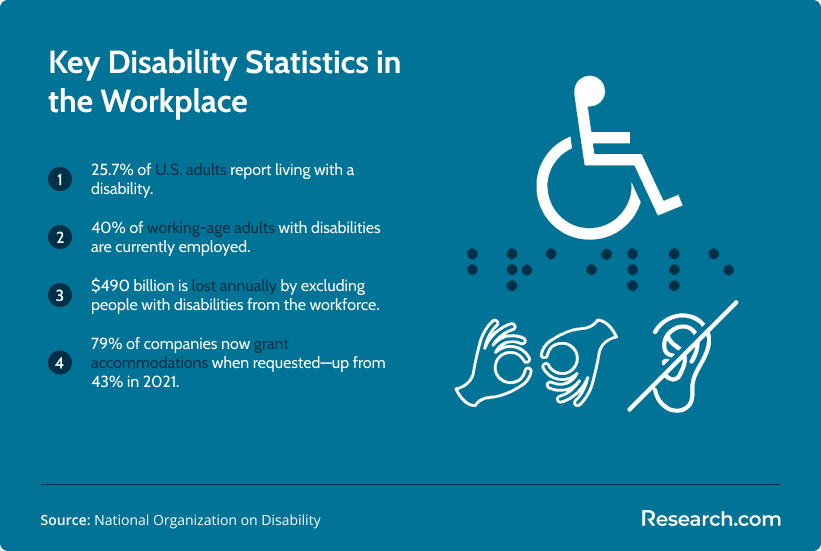
The CIA states that it provides reasonable accommodations for qualified applicants and employees with disabilities. Like 79% of companies in the US, the Agency grants accommodations when requested. Accommodation requests are reviewed individually, and disability-related information is kept confidential and not shared with selection officials.
Technical applicants, including those researching computer forensics investigator requirements, may need accessible testing conditions, specialized tools, or workplace adjustments. The CIA’s Ability Talent Broker and Reasonable Accommodations Staff help coordinate appropriate support.
Examples of possible accommodations
- Assistive technology.
- Modified testing arrangements.
- Accessible office setups.
- Sign language interpreters.
- Flexible work schedules when appropriate.
The visual below adds broader context about disability in the United States, including the previously cited figure that 25.7% of U.S. adults live with a disability.
What should veterans know about working at the CIA?
Veterans may bring experience that fits CIA work well, including leadership, operational discipline, mission focus, teamwork, security awareness, and comfort working within structured rules. The CIA recruits former service members and offers programs such as Operation Warfighter, which allows eligible wounded, ill, or injured service members to complete flexible internships while receiving medical care.
Military service does not guarantee selection, but it can strengthen an application when combined with relevant education, job-specific skills, and a strong clearance profile. Veterans may also qualify for benefits such as leave accrual credit for prior military service and the ability to apply military service toward federal retirement. National Guard and Reserve members can receive up to 15 days of paid military leave per fiscal year.
Veterans interested in oversight, finance, investigations, compliance, or accountability work may also consider an internal auditor career path. The CIA employs professionals in auditing, internal controls, compliance, and accountability in addition to operations and analysis.
Is becoming a CIA agent worth it?
Becoming a CIA agent can be worthwhile for the right person, but it is not the best choice for every applicant. Zippia lists the average CIA agent salary at $49,714 per year, which is below the national average salary of $59,228 cited in the original data. Many candidates are motivated less by immediate pay and more by mission, benefits, specialized work, stability, and public service.
The education investment can also be significant. A bachelor’s degree often costs between $25,000 and $40,000 depending on the school and program. If you want to keep options open across intelligence, policing, investigations, and national security, reviewing degree options for law enforcement careers can help you compare majors with broader career value.
Relocation and living costs should be part of the decision. As of March 2025, the average monthly cost of living for a single person in the U.S. is $1,174, not including rent. Since many CIA jobs are located near Washington, DC, applicants should plan for the financial realities of moving to a high-cost metro area.
| A CIA career may be worth it if... | You may prefer another path if... |
| You are strongly motivated by public service and national security. | You want work that you can describe openly and publicly. |
| You can tolerate a long, detailed, and uncertain hiring process. | You need a fast hiring decision or immediate income certainty. |
| You are willing to relocate to the Washington, DC area. | You cannot move or have strict geographic limits. |
| You value mission, benefits, specialized work, and career growth in addition to salary. | Your main goal is to maximize pay as quickly as possible. |
| You can maintain discretion in person and online. | You prefer public recognition or frequent sharing about your work. |
Common mistakes to avoid before applying
- Picking a major only because it sounds intelligence-related. Choose a program that builds useful skills and supports backup careers.
- Overlooking accreditation and total cost. A fast or inexpensive program may not be the best choice if it weakens your employment, graduate school, or credential options.
- Assuming every CIA job is a field operations role. The Agency also needs analysts, cyber specialists, linguists, accountants, scientists, engineers, security staff, auditors, and administrative professionals.
- Talking publicly about your application. Posting or discussing the process can show poor discretion and create unnecessary risk.
- Downplaying past conduct issues. Accurate disclosure is usually safer than concealment; lack of candor can be especially damaging.
- Forgetting relocation costs. DC-area housing, commuting, deposits, and moving expenses can affect whether an offer is financially practical.
- Relying only on salary averages. CIA pay varies by job type, and there is no official salary that applies to all people described as “agents.”
Key Insights
- “CIA agent” is a popular search phrase, but CIA careers include many officer and professional roles rather than one standard job title.
- Basic eligibility includes U.S. citizenship, being at least 18, willingness to relocate to the Washington, DC area for most roles, and the ability to pass extensive screening.
- The hiring process can take several months to a year and may include interviews, a background investigation, polygraph, medical review, psychological evaluation, and Top Secret clearance decision.
- Zippia estimates the average CIA agent salary at $49,714 per year and projects 3% growth between 2018 and 2028, but the CIA does not publish one official “agent” salary or detailed public hiring forecast.
- Education often costs $25,000 to over $40,000, and applicants may also need to budget for graduate study, certifications, language training, cybersecurity preparation, and relocation.
- The best degree depends on the target role: cyber candidates need technical skills, analysts need research and writing strength, and operations-focused applicants need judgment, adaptability, cultural knowledge, and discretion.
- Honesty is critical. Recent illegal drug use, criminal conduct, inconsistent statements, poor communication, or public discussion of the application can harm your candidacy.
- This career is most suitable for people who value national security, public service, specialized work, and long-term federal opportunities enough to accept privacy limits, relocation expectations, and a demanding selection process.
References:
- Bureau of Labor Statistics. Economists occupational outlook.
- Bureau of Labor Statistics. Information security analysts occupational outlook.
- Bureau of Labor Statistics. Police and detectives occupational outlook.
- Bureau of Labor Statistics. Political scientists occupational outlook.
- CIA. Applicant and employee accommodations.
- CIA. CIA hiring process.
- CIA. Examples of CIA missions.
- CIA. Veterans at the CIA.
- College Tuition Compare. Business tuition data.
- College Tuition Compare. Economics tuition data.
- College Tuition Compare. Engineering tuition data.
- College Tuition Compare. Information technology education cost data.
- College Tuition Compare. International relations and affairs tuition data.
- College Tuition Compare. Social sciences tuition data.
- Education Data Initiative. Average cost of college.
- Education Data Initiative. Private versus public college tuition.
- National Organization on Disability. Disability in the Workplace: 2023 Insights Report.
- Numbeo. Cost of living in the United States.
- Zippia. CIA agent career comparison.
Other Things You Should Know About CIA Agent Requirements
CIA candidates must obtain a Top Secret security clearance with access to Sensitive Compartmented Information before entering most operational training. The review includes background checks, interviews, polygraph testing, financial screening, and a medical and psychological evaluation conducted under CIA hiring standards.
In 2027, aspiring CIA agents typically need a bachelor's degree in fields like international relations, criminal justice, or political science. Certain roles may require advanced degrees or specialized skills. The CIA values diverse educational backgrounds to support its wide-ranging intelligence missions.


