
2027 Best Degrees for Law Enforcement Jobs & Careers

Co-Founder and Chief Data Scientist
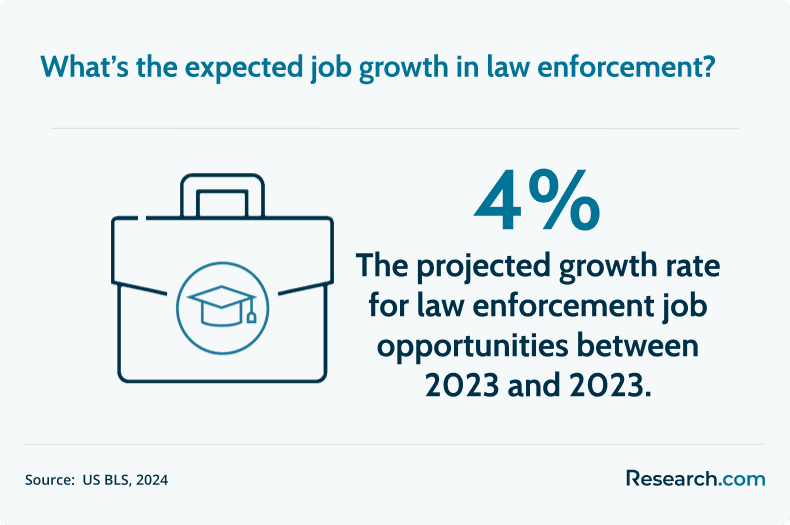
A law enforcement degree can help you prepare for careers in policing, investigations, corrections, public safety, homeland security, and private-sector security. The decision is not just whether to study criminal justice or law enforcement; it is which credential, format, specialization, and school will actually support your career goal. In the United States, law enforcement job opportunities are projected to grow by 4% between 2023 and 2033 (BLS, 2024), and employers increasingly value candidates who understand ethics, technology, community relations, evidence handling, and data-informed policing.
This guide explains what to expect from a law enforcement degree, how online and campus programs compare, what programs may cost, which careers graduates commonly pursue, and how to choose a school without relying only on rankings. It is written for first-time college students, working public safety professionals, military-connected students, and career changers who want a practical path into or upward within the criminal justice field.
Quick answer: Is a law enforcement degree worth considering?
A law enforcement degree is worth considering if you want broader career options than academy training alone may provide. It can support entry into local, state, federal, correctional, investigative, security, and administrative roles. It may also help with promotion into supervisory or specialized positions, though hiring, academy requirements, background checks, physical standards, and salary outcomes vary by agency, employer, location, and experience.
What are the main benefits of earning a law enforcement degree?
- More career flexibility: A law enforcement degree can prepare you for work in patrol, investigations, crime prevention, corrections, emergency management, forensic support, and private security.
- Steady hiring activity: At least 63,000 openings in law enforcement are expected each year (BLS, 2024), although competition and requirements differ by agency.
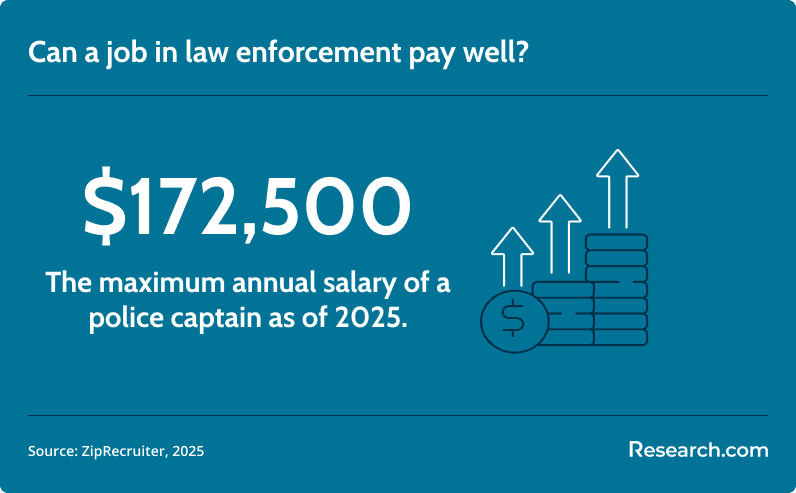
- Advancement potential: Education may strengthen your profile for leadership, investigative, or specialized roles, with some law enforcement salaries reaching up to $172,500 annually (ZipRecruiter, 2025).
What can I expect from a law enforcement degree?
A law enforcement degree usually combines criminal justice theory with applied training in policing, public safety, law, ethics, investigations, and community relations. Students learn how criminal justice systems work, why crime occurs, how agencies respond, and how legal and constitutional limits shape police work. Depending on the school, the program may be called law enforcement, police studies, criminology, criminal justice, public safety, or security studies.
Common courses include criminal law, criminology, forensic science, policing ethics, investigative methods, emergency response, corrections, and criminal justice administration. Some programs add internships, scenario-based exercises, research projects, mock investigations, or partnerships with police departments and public safety agencies. If your long-term goal involves intelligence or national security, the academic foundation can also help you explore paths such as becoming a CIA officer.
| Degree level | Best fit | Common outcomes | Decision point |
| Associate degree | Students seeking a faster, lower-cost starting point | Entry-level support roles, transfer into a bachelor’s program, preparation for academy application | Confirm whether credits transfer before enrolling. |
| Bachelor’s degree | Students who want wider career options and promotion potential | Police, corrections, security, investigations, emergency management, federal agency preparation | Choose a concentration aligned with your target role. |
| Master’s degree | Working professionals seeking leadership, research, policy, or administrative roles | Command staff, agency administration, policy analysis, advanced criminal justice roles | Compare tuition against realistic promotion and salary expectations. |
Where can I work with a law enforcement degree?
Law enforcement graduates work across government, nonprofit, and private-sector organizations. The right setting depends on whether you prefer public contact, investigative work, emergency response, policy, rehabilitation, or security operations.
- Local and state law enforcement: Municipal police departments, sheriff’s offices, and state agencies hire officers, deputies, and troopers to respond to calls, enforce laws, conduct preliminary investigations, and protect communities.
- Federal law enforcement: Agencies such as the FBI, DEA, U.S. Secret Service, U.S. Marshals Service, and Border Patrol handle national security, fugitive apprehension, drug enforcement, border protection, cybercrime, terrorism, and other specialized investigations.
- Private security and corporate investigations: Employers in finance, retail, healthcare, logistics, technology, and insurance use security and investigation professionals for fraud prevention, workplace investigations, asset protection, and risk management.
- Corrections, probation, and parole: Correctional officers, probation officers, and parole officers supervise individuals in custody or under community supervision while supporting safety, compliance, and rehabilitation.
- Emergency management and homeland security: These roles focus on disaster planning, crisis response, infrastructure protection, cyber threats, terrorism prevention, and interagency coordination.
How much can I make with a law enforcement degree?
Pay depends heavily on the job title, employer, geographic area, union agreements, overtime, rank, certifications, and years of service. A degree does not guarantee a particular salary, but it can support eligibility for specialized assignments, promotion exams, and administrative opportunities. According to ZipRecruiter (2025), law enforcement-related earnings include the following ranges and examples:
- Police officers and state troopers commonly earn between $48,500 and $75,000 per year, with overtime and promotion opportunities affecting total compensation.
- Senior leadership roles, including police captains, range from $87,000 to $172,500 annually.
- Specialized work in forensic science, cybersecurity, and criminal investigations reports an average annual wage of $132,962.
| Career direction | What affects earnings most | Degree strategy |
| Patrol and field operations | Agency pay scale, overtime, shift differentials, rank | Choose programs with police studies, ethics, report writing, and community policing. |
| Investigations | Experience, specialized unit assignment, certifications, agency size | Prioritize criminal investigation, evidence, interviewing, and forensic coursework. |
| Corrections and supervision | Government level, facility type, union contracts, supervisory rank | Look for corrections, rehabilitation, psychology, and case management courses. |
| Cybersecurity and intelligence-adjacent roles | Technical skills, clearance eligibility, analytical experience, certifications | Select programs with data analysis, cybercrime, intelligence, or homeland security content. |
- Best universities for law enforcement degree programs for 2027
- Typical completion time for a law enforcement degree
- Online versus on-campus law enforcement programs
- Average cost of a law enforcement degree
- Scholarships and financial aid for law enforcement students
- Admission requirements for law enforcement degree programs
- Career options outside traditional police work
- Technology trends in law enforcement education
- Diversity, inclusion, and community-focused policing and technology preparation
- Whether an advanced law enforcement degree makes sense
- Accelerated options for faster completion
- Accreditation and professional certification considerations
- Long-term return on investment
- Common law enforcement degree courses
- Available specializations
- How to choose the right law enforcement degree program and use the program selection checklist
- Career paths for law enforcement graduates
- Job market outlook for law enforcement degree holders
List of the best universities for law enforcement degree programs for 2027
How do we rank schools?
A law enforcement degree should be evaluated as both an academic credential and a career investment. Research.com’s ranking approach uses data-focused review methods and trusted education sources, including the IPEDS database, Peterson’s database, the Distance Learning Licensed Data Set, the College Scorecard database, and the National Center for Education Statistics. To understand how schools are assessed, review the Research.com ranking methodology.
The following universities offer strong law enforcement, criminology, criminal justice, public safety, or police studies programs. Use the list as a starting point, then verify admissions requirements, tuition, transfer policies, delivery format, internships, and alignment with your target career.
1. University of California - Berkeley
University of California - Berkeley provides criminal justice education shaped by faculty with backgrounds in prosecution, defense, criminal law, immigration, and international justice. Students can connect classroom study with clinical work, public service, criminal law research, the Criminal Law & Justice Center, the Berkeley Journal of Criminal Law, and pro bono opportunities that begin early in the student experience.
- Program Length: 3 years
- Tracks/concentrations: Criminal Justice
- Estimated Cost Per Academic Year: $63,196 for California residents and $75,624 for non-residents
- Required Credits to Graduate: 120
- Accreditation: Western Association of Schools and Colleges (WASC)
2. University of Wisconsin - Whitewater
University of Wisconsin - Whitewater offers the only criminology degree in the state system. The curriculum blends applied preparation for public safety and crime scene work with theory that helps students understand criminal behavior. Graduates may pursue law enforcement, corrections, and legal-related careers, while employers may value the program’s emphasis on critical thinking and cultural awareness.
- Program Length: 4 years
- Tracks/concentrations: Law Enforcement
- Estimated Cost Per Academic Year: $16,594 for Wisconsin residents and $26,694 for non-residents
- Required Credits to Graduate: 120
- Accreditation: The Higher Learning Commission
3. University of Pennsylvania
University of Pennsylvania is internationally known for criminology scholarship. The university created its Department of Criminology in 2003 as the field became more central to public policy. Its academic strength includes quantitative criminological research and evidence-focused analysis with policy relevance.
- Program Length: 4 years
- Tracks/concentrations: Criminology
- Estimated Cost Per Academic Year: $92,288
- Required Credits to Graduate: 34
- Accreditation: Middle States Commission on Higher Education (MSCHE)
4. Eastern Kentucky University (EKU)
Eastern Kentucky University offers a Bachelor’s in Police Studies designed for students entering policing and professionals seeking advancement. The program emphasizes ethics, theory, applied policing, and the responsibilities officers face in modern public safety environments.
- Program Length: 4 years
- Tracks/concentrations: Law Enforcement
- Estimated Cost Per Academic Year: $10,020 for in-state students and $11,120 for out-of-state students.
- Required Credits to Graduate: 120
- Accreditation: Southern Association of Colleges and Schools Commission on Colleges (SACSCOC)
5. University of Michigan - Dearborn
University of Michigan - Dearborn offers a Criminology and Criminal Justice bachelor’s degree that examines crime, justice, policy, law, and public systems from multiple disciplines. Students can use the degree to prepare for public safety, legal services, criminal justice administration, policy work, social work, community advocacy, law school, or graduate study, including the University of Michigan-Dearborn’s master's program in criminology and criminal justice.
- Program Length: 5 years
- Tracks/concentrations: Criminology and Criminal Justice
- Estimated Cost Per Academic Year: $$16,940 for Michigan residents and $34,196 for non-residents
- Required Credits to Graduate: 120
- Accreditation: Higher Learning Commission (HLC)
6. Florida State University
Florida State University offers a Public Safety and Security program focused on crime, intelligence, investigations, emergency response, prevention, and security operations. The multidisciplinary curriculum connects theory with applied training and uses data-informed decision-making as part of its public safety framework.
- Program Length: 4 years
- Tracks/concentrations: Public Safety and Security
- Estimated Cost Per Academic Year: $25,398 for in-state students and $39,831 for out-of-state students
- Required Credits to Graduate: 60 credit hours
- Accreditation: Southern Association of Colleges and Schools Commission on Colleges (SACSCOC)
7. Northeastern University
Northeastern University offers a Criminal Justice program that develops analytical, ethical, and policy-oriented thinking about crime and social response. Students study theory alongside experiential learning and can choose electives in areas such as security, policing, corrections, and juvenile justice.
- Program Length: 4 years
- Tracks/concentrations: Criminal Justice
- Estimated Cost Per Academic Year: $63,141
- Required Credits to Graduate: 128 semester hours
- Accreditation: New England Commission of Higher Education (NECHE)
8. Eastern New Mexico University
Eastern New Mexico University offers Bachelor of Science and Bachelor of Arts options in Criminal Justice. The program combines theoretical study of crime control and justice systems with an internship for applied experience. Students may complete the degree on campus, fully online through web-based or lecture-capture courses, or through a hybrid schedule.
- Program Length: 4 years
- Tracks/concentrations: Criminal Justice
- Estimated Cost Per Academic Year: $17,136
- Required Credits to Graduate: 120
- Accreditation: Higher Learning Commission (HLC)
9. CUNY John Jay College of Criminal Justice
CUNY John Jay College of Criminal Justice offers multiple law enforcement-related programs, including Criminal Justice: Crime Control & Prevention (BA), Criminal Justice: Institutional Theory & Practice (BS), Criminal Justice Management (BS), and Criminology (BA). Founded in the mid-1950s in response to the need for stronger police oversight and police-community relations in New York City, John Jay has developed into a prominent institution for justice and public safety education.
- Program Length: 1-2 years
- Tracks/concentrations: Criminal Justice
- Estimated Cost Per Academic Year: $7,470
- Required Credits to Graduate: 39 to 42 credit hours
- Accreditation: Middle States Commission on Higher Education (MSCHE)
10. Thomas University
Thomas University offers an online Criminal Justice bachelor’s degree for students who need flexibility while building knowledge of constitutional law, criminal procedure, justice organizations, and responses to crime. The format can be especially practical for working adults, including current law enforcement or criminal justice professionals.
- Program Length: 4 years
- Tracks/concentrations: Criminal Justice
- Estimated Cost Per Academic Year: $11,740
- Required Credits to Graduate: 120
- Accreditation: Middle States Commission on Higher Education (MSCHE)
How long does it take to complete a law enforcement degree program?
Completion time depends on degree level, enrollment status, transfer credits, program format, and whether the school awards credit for prior learning, military training, academy experience, or professional certifications. Associate programs are generally faster than bachelor’s programs, while graduate programs are intended for students who already hold an undergraduate degree.
According to Maryville University Online (n.d.), a bachelor’s-level criminal justice program typically requires 120 to 128 credit hours. A traditional full-time campus bachelor’s program can take up to four years, while many online bachelor’s degrees in criminal justice allow working students to study with more scheduling flexibility. Transfer-friendly programs may shorten the path for students who already have college credits.
| Student situation | What may shorten completion | What may extend completion |
| First-time college student | Full-time enrollment and summer terms | Part-time attendance or developmental coursework |
| Transfer student | Accepted general education and major credits | Credits that do not apply to degree requirements |
| Working officer or military-connected student | Credit for prior learning, academy training, or military experience | Irregular work schedules or field training demands |
| Online learner | Asynchronous courses and multiple start dates | Limited course availability or self-paced delays |
How does an online law enforcement degree compare to an on-campus program?
An online law enforcement degree can offer the same academic foundation as a campus program when it is properly accredited and uses comparable curriculum standards. Online study is often better for working adults, parents, military students, and current public safety employees because it reduces commute time and may provide asynchronous coursework, virtual discussions, digital libraries, and remote access to instructors.
Campus programs can be stronger for students who want more structure, frequent face-to-face interaction, direct mentoring, or access to specialized facilities. In-person programs may provide crime labs, simulation spaces, forensic equipment, physical skills training, field exercises, or other supervised learning experiences that are harder to replicate online.
The better choice depends on your schedule, learning style, location, and target job. If your goal requires hands-on training, verify how the online program handles fieldwork, internships, labs, or academy preparation. Students who want simpler admissions or flexible formats can also compare Research.com’s guide to the easiest criminal justice degree programs.
| Factor | Online law enforcement degree | On-campus law enforcement degree |
| Flexibility | Best for students balancing school with work or family duties | Best for students who can attend scheduled classes regularly |
| Hands-on learning | May use local internships, simulations, or virtual tools | May offer direct access to labs, training spaces, and live exercises |
| Networking | Often includes virtual networking with classmates and faculty | Usually provides more frequent in-person contact |
| Best fit | Working adults, transfer students, active officers, remote learners | Traditional students, hands-on learners, students near partner agencies |
What is the average cost of a law enforcement degree program?
Law enforcement degree costs vary by school type, residency status, delivery format, and fees. The average cost of a law enforcement degree program from an in-state public university is $6,930. Out-of-state private tuition averages $27,760. Online schools cost $8,100 per year, based on a standard 30-credit-hour course load. Campus students may also need to budget for housing, which can range from $500 to $1,000 per month (Booking Ninjas, 2024).
Students should look beyond tuition alone. Some law enforcement programs include additional expenses for uniforms, supplies, background checks, physical exams, lab materials, certification fees, internships, and training. CPR/First Aid certification typically costs around $50 per student (University of Southern Mississippi, n.d.), while firearms training courses may range from $100 to $1,000 depending on length and scope (Alpha Training and Tactics, n.d.). Cost-conscious students can compare the most affordable online criminal justice degree programs.
Estimated Cost of a Law Enforcement Degree by Institution Type
| Type of Institution | Annual Cost | Notes |
| In-state public university | $6,930 | Usually the lowest tuition route for state residents |
| Out-of-state private university | $27,760 | Often higher because of private tuition structures |
| Online schools | $8,100 | Calculated using a typical 30-credit-hour annual course load |
Source: Data USA, n.d.
What are the financial aid and scholarship options for students enrolling in a law enforcement degree program?
Students pursuing law enforcement, criminal justice, police science, public safety, or related degrees may qualify for federal aid, institutional aid, state grants, employer tuition assistance, military education benefits, local scholarships, and public safety-focused awards. Police Officer Assistance Trust (n.d.) identifies several scholarship options, including:
- Paul Janosky Scholarships: The Paul Janosky Criminal Justice Scholarship provides $2,000 to a criminal justice student. Applicants must be high school seniors or full-time college students from Miami-Dade, Broward, or Monroe County.
- Christopher W. Todd Scholarship: Created in 2011 to honor Miami-Dade Police Detective Christopher W. Todd, this scholarship awards $2,000 to students enrolled full-time or part-time in programs such as Criminal Justice, Police Science, Law, Public Safety, or Social Services.
- Mike Byrd Crime Scene Investigation Scholarship: This $2,000 scholarship is open to high school seniors or full-time college students in Miami-Dade, Broward, or Monroe County, and previous applicants and recipients may apply again each year.
Students should complete the FAFSA when eligible and ask each school about Pell Grant eligibility, Federal Work-Study (FWS), Direct Loans, departmental scholarships, emergency grants, and tuition discounts for public safety employees. If you are still comparing fields, it may help to understand criminal justice administration careers and salaries, since that area focuses on managing law enforcement agencies, court systems, and correctional institutions.
What are the prerequisites for enrolling in a law enforcement degree program?
Admission requirements differ by school and degree level. Academic admission to a college program is also separate from agency hiring, police academy entry, licensure, certification, or background screening requirements. Common prerequisites include:
- Education: Associate and bachelor’s programs generally require a high school diploma or GED. Foundational education can also support related paths, including students researching how to become a bounty hunter.
- Minimum GPA: Many schools expect a GPA between 2.0 to 3.0.
- Standardized Tests: Some colleges still request SAT or ACT scores, while others are test-optional.
- Graduate Programs: Master’s programs often ask for a relevant bachelor’s degree, recommendation letters, a statement of purpose, and professional experience.
- Additional Requirements: Some programs may require a background check, fitness assessment, drug screening, interview, or law enforcement academy component.
What alternative career avenues exist beyond traditional law enforcement roles?
A law enforcement degree does not limit you to patrol work. Graduates may apply investigative, legal, communication, risk assessment, and leadership skills in corporate security, compliance, fraud examination, insurance investigation, loss prevention, threat assessment, emergency planning, victim services, court administration, and policy support. These roles may appeal to students who want public safety-related work without the schedule, physical demands, or risks of sworn policing. For a broader look at career options, review jobs you can pursue with a criminal justice degree.
How are emerging technologies integrated into law enforcement degree programs?
Modern law enforcement education increasingly addresses digital evidence, cybercrime, surveillance technology, data analytics, forensic imaging, records systems, body-worn camera policy, and intelligence analysis. Strong programs do more than mention technology; they teach students how to evaluate evidence, protect privacy, follow legal standards, and communicate technical findings clearly. Students interested in research, analysis, or investigative careers can also explore criminology career paths.
| Technology area | Why it matters | What students should look for |
| Digital evidence | Many investigations now involve phones, cloud data, video, or online activity. | Courses in cybercrime, digital forensics, evidence handling, and legal procedure. |
| Data analytics | Agencies use data to study crime patterns, staffing, resource allocation, and risk. | Training in statistics, research methods, mapping, and ethical data use. |
| Forensic tools | Evidence analysis can require lab techniques and specialized documentation. | Access to forensic science coursework, labs, or applied projects. |
| Simulation training | Scenario-based learning can help students practice judgment and communication. | Virtual or in-person simulations with instructor feedback. |
How do law enforcement degree programs promote diversity and inclusion?
Effective law enforcement education now places greater emphasis on procedural justice, cultural competency, bias recognition, communication, conflict de-escalation, ethics, and police-community trust. These topics matter because officers and public safety professionals serve communities with different histories, needs, languages, and expectations. Programs may include community-based projects, guest speakers, service learning, restorative justice discussions, and training in respectful communication.
Students comparing flexible education models may also review resources on the best online degrees to get, but law enforcement students should judge any program by whether it teaches practical community engagement rather than treating diversity as a single required course.
Is an advanced law enforcement degree a worthwhile investment?
An advanced law enforcement degree may be worthwhile for professionals targeting command roles, teaching, research, policy, emergency management leadership, federal careers, or specialized analysis. Master’s programs often focus on advanced criminology, organizational leadership, budgeting, strategic management, research methods, and data-informed decision-making. However, it is not always necessary for entry-level policing, and students should compare tuition with realistic agency promotion policies before enrolling. For broader graduate-degree comparisons, Research.com’s guide to the highest-paying master’s degrees may provide useful context.
Are accelerated law enforcement degree programs a viable option for fast-tracking your law enforcement career?
Accelerated law enforcement programs can make sense for disciplined students who already have transfer credits, prior professional training, or the schedule flexibility to handle heavier course loads. They may help students reach academy eligibility, promotion qualifications, or bachelor’s completion faster. The trade-off is intensity: accelerated formats can leave less time for internships, networking, writing-heavy assignments, and careful preparation for agency applications. Students who want a faster entry point can also compare options such as a fast associate degree.
Are law enforcement degree programs accredited and do they provide professional certifications?
Accreditation should be one of your first checks. Institutional accreditation affects transfer credits, graduate school eligibility, employer recognition, and access to federal financial aid. Program-level recognition or alignment may also matter for specific criminal justice, forensic, public safety, or academy-related pathways. Some programs offer or prepare students for CPR/First Aid, emergency management, investigative, forensic, cybersecurity, or other professional certifications, but availability varies widely.
Do not assume that a degree automatically satisfies academy, state certification, or hiring requirements. Ask whether the program is regionally accredited, whether credits transfer, whether certifications are included or cost extra, and whether the curriculum aligns with your state or target agency. Even flexible programs marketed among the easiest online college degrees and majors should still meet recognized academic and employer standards.
Is a law enforcement degree a sound long-term financial investment?
A law enforcement degree can be a sound investment when the total cost is reasonable, the program is accredited, and the curriculum supports a clear career target. ROI should be evaluated through tuition, fees, books, housing, certifications, travel, lost work time, expected salary growth, promotion policies, pension or retirement benefits, and job stability. Public safety compensation can include benefits that do not show up in base salary comparisons, but overtime, shift work, injury risk, and stress should also be considered.
Before enrolling, compare the degree with other education investments and avoid unrelated comparisons unless they clarify cost, time, or career value. For example, reviewing programs such as 2 year PhD psychology programs may highlight how different credentials serve very different career goals, timelines, and costs.
Common mistakes to avoid when choosing a law enforcement degree
- Choosing a school without checking accreditation: Accreditation affects financial aid, transferability, and employer confidence.
- Looking only at tuition: Fees, uniforms, background checks, commuting, housing, certifications, and training costs can change the true price.
- Assuming online programs meet local requirements: Ask whether the degree supports academy, internship, or certification expectations in your state.
- Ignoring transfer policies: Transfer students should get a written credit evaluation before enrolling.
- Relying only on rankings: A highly ranked school is not automatically the best fit for your schedule, budget, specialization, or location.
- Expecting a guaranteed salary: Pay depends on employer, rank, experience, location, overtime, and specialized assignments.
- Skipping internship questions: Field experience can be valuable for networking and career clarity, especially for students without public safety experience.
What courses are typically in a law enforcement degree program?
Law enforcement programs usually include a mix of legal, behavioral, administrative, investigative, and ethics-focused coursework. The strongest curriculum should help students understand both the authority and limits of public safety work.
- Criminal Justice Foundations: Introduces the major parts of the justice system, including law enforcement, courts, and corrections, while examining historical and current challenges.
- Police Administration: Covers how police organizations are structured and managed, including leadership, staffing, budgeting, policies, and operational planning.
- Ethics: Examines professional responsibility, accountability, use of discretion, conflicts of interest, and decision-making under pressure.
- Criminal Law: Explores crime classifications, legal principles, prosecution and defense procedures, constitutional issues, and the role of law in justice systems.
- Emergency Management: Teaches preparation, response, recovery, coordination, and communication during disasters, emergencies, and public safety incidents.
- Criminal Psychology: Courses connected to a criminal psychology degree examine behavioral, psychological, and social factors linked to offending, profiling, and investigations.
What types of specializations are available in law enforcement degree programs?
Specialization matters because law enforcement-related careers are not all the same. As of 2025, the highest-paid law enforcement professionals, such as police captains, can earn up to $172,500 per year (ZipRecruiter). However, pay should not be the only factor. Choose a specialization based on the work you want to do, the skills employers request, and whether the program provides relevant field experience.
- Corrections: Focuses on custody, supervision, rehabilitation, probation, parole, correctional policy, inmate behavior, and recidivism reduction.
- Criminology: Studies the causes, patterns, social effects, and prevention of crime using research, psychology, sociology, and policy analysis.
- Forensic Science: Combines science and investigation through crime scene work, evidence processing, DNA analysis, laboratory methods, and forensic technology.
- Pre-Law and Legal: Emphasizes constitutional law, criminal procedure, legal research, courts, advocacy, and preparation for law school or policy work.
- Law Enforcement Administration: Prepares students for leadership in policing, emergency management, agency operations, budgeting, ethics, and strategic planning.
- Rehabilitation Services: Centers on reintegration, counseling, support programs, social services, and strategies that help reduce reoffending.
Students comparing specialization and salary possibilities can review Research.com’s list of the highest-paying criminal justice careers.
How to choose the best law enforcement degree program?
The best law enforcement degree is the one that fits your career target, budget, schedule, state requirements, and learning needs. Use the following steps before you apply:
- Start with the job, not the school: Decide whether you want policing, corrections, forensics, emergency management, legal studies, intelligence, private security, or administration.
- Match the specialization to the role: A student interested in federal intelligence work and researching CIA agent qualifications may benefit from criminal justice, international relations, cybersecurity, language study, or intelligence-related coursework.
- Verify accreditation: Confirm institutional accreditation and review any relevant recognition from bodies such as the Academy of Criminal Justice Sciences (ACJS), Higher Learning Commission (HLC), or Middle States Commission on Higher Education (MSCHE).
- Compare delivery formats honestly: Online, hybrid, and campus programs can all work, but hands-on requirements, internships, and lab access may differ.
- Ask about internships and agency partnerships: Field placement, ride-alongs, research projects, and agency connections can improve career readiness.
- Calculate the full cost: Include tuition, fees, books, travel, housing, certifications, uniforms, and training materials.
- Review faculty and student support: Look for instructors with relevant academic or field experience, career advising, tutoring, writing support, and employer connections.
| Question to ask | Why it matters |
| Is the institution accredited? | Accreditation affects aid, transfer credits, graduate study, and employer recognition. |
| Will my credits transfer? | Transfer rules can change cost and graduation time. |
| Does the program include internships or fieldwork? | Applied experience can help confirm your career direction and build contacts. |
| Does the curriculum support my target agency or role? | Policing, forensics, corrections, cybercrime, and administration require different preparation. |
| What are the real total costs? | Tuition alone may understate the cost of attendance. |
| Are certifications included? | Some credentials may be useful, but they may also cost extra. |
What career paths are available for graduates of law enforcement degree programs?
With 63,000 law enforcement jobs available across various roles, including detectives and criminal investigations (BLS, 2024), graduates can pursue work in traditional agencies, federal service, corrections, courts, emergency management, investigations, and private security. Career outcomes depend on agency requirements, background checks, physical standards, academy completion, location, and experience.
| Career path | Typical responsibilities | Helpful preparation |
| Police officer or sheriff’s deputy | Respond to calls, patrol communities, write reports, enforce laws, assist the public | Police studies, ethics, communication, criminal law, academy readiness |
| Detective or criminal investigator | Interview witnesses, collect evidence, build cases, coordinate with prosecutors | Investigations, evidence, report writing, interviewing, criminal procedure |
| State trooper | Enforce traffic and criminal laws, respond to emergencies, support statewide operations | Law enforcement operations, emergency response, physical readiness |
| Correctional officer | Supervise people in correctional facilities and maintain safety and order | Corrections, conflict management, psychology, rehabilitation |
| Probation or parole officer | Monitor compliance, prepare reports, connect individuals with services | Case management, rehabilitation services, communication, legal systems |
| Private investigator or corporate security specialist | Conduct investigations, assess risk, prevent fraud, protect people and assets | Investigative methods, fraud, security management, legal compliance |
| Emergency management specialist | Support planning, preparedness, crisis response, and interagency coordination | Emergency management, homeland security, public administration |
What is the job market for graduates with a law enforcement degree?
The job market for law enforcement degree holders is broad because public safety needs exist across local, state, federal, and private organizations. Traditional police hiring is only one part of the market; employers also need people who understand investigations, compliance, corrections, cybersecurity, intelligence analysis, emergency planning, and risk management.
Statista (2024) reported that the number of full-time law enforcement officers rose from 660,288 in 2021 to 720,652 in 2023. The chart below illustrates that change.
References:
- Alpha Training and Tactics. (n.d.). Law enforcement training programs. Alpha Training and Tactics. Retrieved 16 March 2025.
- Booking Ninjas. (2024). What is the average cost of student housing in the US? Booking Ninjas. Retrieved 16 March 2025.
- Columbia Southern University. (n.d.). Tuition overview. Columbia Southern University. Retrieved 16 March 2025.
- Data USA. (n.d.). Criminal justice & law enforcement administration. Data USA. Retrieved 16 March 2025.
- Maryville University, (n.d.). How Long Does It Take to Get a Bachelor’s Degree in Criminal Justice? Maryville University. Retrieved 11 March 2025.
- Police Officer Assistance Trust. (2025). Christopher W. Todd Police Science Scholarship. Police Officer Assistance Trust. Retrieved 11 March 2025.
- Police Officer Assistance Trust. (2025). Mike Byrd Science Scholarship. Police Officer Assistance Trust. Retrieved 11 March 2025.
- Police Officer Assistance Trust. (2025). Paul Janosky Scholarships. Police Officer Assistance Trust. Retrieved 11 March 2025.
- Statista. (2024). Number of law enforcement officers U.S. 2004-2023. Statista. Retrieved 11 March 2025.
- The University of Southern Mississippi. (n.d.). Law enforcement certifications. The University of Southern Mississippi. Retrieved March 16, 2025.
- US Bureau of Labor Statistics. (2024). Police & detectives. US Bureau of Labor Statistics. Retrieved 11 March 2025.
- ZipRecruiter. (2025). 25 of the Highest Paying Police Jobs in 2025. ZipRecruiter. Retrieved 11 March 2025.
Key Insights
- A law enforcement degree is most useful when it matches a specific goal, such as policing, investigations, corrections, emergency management, federal service, forensic support, or private security.
- Projected law enforcement job growth is 4% between 2023 and 2033 (BLS, 2024), with at least 63,000 openings expected each year, but hiring standards vary by agency.
- Cost can differ sharply by school type: $6,930 for an in-state public university, $27,760 for out-of-state private tuition, and $8,100 for online schools based on a 30-credit-hour annual course load.
- Online programs are best for flexibility; campus programs may be stronger for labs, field exercises, and in-person mentoring. Accreditation matters in either format.
- Do not assume the degree replaces academy training, certification, fitness standards, background checks, or state-specific hiring requirements.
- The best program is not automatically the highest-ranked one. Choose based on accreditation, transfer credit, specialization, internship access, total cost, and connection to your target career.
Other Things You Should Know About Degrees for Law Enforcement Jobs & Careers
No. A degree does not replace police academy training. Most municipal and state agencies require recruits to complete a state-certified academy before field training. Academy length often ranges from 12 to 28 weeks, and federal agencies use their own hiring and training standards.
A Criminal Justice degree with a specialization in Cybersecurity is highly valued for federal law enforcement jobs in 2027. This specialization equips candidates with skills to tackle cybercrime, a growing concern in the federal sector, making them attractive to agencies like the FBI and DHS.


