2027 Best Accelerated Medical Assistant to RN Online Bridge Programs

Co-Founder and Chief Data Scientist
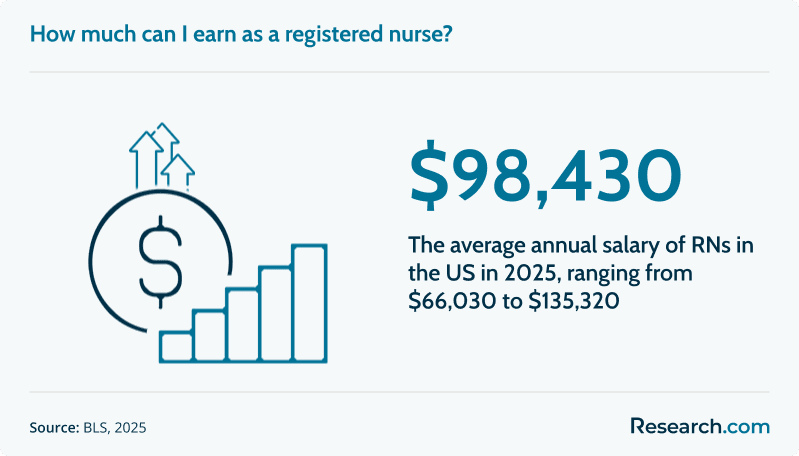
For many experienced medical assistants, the path to becoming a registered nurse can feel like starting over, a process that seems to discount the years of valuable clinical expertise they have accumulated. However, this is a strategic upgrade, not a reset. The significant leap in earning potential—from a median of $44,200 for MAs to an average of $98,430 for RNs—proves the immense value of this move. The key is understanding how to leverage existing experience as a direct advantage in an accelerated program.
This guide was developed by career planning experts to provide a clear path forward. It details the best online medical assistant to RN bridge programs, helping you translate your current skills into a rewarding new career.
What are the benefits of getting a medical assistant to RN online bridge program?
- Medical assistants earn a median annual salary of approximately $44,200. For registered nurses, the average wage is $98,430. This move can more than double your income, providing a powerful return on your investment.
- An RN license opens doors to numerous specializations and leadership positions, including Nurse Manager. You gain the power to continually grow and pivot throughout your professional life.
- As an RN, you earn a higher level of clinical responsibility and decision-making authority. The online medical assistant to RN bridge programs that make this possible also offer flexibility.
What can I expect from a medical assistant to RN online bridge program?
You can expect a challenging and structured curriculum that combines two distinct learning modes. All legitimate bridge programs are hybrid, meaning you will complete theory coursework online with flexible deadlines but also complete hundreds of hours of mandatory, in-person clinical rotations at approved healthcare facilities. There is no such thing as a 100% online nursing degree, because hands-on practice is non-negotiable for state licensure and employer trust.
Beyond the format, expect a fundamental shift in your thinking. You will move from performing tasks to mastering the nursing process—a critical thinking model of Assessment, Diagnosis, Planning, Implementation, and Evaluation (ADPIE). This is the intellectual "operating system" of a registered nurse. It empowers you to manage comprehensive patient care, anticipate needs, and make complex clinical judgments, building directly on the patient-care foundation you already have.
Where can I work with a medical assistant to RN online bridge program?
Your RN license opens doors far beyond the hospital floor. Many graduates find rewarding roles in familiar settings, such as physicians' offices, outpatient care centers, and home health agencies. You can also pursue opportunities in public health, schools, and corporate wellness programs.
The entire healthcare system is shifting toward ambulatory care to improve efficiency. This creates a high demand for RNs who already understand the workflow of a busy clinic. Your background as an MA gives you a significant advantage, positioning you perfectly for future leadership roles in these growing sectors.
How much can I make with a medical assistant to RN online bridge program?
The national average annual salary for a registered nurse is approximately $98,430. Employers set pay based on real-world market factors, so your actual income will vary. Key variables include your geographic location, the type of healthcare facility, and your specific role within that facility.
The full earning spectrum for RNs ranges from about $66,000 to over $135,000. As a new graduate, you can expect to start at the beginning of that range. Still, your MA experience and future specializations give you a clear path for significant salary growth.
- List of the Best Medical Assistant to RN Online Bridge Programs for 2027 List of Programs
- How long does it take to complete a medical assistant to RN online bridge program? Completion Time
- How does a medical assistant to RN online bridge program compare to an on-campus program? How does a medical assistant to RN online bridge program compare to an on-campus program?
- What is the average cost of a medical assistant to RN online bridge program? Program Cost
- What are the financial aid options for students enrolling in a medical assistant to RN online bridge program? Financial Aid
- What are the prerequisites for enrolling in a medical assistant to RN online bridge program? What are the prerequisites for enrolling in a medical assistant to RN online bridge program?
- What courses are typically in a medical assistant to RN online bridge program? What courses are typically in a medical assistant to RN online bridge program?
- What types of specializations are available in a medical assistant to RN online bridge program? What types of specializations are available in a medical assistant to RN online bridge program?
- How to choose the best medical assistant to RN online bridge program? How to choose the best medical assistant to RN online bridge program?
- What career paths are available for graduates of a medical assistant to RN online bridge program? What career paths are available for graduates of a medical assistant to RN online bridge program?
- What challenges might you face in a medical assistant to RN online bridge program? What challenges might you face in a medical assistant to RN online bridge program?
- What is the job market for graduates with a medical assistant to RN online bridge program? Job Market
- What advanced nursing degrees can further enhance my career after the bridge program? What advanced nursing degrees can further enhance my career after the bridge program?
- How Can Mentorship and Networking Propel My Nursing Career? How Can Mentorship and Networking Propel My Nursing Career?
- Can accelerated DNP programs further enhance my leadership skills? Can accelerated DNP programs further enhance my leadership skills?
Best Medical Assistant to RN Online Bridge Programs for 2027
Moving from medical assisting into registered nursing is a major career decision. You may already know how clinics run, how to communicate with patients, and how to perform routine clinical tasks, but becoming an RN requires a broader scope of practice, nursing judgment, state licensure, and completion of an approved nursing program.
This guide is for certified medical assistants, medical assistants with associate degrees, and working healthcare professionals comparing online or hybrid bridge options. You will learn which programs are available, how long they take, what they cost, what prerequisites to expect, how online programs handle clinical training, and how to decide whether an MA-to-RN path is the right next step.
Quick answer: What is the best medical assistant to RN online bridge program?
The best medical assistant to RN online bridge program is the one that is accredited, approved by the state Board of Nursing where you plan to become licensed, transparent about clinical placements, and realistic for your schedule and budget. Some programs lead directly to RN eligibility, while others are MA-to-LPN or practical nursing pathways that can become a stepping stone toward an RN program later.
For most medical assistants, the fastest credible path depends on previous college credit. MAs with only a certificate or diploma may need additional science and general education prerequisites before applying to nursing coursework. MAs with an associate degree may qualify for more transfer credit and finish sooner.
How these programs were selected
This ranking is designed to help students compare bridge programs using verifiable education data rather than marketing claims. Research.com’s ranking process follows a transparent methodology that evaluates institutional and program-level information from established education sources.
Institutional data is informed by the U.S. Department of Education’s IPEDS database and the National Center for Education Statistics (NCES). Cost and outcome context is drawn from the College Scorecard, while Peterson’s database supports review of online program characteristics.
Program comparison at a glance
| School | Pathway | Length | Credits or Hours | Published Cost | Accreditation |
| Allegany College of Maryland | CMA to Nursing (RN) Program | 12 to 18 months | 70 credits | $136 in-state; $392 out-of-state | Accreditation Commission for Education in Nursing (ACEN) |
| Herzing University | Medical Assistant to RN Program | Approximately 2 years and 4 months | 120 credits | $515 per credit | Accreditation Commission for Education in Nursing (ACEN) |
| Fletcher Technical Community College | MA to LPN Bridge Program | 2 years | 62 credits | $83 in-state; $139 out-of-state | Accreditation Commission for Education in Nursing (ACEN) |
| Lakeshore Technical College | Medical Assistant Bridge to Practical Nursing Pathway | Approximately 1 year | 33 credits | $185 per credit | Accreditation Commission for Education in Nursing (ACEN) |
| Green River College | Medical Assistant-Certified to Practical Nursing Pathway | 17 months | 90 credits | $88 per credit | Accreditation Commission for Education in Nursing (ACEN) |
| Ivy Tech Community College | Nursing Medical Assistant to ASN Transition, AS Completion Track | Approximately 2 years | 61 credits | $149.55 in-state; $292.57 out-of-state | Accreditation Commission for Education in Nursing (ACEN) |
| Northeast Wisconsin Technical College | Medical Assistant to Practical Nursing Bridge | Approximately 1 year | 24 credits | $236.83 per credit | Accreditation Commission for Education in Nursing (ACEN) |
| Tennessee College of Applied Technology, Jackson | Certified Medical Assistant to Practical Nursing Bridge Program | 10 months | 1,080 clock hours | $5,725 total program cost | Commission of the Council on Occupational Education (COE) |
1. Allegany College of Maryland — CMA to Nursing (RN) Program
Allegany College of Maryland offers a CMA-to-nursing route for certified medical assistants who want a structured pathway toward RN licensure. The program starts with a hybrid online transition course and includes required in-person clinical experiences, giving students a bridge from medical assisting into nursing theory, clinical decision-making, and NCLEX-RN preparation.
- Program length: 12 to 18 months
- Required credits to graduate: 70
- Cost per credit: $136 (in-state); $392 (out-of-state)
- Accreditation: Accreditation Commission for Education in Nursing (ACEN)
2. Herzing University — Medical Assistant to RN Program
Herzing University provides a bridge option for medical assistants who want to move into RN-level responsibilities such as medication administration, care coordination, patient education, and nursing care planning. Time to completion depends partly on transfer credits, so applicants should request a transcript review before estimating their graduation timeline.
- Program length: Approximately 2 years and 4 months
- Required credits to graduate: 120
- Cost per credit: $515
- Accreditation: Accreditation Commission for Education in Nursing (ACEN)
3. Fletcher Technical Community College — MA to LPN Bridge Program
Fletcher Technical Community College offers an MA-to-LPN bridge for students who want to become licensed practical nurses before pursuing additional nursing education. This option is not a direct RN pathway, and admission depends on prior completion of the school’s MA program, so applicants should verify eligibility before applying.
- Program length: 2 years
- Required credits to graduate: 62
- Cost per credit: $83 (in-state); $139 (out-of-state)
- Accreditation: Accreditation Commission for Education in Nursing (ACEN)
4. Lakeshore Technical College — Medical Assistant Bridge to Practical Nursing Pathway
Lakeshore Technical College offers a bridge pathway for certified medical assistants who want to become practical nurses. The program can appeal to MAs seeking a shorter transition into licensed nursing practice, but seats are limited and applicants need current MA certification.
- Program length: Approximately 1 year
- Required credits to graduate: 33
- Cost per credit: $185
- Accreditation: Accreditation Commission for Education in Nursing (ACEN)
5. Green River College — Medical Assistant-Certified to Practical Nursing Pathway
Green River College serves Washington State MA-C license holders who want to transition into practical nursing. A notable feature is the ability to earn credit for prior learning through a skills proficiency exam, which may reduce duplication for students who already have documented clinical competence.
- Program length: 17 months
- Required credits to graduate: 90
- Cost per credit: $88
- Accreditation: Accreditation Commission for Education in Nursing (ACEN)
6. Ivy Tech Community College — Nursing Medical Assistant to ASN Transition, AS Completion Track
Ivy Tech Community College offers an AS completion track for CMA (AAMA) certified professionals pursuing an associate-level route to RN eligibility. The program recognizes prior learning and is designed for students who want to build from medical assisting into broader nursing assessment, patient management, and clinical reasoning skills.
- Program length: Approximately 2 years
- Required credits to graduate: 61
- Cost per credit: $149.55 (in-state); $292.57 (out-of-state)
- Accreditation: Accreditation Commission for Education in Nursing (ACEN)
7. Northeast Wisconsin Technical College — Medical Assistant to Practical Nursing Bridge Technical Diploma
Northeast Wisconsin Technical College offers a practical nursing bridge technical diploma for experienced medical assistants with a pharmacology background. Students should pay close attention to admissions requirements because the program has limited availability and requires documented work experience.
- Program length: Approximately 1 year
- Required credits to graduate: 24
- Cost per credit: $236.83
- Accreditation: Accreditation Commission for Education in Nursing (ACEN)
8. Tennessee College of Applied Technology, Jackson — Certified Medical Assistant to Practical Nursing Bridge Program
Tennessee College of Applied Technology, Jackson offers a practical nursing diploma for certified medical assistants. The program grants credit for previous MA knowledge and provides a shorter route into LPN preparation, which may suit students who want licensed nursing experience before considering an RN bridge later.
- Program length: 10 months
- Required clock hours to graduate: 1,080
- Total program cost: $5,725
- Accreditation: Commission of the Council on Occupational Education (COE)
How Long Does It Take to Complete a Medical Assistant to RN Online Bridge Program?
Completion time usually depends less on the word “bridge” and more on your transcript. Some students can move quickly because they already completed college-level science and general education courses. Others need to finish prerequisites before they can enter the nursing sequence.
Path 1: Medical assistants with a certificate or diploma
If your medical assistant training ended with a certificate or diploma, expect a longer path of 2.5 to 4 years. The first stage is usually prerequisite coursework, which may take about 1-2 years at a community college or through an approved college provider.
Common prerequisites include Anatomy & Physiology, Microbiology, Chemistry, English, math, psychology, and other general education requirements. After those courses are complete, the nursing portion often takes another 1.5 to 2 years.
Path 2: Medical assistants with an associate degree
If you already hold an Associate of Science (AS) or Associate of Applied Science (AAS), your timeline may be closer to 1 to 2 years. The deciding factor is transfer credit. English, math, and general education courses often transfer more easily than older science classes.
Before you apply, ask each program for an official transcript evaluation. This step shows which credits count, which prerequisites remain, and whether any science courses must be repeated because of recency rules.
| Your starting point | Likely timeline | Main issue to verify | Best first step |
| MA certificate or diploma | 2.5 to 4 years | Missing college prerequisites | Map required sciences and general education courses |
| MA plus AS or AAS degree | 1 to 2 years | Transferability and age of credits | Request a formal transcript review |
| MA-to-LPN bridge student | Varies by next RN program | Whether LPN credits later apply to RN admission | Confirm LPN-to-RN options before enrolling |
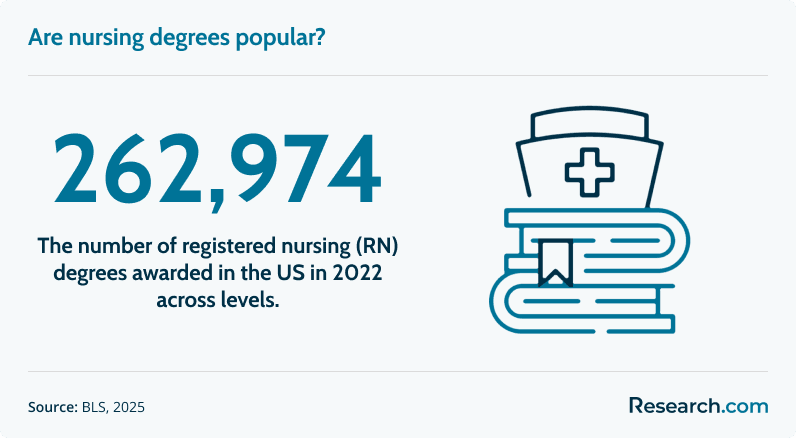
The chart below shows the most common RN degrees awarded, based on BLS reporting in 2025.
Online vs. Campus Medical Assistant to RN Bridge Programs: Which Format Fits You?
An accredited and state-approved nursing program can prepare students for the same RN license whether theory courses are delivered online, on campus, or in a hybrid format. The major difference is not the credential itself. It is how you learn, how much structure you need, and how clinical requirements are arranged.
Accreditors such as the Accreditation Commission for Education in Nursing (ACEN) and the Commission on Collegiate Nursing Education (CCNE) evaluate whether nursing programs meet expectations for curriculum, faculty, clinical learning, student outcomes, and program quality. State Boards of Nursing determine whether a program qualifies graduates for licensure in that state.
Students comparing healthcare routes may also look at shorter clinical credentials, such as a fast track surgical tech associate's degree online, especially if their immediate goal is to enter an operating room or procedural setting faster. For RN licensure, however, employers and boards focus on nursing program approval, accreditation, clinical completion, and passing the NCLEX.
Online bridge programs: best for flexible, self-directed learners
Online and hybrid formats can work well for medical assistants who are employed, parenting, commuting long distances, or trying to keep income while studying. The trade-off is that flexibility requires discipline. You must manage deadlines, complete online coursework, communicate proactively, and travel to approved clinical sites when required.
Campus programs: best for students who want structure and face-to-face support
Campus-based nursing programs offer fixed class times, in-person faculty access, peer study groups, and immediate use of labs and simulation spaces. This format may be better if you learn best through direct interaction or need a predictable weekly schedule.
| Factor | Online or hybrid bridge program | Campus program |
| Schedule | More flexible for theory coursework | More fixed and predictable |
| Clinical training | Still requires in-person clinical hours | Clinical coordination may be more local to campus |
| Best fit | Working adults with strong time management | Students who prefer direct structure |
| Main risk | Weak clinical placement support can delay progress | Less flexibility for work and family obligations |
How Much Does a Medical Assistant to RN Online Bridge Program Cost?
Costs vary widely. A public Associate's Degree in Nursing (ADN) may cost approximately $10,000 to $20,000, while a private Bachelor of Science in Nursing (BSN) can exceed $40,000. The final price depends on school type, residency status, degree level, transfer credit, fees, books, uniforms, background checks, testing costs, supplies, technology requirements, and travel to clinical sites.
Do not compare programs by tuition alone. Ask each school for a full cost estimate that includes required fees and nursing-specific expenses. Students evaluating shorter healthcare options, including the fastest surgical tech certificate programs online, should use the same approach because program fees and clinical costs can change the real price.
Is the cost worth it?
The answer depends on debt, completion likelihood, local RN wages, and whether the program leads to licensure in your state. The average RN salary cited in this guide is around $98,430, and earnings can be higher in top-paying states such as California. Still, salary is never guaranteed, and students should compare expected borrowing against realistic local job options.
If affordability is your top concern, compare community college ADN programs, employer-sponsored pathways, and options similar to affordable EMT to RN programs online. Students who later want a BSN can also research cheapest accredited online RN to BSN programs after earning an RN license.
| Cost item | Why it matters | Question to ask |
| Tuition | Largest direct academic cost | Is the rate different for in-state and out-of-state students? |
| Nursing fees | May cover labs, testing, simulation, or program resources | Are all mandatory fees included in the published estimate? |
| Clinical travel | Online students may need to commute to approved sites | Where are clinical placements located? |
| Supplies and compliance | Uniforms, health screenings, background checks, and equipment add cost | What must be purchased before clinicals begin? |
| Lost work hours | Clinical schedules may reduce your ability to work | Can clinicals be scheduled around employment? |
Financial Aid Options for Medical Assistant to RN Bridge Students
Most students should begin with federal financial aid, then add scholarships, state aid, employer assistance, and payment plans if needed. Funding works best when you combine several sources instead of relying on one option.
Start with the FAFSA
Complete the Free Application for Federal Student Aid (FAFSA) even if you are working full time. Many adult learners assume they will not qualify and skip the application, but FAFSA data is used for more than need-based grants. It can also determine access to federal loans and school-based aid.
- Federal and state aid: FAFSA results may qualify students for federal grants, federal loans, and state-based aid programs. Some states prioritize high-demand fields such as nursing.
- Scholarships: Look for awards for nursing students, adult learners, first-generation students, career changers, and healthcare workers. Your program’s financial aid office can identify institutional scholarships.
- Employer tuition assistance: Healthcare employers may support medical assistants who are preparing for nursing roles. If you previously compared cheap online medical assistant programs, use the same cost-conscious mindset and ask your HR department about reimbursement, scheduling support, or work-study arrangements.
- Payment plans: Some colleges allow students to divide tuition into installments. This does not reduce the total cost, but it may reduce the need for high-interest borrowing.
Prerequisites for Medical Assistant to RN Online Bridge Programs
Most MA-to-RN bridge applicants must complete college-level science prerequisites before starting nursing coursework. The most common requirements include Anatomy & Physiology I & II, Microbiology, and Chemistry, usually with lab components.
Does medical assistant experience replace prerequisites?
Usually, no. Your clinical experience can make nursing school more familiar, but it does not typically replace required college coursework. Nursing programs need proof that every student has a standardized academic foundation in biology, chemistry, anatomy, physiology, and evidence-based patient care.
For example, you may already know the practical answer to whether medical assistants can draw blood. Nursing prerequisites go deeper by teaching the scientific reasoning behind body systems, infection processes, medication effects, and patient safety decisions.
- Core science courses: Anatomy & Physiology I & II with labs, Microbiology with lab, and General or Introductory Chemistry are common requirements.
- General education courses: Programs may also require English, math, psychology, human development, or communication.
- Minimum grades: A “C” or better is often required, but competitive nursing applicants frequently need stronger grades such as “B” or higher.
- Recency rules: Many schools require science courses to be completed within the last 5 to 7 years. Older coursework may need to be repeated.
Courses in a Medical Assistant to RN Online Bridge Program
MA-to-RN bridge coursework shifts students from task-focused clinical support into RN-level nursing judgment. You study how to assess patients, identify nursing priorities, plan care, implement interventions, evaluate outcomes, and communicate within an interprofessional healthcare team.
Typical nursing courses
| Course area | What students learn | How MA experience helps |
| Fundamentals of Nursing | Basic nursing care, safety, documentation, communication, and clinical reasoning | Patient intake, vital signs, and clinic workflow provide useful context |
| Pharmacology | Medication actions, side effects, administration principles, and patient education | Prior exposure to medication lists and office procedures can support learning |
| Medical-Surgical Nursing | Care for adults with acute and chronic conditions | Experience with chronic disease visits can make patient needs more familiar |
| Mental Health Nursing | Therapeutic communication, psychiatric conditions, crisis response, and safety | Front-office and rooming experience can strengthen communication skills |
| Pediatric or Maternal-Child Nursing | Care for children, families, pregnancy, birth, and postpartum patients | Clinic experience with families can support patient education |
How the nursing process builds on your MA background
The nursing process is often explained as Assessment, Diagnosis, Planning, Implementation, and Evaluation (ADPIE). Medical assistants often have experience with pieces of this workflow, but RN education requires you to apply it with greater independence and accountability.
- Assessment: Taking vital signs and collecting patient histories gives you a foundation for more advanced patient assessment.
- Implementation: Assisting with procedures and patient care tasks helps you understand how nursing interventions are performed safely.
- Planning and evaluation: Familiarity with Electronic Health Records (EHRs) can help you understand how care plans, outcomes, and follow-up are documented.
Some students use RN education as a foundation for later healthcare specialization, while others compare related long-term paths such as the shortest PharmD online programs if they are interested in pharmacy-focused practice. For MA-to-RN students, the immediate goal is still RN licensure and safe entry-level nursing practice.
The chart below identifies industries with the highest employment levels for registered nurses, as reported by the BLS in 2025.
Can You Specialize During a Medical Assistant to RN Online Bridge Program?
Most bridge programs do not provide formal specialization during the initial RN pathway. Their purpose is to prepare students for generalist registered nursing practice and NCLEX eligibility. This is similar to accelerated EMT to RN bridge programs online, where students first build broad nursing competence before narrowing into a specialty.
Specialization usually happens after graduation, licensure, and work experience. New RNs commonly begin in general medical-surgical, outpatient, long-term care, home health, or hospital-based roles before moving into a focused area.
Common RN specialty directions after licensure
- Pediatric Nursing
- Critical Care Nursing
- Emergency and Trauma Nursing
- Oncology Nursing
- Cardiac Care Nursing
- Public Health Nursing
- Informatics Nursing
Your RN license is the entry point. Specialty certifications, graduate education, and advanced practice roles typically require additional experience and education after the bridge program.
How to Choose the Best Medical Assistant to RN Online Bridge Program
The strongest program is not always the fastest or the cheapest. It is the one that can legally and practically get you to licensure with the least unnecessary risk. Before enrolling, verify accreditation, state approval, clinical placement support, NCLEX outcomes, cost, transfer credit, and student services.
Non-negotiable checks before you apply
- Accreditation: Look for recognized nursing accreditation such as ACEN or CCNE when applicable.
- State Board of Nursing approval: Confirm that the program qualifies graduates to sit for the NCLEX in the state where you plan to become licensed.
- Clinical placement process: Ask whether the school secures clinical sites or expects students to find their own.
- NCLEX pass rates: Review first-time pass rates and look for consistent performance, ideally 90% or above.
- Transfer credit policy: Request a written evaluation showing exactly which credits apply.
- Schedule realism: Compare required labs and clinical days against your work and family obligations.
The clinical placement question that matters most
Ask every program: “How, specifically, do you help online students secure required clinical placements?” A strong program can explain its clinical coordination process, site partnerships, deadlines, compliance requirements, and what happens if a placement falls through.
Be cautious if a program places the full responsibility on students to locate preceptors or clinical sites. That approach can delay graduation, increase stress, and create serious problems for students who live far from partner facilities.
Questions to ask admissions advisors
| Question | Why it matters |
| Is this program approved for RN licensure in my state? | Approval determines whether the program can lead to NCLEX eligibility where you live. |
| How many credits will transfer from my MA training or associate degree? | Transfer credit affects cost and time to graduation. |
| Who arranges clinical placements? | Clinical delays can prevent students from completing the program on time. |
| What are the latest NCLEX pass rates? | Pass rates help show whether graduates are prepared for licensure. |
| What fees are not included in tuition? | Hidden costs can change affordability. |
| Can I work while enrolled? | Nursing programs often require daytime labs, simulations, or clinical rotations. |
Common Mistakes to Avoid When Choosing an MA-to-RN Bridge Program
- Assuming “online” means fully online: Nursing programs require in-person clinical training. Ask where and when those hours occur.
- Skipping state approval checks: Accreditation alone is not enough. Your state Board of Nursing must recognize the program for licensure eligibility.
- Choosing only by tuition: Fees, supplies, travel, and lost work hours can make a cheap-looking program more expensive.
- Overestimating transfer credit: MA experience may help you perform better, but it may not replace nursing prerequisites.
- Ignoring science recency limits: Anatomy, physiology, microbiology, or chemistry courses older than the program’s limit may need to be repeated.
- Relying only on rankings: Rankings can narrow your list, but your final decision should depend on licensure fit, clinical access, cost, schedule, and support.
Career Paths After a Medical Assistant to RN Online Bridge Program
An RN license expands your scope of practice and opens career paths beyond medical assisting. Many graduates begin as staff nurses, then move into charge nurse, preceptor, specialty, management, education, or advanced practice roles over time.
Typical nursing career ladder
- Staff nurse: Provides direct patient care, develops bedside judgment, manages time-sensitive care, and builds clinical confidence.
- Charge nurse or preceptor: Supports unit workflow, mentors newer nurses, and begins taking on leadership responsibilities.
- Nurse manager or unit director: Oversees staffing, quality metrics, budgets, and team performance, often with additional education or experience.
Why the BSN matters for advancement
An ADN can be a fast route to RN licensure, but a BSN may improve long-term mobility. A substantial majority of healthcare systems, 71.7%, now report a preference for hiring BSN-prepared nurses, especially for positions beyond basic bedside practice.
A BSN is also commonly required for advanced practice nursing programs and specialized roles. For example, nurses interested in cardiology may eventually research what cardiac nurses do and pursue experience, certification, or graduate study in that area.
Challenges in Medical Assistant to RN Online Bridge Programs
Online and hybrid bridge programs can be manageable, but they are not easy. Students must handle demanding science content, nursing exams, skills labs, clinical rotations, and often part-time or full-time work. The biggest challenge is usually coordination: online coursework may be flexible, but clinical schedules are not always convenient.
| Challenge | Why it can become a problem | How to reduce the risk |
| Clinical placement uncertainty | Students may be delayed if sites are not available | Choose programs with clear placement support |
| Heavy workload | Nursing content requires sustained weekly study | Build a realistic study schedule before classes begin |
| Transfer credit confusion | Students may discover late that credits do not apply | Get transcript decisions in writing |
| Technology demands | Online exams, simulations, and learning platforms require reliable access | Confirm computer, internet, webcam, and software requirements |
| Work-life balance | Clinical days may conflict with job shifts or caregiving | Discuss scheduling flexibility with your employer early |
If your long-term goal includes finishing a BSN after RN licensure, compare affordable continuation options such as accredited online RN to BSN programs before you commit to a pathway.
Job Market for Graduates of Medical Assistant to RN Bridge Programs
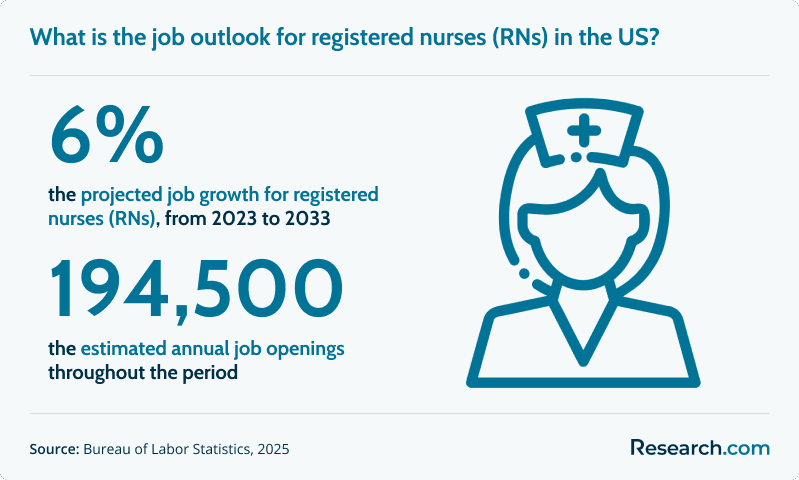
The registered nursing job market remains strong. The cited outlook in this guide projects about 194,500 new nurses each year through 2033. Registered nursing is also a much larger occupation than medical assisting, so a 6% projected growth rate for RNs can still represent a substantial number of openings, even though the cited growth rate for MAs is 15%.
How to approach your first RN job search
Many new RNs begin in generalist roles, including medical-surgical units, long-term care, outpatient clinics, physician practices, home health, and other settings that help build broad clinical judgment. Your medical assistant background can be a strong advantage because you already understand patient flow, documentation, communication, and clinic operations.
- Highlight direct patient experience: Emphasize vital signs, patient education, EHR use, procedure support, and teamwork.
- Apply to new graduate residency programs: These paid programs can provide mentorship and a structured transition into practice.
- Be open to several settings: Hospitals are common, but outpatient, ambulatory, and home-based roles may also fit your goals.
- Connect your MA experience to RN judgment: Show employers how your background helps you recognize patient needs and communicate effectively.
Students interested in flexible community-based work may also explore how to become a home health nurse after licensure and appropriate clinical preparation.
Advanced Nursing Degrees After an MA-to-RN Bridge Program
After earning RN licensure, many nurses continue their education to qualify for broader roles. If you graduate with an ADN, the next academic step is often an RN-to-BSN program. Nurses who want advanced clinical, teaching, leadership, or nurse practitioner roles may later consider a Master of Science in Nursing (MSN).
Students planning for advanced practice can compare direct NP programs, although admission requirements vary and many advanced nursing tracks expect an RN license, a BSN, clinical experience, or a combination of these. The right pathway depends on your current degree, licensure status, specialty interest, and state requirements.
What Graduates Say About MA-to-RN Bridge Programs
- : "I delayed nursing school because I was worried about borrowing money. Once I became an RN, the pay increase changed our household finances much faster than I expected. The program was difficult, but the credential gave me stability I did not have before. — Liam"
- : "I assumed RN work meant only hospital chaos, and that made me hesitate. During the program, I learned how many nursing jobs exist in outpatient and procedural settings. My medical assistant experience helped me adjust quickly, and I found a role in an ambulatory surgery center after graduation. — Fatima"
- : "Because I already had an associate degree, I needed a program that would not make me repeat coursework unnecessarily. The transcript review showed exactly what transferred, and I finished in just under 18 months while continuing to work as a medical assistant. — Merlin"
How Mentorship and Networking Can Support Your Nursing Career
Mentorship can make the transition from MA to RN less isolating. Faculty, clinical instructors, preceptors, nurse managers, and experienced RNs can help you interpret feedback, prepare for interviews, understand specialty options, and avoid early-career mistakes.
Networking also matters. Classmates, alumni, clinical site staff, and professional contacts can alert you to residency programs, specialty units, employer tuition support, and future leadership opportunities. If you are still comparing possible healthcare paths before committing to RN education, you may also review a direct entry to nurse practitioner program for non nurses to understand how different nursing entry routes are structured.
Can Accelerated DNP Programs Build Nursing Leadership Skills?
Doctor of Nursing Practice programs are designed for advanced nursing leadership, systems improvement, evidence-based practice, and high-level clinical or administrative roles. They are not the next immediate step for most medical assistants, but they may become relevant after RN licensure, BSN or MSN preparation, and significant clinical experience.
Nurses who eventually want executive, advanced practice, or healthcare innovation roles may compare accelerated DNP programs. Before doing so, confirm admission requirements, clinical expectations, accreditation, state authorization, and whether the curriculum matches your intended scope of practice.
Alternative Healthcare Paths to Consider
An MA-to-RN bridge is a strong option if your goal is registered nursing. It may not be the best fit if you want a shorter credential, less academic science, or a role outside bedside nursing. Surgical technology, practical nursing, EMT-to-RN routes, pharmacy education, and direct-entry nursing options can all lead to different responsibilities and timelines.
| Path | When it may make sense | Important caution |
| MA-to-RN bridge | You want RN licensure and broader clinical responsibility | Requires prerequisites, clinicals, and NCLEX eligibility |
| MA-to-LPN bridge | You want a shorter step into licensed nursing | May not lead directly to RN status without additional education |
| Surgical technology | You prefer operating room support and procedural work | It is a different role from nursing |
| RN-to-BSN after ADN | You want long-term advancement after RN licensure | Requires additional coursework after the associate degree |
| Advanced nursing degree | You want leadership, education, or advanced practice roles | Usually requires RN preparation and clinical experience first |
References
- American Association of Colleges of Nursing. (2025). Nursing shortage. Retrieved July 11, 2025, from https://www.aacnnursing.org/news-data/fact-sheets/nursing-shortage
- Bureau of Labor Statistics, U.S. Department of Labor. (2025a). Occupational employment and wage statistics. Retrieved July 11, 2025, from https://data.bls.gov/oesprofile/
- Bureau of Labor Statistics, U.S. Department of Labor. (2025b). Occupational Outlook Handbook, EMTs and paramedics. Retrieved July 11, 2025, from https://www.bls.gov/ooh/healthcare/emts-and-paramedics.htm
- Bureau of Labor Statistics, U.S. Department of Labor. (2025c). Occupational Outlook Handbook, Licensed practical and licensed vocational nurses. Retrieved July 11, 2025, from https://www.bls.gov/ooh/healthcare/licensed-practical-and-licensed-vocational-nurses.htm
- Bureau of Labor Statistics, U.S. Department of Labor. (2025d). Occupational Outlook Handbook, Medical assistants. Retrieved July 11, 2025, from https://www.bls.gov/ooh/healthcare/medical-assistants.htm
- Bureau of Labor Statistics, U.S. Department of Labor. (2025e). Occupational Outlook Handbook, Nursing assistants and orderlies. Retrieved July 11, 2025, from https://www.bls.gov/ooh/healthcare/nursing-assistants.htm
- Bureau of Labor Statistics, U.S. Department of Labor. (2025f). Occupational Outlook Handbook, Registered nurses. Retrieved July 11, 2025, from https://www.bls.gov/ooh/healthcare/registered-nurses.htm
- Data USA. (2025). Registered nursing. Retrieved July 11, 2025, from https://datausa.io/profile/cip/registered-nursing
- National Council of State Boards of Nursing. (2025a). 2024 study highlights. Retrieved July 11, 2025, from https://www.ncsbn.org/research/recent-research/workforce/2024-workforce-pn.page
- National Council of State Boards of Nursing. (2025b). Active RN licenses. Retrieved July 11, 2025, from https://www.ncsbn.org/nursing-regulation/national-nursing-database/licensure-statistics/active-rn-licenses.page
- University of St. Augustine for Health Sciences. (2024). Nursing shortage: A 2024 data study reveals key insights. Retrieved July 11, 2025, from https://www.usa.edu/blog/nursing-shortage/
- US Census Bureau. (2021, April 5). Who are our health care workers? Retrieved July 11, 2025, from https://www.census.gov/library/stories/2021/04/who-are-our-health-care-workers.html
Key Insights
- Not every MA bridge program leads directly to RN licensure. Some listed pathways lead to practical nursing first, so confirm whether the program prepares you for the NCLEX-RN or the NCLEX-PN.
- Your transcript controls your timeline. MAs with certificates may need 2.5 to 4 years, while those with transferable associate-degree credits may finish in 1 to 2 years.
- Accreditation and state approval are essential. Do not enroll until you verify both program quality and licensure eligibility in your state.
- Clinical placement support can make or break an online program. A school that cannot clearly explain how clinicals are arranged creates unnecessary risk.
- Cost should be evaluated as total cost, not tuition alone. Include fees, supplies, clinical travel, lost work time, and borrowing before comparing programs.
- Your MA experience is valuable, but it does not usually replace prerequisites. Expect to complete required sciences such as Anatomy & Physiology, Microbiology, and Chemistry if they are missing or outdated.
- The RN license creates long-term mobility. After licensure, graduates can pursue specialty practice, BSN completion, MSN programs, leadership roles, or advanced nursing education.
Other Things You Should Know About Medical Assistant to RN Online Bridge Programs
To enroll in an accelerated Medical Assistant to RN online bridge program in 2027, candidates typically need a Medical Assistant diploma or equivalent experience, completion of prerequisite courses like biology and chemistry, and possibly a minimum GPA. Some programs may require healthcare experience and passing an entrance exam.
Most programs require proof of current MMR, varicella, hepatitis B, and Tdap immunizations, plus a recent TB test and a physical exam before clinical placement. Many also require annual flu vaccination, CPR certification from the American Heart Association, and a background check or drug screen.