2027 Fastest Online Pharmacy Technician Certificate Programs

Co-Founder and Chief Data Scientist
Need a healthcare role you can start in months, not years? Pharmacy-technician certificates delivered online in as little as 12 weeks qualify graduates for jobs paying a national median $43,460 a year and $20.90 an hour (May 2024).
The Bureau of Labor Statistics projects 7 % employment growth from 2023-33, adding 33,300 positions and 47,400 annual openings. Persistent staffing shortages flagged by industry surveys in 2024 keep demand high for certified techs.
This guide shows how the fastest 100 %-online programs compress training time, reduce costs, and speed your entry into a resilient career.
What are the benefits of completing the fastest online pharmacy technician certificate program?
- Earn a median $43,460 yearly nationwide; hospital roles reach $49,310, boosting earnings after a sub-year program.
- Employment projected to rise 7 % 2023-33, adding 33,300 jobs and 47,400 openings annually, sustaining hiring across retail and hospital pharmacies.
- Opens paths to compounding, hospital, or senior tech positions now, and can springboard ambitious learners toward pharmacist licensure later.
What can I expect from completing the fastest online pharmacy technician certificate program?
Expect an accelerated, laser-focused curriculum—often 50–120 clock-hours spread over 8–16 weeks—that blends asynchronous lectures, virtual simulations, and a short externship. Programs such as Cal State Long Beach’s 50-hour self-paced course prepare students for PTCB’s PTCE and state licensure requirements.
Nationally, PTCB issued 46,725 certifications in 2024, and most states mandate this credential or its equivalent. Completing the certificate opens access to median earnings of $43,460 (BLS 2024) and an entry into one of healthcare’s fastest-growing support roles.
Where can I work with an online pharmacy technician certificate program?
Pharmacy technicians aren’t confined to the corner drugstore. Graduates move into community pharmacies, hospital systems, long-term-care dispensaries, mail-order fulfillment centers, and even federal agencies. In 2023, health & personal-care stores employed 218,650 techs, general medical/surgical hospitals 73,760, and food & beverage stores 27,130—making them the three largest industry homes for new certificate holders.
Top-employing states
- California – 41,420 techs
- Texas – 38,960
- Florida – 37,980
- New York – 23,320
- Illinois – 22,950
These five states alone account for nearly a third of the nation’s 460 K-plus pharmacy-tech workforce, so relocating—or choosing an online program with externships there—can boost hiring odds.
How much can I make with an online pharmacy technician certificate program?
BLS pegs the 2024 median salary at $43,460 per year, about 17 % above the healthcare-support occupational average. Pay varies by source and methodology, but most platforms cluster in the high-30s to low-40s:
- Zippia: national average $36,090
- Salary.com: typical range $36,630 – $52,970 (July 2025)
- ZipRecruiter: average $40,074 / yr; $19.27 / hr
- Indeed: average $20.11 / hr (≈ $41,829 / yr)
- PayScale: average $17.79 / hr (≈ $37,000 / yr)
- Glassdoor: average base pay $41,281 / yr; total pay $44,433
Geography, shift differentials, and certification level (e.g., PTCB vs. ExCPT) explain most gaps. Techs in California’s hospital systems regularly top $55 K, while entry-level roles in low-cost states start closer to $33 K.
- Fastest Online Pharmacy Technician Certificate Programs for 2027 List of Programs
- How long does it take to complete the fastest online pharmacy technician certificate program? Program Duration
- How does an online pharmacy technician certificate compare to an on-campus program? Online vs Campus
- What is the average cost of the fastest online pharmacy technician certificate program? Program Cost
- What are the financial aid options for students enrolling in the fastest online pharmacy technician certificate program? Financial Aid
- What are the prerequisites for enrolling in the fastest online pharmacy technician certificate program? Admission Requirements
- What courses are typically in the fastest online pharmacy technician certificate program? What courses are typically in the fastest online pharmacy technician certificate program?
- What types of specializations are available in pharmacy technician certificate programs? What types of specializations are available in pharmacy technician certificate programs?
- How do you choose the best among the fastest online pharmacy technician certificate program? How do you choose the best among the fastest online pharmacy technician certificate program?
- What career paths are available for graduates of pharmacy technician certificate programs? What career paths are available for graduates of pharmacy technician certificate programs?
- What is the job market like for graduates with the fastest online pharmacy technician certificate? What is the job market like for graduates with the fastest online pharmacy technician certificate?
- What alternative accelerated healthcare certificates should you consider? What alternative accelerated healthcare certificates should you consider?
- What student support services are available in online pharmacy technician certificate programs? What student support services are available in online pharmacy technician certificate programs?
- How Does Accreditation Impact the Quality of Online Pharmacy Technician Programs? How Does Accreditation Impact the Quality of Online Pharmacy Technician Programs?
- What challenges do online pharmacy technician certificate programs face? What challenges do online pharmacy technician certificate programs face?
Fastest Online Pharmacy Technician Certificate Programs for CURRENT-YEAR
Choosing a pharmacy technician certificate usually comes down to three questions: how fast can you finish, whether the program prepares you for certification, and whether the cost makes sense for an entry-level healthcare role. Accelerated online programs can shorten the path into retail, hospital, mail-order, and specialty pharmacy settings, but speed alone is not enough. Students also need to confirm accreditation, exam eligibility, externship support, state registration rules, and total out-of-pocket costs.
This guide is for students who want a fast, practical route into pharmacy technology without committing to a longer degree program. It explains the fastest online pharmacy technician certificate options listed here, how they compare with campus programs, what they cost, what courses and prerequisites to expect, and how to choose a program that can realistically support certification and employment. If you are still comparing broader options, start with this overview of an online pharmacy technician school pathway.
Quick Answer: What Is the Fastest Online Pharmacy Technician Certificate?
The fastest listed university-based option is Purdue University’s 8-week fast-track pharmacy technician training program. Other accelerated options can be completed in a few weeks to a few months depending on whether the program is fully self-paced, includes an externship, or requires in-person hybrid work. In general, the shortest programs are best for disciplined learners who can study consistently, already understand basic math, and can quickly complete background checks, registration steps, and certification exam preparation.
| Decision Factor | What to Look For | Why It Matters |
| Fastest completion | 8 weeks, 2–3 months, or self-paced formats with clear deadlines | Short timelines help you enter the workforce sooner, but only if you can keep up with the pace. |
| Certification preparation | PTCB exam preparation, exam voucher, practice tests, and recognized curriculum | Employers often prefer or require certification, and state rules may also apply. |
| Externship support | Local pharmacy placement, optional practicum, or required supervised experience | Hands-on experience can improve readiness for retail, hospital, and specialty pharmacy work. |
| Total cost | Tuition plus books, exam fee, background check, drug screen, and state registration | The cheapest tuition is not always the lowest total cost. |
| Accreditation | Institutional accreditation and, when available, pharmacy technician program recognition | Accreditation affects employer trust, financial aid access, and transfer or continuing education options. |
How These Fast Pharmacy Technician Programs Were Selected
Research.com rankings are built with a dedicated ranking methodology that combines institutional research and data analysis. The process uses reliable education datasets, including the IPEDS database from the National Center for Education Statistics and information from Peterson’s database, including distance learning data.
Institutional cost and outcome context is also reviewed through the U.S. Department of Education’s College Scorecard database. Because accelerated certificate programs can vary widely in format, students should use rankings as a starting point, then verify current tuition, exam eligibility, externship availability, and state registration requirements directly with each school.
Fastest Online Pharmacy Technician Certificate Programs
The programs below are designed for students who want short, career-focused pharmacy technician training. Some are fully online and self-paced, while others include hybrid options, externships, practicum opportunities, or exam vouchers. The fastest option is not automatically the best option for every student; the right choice depends on schedule, budget, certification goals, and whether you need structured support.
| Rank | School and Program | Program Cost | Program Duration | Program/School Accreditation |
| 1 | California State University, Long Beach – Online Pharmacy Technician Certificate | $1,399 total | Self-paced (approximately 50 hours of instruction | WSCUC (WASC Senior College and University Commission) |
| 2 | AdventHealth University – Pharmacy Technician Training Certificate | ~$4,000 total tuition | 6 to 25 weeks (self-paced online) | SACSCOC (Southern Association of Colleges and Schools Commission on Colleges) |
| 3 | University of Wisconsin–Whitewater – Pharmacy Technician (Voucher Included) | $3,295 total | Self-paced | finish in ≤ 12 mos (190 course hours) | HLC |
| 4 | San Francisco State University – Online Pharmacy Technician Certificate Program | $1,399 total (includes externship fee) | 2–3 months (in-person hybrid) or up to 9 months (fully online, self-paced) | WSCUC (WASC Senior College and University Commission) |
| 5 | University of Texas at San Antonio – Online Pharmacy Technician Certification Course | $3,195 total | Self-paced, up to 1 year (includes a 100+ hour externship) | SACSCOC (Southern Association of Colleges and Schools Commission on Colleges) |
| 6 | University of Houston – Online Pharmacy Technician Training Course | $905 total | Self-paced, up to 1 year (includes externship placement) | SACSCOC (Southern Association of Colleges and Schools Commission on Colleges) |
| 7 | Purdue University – Pharmacy Technician Training Program | $860 total (includes PTCE® practice test and exam fee) | 8 weeks (fast-track option) or 16 weeks self-paced | HLC (Higher Learning Commission) |
| 8 | Auburn University – Pharmacy Technician Online Certificate (Professional Development) | $3,000 total | Self-paced, up to 1 year (fully online) | SACSCOC (Southern Association of Colleges and Schools Commission on Colleges) |
| 9 | San Diego State University Global Campus – Pharmacy Technician Training Program | $3,265 total | Self-paced, up to 1 year (online with optional practicum) | WSCUC (WASC Senior College and University Commission) |
| 10 | University of Georgia – Pharmacy Technician (Voucher Included) Certificate | $3,295 total | 12 months (self-paced, 400 hours) | SACSCOC (institution); prepares for PTCB exam |
1. California State University–Long Beach – Online Pharmacy Technician Certificate
California State University, Long Beach is a public university founded in 1949 in Long Beach, California. For students who want a short university-affiliated option, CSULB’s certificate stands out for its self-paced structure and relatively low listed tuition. The program may fit learners who can move quickly through asynchronous coursework and do not need a long, cohort-based schedule.
- Program cost: $1,399 total
- Program duration: Self-paced (approximately 50 hours of instruction
- Program/School Accreditation: WSCUC (WASC Senior College and University Commission)
2. AdventHealth University – Pharmacy Technician Training Certificate
AdventHealth University is a private health sciences institution in Orlando, Florida, connected with the Seventh-day Adventist Church and the AdventHealth hospital system. Its pharmacy technician training certificate may appeal to students who prefer a healthcare-focused university with a self-paced online format and a broader institutional emphasis on allied health education.
- Program cost: ~$4,000 total tuition
- Program duration: 6 to 25 weeks (self-paced online)
- Program/School Accreditation: SACSCOC (Southern Association of Colleges and Schools Commission on Colleges)
3. University of Wisconsin–Whitewater – Pharmacy Technician (Voucher Included)
Founded in 1868 in Whitewater, Wisconsin, UW-Whitewater is a public university known for accessible academic and professional education. Its voucher-included pharmacy technician option is built for students who want a self-paced certificate with a longer completion window and structured preparation for certification.
- Program cost: $3,295 total
- Program duration: Self-paced | finish in ≤ 12 mos (190 course hours)
- Program/School accreditation: HLC
4. San Francisco State University – Online Pharmacy Technician Certificate Program
San Francisco State University is a public university founded in 1899 and part of the California State University system. Its pharmacy technician certificate gives students a choice between a shorter 2–3 month in-person hybrid pathway and a fully online self-paced route that allows more time to complete the coursework.
- Program cost: $1,399 total (includes externship fee)
- Program duration: 2–3 months (in-person hybrid) or up to 9 months (fully online, self-paced)
- Program/School Accreditation: WSCUC (WASC Senior College and University Commission)
5. University of Texas at San Antonio – Online Pharmacy Technician Certification Course
The University of Texas at San Antonio is a public research university founded in 1969 and part of the University of Texas System. Its online pharmacy technician certification course may be a strong fit for students who want a self-paced course that includes a 100+ hour externship rather than a coursework-only certificate.
- Program cost: $3,195 total
- Program duration: Self-paced, up to 1 year (includes a 100+ hour externship)
- Program/School Accreditation: SACSCOC (Southern Association of Colleges and Schools Commission on Colleges)
6. University of Houston – Online Pharmacy Technician Training Course
The University of Houston is a public research university established in 1927 and the flagship institution of the UH System. Its online pharmacy technician training course has one of the lowest listed tuition amounts in this group and includes externship placement, making it worth reviewing for students who want affordability and practical exposure.
- Program cost: $905 total
- Program duration: Self-paced, up to 1 year (includes externship placement)
- Program/School Accreditation: SACSCOC (Southern Association of Colleges and Schools Commission on Colleges)
7. Purdue University – Pharmacy Technician Training Program
Purdue University, founded in 1869 in West Lafayette, Indiana, is a land-grant research university with a long-standing reputation in pharmacy and technical education. Its pharmacy technician program is one of the most accelerated options listed here, with an 8-week fast-track format and a 16-week self-paced alternative.
- Program cost: $860 total (includes PTCE® practice test and exam fee)
- Program duration: 8 weeks (fast-track option) or 16 weeks self-paced
- Program/School Accreditation: HLC (Higher Learning Commission)
8. Auburn University – Pharmacy Technician Online Certificate (Professional Development)
Auburn University is a public land-grant research university in Auburn, Alabama, established in 1856. Its online pharmacy technician professional development certificate may work well for students who want a fully online, self-paced option backed by a large public university.
- Program cost: $3,000 total
- Program duration: Self-paced, up to 1 year (fully online)
- Program/School Accreditation: SACSCOC (Southern Association of Colleges and Schools Commission on Colleges)
9. San Diego State University (SDSU) – Global Campus Pharmacy Technician Training Program
San Diego State University Global Campus delivers online and continuing education programs for SDSU, a public research university founded in 1897 in San Diego, California. Its pharmacy technician training program is designed for adult learners who want a flexible schedule and the option to add practicum experience.
- Program cost: $3,265 total
- Program duration: Self-paced, up to 1 year (online with optional practicum)
- Program/School Accreditation: WSCUC (WASC Senior College and University Commission)
10. University of Georgia – Pharmacy Technician (Voucher Included) Certificate
The University of Georgia, founded in 1785 in Athens, is the nation’s first state-chartered university and a flagship institution of the University System of Georgia. Its voucher-included pharmacy technician certificate is fully online and self-paced, with a 400-hour structure for students who prefer a more extensive curriculum.
- Program cost: $3,295 total
- Program duration: 12 months (self-paced, 400 hours)
- Program/School Accreditation: SACSCOC (institution); prepares for PTCB exam
How Long Does It Take to Complete a Fast Online Pharmacy Technician Certificate?
The shortest listed programs can be completed in weeks rather than a full academic year. Purdue’s 8-week fast-track option is among the quickest university-affiliated pathways, while California State University–Long Beach lists approximately 50 hours of instruction, which can be completed quickly by students who can study consistently. San Francisco State University lists a 2–3 month in-person hybrid format or up to 9 months for the fully online self-paced version.
Not every “fast” program is equally short. Some self-paced courses allow up to 1 year so working adults can spread out coursework, externship requirements, and exam preparation. The Bureau of Labor Statistics notes that most postsecondary pharmacy technician programs take 1 year or less, so accelerated online certificates compress an already short training path.
Students comparing allied health timelines may also want to review how long EKG technician training takes, since many EKG programs fall into a similar short-term healthcare training category.
| Completion Timeline | Best For | Trade-Off |
| 8 weeks | Students who can study intensively and want the fastest possible pathway | Less time to absorb pharmacology, calculations, and exam content |
| 2–3 months | Learners who want speed but still need some structure | May require hybrid attendance or faster completion of administrative requirements |
| 6 to 25 weeks | Students balancing work, family, and coursework | Completion depends heavily on self-discipline and weekly study time |
| Up to 1 year | Working adults who need flexibility or programs with externships | Slower workforce entry, even if the curriculum is self-paced |
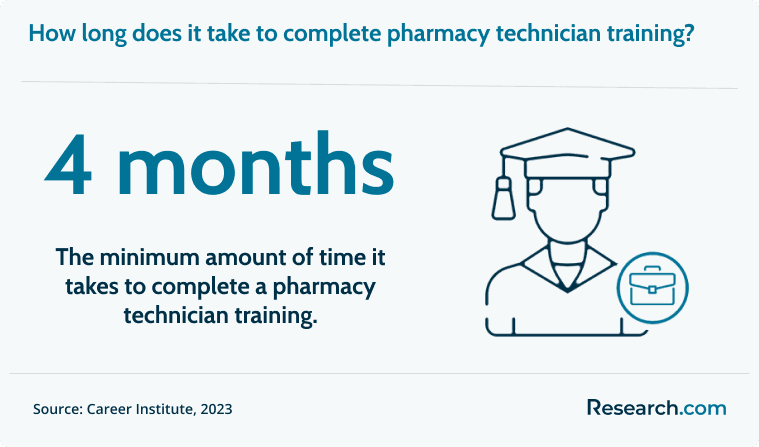
The visual below reinforces the point that accelerated pharmacy technician certificates can move faster than traditional expectations, especially when coursework is self-paced and students are ready to complete exam and externship requirements without delays.
Online vs. On-Campus Pharmacy Technician Certificates: Which Format Is Better?
An online pharmacy technician certificate can be a practical choice when the program is accredited, prepares students for certification, and provides enough hands-on preparation through simulations, labs, or externship placement. Drexel University’s discussion of online and traditional credentials notes that accredited online education can be viewed comparably when the institution has recognized accreditation.
Online programs usually cover the same core subjects as campus programs, including pharmacology, dosage calculations, pharmacy law, medication safety, and prescription processing. They often use recorded lectures, digital simulations, remote exams, and online practice tools. Students who work irregular hours or live far from campus may benefit most from this structure.
Campus and hybrid programs can still be better for students who learn best through scheduled labs, face-to-face instruction, and in-person peer support. On-campus options may also provide more immediate supervised practice with equipment, workflow, and instructor feedback. Students interested in broader public health roles rather than pharmacy-specific training may want to compare this pathway with the shortest online bachelor's degree in public health.
| Format | Advantages | Limitations | Best Fit |
| Fully online | Maximum schedule flexibility, no commute, self-paced study options | Requires strong motivation and may rely heavily on simulations before externship | Working adults, rural students, and independent learners |
| Hybrid | Combines online theory with in-person practice | Requires travel and fixed attendance for some activities | Students who want flexibility but still value hands-on instruction |
| On campus | Scheduled labs, direct instructor access, peer interaction | Less flexible and may involve commuting or housing costs | Students who need structure and in-person accountability |
Certification expectations do not disappear in an online format. Graduates may still need to pass the PTCE, which uses a scaled minimum 1,400 score, or the NHA’s ExCPT, depending on employer preference and state requirements. The best format is the one you can complete successfully while meeting certification, externship, and state registration requirements.
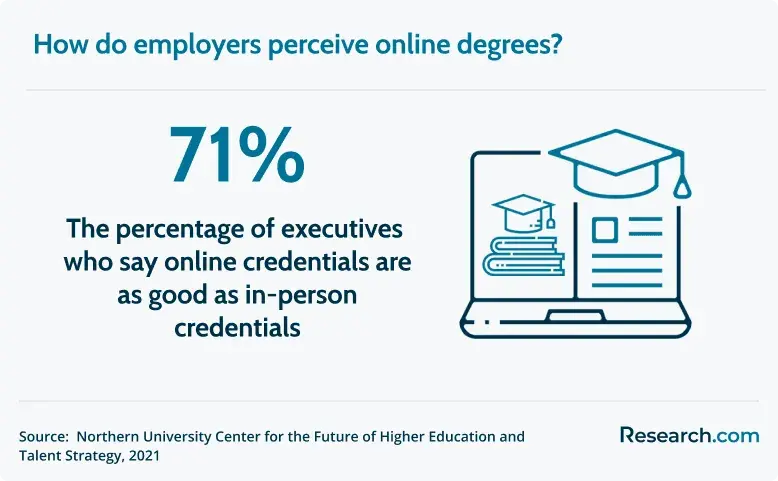
The graphic below highlights the shrinking perception gap between online and campus-based credentials, especially when programs are offered through accredited institutions and align with recognized certification standards.
What Is the Average Cost of a Fast Online Pharmacy Technician Certificate?
Costs vary substantially. In this list, published tuition ranges from $860 total to ~$4,000 total tuition, while broader market estimates show that some self-paced pharmacy technician programs cost between $500 and $2,000 for tuition and materials. VocationalTrainingHQ’s 2025 update reports community-college certificate costs ranging from $460 - $2,600 in-state and up to $21,900 at private vocational schools.
Students should calculate total cost, not just advertised tuition. The PTCB’s CPhT fee is $129 in 2025, and books, state registration, background checks, drug screens, immunizations, and uniforms may add to the final amount. The cost structure can resemble other short allied health options, including some vet tech schools, though pharmacy technician certificates are often designed for faster entry into paid work.
| Cost Item | Typical Consideration | Question to Ask |
| Tuition | May be listed as a single total price or separated from fees | Does the posted cost include all required course access and materials? |
| Certification exam | The PTCB’s CPhT fee remains $129 in 2025 | Is the exam voucher included, or will I pay separately? |
| Externship requirements | May require background checks, drug screening, immunization records, or travel | Who pays for clearance requirements and site-related costs? |
| State registration | Rules and fees vary by state | Will the program explain my state board requirements before I enroll? |
| Technology | Online programs may require reliable internet and proctored exam tools | Are there software, webcam, or remote testing requirements? |
Financial Aid and Funding Options for Fast Pharmacy Technician Programs
Short certificate programs may have different aid rules than degree programs, so students should confirm eligibility before enrolling. Some programs qualify for federal aid, while others are continuing education or workforce training courses that rely on payment plans, employer assistance, workforce grants, or scholarships.
- Federal Pell Grants and Work-Study: NCES reported that 40 percent of undergraduates received Pell in 2019-20, and 72 % received some form of aid. Eligibility depends on the school and program structure.
- Direct Subsidized/Unsubsidized Loans: Eligible certificate students may borrow up to $3,500-$5,500 annually under Title IV rules, with repayment after completion.
- Workforce Innovation and Opportunity Act (WIOA): State workforce boards may fund training for high-demand occupations, including pharmacy technician roles in some areas.
- Employer tuition reimbursement: Large pharmacy employers may help cover tuition, training, or the $129 PTCE fee for eligible workers.
- Institutional scholarships and grants: Some schools reduce costs through tuition discounts, textbook stipends, or certificate-specific awards.
- State vocational grants: Some local workforce or community college initiatives may cover tuition or books for eligible students.
- Private scholarships: Professional associations and foundations may offer need-based or career-specific awards, including pharmacy technician scholarships.
Students comparing multiple fast healthcare options can use the same funding strategy for other pathways, such as an accelerated respiratory care therapy associate's degree online. The practical goal is to combine aid sources while avoiding unnecessary debt for an entry-level credential.
Common Prerequisites for Fast Online Pharmacy Technician Certificates
Pharmacy technician certificate programs are usually more accessible than degree programs, but they still require documentation because students may work around patients, controlled substances, and protected health information. Requirements can vary by school, externship site, and state board of pharmacy.
- High school diploma or GED—all 50 states require it for registration or the PTCB exam.
- Minimum age 18 at program completion, matching board-of-pharmacy licensing rules.
- Criminal background check covering state and FBI records, plus 10-panel drug screen for externship clearance.
- Immunization record—Hep B series, MMR, varicella, TB test and annual flu (some sites add COVID-19).
- Fingerprinting and state technician registration; Texas charges about $95 for both steps in 2025.
- Basic math and English proficiency test or recent CTE credits—NCES notes 79 % of 2019 grads finished at least one CTE course, boosting readiness for applied science certificates.
- Government-issued photo ID / SSN for identity verification and e-signature of HIPAA forms.
- PTCB eligibility documentation—completion of a recognized program or 500 hours of tech work within 60 days of testing.
- Reliable computer and internet capable of running simulation labs and remote-proctored exams.
These requirements can slow down students who wait until the last minute. Before enrolling, ask whether the school helps with state registration, externship clearance, and exam eligibility. Students comparing similar short healthcare training routes can also review fast track dental assistant online certificate programs.
What Courses Are Included in a Fast Online Pharmacy Technician Certificate?
Accelerated pharmacy technician programs move quickly, but they still need to cover the core knowledge used in pharmacy settings. Students should expect a mix of medication knowledge, math, legal compliance, pharmacy workflow, billing, patient safety, and practical preparation for certification. These programs are part of the broader allied health training landscape, which also includes roles such as dialysis technician.
| Course Area | What You Learn | Why It Matters at Work |
| Pharmacy Law and Ethics | Federal and state laws, HIPAA, controlled-substance schedules, and professional conduct | Technicians must protect patients and follow legal dispensing procedures. |
| Pharmaceutical Calculations | Dosage conversions, ratios, proportions, and IV flow-rate calculations | Calculation errors can directly affect medication safety. |
| Pharmacology and Top 200 Drugs | Drug names, uses, contraindications, brand–generic pairs, and prescription abbreviations | Medication familiarity improves accuracy and speed in daily workflow. |
| Sterile and Non-sterile Compounding | USP 795/797 concepts, aseptic technique, beyond-use dating, and preparation standards | Compounding knowledge is important for hospital and specialty pharmacy roles. |
| IV Admixture and Parenteral Products | Laminar-flow hoods, hazardous handling basics, labeling, and preparation protocols | These skills support more advanced pharmacy technician responsibilities. |
| Pharmacy Operations and Inventory Control | Automated dispensing, inventory counts, recalls, and supply tracking | Efficient operations help prevent shortages, waste, and workflow errors. |
| Billing and Reimbursement | NCPDP formats, DAW codes, third-party claims, and Medicare Part D basics | Technicians often help resolve insurance and payment issues. |
| Quality Assurance and Patient Safety | Error prevention, bar-code verification, and look-alike/sound-alike medication safeguards | Patient safety is central to both retail and institutional pharmacy work. |
| Externship or Practicum | 40- to 100-hour supervised experience meeting PTCB and employer mandates | Real pharmacy exposure helps connect online coursework to daily practice. |
Pharmacy Technician Specializations After a Certificate
A basic certificate can prepare students for entry-level pharmacy technician work, but specialization can help technicians move into hospital, sterile compounding, billing, inventory, or advanced practice support roles. Many credentials are stackable and may support progression toward PTCB’s Advanced CPhT credential. Students exploring short credential ladders may also compare this page on the fastest online pharmacy technician certificate programs.
- Compounded Sterile Preparation Technician (CSPT): Focuses on preparing IV medications in controlled cleanroom environments and is the sterile-compounding credential recognized by PTCB.
- Hazardous Drug Management/Hazardous Compounding: Covers USP <800> safety practices for chemotherapy and other hazardous medications.
- Immunization Administration Certificate: Prepares technicians to administer vaccines in states that permit this role and adds six ACPE contact hours.
- Medication History Technician: Supports medication reconciliation in hospitals and helps reduce admission-related medication errors.
- Billing and Reimbursement Certificate: Builds expertise in claims processing, payer requirements, and pharmacy billing workflows.
- Controlled Substances Diversion Prevention: Emphasizes DEA compliance, auditing, documentation, and diversion risk controls.
- Supply-Chain and Inventory Management: Focuses on automated cabinets, ordering systems, inventory optimization, and 340B tracking.
- Nuclear Pharmacy Technician: Involves radiopharmaceutical preparation under NRC rules; demand is projected to “increase faster than usual” through 2035.
The chart below illustrates why specialization can matter financially: ambulatory-care and hospital technician roles, which may favor IV, hazardous-drug, or advanced credentials, average nearly $47,000 a year and outpace many general retail positions.
How to Choose the Best Fast Pharmacy Technician Certificate Program
A fast certificate is only valuable if it helps you become employable and certification-ready. Before submitting an application or paying tuition, compare each program against accreditation, certification preparation, externship support, cost transparency, and student outcomes. Helpful program-evaluation questions are also discussed by PharmacyTechnicianSchools.com in its guide to questions to ask pharmacy technician programs.
- Verify accreditation: Institutional accreditation matters, and ASHP/ACPE or ABHES approval can indicate that pharmacy technician training aligns with national expectations.
- Confirm PTCB-Recognized status: Programs that meet PTCB recognition standards can support exam eligibility more clearly.
- Ask about PTCE pass rates: If a program’s first-time pass rate is below the national PTCE pass-rate ~70 %, ask why and what support is available.
- Review externship length and placement settings: Strong programs explain whether placements are in hospital, community, mail-order, or other pharmacy environments.
- Calculate total cost: Tuition, books, scrubs, background checks and the $129 PTCE fee push real expenses from $500 to $40,129.
- Match the schedule to your life: Self-paced learning is flexible, but it can be risky if you need deadlines, reminders, and instructor accountability.
- Check instructor qualifications: Look for licensed pharmacists, experienced pharmacy technicians, or instructors with current professional credentials.
- Ask about employer relationships: Request 3- and 6-month placement statistics and a list of partner pharmacies when available.
| Common Mistake | Why It Can Hurt You | Better Approach |
| Choosing only the fastest program | You may finish quickly but still feel unprepared for certification or work. | Balance speed with exam preparation, externship support, and instructor access. |
| Looking only at tuition | Fees, exam costs, registration, and clearance requirements can change the real price. | Ask for a full cost sheet before enrolling. |
| Ignoring state registration rules | You may complete a course that does not align with your state’s requirements. | Check your state board of pharmacy before paying tuition. |
| Assuming online means easier | Accelerated online coursework can be intense and math-heavy. | Create a weekly study schedule before classes start. |
| Relying only on rankings | A ranked program may still be a poor fit for your schedule, location, or certification plan. | Use rankings as a shortlist, then verify details directly with schools. |
Career Paths After a Pharmacy Technician Certificate
A fast pharmacy technician certificate can open the door to entry-level work, but long-term growth usually depends on certification, experience, specialization, and employer training. This is one reason some students compare pharmacy technician certificates with other quick degrees that pay well before choosing a healthcare pathway.
- Pharmacy Clerk / Aide: Supports inventory, customer intake, and basic pharmacy operations while working toward registration or certification.
- Entry-Level Pharmacy Technician (CPhT): Processes prescriptions, counts medications, supports billing, and assists pharmacists after certification.
- IV Compounding or Inventory Technician: Develops sterile preparation, purchasing, stock management, or specialty workflow skills; pays ~15 % more.
- Lead / Senior Technician: Trains junior technicians, handles insurance edits, manages workflow, and supports shift leadership.
- Advanced Certified Pharmacy Technician (CPhT-Adv): Earns PTCB’s top credential after three years and four certificates, expanding clinical duties.
- Technician Supervisor / Operations Manager: Oversees staffing, budgets, compliance, workflow, and operations for pharmacy teams.
- Pharmacy Purchasing or Informatics Specialist: Works with 340B, robotics, inventory systems, medication data, or analytics; median pay exceeds $60 K.
- Pathway to PharmD: Uses technician experience and pharmacy exposure to strengthen preparation for pharmacist education.
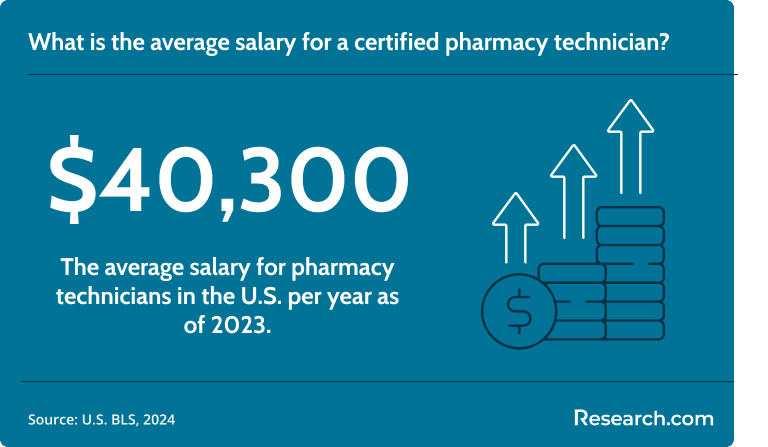
The salary image below places the first step in context: the U.S. average of $40,300 for certified technicians (BLS 2023) represents an early-career benchmark, while specialization and promotion can support higher earnings over time.
Job Market Outlook for Fast Pharmacy Technician Certificate Graduates
The job market for pharmacy technicians remains steady. The Bureau of Labor Statistics projects 7 % growth for pharmacy technicians from 2023-33, including about 33,300 net new jobs and 47,400 openings each year. Data USA reports that the workforce size reached 398,563 in 2022, up 5 % since 2019.
Demand is also visible in job posting data. The AACP Pharmacy Demand Report recorded 39,111 technician vacancies in Q1 2025. Indeed listed more than 19,000 supervisor-level technician jobs in June 2025, and Zippia tracks over 240 new technician ads daily along with a 14 % salary climb since 2020.
Hospitals, retail chains, mail-service pharmacies, ambulatory care centers, and specialty pharmacies all use pharmacy technicians, but hiring conditions can vary by state and metro area. California, Texas, and Florida are large employment markets according to BLS employment tables, while remote order-entry and mail-service roles may create additional options for experienced technicians.
Technology is also changing the role. Automated dispensing, barcode verification, pharmacy robotics, online prescription platforms, and remote medication workflows can reduce repetitive tasks, but they also increase the need for technicians who understand safety checks, systems, inventory, billing, and compliance. AI and automation are more likely to shift technician duties than eliminate the need for trained workers in patient-facing and regulated pharmacy environments.
The BLS chart below shows projected national employment growth from roughly 460,000 technicians in 2023 to nearly 500,000 by 2033, illustrating the 7 % growth outlook described above.
Alternative Accelerated Healthcare Certificates to Consider
A pharmacy technician certificate is a good fit if you want medication-focused work, pharmacy operations, and a short path into healthcare. It may not be the best fit if you prefer office-based healthcare administration, insurance, coding, public health, or patient care roles outside the pharmacy. Students who want administrative healthcare skills may want to compare pharmacy technician training with the most affordable medical billing and coding programs online.
| Pathway | Better If You Want | Less Ideal If |
| Pharmacy technician certificate | Medication dispensing, pharmacy workflow, certification, and entry-level pharmacy roles | You dislike math, detailed procedures, or regulated environments |
| Medical billing and coding | Claims, coding systems, insurance workflows, and office-based healthcare work | You want direct medication or pharmacy operations experience |
| Dental assistant certificate | Hands-on dental office work and chairside patient support | You prefer pharmacy, medication safety, or retail/hospital pharmacy settings |
| Respiratory care associate pathway | More clinical respiratory therapy preparation and longer healthcare training | You need the shortest certificate route into healthcare |
What Graduates Say About Online Pharmacy Technician Certificates
- : "I began as a pharmacy cashier, completed a four-month online certificate, earned certification, and moved into inventory work before becoming a lead technician. The program helped me understand the next steps, including sterile compounding, billing, and management. That clear ladder makes the job feel like the start of a career, not just a position. — Juniper"
- : "Online coursework made it possible to study pharmacology while working long caregiver shifts and raising my twins. The virtual lab practice helped me feel prepared before the clinical rotation, especially with IV flow-rate calculations. Employer tuition assistance also helped me finish without taking on debt. — Mateo"
- : "An eight-week online pharmacy technician course helped me change direction quickly. After passing the PTCE, I moved into a hospital pharmacy compounding role and earned $21 an hour, which was double my retail pay. The short, focused format worked because the lessons stayed tied to the job. — Princess"
Student Support Services to Look For in Online Pharmacy Technician Programs
Support services matter more in accelerated programs because students have less time to recover from confusion, missed deadlines, or technology problems. Before enrolling, ask whether the program offers academic advising, instructor access, online tutoring, technical support, certification exam preparation, practice tests, externship coordination, and career services.
Career support should include resume feedback, interview coaching, employer connections, and guidance on state registration. If your long-term goal is healthcare leadership rather than pharmacy work, compare certificate training with a low cost online health care administration degree.
Why Accreditation Matters for Online Pharmacy Technician Programs
Accreditation helps students judge whether a school meets recognized educational standards. Institutional accreditation can also affect financial aid eligibility, employer confidence, and whether credits or credentials are easier to use in future education. Pharmacy-specific recognition or approval may also matter for certification eligibility and employer preference.
Do not assume every online certificate carries the same value. Check the institution’s accreditor, ask whether the pharmacy technician program is aligned with certification requirements, and confirm whether the curriculum includes adequate preparation for pharmacy law, calculations, patient safety, and hands-on practice. Students planning to move into health data or management roles may also compare options such as the cheapest health information management program online.
Challenges of Fast Online Pharmacy Technician Certificate Programs
Accelerated online certificates can be efficient, but they are not effortless. Common challenges include limited in-person practice before externship, uneven practicum placement quality, heavy self-paced reading, compressed math instruction, and technology-dependent simulations. Students who need frequent instructor feedback may struggle in programs that rely mainly on recorded lessons and automated quizzes.
The best way to reduce risk is to ask direct questions before enrolling: Who teaches the course? How often can I contact instructors? Is externship placement guaranteed or only optional? What happens if I fail a module or need more time? What are the program’s certification pass rates? Students who want broader healthcare flexibility may also consider complementary coursework through accredited medical billing and coding schools online.
Questions to Ask Before Enrolling
- Does this program meet the pharmacy technician requirements in my state?
- Is the institution accredited, and is the program recognized or aligned with certification requirements?
- Does tuition include books, exam vouchers, background checks, drug screening, and externship fees?
- How long do most students actually take to finish, not just the fastest possible timeline?
- Is an externship required, optional, or unavailable?
- Will the school help me find a local externship site?
- What PTCE or ExCPT preparation is included?
- What are the first-time certification exam pass rates?
- Can I pause or extend the course if my work schedule changes?
- What career support is available after completion?
Key Insights
- The fastest listed pathway is Purdue University’s 8-week fast-track option, but other programs may be better if you need more time, externship support, or a lower total cost.
- Fast does not always mean best. Accreditation, certification preparation, externship quality, and state registration alignment are more important than speed alone.
- Published tuition is only part of the cost. Add the $129 PTCE fee, books, background checks, drug screens, immunizations, registration fees, and technology requirements.
- Online pharmacy technician programs work best for self-directed students who can manage deadlines, practice calculations consistently, and complete administrative requirements quickly.
- Students who want advancement should look beyond the entry-level certificate and consider specializations such as sterile compounding, medication history, billing, inventory, or advanced certification.
- The job outlook is steady, with BLS projecting 7 % growth from 2023-33 and continued demand across retail, hospital, mail-service, and specialty pharmacy settings.
References:
- AACP (American Association of Colleges of Pharmacy). Pharmacy Demand Report (05-14-2025).
- AdventHealth University Workforce. Pharmacy Technician Program.
- Auburn University Harrison College of Pharmacy. Pharmacy Technician Online Program.
- Bureau of Labor Statistics. Pharmacy Technicians – Occupational Outlook Handbook.
- California State University Long Beach CPaCE. Self-Paced Online Pharmacy Technician Course.
- CareerTraining UWW (University of Wisconsin–Whitewater). Pharmacy Technician Program.
- CollegeTuitionCompare. Public 2-4 Years Certificate Statistics.
- Data USA. Pharmacy Technicians SOC Profile.
- Drexel University Online. Online Degree vs Traditional Degree.
- Drug Topics. Student Staffing Shortages Continue to Impact Pharmacy Profession.
- EducationData.org. Average Cost of College.
- Georgia Center for Continuing Education (University of Georgia). Pharmacy Technician Certificate – Voucher Included.
- Glassdoor. US Pharmacy Technician Salary.
- Indeed. Pharmacy Technician Salaries.
- Medical Hero. PTCB Exam Passing Score.
- NCES. Fast Facts: Quick Stats on U.S. Education.
- NCES. IPEDS Trend Generator: Table Builder for Certificates.
- NCES. Undergraduate Financial Aid Highlights (07-26-2023).
- Payscale. Pharmacy Technician Hourly Rate.
- Pharmacy Technician Certification Board. Certified Pharmacy Technician (CPhT) Credential.
- Pharmacy Times. Expanded Technician Roles Call for Defined Career Ladders.
- Purdue University College of Pharmacy. Pharmacy Technician Training Program.
- Salary.com. Pharmacy Technician Salary.
- San Diego State University Global Campus. Pharmacy Technician Program.
- San Francisco State University CEL. Pharmacy Technician Certificate.
- Stepful. Pharmacy Technician School Certification Cost.
- University of Houston Continuing Studies. Pharmacy Technician Program.
- University of Texas at San Antonio Online. Pharmacy Technician Career Training.
- Visante. Pharmacy Technician Workforce White Paper (2023).
- VocationalTrainingHQ. Cost of Pharmacy Technician School.
- Zippia. Pharmacy Technician Salary by State.
- ZipRecruiter. Pharmacy Technician Salary.
Other Things You Should Know About the Fastest Online Pharmacy Technician Certificate Programs
Yes. Most fast online pharmacy technician certificate programs include prep for the Pharmacy Technician Certification Exam (PTCE) from PTCB, and many also cover the ExCPT from NHA. Programs often build in practice tests, vocabulary, and calculations needed for certification testing.
While online pharmacy technician programs in 2027 often provide comprehensive theoretical knowledge, hands-on externships are crucial to gain practical experience. Many accredited programs offer externships with local pharmacies, bridging the gap between learning and real-world application, and often these experiences are necessary for certification.
The fastest online pharmacy technician certificate programs in 2027 can typically be completed in as little as 6 months, depending on the institution. This accelerated timeline allows students to enter the workforce quickly, focusing on essential topics like pharmacology, pharmacy law, and drug administration.
Prerequisites for 2027 online pharmacy technician certificate programs often include a high school diploma or GED. Some programs may require background checks or prerequisite courses in math and science. Be sure to check specific program requirements before applying.