2027 Fastest Way To Become a Counselor in Ohio

Co-Founder and Chief Data Scientist
Becoming a counselor in Ohio is a licensing decision, not just a degree decision. The fastest path depends on choosing a graduate program that satisfies Ohio requirements, completing required exams on time, securing approved supervision, and avoiding administrative delays that can slow down LPC or LPCC approval.
This guide is for Ohio students, career changers, and bachelor’s-level behavioral health workers who want the most direct route into counseling practice. It explains the quickest realistic path to licensure, what jobs are possible before a master’s degree, how accelerated and online programs compare, what employers look for, how much counselors earn in Ohio, and when a fast-track path is worth the pressure.
Quick answer: the fastest counseling path in Ohio
The fastest way to become a licensed counselor in Ohio is to complete a 60-semester-credit counseling master’s program that meets state standards, apply for the Licensed Professional Counselor license as soon as you are eligible, submit transcripts without delay, pass the National Counselor Examination and Ohio Laws and Rules Exam, and begin planning the 3,000 supervised hours required for LPCC advancement. Accelerated and online programs can shorten the school timeline, but they do not remove Ohio’s exam, clinical training, or supervision requirements.
Why counseling in Ohio can be a strong career move
- Demand is broad: Ohio needs counselors in community mental health, addiction treatment, schools, hospitals, crisis services, and rural care settings.
- Pay can improve with credentials: The average counselor salary in Ohio is approximately $55,000 annually, with higher earnings possible for experienced, specialized, or independently licensed professionals.
- Licensure is structured: Ohio’s LPC-to-LPCC pathway gives candidates a defined sequence of graduate education, exams, supervised experience, and renewal requirements.
- Fast-track options exist: Some Ohio programs offer accelerated, cohort-based, online, or dual-degree structures that can reduce time in school when students can handle a heavier pace.
- Fastest route to Ohio counseling licensure
- Counseling-related jobs with a bachelor’s degree
- Accelerated counseling programs in Ohio
- Online vs. traditional counseling programs
- Challenges of fast-track counseling programs
- How Ohio employers evaluate fast-track graduates
- Certifications that can strengthen a counseling career
- Continuing education and license renewal
- Ohio licensure prerequisites
- Interdisciplinary education options
- Cost of fast-track and online programs
- Counselor demand in Ohio
- Counselor salaries in Ohio
- Is the fast route worth it?
What is the fastest way to become a licensed counselor in Ohio?
The quickest practical route is to remove avoidable delays from every stage: program selection, exam approval, transcript submission, application timing, and supervised-hour tracking. A fast program helps, but poor planning can still add months to the process.
- Choose the right master’s program first: Complete a 60-semester-credit graduate counseling program that satisfies Ohio’s education rules. Students who want fewer licensing surprises often compare CACREP-accredited counseling master’s programs because these programs are built around nationally recognized counseling standards.
- Apply as soon as you meet eligibility requirements: Do not wait until graduation paperwork is complete to learn the Ohio application sequence. Review the board process early and prepare required materials before your final term ends.
- Request official transcripts immediately: Transcript delays are common. Ask your school to send official transcripts directly to the Ohio board as soon as the degree is posted.
- Prepare early for required exams: Plan for the National Counselor Examination and the Ohio Laws and Rules Exam before your final semester becomes crowded with internship, graduation, and job applications.
- Organize LPCC supervision from the beginning: Candidates seeking LPCC status should map the 3,000 supervised hours requirement, confirm supervisor eligibility, and keep accurate documentation from the first approved hour.
| Stage | Fastest practical move | Delay to avoid |
| Before applying to graduate school | Confirm the program meets Ohio counseling licensure education standards. | Choosing a program that later requires extra coursework. |
| During the master’s program | Track practicum, internship, exam deadlines, and board requirements in one calendar. | Waiting until the final term to understand the licensing process. |
| After graduation | Submit the LPC application and official transcripts promptly. | Letting transcript processing or missing documents hold up approval. |
| After LPC approval | Begin supervised practice with an approved LPCC-S supervisor if pursuing LPCC. | Accumulating hours that do not count because supervision was not properly arranged. |
What counseling careers can you pursue in Ohio with only a bachelor’s degree?
A bachelor’s degree does not qualify someone for independent professional counseling licensure in Ohio, but it can open the door to supervised behavioral health, case management, crisis response, and addiction-support roles. These jobs are especially useful for students who want relevant experience before committing to graduate school.
Students comparing different counseling degree paths should understand the difference between counseling-adjacent work and licensed counseling practice.
- Behavioral health technician or mental health technician: These workers support clients in hospitals, residential treatment centers, community programs, and crisis settings by monitoring behavior, documenting progress, and helping implement care plans.
- Substance abuse counselor assistant: Entry-level addiction treatment roles may involve group support, recovery education, intake assistance, and case coordination. A CDCA credential is often expected in Ohio substance use settings.
- Case manager or direct care professional: These positions focus on service coordination, referrals, benefits navigation, housing support, employment resources, and client advocacy.
- Behavioral specialist: These professionals may work in schools, community programs, or disability services, helping clients build coping, social, and behavioral skills.
- Crisis support worker: Crisis lines, mobile response teams, and community agencies hire workers who can de-escalate urgent situations, connect callers to resources, and document safety concerns.
| Role | Typical setting | Best fit for | Graduate school value |
| Behavioral health technician | Hospitals, residential programs, community agencies | Students who want direct client exposure | Builds familiarity with treatment teams and documentation |
| Substance abuse counselor assistant | Addiction treatment and recovery programs | Students interested in substance use counseling | Provides experience with recovery models and group support |
| Case manager | Social service agencies, nonprofits, behavioral health centers | Students who like coordination and advocacy | Develops systems knowledge and client-resource navigation skills |
| Crisis support worker | Hotlines, crisis centers, mobile response teams | Students comfortable with high-pressure conversations | Strengthens assessment, communication, and referral skills |
Many people who later enter counseling begin with undergraduate majors related to psychology, human services, social work, sociology, education, or family studies. The chart below shows common bachelor’s-level academic routes into the field.
Are there accelerated counseling degree programs in Ohio?
Yes. Some Ohio universities offer formats that help qualified students move through counseling education faster than a traditional sequence. The key is to distinguish true time savings from simple intensity. A 24-month full-time program, for example, can be efficient, but it may leave little room for full-time work or family obligations.
- John Carroll University dual-degree option: Students may combine a B.S. in Psychology or a B.A. in Gender, Sexuality, and Women’s Studies with an M.A. in Clinical Mental Health Counseling. After completing 90 undergraduate credits, eligible students can start graduate coursework, with nine credits counting toward both degrees.
- John Carroll University online MA in Counseling: This fully online full-time program is designed for completion in just two years, making it one of the faster Ohio counseling master’s options for students able to maintain an intensive pace.
- Baldwin Wallace University full-time cohort format: Baldwin Wallace offers a 60-credit Clinical Mental Health Counseling master’s degree that can be finished in 24 months through a structured cohort model.
| Program format | Potential advantage | Main trade-off | Best for |
| Dual-degree pathway | Graduate credits may begin before the bachelor’s degree is fully complete. | Students must plan early and meet eligibility requirements. | Undergraduates who already know they want counseling licensure. |
| Two-year online master’s | Coursework can be completed quickly without relocating. | The pace may be demanding, especially with fieldwork. | Motivated students with strong time-management skills. |
| 24-month cohort program | Clear schedule and peer support can keep students on track. | Less flexibility if life or work obligations change. | Full-time students who prefer a fixed academic plan. |
Are online counseling programs in Ohio faster than traditional ones?
Online counseling programs in Ohio can be faster for some students, but the format alone does not guarantee a shorter path. Online study saves commuting time, may offer more start dates, and can make full-time enrollment easier for working adults. However, students must still complete required counseling coursework, practicum, internship, exams, and supervised experience.
- Asynchronous coursework can reduce scheduling friction: Students may be able to complete lectures and assignments around work or family responsibilities instead of attending fixed campus sessions.
- Multiple start dates can prevent waiting: Programs with rolling or frequent admissions may allow students to begin sooner than programs that admit only once a year.
- Smaller online cohorts may improve access to faculty: Some programs provide more frequent feedback and advising, which can help students stay aligned with licensure requirements.
- Local field placement planning matters: Online students still need approved practicum and internship sites. A program is only “fast” if it helps students secure placements on time.
| Question | Online program | Campus program |
| Can it shorten the calendar? | Sometimes, especially with year-round or multiple-start formats. | Sometimes, if the school offers a fixed full-time cohort. |
| Does it remove clinical requirements? | No. Fieldwork and supervision still apply. | No. Fieldwork and supervision still apply. |
| Is it easier to work while enrolled? | Often, because coursework may be more flexible. | Less often, especially with daytime classes or fixed schedules. |
| What is the biggest risk? | Difficulty finding approved local placements. | Commuting, limited schedules, or slower course sequencing. |
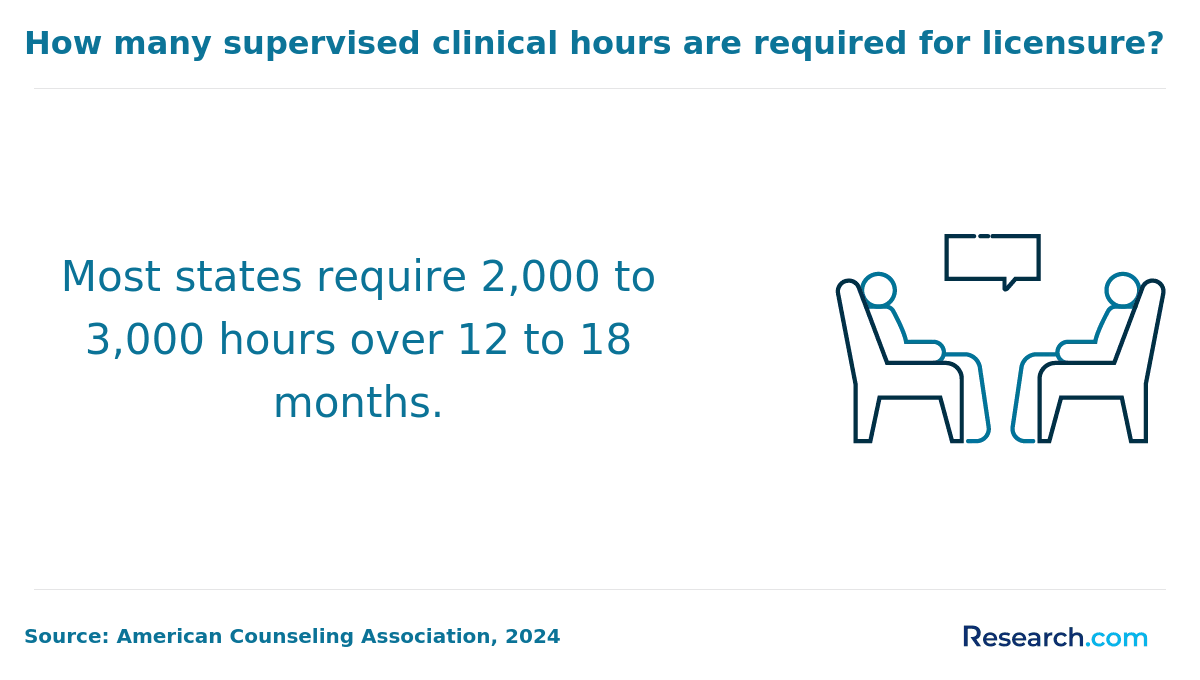
Students considering accelerated online study should confirm clinical-hour expectations before enrolling. The image below summarizes clinical-hour requirements for counseling professionals in the U.S.
What challenges do fast-track counseling students face?
Accelerated counseling programs can work well for disciplined students, but they are not easier programs. They compress reading, skill practice, assessment, ethics, fieldwork preparation, and supervision planning into a tighter schedule.
- Heavy academic workload: Students may need to master counseling theories, diagnostic concepts, multicultural counseling, ethics, research, and clinical skills in rapid sequence.
- Less recovery time between clinical experiences: Practicum and internship can be emotionally demanding. A compressed schedule may leave limited time to reflect, receive feedback, and build confidence.
- Work-life pressure: Fast-track formats often favor students who can reduce outside work hours, arrange childcare, and protect study time.
- Licensure tracking burden: Missing a form, exam step, transcript requirement, or supervision rule can slow down a supposedly fast path.
- Technology and telehealth expectations: Online and hybrid students may need to become comfortable with learning platforms, digital documentation, telehealth etiquette, and privacy practices quickly.
| Common mistake | Why it causes problems | Better approach |
| Choosing the fastest advertised program without checking licensure fit | Extra coursework or approval issues can erase any time savings. | Verify Ohio licensure alignment before applying. |
| Ignoring internship placement support | A delayed placement can delay graduation or licensure. | Ask how the school helps online and campus students secure approved sites. |
| Assuming online means self-paced | Many online counseling programs have strict deadlines and live skill requirements. | Review weekly workload, synchronous sessions, and residency expectations. |
| Underestimating debt | A faster program can still be expensive if aid, fees, and lost work hours are not considered. | Build a full cost estimate before committing. |
Financial pressure is another challenge for many counseling students, especially those who reduce work hours during graduate training. The chart below illustrates how student debt can affect aspiring counselors.
How do employers in Ohio view fast-track counselors?
Ohio employers generally care less about whether a program was fast and more about whether the candidate is clinically prepared, eligible for licensure, ethical, supervised appropriately, and ready to work with the agency’s client population. A fast-track degree can be respected when it comes from a credible program and includes strong field training.
Some hiring managers may ask more questions about accelerated programs, especially if the candidate has limited counseling-related experience. They may want to know how much direct client contact the student completed, what populations they served, how supervision was structured, and whether the graduate can handle documentation, crisis response, and ethical decision-making.
Fast-track graduates can improve employer confidence by showing clear evidence of readiness: strong internship evaluations, relevant bachelor’s-level experience, exam progress, careful supervision plans, and a commitment to continuing education. Students exploring the fastest way to earn counseling credentials should treat employer trust as part of the timeline, not an afterthought.
What specialized certifications can enhance my counseling career in Ohio?
Specialized credentials can help Ohio counselors build expertise in areas such as addiction, trauma-informed care, family systems, crisis work, grief, child and adolescent counseling, or telebehavioral health. Certifications do not replace Ohio licensure, but they can make a counselor more competitive for specific roles and better prepared for certain client needs.
Substance use treatment is a particularly important specialty in Ohio. Candidates who want to focus on addiction services should review the requirements for becoming a substance abuse counselor in Ohio because credential expectations can differ from general professional counseling licensure.
| Certification area | Why it can help | Who should consider it |
| Substance use counseling | Supports work in addiction treatment, recovery programs, and community behavioral health. | Counselors interested in substance abuse, behavioral disorder, and mental health roles. |
| Trauma-informed practice | Builds skills for working with clients affected by violence, loss, crisis, or chronic stress. | Counselors in community agencies, schools, hospitals, and crisis settings. |
| Family or couples counseling | Adds tools for relational, parenting, and family-system concerns. | Counselors who expect to work with families, adolescents, or relationship issues. |
| Telehealth-related training | Helps counselors understand ethical, practical, and communication issues in virtual care. | Online, hybrid, rural, and community-based practitioners. |
What are the continuing education and licensure renewal requirements for counselors in Ohio?
Ohio counselors must keep their licenses current through required continuing education and renewal procedures. The purpose is to ensure that licensed professionals stay informed about ethics, laws, evidence-based practices, cultural competence, documentation standards, and changes in behavioral health care delivery.
Because renewal rules can change, counselors should rely on the Ohio licensing board’s current instructions, keep certificates and attendance records, and choose approved continuing education providers. Counselors who work in schools or are considering school-based practice may also benefit from reviewing the pathway for becoming a school counselor in Ohio, since school counseling requirements can differ from clinical mental health counseling.
- Track continuing education throughout the renewal cycle instead of waiting until the deadline approaches.
- Keep documentation in a dedicated digital folder in case of audit or employer review.
- Prioritize ethics, law, supervision, diagnosis, telehealth, and specialty topics related to your work setting.
- Confirm whether employer-provided trainings count before assuming they satisfy renewal rules.
What are the detailed licensure prerequisites for counselors in Ohio?
Ohio counseling licensure requires the right graduate education, qualifying examinations, legal and ethical compliance, and supervised experience for advanced licensure. Candidates should review each requirement before enrolling in a program because fixing a mismatch after graduation can be costly and time-consuming.
For a deeper breakdown of coursework, exams, supervised practice, and application steps, see this guide to LPC license requirements in Ohio.
| Requirement area | What to verify | Why it matters |
| Graduate education | The master’s program meets Ohio’s counseling education standards. | Licensure delays often begin with program or coursework gaps. |
| Exams | You understand when and how to complete the National Counselor Examination and Ohio Laws and Rules Exam. | Exam timing can affect how quickly you receive approval to practice. |
| Supervision | Your supervisor is approved for the license level you are pursuing. | Hours may not count if supervision is not properly arranged. |
| Documentation | Transcripts, forms, hour logs, and renewal records are complete and accurate. | Missing documents are a common cause of licensing delays. |
Can interdisciplinary education enhance counseling careers in Ohio?
Interdisciplinary training can make counselors more effective with clients whose needs cross mental health, education, healthcare, housing, family services, employment, and legal systems. It can also help professionals collaborate better with social workers, nurses, teachers, case managers, probation officers, and community organizations.
Students should not confuse interdisciplinary learning with substitute licensure. A social work, psychology, public health, education, or human services background can strengthen counseling practice, but it does not automatically qualify someone for counseling licensure. Those comparing related helping professions can review Ohio social worker educational requirements to understand how counseling and social work pathways differ.
- Public health knowledge can help counselors understand prevention, community needs, and population-level barriers to care.
- Social work coursework can improve awareness of benefits systems, housing instability, family services, and client advocacy.
- Education training can support counselors working with children, adolescents, families, and school-based teams.
- Healthcare exposure can prepare counselors for integrated behavioral health settings and interdisciplinary treatment planning.
Are fast-track and online counseling programs in Ohio more affordable?
Fast-track and online counseling programs can reduce some costs, but they are not automatically cheaper. The real cost depends on tuition, fees, number of credits, transfer policies, field placement expenses, travel, technology, books, exam fees, income lost during internships, and how long it takes to graduate.
- Tuition can vary by institution: Many Ohio public universities offer online counseling programs for $500–$800 per credit, but students should compare total program cost rather than the per-credit price alone.
- Shorter timelines may reduce total expenses: Completing a degree in fewer semesters can lower certain fees and living costs, especially for full-time students.
- Online study can preserve income: Flexible coursework may allow students to keep working while enrolled, although practicum and internship can still require daytime availability.
- Remote learning may reduce commuting and housing costs: Students who do not relocate or travel to campus regularly can avoid some indirect expenses.
- Financial aid eligibility still matters: Students should confirm access to federal aid, state aid, scholarships, assistantships, and employer tuition support before enrolling.
| Cost factor | Question to ask before enrolling | Why it matters |
| Tuition | What is the total cost for all required credits? | Per-credit rates can hide the full program price. |
| Fees | Are there online, technology, practicum, internship, or graduation fees? | Mandatory fees can change affordability. |
| Fieldwork | Will I need to travel, reduce work hours, or pay for background checks? | Clinical training can create indirect costs. |
| Program length | Can I realistically finish on the advertised schedule? | A delayed graduation can increase tuition, fees, and lost income. |
| Financial aid | What scholarships, grants, assistantships, or workforce incentives are available? | A higher-priced program may be more affordable if aid is stronger. |
Is there a demand for counselors in Ohio?
Yes. Ohio has sustained need for counselors, particularly in mental health, substance use treatment, school services, and community behavioral health. Between 2013 and 2019, demand for behavioral health services in Ohio rose by an estimated 33%, with southeastern and underserved rural regions experiencing some of the most significant shortages.
As of 2022, Ohio employed over 15,000 counselors in substance abuse, behavioral disorder, and mental health roles. Projections indicate that employment will exceed 17,400 by 2032, representing a 16% growth rate over the decade.
Several forces support demand: high caseloads, behavioral health workforce shortages, expanding telehealth access, greater public awareness of mental health, and school counseling needs that exceed national best-practice guidelines. Demand does not guarantee a specific salary or job offer, but it does make Ohio a state where well-prepared counselors can find opportunities across multiple settings.
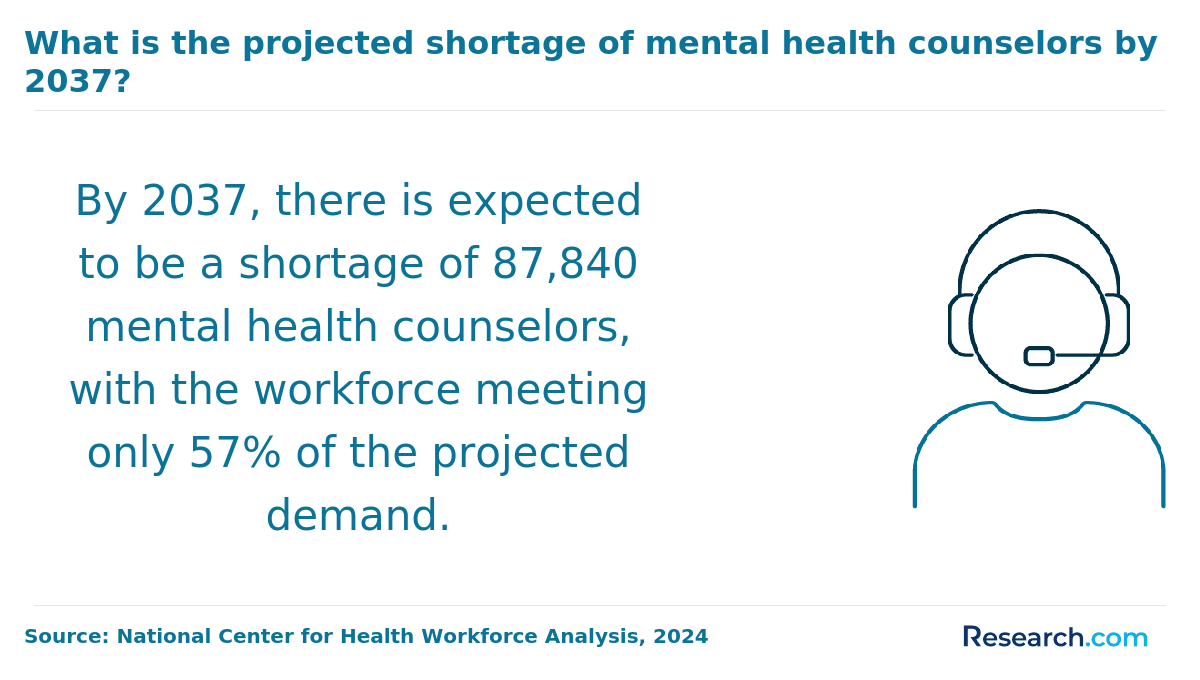
The image below provides additional context on Ohio’s projected mental health counselor shortage.
How much do counselors get paid in Ohio?
Counselors in Ohio earn an average annual salary of approximately $55,816. This is about 7% below the national average, but earnings vary by license level, specialty, employer type, region, caseload, experience, and whether the counselor works in a school, healthcare system, nonprofit, private practice, or community agency. Entry-level positions typically begin near $42,376, while experienced professionals can earn up to $87,006.
- Licensed Professional Counselors: LPCs generally earn between $64,000 and $68,370 per year, with some behavioral health roles approaching $70,000 in high-demand areas.
- School counselors: School counseling positions may pay above the statewide average, especially in better-funded districts.
- Substance abuse and mental health counselors: These roles often align more closely with the statewide average, though pay can rise with advanced credentials, experience, and metropolitan employment.
- License level and work setting: Urban healthcare systems and advanced licensure, such as LPCC status, can improve earning potential compared with some rural, entry-level, or nonprofit roles.
| Factor | How it can affect pay |
| License level | Advanced licensure can expand responsibility, independence, and earning potential. |
| Specialization | Addiction, crisis, school, trauma, and integrated care experience may improve competitiveness. |
| Location | Urban and high-demand areas may offer higher pay, while rural roles may provide different incentives or mission-driven opportunities. |
| Employer type | Hospitals, school districts, community agencies, nonprofits, and private practices often use different pay structures. |
| Experience | Supervised experience, strong documentation skills, and proven clinical competence can support advancement. |
Is taking the fast route to become a counselor in Ohio worth it?
A fast route can be worth it if the program is properly aligned with Ohio licensure, the student can handle the workload, and the cost makes sense compared with expected career outcomes. The main benefit is earlier entry into supervised practice, which can help candidates build clinical skills, earn hours toward LPCC status, and respond to workforce needs sooner.
Fast-track students may also benefit from Ohio workforce initiatives. The Great Minds Fellowship Workforce Commitment Incentive Program offers up to $20,000 in funding for those working in Community Behavioral Health Centers.
The decision is less favorable for students who need a lighter course load, are unsure about counseling as a career, have limited financial flexibility, or cannot commit to practicum and internship schedules. A slower program with stronger advising and field placement support may be the better choice if it reduces the risk of burnout or licensing delays.
Ohio’s care gaps are significant, affecting more than 2.4 million residents. Graduates who enter the field prepared can pursue a wide range of jobs with a counseling degree, including community outreach, crisis response, addiction treatment, school support, and clinical mental health services.
| Choose a fast-track path if... | Consider a slower path if... |
| You already know you want Ohio counseling licensure. | You are still deciding between counseling, social work, psychology, or education. |
| You can study full time or near full time. | You need to maintain heavy work or caregiving responsibilities. |
| The program clearly meets Ohio licensure requirements. | The school cannot clearly explain licensure alignment. |
| You have strong time-management skills and emotional stamina. | You prefer more time to absorb clinical skills and supervision feedback. |
| The total cost and aid package are manageable. | You would need to take on debt without a realistic repayment plan. |
Here’s what Ohio counseling graduates say about their careers
Taking an accelerated counseling route in Ohio helped me enter the workforce sooner than I expected. The demand for mental health professionals made the decision feel practical, but the pace required serious discipline from the first semester. — Eleanor
My training exposed me to very different communities across Ohio, from urban agencies to rural service areas. Moving quickly through the program was challenging, but it pushed me to develop flexibility, patience, and stronger client-centered skills. — Joseph
Ohio has offered many chances to keep learning through workshops, supervision, and specialty training. Starting on a faster timeline helped me build professional connections earlier, but continuing education has been just as important as the degree itself. — Lucy
Related Articles for Nearby States
- 2027 Fastest Way to Become a Counselor in Indiana
- 2027 Fastest Way to Become a Counselor in Kentucky
- 2027 Fastest Way To Become a Counselor in West Virginia
- 2027 Fastest Way To Become a Counselor in Pennsylvania
- 2027 Fastest Way To Become a Counselor in Michigan
- 2027 Fastest Way To Become a Counselor in Illinois
- 2027 Fastest Way To Become a Counselor in Virginia
- 2027 Fastest Way To Become a Counselor in Tennessee
- 2027 Fastest Way To Become a Counselor in North Carolina
- 2027 Fastest Way To Become a Counselor in Missouri
Key Insights
- The fastest Ohio counseling path is not a shortcut around licensure: Students still need the required graduate education, exams, supervised experience, and documentation.
- Program choice matters more than speed claims: A fast program that does not align with Ohio requirements can delay licensure instead of accelerating it.
- Online programs can save time, but only if field placement works: Before enrolling, ask how the school supports practicum and internship placement in Ohio.
- Bachelor’s-level roles can be strategic: Behavioral health technician, case manager, crisis support, and substance use assistant roles can build experience before graduate school.
- Ohio demand is real, but outcomes vary: Employment is projected to exceed 17,400 by 2032 in substance abuse, behavioral disorder, and mental health counselor roles, but salary depends on license level, setting, location, and specialization.
- Affordability requires a full-cost calculation: Compare tuition, fees, fieldwork costs, lost income, financial aid, and completion time—not just the advertised per-credit price.
- The fast route is best for prepared students: It can be worthwhile for focused candidates with strong support systems, clear career goals, and the capacity to manage an intensive academic and clinical schedule.
References:
- Accredited Schools Online. (n.d.). Online master’s in counseling program information. Retrieved from Accredited Schools Online
- Bureau of Labor Statistics. (n.d.). Substance abuse, behavioral disorder, and mental health counselors: Occupational outlook handbook. Retrieved from BLS
- Counseling Psychology.org. (n.d.). Online counseling programs in Ohio. Retrieved from Counseling Psychology.org
- CounselingSchools.com. (n.d.). Counseling degrees and licenses in Ohio. Retrieved from CounselingSchools.com
- Ohio Counseling Association. (n.d.). Ohio Counseling Association resources. Retrieved from Ohio Counseling Association
- Online Counseling Programs. (n.d.). How to become a licensed counselor in Ohio. Retrieved from Online Counseling Programs
- Ohio Public Health Online. (n.d.). Ohio counseling license pathways for CT, LPC, and LPCC candidates. Retrieved from PublicHealthOnline
- O*NET Online. (n.d.). Ohio employment trends: 21-1011.00 - substance abuse and behavioral disorder counselors. Retrieved from O*NET Online
- Walsh University Online. (n.d.). How to become a clinical mental health counselor in Ohio. Retrieved from Walsh University
- Wright State University. (n.d.). Certification and licensure information for counselors. Retrieved from Wright State University
Other Things You Should Know About Fastest Way to Become a Counselor in Ohio
In 2027, aspiring counselors in Ohio must complete 3,000 hours of supervised practice to obtain licensure. This must be under the guidance of an approved supervising professional who holds the appropriate license, ensuring compliance with Ohio's counseling standards.
Ohio counselor applicants must complete a criminal records check through the Ohio Bureau of Criminal Investigation and the FBI. The licensing board may also ask for identity documents and official transcripts showing a qualifying counseling degree from a CACREP-accredited or otherwise board-approved program.