2027 How to Become a Rehabilitation Counselor

Co-Founder and Chief Data Scientist
Becoming a rehabilitation counselor is a career choice for people who want to help individuals with disabilities build independence, find meaningful work, manage life changes, and access the support systems they need. The need is substantial: the World Health Organization reports that around 1.3 billion people, or 16% of the global population, live with a significant disability. Rehabilitation counselors play a practical role in that reality by connecting counseling, vocational planning, advocacy, case coordination, and disability support.
This guide explains how to become a rehabilitation counselor, what the job actually involves, how long the training path can take, where counselors work, which credentials matter, what salaries and job prospects look like, and how to decide whether this career fits your goals. It is designed for students comparing counseling careers, working professionals considering graduate school, and future counselors who want a clear path before investing time and money.
Quick answer: How do you become a rehabilitation counselor?
To become a rehabilitation counselor, you typically earn a bachelor’s degree, complete a master’s degree in rehabilitation counseling or a closely related counseling field, gain supervised clinical or vocational rehabilitation experience, pass required licensing or certification exams, and maintain continuing education. The full path commonly takes about six to ten years after high school, depending on your state, graduate program, supervised-hour requirements, and whether you study full time or part time.
Key facts to know before choosing this career
- A rehabilitation counselor supports people with physical, mental, emotional, or developmental disabilities as they work toward independence, employment, education, and improved daily functioning.
- The education and training route usually takes about six to ten years after high school, including undergraduate study, graduate education, and supervised experience.
- According to 2025 data from Zippia, the skills most often found on U.S. rehabilitation counselor resumes are rehabilitation (23.2%), social work (12.5%), mental health (12.1%), patients (6%), management system (4.4%), vocational rehabilitation (4.2%), and community resources (3.7%).
- The employment of rehabilitation counselors is projected to grow by 2% from 2023 to 2033.
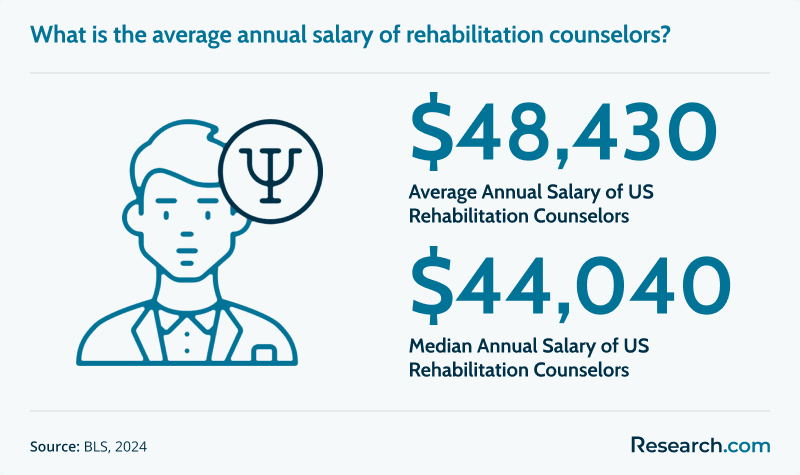
- The average annual salary for rehabilitation counselors in the United States is $48,430, and the median annual salary is $44,040.
- The highest-paying states by average annual salary are Alaska ($69,370), Maine ($67,190), the District of Columbia ($66,120), Rhode Island ($62,820), and North Dakota ($57,730).
- What does a rehabilitation counselor do?
- How to become a rehabilitation counselor for 2027?
- How long does it take to become a rehabilitation counselor?
- Where do rehabilitation counselors work?
- What are the top certifications for rehabilitation counselors?
- What skills are essential for a successful rehabilitation counselor?
- How can additional training advance rehabilitation counseling practice?
- What are the possible career paths of aspiring rehabilitation counselors?
- Which affordable graduate programs can enhance my rehabilitation counseling career?
- Can rehabilitation counselors integrate substance abuse counseling into their practice?
- What is the job outlook for rehabilitation counselors?
- What distinguishes rehabilitation counseling from social work and psychology?
- How can affordable online master’s degrees in psychology complement rehabilitation counseling?
- How Does Advanced Psychological Training Influence Rehabilitation Counseling Outcomes?
- How is technology reshaping rehabilitation counseling practices?
- Can Interdisciplinary Social Work Training Enhance Rehabilitation Counseling Outcomes?
- What is the average salary of rehabilitation counselors?
- What are the biggest challenges rehabilitation counselors face for 2027?
- How Can Specialized Training in Applied Behavior Analysis Enhance Rehabilitation Counseling?
- How can rehabilitation counselors accelerate their career advancement?
What does a rehabilitation counselor do?
A rehabilitation counselor helps people with disabilities identify barriers, build practical coping strategies, access services, and pursue education, work, and independent living goals. The role overlaps with counseling, case management, vocational planning, disability advocacy, and community resource coordination. Readers comparing related helping professions may also find Research.com’s disability social worker career guide useful because both fields involve advocacy and support, although their training and job focus can differ.
In daily practice, rehabilitation counselors often perform the following work:
- Client assessment: They review medical, psychological, educational, and vocational information to understand a client’s abilities, limitations, strengths, needs, and goals.
- Individual rehabilitation planning: They create customized plans that may include counseling, workplace accommodations, assistive technology, adaptive equipment, job training, physical conditioning, education planning, or referrals.
- Counseling and emotional support: They help clients adjust to disability, injury, mental health challenges, or major life transitions while also supporting family members when appropriate.
- Employment support: They assist with career exploration, job readiness, résumé preparation, interview practice, vocational training, job placement, and workplace accommodation planning.
- Advocacy: They help clients navigate systems related to employment, education, housing, healthcare, benefits, and community support.
- Case coordination: They communicate with physicians, therapists, educators, employers, social workers, workforce agencies, and community organizations to keep services aligned.
- Client and family education: They explain disability rights, available benefits, community programs, assistive tools, and responsibilities connected to rehabilitation plans.
- Progress monitoring: They track whether clients are meeting goals and revise plans when barriers, health status, employment conditions, or personal priorities change.
| Core responsibility | What it means in practice | Why it matters to clients |
| Assessment | Gathering medical, vocational, psychological, and social information | Creates a realistic starting point for services and goals |
| Counseling | Helping clients process challenges, build coping skills, and strengthen confidence | Supports emotional adjustment and persistence |
| Vocational planning | Matching skills, interests, accommodations, and labor-market options | Improves the chance of sustainable employment |
| Advocacy | Helping clients access rights, services, accommodations, and community support | Reduces barriers that clients may not be able to navigate alone |
| Case management | Coordinating providers, agencies, employers, schools, and family supports | Keeps services organized and prevents gaps in care |
The chart below shows the U.S. states that employ the most rehabilitation counselors.
How to become a rehabilitation counselor for 2027?
The standard route to this profession combines counseling education, supervised experience, examination, and ongoing professional development. Requirements vary by state and by job setting, so students should verify licensure rules early rather than waiting until graduation.
Step 1: Complete a relevant bachelor’s degree
Most future rehabilitation counselors begin with undergraduate study in rehabilitation and disability studies, psychology, social work, human services, or another closely related field. Useful courses include human development, counseling theory, abnormal psychology, disability studies, assessment, ethics, vocational evaluation, and case management. Students who want to move faster through undergraduate education may compare options such as an accelerated bachelor's degree.
Step 2: Earn a master’s degree in rehabilitation counseling or a related counseling field
A master’s degree in rehabilitation counseling from a CACREP-accredited university is generally the key graduate credential for this career path. It is often required for professional counseling licensure and for the Certified Rehabilitation Counselor credential. Students who need a shorter graduate timeline may want to research online masters degree 1 year options, while confirming that any accelerated format still meets state and certification requirements.
Step 3: Complete supervised fieldwork and post-master’s experience
Graduate programs include supervised practical training, and many states require additional supervised experience after graduation. Requirements often fall between 2,000 and 3,000 post-masters hours, though graduates of CACREP-accredited programs may be subject to different rules depending on the state or credential.
Step 4: Pass the required examination
Licensure commonly involves a state-approved counseling exam, such as the National Counselor Examination or the National Clinical Mental Health Counseling Examination. Candidates pursuing the Certified Rehabilitation Counselor credential must also pass the CRC exam, which focuses on rehabilitation counseling knowledge and practice.
Step 5: Apply for licensure or certification
After meeting education, supervised experience, and exam requirements, candidates submit documentation to the relevant state board or certification organization. Because requirements differ across jurisdictions, students should keep detailed records of coursework, practicum hours, internship hours, supervisors, and exam results.
Step 6: Maintain credentials with continuing education
Professional learning continues after licensure. Certified Rehabilitation Counselors must complete 100 hours of continuing education every five years. Continuing education helps counselors stay current on ethics, disability policy, employment practices, telehealth, assistive technology, and evidence-based interventions.
| Stage | Main decision | What to verify before moving forward |
| Bachelor’s degree | Choose a major that prepares you for counseling graduate study | Prerequisite courses, transfer policies, field experience options |
| Master’s degree | Select a CACREP-accredited or otherwise state-eligible program | Licensure alignment, internship structure, CRC preparation |
| Supervised experience | Work under qualified supervision | Required hours, supervisor credentials, documentation rules |
| Exams | Take required licensing or certification exams | Which exam your state or credentialing body accepts |
| Continuing education | Keep credentials active | Renewal deadlines, approved CE providers, ethics requirements |
How long does it take to become a rehabilitation counselor?
The path usually takes about six to ten years after high school. A bachelor’s degree generally takes four years, and a master’s degree in rehabilitation counseling or a related field usually requires approximately 60 hours of coursework and about two years of study. Some master’s programs can be completed in as little as 1.5 years. Students trying to shorten the undergraduate portion may explore fast track bachelor degree programs.
After graduate school, many states require supervised work experience before full licensure. Depending on the state, this can range from 2,000 to 6,000 hours, or about one to four years. Some states reduce supervised-hour requirements for candidates with specific graduate preparation, while others require an associate, intern, or provisional license during the supervision period.
| Training component | Typical length or requirement | Decision point for students |
| Bachelor’s degree | Generally four years | Choose a major that supports counseling graduate admission |
| Master’s degree | Approximately 60 hours of coursework and about two years | Confirm CACREP status and licensure alignment |
| Accelerated master’s option | Some programs can be completed in as little as 1.5 years | Make sure faster pacing does not reduce required fieldwork quality |
| Supervised experience | 2,000 to 6,000 hours depending on the state | Verify supervisor and documentation requirements before starting |
Where do rehabilitation counselors work?
Rehabilitation counselors are employed in healthcare, education, government, nonprofit, workforce development, and private settings. The right setting depends on whether you prefer direct counseling, employment services, school-based support, medical rehabilitation, disability services administration, or independent consulting.
- Community rehabilitation centers: Counselors provide disability support, vocational training, counseling, and independent living services in community-based programs.
- Nursing homes: They help residents manage physical, cognitive, emotional, and adjustment-related challenges while promoting independence and quality of life.
- Government agencies: Federal, state, and local agencies hire rehabilitation counselors for vocational rehabilitation, social services, veterans’ services, and disability programs.
- Hospitals: Counselors collaborate with medical teams to help patients recover from illness, injury, or surgery and plan for life after discharge.
- Schools: They support students with disabilities through academic planning, vocational counseling, personal counseling, and collaboration with families and educators.
- Senior citizen centers: Counselors assist older adults with independence, health-related adjustment, community resources, and aging-related concerns.
- Youth guidance organizations: They help young people with disabilities or other barriers develop goals, life skills, and transition plans.
- Clients’ homes: Some counselors provide in-home services for clients who need mobility-sensitive or specialized support.
- Vocational rehabilitation programs: State-run programs employ many counselors who help clients prepare for, secure, and retain employment.
- Veterans Administration facilities: Counselors assist veterans with disabilities as they pursue employment, independent living, healthcare referrals, and transition goals.
- Colleges and universities: Disability services offices employ counselors and specialists who coordinate accommodations and support academic success.
- Private practice: Experienced counselors may offer rehabilitation counseling, vocational assessment, disability consultation, or related services independently.
| Work setting | Best fit for counselors who want to... | Common client needs |
| Vocational rehabilitation agency | Focus on employment and job retention | Career planning, accommodations, job placement |
| Hospital or rehabilitation facility | Work with medical and recovery teams | Adjustment after illness, injury, surgery, or disability onset |
| School or university | Support students with disabilities | Academic accommodations, transition planning, career readiness |
| Government or nonprofit agency | Connect clients to public and community services | Benefits, housing, employment services, case coordination |
| Private practice | Build an independent counseling or consulting service | Vocational assessment, counseling, disability consultation |
Students with limited budgets should compare tuition, fees, accreditation, field-placement support, and financial aid before enrolling. Research.com’s guide to affordable online courses and programs can help learners begin that comparison.
What are the top certifications for rehabilitation counselors?
Credentials can affect employability, scope of practice, reimbursement options, and eligibility for advanced roles. Some credentials are certifications, while others are state licenses. The right choice depends on whether you want to provide counseling independently, specialize in disability and employment services, manage cases, or work with specific populations.
- Certified Rehabilitation Counselor: The CRC credential from the Commission on Rehabilitation Counselor Certification is widely recognized in rehabilitation counseling. It signals specialized preparation in disability, vocational rehabilitation, counseling, and case coordination. Requirements include a master’s degree in rehabilitation counseling, supervised experience, and a passing score on the CRC exam.
- Licensed Professional Counselor or Licensed Mental Health Counselor: LPC and LMHC titles are state-regulated licenses that generally allow qualified counselors to provide professional counseling services. Eligibility commonly includes a master’s degree, 2,000–3,000 supervised hours, and a state-approved exam such as the NCE or NCMHCE.
- National Certified Counselor: The NCC credential from the National Board for Certified Counselors is a broad counseling certification that can strengthen professional credibility. Candidates typically need a master’s degree in counseling, supervised experience, and a passing score on the National Counselor Examination.
- Certified Case Manager: The CCM credential from the CCMC is relevant for rehabilitation counselors who coordinate healthcare, benefits, community services, and long-term support plans. It requires professional experience and a passing score on the CCM exam.
- Certified Brain Injury Specialist: The CBIS credential from the Brain Injury Association of America recognizes specialized preparation for professionals who work with people affected by traumatic brain injury. Candidates complete brain injury training and pass the CBIS exam.
| Credential | Best for | Important caution |
| CRC | Rehabilitation counseling, vocational rehabilitation, disability services | Confirm education and experience eligibility before applying |
| LPC or LMHC | Counselors seeking state-regulated clinical practice authority | Rules are state-specific and may not transfer automatically |
| NCC | Counselors seeking a broad national counseling credential | It does not replace state licensure |
| CCM | Professionals emphasizing case coordination and service navigation | Experience requirements matter |
| CBIS | Counselors serving clients with traumatic brain injury | It is specialized and may not be necessary for all roles |
Professionals who want to combine counseling with motivational development may also compare this field with how to become a transformational coach, especially if they are interested in nonclinical coaching pathways.
What skills are essential for a successful rehabilitation counselor?
Strong rehabilitation counselors combine clinical judgment, practical problem-solving, cultural humility, and detailed knowledge of disability systems. Technical knowledge matters, but so do patience, clear communication, and the ability to coordinate services across complex systems. Students researching programs may review a list of online schools to identify options with counseling, psychology, social work, or rehabilitation-related coursework.
- Assessment: Counselors must evaluate clients’ strengths, limitations, goals, medical history, vocational background, psychological needs, and environmental barriers.
- Communication: The job requires clear conversations with clients, families, healthcare providers, employers, educators, and agencies.
- Counseling ability: Counselors help clients cope with disability, injury, mental health concerns, stress, grief, and barriers to recovery or employment.
- Advocacy: Effective counselors understand disability rights, workplace accommodations, education systems, healthcare access, and benefits programs.
- Cultural awareness: Clients’ values, identities, communities, and lived experiences shape how services should be delivered.
- Relationship-building: Progress often depends on trust with clients and productive collaboration with families, employers, providers, and community partners.
- Critical thinking: Counselors must adapt plans when health conditions, employment realities, motivation, funding, or family circumstances change.
- Active listening: Clients need to be heard accurately before the counselor can recommend realistic supports.
- Compassion and patience: Disability adjustment, vocational progress, and systems navigation can take time.
- Empathy: Understanding a client’s experience helps build trust while still maintaining professional boundaries.
- Resource navigation: Counselors need working knowledge of housing programs, employment agencies, healthcare referrals, transportation options, assistive technology, and community supports.
According to 2025 data from Zippia, the most common skills listed on U.S. rehabilitation counselor resumes are rehabilitation (23.2%), social work (12.5%), mental health (12.1%), patients (6%), management system (4.4%), vocational rehabilitation (4.2%), and community resources (3.7%).
How can additional training advance rehabilitation counseling practice?
Additional training can help rehabilitation counselors serve clients with more complex needs, especially when disability intersects with family stress, trauma, mental health concerns, substance use, aging, or employment instability. Short courses, graduate certificates, and specialized degrees can deepen a counselor’s toolkit, but the best option depends on the counselor’s current license, employer requirements, and target client population.
For counselors who frequently work with family systems, caregiver stress, or relationship dynamics, programs such as a marriage and family counseling degree online may offer useful training in family-based interventions. Before enrolling, professionals should confirm whether the program supports their licensing goals or functions mainly as supplemental education.
What are the possible career paths of aspiring rehabilitation counselors?
Rehabilitation counseling can lead to direct-service, administrative, educational, consulting, and research-oriented roles. The best path depends on whether you prefer employment counseling, mental health support, disability advocacy, program leadership, technology access, or academic work.
- Vocational rehabilitation counselor: Helps clients with disabilities prepare for work, find jobs, maintain employment, and obtain reasonable accommodations.
- Mental health rehabilitation counselor: Supports clients managing mental health conditions, trauma, substance use disorders, or major life disruptions in clinical or community settings.
- School or university disability counselor: Coordinates accommodations, academic support, transition planning, and career guidance for students with disabilities.
- Veterans rehabilitation counselor: Works with veterans and service members on employment, independent living, disability services, and transition to civilian life.
- Case manager or social services coordinator: Connects clients with housing, medical care, financial support, benefits, employment services, and community programs.
- Private practice counselor or independent consultant: Provides counseling, vocational assessments, disability evaluations, accommodation recommendations, or consulting services.
- Rehabilitation program director or administrator: Oversees staff, budgets, service quality, program design, compliance, and organizational performance.
- Assistive technology specialist: Assesses accessibility needs and helps clients use adaptive tools in school, work, healthcare, and daily life.
- Corporate disability specialist: Supports workplace accessibility, employee accommodations, ADA-related processes, and disability inclusion strategies.
- Researcher or professor: Studies disability services, vocational rehabilitation, counseling outcomes, and rehabilitation policy while training future professionals.
Students drawn to the employment side of the profession may also want to explore how to become a career counselor, since both paths involve helping people connect strengths, goals, and work opportunities.
| Career path | Strong fit if you enjoy... | Common employers |
| Vocational rehabilitation counselor | Employment planning and job accommodation work | State agencies, workforce programs, nonprofits |
| Mental health rehabilitation counselor | Counseling clients with complex emotional or behavioral needs | Hospitals, clinics, community mental health programs |
| Disability counselor in education | Helping students access accommodations and plan transitions | Schools, colleges, universities |
| Case manager | Coordinating services and navigating systems | Government agencies, hospitals, nonprofits |
| Program director | Leading teams and improving service delivery | Agencies, rehabilitation centers, community organizations |
Which affordable graduate programs can enhance my rehabilitation counseling career?
A graduate program can improve career options only if it is affordable, properly accredited or state-recognized, aligned with licensure requirements, and strong enough in field placement support. Price matters, but a low-tuition program that does not qualify you for the credential you need can become expensive in the long run.
When comparing affordable masters in counseling options, look beyond tuition. Ask whether the curriculum supports rehabilitation counseling, whether supervised internships are available in your area, whether graduates qualify for relevant exams, and whether the school has experience helping online students meet state-specific requirements.
Can rehabilitation counselors integrate substance abuse counseling into their practice?
Yes, rehabilitation counselors may strengthen their practice by developing substance abuse counseling knowledge, especially because disability, mental health conditions, employment barriers, chronic pain, and substance use concerns can overlap. However, counselors must stay within their legal scope of practice and obtain any state-required credential before independently treating substance use disorders.
Professionals who want deeper preparation can investigate education paths connected to becoming a drug counselor. This type of training can support screening, referral, relapse-prevention awareness, integrated treatment planning, and collaboration with addiction specialists.
What is the job outlook for rehabilitation counselors?
The United States Bureau of Labor Statistics projects that employment of rehabilitation counselors will grow by 2% from 2023 to 2033. That is slower than the average growth rate for all occupations, which is 4%. The occupation is projected to rise from 87,600 workers in 2023 to 89,200 by 2033.
Openings still exist because hiring is affected not only by growth but also by replacement needs, retirements, turnover, and demand across public agencies, healthcare, disability services, and vocational programs. As of February 2025, Indeed listed over 8,000 openings for rehabilitation counseling roles. From 2023 to 2033, aspiring counselors can expect about 8,000 openings each year.
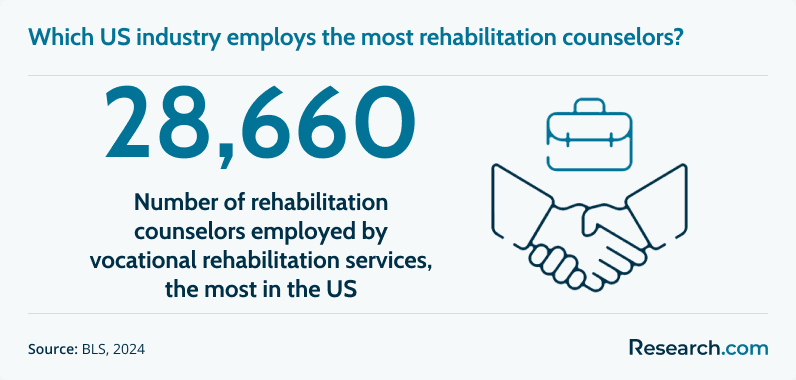
The industries employing the most rehabilitation counselors are vocational rehabilitation services (28,660), state government units (13,620), individual family services (10,530), residential intellectual and developmental disability, mental health, and substance abuse facilities (10,270), and local government units (5,100).
What distinguishes rehabilitation counseling from social work and psychology?
Rehabilitation counseling is more specialized than many broader helping professions because it centers on disability, vocational rehabilitation, independent living, and functional outcomes. Social work often emphasizes social systems, benefits, community resources, and family or population-level support. Psychology generally focuses more heavily on assessment, diagnosis, research, and psychological treatment, depending on the role and level of training.
In practice, these fields often collaborate. A rehabilitation counselor may work with a social worker on housing or benefits, consult a psychologist about assessment or mental health treatment, and coordinate with employers about accommodations. Readers deciding between these fields can compare professional differences in Is social work or psychology better?.
| Field | Primary emphasis | Typical client goal |
| Rehabilitation counseling | Disability, employment, independence, adjustment, accommodations | Increase functional independence and work or education participation |
| Social work | Systems support, advocacy, services, social conditions | Connect clients with resources and improve social functioning |
| Psychology | Assessment, behavior, mental processes, treatment, research | Understand and treat psychological or behavioral concerns |
How can affordable online master’s degrees in psychology complement rehabilitation counseling?
An affordable online psychology master’s degree may help rehabilitation counselors strengthen their understanding of assessment, behavior, research methods, developmental factors, and evidence-based interventions. This can be useful for counselors who want broader psychological knowledge, but it should not be assumed to replace a rehabilitation counseling degree or satisfy counseling licensure requirements.
Professionals considering the cheapest online master's in psychology programs should compare curriculum, accreditation, fieldwork, licensure relevance, and employer expectations before enrolling. The best choice depends on whether the goal is clinical practice, research literacy, career advancement, or supplemental expertise.
How Does Advanced Psychological Training Influence Rehabilitation Counseling Outcomes?
Advanced psychological training can improve a rehabilitation counselor’s ability to interpret client behavior, apply evidence-informed strategies, understand complex mental health factors, and evaluate outcomes. Doctoral-level study may also improve research literacy and assessment skills, especially for professionals pursuing teaching, consulting, leadership, or specialized clinical work.
Programs such as PsyD online accredited programs may interest counselors seeking deeper applied psychology training. Before pursuing this route, professionals should weigh cost, time commitment, licensure goals, and whether doctoral training is necessary for the roles they want.
How is technology reshaping rehabilitation counseling practices?
Technology is changing rehabilitation counseling through telehealth, remote assessments, digital case documentation, online scheduling, virtual job coaching, assistive technology, and electronic progress tracking. These tools can expand access for clients in rural areas, reduce travel barriers, and make coordination easier across providers.
Digital systems can also help counselors monitor progress, organize case notes, and adjust rehabilitation plans based on measurable goals. At the same time, counselors must protect confidentiality, follow telehealth rules, and ensure that clients can actually access and use the technology involved.
Professionals interested in the organizational side of technology adoption may find programs such as the cheapest online masters program organizational psychology relevant, particularly if they want to lead teams, improve service systems, or support workplace disability inclusion.
Can Interdisciplinary Social Work Training Enhance Rehabilitation Counseling Outcomes?
Social work training can strengthen a rehabilitation counselor’s ability to understand poverty, housing instability, family stress, benefits systems, community resources, and policy barriers that affect client outcomes. This perspective is especially valuable when clients need coordinated support beyond counseling alone.
Professionals considering online MSW programs should first clarify their goal. An MSW may support broader social-service or clinical social work pathways, but it may not automatically replace rehabilitation counseling credentials or state counseling licensure requirements.
What is the average salary of rehabilitation counselors?
According to BLS data, rehabilitation counselors in the United States earn an average annual salary of $48,430 and a median annual salary of $44,040. These figures are close to the national average of $48,060 and similar to the typical library science salary of $48,000. Actual earnings can vary by state, employer type, credential, experience level, specialization, and whether the counselor works in public service, healthcare, private practice, or insurance-related roles.
The highest-paying industries by average annual salary are agencies, brokerages, and other insurance-related activities ($75,440), other ambulatory healthcare services ($72,160), insurance carriers ($68,630), continuing care retirement communities and assisted living facilities for the elderly ($63,540), and psychiatric and substance abuse hospitals ($62,170).
The states with the highest average annual salaries are Alaska ($69,370), Maine ($67,190), the District of Columbia ($66,120), Rhode Island ($62,820), and North Dakota ($57,730).
| Salary factor | Why it matters | How to use it when planning |
| State | Pay varies by location and employer demand | Compare salaries with cost of living before relocating |
| Industry | Some industries pay more than traditional service settings | Look at insurance, ambulatory healthcare, and specialized facilities if income is a priority |
| Credential | Licensure and certification can affect eligibility for roles | Choose credentials that match your target jobs |
| Experience | Advanced roles may require years of practice | Build supervision, case management, and leadership experience early |
| Specialization | Brain injury, substance use, vocational rehabilitation, and assistive technology may shape opportunities | Select training based on local employer needs and client populations |
What are the biggest challenges rehabilitation counselors face for 2027?
Rehabilitation counseling can be meaningful, but the work is not simple. Counselors often support clients through complicated health, employment, legal, social, and emotional barriers while also managing documentation, caseloads, limited resources, and changing policies.
- Emotional strain: Supporting clients through disability, trauma, unemployment, illness, or major life changes can contribute to burnout or compassion fatigue.
- Limited resources: Funding shortages, long waitlists, transportation barriers, and gaps in community programs can make rehabilitation plans harder to implement.
- Complex client needs: Clients may have overlapping physical, psychological, social, financial, and vocational challenges that require careful coordination.
- Changing laws and policies: Disability rights, employment rules, benefits programs, healthcare requirements, and counseling regulations can shift over time. Some counselors pursue options such as best online graduate certificate programs in counseling to keep skills current.
- Professional boundaries: Counselors must balance empathy with ethical limits, confidentiality, informed consent, and role clarity.
- Interdisciplinary coordination: Effective rehabilitation often requires communication with physicians, therapists, employers, educators, social workers, and agencies.
- Cultural competence: Counselors need to provide services that respect a client’s language, culture, identity, family structure, values, and lived experience.
- Psychiatric disabilities: Counselors increasingly need skills for supporting clients with severe and lifelong psychiatric disabilities.
Common mistakes to avoid when entering the field
- Choosing a graduate program without checking licensure alignment: Always confirm whether the program meets requirements in the state where you plan to work.
- Looking only at tuition: Fees, travel for internships, exam costs, supervision costs, and lost work time can affect total cost.
- Assuming online programs automatically meet fieldwork rules: Online coursework may be flexible, but practicum and internship placement rules still matter.
- Ignoring accreditation: Accreditation can affect eligibility for certification, licensure, and employer recognition.
- Assuming salary outcomes are guaranteed: Published salary figures describe averages or medians, not guaranteed earnings for new graduates.
- Waiting too long to document supervised hours: Poor records can delay licensure or certification.
Questions to ask before enrolling in a rehabilitation counseling program
- Does the program meet the education requirements for the state where I plan to become licensed?
- Is the program CACREP-accredited or otherwise accepted by the credentialing bodies relevant to my goal?
- How are practicum and internship placements arranged for online or distance students?
- What exams do graduates typically take after completing the program?
- Does the curriculum prepare students for CRC certification, state counseling licensure, or both?
- What is the total estimated cost, including tuition, fees, books, technology, travel, exams, and supervision?
- What disability populations, employment settings, or counseling approaches does the program emphasize?
- How does the program support students who work full time?
How Can Specialized Training in Applied Behavior Analysis Enhance Rehabilitation Counseling?
Applied behavior analysis training can help rehabilitation counselors understand behavior patterns, design measurable interventions, reinforce skill development, and support clients with behavioral barriers that affect school, work, relationships, or daily functioning. It may be especially useful for counselors working with developmental disabilities, brain injury, behavioral health needs, or structured skill-building programs.
Professionals considering an online MS in psychology applied behavior analysis should check whether the curriculum matches their role. ABA training can be a valuable supplement, but counselors should confirm licensure, certification, and scope-of-practice requirements before offering specialized behavioral services.
How can rehabilitation counselors accelerate their career advancement?
Career growth in rehabilitation counseling usually comes from a mix of credentials, specialization, supervision experience, leadership skills, and strong professional networks. Counselors who want to move into higher-responsibility roles should identify the settings where they want to work and then build the specific qualifications those employers value.
- Earn targeted credentials: CRC, LPC, LMHC, NCC, CCM, or specialized credentials can improve eligibility for certain jobs.
- Develop a specialization: Brain injury, vocational rehabilitation, assistive technology, substance use, veterans services, psychiatric disability, or disability inclusion can help define a career niche.
- Build leadership experience: Supervising interns, managing cases, improving programs, and training staff can support advancement into director or administrator roles.
- Stay current with technology: Telehealth, digital documentation, assistive tools, and data-informed progress tracking are increasingly relevant.
- Compare compensation paths realistically: Guides to highest paying counseling jobs can help counselors understand how pay varies across counseling specialties.
Key Insights
- Rehabilitation counseling is best suited for people who want to combine counseling, disability advocacy, vocational planning, and practical service coordination.
- The typical path requires a bachelor’s degree, a master’s degree, supervised experience, exams, and continuing education; most candidates should expect about six to ten years after high school.
- A CACREP-accredited master’s program can be important for licensure and certification planning, but students must still verify state-specific requirements.
- The CRC is a major credential for rehabilitation counseling, while LPC or LMHC licensure may be necessary for broader counseling practice depending on the state and role.
- Job growth is projected at 2% from 2023 to 2033, slower than the 4% average for all occupations, but openings remain available across vocational rehabilitation, government, healthcare, education, and community service settings.
- Salary varies significantly by state and industry; the national average annual salary is $48,430, while higher-paying sectors include insurance-related activities and ambulatory healthcare services.
- Before choosing a program, compare accreditation, licensure alignment, field placement support, total cost, certification preparation, and whether the curriculum fits your intended career path.
References:
- BLS (2024, April 3). 21-1015 Rehabilitation Counselors. BLS
- BLS (2024, August 29). Field of degree: Library science. BLS
- BLS (2024, December 4). Rehabilitation Counselors. BLS
- World Health Organization (2023, March 7). Disability. World Health Organization
- Zippia (2025, January 8). Rehabilitation Counselor skills for your resume and career. Zippia
Other Things You Should Know About Becoming a Rehabilitation Counselor
To work as a rehabilitation counselor in 2027, you may need to be certified by the Commission on Rehabilitation Counselor Certification (CRCC). This typically requires passing the Certified Rehabilitation Counselor (CRC) exam and meeting specific education and work experience criteria set by the CRCC.
Yes. Most states require a master’s degree in rehabilitation counseling or a closely related field, usually from a CACREP-accredited program. Licensure also commonly requires 60 semester credits, supervised clinical experience, and passing the Commission on Rehabilitation Counselor Certification’s CRC exam.