
2027 How to Become a Career Counselor

Co-Founder and Chief Data Scientist
Career counseling is the work of helping people turn education, training, interests, and work experience into realistic career decisions. The need is clear: only around 20% of recent graduates from public colleges and universities in 2024 received all three parts of strong education-to-career coaching: guidance, timely information, and support. Without that help, students and job seekers may choose programs without understanding employment outcomes, earnings, hiring demand, or alternative routes such as certificates, apprenticeships, or trade school.
This guide explains how to become a career counselor for 2027, including degree expectations, licensing, certifications, timelines, work settings, salary data, job outlook, and practical steps for choosing the right preparation path. It is written for students exploring counseling careers, professionals moving from advising or human resources into career development, and educators who want to support learners through better career planning.
Quick Answer: How do you become a career counselor?
To become a career counselor, you typically earn a bachelor’s degree in a relevant field, gain experience in advising or human services, complete a master’s degree in counseling or a related discipline if your target role requires it, meet state licensing rules for school or clinical practice, and continue professional development in career assessment, labor market data, ethics, and client support. Requirements vary by state and employer, so the right path depends on whether you want to work in schools, colleges, workforce programs, corporate coaching, rehabilitation services, or private practice.
Key Things You Should Know About How to Become a Career Counselor
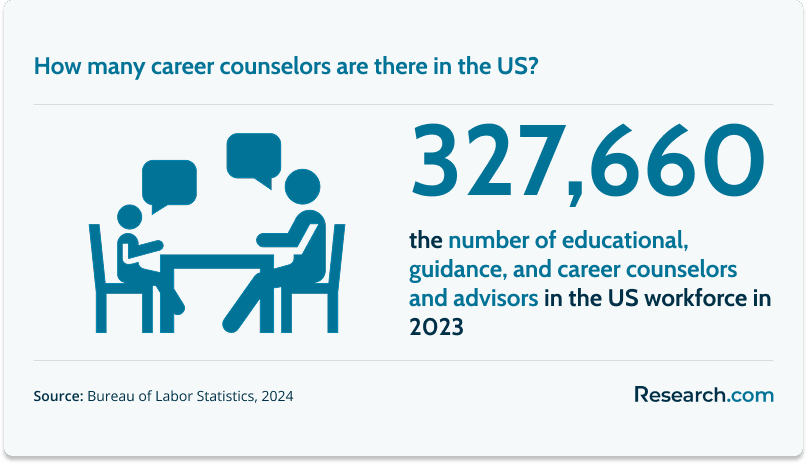
- The field is established and offers steady demand. In 2023, there were 327,660 educational, guidance, and career counselors and advisors in the US workforce. Job openings are projected to average 29,100 per year through 2033, making this a stable guidance-focused profession across schools, colleges, agencies, and private organizations.
- Most formal counseling roles require graduate education. Entry-level advising jobs may be possible with a bachelor’s degree, but many school, college, and licensed counseling positions expect a master’s degree in counseling, school counseling, psychology, or a closely related area.
- Licensing rules are not the same everywhere. School counselors usually follow state education agency requirements, while private practice counselors may need a Licensed Professional Counselor credential or similar state license. Always check the rules in the state where you plan to work.
- Pay varies widely by setting, location, and experience. The average annual salary for career counselors in 2023 was $66,990, with earnings ranging from around $40,140 to over $100,050. Higher-paying industries included offices of health practitioners ($104,640), insurance-related fields ($85,630), and government agencies ($81,130).
- Career counseling fills a real education-to-workforce gap. Only 20% of recent bachelor’s degree graduates report receiving quality coaching that includes guidance, timely information, and support, and just 33% received employment outcome data from their institutions.
- Steps to Become a Career Counselor for 2027
- What Career Counselors Do
- Education Requirements for Career Counselors
- Licensing Requirements for Career Counselors
- How Long It Takes to Become a Career Counselor
- Skills and Qualities Career Counselors Need
- Career Counseling Specializations
- Where Career Counselors Work
- Certifications That Can Strengthen Your Career Counseling Practice
- Emerging Trends in Career Counseling
- How to Choose a Graduate Program for Career Counseling
- When Addiction Support Training May Help Career Counselors
- Ongoing Training Options for Career Counselors
- Challenges and Collaboration in Career Counseling
- Affordable Advanced Degrees and Career Counselor ROI
- Online Psychology Programs and Career Counseling Practice
- Legal and Ethical Rules Career Counselors Should Follow
- Career Counselor Salary
- Career Paths for Career Counselors
- Career Counselor Job Outlook
- Interdisciplinary Training for Better Career Counseling Outcomes
Steps to Become a Career Counselor for 2027
The career counselor pathway depends on your intended work setting. A high school counselor, a college career advisor, a vocational rehabilitation counselor, and a private career coach may all help people make career decisions, but they can face different education, supervision, licensing, and certification expectations.
- Complete a relevant bachelor’s degree. Common undergraduate majors include psychology, education, counseling-related studies, sociology, human services, and business. Students interested in corporate career development may also come from human resources or organizational leadership backgrounds.
- Build experience in advising, coaching, education, or workforce services. Before entering graduate school, many future career counselors work as academic advisors, admissions staff, HR coordinators, employment specialists, job coaches, or workforce program assistants. If you are interested in disability-focused employment support, compare this path with the steps to become a rehabilitation counselor.
- Earn a master’s degree when your target role requires one. Many school counseling, college counseling, and licensed professional counseling roles require graduate training. A master’s program often includes counseling theory, assessment, ethics, multicultural counseling, career development, and supervised fieldwork.
- Complete supervised practice. Graduate programs and state boards often require practicum, internship, or post-degree supervised hours. The exact number and type of hours depend on your state, credential, and setting.
- Apply for the required license or credential. School-based roles often require a school counseling license or state certification. Private practice may require a Licensed Professional Counselor credential or a comparable state license. Some career specialists pursue national or professional certifications to document expertise.
- Develop career-specific tools. Strong career counselors know how to interpret assessments, explain labor market information, help with job search strategy, evaluate training options, and support clients who feel uncertain or overwhelmed.
- Keep learning after you enter the field. Labor markets, hiring tools, degree requirements, and employer expectations change. Continuing education helps counselors provide current, ethical, and practical guidance.
| Step | Why it matters | Best next action |
| Bachelor’s degree | Creates a foundation in human behavior, education, communication, or workforce systems | Choose a major that fits your target setting, such as schools, HR, or human services |
| Advising or human services experience | Helps you confirm that you enjoy client-facing guidance work | Look for roles in academic advising, workforce agencies, HR, admissions, or student services |
| Master’s degree | Often required for school counseling, licensure, and advanced counseling roles | Compare accredited programs, fieldwork requirements, cost, and state eligibility |
| Licensure or certification | Determines whether you can work in regulated counseling or school settings | Review state board and employer requirements before enrolling |
| Continuing education | Keeps your practice aligned with current workforce and counseling standards | Follow professional associations, attend workshops, and renew credentials on time |
What Career Counselors Do
Career counselors help people make informed decisions about education, training, job searches, career changes, and long-term professional goals. Their work combines counseling skills with practical knowledge of programs, credentials, employment trends, hiring processes, and workplace expectations.
A career counselor may help a high school student compare college majors, guide a recent graduate through a job search, assist a laid-off worker with retraining options, or support a mid-career professional who wants a new direction. For students considering non-degree routes, counselors may use resources such as a trade school careers list to compare skilled trades, training length, earning potential, and job fit.
Effective education-to-career coaching usually includes three connected elements:
- Guidance. The counselor helps the client identify strengths, interests, values, constraints, and realistic education or work options.
- Timely information. The client receives up-to-date details about job opportunities, earnings, training requirements, and career outcomes.
- Support. The counselor helps the client turn decisions into action through goals, applications, resumes, interviews, referrals, and follow-up.
In 2023, there were around 327,660 educational, guidance, and career counselors and advisors in the US workforce. Their work matters because students and workers often need help sorting through complex choices, especially when degree costs, employer expectations, and career paths are changing.
| Client type | Common questions | How a career counselor helps |
| High school students | Should I choose college, trade school, military service, or work? | Explains pathways, compares requirements, supports course planning, and reviews training options |
| College students | What can I do with my major? | Connects coursework to internships, industries, graduate school, and entry-level roles |
| Job seekers | How do I find work that matches my skills? | Improves resumes, interview preparation, job search strategy, and networking plans |
| Career changers | How do I move into a new field without starting over? | Identifies transferable skills, short training routes, certifications, and realistic transition steps |
| Workers with barriers to employment | What support or accommodations can help me work? | Coordinates resources, explores vocational options, and may refer to rehabilitation or social services |
Education Requirements for Career Counselors
The educational route to career counseling usually begins with undergraduate study and often continues into graduate training. The level of education you need depends on whether you want to provide general career advising, school counseling, licensed counseling, rehabilitation services, or private coaching.
- Bachelor’s degree. A bachelor’s degree in psychology, education, sociology, human services, communications, business, or a related field can prepare you for entry-level advising and support roles. It may not be enough for licensed counseling jobs, but it can help you enter student services, workforce programs, or HR. Students comparing related counseling fields may also review how to become a pastoral counselor.
- Master’s degree. A master’s degree in counseling, school counseling, career development, psychology, or a related discipline is commonly expected for school counseling roles, many higher education counseling jobs, and licensure-track positions.
- Graduate certificate. Some professionals who already hold a graduate degree use a career counseling certificate to add specialization without completing a second full degree.
- Practicum and internship. Graduate programs often require supervised experience where students practice counseling skills, assessment interpretation, documentation, referrals, and ethical decision-making.
If a master’s degree is not immediately affordable, you can still build toward the field. Roles in admissions, academic advising, workforce development, human resources, tutoring, coaching, or nonprofit employment services can provide relevant experience while you decide whether graduate school is the right investment.
| Education option | May qualify you for | Important limitation |
| Associate degree or transfer pathway | Early college coursework and lower-cost entry into higher education | Usually not enough for professional counseling roles |
| Bachelor’s degree | Entry-level advising, student services, HR, workforce support, or coaching-adjacent roles | Many school and licensed counseling positions require graduate education |
| Master’s degree | School counseling, college counseling, licensure-track counseling, advanced advising roles | Must be matched carefully to state licensing and employer requirements |
| Graduate certificate | Specialized career development knowledge for professionals who already have related training | May not replace a required master’s degree or state license |
Licensing Requirements for Career Counselors
Licensing is one of the most important decision points in this career. The requirements depend on where you work and what services you provide. A person offering resume coaching in a workforce center may face different rules than a school counselor serving students or a private practitioner providing counseling services.
- School counselor licensure or certification. K-12 school counselors generally follow state education requirements. Many states require a counseling-related master’s degree, supervised school experience, and a state-approved exam. Some states also include additional education or teaching-related requirements.
- Licensed Professional Counselor pathway. Career counselors who want to provide counseling in private practice often pursue an LPC credential or similar state license. This usually involves a master’s degree, supervised clinical hours, and a national exam such as the National Counselor Examination.
- Professional career counseling certifications. Credentials such as the Certified Career Counselor from the National Career Development Association can help document specialized career development expertise, especially for counselors who want to stand out in advising, coaching, or consulting roles.
Continuing Education for Career Counselors
Many licenses and credentials require continuing education for renewal. Even when it is not mandatory, ongoing training is essential because career counseling depends on current labor market knowledge, ethical practice, assessment literacy, and familiarity with changing education and hiring systems. Continuing education topics may include labor market trends, career coaching methods, psychological assessment tools, technology in counseling, and legal or ethical updates.
| Credential area | Typical setting | What to verify before choosing a program |
| School counseling license | K-12 schools | State education agency requirements, internship rules, exams, and whether teaching experience is required |
| LPC or similar counseling license | Private practice, agencies, counseling settings | State board rules, supervised hours, exam requirements, and whether the degree is license-eligible |
| Career counseling certification | Career centers, consulting, coaching, workforce programs | Eligibility requirements, renewal rules, supervision expectations, and employer recognition |
How Long It Takes to Become a Career Counselor
A traditional route to career counseling can take approximately 7 to 10 years when it includes a bachelor’s degree, graduate school, supervised experience, and licensing. The timeline can be shorter for non-licensed advising roles and longer for those who begin part time, transfer credits, or complete post-degree supervised hours slowly.
Some students begin with lower-cost college options before transferring. If you are still comparing starting points, reviewing the best associate degrees can help you think through early academic options before committing to a four-year or graduate pathway.
- Bachelor’s degree: 4 years. Most students begin with a bachelor’s program in psychology, education, counseling-related studies, human services, or a similar area.
- Master’s degree: 2 to 3 years. Many counseling roles require graduate study, often including practicum or internship hours.
- Supervised experience: 1 to 2 years. Depending on state requirements and credential goals, career counselors may complete 1,000 to 3,000 hours of supervised work.
- Licensure or certification: varies by state. Application processing, exams, background checks, and documentation can add time.
- Continuing education: ongoing. Career counselors continue learning throughout their careers to maintain credentials and provide accurate guidance.
| Pathway | Approximate timeline | Best fit |
| Entry-level advising route | Bachelor’s degree plus relevant experience | People who want to work in admissions, student services, workforce programs, or HR before graduate school |
| School counseling route | Bachelor’s degree, master’s degree, internship, state credential | People who want to work with K-12 students in regulated school settings |
| Licensed counseling route | Bachelor’s degree, master’s degree, supervised hours, exam, state license | People who want broader counseling practice options, including possible private practice |
| Career coaching or consulting route | Varies by background, market, and credential goals | Experienced professionals from HR, education, training, or workforce development |
Skills and Qualities Career Counselors Need
Strong career counselors combine counseling ability with practical workforce knowledge. According to interpersonal, analytical, and problem-solving skills associated with this occupation, the work requires careful listening, clear communication, judgment, and the ability to help people evaluate choices under uncertainty.
- Active listening. Clients often arrive with anxiety, family pressure, financial limits, academic concerns, or unclear goals. A counselor must hear both the stated question and the underlying concerns.
- Empathy and cultural competence. Career decisions are shaped by culture, income, disability, family expectations, immigration status, location, and access to education. Counselors need to avoid one-size-fits-all advice.
- Assessment and interpretation. Career counselors may use interest inventories, values assessments, skills reviews, and labor market data, but they must explain results without overclaiming what any assessment can predict.
- Labor market literacy. Counselors need to understand occupations, training requirements, earnings ranges, hiring trends, and alternatives to traditional degree pathways.
- Practical coaching. Clients often need help with resumes, interviews, applications, networking, employer research, and decision timelines.
- Ethical judgment. Counselors must protect confidentiality, use appropriate referrals, avoid conflicts of interest, and stay within their scope of practice.
A good career counselor does not assume that every client should follow the same academic path. For example, a student who wants stable pay but prefers hands-on learning may benefit from exploring easy trades to learn that pay well, while another client may be better served by a bachelor’s degree, graduate school, or a professional certification.
Career counseling is most useful when it connects personal fit with real-world opportunity. The data below shows differences in outcomes for graduates who received all three parts of quality career coaching: guidance, timely information, and support.
Career Counseling Specializations
Career counseling is not limited to one type of client or workplace. Specializing can help you build deeper expertise, choose more relevant training, and market your services more clearly.
- School career counseling. These counselors work with middle school, high school, or college students on academic planning, career exploration, college applications, vocational choices, and transition planning.
- College and university career services. Professionals in this area help students connect majors to internships, graduate school, job applications, alumni networks, and employer recruiting.
- Workforce development counseling. These counselors support unemployed workers, displaced workers, adults changing fields, and job seekers who need training, placement assistance, or reentry support.
- Corporate career coaching. Employers and consultants use career coaching to support employee development, leadership preparation, internal mobility, and career transitions.
- Vocational rehabilitation counseling. Specialists in this area help people with disabilities or employment barriers plan careers, request accommodations, and connect with support services.
- Industry-specific advising. Some counselors focus on sectors such as healthcare, finance, education, technology, or skilled trades. For example, a counselor working with accounting students may use a guide to the highest paying accounting jobs to explain certification paths, job progression, and career options.
- Military and veteran transition counseling. These counselors help service members translate military skills into civilian careers, evaluate education benefits, and prepare for workforce transition.
Certification Options for Specialized Career Counselors
Specialized credentials can help counselors demonstrate focused expertise. The Certified Career Counselor credential from the National Career Development Association supports career development practice. The Certified Rehabilitation Counselor credential is relevant for professionals working with clients with disabilities. A Board Certified Coach credential with a career coaching focus may be useful for professionals emphasizing coaching rather than clinical counseling. The Certified Workforce Development Professional credential can support counselors working in job readiness, employment services, and workforce programs.
Specialization can also shape earning opportunities. In 2023, the highest-paying industries were health practitioners' offices ($104,640) and insurance agencies ($85,630). The chart below provides more detail about salary differences by industry.
Where Career Counselors Work
Career counselors work across education, workforce services, government, nonprofits, private practice, and business environments. Most are not in the highest-paying industries. Around 49.63% work in elementary and secondary schools, where they help students connect academic choices with future opportunities and earn an average salary of $74,910. Others work in colleges, universities, junior colleges, vocational rehabilitation services, and family service organizations.
What a Typical Workday Looks Like
The daily work depends heavily on the setting. In schools, counselors may meet with students, review course plans, support career exploration, coordinate transition services, and communicate with families or teachers. In colleges, they may lead workshops, review resumes, help students find internships, and work with employers. In workforce programs, they may help clients prepare for interviews, identify retraining options, and navigate job applications.
Private consultants and corporate career coaches often work with adults who want advancement, leadership roles, or career changes. For example, someone exploring how to become a project manager may seek help comparing certifications, transferable skills, entry points, and industry expectations.
The chart below shows the industries with the highest employment levels for career counselors in the United States and their average annual salaries.
Certifications That Can Strengthen Your Career Counseling Practice
Additional certifications can help career counselors serve clients with more complex needs, but they should be chosen carefully. The best credential is one that matches your clients, your legal scope of practice, and your intended workplace. For example, clients’ career concerns may be affected by family systems, relationship strain, caregiving demands, or household conflict. Counselors interested in that broader context may compare programs such as masters in marriage and family therapy online, while remembering that marriage and family therapy training may involve separate licensure rules.
| Credential or training area | Useful when clients need | Decision caution |
| Career counseling certification | Specialized career development guidance, assessments, and coaching | Check whether employers in your setting recognize the credential |
| Rehabilitation counseling training | Employment support related to disability, accommodations, or barriers to work | Licensure and certification requirements may differ from general career counseling |
| Coaching credential | Goal setting, career transitions, leadership development, or executive coaching | Coaching credentials do not automatically authorize counseling practice |
| Family systems or therapy-related training | Better understanding of personal and relational factors that affect career decisions | Do not provide therapy unless properly trained and licensed to do so |
Emerging Trends in Career Counseling
Career counseling is changing as clients expect faster information, virtual access, and advice that reflects current labor market realities. Digital platforms, virtual appointments, online assessment tools, and AI-supported career exploration can make services more accessible, but counselors still need professional judgment to interpret results and help clients make decisions that fit their lives.
Technology also affects expectations around counselor skills and compensation. Professionals who can combine counseling, labor market analysis, ethical use of digital tools, and practical job search coaching may be better positioned as the field evolves. Readers comparing compensation across counseling roles can review broader counselor salary information.
- AI-supported tools require human interpretation. Career platforms can suggest occupations, but counselors help clients evaluate fit, risk, cost, and feasibility.
- Virtual counseling is now a normal service option. Online sessions can expand access for rural, working, or adult learners.
- Outcome data matters more. Students increasingly need transparent information about job placement, earnings, and program value.
- Career pathways are less linear. Clients may combine degrees, certificates, work experience, employer training, and career changes over time.
How to Choose a Graduate Program for Career Counseling
Graduate school can be a major investment, so the right program should match your intended license, work setting, budget, and schedule. Do not choose a program based only on convenience or tuition. A low-cost program that does not meet your state’s requirements can delay or limit your career options.
Start by confirming accreditation, state eligibility, field placement structure, faculty expertise, and career counseling coursework. If affordability is your main concern, compare options such as the cheapest online masters in mental health counseling, but verify whether each program supports the credential you need.
| Question to ask | Why it matters |
| Does the program meet licensing requirements in my state? | A degree that is not license-eligible may not qualify you for school or clinical counseling roles |
| Is career counseling included in the curriculum? | Some counseling programs emphasize mental health or school counseling more than career development |
| What practicum or internship support is provided? | Field placements affect graduation, licensure preparation, and hands-on skill development |
| What is the total cost, including fees and required residencies? | Tuition alone may not show the full cost of attendance |
| Can I complete the program while working? | Schedule flexibility matters for career changers and adult learners |
| What outcomes are available for graduates? | Employment, licensure pass rates, and placement support can help you assess program value |
When Addiction Support Training May Help Career Counselors
Some clients face career barriers connected to substance use, recovery, relapse risk, housing instability, or related family and legal issues. Career counselors do not need to become addiction counselors to recognize when a referral is appropriate, but cross-training can improve screening, empathy, and collaboration.
If you want to work with clients whose employment goals intersect with recovery or behavioral health, you may benefit from learning about the addiction counselor pathway. The key is scope of practice: provide career support within your competence, and refer clients to licensed addiction or mental health professionals when treatment needs are present.
Ongoing Training Options for Career Counselors
Career counselors should treat professional development as part of the job, not an optional extra. The economy changes, hiring practices change, and client needs change. Ongoing training helps counselors update their methods and avoid giving outdated advice.
Useful training topics include labor market data, AI career tools, resume screening systems, culturally responsive counseling, disability accommodations, trauma-informed practice, assessment interpretation, and ethical documentation. Counselors interested in evidence-based behavior change and skill development may also examine an online masters in behavior analysis program to understand how behavioral science can inform coaching and goal achievement.
- Professional association workshops. Useful for current practice standards and networking.
- Credential renewal courses. Often necessary for maintaining licenses or certifications.
- Employer-sponsored training. Common in schools, universities, workforce agencies, and nonprofits.
- Graduate certificates. Helpful for targeted specialization without completing a full degree.
- Peer consultation. Supports ethical decision-making and complex case discussions.
Challenges and Collaboration in Career Counseling
Career counselors often meet clients whose employment questions are tied to mental health, family pressure, disability, financial stress, discrimination, legal concerns, immigration issues, or academic difficulty. A strong counselor knows when to help directly and when to collaborate with other professionals.
Clear boundaries protect clients and counselors. Career counselors should not provide therapy, legal advice, disability determinations, or financial planning unless they are qualified and authorized to do so. Collaboration with school staff, mental health professionals, social workers, rehabilitation specialists, academic advisors, and community agencies can provide more complete support. Understanding what is the difference between a social worker and a psychologist can help counselors make appropriate referrals and communicate clearly across disciplines.
| Common challenge | Better strategy |
| Client needs are outside your training | Use a referral network and explain the reason for the referral clearly |
| Client wants a guaranteed career outcome | Explain probabilities, requirements, risks, and alternatives without promising employment or salary |
| Labor market information is outdated | Use current sources and teach clients how to verify information |
| Family or social pressure drives the decision | Help the client clarify values, constraints, and realistic options |
| Online program claims are unclear | Check accreditation, licensing alignment, costs, and outcomes before recommending a path |
Affordable Advanced Degrees and Career Counselor ROI
An advanced degree can be worthwhile if it qualifies you for the role you want, supports licensure, and fits your financial situation. The degree should be evaluated like any career investment: total cost, time away from work, debt, licensing eligibility, practicum requirements, employer demand, and likely work setting all matter.
Prospective students who want a cost-conscious route can compare options such as the cheapest masters in psychology. However, affordability should not be the only factor. A program must align with your career counseling goals and state requirements. A cheaper degree that does not support your intended credential may cost more in the long run.
Online Psychology Programs and Career Counseling Practice
Online graduate study can help working professionals expand their counseling and psychology knowledge, especially when they need flexibility. Advanced psychology training may strengthen assessment skills, understanding of behavior, research literacy, and evidence-based practice. It can also be useful for career counselors who work with complex client concerns.
Some professionals explore doctoral options such as online PsyD programs accredited. A doctoral program is a major commitment and is not required for many career counseling jobs, so it should be considered only if it supports your long-term goals, licensure plans, budget, and desired scope of practice.
Legal and Ethical Rules Career Counselors Should Follow
Career counselors handle sensitive information about education, finances, family circumstances, disability, work history, immigration concerns, mental health, and employment barriers. Ethical practice requires confidentiality, informed consent, accurate representation of credentials, appropriate documentation, and clear boundaries.
Professional guidelines from organizations such as the National Career Development Association can help counselors handle conflicts of interest, dual relationships, assessment use, privacy, and referral decisions. Counselors working in schools, agencies, or private practice must also follow applicable state and federal rules. Professionals interested in workplace behavior, ethics, and organizational systems may compare programs such as the cheapest online masters degree in organizational psychology.
- Do not promise salaries, admissions, licensure, or job placement. Provide data and context, but avoid guarantees.
- Use assessments responsibly. Career tests are tools, not final answers.
- Protect client information. Explain confidentiality and its limits before services begin.
- Disclose credentials accurately. Do not imply licensure or specialization you do not hold.
- Refer when needed. Mental health, legal, financial, and disability-related issues may require other professionals.
Career Counselor Salary
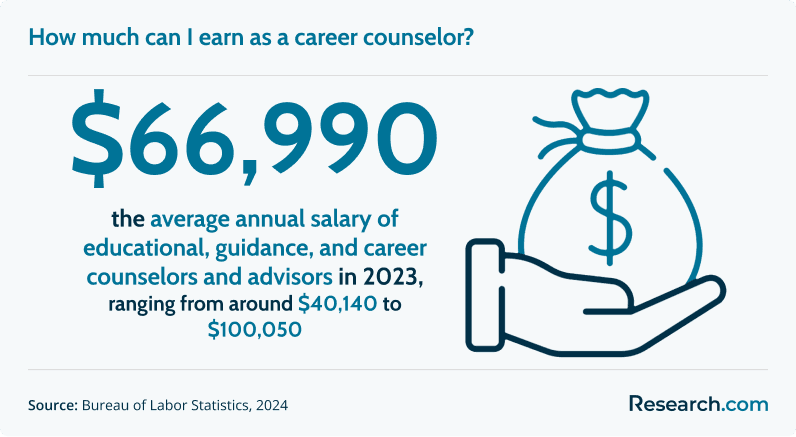
Career counselors earned an average annual salary of $66,990 as of 2023. Reported earnings ranged from $40,140 to $100,050, depending on location, employer, experience, credentials, and work setting. School-based counselors may earn differently from counselors in vocational rehabilitation, higher education, nonprofit services, private practice, or corporate consulting.
Location can also influence pay. Career counselors in California earned the highest average salary at $85,820, followed by Washington ($81,280) and Massachusetts ($79,670). Cost of living, state education funding, employer type, and regional demand can all affect what those figures mean in practice.
If you are comparing related psychology and counseling careers, the military psychologist career path is one adjacent option that may interest readers who want a structured environment and psychological services focus.
The image below shows career counselor earnings.
Career Paths for Career Counselors
Career counseling can lead to school-based work, higher education roles, workforce development, private practice, corporate consulting, rehabilitation services, and leadership positions. Your path will depend on your degree, license, experience, specialization, and preferred client population.
- K-12 school counseling. Counselors help students explore careers, plan coursework, prepare for college or vocational training, and make postsecondary decisions.
- College career services. These professionals support internships, job searches, graduate school planning, employer events, and major-to-career exploration.
- Workforce development and vocational counseling. Counselors help job seekers build skills, return to work, change careers, or access community and government employment programs.
- Corporate career consulting. Organizations may hire career consultants to support employee growth, mobility, succession planning, and professional development. In companies with supply chain or transportation functions, for instance, consultants may guide employees pursuing careers in logistics.
- Private practice or entrepreneurship. Experienced counselors may offer career coaching, resume services, interview preparation, assessment interpretation, or transition planning independently.
- Policy, program leadership, and research. Counselors with experience in education or workforce systems may move into roles that design programs, analyze outcomes, or shape employment initiatives.
| Career path | Best for | Typical growth direction |
| School counseling | People who want to work with students in structured education systems | Lead counselor, department chair, student services administrator |
| Higher education career services | People who enjoy working with college students and employers | Career center director, employer relations leader, student success administrator |
| Workforce development | People interested in community employment, retraining, and adult learners | Program manager, workforce strategist, nonprofit or agency leader |
| Corporate consulting | People with interest in employee development and organizational growth | Talent development consultant, leadership coach, HR leader |
| Private practice | Experienced professionals comfortable with business development | Independent consultant, niche coach, training provider |
Career Counselor Job Outlook
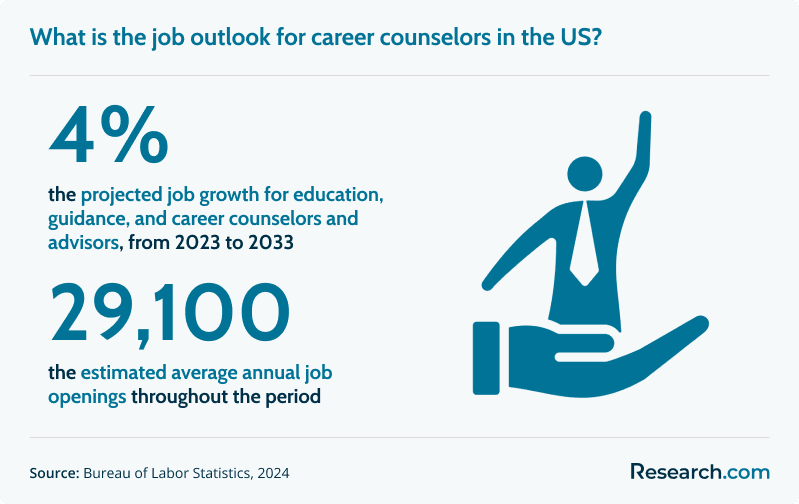
The job market for career counselors is projected to grow 4% from 2023 to 2033. That rate aligns with the average for all occupations. An estimated 29,100 job openings are expected each year, largely because of workforce turnover, retirements, and ongoing demand in schools, colleges, and workforce programs.
Demand remains steady because career decisions have become more complicated. Students and workers need to compare degree costs, training alternatives, employer requirements, earnings, and long-term fit. Career counselors help translate that information into decisions people can act on.
Readers interested in similar guidance-focused roles can compare the child counselor job outlook, especially if they are considering work with young people in educational or counseling environments.
The image below shows the job outlook for career counselors.
Interdisciplinary Training for Better Career Counseling Outcomes
Career counseling often improves when counselors understand related fields such as social work, psychology, education, human resources, rehabilitation, and behavioral science. Interdisciplinary training can help counselors recognize barriers, coordinate referrals, and support clients whose career decisions are shaped by more than job interests alone.
For example, professionals who want a stronger understanding of social systems, community resources, and client advocacy may explore MSW online programs. This does not replace career counseling preparation, but it can broaden how counselors understand employment barriers and support networks.
Common Mistakes to Avoid When Becoming a Career Counselor
- Choosing a graduate program before checking state requirements. Always confirm whether the degree supports the license or credential required in your target state and setting.
- Assuming every career counseling job requires the same credential. School counseling, private practice, workforce advising, and corporate coaching can have different requirements.
- Looking only at tuition. Include fees, books, travel, residency requirements, internship costs, lost work time, and loan interest when comparing programs.
- Relying only on rankings or marketing claims. Ask about outcomes, field placements, licensing alignment, faculty support, and employer connections.
- Ignoring labor market data. Career counselors must be comfortable using current information about jobs, wages, training, and hiring practices.
- Overpromising outcomes to clients. Ethical counselors help clients evaluate choices but do not guarantee employment, salary, admissions, or promotion.
- Skipping professional development. Career tools, employer expectations, and education pathways change too quickly for counselors to rely only on old training.
Questions to Ask Before You Choose This Career
- Do I want to work mostly with students, adults, job seekers, employees, veterans, or clients with barriers to employment?
- Am I willing to complete a master’s degree if my target role requires it?
- Which state do I plan to work in, and what license or certification does that state require?
- Do I prefer counseling, coaching, advising, program management, or consulting?
- Am I comfortable using data, assessments, and labor market information in client conversations?
- Can I discuss education costs, career uncertainty, and employment barriers honestly without pushing one path?
- What salary range is realistic for the setting and location where I want to work?
Key Insights
- Career counseling is a practical guidance profession that helps people connect education, training, work experience, and labor market realities to better career decisions.
- The typical path includes a bachelor’s degree, relevant experience, a master’s degree for many roles, supervised practice, and state-specific licensing or certification when required.
- Requirements differ sharply by setting. K-12 school counseling, private practice, higher education advising, workforce development, and corporate coaching do not always follow the same credential path.
- The field is steady rather than rapidly expanding, with projected 4% growth from 2023 to 2033 and about 29,100 openings expected each year.
- Salary depends on work setting and geography. The average annual salary was $66,990 in 2023, with reported earnings ranging from $40,140 to $100,050.
- Most career counselors work in education, especially elementary and secondary schools, where around 49.63% are employed and the average salary is $74,910.
- Before enrolling in graduate school, verify accreditation, licensing alignment, fieldwork requirements, total cost, and career outcomes. The right program is the one that supports your intended credential and work setting.
- Strong career counselors avoid generic advice. They combine empathy, ethics, assessment skills, labor market knowledge, and practical coaching to help clients make decisions they can actually use.
References:
- Bureau of Labor Statistics. (2024). School and career counselors and advisors. Retrieved February 20, 2025, from BLS.
- Bureau of Labor Statistics. (2024). Occupational employment and wages, May 2023 - 21-1012 educational, guidance, and career counselors and advisors. Retrieved February 20, 2025, from BLS.
- Mowreader, A. (2024, October 9). Career coaching can aid student success, but not every student receives guidance. Retrieved February 20, 2025, from Inside Higher Ed.
- Strada Education Foundation. (2024). Quality coaching: Helping students navigate the journey from education to career. Retrieved February 20, 2025, from Strada.
Other Things You Should Know About How to Become a Career Counselor
Most career counselor credentials require 2,000 to 3,000 hours of supervised practice after graduate study. Supervision usually must be provided by a licensed counselor or approved mental health professional, and the exact hour total is set by the state licensing board or national credentialing body.
To become a career counselor in 2027, a master’s degree in counseling or a related field is typically required. Additionally, licensure and certification, such as the National Certified Counselor (NCC) credential, are important for professional practice. Continuous professional development and familiarity with career assessment tools also enhance qualifications.


