2027 How to Become a School Counselor

Co-Founder and Chief Data Scientist
Becoming a school counselor is a serious career decision because the role sits at the intersection of education, mental health, family support, crisis response, and career planning. Students are facing academic pressure, social stress, bullying, family instability, college and career uncertainty, and rising mental health needs. A recent study shows that more than 60% of college students have at least one mental health problem, which may include stress and anxiety. Schools depend on trained counselors to help students stay on track, access support, and make informed decisions about their futures.
This guide explains how to become a school counselor, what the job actually involves, how long the path takes, which credentials matter, what skills employers look for, and how salary and job outlook compare across settings. It is designed for students considering a counseling career, educators thinking about a transition, and working professionals comparing school counseling with related mental health roles.
Quick answer: How do you become a school counselor?
To become a school counselor, you generally need a bachelor’s degree, a master’s degree in school counseling or a closely related field, supervised practicum and internship experience, passing scores on required exams, and state licensure or certification. The full process typically takes about six to eight years. Requirements vary by state, so candidates should check their state education department or licensing board before choosing a program.
Key Things You Should Know About Becoming a School Counselor
- School counselors support students’ academic progress, emotional well-being, social development, and career readiness.
- The path usually takes about six to eight years, including undergraduate study, graduate school, supervised fieldwork, exams, and licensure or certification.
- Effective counselors contribute to a 3.4% increase in graduation rates for low-achieving students.
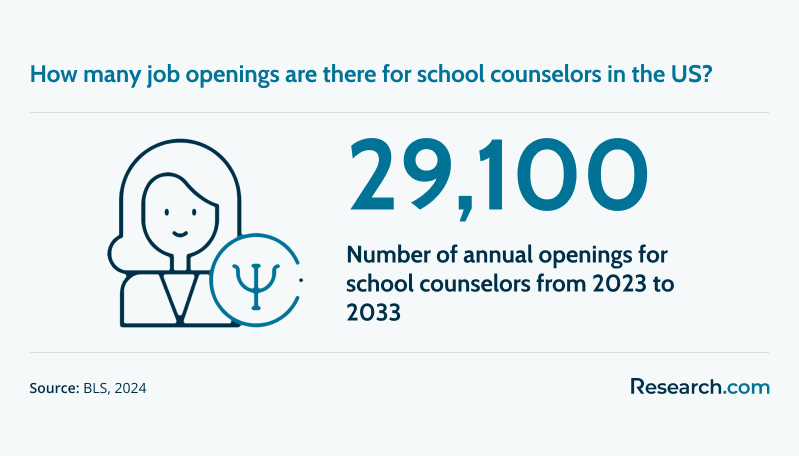
- Job seekers can expect around 29,100 openings each year for school counselors and closely related roles from 2023 to 2033 in the United States.
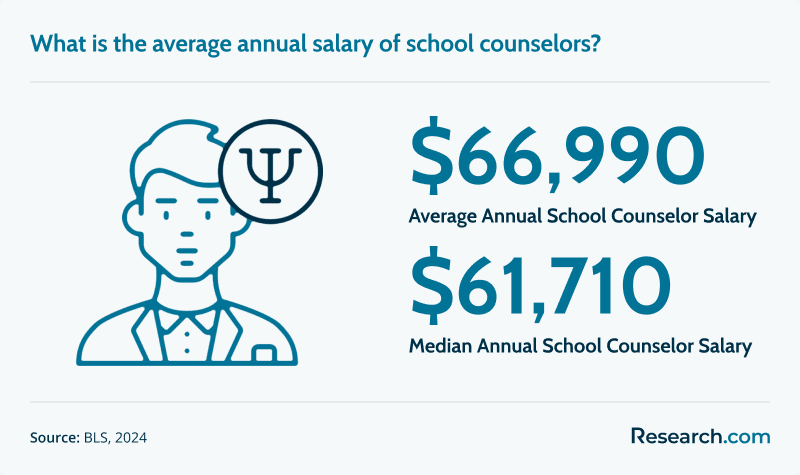
- The average annual salary of school counselors in the United States is $66,990, while the median annual salary is $61,710.
- The industries with the highest average annual salaries, as shown in the chart below, are offices of health practitioners ($104,640), agencies, brokerages, and other insurance-related firms ($85,630), insurance and employee benefit funds ($84,900), government institutions ($81,130), and insurance carriers ($77,560).
| Decision point | What it means for aspiring school counselors |
| Minimum education | A bachelor’s degree followed by a master’s degree in school counseling or a related field is typically required. |
| Licensure | Most states require exams, supervised field experience, a background check, and an application through a state agency. |
| Best fit | This career is strongest for people who want to work with students, families, teachers, and administrators in a school setting. |
| Potential drawback | The job can involve high caseloads, crisis situations, documentation, and emotional strain. |
| Career flexibility | Experience can lead to roles in K-12 schools, higher education, vocational counseling, student services, administration, or related counseling work. |
- What does a school counselor do?
- How to Become a School Counselor
- How long does it take to become a school counselor?
- What counseling techniques do school counselors use?
- What skills do school counselors need?
- What certifications are available for school counselors?
- What career paths can school counselors pursue?
- What challenges do school counselors face today?
- What ethical and legal responsibilities do school counselors have?
- How can school counselors support diversity and inclusion?
- How can school counselors reduce stress and prevent burnout?
- How can school counselors use applied behavior analysis?
- How is school counseling different from related mental health roles?
- How can school counselors measure their effectiveness?
- What advanced credentials can help school counselors grow?
- How can school counselors improve parent and community engagement?
- How can social work training help school counselors?
- What is the job outlook for school counselors?
- What is the average salary of school counselors?
- How is technology changing school counseling?
- What professional development options are available for school counselors?
What does a school counselor do?
A school counselor helps students succeed in school and prepare for life after graduation. The work includes academic planning, short-term counseling, career exploration, crisis response, family communication, and coordination with teachers and administrators. The exact duties depend on the grade level, school resources, state rules, and student population.
Unlike private therapists who usually provide ongoing clinical treatment, school counselors work inside educational systems. Their goal is to reduce barriers that interfere with learning, safety, attendance, behavior, and future planning.
- Academic support: Counselors help students improve study routines, organization, time management, class selection, and academic planning. They may also monitor students who are at risk of falling behind.
- Career and college guidance: Counselors help students explore occupations, training options, college requirements, scholarships, internships, and vocational pathways. For example, students interested in healthcare and communication sciences may be directed to information on becoming an audiologist.
- Social and emotional support: Counselors provide short-term individual or group support for stress, anxiety, grief, bullying, friendship problems, family concerns, and adjustment issues. They may also share resources such as affordable online substance abuse counseling programs when students or families need addiction-related support information.
- Crisis response: Counselors respond when students face trauma, abuse, suicidal ideation, threats, violence, or other urgent concerns. They work with families, school leaders, and outside agencies when a student needs immediate intervention. Students interested in this area may also ask about the requirements to become a substance abuse counselor.
- Collaboration: Counselors work with teachers, administrators, parents, special education teams, community partners, and mental health professionals to create coordinated support plans.
- Student advocacy: Counselors help make sure students have access to academic resources, emotional support, fair treatment, and developmentally appropriate guidance.
| School level | Common counseling focus | Examples of daily work |
| Elementary school | Social skills, behavior, early academic habits, family transitions | Classroom lessons, small groups, parent meetings, conflict resolution, teacher consultation |
| Middle school | Peer relationships, academic adjustment, identity development, emotional regulation | Study-skills support, bullying response, group counseling, transition planning, crisis support |
| High school | Graduation planning, college and career readiness, mental health support | Course planning, application guidance, scholarship information, career inventories, intervention meetings |
How to Become a School Counselor
The school counselor pathway is structured because counselors work with minors, confidential student information, crisis situations, and educational records. Most candidates move through the same broad sequence: undergraduate education, graduate preparation, supervised fieldwork, exams, licensure or certification, and continuing education.
- Earn a bachelor’s degree: Start with an undergraduate degree. Common majors include psychology, education, counseling, human services, or a related social science field. Students who need flexibility can compare online counseling degree options.
- Choose a state-aligned master’s program: A master’s degree in school counseling or a closely related discipline is usually required. Programs commonly cover counseling theories, ethics, child and adolescent development, assessment, multicultural counseling, career development, and school counseling program design. Students who prefer remote study can research online master of school counseling programs. Professionals who expect to move into district leadership or administrative roles may also compare whether an MPA or MBA is better for their long-term goals.
- Complete supervised practicum and internship hours: Graduate programs require hands-on experience in school settings. During fieldwork, candidates practice counseling skills, observe experienced professionals, lead activities, document cases, and learn how schools respond to student needs.
- Pass required exams: Many states require candidates to pass exams such as the Praxis School Counselor Exam, the National Counselor Examination (NCE), or state-specific assessments like the TExES in Texas or the CBEST in California. Candidates should confirm which exam applies before registering.
- Apply for state licensure or certification: After meeting academic, fieldwork, and exam requirements, candidates apply through the relevant state department of education or licensing board. Applications often require transcripts, verification of supervised hours, exam results, fees, and a background check.
- Check for state-specific conditions: Some states require teaching experience, a teaching license, extra coursework, or additional supervised practice. These requirements can affect both program choice and career timeline.
- Apply for school counseling roles: Licensed or certified candidates can pursue jobs in elementary schools, middle schools, high schools, private schools, virtual schools, charter schools, and educational organizations.
- Keep credentials active: School counselors usually need continuing education units, professional development, or renewal documentation to maintain their license or certification.
Program selection matters. Candidates should prioritize legitimate accreditation, state licensure alignment, supervised placement support, and clear graduate outcome information. Many students compare CACREP accredited online masters counseling programs along with regionally accredited options because accreditation can affect licensure eligibility, transferability, and employer confidence.
| Step | Why it matters | What to verify before enrolling or applying |
| Bachelor’s degree | Builds the academic foundation for graduate counseling study | Prerequisites, GPA expectations, transfer policies, relevant coursework |
| Master’s degree | Usually the core professional requirement for school counseling licensure | Accreditation, state approval, field placement support, exam preparation |
| Practicum and internship | Provides supervised experience with real students and school systems | Required hours, placement locations, supervisor qualifications, school-level exposure |
| Licensure exams | Demonstrates readiness for professional practice under state rules | Required exam name, passing score, testing window, retake policy |
| State application | Authorizes employment as a school counselor in many settings | Documentation, background check, fees, renewal rules |
How long does it take to become a school counselor?
Becoming a school counselor typically takes about six to eight years. A bachelor’s degree usually takes around four years. A master’s degree in school counseling or a related field generally adds two to three more years. Practicum and internship requirements are usually built into graduate study, although the exact timeline depends on the program structure, enrollment pace, and state requirements.
Some students look for the fastest way to become a licensed counselor by choosing accelerated, bridge, or full-time programs. These options may shorten the calendar time, but they often require heavier course loads, less scheduling flexibility, and careful planning around field placements.
After graduation, candidates still need to complete state-specific steps such as exams, background checks, documentation, and formal certification or licensure approval. For that reason, students should not evaluate programs only by advertised degree length. The better question is whether the program leads efficiently to the credential required in the state where they plan to work.
| Stage | Typical time involved | Decision tip |
| Bachelor’s degree | Around four years | Choose a major that prepares you for graduate counseling coursework, but confirm specific prerequisites. |
| Master’s degree | Generally two to three years | Make sure the program meets school counseling requirements in your target state. |
| Practicum and internship | Included in most graduate programs, with timing that varies | Ask whether the school helps secure placements or expects students to find their own. |
| Exams and licensing | Varies by state and application processing time | Plan ahead for test dates, background checks, transcript requests, and verification forms. |
The chart below shows what majors many of the school counselors in the country have.
What counseling techniques do school counselors use?
School counselors use practical, developmentally appropriate techniques rather than a single one-size-fits-all method. The technique depends on the student’s age, concern, risk level, cultural background, school policy, and whether the issue is academic, behavioral, emotional, social, or career-related.
- Individual counseling: One-on-one meetings help students discuss personal concerns, academic barriers, stress, behavior, or future planning. Counselors commonly use active listening, goal-setting, and short-term intervention strategies.
- Group counseling: Small groups can support students dealing with grief, social skills, anxiety, peer conflict, academic motivation, or transitions. Group formats allow students to learn from peers in a structured setting.
- Solution-focused brief counseling: This approach emphasizes strengths, realistic next steps, and achievable goals instead of spending most of the session on the problem itself.
- Cognitive behavioral techniques: Counselors may help students recognize unhelpful thoughts, challenge inaccurate beliefs, and practice healthier responses to stress or conflict.
- Behavior modification: This method uses reinforcement, behavior tracking, and clear expectations to encourage positive behavior and reduce disruptive patterns.
- Career counseling: Counselors use interest inventories, aptitude tools, course planning, labor market information, scholarship resources, and internship guidance to help students connect school decisions with future goals.
- Play-based methods: With younger children, play can help students express feelings, process events, and build coping skills when direct conversation is difficult.
- Crisis intervention: In urgent situations, counselors focus on safety, de-escalation, risk assessment, documentation, parent or guardian contact, and referral to appropriate services.
- Social skills training: Students may practice communication, conflict resolution, empathy, boundary-setting, and relationship-building through role-play and guided exercises.
- Mindfulness and stress management: Breathing exercises, grounding strategies, relaxation techniques, and emotional regulation tools can help students manage anxiety and stress.
| Student need | Possible counseling approach | When referral may be needed |
| Academic struggles | Study-skills coaching, goal-setting, teacher collaboration | When learning, disability, attendance, or family issues require additional evaluation or services |
| Peer conflict | Mediation, social skills training, restorative conversations | When bullying, threats, harassment, or safety concerns are present |
| Anxiety or stress | Brief counseling, coping strategies, mindfulness, problem-solving | When symptoms are severe, persistent, or outside the school counselor’s scope |
| Career uncertainty | Interest inventories, career exploration, course planning | When students need specialized vocational, disability, or postsecondary transition services |
| Crisis or safety risk | Immediate safety planning, de-escalation, mandated protocols | When risk involves self-harm, abuse, violence, or emergency mental health needs |
What skills do school counselors need?
Strong school counselors combine interpersonal skill, ethical judgment, educational knowledge, cultural awareness, and crisis readiness. Their work is not limited to giving advice. They must listen carefully, document accurately, collaborate across systems, communicate with families, and make sound decisions under pressure.
Effective counselors who have mastered these skills contribute to a 3.4% increase in graduation rates for low-achieving students.
- Active listening: Counselors need to hear both what students say and what they may be struggling to express. This builds trust and improves assessment.
- Clear communication: Counselors must explain options, boundaries, resources, and next steps in language that students, parents, and school staff can understand.
- Cultural responsiveness: Students’ experiences are shaped by culture, language, disability, identity, family structure, income, immigration background, and community context. Counselors must avoid assumptions and adapt support appropriately.
- Crisis intervention: Counselors must recognize warning signs, respond calmly, follow policy, document accurately, and involve the correct professionals when safety is at stake.
- Problem-solving: Student concerns are often complex. Counselors need to identify the real barrier, consider available resources, and help students develop workable plans.
- Empathy: Students are more likely to seek help when they feel respected, believed, and emotionally safe.
- Collaboration: Counselors rarely solve problems alone. They coordinate with teachers, administrators, families, nurses, social workers, psychologists, and outside providers.
- Program development: Counselors design activities and services that support academic readiness, social-emotional learning, career planning, and prevention efforts.
- Technology skills: Counselors use student information systems, scheduling tools, digital communication platforms, data dashboards, and virtual meeting tools.
- Advocacy: Counselors help students access services, challenge barriers, and receive fair opportunities to succeed.
Understanding different areas of counseling can also strengthen practice. Some programs include coursework related to addiction, family systems, behavioral issues, and crisis work. Students who want a broader foundation may compare options such as online substance abuse counseling courses and other counseling-focused programs.
According to 2025 data from Zippia, the most common skills on the CVs of school counselors are mental health (10%), community resources (7.9%), crisis intervention (5.5%), professional development (5%), behavioral issues (4.5%), CPR (4.2%), and social work (4.1%).
The chart below shows the US states that hire the most school counselors.
What certifications are available for school counselors?
Certifications can help school counselors show professional commitment, deepen specialized expertise, and prepare for advanced responsibilities. They do not replace state licensure or certification requirements, but they can support career growth, supervision roles, program leadership, or work in specialized educational settings.
- National Certified School Counselor (NCSC): Offered by the National Board for Certified Counselors, this credential requires candidates to hold the National Certified Counselor credential first and meet additional education, examination, and supervised experience standards. The NCSC certification signals advanced preparation in school counseling practice.
- ASCA-Certified School Counselor (ACSC): This credential from the American School Counselor Association emphasizes school counseling program design, implementation, evaluation, ethics, and ongoing professional growth.
- School Counseling Certification PK-12: Programs such as those offered through institutions like Immaculata University prepare counselors to serve students across PK-12 settings through coursework in child development, counseling methods, and ethics.
- Certificate in School Counseling: Post-master’s certificates, including options such as Antioch University’s program, can help professionals add school counseling preparation after completing a related graduate degree.
- School Counseling Supervision Certificate: Programs offered by organizations such as the California Association of School Counselors prepare experienced counselors to supervise fieldwork students and develop leadership capacity.
- International School Counseling Certificate: This type of credential is designed for counselors serving students in international schools, where mobility, multicultural adjustment, language differences, and global university pathways may shape student needs.
| Credential type | Best for | Important caution |
| State licensure or certification | Anyone who wants to work as a school counselor in public schools | Requirements vary by state, so verify eligibility before enrolling in a program. |
| National or professional certification | Counselors seeking added recognition or specialized credibility | These credentials usually do not replace state authorization. |
| Post-master’s certificate | Professionals who already hold a graduate degree and need school counseling coursework | Confirm whether the certificate satisfies state requirements. |
| Supervision credential | Experienced counselors who want to supervise trainees or lead programs | Eligibility may require prior experience and an active credential. |
What career paths can school counselors pursue?
School counseling can lead to several careers in counseling and student support. Many professionals stay in K-12 schools, while others move into higher education, vocational services, community organizations, private practice, or leadership roles. The best path depends on preferred age group, work setting, credential requirements, and tolerance for crisis work, documentation, and school-system constraints.
- Elementary school counselor: Works with younger children on early academic habits, emotional expression, peer relationships, behavior, and family transitions.
- Middle school counselor: Supports students during a major developmental shift involving identity, friendships, academic pressure, social conflict, and emotional regulation.
- High school counselor: Focuses heavily on graduation requirements, course planning, college applications, scholarships, career exploration, vocational pathways, and social-emotional concerns.
- College or university counselor: Works in higher education settings to support academic success, career planning, adjustment, personal development, and sometimes mental health concerns.
- Vocational counselor: Helps students or clients explore occupational options, identify strengths, build job-search skills, and connect education with workforce goals.
- Private practice counselor: Some counselors pursue additional credentials that allow independent practice. This path usually requires meeting separate clinical licensure requirements, not only school counseling credentials.
- Community counseling role: Counselors may work in youth development, family support, community mental health, nonprofit programs, or prevention services that partner with schools.
- Administrative or program leadership: Experienced counselors may become counseling coordinators, directors of student services, district-level leaders, or program managers.
| Career path | Best fit for candidates who want to... | Potential trade-off |
| K-12 school counselor | Work directly with students in an educational environment | Caseloads, school schedules, administrative duties, and crisis response can be demanding. |
| Higher education counselor | Support college students with academic, career, and personal development | Job duties may differ significantly by campus department and credential expectations. |
| Vocational counselor | Focus on employment readiness and career pathways | The role may involve workforce systems more than traditional school counseling. |
| Private practice | Provide more independent counseling services | Additional clinical licensure, business responsibilities, and liability issues may apply. |
| District leadership | Design programs, supervise teams, and influence policy | Less direct student contact and more administrative responsibility are common. |
What challenges do school counselors face today?
School counselors are expected to support academic planning, student mental health, crisis intervention, parent communication, college and career readiness, and schoolwide prevention efforts. In practice, this can create competing priorities. A counselor may move from a student in crisis to a scheduling issue, then to a parent meeting, then to a data report for administrators.
The most difficult challenges often include large caseloads, rising student mental health concerns, limited time for direct counseling, documentation demands, confidentiality questions, and uneven access to outside services. Counselors who want stronger family-systems preparation may explore related graduate training, including online MFT degrees, although they should confirm how any program aligns with their intended license or role.
| Challenge | Why it matters | Practical response |
| High student need | Counselors may not have enough time for every student who needs support. | Use tiered supports, small groups, referral networks, and data to prioritize urgent cases. |
| Role confusion | Schools may assign counselors clerical or administrative duties that reduce counseling time. | Clarify responsibilities with administrators and align work with a school counseling program model. |
| Crisis response | Student safety concerns require immediate, accurate, and policy-compliant action. | Maintain updated crisis protocols, referral lists, documentation practices, and supervision routines. |
| Limited outside resources | Families may face barriers to therapy, transportation, insurance, or specialized care. | Build partnerships with community agencies and maintain accessible referral options. |
What ethical and legal responsibilities do school counselors have?
School counselors must protect students while following school policy, state law, federal rules, and professional ethics. The most important tension is confidentiality. Students need privacy to speak honestly, but counselors also have mandatory reporting duties when there are concerns involving abuse, self-harm, threats, or safety.
Strong ethical practice includes explaining confidentiality limits, documenting accurately, avoiding dual relationships when possible, using appropriate referrals, respecting student identity and family context, and consulting supervisors or legal guidance when a situation is unclear. Compensation and responsibility can vary across counseling roles, so professionals comparing paths may also review mental health counselor salary information.
- Confidentiality: Students should know what stays private and what must be reported.
- Mandatory reporting: Counselors must follow required procedures when abuse, neglect, self-harm, or danger is suspected.
- Documentation: Notes and records should be factual, secure, and consistent with school and legal standards.
- Scope of practice: Counselors should not provide services beyond their training, role, or credential.
- Equity: Services should be accessible and fair across race, disability, language, gender, income, religion, and other student characteristics.
How can school counselors support diversity and inclusion?
Diversity and inclusion work is not limited to awareness campaigns. School counselors can help identify barriers that affect student achievement, discipline, belonging, attendance, course access, and postsecondary planning. This requires culturally responsive communication, careful data review, inclusive programming, and collaboration with families and community organizations.
Counselors may also benefit from learning behavioral and intervention strategies that support students with varied learning and developmental needs. Professionals exploring this area may review information related to ABA certification online cost, while keeping in mind that applied behavior analysis credentials and school counseling credentials serve different purposes.
- Review academic, attendance, discipline, and referral data for patterns that may indicate unequal access or outcomes.
- Use language-access resources when communicating with families.
- Include culturally relevant examples in classroom lessons and career planning activities.
- Build referral lists that reflect the communities students come from.
- Ask students directly about barriers rather than assuming what they need.
How can school counselors reduce stress and prevent burnout?
School counseling can be emotionally intense. Counselors may carry responsibility for student crises, family conflict, trauma disclosures, testing pressure, deadlines, and large caseloads. Burnout prevention requires more than generic self-care. Counselors need boundaries, realistic workload conversations, supervision, peer support, and clear procedures for high-risk situations.
Understanding how responsibilities compare across counseling specialties can also help professionals set realistic career expectations. Those comparing school counseling with addiction-focused work may review information related to substance abuse counselor salary and training pathways.
| Burnout risk | Better practice |
| Trying to be available to everyone at all times | Use appointment systems, crisis triage, and clear communication about availability. |
| Handling serious cases without consultation | Seek supervision, follow protocols, and document decisions. |
| Letting administrative tasks replace student support | Track time use and discuss role alignment with school leaders. |
| Ignoring emotional impact | Use peer consultation, professional support, and recovery routines after crisis work. |
How can school counselors use applied behavior analysis?
Applied behavior analysis can help school counselors understand behavior patterns, triggers, reinforcement, and measurable intervention outcomes. In schools, ABA-informed strategies may support behavior intervention plans, classroom collaboration, social skills development, and progress monitoring.
School counselors should use ABA techniques within their training and role, especially when working with students who have behavior plans or specialized support needs. Counselors who want deeper training may compare online applied behavior analysis master's programs, while also checking whether the program aligns with their state requirements and intended credential.
How is school counseling different from related mental health roles?
School counselors, school psychologists, school social workers, mental health counselors, and therapists may all support student well-being, but their scopes are not identical. School counselors focus on academic success, social-emotional development, career planning, prevention, short-term support, and school-based interventions. Other professionals may conduct diagnostic assessments, provide long-term therapy, manage special education evaluations, or coordinate social services.
Students comparing roles should look closely at training requirements, licensure, daily tasks, and whether they want to work inside schools or in clinical/community settings. For a related comparison, see this guide on school psychologist vs school social worker.
| Role | Primary focus | Typical distinction |
| School counselor | Academic, social-emotional, and career development in schools | Works broadly with students and school systems, often through short-term support and programming. |
| School psychologist | Assessment, learning needs, behavior, and special education support | Often conducts evaluations and supports individualized educational planning. |
| School social worker | Student, family, community, and social-service needs | Often connects families with resources and addresses broader social barriers. |
| Mental health counselor or therapist | Clinical counseling and treatment | May provide ongoing therapy outside the school counseling role, depending on licensure. |
How can school counselors measure their effectiveness?
Effective school counseling programs use data, not just good intentions. Counselors can evaluate their impact by looking at academic performance, attendance, behavior changes, graduation progress, course completion, student surveys, referral patterns, and participation in counseling activities.
Advanced study in psychology and research methods can strengthen data-informed practice. Counselors considering this direction may compare affordable online master's programs in psychology, while verifying whether those programs lead to the specific credential they need.
- Set measurable goals for counseling programs, groups, and interventions.
- Track baseline data before starting a major initiative.
- Compare outcomes after interventions while accounting for student context.
- Use student, parent, and teacher feedback to improve services.
- Share results with administrators to protect counseling time and improve program support.
What advanced credentials can help school counselors grow?
After earning a master’s degree and gaining experience, school counselors may pursue advanced credentials to move into supervision, district leadership, counselor education, specialized intervention, research, or clinical practice. A doctoral credential may be useful for some goals, but it is not necessary for every counselor.
Professionals interested in doctoral-level preparation can review options such as PsyD online programs. Before enrolling, candidates should ask whether the degree supports their intended license, qualifies them for the jobs they want, and provides a reasonable return on investment.
| Advanced option | When it may make sense | When to be cautious |
| Post-master’s school counseling certificate | You already have a related graduate degree and need school counseling preparation. | It may not meet every state’s requirements. |
| Supervision credential | You want to mentor trainees or lead fieldwork experiences. | It may require prior counseling experience. |
| Doctoral study | You want roles in higher education, leadership, research, or advanced clinical practice. | Cost, time, and licensure alignment should be carefully evaluated. |
| Specialized certificates | You want expertise in behavior, trauma, college advising, or multicultural practice. | Certificates vary widely in recognition and career value. |
How can school counselors improve parent and community engagement?
Students rarely struggle in isolation. Family circumstances, community resources, transportation, housing, health care, language access, and local opportunities can all affect school success. School counselors can improve outcomes by building reliable communication with families and developing referral relationships before a crisis occurs.
Some counselors also study organizational behavior, leadership, and systems change to improve schoolwide support. Related training options include affordable online masters programs in organizational psychology.
- Create predictable communication channels for parents and guardians.
- Offer workshops on course planning, graduation requirements, college applications, financial aid, and student wellness.
- Maintain updated lists of local mental health, housing, food, employment, and family support resources.
- Invite community partners into career exploration and mentoring activities.
- Use interpreters and translated materials when families need language access.
How can social work training help school counselors?
Social work training can broaden a school counselor’s understanding of family systems, community resources, crisis response, case management, and social barriers that affect learning. This can be especially useful in schools where students face housing instability, food insecurity, family stress, trauma, or limited access to health services.
Counselors considering additional graduate study may explore online MSW programs. However, an MSW and a school counseling credential lead to different professional pathways, so candidates should confirm licensure outcomes before enrolling.
What is the job outlook for school counselors?
According to the United States Bureau of Labor Statistics, employment of school counselors is projected to grow by 4% from 2023 to 2033, which matches the national average pace. The number of school counselors is expected to increase from 360,800 in 2023 to about 377,000 by 2033.
During the same period, job seekers can expect around 29,100 openings each year for school counselors and closely related roles in the United States. The sectors with the highest employment levels are elementary and secondary schools (162,610), postsecondary institutions (85,280), junior colleges (25,790), vocational rehabilitation services (8,180), and individual and family services (6,640).
These figures suggest steady demand, but local hiring can vary by school funding, district priorities, state credential rules, student enrollment, and counselor-to-student staffing decisions. Candidates should review job postings in their target state before choosing a program or specialization.
What is the average salary of school counselors?
According to the BLS, the average annual salary of school counselors in the United States is $66,990, while the median annual salary is $61,710. Both figures are higher than the national average of $48,060. Actual pay depends on location, school type, contract structure, experience, education level, union agreements, and whether the role is in K-12, higher education, government, or another setting.
The US states with the highest annual pay for school counselors are California ($85,820), Washington ($81,280), Massachusetts ($79,670), New Jersey ($79,030), and Maryland ($76,250).
The industries with the highest average annual salaries, as shown in the chart below, are offices of health practitioners ($104,640), agencies, brokerages, and other insurance-related firms ($85,630), insurance and employee benefit funds ($84,900), government institutions ($81,130), and insurance carriers ($77,560).
| Salary factor | Why it can change earnings |
| State and region | Pay scales often reflect local budgets, cost of living, and district salary schedules. |
| School setting | K-12 schools, colleges, government agencies, and related industries may compensate differently. |
| Experience | Many school systems use step-based salary schedules tied to years of service. |
| Education and credentials | Advanced degrees or certifications may affect salary placement depending on employer policy. |
| Contract length | Some roles follow school-year contracts, while others may be year-round. |
How is technology changing school counseling?
Technology is changing how school counselors communicate, identify student needs, deliver resources, and evaluate programs. It can improve access and efficiency, but it also raises questions about privacy, data security, equity, and the limits of digital support.
- Student data systems: Counselors can use secure platforms to monitor grades, attendance, behavior, graduation progress, and intervention outcomes.
- Digital communication: Email, messaging tools, scheduling systems, and video platforms can make it easier for students and families to contact counselors, especially when in-person access is limited.
- Online lessons and resources: Counselors can use digital tools for career exploration, social-emotional learning, college planning, and classroom guidance activities.
- Telehealth and virtual counseling support: Remote services may expand access for some students, but counselors must follow privacy rules, school policies, and scope-of-practice boundaries.
- AI, chatbots, and emerging tools: These technologies may help with resource navigation, reminders, and information access, but they should not replace professional judgment, crisis response, or human relationships.
| Technology use | Potential benefit | Risk to manage |
| Data dashboards | Earlier identification of students who need support | Misinterpreting data without context |
| Virtual meetings | More flexible access for students and families | Privacy, consent, and confidentiality concerns |
| AI-supported tools | Faster access to general information or resources | Incorrect guidance, bias, overreliance, and inappropriate use in crisis situations |
| Digital career platforms | Broader exposure to career and college options | Students may still need human guidance to interpret choices realistically |
What professional development options are available for school counselors?
Professional development helps school counselors stay current with ethics, law, crisis response, trauma-informed practice, college and career readiness, technology, cultural responsiveness, and student mental health. It also supports license renewal in many states.
Useful options include state and national counseling conferences, workshops, peer consultation groups, supervision training, graduate certificates, webinars, district training, and interdisciplinary learning with psychologists, social workers, teachers, and administrators. Counselors who want to expand their family-systems knowledge may also review guidance on how to become a family therapist, while recognizing that marriage and family therapy has its own licensure pathway.
Is becoming a school counselor worth it?
Becoming a school counselor can be worth it for people who want a student-centered career with meaningful daily impact, stable demand, and opportunities to work within education systems. It is a weaker fit for people who want primarily long-term clinical therapy, minimal paperwork, predictable emotional demands, or a role with little interaction with families and school administrators.
| Choose school counseling if... | Consider another path if... |
| You want to help students with academics, emotions, behavior, and future planning. | You want to focus almost entirely on clinical diagnosis and long-term therapy. |
| You are comfortable working with teachers, parents, administrators, and outside agencies. | You prefer independent work with fewer institutional policies and school-system constraints. |
| You can handle crisis situations while following protocols and documentation rules. | You want a role with low emotional intensity and limited urgent decision-making. |
| You value prevention, advocacy, and schoolwide programming. | You only want one-on-one counseling without classroom lessons, meetings, or administrative tasks. |
Common mistakes to avoid when pursuing school counseling
- Choosing a program before checking state requirements: A degree is only useful if it helps you qualify for the credential required where you want to work.
- Looking only at tuition: Fees, books, travel for fieldwork, exam costs, background checks, and lost work hours can change the real cost.
- Assuming every online program leads to licensure: Online delivery does not guarantee state approval or placement access.
- Ignoring field placement support: Practicum and internship access can make or break your timeline.
- Confusing school counseling with clinical counseling: Some roles require different licenses, training, and supervised experience.
- Relying only on rankings: Program reputation matters, but licensure alignment, accreditation, cost, support, and outcomes matter more.
- Assuming salary is guaranteed: BLS figures describe reported wages, not individual job offers.
Questions to ask before choosing a school counseling program
- Does this program meet school counseling requirements in the state where I plan to work?
- Is the institution regionally accredited, and does the counseling program hold relevant programmatic accreditation or state approval?
- How are practicum and internship placements arranged?
- What exams do graduates typically need to pass?
- What are the program’s total costs, including fees and fieldwork-related expenses?
- Can I complete the program while working full time?
- Does the curriculum include crisis intervention, ethics, multicultural counseling, child and adolescent development, and career counseling?
- What support is available for licensure applications and job placement?
- What percentage of graduates become licensed or certified school counselors?
- Will credits transfer if I later pursue advanced credentials?
Here's What School Counselors Say About Their Jobs
-
: "
The relationships I build with students and their families are the most meaningful part of the work. Being a steady, supportive person as they move through school challenges gives the job a sense of purpose that is hard to replace. - Stephanie
"
-
: "
Each day gives me a chance to encourage students and help them see possibilities for themselves. When students trust me enough to share their worries and goals, I’m reminded why this work matters. - Victoria
"
-
: "
School counseling lets me support students through academic pressure and personal struggles. Watching them build confidence and resilience is deeply rewarding, even on difficult days. - Nadia
"
References:
- American Psychological Association (2022, October 1). Student mental health is in crisis. Campuses are rethinking their approach. American Psychological Association
- BLS (2024, April 3). 21-1012 Educational, Guidance, and Career Counselors and Advisors. BLS
- BLS (2024, August 29). School and Career Counselors and Advisors. BLS
- Mulhern, C. (2020, May 5). Better School Counselors, Better Outcomes. Education Next
- Zippia (2025, January 8). School Counselor Education Requirements. Zippia
- Zippia (2025, January 8). School Counselor skills for your resume and career. Zippia
Key Insights
- School counseling usually requires a bachelor’s degree, a master’s degree, supervised school-based fieldwork, required exams, and state licensure or certification.
- The typical timeline is about six to eight years, but program format, field placement timing, and state application rules can make the path shorter or longer.
- The role is broader than individual counseling. School counselors also handle academic planning, career guidance, prevention programs, crisis response, family communication, and student advocacy.
- Accreditation and state alignment are critical. Before enrolling, confirm that the program qualifies graduates for school counseling credentials in the state where they plan to work.
- BLS data show 4% projected employment growth from 2023 to 2033 and around 29,100 openings each year for school counselors and closely related roles.
- The average annual salary is $66,990, and the median annual salary is $61,710, but pay depends heavily on state, setting, experience, contract type, and employer policies.
- Technology, data systems, and AI tools can support counseling work, but they do not replace professional judgment, confidentiality safeguards, or human relationships with students.
- This career is best for people who want to work directly with students inside educational systems and can manage emotional demands, collaboration, documentation, and ethical responsibility.
Other Things You Should Know About Becoming a School Counselor
Several states require a dedicated school counselor credential issued by the state education department or licensing board, while others license counselors through a broader pupil personnel or educator system. Requirements often include a master’s degree, supervised practicum, and the Praxis School Counselor exam.
The Praxis test is often required for school counselors to demonstrate their knowledge. In 2027, states may mandate specific Praxis exams for licensure. Check your state's education department for detailed test requirements and passing scores.