2027 Best Online Media Communication Degree Programs

Co-Founder and Chief Data Scientist
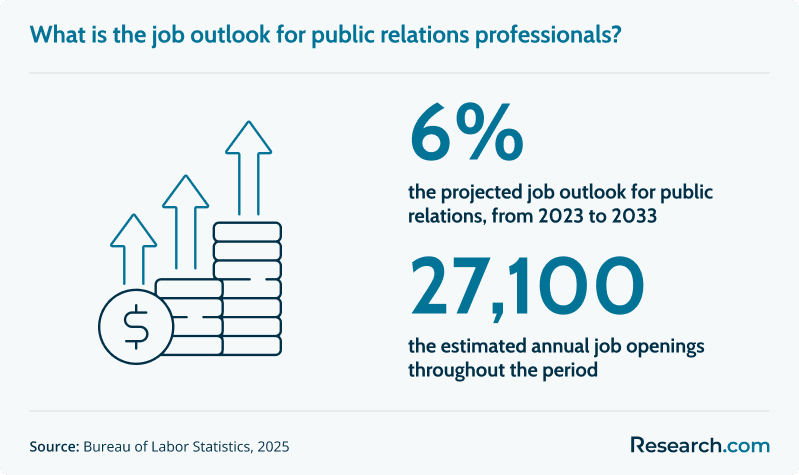
Choosing a creative career path can feel like a big risk, especially when the lines between public relations, digital media, and strategic communication seem to blur. But with the public relations field projected to grow 6% by 2033, the opportunities are undeniable and expanding. The key is translating your passion into a focused plan.
This guide was built by career planning experts to give you that clarity. We'll help you understand the different paths available with an online media communication degree and give you the tools to confidently choose the program that’s right for you.
What are the benefits of getting an online media communication degree?
- This degree prepares you for a wide variety of growing career fields, including public relations, marketing, corporate communications, and digital strategy.
- It offers strong earning potential, with public relations specialists earning a median of $69,780 and marketing managers earning a median of $161,030 annually.
- Studying online provides the flexibility to earn your degree on your schedule, fitting your education into your current life and work commitments.
What can I expect from an online media communication degree?
You can expect a curriculum that balances foundational communication principles with practical, hands-on skill development. Top programs are designed to help you build a professional portfolio of work. You'll complete projects like creating media kits, developing social media campaigns, or writing strategic communication plans.
This approach ensures you graduate with more than a diploma—you leave with tangible proof of your abilities that you can show to potential employers. While most coursework is online, some programs may have occasional in-person requirements for specific hands-on learning experiences.
Where can I work with an online media communication degree?
Graduates with a media communication degree work in nearly every industry you can think of. Strong communicators are essential in tech, healthcare, finance, government, and nonprofit organizations. You aren't limited to just traditional media companies.
Many graduates begin their careers at PR or advertising agencies, gaining experience across multiple clients. Increasingly, companies are building in-house creative teams, offering more stability and industry focus. An online media communication degree equips you to thrive in both settings.
How much can I make with an online media communication degree?
Your earning potential is strong and grows significantly with experience. According to the U.S. Bureau of Labor Statistics, public relations specialists had a median annual salary of $69,780 in 2024.
As you gain experience and move into leadership, that potential increases substantially. For example, marketing managers earned a median annual wage of $161,030. Your specific salary will depend on your chosen specialization, the industry you work in, and your geographic location, but the opportunities for financial growth are excellent.
- List of the Best Online Media Communication Degree Programs for 2027 List of Programs
- How long does it take to complete an online media communication degree program? Completion Time
- How does an online media communication degree program compare to an on-campus program? How does an online media communication degree program compare to an on-campus program?
- What is the average cost of an online media communication degree program? Program Cost
- What are the financial aid options for students enrolling in an online media communication degree program? Financial Aid
- What are the prerequisites for enrolling in an online media communication degree program? What are the prerequisites for enrolling in an online media communication degree program?
- What courses are typically in an online media communication degree program? What courses are typically in an online media communication degree program?
- What types of specializations are available in an online media communication degree program? What types of specializations are available in an online media communication degree program?
- How to Choose the Best Online Media Communication Degree Program How to Choose the Best Online Media Communication Degree Program
- What career paths are available for graduates of an online media communication degree program? Career Paths
- Could an MFA in Creative Writing Be a Better Option for My Career Goals? Could an MFA in Creative Writing Be a Better Option for My Career Goals?
- What is the job market for graduates with an online media communication degree program? Job Market
- How are emerging digital trends influencing online media communication education? How are emerging digital trends influencing online media communication education?
Best Online Media Communication Degree Programs for 2027
Choosing an online media communication degree is really a career-planning decision: you are deciding how to build marketable skills in writing, digital storytelling, public relations, social media strategy, audience research, and brand communication without putting your life on hold. The right program can help you prepare for roles in journalism, corporate communications, advertising, digital marketing, public relations, and content strategy. The wrong one can leave you with a high tuition bill, weak portfolio samples, or courses that do not match your goals.
This guide is designed for students comparing online bachelor’s programs in media communication, working adults returning to college, transfer students with prior credits, and career changers who want a structured path into communication-focused roles. You will find program options, cost and time comparisons, admissions guidance, financial aid considerations, common courses, specialization choices, career paths, job market information, and practical questions to ask before enrolling. If your interests lean more toward reporting and news production, you may also want to compare these options with a journalism degree online.
Quick answer: Is an online media communication degree worth considering?
An online media communication degree can be a strong option if you want a flexible bachelor’s program that develops writing, messaging, digital media, public relations, and strategic communication skills. It is especially useful for students who need remote coursework, want to keep working while studying, or plan to build a portfolio alongside their degree. Before enrolling, confirm accreditation, total tuition, transfer credit rules, faculty experience, internship or portfolio support, and whether the curriculum matches your target career path.
How we rank the programs
Because a bachelor’s degree can be a major financial commitment, rankings should be based on transparent, comparable information rather than marketing claims. Our evaluation considers data from the IPEDS database, Peterson's database, the College Scorecard database, and The National Center for Education Statistics. These sources help support a more consistent review of online media communication programs. You can learn more about the broader evaluation process on Research.com's methodology page.
Online media communication programs at a glance
| Rank | School and program | Credits required | Cost per credit | Best fit |
| 1 | Southern New Hampshire University - Bachelor of Arts in Communication (New Media) | 120 | $342 | Students seeking communication, branding, and new media coursework in a flexible format |
| 2 | Purdue Global - Bachelor of Science in Communication (Digital Communication) | 180 quarter credits | $371 | Learners interested in digital writing, marketing, persuasion, and applied communication |
| 3 | Grand Canyon University - Bachelor of Arts in Communications (Broadcasting and New Media) | 120 | $485 | Students drawn to broadcasting, social media storytelling, and visual communication |
| 4 | University of Massachusetts Global - BA in Communications & Media | 120 | $500 | Students who want media, public relations, journalism, and data-informed campaign skills |
| 5 | University of Maryland Global Campus - Bachelor of Arts in Communication Studies | 120 | $330 (in-state); $499 (out-of-state) | Students seeking applied communication, PR, ethics, and news writing in an online format |
| 6 | Arizona State University - Bachelor of Arts in Communication | 120 | $508.80 | Students interested in interpersonal, intercultural, organizational, and leadership communication |
| 7 | Northeastern University - Bachelor of Science in Digital Communication and Media | 120 | $560 | Students who want digital strategy, social media, SEO, and campaign-based experience |
| 8 | National University - Bachelor of Arts in Communication | 180 quarter credits | $374.44 | Students looking for communication theory, professional messaging, and applied projects |
1. Southern New Hampshire University - Bachelor of Arts in Communication (New Media)
The Bachelor of Arts in Communication with a New Media focus at Southern New Hampshire University is built around message strategy, storytelling, branding, and communication across digital and traditional channels. It may fit students who want a broad communication foundation with coursework that connects to public relations, content development, brand messaging, and audience engagement.
- Program Length: ~4 years
- Required Credits to Graduate: 120
- Cost per Credit: $342
- Accreditation: New England Commission of Higher Education (NECHE)
2. Purdue Global - Bachelor of Science in Communication (Digital Communication)
The Bachelor of Science in Communication with a Digital Communication focus from Purdue Global emphasizes writing, marketing, digital communication, persuasion, conflict management, and communication fundamentals. The program may be a good match for students who want to apply communication theory to online media, workplace messaging, and digital audience engagement.
- Program Length: ~4 years
- Required Quarter Credits to Graduate: 180
- Cost per Credit: $371
- Accreditation: Higher Learning Commission (HLC)
3. Grand Canyon University - Bachelor of Arts in Communications (Broadcasting and New Media)
The Bachelor of Arts in Communications with a Broadcasting and New Media emphasis at Grand Canyon University focuses on interpreting and producing verbal and visual messages for mainstream media, digital platforms, and social channels. Students can expect exposure to formats such as press releases, podcasts, and social media stories, making it relevant for those interested in media production and audience-facing communication.
- Program Length: ~4 years
- Required Credits to Graduate: 120
- Cost per Credit: $485
- Accreditation: Higher Learning Commission (HLC)
4. University of Massachusetts Global - BA in Communications & Media
The BA in Communications & Media at University of Massachusetts Global combines media, messaging, storytelling, journalism, public relations, and data-informed communication. It may suit students who want an interdisciplinary program that connects writing and media strategy with employer-facing communication needs.
- Program Length: ~4 years
- Required Credits to Graduate: 120
- Cost per Credit: $500
- Accreditation: WASC Senior College and University Commission (WSCUC)
5. University of Maryland Global Campus - Bachelor of Arts in Communication Studies
The Bachelor of Arts in Communication Studies at University of Maryland Global Campus is designed around practical communication skills, including ethical communication, public relations, and news writing. The curriculum may appeal to students who want skills they can use across business, government, nonprofit, media, and organizational settings.
- Program Length: ~4 years
- Required Credits to Graduate: 120
- Cost per Credit: $330 (in-state); $499 (out-of-state)
- Accreditation: Middle States Commission on Higher Education (MSCHE)
6. Arizona State University - Bachelor of Arts in Communication
The Bachelor of Arts in Communication from Arizona State University approaches communication through humanities, qualitative research, conflict resolution, leadership, intercultural communication, and professional interaction. It may be best for students who want to understand how communication works in organizations, relationships, teams, and diverse social contexts.
- Program Length: ~4 years
- Required Credits to Graduate: 120
- Cost per Credit: $508.80
- Accreditation: Higher Learning Commission (HLC)
7. Northeastern University - Bachelor of Science in Digital Communication and Media
The Bachelor of Science in Digital Communication and Media at Northeastern University emphasizes digital strategy, social media, content creation, SEO, mobile platforms, and applied campaign work. Its Virtual PR Firm component may be especially useful for students who want project-based experience they can discuss with employers or include in a portfolio.
- Program Length: 2-4 years
- Required Credits to Graduate: 120
- Cost per Credit: $560
- Accreditation: New England Commission of Higher Education (NECHE)
8. National University - Bachelor of Arts in Communication
The Bachelor of Arts in Communication at National University blends human communication, professional communication theory, strategic thinking, message design, case studies, and applied projects. It may be a practical choice for students interested in public relations, advertising, corporate communication, and leadership-oriented communication roles.
- Program Length: 2-4 years
- Required Quarter Credits to Graduate: 180
- Cost per Credit: $374.44
- Accreditation: WASC Senior College and University Commission (WSCUC)
How Long Does It Take to Complete an Online Media Communication Degree?
A typical online bachelor’s degree in media communication takes about four years of full-time study and commonly requires 120 credits. That timeline is common for first-time college students who enroll full time and follow the standard course sequence. This degree path is also relevant to fields such as public relations, where there are over 308,000 public relations specialists working across the United States.
The actual completion time depends on transfer credits, course load, academic calendar, and whether the program uses traditional semesters, shorter terms, or accelerated pacing. Students who work full time often choose part-time enrollment, while students with previous college credit may be able to shorten the path significantly.
Can you graduate faster or study part time?
Yes. Online programs often give students more control over pace than campus-based programs, but every school sets its own rules. If you already completed general education courses, ask for a transfer credit evaluation before enrolling. If you want a faster path, compare term length, maximum course load, prior learning credit, and whether summer courses are available.
Students focused on speed may also want to review accelerated online social media programs, especially if their career goals center on digital content, social platforms, and online audience engagement. Some accelerated options may allow students to finish in as little as three years, depending on program structure and transfer credits.
| Student situation | Likely pacing | What to ask before enrolling |
| First-time full-time student | ~4 years | How many credits should I take each term to stay on track? |
| Transfer student | May be shorter | How many of my credits apply to the major, not just electives? |
| Working adult | Often part time | Can I pause, reduce course load, or take one course at a time? |
| Accelerated student | Potentially faster | Are accelerated courses manageable with my work and family schedule? |
Online vs. On-Campus Media Communication Degrees: What Changes?
For accredited universities, online and on-campus media communication programs are generally held to the same institutional academic standards. The main difference is how students complete the coursework: campus students attend classes in person, while online students use learning platforms, video lectures, discussion boards, digital collaboration tools, and remote assignments.
Do not assume every online program is identical to its campus version. Some programs use live class meetings, while others are asynchronous. Some include required internships, portfolio projects, or group campaigns. Review the course format carefully before deciding.
When online learning makes sense
An online media communication degree can be a practical choice if you need scheduling flexibility, live far from the campus you want to attend, plan to keep working, or want to learn in the same digital environments used by remote and hybrid teams. Online study can also strengthen habits that employers often value, including self-management, written communication, virtual teamwork, deadline discipline, and comfort with digital tools.
Students who enjoy technology-supported business environments may find overlap between communication, digital collaboration, and information systems. For a more technical comparison point, explore a management information systems degree online.
| Factor | Online media communication degree | On-campus media communication degree |
| Schedule | Often more flexible, especially if asynchronous | Usually tied to class times and campus schedule |
| Networking | Requires intentional participation in virtual events, groups, and faculty office hours | More natural access to campus events and face-to-face relationships |
| Portfolio work | Can be strong if the program includes digital campaigns, writing samples, and media projects | Can be strong if students access campus media labs, organizations, or production spaces |
| Best for | Working adults, remote learners, transfer students, and self-directed students | Students who want in-person structure, campus resources, and local networking |
How Much Does an Online Media Communication Degree Cost?
Program cost varies by institution, residency status, transfer credits, fees, and the number of credits you need to complete after admission. Based on our research, the average cost is around $434 per credit for in-state students and $455 for out-of-state students. That places average total tuition between $57,000 and $61,000.
Those estimates refer to tuition only. Online students may avoid some campus-related costs, such as housing, meal plans, and commuting, but they may still pay technology fees, books, software costs, graduation fees, or portfolio-related expenses. Always ask for a full cost estimate, not just the advertised cost per credit.
How to think about tuition and earning potential
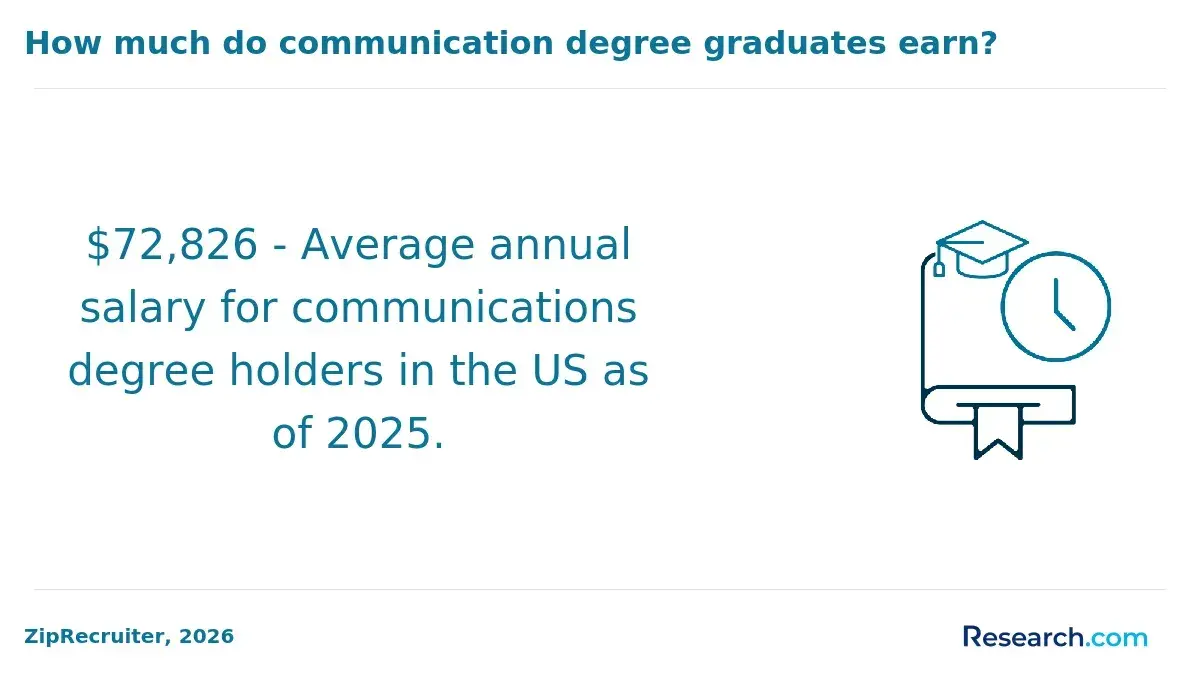
A degree should be evaluated as both an educational investment and a financial commitment. The first step in comparing affordability is to complete the FAFSA, because it determines eligibility for many federal aid options. According to the salary information reflected in the chart below, the average salary for a PR professional is about $48,000, while the top 25% of earners make $60,000 or more per year.
Income can vary by job title, industry, location, experience, portfolio quality, and management responsibility. The top 10% of earners in the field bring in over $72,000 annually, but no degree can guarantee a specific salary. If speed and cost are major priorities, compare communication options with related programs such as the shortest business communication degree online pathways.
| Cost factor | Why it matters | Question to ask |
| Cost per credit | It determines the base tuition before fees and transfer credits | Is this rate the same for online, in-state, and out-of-state students? |
| Transfer credits | Accepted credits can reduce both time and tuition | Which credits apply to the major, general education, and electives? |
| Fees | Technology, course, or graduation fees can raise the final price | Can you provide a complete program cost estimate? |
| Course materials | Books, software, and media tools may add expenses | Are digital tools included in tuition or billed separately? |
| Time to completion | Longer enrollment can increase total costs | What is the realistic timeline for a student with my schedule? |
Financial Aid Options for Online Media Communication Students
Students enrolled in accredited online programs may qualify for many of the same financial aid options available to campus students, including federal grants, federal loans, and work-study opportunities where applicable. Aid eligibility depends on the institution, enrollment status, program type, and individual financial circumstances.
The most important first step is submitting the Free Application for Federal Student Aid. After that, compare school-based aid, outside scholarships, employer benefits, and loan options in that order.
Prioritize aid you do not have to repay
- Grants: Grants are typically based on financial need and do not need to be repaid if eligibility requirements are met. The Pell Grant is a common undergraduate example.
- Scholarships: Scholarships may be awarded by colleges, professional associations, nonprofits, employers, and private organizations. Search broadly, including options such as a bachelor of communications scholarship.
- Employer tuition reimbursement: Working students should ask HR whether their company pays for courses related to communication, marketing, public relations, management, or professional development.
- Federal loans: Federal loans must be repaid, but they often include fixed interest rates and repayment protections that private loans may not offer.
Smart ways to reduce the total cost
- Request a transfer credit evaluation before committing to a school.
- Ask whether prior learning, military training, professional certifications, or workplace training can count toward credit.
- Compare total program cost, not just cost per credit.
- Apply for scholarships every year, not only before your first term.
- Avoid borrowing the full amount offered unless you truly need it.
Admissions Requirements for an Online Media Communication Degree
Freshman applicants typically need a high school diploma or a GED. Transfer applicants generally need official transcripts from every college previously attended. Schools may also review GPA, essays, resumes, recommendation letters, work experience, military experience, or creative samples depending on the admissions process.
Communication programs often value evidence that you can write clearly, collaborate well, meet deadlines, and think critically about audiences and messages. A strong application does not always depend on GPA alone.
How to strengthen your application
If the school uses holistic review, use every required and optional component to show readiness. A concise admissions essay can explain why communication fits your goals. A resume can show work history, leadership, volunteer experience, or content-related projects. If allowed, a portfolio can include writing samples, social media campaigns, videos, newsletters, blog posts, presentations, or media projects.
A bachelor's degree is the industry-standard credential, with 75% of PR specialists holding one. Students who want a writing-centered pathway may also compare media communication programs with the fastest online professional writing degree programs.
Documents commonly requested
- Online application
- High school transcript, GED documentation, or college transcripts
- Transfer credit records, if applicable
- Personal statement or admissions essay
- Resume or work history, especially for adult learners
- Optional portfolio, if the program allows creative or professional samples
Courses Commonly Found in Online Media Communication Programs
Online media communication programs usually combine theory, writing, ethics, digital tools, public relations, audience analysis, and applied projects. The goal is not only to teach students how to write, but also how to choose the right message, format, channel, and strategy for a specific audience.
Many programs aim to produce broad communication professionals with deeper expertise in a chosen area. That means students often build a foundation across the field while using electives or concentrations to focus on digital media, public relations, journalism, social media, or strategic communication.
Common core courses
- Introduction to Media and Communication: A survey of media industries, communication channels, audience behavior, and the role of communication in society and organizations.
- Communication Ethics and Law: An examination of legal responsibilities, ethical decision-making, privacy, accuracy, intellectual property, and professional accountability.
- Communication Theory: A study of the models and concepts that explain how messages influence individuals, groups, organizations, and publics.
- Media Writing: Practice writing for multiple audiences and platforms, including press releases, digital content, social posts, articles, scripts, or campaign materials.
Students who want a stronger news and reporting focus can compare this curriculum with the best accelerated online journalism degree programs.
Skills you should expect to build
| Skill area | Why it matters in communication careers |
| Writing and editing | Nearly every communication role requires clear, accurate, audience-specific writing. |
| Strategic messaging | Employers need communicators who can connect messages to business, public, or organizational goals. |
| Digital content creation | Media work increasingly involves web, social, video, mobile, and multimedia platforms. |
| Research and analytics | Audience data, campaign results, and media metrics help improve decisions. |
| Ethics and judgment | Communication professionals often handle sensitive information, public messaging, and reputation risk. |
Common Specializations in Online Media Communication Degrees
Specializations help you turn a broad communication degree into a more targeted career path. Common options include public relations, journalism, digital and social media, and strategic communication. Your choice should reflect the type of work you want to do after graduation, not just the course titles that sound interesting.
The best specialization is the one that helps you build relevant portfolio samples. For example, public relations students should graduate with campaign plans, press materials, and media pitches. Digital media students should have social content, analytics examples, and platform-specific work. Journalism-focused students should leave with reporting clips or multimedia stories.
Popular specialization choices
- Public Relations: Focuses on reputation, media relations, press materials, crisis communication, and organizational messaging.
- Journalism: Emphasizes reporting, interviewing, fact-checking, news judgment, ethics, and multimedia storytelling.
- Digital and Social Media: Centers on online content, platform strategy, community engagement, digital campaigns, and audience analytics.
- Strategic Communication: Develops long-term planning, message architecture, campaign design, stakeholder communication, and organizational goals.
How specialization can shape career direction
Communication salaries can differ by industry and role. As the data below indicates, a PR specialist working in government may have a different median salary than one working in education or healthcare. When choosing a specialization, look at job postings in your target market and note which skills, tools, and samples employers request most often.
Students who want to combine creative media with technical production may also look at related fields such as the fastest online animation degree programs.
| If you choose... | You may be preparing for... | Portfolio evidence to build |
| Public relations | PR assistant, communications coordinator, media relations associate | Press releases, campaign plans, pitch emails, crisis response samples |
| Journalism | Reporter, content writer, multimedia journalist, editor assistant | Published clips, interviews, feature stories, multimedia packages |
| Digital and social media | Social media specialist, content coordinator, digital marketing assistant | Content calendars, analytics reports, campaign samples, short-form media |
| Strategic communication | Corporate communications assistant, internal communications specialist, brand communication associate | Communication plans, audience research, messaging guides, stakeholder memos |
How to Choose the Best Online Media Communication Degree Program
The best online media communication degree is the one that fits your goals, budget, schedule, and preferred learning style. Rankings can help you build an initial shortlist, but they should not replace your own evaluation. A highly ranked program may still be a poor fit if it lacks your desired concentration, does not accept many transfer credits, or offers limited career support.
Focus on evidence. Review the curriculum, accreditation, faculty backgrounds, student support, portfolio opportunities, internship access, total cost, and graduate outcomes where available.
Decision checklist for comparing programs
- Verify accreditation first. Confirm that the institution is regionally accredited so your degree is more likely to be recognized by employers, graduate schools, and transfer institutions.
- Match the curriculum to your target job. If you want PR, look for media relations and campaign planning. If you want social media, look for analytics, content strategy, and digital campaigns.
- Ask about portfolio development. Communication hiring often depends on samples. Choose a program that helps you produce work you can show employers.
- Review faculty experience. Instructors with current or recent industry experience can bring practical examples into coursework.
- Compare career services. Ask about internship support, resume reviews, portfolio feedback, networking events, and alumni connections.
- Calculate the final price. Include tuition, fees, books, software, transfer credits, and expected time to completion.
- Check online course format. Know whether classes are live, asynchronous, self-paced, or cohort-based before you enroll.
If you already hold a bachelor’s degree and want management-focused communication training, compare undergraduate options with the shortest online master of communication management degree paths.
Common mistakes to avoid
| Mistake | Why it can hurt you | Better approach |
| Choosing based only on tuition | A cheap program may cost more if credits do not transfer or career support is weak. | Compare total cost, transfer policy, and career value together. |
| Ignoring accreditation | Accreditation affects transfer credits, aid eligibility, and employer recognition. | Verify accreditation before applying. |
| Assuming online means self-paced | Some online programs have fixed deadlines, group work, or live sessions. | Ask about course format, weekly workload, and attendance expectations. |
| Overlooking portfolio support | A degree without strong samples may not be enough for competitive communication roles. | Choose courses that produce usable writing, campaign, and media samples. |
| Relying only on rankings | Rankings may not reflect your career goal, transfer credits, or budget. | Use rankings as a starting point, then evaluate fit personally. |
Could an MFA in Creative Writing Be a Better Fit Than Media Communication?
An online media communication degree is usually broader and more career-applied, covering topics such as public relations, media writing, strategic messaging, digital content, branding, and audience engagement. An MFA in Creative Writing is more specialized and typically better suited for students whose primary goal is literary craft, fiction, poetry, creative nonfiction, teaching writing, or building a creative manuscript portfolio.
If you want to work in brand communication, PR, digital media, social strategy, or organizational messaging, media communication is likely the more direct option. If your main goal is to develop as a literary writer, compare communication degrees with the most affordable online MFA creative writing programs.
Career Paths With an Online Media Communication Degree
A media communication degree can lead to many entry-level and mid-career pathways because organizations in nearly every industry need people who can write clearly, manage messages, understand audiences, and communicate across platforms. Graduates may begin in tactical roles and move into strategy, management, or specialized communication functions over time.
Common early roles include communications coordinator, social media specialist, content assistant, PR assistant, marketing communications associate, and media relations assistant. With experience, professionals may move into content strategist, marketing manager, communications manager, public relations manager, or director-level roles.
Example career progression
A possible 10-year path might begin with a Social Media Specialist role, move into Content Strategist responsibilities, then progress to Marketing Manager and eventually Marketing Director. Career growth depends on performance, industry, portfolio strength, leadership ability, and continued skill development. Top companies like McKinsey & Company, HP, and Amazon are known to hire communication graduates for high-paying roles.
The average age for a communications manager is 41, suggesting that many professionals build toward management over time rather than entering senior roles immediately. Some professionals also pursue niche business-focused media paths, including options such as a fast-track online bachelor's degree in entertainment business.
| Career stage | Possible roles | Skills that matter most |
| Entry level | Communications coordinator, PR assistant, social media specialist, content assistant | Writing, editing, organization, social platforms, basic analytics |
| Early to mid-career | Content strategist, media relations specialist, internal communications specialist | Campaign planning, audience research, messaging, project management |
| Management | Marketing manager, communications manager, public relations manager | Leadership, strategy, budgeting, stakeholder communication, performance measurement |
| Senior leadership | Director of Corporate Communications, Marketing Director, Chief Communications Officer (CCO) | Executive communication, reputation management, organizational strategy, crisis judgment |
Job Market Outlook for Media Communication Graduates
The job market for communication graduates is active, but it is also competitive. According to the U.S. Bureau of Labor Statistics, employment for public relations specialists is projected to grow 6% through 2033, which is faster than the average for all occupations. This growth is expected to create about 27,100 new job openings for PR specialists each year over the next decade.
A bachelor’s degree can help you meet baseline expectations, but employers often look closely at writing ability, digital fluency, campaign experience, analytics knowledge, and portfolio quality. Students should treat every major assignment as a possible portfolio piece.
How to stay competitive
- Build a portfolio with writing samples, campaign materials, social content, media plans, and analytics reports.
- Learn how to use data to explain communication performance.
- Practice writing for different audiences, including executives, customers, employees, journalists, and online communities.
- Seek internships, freelance projects, campus media roles, volunteer communication work, or employer-based projects.
- Stay current with AI tools, social media platform changes, search behavior, short-form video, and audience analytics.
AI is changing communication work, but it does not eliminate the need for human judgment. Employers still need professionals who can verify information, protect brand reputation, understand context, make ethical choices, and adapt messages for real audiences.
How Emerging Digital Trends Are Changing Media Communication Education
Online media communication programs are adapting as employers expect graduates to understand digital content workflows, audience data, interactive media, brand storytelling, and platform-specific strategy. Students are increasingly expected to know how to write for web and social platforms, interpret engagement metrics, collaborate remotely, and use digital tools responsibly.
AI-assisted writing, search behavior, short-form video, influencer communication, UX writing, accessibility, and data-driven storytelling are especially relevant. Communication students do not need to become software engineers, but they should understand how people interact with digital products and content. Students interested in this intersection may benefit from exploring a UX design degree online to understand user-centered design principles.
What Graduates Say About Online Media Communication Programs
- Isabella: "My family wanted to know how a creative degree would lead to a real job. The program helped me explain my interests in practical terms: strategy, audience research, analytics, and business communication. The projects mattered most because I finished with portfolio samples I could show employers, and that helped me get started in digital marketing."
- Lenny: "I expected online learning to feel disconnected, but group projects changed that. We worked across time zones, shared files, gave feedback, and had to be very clear in writing. It felt similar to the way many workplaces operate now. A few classmates are still part of my professional network."
- Jason: "I liked writing, but I did not understand how many careers used writing beyond personal blogging. My courses introduced me to content strategy, corporate storytelling, UX writing, and brand voice. It helped me turn a creative strength into professional direction."
Key Insights
- An online media communication degree is best for students who want flexible training in writing, digital media, public relations, branding, and strategic messaging.
- Most bachelor’s programs require 120 credits and take about four years full time, though transfer credits, part-time study, and accelerated formats can change the timeline.
- Based on our research, the average cost is around $434 per credit for in-state students and $455 for out-of-state students, with average total tuition between $57,000 and $61,000.
- Accreditation should be your first filter. Then compare curriculum, portfolio opportunities, faculty experience, career services, transfer policies, and total cost.
- Specialization matters. Public relations, journalism, digital and social media, and strategic communication can lead to different portfolios and job targets.
- The U.S. Bureau of Labor Statistics projects 6% growth for public relations specialists through 2033, with about 27,100 new job openings each year over the next decade.
- A degree alone is not enough in a competitive communication job market. Build a strong portfolio, learn analytics, understand AI-assisted workflows, and gain practical experience before graduation.
References:
- National Center for O*NET Development. (n.d.). Public relations specialists. O*NET OnLine. Retrieved May 24, 2024, from O*NET public relations specialists profile
- U.S. Bureau of Labor Statistics. (2025, April). Advertising, promotions, and marketing managers. Occupational Outlook Handbook. Retrieved May 24, 2024, from BLS advertising, promotions, and marketing managers outlook
- U.S. Bureau of Labor Statistics. (2025, April). Media and communication occupations. Occupational Outlook Handbook. Retrieved May 24, 2024, from BLS media and communication occupations overview
- U.S. Bureau of Labor Statistics. (2025, April). Public relations specialists. Occupational Outlook Handbook. Retrieved May 24, 2024, from BLS public relations specialists outlook
- Zippia. (2025, January). What is a communications manager and how to become one. Retrieved May 24, 2024, from Zippia communications manager career guide
- Zippia. (2025, January). What is a public relations and how to become one. Retrieved May 24, 2024, from Zippia public relations career guide
- Additional labor market and education data references include Zippia communications manager jobs, BLS public relations specialists, BLS media and communication occupations, BLS advertising, promotions, and marketing managers, O*NET public relations specialists, and Data USA communications profile.
Other Things You Should Know About Online Media Communication Degree Programs
Many online media communication degrees require a practicum or internship for graduation, often worth 3 to 6 credit hours. Programs commonly expect 150 to 300 supervised hours in a communications, media, or digital-content setting, with faculty approval before placement.
Admission requirements for 2027's top online media communication degree programs typically include a completed application, official transcripts, a minimum GPA of 2.5 or higher, and possibly letters of recommendation or a personal statement. Check individual programs for specific criteria.