2027 Best Online Journalism Degree Programs

Co-Founder and Chief Data Scientist
Online journalism degrees remain relevant despite shifts in the media landscape, but traditional journalism roles like reporters and news analysts are projected to decline over the next decade, with some BLS data indicating an 11 % drop for reporters and broadcasters through 2029 and similar softness in newsroom jobs due to industry contraction and digital disruption.
To help you get started on your career, I crafted this comprehensive guide to online journalism degree programs. Explore academic institutions, program curricula, tuition rates, salary potential, and job opportunities.
What are the benefits of completing an online journalism degree program?
- Earning an online journalism degree can help you land several roles in various industries, such as journalist, writer, editor, photographer, and public relations specialist.
- In May 2025, news analysts, reporters, and journalists in the US had a median annual wage of $62,430.
- Earning a journalism degree online offers flexibility to balance studies with work or personal commitments. It provides access to diverse digital tools, real-world projects, and experienced instructors.
What can I expect from an online journalism degree program?
- Students enrolled in online journalism degree programs can expect a comprehensive curriculum that blends foundational journalism skills with modern digital media training.
- Courses often cover news writing, media law, ethics, investigative reporting, and multimedia storytelling.
- Many programs include hands-on assignments, virtual newsroom experiences, and portfolio-building projects.
- Students can also expect flexible scheduling. They can learn at their own pace while balancing work or personal responsibilities.
- Interaction with experienced faculty and networking opportunities with peers across different regions help enrich the learning experience.
Where can I work with an online journalism degree program?
Around 51,700 news analysts, reporters, and journalists were employed in the US. The following employed the largest shares of these professionals as of the most recent labor data.
- Newspaper Publishers (29%): Journalists employed in these workplaces are typically expected to research and write news articles, features, and editorials for print and digital newspapers. They often cover local, national, or global events.
- Media Streaming Distribution Services, Social Networks, and Other Media Networks and Content Providers (25%): Journalists in this sector create digital-first content, such as video segments, blogs, or interactive features, for online platforms and audience engagement.
- Television Broadcasting Stations (18%): Journalists working for TV are tasked with creating scripts and present news stories for broadcast. They often work on live segments or investigative reports.
- Self-employed Workers (11%): Freelance journalists pitch, research, and produce stories independently for various media outlets. They may specialize in niche topics or multimedia storytelling.
- Radio Broadcasting Stations (3%): Journalists employed by radio stations produce audio news segments, conduct interviews, and report on current events for radio audiences.
How much can I make with an online journalism degree program?
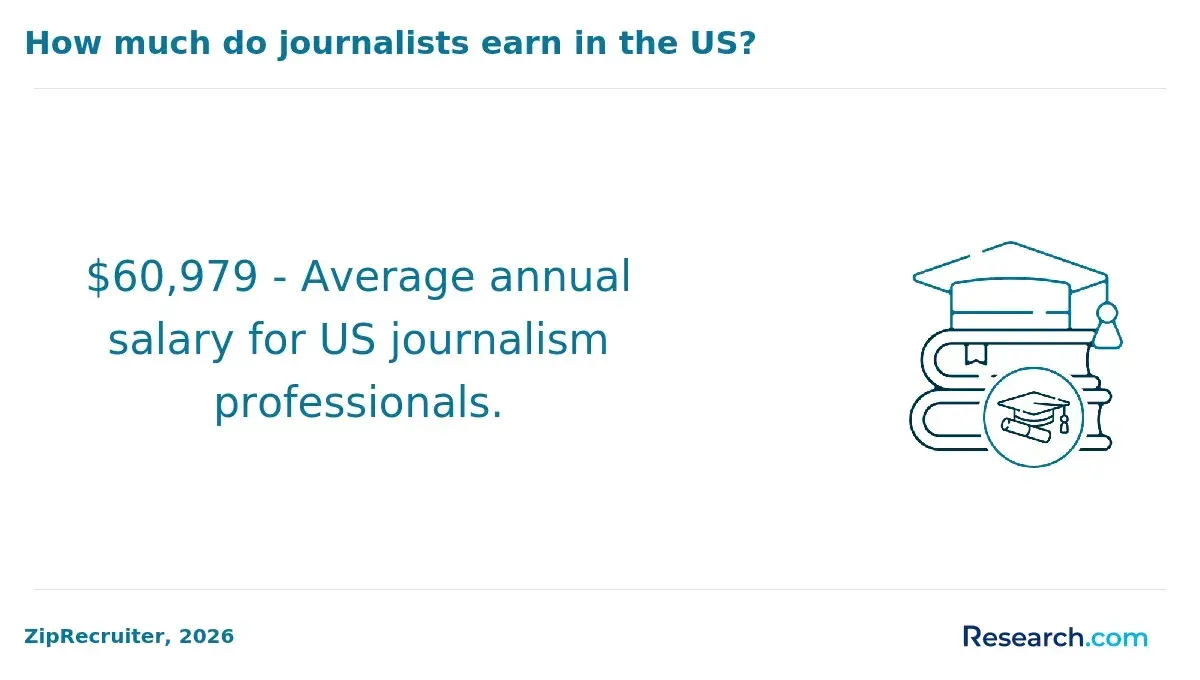
News analysts, reporters, and journalists in the US had a median annual wage of $60,280. Notably, editors had a median annual wage of $75,260 in the same period. Moreover, writers and authors had $72,270.
These figures are significantly higher than the $49,500 median annual wage of all US occupations in the same period.
Moreover, these professionals may find good income potential in the following high-paying industries:
- Media Streaming Distribution Services, Social Networks, and Other Media Networks and Content Providers: $77,460
- Television Broadcasting Stations: $65,670
- Radio Broadcasting Stations: $56,230
- Newspaper Publishers: $46,640
- List of Online Journalism Degree Programs for 2027 List of Programs
- How long does it take to complete an online journalism degree program? Completion Time
- How does an online journalism degree program compare to an on-campus program? How does an online journalism degree program compare to an on-campus program?
- What is the average cost of an online journalism degree program? Program Cost
- What are the financial aid options for students enrolling in an online journalism degree program? Financial Aid
- What are the prerequisites for enrolling in an online journalism degree program? Admission Requirements
- What courses are typically in an online journalism degree program? What courses are typically in an online journalism degree program?
- What types of specializations are available in online journalism degree programs? What types of specializations are available in online journalism degree programs?
- How do you choose the best online journalism degree programs? How do you choose the best online journalism degree programs?
- What career paths are available to graduates of online journalism degree programs? Career Paths
- What is the job market like for graduates of online journalism degree programs? Job Outlook
- Is the Online Journalism Degree Program Accredited and Recognized? Is the Online Journalism Degree Program Accredited and Recognized?
- How can digital and cross-disciplinary skills complement an online journalism degree? How can digital and cross-disciplinary skills complement an online journalism degree?
Best Online Journalism Degree Programs for 2027
Choosing an online journalism degree is not just about finding a remote-friendly writing program. Students need to know whether the curriculum teaches reporting, verification, media law, multimedia production, audience analytics, and portfolio development—the skills employers expect from journalists and communication professionals working across digital platforms. This guide is designed for first-time college students, transfer students, working adults, and career changers who want a practical way to compare online journalism programs before applying.
You will find a ranked list of online journalism and closely related communication programs, cost and credit details, admissions expectations, course topics, career outcomes, job-market considerations, and questions to ask before enrolling. If you are still comparing broader communication pathways, you may also want to review online media and communication degree programs.
Quick answer: Is an online journalism degree worth considering?
An online journalism degree can be a strong fit if you want formal training in reporting, writing, editing, media ethics, multimedia storytelling, and digital publishing while keeping the flexibility to work or manage other responsibilities. It is most useful when the program is accredited, includes hands-on assignments or internship options, and helps you build a publishable portfolio. Students who want only general writing practice, a low-cost credential, or a fast route into marketing may want to compare journalism with communication, professional writing, public relations, social media marketing, or digital media programs before committing.
How this list was developed
The programs below were selected using the Research.com methodology and available institutional and federal data sources. Our research process considered information from the IPEDS database, Peterson's database, the College Scorecard database, and the National Center for Education Statistics. Students should still confirm tuition, transfer policies, accreditation status, and program requirements directly with each school before applying.
| School | Online program | Credits | Published cost per credit | Accreditation listed |
| Colorado State University Online | BA in Journalism and Media Communication | 120 credits | $490 | Higher Learning Commission (HLC) |
| Ohio University | BS in Journalism | 120 credits | $334 (Resident); $344 (Non-resident) | HLC |
| Penn State World Campus | BA in Digital Journalism and Media | 120 credits | $638/$685 | Middle States Commission on Higher Education (MSCHE) |
| Atlantic International University | BA in Journalism | 120 credits | Contact the university for tuition information. | Accreditation Service for International Schools, Colleges, and Universities (ASIC) |
| University of North Dakota | BA in Journalism | 120 credits | $407.97 | HLC |
| Montana State University-Billings | BA in Communication | 120 credits | Approx. $197.31 (based on in-state tuition total of $23,676.80) | NWCCU |
| Southern Illinois University-Carbondale | BS in Journalism | 120 credits | $321.50 | HLC |
| Liberty University | BS in English and Writing with a Journalism concentration | 120 credits | $390 | SACSCOC |
| Regent University | BA in Communication Studies with a Journalism concentration | 120 credits | $395 | SACSCOC |
| University of Florida | BS in Journalism with a Sports & Media specialization | 120 credits | $129.18 (residents), $552.62 (non-residents) | ACEJMC |
1. Colorado State University Online
Colorado State University Online offers an online Bachelor of Arts in Journalism and Media Communication for students who want a broad foundation in journalism, media systems, visual communication, audience engagement, and digital storytelling. The curriculum includes topics such as media in society, newswriting, online storytelling, visual communication, audience engagement, and media history.
- Program length: 4 years
- Specialization: Journalism and Media Communication
- Cost per credit: $490
- Required credits to graduate: 120 credits
- Accreditation: Higher Learning Commission (HLC)
2. Ohio University
Ohio University provides an online Bachelor of Science in Journalism that emphasizes reporting across platforms. Students study areas such as multiplatform reporting and writing, communication law, narrative journalism, economics reporting, and data journalism.
- Program length: 4 years
- Specialization: Journalism
- Cost per credit: $334 (Resident); $344 (Non-resident)
- Required credits to graduate: 120 credits
- Accreditation: HLC
3. Penn State World Campus
Penn State World Campus offers an online Bachelor of Arts in Digital Journalism and Media. The program is designed for students interested in news writing, multimedia production, photojournalism, ethics, and field-based video work.
- Program length: 4 years
- Specialization: Digital Journalism and Media
- Cost per credit: $638/$685
- Required credits to graduate: 120 credits
- Accreditation: Middle States Commission on Higher Education (MSCHE)
4. Atlantic International University
Atlantic International University lists an online Bachelor of Arts in Journalism with coursework in broadcast journalism, investigative journalism, photojournalism and visual storytelling, media law and ethics, and digital media. Applicants should contact the university directly for current tuition information and should carefully review accreditation recognition for their intended academic or career goals.
- Program length: 4 years
- Specialization: Journalism
- Cost per credit: Contact the university for tuition information.
- Required credits to graduate: 120 credits
- Accreditation: Accreditation Service for International Schools, Colleges, and Universities (ASIC)
5. University of North Dakota
The University of North Dakota offers an online Bachelor of Arts in Journalism that covers online news writing fundamentals, sports journalism, multimedia reporting, storytelling, interactive and data journalism, and introductory media law.
- Program length: 4 years
- Specialization: Journalism
- Cost per credit: $407.97
- Required credits to graduate: 120 credits
- Accreditation: HLC
6. Montana State University-Billings
Montana State University-Billings offers a fully online Bachelor of Arts in Communication. While broader than a journalism-only degree, the program includes communication coursework that can support students interested in writing, public speaking, interpersonal communication, and media-related careers.
- Program length: 4 years
- Specialization: Communication
- Cost per credit: Approx. $197.31 (based on in-state tuition total of $23,676.80)
- Required credits to graduate: 120 credits
- Accreditation: NWCCU
7. Southern Illinois University-Carbondale
Southern Illinois University-Carbondale offers a fully online Bachelor of Science in Journalism. Students complete 9 credit hours of core Journalism courses and 39 credit hours in Journalism specialization coursework, with topics that include Mass Communication in a Diverse Society and Understanding Data Communications.
- Program length: 4 years
- Specialization: Journalism
- Cost per credit: $321.50
- Required credits to graduate: 120 credits
- Accreditation: HLC
8. Liberty University
Liberty University offers a fully online Bachelor of Science in English and Writing with a concentration in Journalism. This option may appeal to students who want journalism training alongside broader writing, composition, grammar, audience development, and content strategy skills. Courses include Composition and Literature and Modern Grammar.
- Program length: 4 years
- Specialization: English and Writing
- Cost per credit: $390
- Required credits to graduate: 120 credits
- Accreditation: SACSCOC
9. Regent University
Regent University offers a fully online Bachelor of Arts in Communication Studies with a concentration in Journalism. The program focuses on communication skills that may apply to media, politics, business, and entertainment. Featured courses include Public Speaking, Foundations of Communication, and Interpersonal Communication.
- Program length: 4 years
- Specialization: Communication Studies/Journalism
- Cost per credit: $395
- Required credits to graduate: 120 credits
- Accreditation: SACSCOC
10. University of Florida
The University of Florida College of Journalism and Communications offers a fully online Bachelor of Science in Journalism with a specialization in Sports & Media. The program is built for students interested in sports reporting, broadcast writing, multimedia reporting, sports media law, and fact finding.
- Program length: 4 years
- Specialization: Sports & Media Reporting
- Cost per credit: $129.18 (residents), $552.62 (non-residents)
- Required credits to graduate: 120 credits
- Accreditation: ACEJMC
How Long Does an Online Journalism Degree Take?
Most online bachelor’s degrees in journalism are designed around 120 credits and take about 4 years for full-time students. The actual timeline depends on transfer credits, enrollment intensity, course availability, summer study, and whether the program uses accelerated terms.
Students who already have college credits or who choose an accelerated online journalism bachelor’s degree may be able to finish in 2 to 3 years. Part-time students often need more time because they take fewer courses each term. Online associate programs in journalism usually take 2 years, while master’s programs are commonly completed in 1 to 2 years.
| Student situation | Typical timeline | What to check before enrolling |
| First-time full-time bachelor’s student | About 4 years | Whether all required journalism courses are available online each year |
| Transfer student | May finish in 2 to 3 years | How many prior credits count toward major, general education, and elective requirements |
| Part-time student | Longer than 4 years | Maximum time-to-completion rules and course rotation schedules |
| Associate degree student | Usually 2 years | Whether credits transfer into a bachelor’s program later |
| Master’s student | Often 1 to 2 years | Portfolio, professional experience, or thesis/project requirements |
Online journalism programs can be flexible, but they are not passive. Expect reporting assignments, interviews, multimedia projects, peer review, deadlines, and portfolio work. Before enrolling, ask whether the program requires internships, live sessions, specific software, recording equipment, or local reporting assignments.
Online vs. On-Campus Journalism Degrees: Which Format Fits You?
Online and campus-based journalism degrees can cover similar academic material and lead to comparable credentials, but the student experience differs. The better option depends on how you learn, your schedule, your access to equipment, and the type of newsroom experience you want.
| Factor | Online journalism degree | On-campus journalism degree |
| Schedule | Often more flexible, especially when courses are asynchronous | Usually follows set class times and campus meeting schedules |
| Networking | Relies on discussion boards, video meetings, email, remote group projects, and virtual events | Offers more face-to-face interaction with classmates, faculty, student media, and campus organizations |
| Equipment access | Students may need their own camera, microphone, editing software, or reliable internet connection | Students may have easier access to studios, media labs, campus newsrooms, and loaner equipment |
| Best for | Working adults, transfer students, caregivers, military students, and learners who need location flexibility | Students who want in-person newsroom culture, live mentoring, and campus media opportunities |
| Potential drawback | Requires discipline, self-direction, and proactive networking | Less flexible for students with full-time work or family obligations |
Learning format
Many online programs use asynchronous coursework, which lets students complete lectures and assignments around work or family obligations. Students who mainly want a faster writing credential may also compare journalism with short online professional writing degree options. Campus programs, by contrast, often provide a more fixed weekly rhythm through scheduled lectures, workshops, lab sessions, and student media activities.
Interaction and networking
Campus students can build relationships through in-person classes, newsroom meetings, faculty office hours, and student publications. Online students need to be more intentional: attend virtual events, join professional journalism associations, use faculty feedback, pitch stories independently, and build a digital portfolio that can be shared with editors and employers.
Access to newsroom tools
On-campus programs may provide direct access to studios, editing bays, cameras, audio equipment, and media labs. Online programs usually deliver instruction through digital platforms, but students may need to supply their own equipment or software for audio, video, photography, or data projects.
How Much Does an Online Journalism Degree Cost?
Published tuition among the featured online programs varies by school, residency, and program type. Examples in this guide include per-credit costs such as $334 (Resident); $344 (Non-resident), $490, $638/$685, $407.97, Approx. $197.31 (based on in-state tuition total of $23,676.80), $321.50, $390, $395, and $129.18 (residents), $552.62 (non-residents). One listed program advises students to contact the university for tuition information.
Do not compare programs by tuition alone. Total cost can change once you factor in fees, books, software, equipment, transfer credits, residency rules, and the number of credits you must complete after admission. Students comparing journalism with other digital or management-focused pathways may also look at pricing patterns in online technology management degree programs.
| Cost factor | Why it matters | Question to ask |
| Residency tuition | Public universities may charge different rates for resident and non-resident students | Will I pay resident, non-resident, or a special online rate? |
| Transfer credits | Accepted credits can reduce the number of courses you still need | How many of my credits apply to the major, general education, and electives? |
| Technology fees | Online programs may add charges for learning platforms, proctoring, or digital services | What fees are mandatory each term? |
| Media equipment | Journalism courses may require audio, video, photography, or editing tools | Do I need to buy software, a camera, a microphone, or editing equipment? |
| Internships or field reporting | Some requirements may create travel, scheduling, or unpaid work costs | Can I complete fieldwork locally or remotely? |
Financial Aid and Scholarships for Online Journalism Students
Online journalism students may be eligible for federal aid, institutional aid, state aid, employer tuition benefits, military education benefits, private scholarships, and journalism-specific awards. Eligibility depends on the school, enrollment status, program accreditation, citizenship or residency rules, academic standing, and scholarship criteria.
- Davidson Institute Fellows Scholarship: The Davidson Institute Fellows Scholarship provides awards of $100,000, $50,000, and $25,000. Applicants must be 18 years old or younger, a US citizen or permanent resident of the US living in the country, and must have completed a significant body of work.
- The James Alan Cox Foundation for Student Photojournalists: Created in memory of TV photojournalist James Alan Cox, the James Alan Cox Foundation supports student photographers at the high-school and college levels.
- Overseas Press Club Foundation Awards: The Overseas Press Club Foundation scholarship awards include opportunities such as the David R. Schweisberg Memorial Scholarship, the Reuters Fellowship, and the HL Stevenson Scholarship.
Students comparing aid options across fields can also look at how scholarship planning works in other online programs, including online communication disorders degree programs. The key is to verify whether the program’s accreditation and enrollment format qualify for the aid you plan to use.
Admission Requirements for Online Journalism Degree Programs
Most online bachelor’s programs in journalism expect applicants to show college readiness and basic writing ability. Requirements vary by institution, so students should review first-year, transfer, and adult-learner admissions rules separately.
- High school diploma or equivalent: First-year applicants generally need a completed high school education or GED. Some schools may also set a minimum GPA.
- Standardized test scores: Many colleges are test-optional, but some programs may still request SAT or ACT scores for admission review or scholarship consideration.
- Writing sample or personal statement: Journalism programs may ask students to submit an essay, personal statement, or writing sample to evaluate communication skills and motivation.
- Transfer transcripts: Transfer applicants should submit official transcripts from prior colleges and ask for a degree audit before enrolling.
- Technology readiness: Online students need reliable internet access and may need software or hardware for multimedia assignments.
Admission requirements for journalism are usually less licensure-driven than fields such as public safety analytics, but students can compare how prerequisites differ in programs like online crime analysis degrees if they are considering multiple career directions.
Common Courses in an Online Journalism Degree
A strong online journalism curriculum should move beyond general writing. Look for courses that teach students how to verify information, interview sources, write under deadline, understand media law, create multimedia packages, analyze data, and publish for digital audiences.
| Course area | What students learn | Why it matters professionally |
| News writing and reporting | Interviewing, source development, fact-gathering, lead writing, story structure, and deadline writing | Builds the foundation for reporting roles across print, broadcast, and digital media |
| Media ethics and law | Libel, copyright, privacy, freedom of the press, conflicts of interest, and ethical decision-making | Helps journalists reduce legal risk and make responsible editorial choices |
| Digital journalism | Online publishing, social media reporting, multimedia storytelling, audience engagement, and platform strategy | Prepares students for newsrooms where stories are distributed across multiple channels |
| Investigative reporting | Public records, data review, document analysis, source protection, and long-form reporting methods | Supports accountability journalism and in-depth reporting projects |
| Editing and publishing | Grammar, AP style, headlines, clarity, accuracy, layout, and editorial workflow | Develops skills needed for copy editing, content editing, and publication management |
Media law and communication policy can also matter in other professional fields. Students interested in leadership and technical communication may compare these foundations with content covered in the fastest online master's degree programs in engineering management.
Journalism Specializations You Can Study Online
Specializations help students shape a journalism degree around a specific career direction. The best choice depends on the kind of stories you want to tell, the platforms you want to use, and the audience you want to serve.
| Specialization | Best fit for students interested in | Common skill focus |
| Broadcast journalism | Television, radio, video news, podcasts, and on-camera reporting | Script writing, interviewing, audio/video production, and live reporting |
| Investigative journalism | Accountability reporting, public records, social issues, government coverage, and long-form stories | Research, source development, data review, document analysis, and ethics |
| Sports journalism | Sports media, athlete profiles, event coverage, commentary, and multimedia sports storytelling | Game coverage, sports law, feature writing, broadcast writing, and audience engagement |
| Photojournalism | Visual reporting, documentary storytelling, news photography, and digital image editing | Composition, caption writing, ethics, field photography, and visual narrative |
| Political journalism | Government, elections, policy, public affairs, and civic reporting | Policy research, source evaluation, public records, and explanatory writing |
The analytical and storytelling skills used in journalism can also support careers in education, publishing, and literacy-focused communication. Students considering teaching, curriculum, or educational publishing may compare journalism with an accelerated master's degree in reading and literacy.
The chart below visualizes employment levels for occupations connected to journalism in the US.
How to Choose the Best Online Journalism Degree Program
The best online journalism degree is the one that fits your career goal, budget, schedule, transfer-credit situation, and learning style. A highly ranked program is not automatically the right choice if it lacks your preferred specialization, offers limited portfolio support, or costs more than you can reasonably repay.
- Verify accreditation first. Confirm that the institution is accredited by a recognized accrediting body. Accreditation can affect credit transfer, graduate school admission, employer recognition, and financial aid eligibility.
- Compare the curriculum against your career goal. A student aiming for investigative reporting needs different coursework than someone targeting sports media, public relations, editing, or digital content strategy.
- Ask how students build a portfolio. Employers often want published clips, multimedia samples, editing work, or campaign materials—not just a diploma.
- Review internship and newsroom connections. Ask whether the program helps online students find internships, student media opportunities, freelance assignments, or local reporting placements.
- Calculate total cost, not just tuition. Include fees, software, equipment, books, transfer-credit loss, and time away from work.
- Evaluate online support. Strong online programs provide advising, library access, writing help, technical support, career services, and faculty availability.
- Check faculty experience. Look for instructors with newsroom, editing, broadcasting, digital media, data journalism, public relations, or publishing backgrounds.
This evaluation process is similar to choosing online interdisciplinary studies bachelor’s programs: the right fit depends on whether the degree structure supports your long-term plan rather than simply offering broad flexibility.
Questions to ask before applying
- Is the institution accredited, and is the journalism program recognized by any field-specific accreditor?
- Are all major courses available fully online?
- Can transfer credits reduce my required 120 credits?
- What software, equipment, or subscriptions will I need?
- Does the program help online students secure internships or publish work?
- Will I graduate with a portfolio, capstone project, or published clips?
- How often are specialized courses offered?
- What career services are available to online students?
Careers You Can Pursue With an Online Journalism Degree
Journalism graduates work in more than traditional newsrooms. Their research, writing, editing, interviewing, and audience-focused communication skills can apply to digital media, publishing, public relations, nonprofit communication, corporate content, sports media, and freelance work.
| Career path | Typical work | Skills from a journalism degree that help |
| Photographers | Create images for news outlets, magazines, digital publications, and visual storytelling projects | Photojournalism, ethics, caption writing, field reporting, and visual composition |
| News Analysts, Reporters, and Journalists | Research, write, investigate, and present news for print, broadcast, and digital platforms | Reporting, interviewing, verification, news judgment, writing, and multimedia production |
| Public Relations Specialists | Manage public communication, write press materials, coordinate media outreach, and support brand reputation | Clear writing, audience awareness, media relations, editing, and strategic messaging |
| Writers and Authors | Produce articles, essays, books, scripts, web content, and other written materials | Research, drafting, revision, storytelling, and audience analysis |
| Editors | Review, revise, fact-check, plan, and prepare content for publication | AP style, grammar, headline writing, accuracy checks, workflow management, and editorial judgment |
Students who enjoy storytelling but want to work in media-adjacent fields may compare journalism with entertainment, marketing, or content-business pathways. For example, the shortest online entertainment business degree options may appeal to students more interested in media business operations than reporting.
The chart below shows median annual wages for occupations related to journalism in the US.
Job Outlook for Journalism Degree Graduates
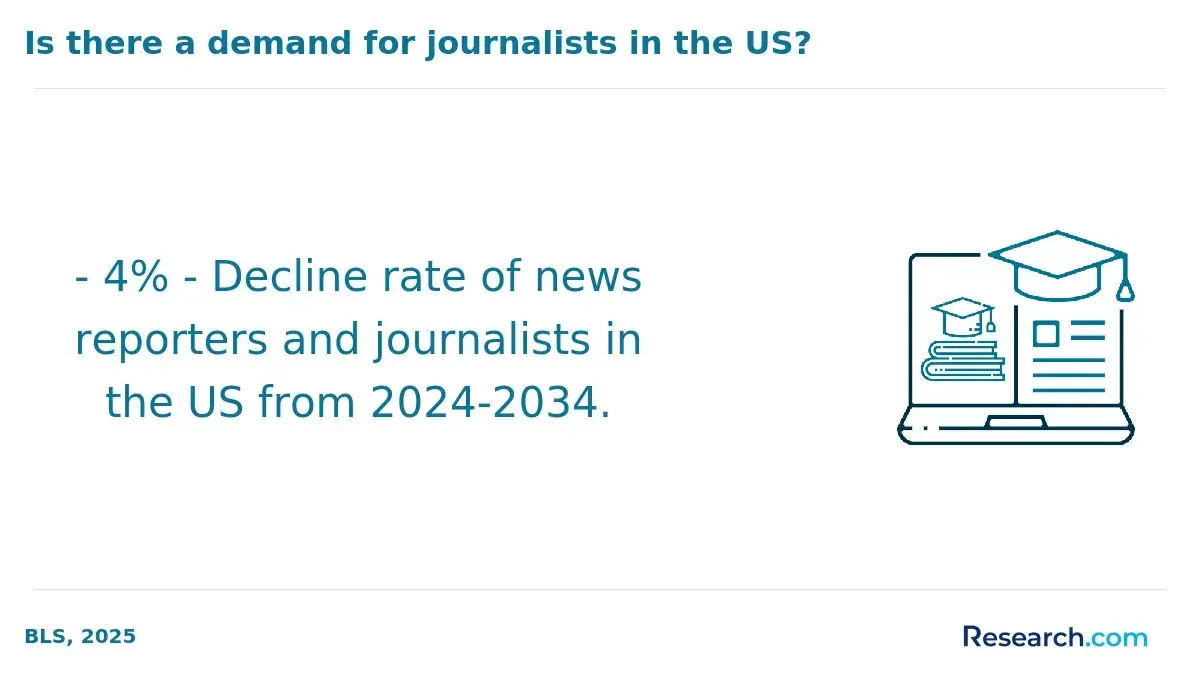
The journalism labor market is mixed. Through 2033, employment for news analysts, reporters, and journalists across the US is projected to decline by 4%, while the occupation is still expected to have an average of around 4,500 job openings annually over the decade.
For related writing careers, employment for writers and authors in the US is expected to grow by 5%, which is as fast as the average job growth rate for all US occupations. That projection equals an average of around 15,100 job openings yearly over the decade (US BLS, 2025).
Public relations may offer a broader growth path for students who like media strategy and organizational communication. Employment for public relations specialists is forecasted to increase by 6%, equal to an average of about 27,100 job openings every year over the decade (US BLS, 2025).
Because traditional reporting jobs are competitive, journalism students should graduate with adaptable skills: multimedia production, data analysis, search and social distribution, audience engagement, short-form video, newsletter writing, editing, and ethical use of AI-assisted tools. Students who want to enter social media, digital marketing, or PR more quickly may also compare journalism with an accelerated online social media marketing degree.
Accreditation: What Online Journalism Students Must Verify
Accreditation is one of the most important checks before enrolling in an online journalism degree. Institutional accreditation can affect financial aid eligibility, credit transfer, graduate school admission, and employer confidence. Some journalism programs also hold field-specific recognition, such as ACEJMC, but requirements vary by school and program.
Students should confirm accreditation through the school, the accreditor, and appropriate government-recognized databases before applying. This step is especially important if you plan to transfer credits later, use federal financial aid, pursue graduate study, or work for employers that screen for accredited degrees. Students considering graduate creative or writing-focused study after journalism may also compare advanced options such as the most affordable online MFA programs.
Current Trends Affecting Journalism Students
Journalism education is changing because the media industry is changing. Students should look for programs that address how reporting now works across websites, newsletters, podcasts, video platforms, social media, data tools, and audience analytics. A degree that focuses only on traditional print reporting may be too narrow unless it also builds transferable writing, editing, and verification skills.
- AI-assisted workflows: Journalists increasingly need to understand how AI tools can support transcription, research organization, headline testing, and production while still requiring human verification, ethical judgment, and editorial accountability.
- Multimedia storytelling: Employers often value graduates who can write, shoot, edit, record, publish, and promote stories across several formats.
- Data and investigative skills: Public records, spreadsheets, visualization, and data interpretation are useful for accountability reporting and explanatory journalism.
- Audience-first publishing: Journalists need to understand how readers find, share, and interact with news through search, newsletters, social platforms, and mobile formats.
- Cross-disciplinary careers: Many journalism graduates move into PR, communications, content strategy, nonprofit media, corporate storytelling, or digital marketing.
How Digital and Cross-Disciplinary Skills Can Strengthen a Journalism Degree
A journalism degree becomes more versatile when students add skills in data visualization, social media strategy, product thinking, analytics, search behavior, accessibility, and interactive storytelling. These skills can help graduates compete for roles that combine reporting, editing, audience development, and digital content strategy.
User experience knowledge can also help journalists design clearer story packages, explain complex information, and create more useful audience-centered digital products. Students interested in interactive media may consider supplementing journalism coursework with a UX design bachelor’s degree online or related design training.
Common Mistakes to Avoid When Choosing an Online Journalism Degree
| Mistake | Why it can hurt you | Better approach |
| Choosing only by tuition | A cheaper program may cost more if few credits transfer or required courses are not offered often | Compare total completion cost, transfer credits, fees, and time to graduation |
| Ignoring accreditation | Unrecognized accreditation can limit financial aid, transfer, graduate school, or employer acceptance | Verify institutional accreditation before applying |
| Assuming online means easier | Journalism courses still require deadlines, interviews, writing revisions, and multimedia projects | Plan weekly time for reporting, editing, and production work |
| Graduating without a portfolio | Employers and editors often want evidence of published or publishable work | Build clips, multimedia samples, newsletters, podcasts, or data projects throughout the program |
| Overlooking internships | A degree alone may not be enough in a competitive media market | Ask how online students find internships, student media roles, freelance work, or local reporting opportunities |
| Picking the wrong specialization | A sports media, PR, writing, or digital content goal may require different coursework than general reporting | Match the curriculum to the job titles and industries you want |
Student Perspectives on Online Journalism Programs
- Pamela: "Completing my journalism degree online let me keep a part-time job while developing stronger interviewing, reporting, and writing habits. The virtual newsroom projects made the work feel close to real editorial practice."
- Ryan: "I was unsure about studying journalism remotely, but the program helped me connect with committed instructors and classmates from different areas. I became much more comfortable pitching stories and revising work on deadline."
- Joshua: "Online study gave me room to balance family responsibilities while building a portfolio. The workload was demanding, but it helped me become more confident in my reporting voice."
Key Insights
- Online journalism degrees can be legitimate career preparation when they are accredited and portfolio-focused. Look for reporting practice, media law, ethics, editing, multimedia production, and internship support.
- Most bachelor’s programs require 120 credits and take about 4 years full time. Transfer credits and accelerated formats may shorten the timeline to 2 to 3 years for some students.
- Cost varies widely by school and residency status. Published examples include $129.18 (residents), $552.62 (non-residents), $334 (Resident); $344 (Non-resident), $490, $638/$685, and other listed rates, but total cost depends on fees, transfer credits, and equipment needs.
- The job market rewards adaptable communication skills. News analysts, reporters, and journalists are projected to decline by 4% through 2033, while related roles such as writers and authors and public relations specialists show different outlooks.
- Do not choose a program based only on rankings or tuition. Accreditation, curriculum fit, faculty experience, online support, internships, and portfolio outcomes matter more for long-term value.
- Digital skills make journalism graduates more competitive. Data journalism, social media strategy, video, audio, analytics, UX, and ethical AI awareness can expand options beyond traditional newsroom roles.
References:
- College Board. Trends in College Pricing and Student Aid 2024.
- US Bureau of Labor Statistics. (2025, April 18). Editors. Occupational Outlook Handbook. https://www.bls.gov/ooh/media-and-communication/editors.htm
- US Bureau of Labor Statistics. (2025, April 18). News Analysts, Reporters, and Journalists. Occupational Outlook Handbook. https://www.bls.gov/ooh/media-and-communication/reporters-correspondents-and-broadcast-news-analysts.htm
- US Bureau of Labor Statistics. (2025). Occupational Employment and Wage Statistics, Industry: Cross-industry, Private, Federal, State, and Local Government. Occupational Employment and Wage Statistics Query System. https://data.bls.gov/oes/#/industry/000000
- US Bureau of Labor Statistics. (2025, April 18). Photographers. Occupational Outlook Handbook. https://www.bls.gov/ooh/media-and-communication/photographers.htm
- US Bureau of Labor Statistics. (2025, April 18). Public Relations Specialists. Occupational Outlook Handbook. https://www.bls.gov/ooh/media-and-communication/public-relations-specialists.htm
- US Bureau of Labor Statistics. (2025, April 18). Writers and Authors. Occupational Outlook Handbook. https://www.bls.gov/ooh/media-and-communication/writers-and-authors.htm
Other Things You Need to Know about Online Journalism Degree Programs
Yes. Many accredited online journalism programs accept up to 60 transfer credits toward a bachelor’s degree, but only from regionally accredited colleges. Most schools also require a minimum grade of C in transferable courses and may limit the number of major-specific credits that can be transferred.
Admission requirements for the best online journalism degree programs in 2027 typically include a high school diploma or GED, letters of recommendation, a personal statement, and sometimes SAT or ACT scores. Some programs may also require a writing sample or portfolio demonstrating journalism skills.