2027 Fastest Online Anthropology Degree Programs

Co-Founder and Chief Data Scientist
Anthropology’s importance is expanding as globalized workplaces and technological change require cross-cultural expertise and insight into human behavior. Recent trends highlight increased interdisciplinary research and the use of digital tools, while job prospects for anthropologists are improving.
The U.S. Bureau of Labor Statistics (BLS) reports that the overall employment in life, physical, and social science occupations is projected to grow faster than average from 2023 to 2033, with about 148,400 openings expected each year.
Accelerated online anthropology degree programs empower students to rapidly enter a dynamic field at the heart of understanding humanity’s greatest challenges. This guide provides information on how to graduate faster and the opportunities that await someone with in-demand skills in critical thinking, cultural awareness, and research.
What are the benefits of getting an accelerated online anthropology degree?
- Diverse Career Opportunities. Anthropology is more vital than ever, with professionals in demand across a variety of fields, including tech, business, and government.
- Competitive Salary Potential. According to the U.S. Bureau of Labor Statistics, anthropologists and archaeologists earn a median annual salary of around $64,000, with higher earnings possible in federal agencies, private research firms, or consulting roles.
- Flexibility and Faster Completion. Earning the degree online allows students to study from anywhere, balance work and personal commitments, and graduate faster than traditional programs, entering the job market or advancing academically sooner.
What can I expect from the fastest online anthropology degree programs?
- An accelerated online anthropology degree program is designed to provide comprehensive knowledge of human cultures, biology, and societies in a faster, flexible format.
- Through a blend of virtual lectures, discussions, and independent study, you will explore human societies, cultures, and evolution across time and space.
- While the format is fast-paced, the academic rigor is not compromised; you will develop strong research, analytical, and critical thinking skills.
- Expect to engage with core theories, research methods, and case studies, often culminating in a capstone project or a senior thesis.
- Though online, many programs may offer virtual field experiences or opportunities to participate in research projects.
Where can I work with an accelerated online anthropology degree?
Graduates with an accelerated online anthropology degree can find opportunities in a wide range of industries, applying their understanding of human behavior, culture, and social structures to real-world challenges.
- Museums and Cultural Institutions. Graduates can develop exhibits, manage artifacts, and create educational material that helps the public understand diverse cultures.
- Government and Public Sector. Anthropologists can evaluate programs, craft policy recommendations, or preserve historical and archaeological sites.
- Nonprofits and International Organizations. Many anthropologists work for humanitarian groups and non-government organizations (NGOs), helping design and implement programs focused on health, education, and cultural sustainability.
- Education and Academia. Some teach at various levels, developing curriculum, or engage in academic research, especially those who continue with graduate study.
- Business and Market Research. Anthropologists conduct ethnographic research, analyze consumer behaviors, and help companies design products, services, and marketing campaigns that resonate with diverse audiences.
- Healthcare. Within hospitals or public health organizations, graduates might assess health practices in different communities, work on policy planning, or facilitate culturally competent care for diverse populations.
- Technology and User Experience (UX) Design Firms. Anthropologists often serve as UX researchers or design strategists, studying human interaction with technology to create user-friendly products and services tailored to varied cultural backgrounds.
- Consulting. Some graduates work as independent or firm-based consultants, advising organizations on diversity and inclusion, organizational culture, or international business expansion strategies.
How much can I make with an accelerated online anthropology degree?
While salaries for anthropology graduates vary widely based on their chosen field and location, the degree provides a solid foundation for careers with competitive earnings. According to the BLS, the median annual wage for anthropologists and archaeologists was $64,910 as of May 2024.
However, it is important to note that many graduates of an accelerated online anthropology program will not pursue a career as a traditional anthropologist. Instead, they leverage their skills in other industries, which can lead to different salary outcomes.
Salaries for anthropologists typically range from $51,240 to $83,080, but certain roles provide wages of about $104,000 or more.
Some industries also offer higher salaries, such as the Federal Executive Branch, which paid anthropologists and archaeologists a median annual wage of $89,460 in 2024.
Where you work can also matter, as certain states tend to have higher wages for such professionals. Using 2024 salary data from BLS, here are the top states that offer the highest median annual wages for anthropologists and archaeologists:
- Massachusetts - $106,540
- Alaska - $92,870
- Nebraska - $92,750
- Hawaii - $88,390
- Missouri - $86,940
- List of Fastest Online Anthropology Degree Programs for 2027 List of Programs
- How long does it take to complete the fastest online anthropology degree programs? Completion Time
- How does an accelerated online anthropology degree compare to a traditional program? How does an accelerated online anthropology degree compare to a traditional program?
- What is the average cost of an accelerated online anthropology program? Average Cost
- What are the financial aid options for students enrolling in an accelerated online anthropology program? Financial Aid
- What are the prerequisites for enrolling in an accelerated online anthropology program? Requirements
- What courses are typically in an accelerated online anthropology program? What courses are typically in an accelerated online anthropology program?
- What types of specializations are available in accelerated online anthropology programs? What types of specializations are available in accelerated online anthropology programs?
- How to choose the best accelerated online anthropology program? How to choose the best accelerated online anthropology program?
- What career paths are available for graduates of accelerated online anthropology programs? Career Paths
- What is the job market for graduates with an accelerated online anthropology degree? Job Market
- Is my accelerated online anthropology degree accredited and recognized? Is my accelerated online anthropology degree accredited and recognized?
- Is an Accelerated Online Anthropology Degree a Cost-Effective Investment? Is an Accelerated Online Anthropology Degree a Cost-Effective Investment?
Fastest Online Anthropology Degree Programs for 2027
Choosing an online anthropology degree is not only about finding a school that offers the major. If your goal is to graduate sooner, you need to look closely at course length, transfer credit rules, start dates, tuition structure, and whether the program is realistic for your schedule. Anthropology can lead to work in cultural resource management, museums, community programs, research support, public agencies, business research, and graduate study, but the fastest path is not always the best fit for every student.
This guide is designed for transfer students, working adults, career changers, and first-time college students who want an online anthropology bachelor’s degree with a shorter completion timeline. You will learn which programs offer flexible or accelerated structures, how fast completion usually works, what these degrees cost, what to check before enrolling, and how to decide whether an accelerated anthropology degree is worth the workload.
Quick Answer: What Is the Fastest Way to Earn an Online Anthropology Degree?
The fastest online anthropology bachelor’s degree path usually combines three things: a regionally accredited online program, short or year-round course terms, and a generous transfer credit policy. Most bachelor’s degrees require 120 credits, but students who transfer an associate degree or a large number of prior credits may finish much faster than first-time students. Programs with 7.5-week or 8-week courses, multiple start dates, summer enrollment, and credit-for-experience options can help reduce time to completion.
For students starting with few or no credits, a realistic accelerated timeline is often about two to three years with heavy full-time enrollment. For students entering with substantial transfer credit, completion may be possible in 12 to 18 months, depending on school policy, remaining major requirements, course availability, and the student’s ability to maintain an intensive pace.
How we identified fast online anthropology options
For this guide, we reviewed online anthropology bachelor’s programs that may not always use the word “accelerated” but offer structures that can support faster completion. These include shortened sessions, flexible online delivery, year-round enrollment, transfer-friendly policies, and degree-completion formats.
Our review draws from established education data sources, including the College Scorecard, the IPEDS database, the National Center for Education Statistics, and Peterson’s, including its Distance Learning Licensed Data Set. You can also review the Research.com methodology for more details on how we evaluate schools and programs.
Fastest Online Anthropology Degree Programs: Program Snapshot
| School | Online anthropology option | Why it may support faster completion | Credits | Tuition information provided | Accreditation |
| Arizona State University | Bachelor of Arts (BA) in Anthropology; Bachelor of Science(BS) in Anthropology; Accelerated Master’s in Anthropology | Courses are delivered in 7.5-week sessions, and students may continue into an Accelerated Master's program after the bachelor’s degree. | 120 | Full-time tuition is $543 for residents and $630 for non-residents | Higher Learning Commission (HLC) |
| Southern New Hampshire University | BA in Anthropology General Track; BA in Anthropology in Environmental Sustainability | Year-round online coursework and acceptance of up to 90 transfer credits can help qualified students shorten the path to graduation. | 120 | $342 per credit | New England Commission of Higher Education (NECHE) |
| Thomas Edison State University | BA in Anthropology | Flexible pacing and credit-for-experience options can reduce the number of new courses some students need to complete. | 120 | Flat-rate tuition of $3,522 for New Jersey residents and $4,561 to out-of-state students who are registering for at least nine credits per term | Middle States Commission on Higher Education (MSCHE) |
| University of Florida | BA in Anthropology with concentrations in Archaeology; Biological Anthropology; Cultural Anthropology; Linguistics | Transfer credit, full-time year-round study, and online course delivery may help students move more quickly through remaining requirements. | 120 | $129.18 for residents, $552.62 for non-residents | Southern Association of Colleges and Schools Commission on Colleges (SACSCOC) |
| University of Houston-Clear Lake | BS in Anthropology with options including African Studies; Health in Cross-Cultural Perspectives; Immigration, Refugees, Globalization; International and Global Studies; Latin American Studies; Middle Eastern Studies; Social Justice; Women, Gender, and Sexuality | The program can function as a completer pathway for students who already finished freshman- and sophomore-level coursework. | UHCL provides an estimate of $3,246 for Texas residents enrolled in 12 credits | $220.50 for residents | Southern Association of Colleges and Schools Commission on Colleges |
1. Arizona State University
Arizona State University offers online anthropology bachelor’s options that may appeal to students who want a faster academic calendar. Its 7.5-week course sessions let motivated students complete courses in shorter blocks instead of waiting through a traditional semester schedule. This format can be useful for students who can handle frequent deadlines and continuous enrollment.
ASU also offers an Accelerated Master's program that allows eligible students to earn a master’s degree in as little as one year after completing their undergraduate degree. Students considering graduate study should ask an advisor how undergraduate course planning affects eligibility for the accelerated pathway.
- Program length: Approximately one to three years
- Tracks/concentrations: Bachelor of Arts (BA) in Anthropology; Bachelor of Science(BS) in Anthropology; Accelerated Master’s in Anthropology
- Cost per credit: Full-time tuition is $543 for residents and $630 for non-residents
- Required credits to graduate: 120
- Accreditation: Higher Learning Commission (HLC)
2. Southern New Hampshire University
Southern New Hampshire University’s online BA in Anthropology is built for adult learners who need flexibility. The curriculum includes archaeology, ethics, conservation, research and data analysis, theory, concept application, and culturally informed perspectives.
SNHU may be especially practical for transfer students because the program accepts up to 90 transfer credits. Students who enter with substantial prior coursework and enroll year-round may reduce their total time in school compared with a standard four-year calendar.
- Program length: Approximately one to three years
- Tracks/concentrations: BA in Anthropology General Track; BA in Anthropology in Environmental Sustainability
- Cost per credit: $342
- Required credits to graduate: 120 (accepts up to 90 transfer credits)
- Accreditation: New England Commission of Higher Education (NECHE)
3. Thomas Edison State University
Thomas Edison State University offers an online BA in Anthropology focused on cross-cultural understanding, international connections, and the management of cultural resources across fields such as business, education, human and governmental services, law, media, and medicine.
TESU is often a strong option for students who bring prior college learning, professional training, or experience that may qualify for credit. Its flexible model can be valuable for degree-completion students who want to avoid retaking material they have already mastered.
- Program length: Approximately 2.5 to three years
- Tracks/concentrations: BA in Anthropology
- Cost per credit: TESU offers a flat-rate tuition of $3,522 for New Jersey residents and $4,561 to out-of-state students who are registering for at least nine credits per term
- Required credits to graduate: 120
- Accreditation: Middle States Commission on Higher Education (MSCHE)
4. University of Florida
The University of Florida offers an online BA in Anthropology with four concentration areas. Students may also use an interdisciplinary approach by pairing anthropology with another major or minor, depending on academic planning and availability.
UF can be a good fit for students who want a broad public university option with defined anthropology subfields. To move quickly, students should confirm how previously earned credits apply, whether required courses are available in the needed terms, and how full-time year-round enrollment affects tuition and workload.
- Program length: Approximately 2.5 to three years
- Tracks/concentrations: Archaeology; Biological Anthropology; Cultural Anthropology; Linguistics
- Cost per credit: $129.18 for residents, $552.62 for non-residents
- Required credits to graduate: 120
- Accreditation: Southern Association of Colleges and Schools Commission on Colleges (SACSCOC)
5. University of Houston-Clear Lake
University of Houston-Clear Lake offers a fully online BS in Anthropology that emphasizes critical thinking, fieldwork, professional communication, and research skills. The program may work particularly well for students who have already completed lower-division coursework and want to focus on junior- and senior-level requirements.
UHCL’s transfer-friendly structure can make the degree faster for students entering with freshman- and sophomore-level credits. Before enrolling, students should request a detailed transfer evaluation so they understand exactly how many credits remain.
- Program length: As little as two years
- Tracks/concentrations: African Studies; Health in Cross-Cultural Perspectives; Immigration, Refugees, Globalization; International and Global Studies; Latin American Studies; Middle Eastern Studies; Social Justice; Women, Gender, and Sexuality
- Cost per credit: $220.50 for residents
- Required credits to graduate: UHCL provides an estimate of $3,246 for Texas residents enrolled in 12 credits
- Accreditation: Southern Association of Colleges and Schools Commission on Colleges
How Long Does an Accelerated Online Anthropology Degree Take?
Most online anthropology bachelor’s degrees still require 120 credits. “Accelerated” usually refers to how those credits are scheduled, how many credits the school accepts in transfer, and whether students can study continuously through the year. The degree is not shorter academically; the timeline becomes shorter because students complete requirements more efficiently.
| Student situation | Typical speed factor | Possible timeline mentioned by programs | What to verify before enrolling |
| First-time college student | Short terms, full-time enrollment, and summer study | As little as two to three years for students who can maintain a demanding pace | Maximum credits per term, course sequencing, and whether required classes are offered year-round |
| Student with some transfer credits | Prior credits reduce remaining general education or elective requirements | Varies by number of accepted credits and remaining major courses | How credits apply to the degree, not just how many transfer in |
| Associate degree holder or high-credit transfer student | Degree-completion format and up to 90 transfer credits at some schools | As little as 12 to 18 months, depending on program rules and course load | Residency requirements, upper-division credit minimums, and capstone requirements |
| Working adult studying part time | Flexible online scheduling | Often longer than advertised accelerated timelines | Whether part-time pacing still aligns with financial aid, employer benefits, and graduation goals |
- Traditional bachelor’s degrees commonly require 120 credit hours and are planned around a four-year schedule.
- Accelerated online programs may use shorter academic terms, allowing students to complete more courses during a calendar year.
- Students who take full-time or heavier-than-full-time course loads may finish in about two to three years, but that pace requires strong time management.
- Students with an associate degree or a large number of transferable credits may finish in 12 to 18 months if the program accepts those credits and offers the remaining courses when needed.
Accelerated Online Anthropology Degree vs. Traditional Program
An accelerated online anthropology degree and a traditional campus-based anthropology degree can lead to similar academic outcomes, but the student experience is different. The right choice depends on your schedule, learning style, transfer credits, need for campus resources, and tolerance for condensed coursework. Students comparing online anthropology with other digital-first majors may also find it useful to review how flexible formats are structured in fields such as online social media marketing degree programs.
| Factor | Accelerated online anthropology degree | Traditional anthropology degree | Best fit |
| Time to completion | Often uses 7.5-week or 8-week courses, multiple start dates, and year-round enrollment | Usually follows 16-week semesters across a four-year academic plan | Online accelerated formats fit students who need a shorter path and can manage frequent deadlines |
| Flexibility | Coursework can often be completed from any location, sometimes asynchronously | Requires more fixed class times and campus attendance | Online formats fit working adults, parents, military students, and students who cannot relocate |
| Learning pace | Condensed courses move quickly and may require several deadlines each week | Longer terms provide more time to absorb material | Traditional formats may suit students who prefer more gradual pacing and in-person structure |
| Transfer credits | Many programs are designed for transfer and degree-completion students | Transfer is possible, but policies may be less central to the program design | Accelerated online programs often work well for students with prior college credit |
| Support and networking | Support depends heavily on online advising, virtual tutoring, faculty responsiveness, and digital library access | Students may have easier access to campus labs, faculty offices, clubs, and field opportunities | Students who want face-to-face mentoring or campus field experiences should compare support carefully |
Both formats can cover core anthropology areas such as cultural anthropology, archaeology, biological anthropology, linguistic anthropology, methods, theory, and applied work. The bigger question is whether the accelerated online format gives you enough time, support, and access to the experiences you need for your goals.
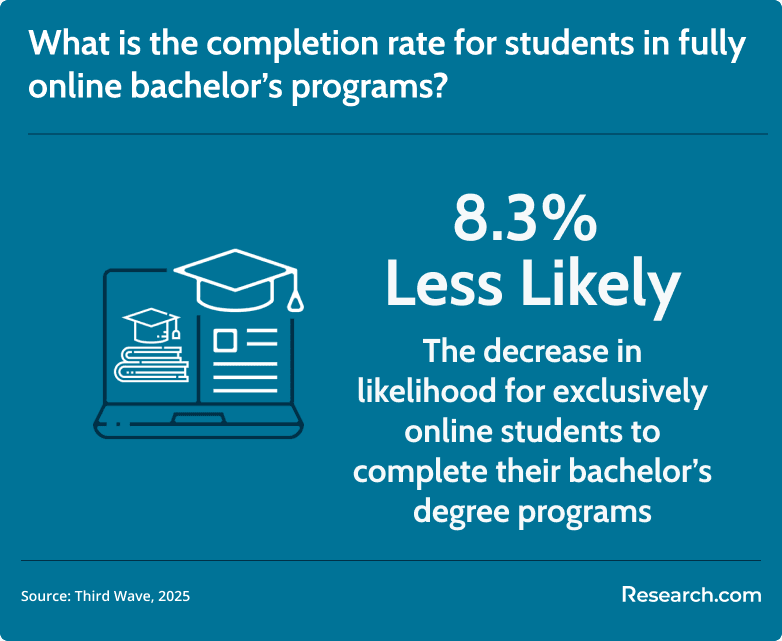
Fast programs can create pressure, especially for online learners balancing employment, caregiving, or military responsibilities. A Third Wave study published in 2024 reported that students in exclusively online degree programs were 8.3% less likely to complete a bachelor’s degree than peers who had some in-person instruction. That does not mean online degrees are a poor choice, but it does mean students should evaluate advising, engagement, course design, and completion support before enrolling.
- : "A faster anthropology degree is only helpful if you can finish it. Before choosing an accelerated online program, ask how the school supports online students who fall behind, need tutoring, or have to reduce their course load."
What Does an Accelerated Online Anthropology Program Cost?
The cost of an accelerated online anthropology bachelor’s degree varies by institution, residency status, tuition model, transfer credits, and fees. Many programs price tuition by the credit hour, while some use flat-rate tuition for students taking a minimum number of credits.
- Based on programs reviewed for this guide, online anthropology bachelor’s tuition commonly ranges from approximately $250 to over $500 per credit hour.
- For a 120-credit bachelor’s degree, tuition can total around $30,000 to over $60,000 before fees, books, and materials.
- Some schools, including Southern New Hampshire University, use one tuition rate for online students regardless of residency.
- Other institutions, such as Thomas Edison State University, may use flat-rate tuition for full-time students and different pricing for residents and non-residents.
- Additional expenses can include technology fees, textbooks, digital materials, graduation fees, fieldwork costs, transcript fees, and prior learning assessment charges.
| Cost factor | Why it matters | Question to ask |
| Transfer credits | Accepted credits reduce the number of courses you must pay for | How many of my credits apply directly to the anthropology degree requirements? |
| Residency pricing | Some public universities charge different rates for in-state and out-of-state students | Does the online program have separate resident and non-resident tuition? |
| Flat-rate tuition | Flat-rate pricing may benefit students taking a heavy full-time load | How many credits must I take to qualify for the flat rate? |
| Course availability | Unavailable required courses can delay graduation and increase living or opportunity costs | Are all required anthropology courses offered often enough for accelerated completion? |
| Fees and materials | Total cost can exceed tuition alone | What is the estimated full cost of attendance for online students? |
Students seeking lower-cost options should compare tuition after transfer credits, not just published per-credit rates. You can also review affordable online anthropology degree programs to identify schools where the total cost may be more manageable.
Financial Aid Options for Accelerated Online Anthropology Students
Online and accelerated students can often use the same major forms of financial aid as campus students, provided the institution is properly accredited and the student meets eligibility rules. The starting point is typically the Free Application for Federal Student Aid (FAFSA), which may provide access to Pell Grants, direct subsidized and unsubsidized loans, work-study programs, and other federal aid.
Other funding sources may include:
- Institutional scholarships and grants: Universities may offer schoolwide awards, department scholarships, completion grants, or emergency microgrants for eligible anthropology students.
- Anthropology and social science organizations: Groups such as the American Anthropological Association (AAA) and the Society for Visual Anthropology may support student research, projects, or conference participation.
- Private scholarships: Foundations, employers, nonprofit organizations, and community groups may fund students in anthropology, social sciences, public service, or related fields.
- State aid programs: Some states offer grant and scholarship programs for residents, adult learners, transfer students, and online students who meet eligibility rules.
- Employer tuition assistance: Working adults should ask whether their employer reimburses tuition for degrees connected to research, communication, diversity, community engagement, or public service roles.
An Ellucian report on college financial stress underscores why students should evaluate affordability before they enroll, not after the first bill arrives. Although scholarships specifically labeled for “accelerated online anthropology degrees” are uncommon, many anthropology, social science, transfer student, adult learner, and institutional awards may still apply if students meet the requirements.
According to College Board data, full-time undergraduate students received an average of $16,360 in financial aid during the 2023-2024 academic year. Students should still compare net price carefully because aid packages vary by school, income, dependency status, enrollment intensity, and prior borrowing.
Admission Requirements for Accelerated Online Anthropology Programs
Accelerated online anthropology bachelor’s programs generally use admissions requirements similar to traditional bachelor’s programs, but transfer-friendly and degree-completion programs may place extra emphasis on prior college performance. Because the pace is faster, schools may also expect applicants to demonstrate that they can succeed in an online environment.
| Requirement | What it usually means | Why it matters for fast completion |
| High school diploma or GED | Applicants generally need proof of secondary completion | First-time students must complete the full bachelor’s sequence unless they bring college credit |
| Minimum GPA | Competitive programs may expect a 2.5 to 3.0 GPA | Prior grades can affect admission, transfer eligibility, and scholarship consideration |
| Transfer credits or associate degree | Many accelerated pathways are designed for students with 30 to 60 transferable credits | Accepted credits can shorten the degree and reduce tuition |
| Prerequisite coursework | Schools may require English composition, social science, introductory anthropology, or sociology | Missing prerequisites can delay entry into upper-level anthropology courses |
| Test scores | Some institutions accept ACT/SAT scores, while many online programs are test-optional | Applicants should confirm current policy before spending time or money on testing |
| Technology access | Students need a reliable computer, internet access, and comfort using learning platforms | Technical barriers can quickly become academic barriers in condensed courses |
Many students entering accelerated bachelor’s programs, including those in fields such as an online social work degree, are transfer students or working adults. For these applicants, the most important step is getting a course-by-course transfer evaluation before committing to a school.
Common Courses in an Accelerated Online Anthropology Degree
Accelerated anthropology programs typically cover the same core content as traditional programs but deliver it in shorter terms or more flexible formats. Students should expect a mix of theory, research methods, subfield coverage, and applied learning.
- Introduction to Anthropology: A broad survey of anthropology, including cultural, biological, linguistic, and archaeological perspectives.
- Anthropological Theory: Study of major frameworks used to analyze culture, human behavior, society, adaptation, and change.
- Ethnographic Methods: Training in qualitative and quantitative research tools, participant observation, interview design, and fieldwork planning.
- Social and Cultural Anthropology: Examination of cultural variation, social organization, identity, globalization, and cross-cultural comparison.
- Biological/Evolutionary Anthropology: Study of human evolution, biological diversity, primatology, and relationships between biology and culture.
- Archaeology: Introduction to excavation, artifact interpretation, site analysis, preservation, and reconstruction of past societies.
- Statistics for Anthropology: Quantitative tools for interpreting anthropological and social science data.
- Applied Anthropology or Practicum: A capstone, project, or practice-based course using anthropological methods in a real or simulated setting.
Electives may allow students to focus on medical anthropology, environmental anthropology, museum studies, gender, migration, language, heritage management, or other areas. Students interested in communities, land use, and social systems may also compare anthropology with an online urban planning degree, especially if they want to work in community development or policy-adjacent roles.
Not every anthropology requirement can be fully replicated online. Programs with archaeology, field methods, or lab-oriented components may require in-person field school, local fieldwork, or approved practical experiences. Students should ask about this before enrolling, especially if relocation or travel is not possible.
Anthropology Specializations Available Online
Specializations help students connect anthropology coursework with career goals. Not every online program offers every track, so students should review the course catalog, not just the program title.
| Specialization | What you study | May fit students interested in |
| Cultural Anthropology | Human cultures, social systems, identity, community life, and cross-cultural interaction | Community programs, research, international work, public service, communications |
| Archaeology | Past societies, excavation, artifacts, preservation, and material culture | Cultural resource management, museums, heritage work, graduate study |
| Biological/Evolutionary Anthropology | Human evolution, primates, biological variation, adaptation, and the biology-culture relationship | Research support, health-related pathways, graduate anthropology programs |
| Museum Studies | Curation, collections care, interpretation, preservation, and public education | Museums, archives, cultural institutions, historical organizations |
| Linguistic Anthropology | Language, meaning, communication, sociolinguistics, and cultural context | Education, research, international development, communications |
| Environmental Sustainability | Human-environment relationships, conservation ethics, sustainability, and cultural approaches to ecology | Environmental programs, conservation, sustainability-focused organizations |
| Applied Anthropology | Use of anthropological research methods in organizations, communities, government, healthcare, and business | Program evaluation, user research, public agencies, nonprofit work |
| Medical Anthropology | Cultural understandings of health, illness, medicine, care systems, and global health | Public health, community health, healthcare research, global health programs |
Archaeology can be a natural fit for students who also enjoy history; those comparing related humanities pathways may want to review fast online bachelor’s in history degree programs. Students drawn to environmental sustainability can also explore how to become a conservationist. If your interest is forensic anthropology, compare programs carefully and review how anthropology connects with different forensic science fields.
To better understand where anthropology expertise is used in the labor market, review the employment data for anthropologists and archaeologists by industry below.
How to Choose the Best Accelerated Online Anthropology Program
The best accelerated online anthropology program is the one you can complete, afford, and use for your next step. A school with short courses is not automatically the best choice if it accepts few transfer credits, offers limited advising, or lacks electives related to your goals. Students interested in broader cultural, ethical, or religious dimensions of human societies may also compare anthropology with online theology degrees, but the two paths serve different academic and career purposes.
Key factors to compare
- Accreditation: Confirm that the institution is accredited by a recognized accreditor. Accreditation affects federal financial aid, transfer credit, graduate admissions, and employer recognition.
- Course length: Short 7.5-week or 8-week terms can speed completion, but they also compress assignments, exams, discussions, and projects.
- Start dates: Programs with multiple start dates reduce waiting time and help students maintain momentum.
- Transfer credit policy: Ask how many credits can transfer and how they apply to general education, electives, and major requirements.
- Upper-division course availability: A program may accept many credits but still delay graduation if required anthropology courses are offered infrequently.
- Online student support: Look for advising, writing help, research support, library access, career services, tutoring, and technical support designed for online learners.
- Specialization fit: Choose a program with electives or concentrations tied to your goals, such as archaeology, cultural anthropology, medical anthropology, or sustainability.
- Total cost: Compare net price after aid and transfer credits, not only tuition per credit.
- Fieldwork expectations: Ask whether any in-person field school, practicum, internship, or local placement is required.
Questions to ask before you apply
| Question | Why it matters |
| How many of my credits will apply to the anthropology major? | A large transfer total does not help if credits only count as electives. |
| Can I finish in the advertised accelerated timeline with my remaining requirements? | Some timelines assume full-time or overloaded enrollment. |
| Are courses asynchronous, synchronous, or mixed? | Live class times can affect students with work or family obligations. |
| What happens if I need to slow down for one term? | Changing pace can affect aid, graduation date, and course sequencing. |
| Does the program include fieldwork or in-person requirements? | Travel requirements can add cost and scheduling challenges. |
| What career support is available to online anthropology students? | Anthropology students often need help translating broad skills into job-specific résumés. |
| What is the full online cost of attendance? | Fees and materials can change the true price of the degree. |
EducationDynamics reports that many modern learners consider at least two or three institutions during the early enrollment process. That is a smart approach for anthropology students because transfer evaluations, pricing, and course availability can differ significantly from one school to another.
Career Paths With an Online Anthropology Degree
An online anthropology degree can prepare graduates for roles that use research, cultural analysis, communication, and human behavior insights. However, many jobs will not have “anthropologist” in the title. Students should plan early for internships, writing samples, research projects, data skills, and specialization-specific experience.
| Career path | Typical focus | How anthropology helps |
| Curator | Manages collections, develops exhibits, and interprets cultural materials | Provides cultural context, research skills, and preservation awareness |
| Education Coordinator | Creates educational programs for museums, nonprofits, or public organizations | Supports culturally informed learning design and public communication |
| Cultural Resource Manager | Helps identify, document, and protect heritage resources | Connects archaeology, preservation, regulation, and community context |
| Community Outreach Coordinator | Builds relationships between organizations and communities | Uses cross-cultural communication and qualitative research |
| Community Liaison | Represents community needs and supports collaboration | Applies cultural understanding, listening, and stakeholder analysis |
| Corporate Ethnographer | Studies workplace culture, customer behavior, and product use | Uses ethnographic methods to interpret real-world behavior |
| Archaeological Field Technician | Assists with surveys, documentation, excavation, and cultural resource projects | Applies archaeology, field methods, and artifact analysis |
Students interested in nonprofit leadership after gaining experience may later compare options such as fast-track online MBA in nonprofit management programs. Anthropology graduates may also explore adjacent social science roles; for example, understanding sociology salary and career paths can help students compare related occupations that use social research and human behavior analysis.
Graduates may also work in cultural tourism, publishing, communications, law enforcement support, public agencies, user research, or community-based organizations. Students aiming for advanced research, college teaching, or specialized anthropologist roles should expect to consider graduate study.
Job Market for Online Anthropology Degree Graduates
The labor market for anthropology graduates is broad but competitive. The number of positions with the exact title “anthropologist” is limited, but anthropology skills can transfer to research, education, museums, community engagement, cultural resource management, market research, and human-centered design roles.
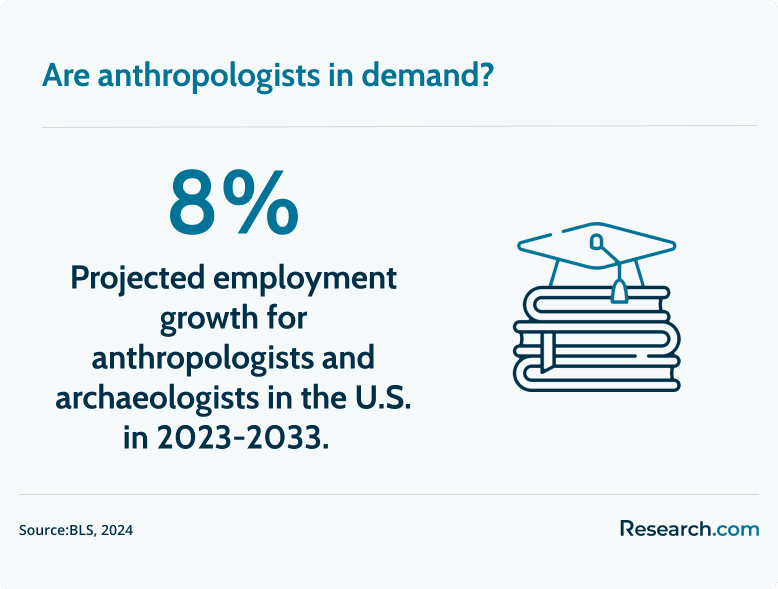
The U.S. Bureau of Labor Statistics projects that employment for anthropologists and archaeologists will grow 8% from 2023 to 2033, equal to 800 jobs each year during that period. Students should interpret this carefully: growth is positive, but the occupation is small, so graduates should build practical skills and consider related roles.
O*NET OnLine lists the following 2023-2033 employment projections for related roles that may connect with anthropology training:
- Anthropology and Archaeology Postsecondary Teachers: 4%
- Human Factors Engineers and Ergonomists: 12%
- Market Research Analysts and Marketing Specialists: 8%
- Sociologists: 7%
- Museum Technicians and Conservators: 11%
To compete well, anthropology graduates should translate their degree into employer-ready evidence: research projects, writing samples, data analysis experience, fieldwork, internships, community partnerships, and examples of cross-cultural communication. When building a résumé, review the skills employers look for in college student résumés and connect those skills directly to your anthropology coursework.
Student Perspectives on Accelerated Online Anthropology Degrees
- Gloria: "The accelerated online format helped me finish a year earlier than I expected while I continued working full time. The schedule was flexible, but the courses still required steady effort and participation. The experience strengthened my confidence in cultural research and helped me stay on track without relocating."
- Zuma: "Studying anthropology online exposed me to classmates and case studies from different cultural settings. Virtual fieldwork and collaborative research projects helped me connect theory to international development issues, and the faster format kept me focused from term to term."
- Moses: "The online anthropology degree let me study human behavior while keeping my job in community outreach. The short courses were demanding, but I could apply ideas from class directly to my work with local groups and public programs."
Is an Accelerated Online Anthropology Degree Accredited and Recognized?
An accelerated online anthropology degree is generally recognized when it comes from an appropriately accredited institution. Accreditation is one of the first things students should verify because it affects federal financial aid, transfer credit, graduate school eligibility, and employer confidence. For bachelor’s programs, institutional accreditation is especially important.
Do not assume a program is acceptable simply because it is online, fast, or offered by a familiar school name. Check the school’s accreditation status through official sources, confirm that the online program is offered by the accredited institution, and ask whether credits will transfer if you later change schools or pursue graduate study. Working adults who need lower-cost accredited options can also compare the most affordable online schools for working adults.
Is an Accelerated Online Anthropology Degree Worth the Cost?
An accelerated online anthropology degree can be cost-effective if it helps you use transfer credits, avoid relocation, continue working, qualify for financial aid, and finish sooner without sacrificing academic quality. The return on investment depends on your career goals, the school’s total cost, your remaining credits, and how well you build job-ready experience during the program.
This degree may be a strong investment if you want a flexible social science background, plan to work in community programs or cultural resource settings, or intend to continue to graduate school. It may be less ideal if you expect a bachelor’s degree alone to guarantee a specialized anthropologist role or a specific salary outcome. Students who want to improve employability after graduation may later consider targeted credentials, including an affordable graduate certificate program, but only if the certificate supports a clear career goal.
Common Mistakes to Avoid
- Choosing only by speed: A fast schedule is not helpful if the program lacks the courses, support, or recognition you need.
- Ignoring accreditation: Always verify institutional accreditation before applying or using financial aid.
- Assuming all transfer credits count toward graduation: Credits may transfer as electives but not satisfy anthropology, general education, or upper-division requirements.
- Looking only at tuition per credit: Fees, books, fieldwork, technology costs, and lost transfer credits can change the true price.
- Underestimating 7.5-week courses: Short courses often require more frequent reading, writing, and discussion deadlines.
- Skipping career planning: Anthropology is versatile, but students need internships, research samples, data skills, and a clear explanation of how their degree fits the job.
- Assuming online means no in-person requirements: Archaeology and field methods courses may still require field school, local projects, or approved practical experiences.
Key Insights
- The fastest online anthropology degree path usually depends more on transfer credits, short terms, and year-round enrollment than on a program officially being labeled “accelerated.”
- Most bachelor’s programs still require 120 credits, but students with an associate degree or substantial transfer credit may finish much faster than first-time students.
- Arizona State University, Southern New Hampshire University, Thomas Edison State University, University of Florida, and University of Houston-Clear Lake all offer online anthropology pathways with features that may support faster completion.
- Program cost varies widely, so compare total cost after transfer credits, aid, fees, and residency pricing rather than relying on the advertised per-credit rate alone.
- Accreditation is non-negotiable. It affects financial aid, credit transfer, graduate school options, and employer recognition.
- Accelerated online study is convenient but demanding. Students should confirm advising, tutoring, course availability, and fieldwork expectations before enrolling.
- Anthropology graduates often find opportunities outside jobs titled “anthropologist,” so career preparation should include research projects, writing samples, data skills, internships, and clear résumé language.
References:
- EducationDynamics (February 2025). Engaging the Modern Learner: 2025 Report on the Preferences & Behaviors Shaping Higher Ed. https://insights.educationdynamics.com/rs/183-YME-928/images/EDDY-Modern-Learner-Report-2025.pdf
- Ma, J. et al. (2024). Trends in College Pricing and Student Aid 2024. College Board. https://research.collegeboard.org/media/pdf/Trends-in-College-Pricing-and-Student-Aid-2024-ADA.pdf
- O*NET OnLine (n.d.). O*NET OnLine Help. https://www.onetonline.org/help/online/find_occ Data retrieved August 2025
- Ortagos, J. et al. (October 2024). Can Fully Online Degree Programs Boost College Completion? Third Wave. https://www.thirdway.org/report/can-fully-online-degree-programs-boost-college-completion?utm_source=Pardot&utm_medium=email
- U.S. Bureau of Labor Statistics (n.d.). Occupational Employment and Wage Statistics (OEWS) Profiles, May 2024 OEWS Profiles. https://data.bls.gov/oesprofile Data retrieved August 2025
- U.S. Bureau of Labor Statistics (April 2025). Anthropologists and Archeologists. https://www.bls.gov/ooh/life-physical-and-social-science/anthropologists-and-archeologists.htm
- U.S. Bureau of Labor Statistics (April 2025). Life, Physical, and Social Science Occupations. https://www.bls.gov/ooh/life-physical-and-social-science
Other Things You Need to Know About Fast-Track Online Anthropology Degrees
Yes. Most accelerated online anthropology bachelor’s programs require a capstone, and some also require a thesis or research project. Capstones are often completed in the final 1–2 terms and may carry 3–6 credit hours, with faculty approval needed before registration.
Admission to the fastest online anthropology degree programs in 2027 typically requires a high school diploma or equivalent, a minimum GPA of 3.0, and submission of standardized test scores like the SAT or ACT. Some programs may also need letters of recommendation and a personal statement.