
2027 What Does a Production Planner Do: Responsibilities, Requirements, and Salary

Co-Founder and Chief Data Scientist
Production planning is the job of turning customer demand, material availability, machine capacity, labor schedules, and delivery deadlines into a workable manufacturing plan. In an economy that produces $34.8 trillion worth of goods every year, even small planning errors can create missed shipments, excess inventory, overtime costs, and frustrated customers.
This career is a strong fit for people who like data, schedules, operations, and practical problem-solving. Production planners sit between the shop floor and the broader supply chain. They do not usually design products or run machines themselves; instead, they make sure the right work happens at the right time with the right materials and resources.
This guide explains how to become a production planner in 2027, including the education employers commonly expect, the skills and software that matter, useful certifications, typical workplaces, salary expectations, career progression, specializations, and common challenges in the role.
Key Things to Know About Becoming a Production Planner
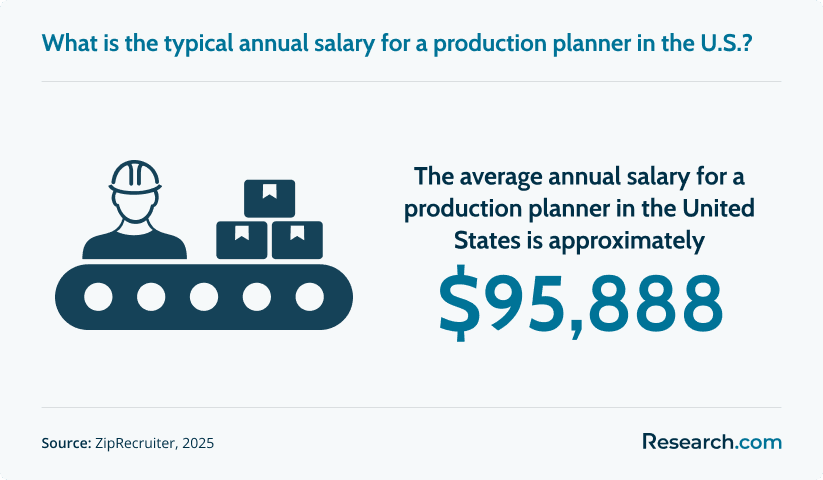
- Production planners in the U.S. earn an average of $95,888 per year.
- Planners can work across manufacturing, aerospace, pharmaceuticals, and food production.
- Many professionals advance into roles like supply chain analyst, operations manager, or plant manager within 5-7 years of experience.
What is the role of a production planner?
A production planner builds and manages the schedule that keeps manufacturing moving. The role connects demand forecasts, customer orders, inventory levels, labor capacity, machine availability, supplier lead times, and quality requirements into a plan the production team can execute.
In practical terms, production planners answer questions such as: What should be produced today? Which materials are available? Which orders should be prioritized? Can the plant meet the delivery date? What happens if a supplier is late, a machine goes down, or demand changes?
Core responsibilities of a production planner
- Creating production schedules: Translating demand, orders, and forecasts into daily, weekly, or monthly production plans.
- Checking material availability: Coordinating with procurement and inventory teams to confirm that raw materials, components, and packaging are ready when needed.
- Monitoring capacity: Reviewing machine time, labor availability, setup times, and maintenance windows to prevent overloads or idle time.
- Coordinating across teams: Working with manufacturing, procurement, logistics, sales, warehouse, and quality teams to keep plans realistic and aligned.
- Adjusting plans quickly: Reworking schedules when demand changes, materials arrive late, equipment fails, or urgent orders appear.
- Tracking performance: Reviewing output, delays, inventory shortages, production bottlenecks, and schedule adherence.
A typical day may start with reviewing open orders, current production status, inventory levels, and any delayed materials. From there, the planner updates schedules, resolves conflicts, communicates changes to affected teams, and checks whether upcoming production runs are still feasible.
Production planners are different from supply planners and operations planners. Supply planners focus more heavily on sourcing, replenishment, and material availability. Operations planners usually work at a broader level, improving how departments, systems, and resources operate across the organization. Production planners are closer to the day-to-day manufacturing schedule and the immediate decisions that keep the factory running.
What education is required to become a production planner?
A bachelor’s degree is typically required to become a production planner, especially for roles in larger manufacturing companies or complex supply chain environments. Common majors include business administration, operations management, supply chain management, industrial engineering, logistics, and manufacturing management.
The degree does not have to carry the exact title “production planning.” Employers usually look for evidence that a candidate understands operations, data, inventory, scheduling, process improvement, and cross-functional coordination.
According to Zippia, 64% of production planners have a bachelor's degree, while 19% hold an associate's degree. This means a bachelor’s degree is the most common route, but it is not the only possible path. Some employers may consider candidates with an associate degree if they also have strong manufacturing, logistics, inventory, warehouse, or scheduling experience.
Best-fit fields of study
- Supply chain management: Strong preparation for inventory control, procurement coordination, forecasting, and supplier-related planning issues.
- Operations management: Useful for understanding capacity, workflow, process efficiency, and production performance.
- Industrial engineering: A strong technical route for candidates interested in process optimization, lean manufacturing, and complex production systems.
- Business administration: A flexible option that can work well if paired with internships, analytics coursework, or manufacturing experience.
- Logistics or manufacturing management: Practical preparation for scheduling, materials flow, warehouse coordination, and shop-floor operations.
Certifications can also strengthen a candidate’s profile, particularly for people whose degree is not directly tied to manufacturing or supply chain work. The Certified in Production and Inventory Management (CPIM) and Certified Supply Chain Professional (CSCP) credentials are two common options for building credibility in planning and supply chain roles.
Some schools offer more focused training. For example, Southwest Wisconsin Technical College provides a Production Planner Pathway Certificate. It can support movement into advanced roles in supply chain management or engineering management. Readers comparing longer-term management pathways may also find it useful to review what you can do with an Engineering Management MBA.
What skills are essential for a production planner to succeed?
Successful production planners combine analytical thinking with practical communication. They must be comfortable working with data, but they also need to understand how decisions affect people on the shop floor, suppliers, customers, and managers.
According to the National Association of Colleges and Employers (NACE), nearly 90% of employers say problem-solving skills are what they look for when reviewing candidates. That matters in production planning because the schedule rarely stays perfect. Materials arrive late, machines fail, urgent orders appear, and demand forecasts change. A good planner can assess the trade-offs and choose the least disruptive option.
Essential production planning skills
- Analytical skills: Production planners must interpret demand forecasts, inventory reports, production metrics, lead times, and capacity data. Strong analytical ability helps them spot shortages, bottlenecks, and schedule risks before they become major problems.
- Problem-solving and decision-making: Planners often make time-sensitive decisions with incomplete information. They must compare options quickly, understand operational consequences, and communicate the revised plan clearly.
- ERP and MRP system proficiency: Employers value candidates who can use enterprise resource planning and material requirements planning systems to manage schedules, inventory, orders, bills of materials, and production workflows.
- Time management and organization: The role involves multiple deadlines, product lines, departments, and priorities. Poor organization can lead to missed orders, duplicate work, or inaccurate schedules.
- Communication and teamwork: Production planners work closely with procurement, production, sales, logistics, warehouse, and quality teams. The communication demands are similar to the coordination skills often discussed in career paths for strategic communications majors, although the production planning context is more operational and data-driven.
- Attention to detail: Small errors in quantities, dates, part numbers, changeovers, or material availability can create costly disruptions. Detail orientation is especially important in regulated or high-volume manufacturing.
- Adaptability: Manufacturing conditions change constantly. Planners need to revise schedules without losing control of priorities, costs, or customer commitments.
- Basic financial awareness: Planners do not always own budgets, but they should understand how overtime, expediting, excess inventory, downtime, scrap, and missed shipments affect cost.
Common mistake to avoid
One of the biggest mistakes new planners make is treating the schedule as a spreadsheet exercise rather than an operational commitment. A schedule must reflect real machine capacity, real labor availability, real supplier constraints, and real quality requirements. Strong planners verify assumptions instead of simply moving dates on a screen.
What certifications or licenses are valuable for production planners?
Production planners usually do not need a government-issued license. Certifications, however, can be valuable because they show employers that a candidate understands planning systems, inventory control, supply chain coordination, process improvement, and logistics.
Certification is especially useful for three groups: entry-level candidates trying to stand out, experienced manufacturing employees moving into planning, and current planners pursuing senior or management roles. Credentialled professionals in supply chain roles earn 15-20% more than their non-certified peers.
Useful certifications for production planners
- Certified in Production and Inventory Management (CPIM): Offered by the Association for Supply Chain Management (ASCM), this credential is one of the most directly relevant options for production planners. It focuses on demand management, scheduling, inventory control, material planning, and production planning.
- Certified Supply Chain Professional (CSCP): Also offered by ASCM, this certification covers broader end-to-end supply chain operations. It can be a good fit for planners who want to move into supply chain leadership or roles that connect production with suppliers, logistics, and customers.
- Six Sigma Green: This credential focuses on process improvement and quality control. It is useful for planners working in environments where waste reduction, defect prevention, throughput, and continuous improvement are priorities.
- Certified Professional in Supply Management (CPSM): Offered by the Institute for Supply Management (ISM), this certification is helpful for planners whose roles overlap with procurement, supplier coordination, sourcing, or materials management.
- Certified in Logistics, Transportation & Distribution (CLTD): Also from ASCM, this credential is relevant when the planner’s work extends beyond production into warehousing, distribution, fulfillment, or transportation planning.
How to choose the right credential
For most production planning roles, CPIM is the most targeted starting point. CSCP is better for people who want a wider supply chain perspective. Six Sigma is useful if the company emphasizes lean operations, quality improvement, and waste reduction. CPSM and CLTD are best when planning work overlaps strongly with purchasing, supplier management, warehousing, or distribution.
What are the most popular production planning tools?
Production planning tools help manufacturers turn orders, forecasts, materials, labor, and capacity into usable schedules. These systems reduce manual work, improve visibility, and help planners respond faster when conditions change. The global market for production-planning software alone was valued at approximately USD 2.5 billion in 2024 and is expected to grow strongly in the coming years.
The right tool depends on company size, manufacturing complexity, budget, integration needs, and the skill level of the planning team. Large companies often use enterprise platforms, while smaller manufacturers may prefer simpler systems that are faster to implement.
Popular production planning tools
- SAP S/4HANA: A major enterprise-level system with modules for production planning, scheduling, materials management, and real-time analytics. It is commonly used in complex organizations that need deep integration across finance, procurement, manufacturing, logistics, and inventory.
- Oracle NetSuite ERP: A cloud-based ERP solution often used by mid-sized manufacturing firms. It supports job scheduling, order management, production workflows, inventory control, and business reporting.
- Microsoft Dynamics 365 Supply Chain Management: A platform for production planning, scheduling, inventory, digital twins, and IoT-enabled shop-floor visibility. It can be useful for organizations already invested in Microsoft business systems.
- MRPeasy: A user-friendly option for small and medium manufacturers. It supports production planning, inventory management, purchasing, and manufacturing operations without the complexity of larger enterprise systems.
- DELMIAWorks (formerly IQMS): A manufacturing-focused platform that integrates production planning, scheduling, quality control, and business operations in one system.
What to learn first
Aspiring production planners do not need to master every platform. It is more important to understand the logic behind planning systems: bills of materials, routings, lead times, work orders, inventory transactions, safety stock, capacity constraints, and schedule changes. Once those concepts are clear, learning a specific ERP or MRP tool becomes much easier.
Where do production planners usually work?
Production planners usually work in manufacturing environments where schedules, material availability, and output targets must be tightly coordinated. They may work on-site at a plant, in a corporate supply chain office, or in a hybrid arrangement, depending on the company and the level of shop-floor interaction required.
The role exists across many industries because any organization that produces goods at scale needs to coordinate orders, materials, capacity, and delivery timing.
Common workplaces for production planners
- Manufacturing Plants: About 30% of production planners in the U.S. work in manufacturing plants. These planners are close to daily operations and often handle scheduling, materials checks, work order tracking, and production target monitoring.
- Transportation Equipment Manufacturing: This sector often involves multi-stage assembly, complex parts flow, supplier coordination, and strict delivery schedules. Planners may work with long lead times and highly sequenced production processes.
- Fabricated Metal Product Manufacturing: Planners in this environment schedule production runs for parts, tooling, machining, fabrication, and finishing. They must account for machine availability, setup time, maintenance windows, and customer due dates.
- Chemical and Pharmaceutical Manufacturing: These workplaces require careful coordination with quality, safety, batch control, regulatory, and compliance requirements. Planning mistakes can create serious cost and compliance risks.
- Food and Beverage Manufacturing: Planners manage perishable materials, packaging schedules, sanitation windows, seasonal demand, and shelf-life constraints.
- Large Private Companies: About 43% of production planners are employed in large firms with over 10,000 employees. These roles may involve more specialized systems, larger teams, more formal processes, and closer coordination with procurement, logistics, finance, and operations leadership.
Smaller manufacturers may give production planners broader responsibilities, including purchasing, inventory control, customer service coordination, and shipping support. Larger manufacturers may divide these duties across specialized roles, which can create clearer promotion paths but narrower day-to-day responsibilities.
What is the average salary of a production planner?
In the United States, the average salary for a production planner in 2027 is approximately $95,888 per year. The salary range varies by experience, industry, location, employer size, planning complexity, and software expertise. The 25th percentile is around $82,000, while the 75th percentile climbs to approximately $111,500 annually.
Salary should be evaluated in context. A planner working in a high-volume, multi-site, regulated, or capital-intensive manufacturing environment may face more complexity than someone managing a smaller and more stable production schedule. Employers may pay more for planners who can work independently, improve schedule reliability, use advanced ERP systems, reduce inventory problems, or coordinate across multiple departments.
Factors that can affect production planner pay
- Experience level: Entry-level planners typically focus on schedule support, data entry, work order updates, and basic coordination. More experienced planners may own product lines, manage escalations, mentor junior staff, or influence capacity and inventory strategy.
- Industry: Pay can differ across food production, aerospace, pharmaceuticals, automotive, electronics, fabricated metal products, and other manufacturing sectors.
- Company size: Large companies may offer more structured pay scales, broader benefits, and specialized planning roles, while smaller firms may offer wider responsibilities and faster exposure to operations.
- Technical skills: ERP, MRP, analytics, forecasting, and process improvement skills can improve competitiveness for higher-paying roles.
- Location: Regions with higher cost-of-living or dense manufacturing activity may offer higher compensation, though pay should always be compared with local expenses.
The pattern is similar to broader management and engineering-adjacent roles, where compensation often rises with technical complexity, leadership scope, and industry demand. Readers comparing related management pathways can also review master's in engineering management salary considerations.
What is the typical career progression for a production planner?
Production planning offers a clear path from coordinator-level roles to senior planning, supply chain, and operations leadership positions. Progression depends on performance, industry, company size, software skill, communication ability, and the complexity of the production environment.
Common career path
- Planning assistant, junior planner, or planning coordinator: Early roles often involve updating schedules, tracking materials, entering work orders, preparing reports, and supporting senior planners.
- Production planner: Within two to five years, many professionals move into full production planner roles. At this stage, they may own schedules, coordinate with manufacturing and procurement, resolve shortages, and manage day-to-day planning decisions.
- Senior production planner: After about five to eight years, experienced planners may handle larger production scopes, multiple product lines, more complex constraints, and higher-impact schedule decisions. They may also mentor junior staff.
- Lead planner or planning manager: Often within ten years, strong planners can move into roles that oversee planning teams, improve processes, manage performance metrics, and coordinate with operations leadership.
- Supply chain, materials, or operations leadership: Some planners move into materials management, supply chain analytics, demand planning, master scheduling, operations strategy, or plant leadership roles.
Certifications such as Lean Six Sigma or APICS CPIM can support faster advancement because they demonstrate knowledge of process efficiency, inventory planning, production control, and demand management. Just as important, however, is a record of solving real operational problems: reducing schedule instability, improving on-time production, cutting material shortages, or helping teams use planning systems more effectively.
Some professionals also make lateral moves into fields that require planning, coordination, analytics, and operational judgment. Those comparing broader cross-functional business and leadership options may find useful context in career guides such as what you can do with a dual MSN MBA degree.
Are there specialized fields within production planning?
Yes. Production planning has several specialized paths, especially as manufacturers adopt more digital tools, automated systems, complex supply networks, and sustainability goals. The shift toward digital operations is clear, with 60% of manufacturers saying digital transformation has already improved their efficiency and product quality.
Specialization can help planners move toward higher-responsibility roles because it gives them deeper expertise in a specific production environment or planning challenge.
Common production planning specializations
- Global Operations Planning: Focuses on coordinating production across multiple plants, regions, or countries. Planners in this area manage time zones, supplier lead times, international logistics, regional regulations, and production balancing across sites.
- Custom and High-Mix Manufacturing: Involves short production runs, frequent changeovers, engineering changes, and customer-specific orders. This path is common in electronics, specialty manufacturing, fashion, and other environments where standard mass production is not the main model.
- Sustainable Manufacturing Planning: Centers on reducing waste, improving material use, cutting energy-related inefficiencies, and aligning schedules with environmental or compliance goals. This work often requires coordination with sustainability, compliance, training, and operations teams. Professionals interested in structured learning design and workforce training may also compare related education options such as online master's in instructional design programs.
- AI-Driven or Predictive Planning: Uses data analytics, ERP systems, and AI tools to forecast demand, identify bottlenecks, simulate scenarios, and optimize inventory decisions. This specialization is growing as manufacturers seek faster and more accurate planning methods.
- Capacity and Resource Planning: Focuses on balancing machine capacity, labor, materials, maintenance schedules, and production targets. These planners help prevent overloading resources while keeping output aligned with demand.
How to choose a specialization
Choose a specialization based on the manufacturing environment you enjoy most. If you like complex networks and supplier coordination, global operations planning may fit. If you prefer data and forecasting, predictive planning may be stronger. If you enjoy continuous improvement and environmental goals, sustainable manufacturing planning may be a better match. If you like solving practical shop-floor constraints, capacity and resource planning can be a strong path.
What are the most common challenges production planners face?
Production planners work in a role where many problems are urgent, interconnected, and visible. A material shortage can delay production. A machine failure can disrupt customer shipments. A forecast change can create excess inventory or overtime. The best planners do not eliminate uncertainty; they build systems and habits that help teams respond to it faster.
Major challenges in production planning
- Talent and skills shortage: The U.S. manufacturing sector is projected to face over 2.1 million unfilled jobs by 2030 due to a persistent skills gap. This shortage increases demand for planners who understand manufacturing, data, systems, and coordination.
- Lack of process visibility: Manufacturing executives often struggle to turn production data into actionable insights because information is spread across disconnected systems or departments. For planners, this makes data literacy and software proficiency increasingly valuable.
- Supply chain disruptions and material delays: In 2021, nearly 90% of manufacturers reported that supply chain disruptions had a direct impact on their business operations. Production planners must know how to prioritize orders, identify substitutes when appropriate, communicate delays, and revise schedules without creating unnecessary chaos.
- Outdated or fragmented planning systems: Around 54% of manufacturers still rely on spreadsheets or disconnected systems for scheduling. This creates version-control problems, slow updates, limited visibility, and higher error risk. Planners who can use modern ERP and AI-powered planning tools have a practical advantage.
- Equipment downtime and capacity constraints: Unplanned downtime costs the world’s top companies about $1.4 trillion annually. Planners must coordinate with maintenance, production supervisors, and operations leaders to account for downtime risk and realistic capacity.
How strong planners manage these challenges
- They verify constraints before finalizing schedules. A realistic schedule is better than an optimistic one that fails immediately.
- They communicate changes early. Procurement, production, sales, logistics, and customer-facing teams need time to react.
- They document assumptions. Notes about lead times, capacity, substitutions, and priority decisions help teams understand why a plan changed.
- They track recurring problems. Repeated shortages, downtime, or forecast errors should lead to process fixes, not just daily firefighting.
- They keep learning systems and analytics. Software skills are becoming more important as manufacturing planning becomes more data-driven.
Here's What Production Planners Have to Say About Their Careers
- : "My operations management degree focused a lot on logistics, but I discovered my real interest was in production flow. Joining a manufacturing firm as a production planner let me apply everything I learned, from ERP systems to lean strategies. Seeing data-driven planning actually cut waste in my team made all the late nights in class worth it. — John Rie"
- : "I graduated from a supply chain management program without knowing exactly where I’d fit in. A mentor suggested production planning, and it turned out to be the perfect blend of analysis and teamwork. Two years later, I’m overseeing scheduling for an aerospace line, and it’s incredibly rewarding to see how every plan I make keeps the system moving. — Lesyel"
- : "I completed a certification in supply chain analytics after my business degree, and that opened the door to production planning. Now I work in a food manufacturing company where I coordinate materials, staff, and delivery schedules. It’s challenging, but there’s a deep satisfaction in seeing how smart planning keeps an entire line running on time. — Zack"
Key Findings
- Production planners keep manufacturing schedules realistic and executable. They coordinate materials, labor, capacity, demand, and deadlines so production teams can meet output goals.
- A bachelor’s degree is the most common education path. According to Zippia, 64% of production planners have a bachelor's degree, while 19% hold an associate's degree.
- Relevant majors include supply chain management, operations management, business administration, logistics, industrial engineering, and manufacturing management. Experience in manufacturing, inventory, procurement, or scheduling can also help candidates qualify.
- Problem-solving is central to the role. Nearly 90% of employers say problem-solving skills are what they look for when reviewing candidates, according to the National Association of Colleges and Employers (NACE).
- Certifications can improve competitiveness. CPIM is especially relevant for production and inventory management, while CSCP, Six Sigma Green, CPSM, and CLTD can support broader supply chain, process improvement, procurement, or logistics goals.
- Software skills matter. Common tools include SAP S/4HANA, Oracle NetSuite ERP, Microsoft Dynamics 365 Supply Chain Management, MRPeasy, and DELMIAWorks.
- Production planners work across many manufacturing sectors. Common settings include manufacturing plants, transportation equipment manufacturing, fabricated metal product manufacturing, chemical and pharmaceutical manufacturing, food and beverage manufacturing, and large private companies.
- The average U.S. salary is approximately $95,888 per year in 2027. The 25th percentile is around $82,000, while the 75th percentile is approximately $111,500 annually.
- Career growth can lead to senior planning and management roles. Many planners progress from coordinator roles to production planner, senior production planner, lead planner, planning manager, or related supply chain and operations roles.
- The field is becoming more specialized and technology-driven. Growth areas include global operations planning, high-mix manufacturing, sustainable manufacturing planning, AI-driven planning, and capacity and resource planning.
Other Things You Should Know About What a Production Planner Does
In 2027, a production planner often needs to be proficient in enterprise resource planning (ERP) software like SAP or Oracle, as well as Microsoft Excel for data analysis and scheduling. Familiarity with project management tools can also be beneficial.
In 2027, key responsibilities of a production planner include coordinating production schedules, ensuring resource availability, balancing supply and demand, and improving process efficiencies. Planners must also facilitate effective communication across departments, adhere to safety and quality standards, and leverage technology for data analysis and forecasting.
APICS certification is not required, but many employers prefer it for production planner roles. The main credential is CPIM from the Association for Supply Chain Management, which covers inventory, planning, and operations. Candidates usually need production or supply chain experience plus a bachelor’s degree in a related field.
References
- Bureau of Labor Statistics. (n.d.). Industrial production managers. U.S. Department of Labor. Retrieved from https://www.bls.gov/ooh/management/industrial-production-managers.htm
- Data USA. (n.d.). Production, planning, & expediting clerks. Retrieved from https://datausa.io/profile/soc/production-planning-expediting-clerks
- Gitnux. (2025, April 29). Digital transformation in the manufacturing industry statistics. Retrieved from https://gitnux.org/digital-transformation-in-the-manufacturing-industry-statistics/
- Manufacturing Today India. (n.d.). Six critical challenges in production management and how to overcome them. Retrieved from https://www.manufacturingtodayindia.com/six-critical-challenges-in-production-management-and-how-to-overcome-them
- National Association of Colleges and Employers. (2024, November). Job outlook 2025. Retrieved from https://www.naceweb.org/research/reports/job-outlook/2025
- National Association of Colleges and Employers. (n.d.). What are employers looking for when reviewing college students’ resumes? Retrieved from https://www.naceweb.org/talent-acquisition/candidate-selection/what-are-employers-looking-for-when-reviewing-college-students-resumes
- Supply Chain Analytics. (2025). Supply chain certifications 2025. Retrieved from https://supplychainanalytics.in/supply-chain-certifications-2025/
- ZipRecruiter. (n.d.). Production planner scheduler 3 salary. Retrieved from https://www.ziprecruiter.com/Salaries/Production-Planner-Scheduler-3-Salary
- Zippia. (n.d.). Production planner education. Retrieved from https://www.zippia.com/production-planner-jobs/education/


