
2027 Nurse Attorney Careers: Skills, Education, Salary & Job Outlook

Co-Founder and Chief Data Scientist
Becoming a nurse attorney is not a quick career pivot. It requires two professional identities: licensed nurse and licensed attorney. That usually means completing nursing education, passing the NCLEX-RN, building clinical judgment through practice, earning a Juris Doctor, and passing a state bar exam. The question is not only whether you can do it, but whether the time, cost, and career trade-offs fit your goals.
For nurses who are drawn to advocacy, risk management, malpractice litigation, compliance, patient rights, or healthcare policy, the path can be worth serious consideration. Nurse attorney careers combine clinical credibility with legal authority, which can lead to work in law firms, hospitals, government agencies, insurers, consulting firms, and healthcare organizations.
This guide explains what nurse attorneys do, what skills and credentials matter, how the career path works, what salary and job outlook data suggest, and how to decide whether this specialized role is a practical next step for you.
Key Things You Should Know About Nurse Attorney Career
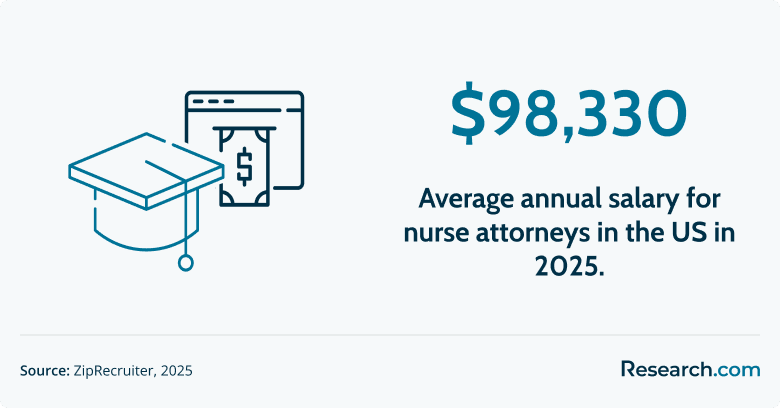
- A nurse attorney typically earns around $98,330 annually, with most salaries ranging from $90,000 to $150,000 based on experience, location, and specialization.
- Demand for nurse attorneys remains stable, driven by ongoing needs in healthcare law, compliance, malpractice, and patient advocacy, offering reliable career opportunities.
- Starting this career requires holding an active registered nurse license and a juris doctor degree, plus passing the NCLEX-RN and the state bar exam.
- Success depends on advanced clinical expertise, sharp legal research and analysis, clear communication, keen attention to detail, strong negotiation, critical thinking, and the ability to perform under pressure.
- Career advancement can lead to executive roles like chief risk officer, healthcare compliance director, hospital general counsel, independent consulting, or academic and leadership positions in healthcare organizations.
What do Nurse Attorneys do?
Nurse attorneys are licensed nurses who also practice law. Their value comes from being able to understand clinical care at a professional level and apply legal reasoning to healthcare disputes, regulations, policies, and patient safety issues.
They may review medical records in malpractice cases, advise hospitals on compliance, represent healthcare providers, support patient advocacy work, prepare expert testimony, or help organizations reduce legal and clinical risk. Unlike legal nurse consultants, nurse attorneys can provide legal representation if they are licensed to practice law in the relevant jurisdiction.
A day in the life of nurse attorneys
The workday depends heavily on the employer and practice area. In a law firm, a nurse attorney may analyze records, draft motions, meet with clients, prepare witnesses, and support litigation strategy. In a hospital or health system, the focus may shift toward compliance, risk management, policy review, staff education, ethics consultation, and regulatory response.
The role is usually less hands-on than bedside nursing but still deeply connected to patient care. Instead of administering treatment directly, nurse attorneys influence whether care standards are understood, documented, defended, improved, and applied fairly.
Common work settings
- Law firms: Medical malpractice, personal injury, insurance defense, healthcare litigation, and professional liability.
- Hospitals and health systems: Compliance, risk management, legal affairs, patient safety, and policy development.
- Government agencies: Regulation, public health law, enforcement, licensing, and administrative hearings.
- Insurance companies: Claims review, coverage disputes, fraud investigation, and risk assessment.
- Consulting firms: Expert analysis, compliance audits, education, and litigation support.
What are the key responsibilities of Nurse Attorneys?
Nurse attorneys use clinical knowledge to make legal work more accurate and use legal training to help healthcare decisions withstand scrutiny. Their responsibilities vary by role, but most involve careful analysis, documentation, communication, and judgment under pressure.
- Review medical records and insurance documents to evaluate malpractice, personal injury, workers’ compensation, or coverage-related claims.
- Represent healthcare providers or organizations in legal proceedings, negotiations, administrative matters, or regulatory disputes.
- Serve as an expert witness or prepare expert testimony by explaining standards of care, clinical procedures, documentation, and patient outcomes in clear language.
- Educate healthcare staff on legal requirements, documentation practices, informed consent, privacy, compliance, and risk reduction.
- Develop and revise healthcare policies so organizational practices align with laws, regulations, professional standards, and patient safety goals.
- Advocate for patient rights and ethical decision-making in situations involving consent, capacity, access to care, adverse events, or professional accountability.
The most challenging tasks
High-stakes malpractice litigation is often the most demanding part of the job. A nurse attorney must identify what happened clinically, determine whether care met accepted standards, evaluate documentation gaps, and explain complex facts to attorneys, judges, juries, administrators, or clients. The work can be emotionally difficult because cases may involve serious injury, death, professional discipline, or preventable harm.
The most rewarding tasks
Many nurse attorneys find the greatest satisfaction in prevention: improving policies, training clinicians, strengthening documentation systems, and helping organizations reduce avoidable harm. The role can also be meaningful for nurses who want to continue advocating for patients without remaining in direct bedside care.
If you are still mapping out the education side of this transition, reviewing flexible options such as the fastest adult degree programs online can help you understand how working adults sometimes structure degree completion around career responsibilities.

What are the key skills for Nurse Attorneys?
Nurse attorneys need more than strong nursing experience and a law degree. The best candidates can connect evidence, clinical standards, legal rules, organizational risk, and human consequences. Employers typically look for professionals who are precise, credible, calm under pressure, and able to communicate across disciplines.
Key hard skills
- Medical record analysis: Reading charts, timelines, orders, notes, test results, medication records, and documentation patterns to determine what occurred and what may be legally significant.
- Legal research and application of precedent: Finding statutes, regulations, case law, and administrative guidance, then applying them to healthcare disputes or compliance questions.
- Risk management and compliance assessment: Identifying where clinical practices, policies, or documentation expose an organization or provider to legal risk.
- Expert testimony preparation: Converting technical clinical information into clear, accurate explanations that non-clinicians can understand.
- Healthcare policy interpretation: Understanding how rules affect real clinical workflows, staffing decisions, reporting obligations, privacy practices, and patient safety processes.
Essential soft skills
- Critical thinking: Separating assumptions from evidence and recognizing when clinical facts do not support a legal claim.
- Complex problem solving: Balancing legal risk, patient safety, ethical concerns, organizational constraints, and professional standards.
- Active listening: Drawing out accurate information from clients, clinicians, witnesses, experts, administrators, and patients.
- Judgment and decision making: Recommending a course of action when information is incomplete, deadlines are tight, or outcomes carry serious consequences.
- Clear writing: Producing briefs, reports, policies, memos, and case summaries that are accurate, organized, and defensible.
The overlooked skill that separates good nurse attorneys from great ones
Interdisciplinary communication is often the deciding skill. Nurse attorneys must translate clinical details for legal teams and explain legal risk to healthcare professionals without oversimplifying either side. A technically correct analysis has limited value if attorneys misunderstand the medicine or clinicians misunderstand the legal implications.
For example, a nurse attorney reviewing a malpractice claim may need to explain why a charting omission matters, why a poor outcome does not automatically prove negligence, or why a clinical decision that seems reasonable to nurses may still create legal exposure. That bridge-building ability can prevent costly errors and improve case strategy.
Professionals planning a later-career transition may also consider flexible academic pathways, including online degrees for seniors, when comparing options for building the academic foundation needed for healthcare, legal, or compliance-focused roles.
Nurse Attorney Careers: A Step-by-Step Guide to Getting Started
The nurse attorney path is sequential. You generally cannot shortcut the core requirements because the role depends on both nursing licensure and legal licensure. The most practical way to evaluate the path is to break it into stages and confirm what each stage requires in your state.
- Complete nursing education. Start with an approved nursing program, such as an Associate Degree in Nursing (ADN) or Bachelor of Science in Nursing (BSN). A BSN is often preferred for broader professional opportunities.
- Earn RN licensure. Pass the NCLEX-RN and meet your state board of nursing requirements so you can practice as a Registered Nurse.
- Gain clinical experience. Build real-world judgment in patient care. Clinical experience is important because legal analysis in this field depends on understanding how healthcare actually works.
- Complete legal education. Apply to and complete a Juris Doctor (JD) program. If your goal is healthcare law, look for relevant coursework, clinics, internships, journals, or externships.
- Pass the bar exam. Meet state bar admission requirements and obtain legal licensure before offering legal services or representing clients as an attorney.
- Build healthcare law experience. Seek roles in malpractice, risk management, compliance, insurance defense, patient advocacy, administrative law, or healthcare regulation.
How to make the path more manageable
- Clarify your target role early. Litigation, compliance, consulting, policy, and advocacy can require different experiences.
- Use nursing experience strategically. Critical care, emergency, obstetrics, surgery, long-term care, and specialty practice can all be useful depending on your legal focus.
- Research state requirements. Nursing boards and bar admissions rules vary, so confirm requirements before investing in a program.
- Plan for cost and opportunity cost. Law school can change your income, schedule, debt load, and family responsibilities for several years.
This step-by-step guide to becoming a nurse attorney is most useful when paired with a personal timeline. Before enrolling in any program, compare admission requirements, accreditation, tuition, licensing outcomes, and whether the format fits your work obligations.
What education, training, or certifications are required?
The core qualifications for nurse attorneys are straightforward but demanding: nursing education, RN licensure, a Juris Doctor (JD), and state bar licensure. Additional credentials can help, but they do not replace the legal authority that comes from passing the bar.
Required education and licensure
- Nursing degree: An Associate Degree in Nursing (ADN) or Bachelor of Science in Nursing (BSN) can provide the nursing foundation. A BSN is often preferred for stronger opportunities.
- RN license: Nurses must pass the NCLEX-RN exam and meet state licensure requirements.
- Juris Doctor: A JD degree is essential for becoming an attorney.
- State Bar license: After completing the JD, candidates must pass the Bar Exam and satisfy state bar admission requirements.
Training and experience
On-the-job preparation usually includes 2 to 4 years of clinical nursing experience before entering law, along with 1 to 2 years of legal work or internships, ideally in healthcare law. Clinical experience helps nurse attorneys recognize standards of care, documentation issues, workflow realities, and patient safety concerns. Legal experience helps them learn case strategy, research, writing, client counseling, and courtroom or administrative procedure.
Are advanced degrees or niche certifications worth the investment?
Advanced nursing degrees and specialty credentials can be useful, but they are not mandatory for most nurse attorney roles. A Master of Science in Nursing (MSN) may strengthen leadership, policy, academic, or advanced clinical credibility. A Certified Legal Nurse Consultant credential may be valuable for consulting-focused work, especially for nurses who want to support legal teams without becoming attorneys.
The trade-off is time and cost. If your goal is to practice law, the RN and JD credentials are the central requirements. Additional education is most defensible when it clearly supports a specific goal, such as compliance leadership, healthcare administration, expert witness work, teaching, or a specialized litigation niche.
Before adding another degree, compare the expected career benefit with tuition, lost work time, licensing needs, and debt. Some lucrative masters degrees may offer strong returns in other fields, but for nurse attorneys, the value depends on how directly the credential supports your intended legal or healthcare role.
What is the earning potential for Nurse Attorneys?
Nurse attorney earning potential is strong because the role combines two licensed professions. Compensation can vary widely based on employer, location, litigation exposure, years of experience, specialization, and whether the attorney works in a law firm, healthcare organization, government agency, insurer, or consulting role.
Nurse attorneys typically earn a median salary of $96,935 per year. Entry-level nurse attorneys typically earn between $95,000 and $110,000 annually, while senior-level professionals can earn $130,000 to $150,000 or more.
What affects nurse attorney salary?
- Practice area: Medical malpractice, healthcare compliance, executive risk management, insurance defense, and regulatory work may differ significantly in compensation.
- Experience level: Attorneys with litigation experience, leadership experience, or a strong clinical specialty may command higher pay.
- Employer type: Law firms, hospitals, government agencies, insurers, and consulting firms often use different pay structures.
- Geographic market: Urban legal markets and regions with large healthcare systems may offer more opportunities than smaller or rural markets.
- Credentials and reputation: Specialty certifications, advanced degrees, expert witness experience, publications, and trial experience can increase marketability.
How to think about return on investment
Salary is only one part of the decision. Prospective nurse attorneys should also account for law school tuition, time away from full-time nursing income, bar preparation costs, potential relocation, and the time required to build legal experience. The career can pay well, but the financial return is strongest when the legal role uses your nursing background directly rather than treating nursing experience as only a secondary qualification.
What is the job outlook for Nurse Attorneys?
The job outlook for nurse attorneys is supported by demand in both healthcare and law. The nurse attorney career is projected to grow at an 8% rate from 2022 to 2032, compared with the 4% average growth predicted for all occupations.
That outlook reflects a larger trend: healthcare is highly regulated, medically complex, and legally sensitive. Organizations need professionals who can understand patient care, documentation, liability, compliance, and policy at the same time.
The key factors shaping future demand
- Healthcare industry growth: Registered nurses are expected to see a 6% growth from 2023 to 2033, with 197,200 new positions. A larger and more complex healthcare workforce can increase demand for professionals who understand both clinical and legal issues.
- Regulatory complexity: Hospitals, insurers, public agencies, and healthcare companies must manage changing rules around compliance, privacy, reimbursement, reporting, quality, and patient safety.
- Malpractice and liability concerns: Medical malpractice, professional negligence, documentation disputes, and risk management remain central areas where nursing expertise can strengthen legal analysis.
- Multiple employment sectors: Nurse attorneys are not limited to one setting. They may work in law firms, hospitals, government agencies, insurance, consulting, education, or advocacy.
How to improve your marketability
Strong candidates usually combine credible clinical experience with focused legal exposure. If you are still selecting an education provider, consider accreditation, student support, program format, licensing alignment, and cost. Resources on the best accredited non profit online colleges can help you compare institutional options before committing to a degree path.
What is the typical work environment for Nurse Attorneys?
Nurse attorneys usually work in professional office environments rather than clinical units. Data shows that 34% of nurse attorneys work in offices of lawyers, 19% work for government entities, and 8% work in hospitals. Their work may involve legal research, meetings, document review, client counseling, hearings, depositions, policy drafting, or compliance work.
Schedule and pace
The typical schedule is often Monday through Friday during standard business hours, but deadlines can change that. Litigation deadlines, court dates, emergency compliance issues, investigations, or administrative hearings may require longer days. Government and in-house healthcare roles may offer more predictable schedules than litigation-heavy law firm positions, though this varies by employer.
Remote and hybrid work
Remote and hybrid work are increasingly common for tasks such as record review, research, writing, policy analysis, and virtual meetings. Court appearances, depositions, on-site investigations, staff training, and executive meetings may still require in-person work.
Culture and collaboration
Nurse attorneys often work with attorneys, physicians, nurses, administrators, insurers, regulators, patients, and expert witnesses. The role requires comfort with both independent analysis and team-based decision-making. It may suit professionals who like complex documents, precise writing, and strategic conversations more than routine clinical workflow.
What are the pros and cons of Nurse Attorney careers?
A nurse attorney career can be intellectually rewarding and financially promising, but it is not the right move for every nurse. The path requires major education, licensing, and time commitments. It also shifts your work away from direct care and into analysis, advocacy, documentation, policy, and legal risk.
Pros
- Meaningful impact: Nurse attorneys can improve patient safety, strengthen policies, support ethical decision-making, and influence healthcare standards.
- Specialized professional identity: Few professionals have both clinical and legal authority, which can make the role distinctive and valuable.
- Strong earning potential: Compensation can be attractive, especially for experienced professionals in specialized or senior roles.
- Career variety: Opportunities exist in litigation, compliance, risk management, government, insurance, consulting, education, and advocacy.
- Less physical strain than bedside care: The work is typically office-based and may offer remote or hybrid options.
Cons
- Long training path: The route requires nursing education, RN licensure, clinical experience, law school, and bar admission.
- High educational cost: Law school can be expensive, and the opportunity cost may be significant for working nurses.
- Emotional stress: Malpractice cases, adverse outcomes, patient harm, and ethical conflicts can be difficult to manage.
- Complex regulations: Healthcare law changes frequently, requiring continuous learning and careful interpretation.
- Professional identity shift: Some nurses miss direct patient care or find it challenging to move into a legal environment.
Who is this career best for?
This career is a strong fit for nurses who enjoy reading, writing, analysis, policy, debate, advocacy, and complex problem-solving. It may be a poor fit for professionals who mainly want hands-on clinical work, minimal schooling, or a predictable low-stress role.
If cost is one of your biggest barriers, researching low cost online universities for working adults can help you compare education options while keeping long-term return on investment in view.
What are the opportunities for advancement for Nurse Attorneys?
Nurse attorneys can advance by gaining seniority, building a litigation or compliance specialty, moving into leadership, or becoming known for a niche area of healthcare law. Advancement often depends on legal performance, clinical credibility, business judgment, and the ability to advise decision-makers under pressure.
Nurse attorney career advancement opportunities
- Associate attorney or staff counsel: Many begin in law firms, healthcare systems, insurance companies, or government agencies after earning RN and JD credentials and passing the bar.
- Senior counsel or lead attorney: With experience, nurse attorneys may manage complex cases, supervise teams, advise executives, or lead healthcare law matters.
- Principal attorney or partner: In law firms, experienced nurse attorneys may build a healthcare law, malpractice, insurance defense, or compliance practice.
- Healthcare leadership: Some move into roles such as Director of Risk Management, Chief Compliance Officer, or head of legal and regulatory affairs.
- Consulting or expert practice: Experienced professionals may provide independent consulting, expert witness services, policy review, or education.
Nurse attorney specialization options
- Medical malpractice and litigation: Evaluating claims, defending or prosecuting cases, preparing experts, and explaining standards of care.
- Healthcare policy and regulatory compliance: Advising organizations on laws, risk controls, audits, reporting, and operational compliance.
- Patient advocacy and ethics: Supporting patient rights, access to care, informed consent, professional accountability, and ethical decision-making.
- Insurance and claims: Reviewing coverage, liability, documentation, injury causation, and claim validity.
- Academic or editorial work: Teaching healthcare law, writing for professional publications, or developing continuing education content.
The best advancement path depends on whether you prefer courtroom advocacy, organizational leadership, public policy, consulting, or education. Early specialization can help, but broad clinical and legal experience often provides the strongest foundation.
What other careers should you consider?
If you are interested in the intersection of healthcare and law but are unsure about becoming a nurse attorney, compare nearby roles before committing to law school. Some alternatives use nursing and legal knowledge without requiring a JD or bar admission.
- Forensic Nurse: Combines clinical care with legal processes, evidence collection, trauma-informed practice, court testimony, and collaboration with law enforcement.
- Legal Nurse Consultant: Reviews medical records, explains clinical issues to attorneys, prepares case summaries, and supports litigation without practicing law.
- Mediator/Arbitrator: Helps resolve disputes outside court. Healthcare knowledge can be valuable in conflicts involving providers, patients, insurers, or organizations.
- Law Professor/Educator: Teaches legal or healthcare topics, especially interdisciplinary subjects involving ethics, policy, regulation, or professional practice.
- Occupational Nurse: Focuses on workplace health, safety, compliance, injury prevention, and employee wellness within organizations.
How to choose between these paths
Choose nurse attorney if you want legal authority, courtroom or advisory responsibility, and the ability to represent clients as a lawyer. Consider legal nurse consulting if you want to use clinical expertise in legal cases without the time and cost of law school. Consider compliance, risk management, or occupational health if you prefer organizational problem-solving over litigation.
Here's What Professionals Say About Their Nurse Attorney Careers
- : "As a nurse attorney, my clinical background gives me a practical advantage in legal work. I understand the terminology, the care process, and the real impact an injury can have on a patient’s life. When I advocate for families affected by medical negligence, the compassion I had at the bedside still drives me. Nursing also helps me recognize when a case is valid and when the facts do not support a claim. That judgment matters in the courtroom. — Jasmine"
- : "One of the hardest parts of moving from nursing into law was learning to say no to cases that lack merit. It is uncomfortable, especially when clients are upset, but my medical background helps me evaluate the facts clearly. Being honest saves time, protects resources, and builds trust with attorney-clients who rely on my judgment. I can see how nursing knowledge directly affects legal outcomes. — Marcus"
- : "My work as a nurse attorney lets me keep the part of nursing I valued most: helping people. I am no longer at the bedside, but I still use clinical experience every day to guide clients through difficult cases. Attorneys often tell me my perspective is essential because I can connect the medical facts to the legal questions. That combination gives the work purpose. — Lydia"
Key Findings
- Nurse attorneys are both licensed nurses and licensed attorneys, combining clinical expertise with legal authority.
- The typical path includes nursing education, RN licensure, clinical experience, a JD degree, and passing the Bar Exam.
- Common responsibilities include medical record review, malpractice analysis, compliance advising, policy development, expert testimony, and patient advocacy.
- Nurse attorneys typically earn a median salary of $96,935 per year, with entry-level earnings between $95,000 and $110,000 and senior-level earnings of $130,000 to $150,000 or more.
- The career is projected to grow at an 8% rate from 2022 to 2032, compared with the 4% average growth predicted for all occupations.
- The role is best suited for nurses who enjoy analysis, writing, advocacy, policy, ethics, and complex problem-solving.
- The biggest trade-offs are the cost and length of legal education, the pressure of high-stakes cases, and the shift away from direct patient care.
Other Things You Should Know About Nurse Attorney
In 2027, nurse attorneys can specialize in areas like medical malpractice, healthcare compliance, and patient advocacy. These fields require an in-depth understanding of healthcare laws and offer unique opportunities for those with dual expertise in nursing and legal practice.
A nurse attorney must keep both credentials current: the law license and the nursing license. Most states require 30 to 50 continuing legal education hours every one to three years, plus nursing continuing education hours for RN renewal, often 20 to 30 hours per renewal cycle.
References
- Tips For Attorney Career Development: Strengthen Both Hard and Soft Skills - Courtroom Sciences https://www.courtroomsciences.com/litigation-consulting-1/tips-for-attorney-career-development-strengthen-both-hard-and-soft-skills-674/
- Legal Nurse Career Overview | Nursejournal.org https://nursejournal.org/careers/legal-nurse/
- How to Become a Nurse Attorney: Your Complete Guide https://www.topnursing.org/careers/nurse-attorney/
- How to Become a Nurse Attorney - Schooling & Salary https://www.registerednursing.org/specialty/nurse-attorney/
- Nurse Attorney Career Guide | NursingEducation https://nursingeducation.org/careers/nurse-attorney/
- 9 Ways To Get Your First Client as a Legal Nurse Consultant - SDN https://sleepdeprivednurse.com/blog/getting-clients-for-your-legal-nurse-consulting-business/
- The American Association of Nurse Attorneys https://www.taana.org/
- Top 12 Hard and Soft Skills Needed in Healthcare https://www.bryantstratton.edu/blog/healthcare-degrees/healthcare-skills-hard-soft/
- Nurse Attorney | Find Education and Training Requirements for Nurse Attorneys | Nursing-School-Degrees.com https://www.nursing-school-degrees.com/nursing-careers/nurse-attorney/
- Career Alternatives for Lawyers https://nationalmagazine.ca/fr-ca/articles/the-practice/young-lawyers/career-alternatives-for-lawyers


