2027 Climatologist Careers: Skills, Education, Salary & Job Outlook

Co-Founder and Chief Data Scientist
Choosing a climatologist career means deciding whether you want to work at the intersection of climate science, data analysis, public risk, and long-term planning. The role is not limited to studying weather patterns. Climatologists examine climate trends over years, decades, and centuries, then help governments, businesses, researchers, and communities understand what those changes mean.
The path is academically demanding. Most entry-level roles require at least a bachelor's degree in climatology, meteorology, atmospheric science, physics, mathematics, geography, or a related field. Research-heavy, senior, academic, and policy-focused positions often call for a master's degree or Ph.D. The reward is a career with strong public relevance: job growth is projected at 12%, and salary benchmarks in the field include figures such as $56,000 for median annual pay and $92,460 in broader climate and atmospheric science contexts, depending on role, source, employer, and specialization.
This guide explains what climatologists do, what skills and credentials matter, how to enter the field, what the work environment is like, and how to evaluate the trade-offs before committing to this career path.
Key Things You Should Know About Climatologist Career
- The typical earning potential for a climatologist in the U.S. ranges between $56,000 and $70,000 annually, with some variance depending on experience and specific roles.
- Employment in climatology is expected to grow by about 8% from 2020 to 2030, matching the average rate for all occupations and indicating steady demand.
- A bachelor's degree in meteorology, atmospheric science, or a related field is generally required to enter the field, while research and academic roles often need advanced degrees.
- Success as a climatologist depends on strong analytical and quantitative skills, proficiency in data analysis and computer modeling, attention to detail, and clear communication abilities.
- Career advancement usually involves progressing from entry-level positions to senior roles such as project leader or supervisor, with opportunities in academia, government, or leading major research projects for those with advanced education and experience.
What do Climatologists do?
Climatologists study long-term climate patterns and explain how climate systems change over time. Their work often involves analyzing historical records, satellite observations, ice cores, ocean data, atmospheric measurements, and computer model outputs to identify trends and assess future risks.
Unlike meteorologists, who commonly focus on short-term weather forecasting, climatologists look at broader climate behavior across seasons, years, decades, or longer periods. Their findings can support climate adaptation plans, agriculture decisions, infrastructure design, disaster preparedness, environmental policy, insurance risk analysis, and scientific research.
A day in the life of Climatologists
A typical day may include cleaning and analyzing datasets, running climate models, comparing current observations with historical patterns, reviewing scientific literature, writing reports, and meeting with other researchers or decision-makers. Many climatologists work in offices, laboratories, universities, government agencies, or research organizations. Some roles also involve fieldwork, travel to monitoring sites, public presentations, or stakeholder briefings.
The work is both technical and communicative. A climatologist must be comfortable with complex data, but the final value often depends on whether the findings can be explained clearly to people who need to act on them.
What are the key responsibilities of Climatologists?
Climatologists turn climate data into evidence that can guide research, planning, and policy. The exact responsibilities vary by employer, but most roles combine scientific analysis, modeling, documentation, and communication.
- Collect, review, and analyze climate data from air, water, soil samples, ice cores, weather stations, satellites, remote sensors, and historical records.
- Identify long-term climate trends, anomalies, and regional patterns in temperature, precipitation, drought, storm activity, sea level, or atmospheric conditions.
- Develop, test, and operate computer models that simulate climate behavior and project possible future scenarios.
- Study climate-related events such as droughts, floods, hurricanes, heat waves, and shifts in seasonal patterns.
- Evaluate how natural variability and human activity may influence climate systems.
- Prepare scientific reports, visualizations, presentations, policy briefs, and technical documentation.
- Advise government agencies, businesses, nonprofits, agriculture groups, energy organizations, and urban planners on climate risk and adaptation.
- Collaborate with meteorologists, oceanographers, geologists, ecologists, data scientists, economists, engineers, and public officials.
The most challenging vs. the most rewarding tasks
The hardest part of the job is often uncertainty. Climate systems are complex, datasets may be incomplete, and projections must be communicated carefully without overstating certainty. Climatologists also work in a field where scientific findings can carry political, economic, and social consequences.
The most rewarding part is impact. A well-designed study can improve flood planning, protect crops, guide infrastructure investment, strengthen public health preparation, or help communities understand local climate risks. For many professionals, that connection between research and public benefit is the main reason to enter the field.
If you are changing careers or completing a degree while working, reviewing the best accelerated online degree completion programs for working adults may help you compare flexible education routes before pursuing advanced climate science training.
What are the key skills for Climatologists?
Climatologists need a rare combination of scientific depth, quantitative ability, technical software skills, and clear communication. The strongest candidates are not only good at analyzing climate data; they can also explain what the data does and does not prove.
Core technical skills
- Climate modeling and simulation: Ability to work with models that represent atmospheric, oceanic, land, and climate-system interactions.
- Statistics and time-series analysis: Skill in identifying trends, variability, confidence intervals, anomalies, and uncertainty in long-term datasets.
- Programming: Practical experience with tools such as R or Python for data cleaning, analysis, visualization, and automation.
- Geographic Information Systems (GIS): Ability to map, interpret, and communicate spatial climate patterns.
- Remote sensing: Familiarity with satellite imagery, LiDAR, and environmental monitoring data.
- Scientific writing: Ability to produce accurate reports, journal articles, technical summaries, and grant materials.
Essential soft skills
- Analytical thinking: Breaking large, messy datasets into meaningful findings.
- Critical judgment: Recognizing weak assumptions, data limitations, and model uncertainty.
- Communication: Explaining technical conclusions to policymakers, business leaders, journalists, students, or the public.
- Collaboration: Working across disciplines with scientists, planners, engineers, economists, and community leaders.
- Patience and precision: Checking methods carefully before drawing conclusions from complex climate evidence.
The one overlooked skill that separates the good from the great
Science-to-policy communication is often the skill that moves a climatologist from being a strong analyst to a trusted advisor. Decision-makers rarely need every technical detail of a model. They need to understand the level of risk, the confidence behind the finding, the range of possible outcomes, and the practical implications.
A strong climatologist can say what the evidence supports, what remains uncertain, and what actions are reasonable despite that uncertainty. This skill is especially valuable in government, consulting, research and development, adaptation planning, and climate risk roles.
If your long-term goal requires doctoral study, resources on the easiest PhD program options can be useful as a starting point for understanding program formats, but you should evaluate climate-related doctoral programs primarily by faculty expertise, research fit, funding, accreditation, and career outcomes.
Climatologist Careers: A Step-by-Step Guide to Getting Started
The path to becoming a climatologist is usually gradual: build a science foundation, gain research or technical experience, deepen your specialization, and then move into applied, academic, government, or private-sector roles. The steps below show the typical sequence.
- Build a strong undergraduate foundation. Choose coursework in atmospheric science, climatology, meteorology, physics, mathematics, statistics, computer science, geography, geology, or environmental science. Prioritize quantitative classes because climate work depends heavily on data analysis.
- Develop technical tools early. Learn programming, GIS, statistics, data visualization, and scientific writing. These skills can make you more competitive for internships, research assistantships, and entry-level positions.
- Gain practical experience. Look for internships, undergraduate research, weather station experience, environmental data projects, or assistant roles with universities, government agencies, laboratories, nonprofits, or consulting firms.
- Decide whether graduate school is necessary. A bachelor's degree may qualify you for some entry-level roles, but many research, academic, and senior scientific positions require a master's degree or Ph.D.
- Build a portfolio of work. Save examples of data analysis projects, maps, model outputs, reports, presentations, publications, or research posters. Employers often want proof that you can apply scientific and technical skills.
- Join professional networks. Participate in conferences, student chapters, research groups, or professional associations to learn about job openings, research trends, and specialization paths.
- Specialize strategically. Choose a focus such as climate modeling, paleoclimatology, climate risk, adaptation planning, hydrology, agriculture, urban resilience, or atmospheric dynamics.
A common mistake is waiting until graduate school to learn technical tools. Students who build programming, statistics, and GIS skills early often have more options when applying for internships, assistantships, and research jobs.
What education, training, or certifications are required?
Most climatologist careers begin with a bachelor's degree in a relevant scientific field. Common options include Bachelor of Science programs in Climatology, Meteorology, Atmospheric Science, Geography with a focus on Meteorology-Climatology, physics, mathematics, geology, or environmental science.
For entry-level work, employers typically value a combination of science coursework, quantitative ability, software skills, and hands-on experience. Internships with research groups, laboratories, weather stations, government agencies, or environmental organizations can be especially helpful because they show that you can work with real data and scientific procedures.
Advanced roles often require graduate education. Master's and doctoral programs in Climatology, Atmospheric Science, or related fields usually involve substantial research, including thesis or dissertation work. These degrees are particularly important for university faculty roles, senior research positions, specialized modeling work, and leadership roles in scientific programs.
Common education and credential options
| Credential | Best fit | What to consider |
| Bachelor's degree | Entry-level technical, research support, data, or environmental roles | Choose quantitative coursework and seek internships or research experience. |
| Master's degree | Applied research, government, consulting, modeling, and specialized analyst roles | Often useful for advancement beyond entry-level work. |
| Ph.D. | Academic, senior research, principal investigator, and highly specialized scientific roles | Requires major time commitment and should align with a clear research goal. |
| Professional certification | Consulting, communication, or specialized professional credibility | Certifications such as Certified Consulting Meteorologist (CCM) or Certified Broadcast Meteorologist (CBM), issued by the American Meteorological Society (AMS), can strengthen credibility but are not mandatory for most climatologist jobs. |
Are advanced degrees or niche certifications worth the investment?
Advanced degrees can be worth it if your target role requires independent research, publication, university teaching, climate modeling leadership, or senior policy advising. They can also help with professional recognition and access to specialized positions.
They are not automatically necessary for every path. If you want an applied data, environmental planning, or technical support role, a bachelor's degree plus strong programming, GIS, statistics, and internship experience may be enough to begin. Before enrolling in a graduate program, compare funding, faculty fit, research facilities, completion expectations, and employment outcomes.
Certifications can add credibility, especially for consulting or public-facing work, but they generally supplement experience rather than replace it. If you are still building a low-cost academic pathway into science or environmental study, comparing the cheapest associate programs online may help you plan general education or transfer options before pursuing a bachelor's degree.
What is the earning potential for Climatologists?
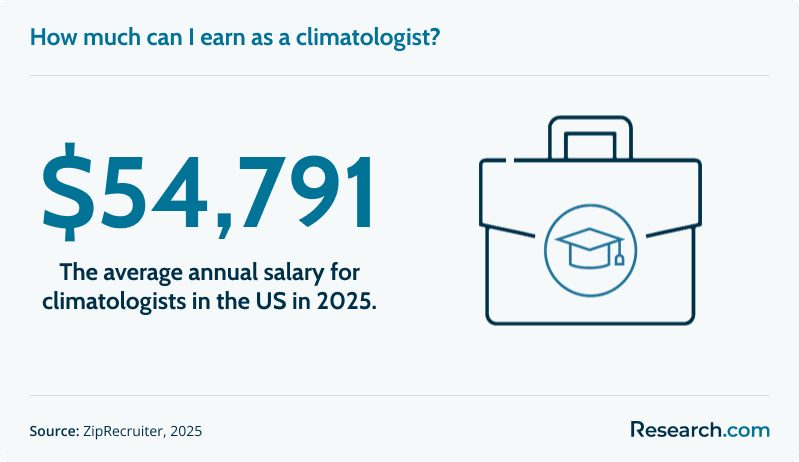
The median annual salary for a climatologist is $56,000. Entry-level positions start around $44,900 per year, while top earners make up to $73,600 annually. These figures provide a useful benchmark, but actual pay can vary widely based on employer, education, location, technical specialization, and level of responsibility.
Higher earning potential is often associated with advanced degrees, strong modeling and programming skills, senior research responsibilities, consulting work, government leadership roles, or private-sector climate risk positions. Geographic location also matters because salaries may reflect regional demand, cost of living, and concentration of research institutions or government agencies.
What can affect pay?
- Education level: Graduate degrees may open access to senior research, faculty, or specialized scientific roles.
- Technical skill set: Climate modeling, Python or R, GIS, remote sensing, and statistical analysis can improve competitiveness.
- Employer type: Government, universities, research organizations, consulting firms, and private companies may use different pay structures.
- Experience: Pay generally rises as professionals move from assistant or analyst roles into independent research, project leadership, or advisory positions.
- Specialization: Climate risk, financial impact analysis, resilience planning, and advanced modeling may create different compensation opportunities.
What is the job outlook for Climatologists?
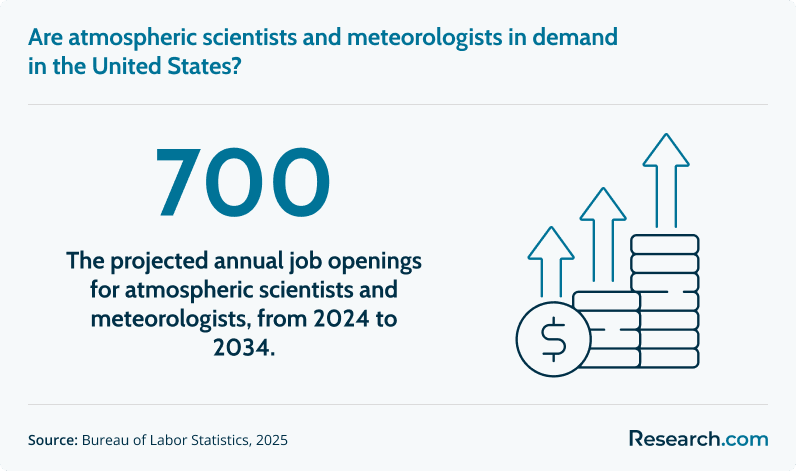
The job outlook for climatologists is strong, with projected growth of 12% from 2016 to 2026. That is faster than the average growth of 7% for all occupations. Demand is supported by climate research needs, risk assessment, environmental planning, and growing use of climate data in public and private decision-making.
The key factors shaping the future outlook
Climate change is the central driver. Governments, universities, companies, insurers, utilities, agricultural organizations, and community planners increasingly need professionals who can interpret climate data and translate it into practical risk information.
Technology is also changing the field. Better satellite systems, larger datasets, machine learning tools, and more powerful modeling platforms are expanding what climatologists can study. At the same time, these advances raise the skill bar. Candidates with strong quantitative and computational abilities are likely to be more competitive.
Policy and regulation may also influence opportunities. When agencies and businesses need climate assessments for planning, compliance, resilience, or infrastructure decisions, climatologists can play an important advisory role.
If cost is a barrier to starting your education, researching universities with low tuition programs that accept financial aid can help you compare more affordable routes into relevant science or data-focused programs.
What is the typical work environment for Climatologists?
Climatologists usually work in offices, laboratories, classrooms, research centers, government agencies, or university settings. Fieldwork may occur at weather stations, remote sensor sites, forests, coastal regions, oceans, or other natural environments, but many roles are primarily computer- and data-based.
Employment settings show the institutional nature of the field: 34% work for the federal government, excluding postal service; 24% work in research and development in physical and life sciences; and 20% work in colleges and universities. These settings often involve collaboration with interdisciplinary teams, including scientists, engineers, planners, policymakers, and technical staff.
Schedule and work-life considerations
Most climatologists work full time during regular business hours. Overtime and weekend work are uncommon in many roles, but deadlines, grant submissions, conference travel, field campaigns, or urgent climate-related events can create occasional schedule pressure.
Remote or hybrid work may be possible for data analysis, modeling, writing, and academic research tasks. However, laboratory work, teaching, stakeholder meetings, and fieldwork may require in-person availability.
What are the pros and cons of Climatologist careers?
A climatologist career can be deeply meaningful, but it is not the right fit for everyone. The work requires patience, technical discipline, comfort with uncertainty, and the ability to communicate difficult findings responsibly.
Pros
- High public relevance: Your work can inform climate adaptation, disaster preparedness, infrastructure planning, agriculture, public health, and environmental protection.
- Strong intellectual challenge: The field combines physics, statistics, computer science, earth systems, and policy questions.
- Interdisciplinary collaboration: Climatologists often work with experts across science, engineering, economics, planning, and public policy.
- Multiple career settings: Opportunities can exist in government, universities, research organizations, nonprofits, consulting, and private industry.
- Purpose-driven work: Many professionals value the chance to contribute to climate understanding and community resilience.
Cons
- Rigorous education requirements: Advanced roles may require a master's degree or Ph.D., which takes time and financial planning.
- Data uncertainty: Climate systems are complex, and findings often require careful explanation of confidence levels and limitations.
- Communication pressure: Climatologists may need to explain technical results to audiences with different levels of scientific background or skepticism.
- Emotional weight: Studying long-term environmental risk can be mentally demanding, especially when findings involve vulnerable communities or ecosystems.
- Competitive research roles: Academic and senior research positions may require publications, grants, specialized expertise, and strong professional networks.
If you are still comparing education and career routes, the most popular vocational colleges online can provide a useful contrast with research-intensive academic pathways, especially if you are weighing hands-on technical training against a longer science degree route.
What are the opportunities for advancement for Climatologists?
Climatologists can advance by taking on more complex research, leading projects, publishing findings, securing grants, managing teams, advising decision-makers, or specializing in high-demand areas. Career growth may be vertical, such as moving from analyst to senior scientist, or horizontal, such as shifting into policy, consulting, climate risk, or adaptation planning.
Advancement path
- Junior Climatologist (0-2 years): Supports research projects, cleans and analyzes climate data, prepares visualizations, assists with literature reviews, and learns modeling or GIS workflows under supervision.
- Climatologist (2-5 years): Manages independent analyses, contributes to climate models, prepares reports or publications, conducts statistical analysis, and presents findings to scientific or stakeholder audiences.
- Senior Climatologist (5-8 years): Leads major research initiatives, designs modeling strategies, mentors junior staff, pursues grants, contributes to assessments such as the IPCC, and advises agencies, organizations, or leadership teams.
Specialization areas
- AI-Enhanced Climate Modeling: Uses artificial intelligence, machine learning, and advanced computation to improve analysis and prediction using tools such as Python or R.
- Climate Risk and Financial Impact Analysis: Helps businesses, financial institutions, insurers, and public agencies understand climate exposure and economic risk.
- Climate Adaptation and Resilience Planning: Supports urban resilience, climate-smart agriculture, infrastructure planning, and community adaptation strategies.
- Paleoclimatology and Atmospheric Dynamics: Studies historical climate patterns and atmospheric processes, often in academic or advanced research settings.
Professionals may also move into roles such as research climatologist, climate policy advisor, climate data scientist, environmental consultant, resilience planner, sustainability analyst, or climate impacts specialist. The best advancement strategy is to combine subject-matter expertise with technical tools and a record of useful, well-communicated work.
What other careers should you consider?
If you are drawn to climatology but unsure whether it is the best fit, consider related careers that use similar skills in different ways. The right choice depends on whether you prefer forecasting, field science, chemistry, data analysis, policy, or earth systems research.
- Meteorologist: Focuses more on weather analysis and forecasting, often using atmospheric data to explain short-term conditions and hazards.
- Environmental Scientist: Studies environmental problems more broadly, including pollution, ecosystems, human health, regulation, and climate-related impacts.
- Atmospheric Chemist: Examines the chemical composition of the atmosphere, including air quality, greenhouse gases, aerosols, and reactions that influence climate.
- Data Analyst with a climate or environmental focus: Uses statistics, programming, and visualization to interpret large environmental datasets for research, government, or business decisions.
- Geologist or Geophysicist: Studies earth systems, geologic history, and physical processes that may intersect with climate, natural hazards, and environmental change.
Choose climatology if you are most interested in long-term climate patterns, climate systems, modeling, and risk interpretation. Choose a related path if you prefer a narrower focus on weather, environmental regulation, chemistry, software, finance, or geoscience.
Here's What Professionals Say About Their Climatologist Careers
- Abegail: "Basically, I am trying to help the people of Minnesota get an evidence-based sense of what the climate of Minnesota is doing and what it is expected to do going forward. Every day, I analyze temperature trends and project future precipitation patterns to give communities a clearer picture of what lies ahead. It feels rewarding to be that bridge between complex climate models and the decisions local leaders make about their environment. I take pride in knowing that my work empowers people to prepare and adapt thoughtfully."
- Omar: "It's a gritty place when you are staring down at data and probabilities for how your favorite places in the world will change during your kid's life span. Carrying the weight of those daunting predictions is emotionally demanding, and sometimes I wrestle with the reality behind the numbers I present. But pushing through that discomfort has forced me to grow, both as a scientist and as a person. Facing these uncomfortable truths is part of what keeps me committed to sharing accurate, honest information."
- Meilin: "The most fun I have is being able to go around the state and talk to people about weather and climate. There's nothing better than seeing someone connect the dots between my research and their everyday experience. When I visit schools or local groups and answer their questions, I feel that my work is not just data on a screen but something that sparks real conversations and awareness. I would go anywhere in the state if somebody wanted to hear from me."
Key Findings
- Climatologists study long-term climate patterns and use data, models, and scientific evidence to explain climate risks and trends.
- A bachelor's degree can support entry-level opportunities, but many research, academic, and senior roles require a master's degree or Ph.D.
- Important skills include statistics, programming, climate modeling, GIS, remote sensing, scientific writing, and science-to-policy communication.
- The median annual salary for a climatologist is $56,000, with entry-level positions around $44,900 and top earners making up to $73,600 annually.
- The projected job growth rate is 12% from 2016 to 2026, compared with 7% for all occupations.
- Most climatologists work in government, research and development, or higher education settings, with 34% employed by the federal government, 24% in physical and life sciences research and development, and 20% in colleges and universities.
- The career offers meaningful public impact, but it also requires comfort with uncertainty, rigorous education, technical complexity, and careful communication.
Other Things You Should Know About Climatologist
In 2027, climatologists typically need a master's degree in climatology or related sciences. Some roles may require a Ph.D., especially in research. These educational requirements ensure climatologists are equipped with the necessary skills to address complex climate issues.
The Certified Consulting Meteorologist credential from the American Meteorological Society can strengthen prospects for experienced climatologists who work in consulting, media, or applied research. The AMS also offers the Certified Broadcast Meteorologist credential, but employers usually value graduate study in climatology or atmospheric science first.
References
- Climate Scientist Career Paths - Consensus Academic Search Engine https://consensus.app/questions/climate-scientist-career-paths/
- 6 Climatologist Interview Questions and Answers for 2025 | Himalayas https://himalayas.app/interview-questions/climatologist
- Climatologist Interview Guide: Questions, Dress Code and Research Tips | UK Career Advice https://workbred.co.uk/career/climatologist
- How to Become a Climate Scientist: Is it the Right Career for You? https://www.careerfittest.com/how-to-become-a-climate-scientist/
- Climate scientists: Salary, career path, job outlook, education and more - RaiseMe https://www.raise.me/careers/life-physical-and-social-science/atmospheric-scientists-including-meteorologists/climate-scientists/
- Skills for Success in Climate Careers: Technical Expertise and Soft Skills | EuroClimateJobs https://www.euroclimatejobs.com/article/808/skills-for-success-in-climate-careers-technical-expertise-and-soft-skills
- Make a Difference: 10 Climate Change Careers | ASU Online https://asuonline.asu.edu/newsroom/asu-online-news/climate-change-jobs/
- Climate Scientist Job Description | Planet Possibility https://www.planetpossibility.co.uk/advice/jobs-in-physics/climate-scientist-job-description