
2027 Best HVAC Trade Schools & Certifications Online

Co-Founder and Chief Data Scientist
Choosing an online HVAC trade school is not just about finding the cheapest course or the fastest certificate. The real decision is whether the program will prepare you for hands-on work, required credentials, employer expectations, and long-term advancement in heating, ventilation, air conditioning, and refrigeration. That matters because HVAC employment is projected to grow by 9% from 2023 to 2033, faster than the average for all occupations, as homes, commercial buildings, schools, and industrial facilities continue to need installation, repair, maintenance, and energy-efficient system upgrades.
This guide is for prospective HVAC technicians, career changers, working adults, military-connected learners, and entry-level trade students comparing online HVAC schools and certification programs for 2027. You will learn what online HVAC training includes, how much programs cost, how online and campus formats differ, which certifications matter, what employers look for, and how to evaluate whether a program is worth the investment.
Quick Answer: Are Online HVAC Trade Schools Worth Considering?
Online HVAC trade schools can be a practical option if they combine strong technical coursework with certification preparation, local hands-on training, or internship opportunities. They are especially useful for students who need flexible scheduling while working or managing family responsibilities. However, HVAC is a hands-on trade, so the best online programs do more than deliver videos and quizzes. They prepare students for real equipment, safety procedures, electrical troubleshooting, refrigerant rules, and credentials such as EPA Section 608 Certification.
What are the benefits of enrolling in an online HVAC trade school and certification program?
- Career access in a skilled trade: An online HVAC certification can help prepare students for roles such as HVAC technician, refrigeration mechanic, or HVAC installer across residential, commercial, and industrial settings.
- Competitive earning potential: HVAC professionals earn a median annual salary of approximately $63,244, with total annual pay ranging from $54,000 to $81,000 depending on experience, location, employer, and specialization.
- Flexible training format: Online programs often allow students to study around work schedules and personal responsibilities. They may also reduce commuting and housing-related expenses compared with campus-based training.
- Certification preparation: Many programs include preparation for EPA Section 608 Certification, NATE, HVAC Excellence, or other credentials that employers may value.
What can I expect from an online HVAC trade school and certification program?
An online HVAC program typically introduces students to heating, ventilation, air conditioning, and refrigeration systems through digital lessons, readings, videos, simulations, assignments, and exam preparation. Core topics often include HVAC fundamentals, refrigeration cycles, electrical systems, system design, installation practices, troubleshooting, airflow, safety, and refrigerant handling. Some programs also include a capstone, local internship, lab requirement, or hands-on component arranged through employer or school partnerships.
Tuition varies by school, credential level, and program length, but many online HVAC training programs generally fall between $800 and $2,900. Some programs cost more when they include extended access, exam vouchers, added certifications, or broader technician training. Many courses are self-paced, which can help working adults move through lessons on evenings or weekends. Students should still confirm whether the program includes practical training, whether exam vouchers are included, and whether the curriculum prepares them for EPA Section 608 Certification if they plan to work with refrigerants.
Online HVAC program features to compare before enrolling
| Program Feature | Why It Matters | What to Ask |
| EPA Section 608 preparation | Technicians who handle refrigerants must meet EPA certification requirements. | Does the program prepare students for EPA Section 608 Certification, and are exam fees or vouchers included? |
| Hands-on training | HVAC work requires physical equipment practice, not only theory. | Are labs, internships, simulations, or local training partnerships available? |
| Self-paced access | Flexible pacing helps working adults, but it also requires discipline. | How long do students have access to the course, instructors, and materials? |
| Career support | Entry-level students may need help with resumes, interviews, and employer connections. | Does the school offer job search support, employer referrals, or apprenticeship guidance? |
| Accreditation and recognition | Accreditation can affect credibility, transfer options, and financial aid eligibility. | Which institution or agency accredits the school or program? |
Where can I work after earning an online HVAC certification?
After completing an online HVAC training program and earning relevant certifications, graduates may pursue work in several settings that rely on heating, ventilation, air conditioning, and refrigeration systems. Employment is concentrated among contractors, but HVAC skills are also used in schools, retail facilities, wholesale distribution, and self-employment.
- Plumbing, heating, and air-conditioning contractors: These employers account for 67% of HVAC technician employment and commonly hire technicians for installation, maintenance, replacement, and repair work.
- Self-employment: About 8% of HVAC professionals operate independently, often serving residential or small commercial clients directly.
- Wholesale trade: Around 3% work in distribution-related roles involving HVAC equipment, replacement parts, supplies, and technical customer support.
- Educational services: Roughly 3% work for schools, colleges, and universities that need climate control, maintenance, and system reliability.
- Retail trade: Another 3% support HVAC systems in retail environments, where temperature control affects customer comfort, inventory, and operations.
How much can I earn after completing an online HVAC trade school?
HVAC pay varies widely by state, employer type, certifications, overtime opportunities, technical specialization, and years of experience. A certificate can help open the door, but it does not guarantee a specific salary. The strongest earning outcomes usually come from combining training with field experience, safety knowledge, refrigerant credentials, customer service, and advanced troubleshooting skills.
- Average salary: As of 2025, HVAC professionals in the United States earn approximately $63,244 per year on average, or about $30 per hour.
- Location differences: Pay can vary sharply by state. HVAC technicians in Washington earn an average of $66,577 annually, while those in Florida average around $43,928 per year.
- Experience levels: Entry-level HVAC technicians with 0-1 year of experience earn approximately $59,863 annually. Technicians with 15+ years of experience can earn around $86,976 per year.
- Industry differences: HVAC professionals in wholesale trade earn $60,980, while those working in plumbing and HVAC contracting earn $54,490 per year.
- Specialization: Advanced certifications and focused skills can improve earning potential. HVAC refrigeration technicians, for example, earn an average wage of $30.92.
- Best Online HVAC Trade Schools and Certification Programs for 2027
- How long does an online HVAC trade school and certification program take?
- Online vs. on-campus HVAC training: which format is better?
- How much does an online HVAC trade school and certification program cost?
- Financial aid options for online HVAC trade school students
- Prerequisites for online HVAC trade school and certification programs
- Common courses in online HVAC training programs
- Types of HVAC certifications available online
- Challenges of online HVAC certification programs
- Emerging technologies covered in online HVAC programs
- Do employers recognize online HVAC certifications?
- Can online HVAC certification lead to advanced education and leadership roles?
- Is an online HVAC certification worth the investment?
- Networking and mentorship in online HVAC programs
- Continuing education for HVAC career advancement
- How to choose the best online HVAC trade school and certification program
- Career opportunities after online HVAC trade school
- Job market for workers with online HVAC certification
Best Online HVAC Trade Schools and Certification Programs for 2027
How do we rank the programs?
Training for a skilled trade requires time, money, and careful comparison. Research.com evaluates HVAC trade schools and certification programs using transparent education data from sources such as the IPEDS database, Peterson's database, the College Scorecard database, and The National Center for Education Statistics. These sources help assess institutional quality, program information, and student-facing data. To learn more about the evaluation process, visit Research.com's methodology page.
1. University of Texas at San Antonio
The University of Texas at San Antonio (UTSA) offers an online HVAC/R technician training course for students preparing for entry-level work in heating, ventilation, air conditioning, and refrigeration. The course emphasizes vapor-compression cycles, refrigerant safety, and EPA-related standards. Students receive exam vouchers and 12 months of access to course materials.
- Program Length: 12 months
- Total Tuition Cost: $2,895
- Accreditation: Southern Association of Colleges and Schools Commission on Colleges (SACSCOC)
2. Colorado State University
Colorado State University provides an online HVAC/R Certified Technician program for students seeking training in heating, ventilation, air conditioning, and refrigeration. Coursework covers service procedures, maintenance, and troubleshooting for complex HVAC/R systems. The program also prepares students for HVAC Excellence or NATE certification exams.
- Program Length: 12 months
- Total Tuition Cost: $4,695
- Accreditation: Higher Learning Commission (HLC)
3. University of West Florida
The University of West Florida offers an online HVAC/R Technician training program that prepares students for credentials such as NATE, HVAC Excellence, and EPA Section 608. The curriculum addresses measurement accuracy, heat transfer, refrigeration cycles, installation, maintenance, and repair.
- Program Length: Up to 12 months
- Total Tuition Cost: $2,895
- Accreditation: Southern Association of Colleges and Schools Commission on Colleges (SACSCOC)
4. Texas State University
Texas State University offers an online HVAC/R Certified Technician program that prepares students for industry-recognized credentials such as NATE or HVAC Excellence. The program covers measurement and conversion accuracy, heat carrying capacity, condensation and vaporization, and the weight and value of air.
- Program Length: Up to 12 months
- Total Tuition Cost: $2,995
- Accreditation: Southern Association of Colleges and Schools Commission on Colleges (SACSCOC)
5. University of North Dakota
The University of North Dakota offers a fully online Certified HVAC/R Technician Training program for students preparing for entry-level roles in the HVAC/R field. Its self-paced curriculum introduces HVAC/R concepts, component functions, installation practices, and troubleshooting methods.
- Program Length: 12 months or less
- Total Tuition Cost: $2,895
- Accreditation: Higher Learning Commission (HLC)
6. Midlands Technical College
Midlands Technical College offers an entry-level HVAC technician training certificate focused on refrigeration cycles, electrical operations, heat pumps, and airflow design. The program prepares students for entry-level work with residential and commercial HVAC contractors and includes preparation for the EPA 608 certification exam.
- Program Length: 5 months
- Total Tuition Cost: $3,596
- Accreditation: Southern Association of Colleges and Schools Commission on Colleges (SACSCOC)
7. North Central Texas College
North Central Texas College (NCTC) provides HVAC programs designed to build installation, maintenance, and repair skills for heating, ventilation, and air conditioning systems. Course delivery includes online, hybrid, and face-to-face options. NCTC is recognized as an HVAC training site by the Texas Department of License and Regulation (TDLR).
- Program Length: 4-12 months
- Total Tuition Cost: $2,899
- Accreditation: Southern Association of Colleges and Schools Commission on Colleges (SACSCOC)
8. Austin Community College
Austin Community College (ACC) offers a continuing education HVAC program designed for students seeking fast preparation for entry-level heating, ventilation, and air conditioning jobs. The program includes hands-on training and courses such as introduction to the construction industry, basic electricity for HVAC, refrigeration principles, and EPA recovery certification preparation.
- Program Length: 4-5 months
- Total Tuition Cost: $1,450
- Accreditation: Southern Association of Colleges and Schools Commission on Colleges (SACSCOC)
9. University of California - San Diego
The University of California - San Diego (UCSD) offers an HVAC systems design and control certificate through its extended studies division. The program focuses on HVAC theory, codes, calculations, and applied system design. It is recommended for HVAC designers and engineers, recent engineering graduates, facility engineers, and professionals who work with HVAC systems.
- Program Length: 15 months
- Total Tuition Cost: $3,600
- Accreditation: Western Association of Schools and Colleges (WASC)
10. University of Memphis
The University of Memphis offers an online HVAC/R Technician training program for students preparing for entry-level roles in heating, ventilation, air conditioning, and refrigeration. Graduates are prepared to pursue industry-recognized credentials, including HVAC Excellence Employment Ready Certificates, the NATE Ready to Work Certificate, and EPA 608 Certification.
- Program Length: over 12 months
- Total Tuition Cost: $2,995
- Accreditation: Southern Association of Colleges and Schools Commission on Colleges (SACSCOC)
How long does it take to complete an online HVAC trade school and certification program?
Most online HVAC trade school and certification programs can be completed in 5 to 9 months for shorter, career-focused options or up to 12 months for more comprehensive programs. Program length depends on whether the course is self-paced or scheduled, how many hours students can study each week, and whether hands-on training or certification exam preparation is included.
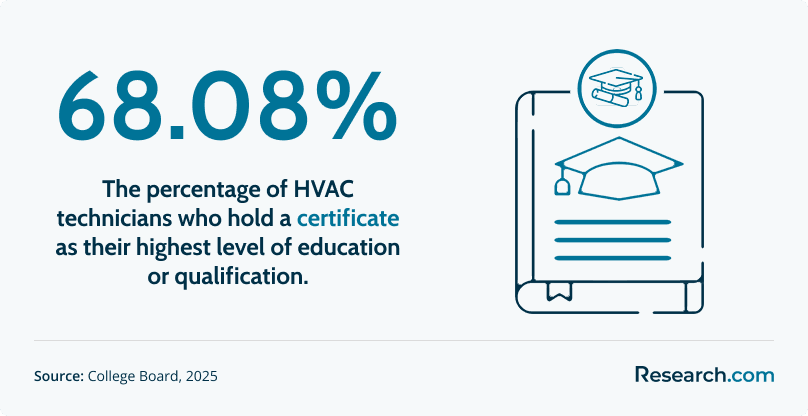
Certificate pathways are common in this field. The majority of HVAC technicians hold a certificate, with 68.08% having completed certificate programs. That reflects the trade’s practical nature: many students want targeted training that can help them enter the workforce without committing to a longer academic degree. Students comparing shorter skilled-trade routes with longer career paths may also review Research.com guides such as how to become an information systems manager to see how technical management careers often require more extended education.
How does an online HVAC degree or certification program compare to an on-campus program?
The better format depends on how you learn and how much hands-on support you need. Online HVAC programs are often more flexible and can work well for self-directed students. Campus-based programs may be stronger for students who want regular lab access, in-person instruction, and immediate equipment practice. Hybrid programs can offer a middle ground.
| Aspect | Online HVAC Program | On-Campus HVAC Program |
| Cost | Often lower because students may avoid commuting, housing, and some campus-based fees. | May cost more because facilities, labs, and campus services are built into the experience. |
| Hands-on Training | May rely on virtual labs, simulations, shipped materials, local internships, or required in-person practice. | Usually provides direct lab access and supervised practice with HVAC equipment. |
| Accreditation | Accredited options exist, but students must verify the school and program carefully. | Many campus programs are tied to local colleges or technical institutions with established recognition. |
| Course Delivery | Often delivered through recorded lessons, readings, assignments, and self-paced modules. | Usually includes classroom lectures, scheduled labs, and direct instructor interaction. |
| Job Placement Assistance | Support varies; some schools offer online career services and employer resources. | Campus programs may have stronger local employer relationships and placement support. |
Who should choose an online HVAC program?
- Students who need flexible scheduling because of work, childcare, or transportation limits.
- Career changers who want to complete theory coursework before arranging hands-on practice locally.
- Self-motivated learners who can stay on schedule without frequent in-person reminders.
- Students who already work near HVAC employers and can seek field exposure while studying.
Who may be better served by an on-campus or hybrid program?
- Beginners who have never handled tools, electrical components, or mechanical systems.
- Students who learn best through live demonstrations and immediate instructor correction.
- Applicants who want school-arranged labs, apprenticeships, or local employer introductions.
- Students pursuing programs where licensure, local requirements, or employer expectations favor in-person training.
What is the average cost of an online HVAC trade school and certification program?
Online HVAC program costs vary by institution type, program length, included exam preparation, materials, and student residency status. Some programs cost less than $2,000, while broader certificate options may cost more when they include exam vouchers, longer course access, or additional technical preparation.
- Public vs. private institutions: Public institutions may offer lower tuition, particularly for local or in-state students. Austin Community College, for example, charges $1,450 for its HVAC program. Colorado State University charges $4,695 for its HVAC/R Certified Technician program.
- In-state vs. out-of-state tuition: Some public colleges charge different tuition rates based on residency. Other online programs use flat-rate pricing regardless of where the student lives.
- Additional fees: Students should ask about books, tools, materials, technology fees, exam fees, and certification costs. These added expenses can range from $200 to $1,000 depending on the program.
When comparing costs, do not look only at tuition. A lower-priced program may become more expensive if it excludes certification exams, textbooks, tools, or lab access. Students comparing technical education options can also review broader online trade school programs to understand how HVAC costs compare with other skilled-trade pathways.
What financial aid options are available for students enrolling in an online HVAC trade school and certification program?
Financial aid availability depends on the school, program type, accreditation, length, and whether the credential is eligible for federal or state support. Before enrolling, ask the school’s financial aid office which forms of aid apply to the specific HVAC program, not just to the institution overall.
- Federal financial aid: Students may be able to use federal aid if they enroll in eligible programs at qualifying institutions. Research.com’s guide to FAFSA-approved online certificate programs can help students understand the broader process for federal aid access.
- Scholarships: HVAC industry associations, community organizations, employers, and schools may offer scholarships based on need, academic performance, career goals, or trade interest.
- Employer tuition assistance: Some employers help pay for HVAC training, especially when the credential improves job-related skills. Students already working in maintenance, facilities, construction, or related fields should ask about reimbursement.
- State grants and loans: Many states support workforce training through grants, technical education funding, or low-interest loans. Eligibility rules vary by state.
- Payment plans: Some schools allow students to divide tuition into installments, which can reduce the need for large upfront payments or borrowing.
Questions to ask before using aid or financing
- Is this exact HVAC program eligible for federal financial aid, or only other programs at the school?
- Are certification exams, tools, and books included in the quoted tuition?
- What happens financially if I withdraw, pause, or miss the completion deadline?
- Will employer reimbursement require me to remain employed for a certain period?
- Are payment plans interest-free, or do they include fees?
What are the prerequisites for enrolling in an online HVAC trade school and certification program?
Most online HVAC trade schools require applicants to have a high school diploma or equivalent, such as a GED. This baseline matters because HVAC training uses math, measurement, electrical concepts, mechanical reasoning, safety procedures, and applied science.
Some programs are built for absolute beginners, while others assume prior technical exposure or one to two years of HVAC/R industry experience. Review each school’s admissions requirements carefully so you do not enroll in a course that is either too basic or too advanced for your current skill level. This type of eligibility review is similar to evaluating ICE agent education requirements, where baseline credentials and role-specific requirements affect whether a candidate is ready to apply.
What courses are typically included in an online HVAC trade school and certification program?
Online HVAC programs usually combine mechanical theory, electrical basics, safety, system diagnostics, and certification preparation. The strongest programs also connect theory to real equipment, customer scenarios, preventive maintenance, and code-aware installation practices.
- HVAC Fundamentals: Students learn the basic principles behind heating, cooling, ventilation, thermodynamics, heat transfer, system types, and energy efficiency.
- Refrigeration Systems: Coursework covers refrigeration cycles, refrigerants, compressors, condensers, system components, refrigerant handling, and EPA-related rules.
- Electrical Systems for HVAC: Students study circuits, wiring, controls, meters, and electrical troubleshooting used in HVAC systems.
- Heating Systems: This course explains gas, electric, and hydronic heating; furnace components; safety practices; and efficiency standards.
- Air Conditioning Systems: Students learn cooling cycles, air conditioning equipment, maintenance routines, and common AC troubleshooting procedures.
- HVAC System Design and Installation: Training may include residential and commercial system planning, ductwork, load calculations, installation steps, and energy-efficient design considerations.
- Troubleshooting and Maintenance: Students practice identifying common system failures, conducting preventive maintenance, and improving system reliability.
Hands-on practice remains important. According to 15.25% of HVAC skills, practical exercises and applied training contribute to technician readiness. Students also need customer service, safety awareness, documentation habits, and preventive maintenance skills. The need to combine academic knowledge, training, and specialized requirements is also visible in career paths such as what qualifications you need to be an FBI agent, where candidates must meet multiple layers of preparation.
What types of online certifications are available for HVAC professionals?
HVAC certifications signal specific skills, safety knowledge, or readiness for specialized work. Students comparing trade certificate programs online should distinguish between school completion certificates and industry-recognized credentials. A school certificate shows that you completed training; an industry certification may be required or preferred for certain work.
| Certification | What It Covers | Best For |
| EPA Section 608 Certification | Required by the U.S. Environmental Protection Agency for technicians who handle refrigerants. It covers refrigerant handling, recycling, recovery, and disposal practices. | Students and technicians who expect to work with refrigerants. |
| NATE Certification | Offered by North American Technician Excellence, this credential validates knowledge in HVAC areas such as air conditioning, heat pumps, installation, and service. | Technicians seeking recognized proof of field knowledge and specialty competence. |
| HVAC Excellence Certification | Includes credentials such as the Employment Ready certificate for entry-level technicians and assessments in electrical theory, heating, and air conditioning. | Entry-level students and working technicians who want structured competency validation. |
| OSHA Safety Certification | Focuses on workplace safety and hazard prevention. Common options include OSHA 10-Hour and 30-Hour Training Programs. | Technicians working around electrical systems, job sites, ladders, confined spaces, and mechanical hazards. |
| Green HVAC Certification | Shows knowledge of energy-efficient and sustainable HVAC practices. Examples include LEED and HVAC Excellence Green Awareness Certification. | Technicians interested in energy efficiency, sustainable building systems, and modern HVAC upgrades. |
Are there potential challenges with online HVAC certification programs?
Yes. Online HVAC programs can be convenient, but they are not automatically equivalent to supervised lab training. The biggest risk is enrolling in a program that teaches theory without giving students a realistic way to practice equipment handling, electrical testing, refrigerant procedures, and troubleshooting. Students should ask whether the program includes local partnerships, on-site intensives, required internships, or documented hands-on assignments.
Another challenge is pacing. Self-paced programs can be excellent for disciplined learners, but students who need structure may fall behind without weekly deadlines or instructor accountability. Finally, students should be cautious about broad claims about job placement, salary, or guaranteed employment. Compare curriculum depth, certification preparation, and outcomes the same way you would compare other good online degrees or career-focused credentials.
What Emerging Technologies Are Online HVAC Programs Incorporating?
Modern HVAC work increasingly includes smart controls, energy-conscious design, and connected systems. Strong online HVAC programs may introduce smart thermostats, IoT-enabled devices, building automation systems, remote monitoring, digital simulation tools, and software-based diagnostics. These topics help students understand how climate systems are managed in newer homes, commercial facilities, schools, and energy-efficient buildings.
Technology training should not replace core HVAC skills. Students still need electrical knowledge, airflow fundamentals, mechanical troubleshooting, refrigerant safety, and customer communication. Those comparing flexible education options across fields may also look at online colleges with no application fee when cost and admissions friction are major concerns.
Do Employers Recognize Online HVAC Certifications?
Employers may recognize online HVAC training when it comes from a credible institution, aligns with industry standards, prepares students for recognized certifications, and includes a way to demonstrate practical skills. Hiring managers generally care less about whether the theory portion was online and more about whether the applicant can work safely, diagnose problems, communicate with customers, and meet credential requirements such as EPA Section 608 when refrigerants are involved.
Before enrolling, ask local employers which schools, certifications, and training formats they respect. Also ask the program whether it offers career support, resume help, interview preparation, and guidance on financial aid. Students comparing cost and aid eligibility can review resources on online schools that accept FAFSA.
Can an online HVAC certification serve as a gateway to advanced education and leadership roles?
An online HVAC certification can be a first step toward a broader career, especially for technicians who later move into supervisory, facilities management, estimating, sales, system design, energy management, or business ownership. Advancement usually depends on experience, technical reliability, customer trust, safety record, and the ability to manage projects or teams.
Some professionals later combine trade experience with business, operations, engineering, or management education. For those comparing accelerated graduate study in other fields, Research.com’s guide to 1 year master's programs online can help frame how advanced education may support leadership goals, although HVAC leadership does not always require a master’s degree.
Is the Online HVAC Certification Investment Worth It?
An online HVAC certification may be worth it if the program is affordable, credible, aligned with employer expectations, and strong enough to prepare you for certification exams and hands-on work. The investment is less attractive if the program has weak practical training, vague outcomes, unclear accreditation, or no support for EPA Section 608 preparation when refrigerant work is part of your career goal.
To evaluate value, compare tuition, included fees, completion time, exam preparation, local training options, employer recognition, and career support. Working adults who need lower-cost education pathways can also compare broader options through Research.com’s guide to cheap online colleges for working adults.
Are networking and mentorship opportunities an integral part of online HVAC certification programs?
Networking and mentorship are not guaranteed in every online HVAC program, but they can make a meaningful difference. Some schools offer discussion boards, instructor access, virtual events, employer webinars, alumni connections, or local training referrals. These features help students ask practical questions, understand job expectations, and connect classroom knowledge to real-world service work.
If mentorship matters to you, ask whether students can contact instructors directly, whether the school has employer relationships, and whether graduates receive job search support. Professionals who later consider advanced academic options, such as easiest masters programs, may also benefit from building a stronger professional network early.
Should HVAC Professionals Invest in Continuing Education for Career Advancement?
Continuing education can help HVAC professionals keep pace with changing equipment, refrigerant rules, smart controls, energy-efficiency standards, safety expectations, and customer needs. Technicians who keep learning may be better positioned for specialization, supervisory duties, estimating, training roles, or business ownership.
Advanced academic credentials are not necessary for every HVAC career goal, but ongoing education can still be valuable. Professionals interested in research, leadership, or broader academic pathways may compare options such as 1 year doctoral programs online, while most HVAC technicians will focus on trade certifications, manufacturer training, safety courses, and field experience.
How to Choose the Best Online HVAC Trade School and Certification Program
The best online HVAC program is the one that matches your schedule, budget, experience level, state or employer expectations, and need for hands-on practice. Do not choose based on speed alone. A program that is too short, too generic, or too light on practical training may leave you underprepared for entry-level work.
- Verify accreditation and institutional credibility: Confirm whether the school is accredited and whether the program is recognized by employers or industry organizations. Students comparing flexible formats may also review accredited self-paced online colleges to understand what to look for in online education quality.
- Review certification alignment: Make sure the curriculum prepares students for credentials that matter in HVAC, especially EPA Section 608 Certification if refrigerant handling is part of the job goal.
- Evaluate hands-on training: Ask how students practice installation, maintenance, electrical troubleshooting, refrigerant procedures, and safety skills.
- Compare total cost, not tuition alone: Include books, tools, exam fees, technology fees, travel for labs, and any required materials.
- Check pacing and support: Decide whether self-paced training fits your learning style or whether you need deadlines, live instruction, tutoring, or instructor feedback.
- Ask about employer connections: Programs with local partnerships, internships, apprenticeships, or career services may be more useful for first-time HVAC job seekers.
- Read reviews carefully: Look for specific comments about instructor quality, hands-on support, exam preparation, and job search help, not just general satisfaction.
Common mistakes to avoid when choosing an online HVAC program
| Mistake | Why It Can Hurt You | Better Approach |
| Choosing only by lowest tuition | A cheap program may exclude tools, exams, labs, or support. | Compare total program cost and what is included. |
| Ignoring hands-on requirements | HVAC employers need technicians who can work safely with real systems. | Ask how the program provides practical experience. |
| Assuming all certificates are equal | A school completion certificate is not the same as an industry credential. | Confirm certification exam preparation and credential recognition. |
| Skipping accreditation checks | Unverified programs may have weaker recognition or aid eligibility. | Confirm institutional accreditation and program reputation. |
| Believing salary guarantees | Pay depends on location, experience, employer, and specialization. | Use salary data as a guide, not a promise. |
What career opportunities are available after completing an online HVAC trade school and certification program?
Online HVAC training can lead to several entry-level and specialized roles, especially when paired with hands-on practice and relevant credentials. Career outcomes depend on employer needs, local licensing or certification expectations, experience, and the student’s ability to perform safely in the field.
1. HVAC Technician
HVAC technicians install, maintain, diagnose, and repair heating, ventilation, and air conditioning equipment. Their work may include replacing components, testing electrical systems, checking airflow, identifying mechanical failures, and confirming that systems operate safely and efficiently in homes, businesses, and industrial settings.
Median salary: $58,782 per year.
2. HVAC Installer
HVAC installers focus on setting up new heating and cooling systems. They may read plans, connect ductwork, install thermostats, test system performance, and ensure the installation follows building codes and safety requirements. This role is often a strong fit for students who enjoy construction-related work and physical installation tasks.
Median salary: $55,555 per year.
3. Refrigeration Technician
Refrigeration technicians work with cooling systems used in homes, restaurants, grocery stores, and industrial facilities. They install, service, and repair refrigeration units, freezers, cooling chambers, and related components. For students comparing skilled credentials, refrigeration can be one of the online certifications that pay well when combined with the right technical experience.
Median salary: $60,266 per year.
4. Building Maintenance Technician
Building maintenance technicians help keep HVAC systems running in offices, hospitals, schools, apartments, and industrial properties. Their responsibilities can include inspections, repairs, preventive maintenance, coordination with contractors, and support for energy efficiency and occupant comfort.
Median salary: $46,052 per year.
5. HVAC Controls Technician
HVAC controls technicians work with automated climate control systems, smart thermostats, sensors, and building automation technology. They may install, program, maintain, and troubleshoot hardware and software that manage indoor comfort, air quality, and energy performance in commercial or institutional facilities.
Median salary: $70,859 per year.
What is the job market for individuals with an online HVAC certification?
The HVAC job market remains favorable for trained workers. The U.S. Bureau of Labor Statistics projects 9% employment growth for heating, air conditioning, and refrigeration mechanics and installers from 2023 to 2033. Demand is supported by energy-efficient system upgrades, construction activity, building maintenance needs, and replacement of workers who leave the occupation.
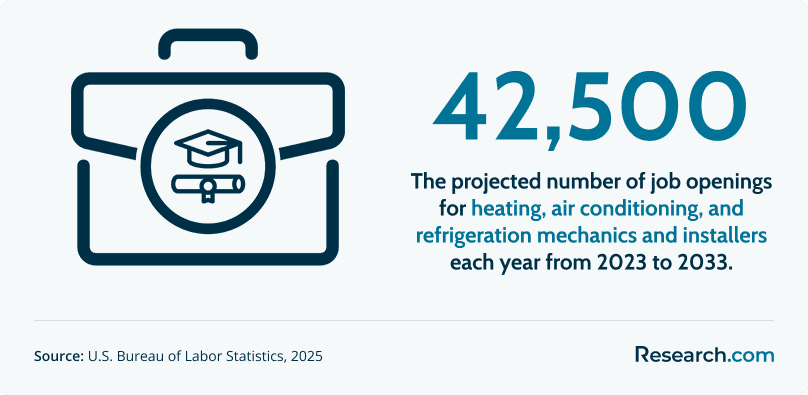
The field is expected to have approximately 42,500 job openings each year throughout the decade. Opportunities exist in residential service, commercial HVAC, refrigeration, controls, maintenance, and energy-conscious systems. With around 441,200 HVAC technician jobs currently available in the U.S., certified workers can pursue several routes depending on their training and local labor market.
Professional certification can also matter in other technical careers where precision and verified skills are important. For example, Research.com’s guide to evidence technician job requirements shows how specialized training can support entry into detail-oriented occupations.
Here’s What Graduates Have to Say About Online HVAC Trade Schools and Certifications
-
: "
Online HVAC training let me keep my full-time job while working through the lessons at a pace I could manage. The course sequence was clear, and the practical training components helped me feel prepared before applying for technician roles. After earning my EPA certification, I was able to join a local HVAC company. — Anthony
"
-
: "
I was unsure whether an online program would give me enough real-world practice, but my school connected students with local businesses for in-person training. The mix of online coursework and field exposure helped me move from studying to working. I found my first HVAC technician job within a month of certification. — Kriziel
"
-
: "
Completing HVAC training online helped me save time and money compared with a traditional campus schedule. The program covered EPA rules, installation methods, and customer service, which helped me start a small service business. I now have regular clients and feel prepared to handle more complex projects. — Angel
"
Key Insights
- Online HVAC training can work, but practical experience is essential: The strongest programs combine flexible coursework with labs, internships, local partnerships, or other hands-on learning opportunities.
- Program length is usually under a year: Many online HVAC trade school programs take 5 to 12 months, depending on pacing, curriculum depth, and required practice.
- Cost varies more than tuition suggests: Program prices can differ widely, and students should account for tools, books, technology fees, exam fees, and certification costs.
- EPA Section 608 matters for refrigerant work: Students who plan to handle refrigerants should choose a program that prepares them for EPA Section 608 Certification.
- Career options are broad: Graduates may pursue work as HVAC technicians, installers, refrigeration technicians, building maintenance technicians, or HVAC controls technicians.
- Demand is projected to grow: HVAC employment is projected to increase by 9% from 2023 to 2033, with approximately 42,500 job openings expected each year throughout the decade.
- Salary outcomes are not automatic: Median salaries for common HVAC roles range from $46,000 to $70,000 annually, but actual earnings depend on location, experience, specialization, certifications, and employer demand.
- The best program is decision-specific: Choose based on accreditation, certification preparation, hands-on training, total cost, career support, and fit with your schedule—not rankings or speed alone.
References:
- DataUSA. (n.d.). Heating, air conditioning, and refrigeration mechanics and installers. Retrieved from DataUSA.
- EPA. (n.d.). Heating, ventilation, and air conditioning systems part: Indoor air quality design tools. Retrieved from EPA.
- EPA. (n.d.). Section 609 technician training and certification programs. Retrieved from EPA.
- EPA. (n.d.). Section 608 technician certification requirements. Retrieved from EPA.
- Energy.gov. (n.d.). HVAC excellence. Retrieved from Energy.gov.
- Glassdoor. (n.d.). HVAC service technician salary. Retrieved from Glassdoor.
- ZipRecruiter. (n.d.). Building maintenance technician salary. Retrieved from ZipRecruiter.
- ZipRecruiter. (n.d.). HVAC controls technician salary. Retrieved from ZipRecruiter.
- ZipRecruiter. (n.d.). HVAC installer salary. Retrieved from ZipRecruiter.
- ZipRecruiter. (n.d.). HVAC technician salary. Retrieved from ZipRecruiter.
- ZipRecruiter. (n.d.). HVAC technician salary by state. Retrieved from ZipRecruiter.
- ZipRecruiter. (n.d.). Refrigeration technician salary. Retrieved from ZipRecruiter.
- ZipRecruiter. (n.d.). HVAC salary. Retrieved from ZipRecruiter.
Other Things You Should Know About Online HVAC Trade Schools and Certifications
In 2027, consider factors such as accreditation, curriculum relevance, faculty expertise, and support services when selecting an online HVAC trade school. It's crucial to ensure the program aligns with your career goals and offers hands-on opportunities or simulations, as these are essential for mastering HVAC skills.
To enroll in an online HVAC certification program in 2027, you typically need a high school diploma or GED. Some programs might require prior coursework in math or science. Age restrictions might apply, generally requiring students to be at least 18 years old.
In 2027, crucial HVAC certifications include the North American Technician Excellence (NATE) and EPA Section 608 Certification. These validate essential skills and knowledge for professionals completing online HVAC programs, ensuring they meet industry standards and environmental regulations.
No. EPA Section 608 certification requires passing a proctored exam approved by the U.S. Environmental Protection Agency. Online classes can prepare you, but the certification itself is earned by passing one of four exam types: Type I, Type II, Type III, or Universal.


