
2027 Most Affordable Online Floor Installer Trade School Programs

Co-Founder and Chief Data Scientist
Choosing an affordable floor installer trade school is harder than it should be because flooring is not a trade you can learn entirely online. You can study safety, estimating, materials, blueprint basics, and manufacturer standards remotely, but you still need supervised practice with subfloors, adhesives, cutting tools, seams, transitions, tile layouts, carpet stretching, and wood or resilient flooring systems.
This guide is for students, career changers, apprentices, veterans, and working installers who want practical training without overpaying. It explains what “online” floor installer training usually means, which affordable programs are available, how costs and certifications compare, what to check before enrolling, and how training can affect your job options, earning potential, and long-term career path.
Quick answer: Are there affordable online floor installer trade school programs?
Yes, but most are hybrid rather than fully online. The most affordable routes are usually union or employer-sponsored apprenticeships, short-term technical college programs, industry certifications, and manufacturer training. A good program should combine online theory with in-person labs or jobsite training, prepare you for recognized credentials, and clearly disclose tuition, tool costs, travel requirements, and certification requirements before you enroll.
What are the benefits of getting an online floor installer training qualification?
- Better entry into the trade: Formal training helps beginners understand jobsite safety, measuring, subfloor preparation, layout, product handling, and installation standards before working independently.
- Stronger credibility with employers and customers: Credentials from respected trade organizations can show that you have been trained to follow industry-recognized methods instead of learning only through trial and error.
- More flexible learning: Hybrid programs let you complete theory online while reserving in-person time for the skills that must be practiced with tools, materials, and instructor feedback.
- Room for wage growth: Flooring installers can build earning power through experience, speed, specialization, leadership, inspection work, or self-employment. Salaries typically range from approximately $40,000 for new professionals to over $70,000 for experienced specialists in the United States.
- Pathways beyond installation: Training can support advancement into lead installer roles, estimating, project coordination, inspection, sales support, or independent contracting.
What can I expect from an online floor installer trade school program?
A realistic online floor installer program is usually a blended program. The online portion teaches concepts; the in-person portion proves whether you can apply those concepts safely and accurately.
| Program component | What you learn | Why it matters |
| Online theory | Materials, estimating, layouts, adhesives, moisture issues, safety rules, and manufacturer instructions | Gives you the technical background needed before entering the lab or jobsite |
| Hands-on labs | Cutting, fitting, stretching, fastening, grouting, transitions, repairs, and finishing work | Builds the physical skills employers expect from an installer |
| Safety training | Tool handling, personal protective equipment, lifting practices, dust control, and OSHA-related practices | Reduces injury risk and prepares you for construction environments |
| Material-specific practice | Carpet, vinyl, hardwood, laminate, tile, resilient flooring, concrete prep, or specialty systems | Helps you choose a marketable specialty or become a more versatile installer |
| Certification preparation | Industry standards, assessments, performance checks, and written or practical exams | Can improve employability and help you document your skill level |
Where can I work with an online floor installer training qualification?
Floor installer training can lead to work across residential, commercial, institutional, and renovation settings. The right workplace depends on whether you want steady employment, apprenticeship support, specialty work, or self-employment.
- Flooring installation contractors: Many graduates start with contractors that install carpet, hardwood, tile, laminate, vinyl, or resilient flooring in homes and businesses.
- Construction firms: General contractors and builders use flooring crews for new construction, remodeling, and large-scale development projects.
- Home improvement retailers: Retailers may hire installers directly or connect customers with certified subcontractors.
- Self-employment: Experienced installers often become independent contractors after developing tools, insurance, client relationships, and estimating skills.
- Facilities and maintenance teams: Schools, hospitals, office campuses, hotels, and large institutions may need workers who can repair, replace, or maintain flooring systems.
How much can I make with an online floor installer qualification?
Floor installer earnings vary by region, employer type, specialty, speed, experience, and whether you work for a company or operate independently. Training does not guarantee a specific salary, but it can help you qualify for entry-level work faster and build toward higher-paying roles.
- Average national salary: The average annual salary is approximately $52,000.
- Common salary range: The majority of flooring installer salaries in the U.S. currently range between $39,000 at the 25th percentile and $54,000 at the 75th percentile.
- Higher earning potential: Experienced installers, specialists, crew leaders, inspectors, and business owners can earn more, with top earners exceeding $70,000 annually.
- Most Affordable Online Floor Installer Trade School Programs for 2027
- What floor installers do
- Average cost of an online floor installer program
- Financial aid for floor installer training
- Enrollment requirements
- Typical floor installer courses
- Floor installation specializations
- How to choose the right program
- Post-graduation support and advancement
- Further education after floor installer training
- Certifications that can improve career prospects
- How to verify industry standards
- Career paths after floor installer training
- Salary potential for floor installers
- Job market outlook
Most Affordable Online Floor Installer Trade School Programs for 2027
No credible floor installation pathway is fully online. The programs below use apprenticeship, hybrid, technical college, industry certification, or manufacturer-training models. Some use contact hours, some use apprenticeship hours, and some are certification-based rather than credit-based.
| Program | Best for | Length | Published cost | Credential or recognition |
| Carpenters Training Institute | Students seeking a paid apprenticeship pathway | 4 years | Typically no direct cost to student | INSTALL preparation and journeyworker status |
| Certified Flooring Inspectors University | Installers moving into inspection or expert consulting | Varies by course | $1195.00 to $1995.00 | Industry-recognized inspection certification |
| Certified Flooring Installers | Beginners and working installers seeking fast certification | 1 day, 2 days, or 5 weeks | $300–$1,500 | CFI certification |
| Floor Your Future | Short-term technical college training | 10–15 weeks | $850–$5,000 | Technical college transcript and certification preparation |
| Great Falls College Montana State University | Fast entry-level hands-on training | 10 weeks | $2,500 | Flooring Technician I and Basic Floor Covering Installer |
| IICRC / XL North | Floor care, cleaning, restoration, and maintenance | Varies | Not stated | IICRC certification |
| INSTALL | Union or employer-sponsored apprenticeship training | Varies by local program | No direct student tuition | INSTALL certification |
| LATICRETE University and MAPEI Technical Institute | Low-cost manufacturer training and upskilling | Self-paced or single/multi-day | Free or $100 per class | Certificates of completion and some continuing education credits |
| NAFCT | Targeted modular certification | Self-paced online plus in-person evaluation | $100 per module plus $100/year membership | NAFCT certification |
| Quick-Step Academy | Dealer-based laminate, timber, and vinyl training | 3 days per course | $800–$1,200 | Quick-Step/Unilin brand certification |
1. Carpenters Training Institute
The Carpenters Training Institute Floor Coverer Apprenticeship is a strong option for students who want structured training while earning wages on the job. The four-year program combines paid work experience with classroom instruction and covers carpet, hardwood, tile, laminate, resilient flooring, and concrete preparation.
The curriculum is organized around nine pillars, including standard skills, safety, productivity, and green building awareness. It also prepares apprentices for INSTALL certification, a respected flooring credential. Some graduates may receive partial credit toward an associate degree at partner colleges.
Because tuition is typically covered through a union or employer sponsorship, this can be one of the most affordable routes into the trade. The program follows U.S. Department of Labor standards and is accredited by the Carpenters International Training Fund through INSTALL. Completion leads to journeyworker status, which can support stronger wages, benefits, and long-term advancement.
- Program Length: 4 years
- Tracks/Concentrations: Carpet, hardwood, tile, laminate, resilient flooring, concrete prep
- Tuition Cost: Typically no direct cost to student (union/employer-sponsored)
- Required Credits to Graduate: 7,000 hours on-the-job training + 640 classroom hours (hours-based)
- Accreditation: Carpenters International Training Fund (INSTALL), U.S. Department of Labor
2. Certified Flooring Inspectors University (CFIU)
Certified Flooring Inspectors University (CFIU) focuses on flooring inspection rather than entry-level installation. Its hybrid training model combines online assignments with hands-on workshops that help students evaluate carpet, hardwood, vinyl, tile, and other flooring systems.
This pathway is especially useful for experienced installers who want to become consultants, inspectors, expert witnesses, or technical authorities in disputes involving flooring failures. Certification is awarded after completing the required training rather than through a traditional credit-hour structure.
CFIU is recognized as an industry training provider in the U.S., Canada, and the U.K., and its credentials are respected by manufacturers and legal entities. Students should request full tuition and schedule details before enrolling, especially if travel is required.
- Program Length: Varies by course
- Tracks/Concentrations: Carpet, hardwood, vinyl, tile inspection
- Tuition Cost: Carpet & Hard Surface Certification: $1995.00; Hard Surface Flooring Inspector Certification: $1195.00; Carpet Inspector Certification: $1195.00
- Required Credits to Graduate: Not credit-based; completion of modules and workshops required
- Accreditation: Recognized industry training provider
3. Certified Flooring Installers (CFI)
Certified Flooring Installers (CFI) offers certification training for carpet, resilient, hardwood, and ceramic flooring. Programs may include online preparation followed by intensive in-person instruction and assessment.
Course formats include 1-day, 2-day, and 5-week options, making CFI a practical choice for both new installers and working professionals who need focused upskilling. Training covers installation procedures, jobsite safety, substrate preparation, and product-specific practices.
CFI certification is recognized nationwide and can help installers document their competency to employers, retailers, contractors, and customers. The organization is accredited by the World Floor Covering Association (WFCA).
- Program Length: 1 day, 2 days, or 5 weeks (varies by course)
- Tracks/Concentrations: Carpet, resilient, hardwood, ceramic flooring
- Tuition Cost: $300–$1,500 (varies by course)
- Required Credits to Graduate: Not credit-based; completion of course and exam required
- Accreditation: World Floor Covering Association (WFCA)
4. Floor Your Future
Floor Your Future connects students with short-term flooring installation programs offered through technical colleges. These programs usually last 10–15 weeks and combine classroom learning, online modules, and hands-on practice.
Students may train in carpet, hardwood, resilient flooring, and tile, with preparation for credentials such as CFI and NWFA. Tuition ranges from $850 to $5,000, and scholarships through the Floor Covering Education Foundation (FCEF) may cover up to 50% of tuition.
Because credits and transcript policies vary by the participating technical college, applicants should confirm whether the program leads to college credit, noncredit workforce training, certification eligibility, or a local employer pathway.
- Program Length: 10–15 weeks
- Tracks/Concentrations: Carpet, hardwood, resilient, tile flooring, multiple flooring types
- Tuition Cost: $850–$5,000 (varies by college and program)
- Required Credits to Graduate: Varies by college; awarded via transcript
- Accreditation: Accredited through respective technical college
5. Great Falls College Montana State University
Great Falls College Montana State University offers a Basic Floor Installing program built for quick workforce entry. The program includes 300 contact hours across 10 weeks, with 75 hours each in carpet, hardwood, resilient, and tile installation.
Students complete classroom and hands-on training and may earn industry-recognized credentials, including Flooring Technician I from CFI and Basic Floor Covering Installer (BFCI) from the National Wood Flooring Association (NWFA). Tuition is $2,500, and scholarships may be available.
This program is contact hour-based rather than credit-based. Its value is strongest for students who want a concentrated, practical training experience tied to recognized industry credentials.
- Program Length: 10 weeks (300 contact hours)
- Tracks/Concentrations: Carpet, hardwood, resilient, tile flooring
- Tuition Cost: $2,500
- Required Credits to Graduate: Not credit-based; 300 contact hours
- Accreditation: Great Falls College Montana State University
6. IICRC / XL North
The IICRC/XL North Fundamentals of Hard Floor Maintenance course is designed for floor care and maintenance rather than full installation training. It introduces cleaning, restoration, and maintenance procedures for tile, vinyl, and wood flooring.
The program uses a hybrid format that combines online theory with in-person practice. Graduates earn IICRC certification, a nationally recognized credential in cleaning and restoration fields.
Tuition details are not published online and must be requested from XL North. Students should ask whether the course fits their goal: installation, maintenance, restoration, or facility care.
- Program Length: Varies
- Tracks/Concentrations: Hard floor care and maintenance; carpet maintenance; resilient floor maintenance
- Tuition Cost: Not stated
- Required Credits to Graduate: Not credit-based; certification upon completion
- Accreditation: Institute of Inspection, Cleaning and Restoration Certification (IICRC)
7. International Standards & Training Alliance (INSTALL)
The International Standards & Training Alliance (INSTALL) trains flooring installers through the UBC Carpenters International Training Fund. Its curriculum includes carpet, resilient flooring, hardwood, concrete polishing, and artificial turf.
Training takes place at INSTALL centers across North America and combines classroom instruction with hands-on skill development. Since the pathway is generally employer- or union-sponsored, students typically do not pay direct tuition.
INSTALL is accredited by the U.S. Department of Labor and Canadian provincial standards. Graduates earn INSTALL certification, which is often valued by major employers, contractors, and institutional clients.
- Program Length: Varies by local program (typically multi-year apprenticeship)
- Tracks/Concentrations: Carpet, resilient, hardwood, concrete polishing, artificial turf
- Tuition Cost: No direct student tuition (employer/union-funded)
- Required Credits to Graduate: Not credit-based; competency and hours-based
- Accreditation: U.S. Department of Labor
8. LATICRETE University & MAPEI Technical Institute
LATICRETE University and MAPEI Technical Institute are good options for low-cost professional development, especially for installers who work with tile, stone, concrete preparation, and specialized flooring systems.
LATICRETE offers approximately 165 online modules, while MAPEI provides online and in-person training, including hands-on classes such as PolyTurf Plus installation. MAPEI’s in-person classes are typically $100 per session.
These programs are not traditional trade school programs, but they can help working professionals learn manufacturer-approved methods and earn certificates of completion. Some modules may provide continuing education credits through AIA & IDCEC.
- Program Length: Self-paced (LATICRETE); single/multi-day (MAPEI)
- Tracks/Concentrations: Tile, stone, concrete prep, specialized flooring systems
- Tuition Cost: Free (LATICRETE online); $100 per class (MAPEI in-person)
- Required Credits to Graduate: Not credit-based; certificate upon completion
- Accreditation: Industry-recognized (AIA & IDCEC for some modules)
9. National Association of Floor Covering Technicians Certification (NAFCT)
The National Association of Floor Covering Technicians Certification (NAFCT) provides modular certification in areas such as subfloor preparation, resilient flooring installation, hardwood, inspection, and maintenance.
Courses use a hybrid structure: students complete self-paced online modules and then attend an in-person evaluation. For example, the Subfloor Prep course includes online learning and a hands-on exam for $100. Certification requires NAFCT membership, which costs $100/year.
NAFCT does not award a traditional degree or academic credit. Its value is in targeted skill validation and certification that may be recognized by employers and manufacturers.
- Program Length: Self-paced online + in-person evaluation
- Tracks/Concentrations: Subfloor prep, resilient installation, hardwood, inspection, maintenance
- Tuition Cost: $100 per module (plus $100/year membership)
- Required Credits to Graduate: Not credit-based; certification upon completion
- Accreditation: National Association of Floor Covering Technicians (NAFCT)
10. Quick-Step Academy (US dealers)
Quick-Step Academy offers Foundation Installer and Master Installer training through U.S. dealers. The courses combine online theory with in-person workshops focused on laminate, timber, and vinyl flooring.
Tuition varies by dealer and typically ranges from $800 to $1,200 per course. Graduates receive Quick-Step/Unilin brand certification, which includes a lifetime installation warranty and may be recognized by flooring retailers and manufacturers.
This route is best for installers who already know they want to work with Quick-Step/Unilin products or with dealers that value this brand-specific credential.
- Program Length: 3 days (each course)
- Tracks/Concentrations: Laminate, timber, vinyl flooring
- Tuition Cost: $800–$1,200 (varies by dealer)
- Required Credits to Graduate: Not credit-based; certification upon completion
- Accreditation: Quick-Step/Unilin brand
What are floor installers and what do they do?
Floor installers are skilled tradespeople who prepare surfaces and install finished flooring in homes, offices, retail spaces, schools, healthcare facilities, industrial sites, and new construction projects. Their work affects both the appearance and performance of a building, so the job requires accuracy, physical stamina, material knowledge, and problem-solving.
- Prepare subfloors: Installers inspect, clean, level, dry, and repair surfaces so flooring does not fail prematurely.
- Measure and estimate: They calculate square footage, waste, pattern direction, transitions, and material needs before the job begins.
- Cut and fit materials: Flooring materials must be cut around walls, corners, stairs, fixtures, pipes, and irregular room shapes.
- Install flooring systems: Installers use tools, adhesives, fasteners, underlayments, grout, tack strips, stretchers, or floating systems depending on the product.
- Finish and repair work: They may install trim, transitions, baseboards, moldings, or repair damaged sections after installation.
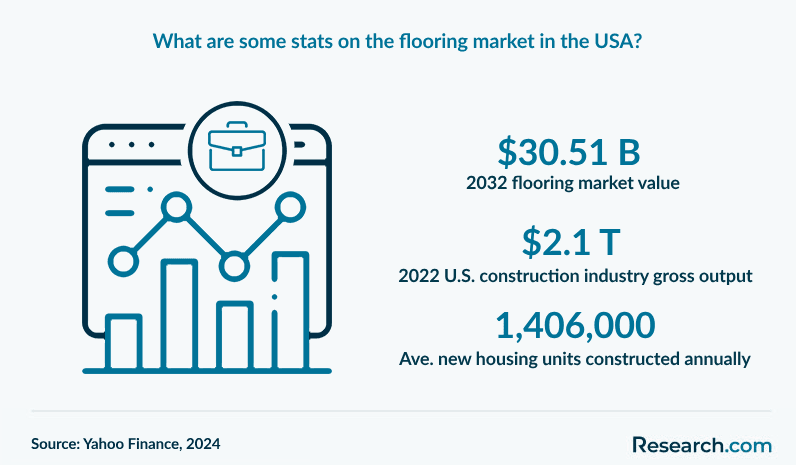
The U.S. flooring market is projected by Yahoo Finance data from 2024 to grow from US$ 20.87 billion in 2023 to US$ 30.51 billion by 2032. That represents a projected Compound Annual Growth Rate (CAGR) of 4.31% for 2024 to 2032.
This demand is connected to the broader construction industry. The U.S. construction industry had a gross output of $2.1 trillion in 2022 and included over 919,000 establishments employing 8 million people. Construction businesses increased by 2.5% in 2023, and the country constructed an average of 1,406,000 new housing units annually.
Flooring also connects naturally with other building and property improvement trades. Workers who want to broaden their skills may compare flooring with related training areas such as affordable online landscaping technology programs, especially if they plan to work in residential renovation, property improvement, or small contracting businesses.
The main takeaway is straightforward: flooring demand is tied to both new construction and renovation. As long as homes, commercial buildings, and institutions need durable finished surfaces, trained installers will remain part of the construction and maintenance workforce.
What is the average cost of an online floor installer program?
Floor installer training costs vary widely because programs use different models. A union apprenticeship may have no direct tuition, while a short technical college program may cost several thousand dollars, and individual certification workshops may cost less but cover a narrower skill set.
| Training type | Typical cost information from listed programs | Best fit |
| Union or employer-sponsored apprenticeship | Typically no direct student tuition | Students who can commit to multi-year paid training |
| Short-term technical college program | $850–$5,000; Great Falls College MSU lists $2,500 | Beginners seeking structured hands-on training |
| Industry certification course | $300–$1,500 for CFI; $100 per NAFCT module plus $100/year membership | Installers who need specific credentials or skill validation |
| Inspection certification | $1195.00 to $1995.00 through CFIU | Experienced installers moving into inspection work |
| Manufacturer training | Free LATICRETE online modules; MAPEI in-person classes typically $100 per session | Working installers learning product-specific methods |
| Standalone workshops | Organizations such as Certified Flooring Installers or the National Wood Flooring Association (NWFA) typically charge between $500 and $1,500 per session | Focused practice in a particular flooring system |
Before comparing tuition, ask what the listed price includes. Tools, safety gear, practice materials, exam fees, travel, lodging, union dues, membership fees, background checks, or lost work time can change the real cost of attendance.
What are the financial aid options for online floor installer programs?
Financial aid depends on the provider. Accredited colleges may offer federal student aid pathways, while industry certifications and private workshops may rely on scholarships, employer support, payment plans, or workforce funding.
- Federal student aid: If the program is offered by an eligible accredited school, students may complete the FAFSA to check eligibility for grants and loans.
- Scholarships and grants: Industry groups, foundations, manufacturers, and trade organizations may offer support for students entering skilled trades.
- Veterans’ benefits: Eligible veterans and dependents may be able to use GI Bill® benefits for approved training programs.
- Employer sponsorship: Flooring companies may pay for training, certification, or apprenticeship costs when they need skilled workers.
- Union apprenticeship funding: Some apprenticeship programs are funded through employer and union systems, reducing or eliminating direct tuition.
- Payment plans: Short-term programs may allow tuition to be paid in installments.
Do not assume every “online” or hybrid trade program qualifies for federal aid. Ask the provider directly whether the program is credit-bearing, noncredit workforce training, certification-only, or apprenticeship-based. If you are comparing broader education costs, resources such as MBA under 10k programs can show how tuition structures differ across fields, but flooring training should be judged by trade outcomes, hands-on access, and credential value.
What are the prerequisites for enrolling in an online floor installer program?
Most floor installer programs are designed to be accessible, especially for beginners entering the skilled trades. Requirements are usually practical rather than academic.
- High school diploma or GED: Many trade schools, technical colleges, and apprenticeship programs require this baseline credential.
- Minimum age: Applicants are typically expected to be at least 18 years old by the program start date.
- Basic math ability: Installers use arithmetic, fractions, geometry, and measurement every day for layouts, cuts, square footage, and material estimates.
- Physical readiness: Flooring work can involve kneeling, lifting, carrying, bending, cutting, and working with tools for long periods.
- Reliable transportation: Hybrid programs, apprenticeships, and labs may require travel to training centers or jobsites.
- Attention to detail: Small errors in measuring, moisture testing, or seams can lead to expensive failures.
Floor installation is not a field that requires graduate education. Students comparing academic options such as easy masters degrees online should understand that flooring is a hands-on trade with a very different training model and career pathway.
What courses are typically in an online floor installer program?
A strong floor installer curriculum should move from materials and safety into estimating, subfloor preparation, installation methods, and supervised practice. If a program teaches only videos and quizzes with no hands-on component, it is not enough for job readiness.
| Course area | What it covers | Red flag to watch for |
| Flooring materials | Hardwood, laminate, vinyl, carpet, ceramic tile, resilient flooring, stone, and specialty systems | No discussion of product limitations or manufacturer guidelines |
| Blueprint reading and estimating | Plans, specifications, measurements, waste factors, layout, and labor estimates | No practice with real measurements or project scenarios |
| Subfloor preparation | Moisture, flatness, leveling, cleaning, patching, underlayments, and substrate compatibility | Treating prep work as optional or minor |
| Safety standards | PPE, tools, adhesives, dust, lifting, cutting, and OSHA-related jobsite practices | No safety module or no supervised tool training |
| Installation labs | Hands-on practice with tools, layouts, seams, transitions, adhesives, fasteners, tile setting, or carpet stretching | No required in-person lab, shop, or apprenticeship component |
| Business and customer communication | Estimating, scheduling, change orders, documentation, warranties, and client expectations | No preparation for real jobsite communication |
Students interested in the design and planning side of construction may later compare trade training with options such as the fastest degree in architecture online. For most new installers, however, the priority should be practical jobsite competence before broader academic study.
What types of specializations are available for floor installers?
General flooring training is useful, but specialization can make you more competitive. The best specialty depends on your local market, the employers near you, the materials you enjoy working with, and whether you prefer residential, commercial, or industrial projects.
- Hardwood flooring and finishing: This area includes solid and engineered hardwood installation, sanding, staining, refinishing, patterns, and custom details. Installers who want broader wood-related skills may also review the cheapest online carpentry classes.
- Carpet installation: Carpet specialists work with stretching, seams, padding, stairs, patterns, and commercial carpet systems.
- Resilient flooring: This includes vinyl, LVT/LVP, linoleum, and rubber flooring, often used in commercial, healthcare, and institutional settings.
- Ceramic, porcelain, and stone tile: Tile setting requires careful layout, cutting, leveling, waterproofing knowledge, mortar selection, grout work, and finishing.
- Concrete coatings and polishing: Epoxy, polished concrete, staining, and industrial surface systems can be valuable in high-traffic or commercial environments. Installers working in sensitive properties may benefit from safety and access-control awareness, such as concepts covered in the cheapest security training programs online.
- Flooring inspection: Experienced installers can move into inspections, failure analysis, manufacturer claims, and expert reporting.
NWFA distributor sentiment shows cautious optimism in the wood flooring market. For 2023, 36 percent of NWFA distributors reported sales similar to 2022, while over 40 percent said sales were up.
For the remainder of 2024, half of distributors expected growth, although some remained cautious due to a bad economy and inflation. Looking toward 2025, nearly two-thirds expected increased sales, and fewer than 10 percent expected a significant decline.
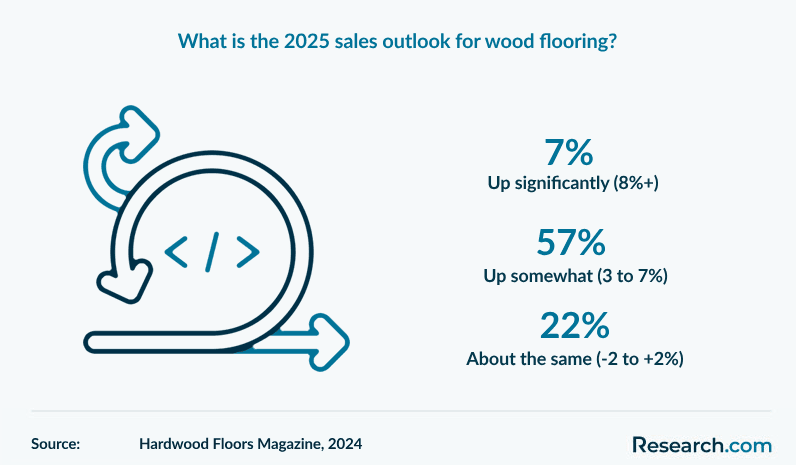
The 2025 sales outlook shows that a combined 64% of distributors expected growth: 57 percent forecast sales to be “up somewhat” by 3 to 7%, and 7 percent expected sales to be “up significantly” by 8%+. Another 22 percent expected sales to stay about the same, while 14 percent anticipated a downturn.
How do you choose the best online floor installer program?
The best program is not always the cheapest. It is the one that gives you enough supervised practice, recognized credentials, employer connections, and transparent costs to help you reach your career goal.
| Question to ask | Why it matters | Better choice |
| Is the program fully online or hybrid? | Flooring installation requires physical skill assessment. | Choose hybrid training, apprenticeship, or in-person labs. |
| Who recognizes the credential? | Not every certificate carries weight with employers. | Look for CFI, NWFA, INSTALL, IICRC, NAFCT, college, union, or manufacturer recognition when relevant. |
| Are tools and materials included? | Low tuition can hide expensive supply costs. | Request a total cost sheet before enrolling. |
| Who teaches the course? | Instructor experience affects the quality of feedback. | Prefer instructors with current field experience and industry credentials. |
| Does the program support job placement? | Employer connections can matter as much as classroom learning. | Ask about apprenticeships, contractor relationships, placement support, and alumni outcomes. |
| Is the institution accredited or industry-recognized? | Accreditation may affect aid, credit, and transfer options. | For colleges, verify accreditation; for trade programs, verify industry recognition. |
For college-based options, accreditation checks are important. A general resource on nationally accredited online colleges can help explain institutional accreditation, but flooring programs often rely more heavily on trade-specific recognition, apprenticeships, and industry credentials.
What common mistakes should you avoid when choosing a floor installer program?
- Assuming “online” means job-ready: Videos can teach concepts, but they cannot replace hands-on tool practice and instructor correction.
- Choosing only by tuition: A cheaper course may cost more overall if it excludes tools, exam fees, materials, travel, or required memberships.
- Ignoring local employer preferences: Ask contractors in your area which credentials they recognize before paying for certification.
- Overlooking physical demands: Flooring work can be hard on the knees, back, hands, and shoulders. Make sure the trade fits your abilities and long-term health.
- Skipping subfloor training: Many installation failures begin below the finished floor. Programs should teach moisture, flatness, leveling, and substrate evaluation.
- Expecting salary guarantees: Pay depends on skill, speed, location, employer, specialization, and business ability.
- Not checking completion requirements: Some programs require in-person evaluations, exams, contact hours, apprenticeship hours, or membership fees.
What post-graduation support and career advancement opportunities can I expect?
Useful post-graduation support may include job leads, apprenticeship placement, employer introductions, resume help, mentorship, refresher courses, alumni networks, or access to advanced workshops. Ask for specific examples rather than accepting broad promises.
For career growth, installers can move into lead installer roles, specialty installation, estimating, project coordination, inspection, sales support, or business ownership. Some workers also combine trade credentials with academic programs. If you want a short academic credential alongside trade experience, you can compare options such as 1 year associate degree programs online, but make sure the coursework supports your actual construction or business goals.
Can floor installer training lead to advanced educational opportunities?
Yes, but it depends on the program. Some apprenticeship or technical college training may provide transcripted credit or partial credit toward a related associate degree. Other certification programs are not credit-bearing, even if employers value them.
Installers who want to become supervisors, estimators, project managers, or business owners may later study construction management, business, accounting, or entrepreneurship. Students who want a faster route to a broader credential can review the best accelerated bachelor's degree online options, but trade experience remains central in flooring careers.
Can additional certifications boost my career prospects?
Additional certifications can help when they match your work. A hardwood credential may help if your market has demand for wood flooring; an inspection credential can help experienced installers move into claims and consulting; manufacturer certificates can matter when dealers or customers request a specific product system.
Before paying for a credential, ask local employers whether they value it, whether it improves your eligibility for better projects, and whether it requires renewal. For broader credential planning, you can compare certifications for good paying jobs, but flooring-specific credentials should be prioritized when your goal is installation work.
How can I verify that an online floor installer program meets industry standards?
Start by identifying what kind of program it is: accredited college program, registered apprenticeship, industry certification, manufacturer training, or private workshop. Then verify the organization behind it, the instructors, the hands-on requirements, and the credential’s recognition in the field.
- Confirm accreditation or recognition: For colleges, check institutional accreditation. For trade programs, verify recognition from industry bodies, unions, manufacturers, or employers.
- Ask about hands-on assessment: A serious program should evaluate practical skills, not just online quizzes.
- Review instructor qualifications: Look for current trade experience, certifications, and familiarity with modern materials.
- Check employer connections: Ask whether the school partners with contractors, unions, retailers, manufacturers, or apprenticeship sponsors.
- Request outcome details: Ask about completion rates, job placement support, exam pass expectations, and whether graduates enter paid work.
- Clarify continuing education: Some credentials require renewal, membership, or additional training.
Advanced academic programs such as the best one year masters programs serve very different goals. For flooring training, industry fit, practical instruction, and employer recognition are usually more important than academic prestige.
What career paths are available for graduates of online floor installer programs?
Floor installer training can support several career directions. Beginners usually start by installing flooring under supervision, while experienced workers may move into leadership, inspection, estimating, or business ownership.
| Career path | Main responsibilities | When it makes sense |
| Flooring installer | Prepare surfaces, install materials, complete finishing work, and follow specifications | Best first step for most graduates |
| Lead installer | Coordinate a crew, check quality, manage productivity, and solve jobsite issues | Good fit after gaining speed, accuracy, and leadership skills |
| Project manager | Schedule crews, coordinate materials, communicate with clients, and oversee budgets | Best for installers with organization and communication strengths |
| Flooring inspector | Evaluate installation failures, write reports, and support claims or disputes | Best for experienced professionals with technical judgment |
| Independent contractor or owner | Estimate jobs, market services, manage clients, buy materials, supervise labor, and handle finances | Best after building skills, tools, insurance, and a customer base |
If your long-term goal is project leadership, you may also compare flooring experience with formal management education such as the cheapest online construction management degree programs.
The U.S. Bureau of Labor Statistics reports that the largest employers of flooring installers and tile and stone setters in 2023 were specialty trade contractors, employing 52% of workers. Self-employed workers accounted for 24%, construction of buildings employed 7%, and manufacturing employed 6%.
How much can I earn with an online floor installer degree?
Most flooring programs lead to a certificate, apprenticeship credential, industry certification, or diploma rather than a traditional degree. Earnings depend on experience, specialization, employer type, location, and whether you work as an employee or self-employed contractor. You do not need fast track degree programs to begin building a stable trade career, but you do need marketable skills and reliable workmanship.
- Entry-level installers: New graduates may start in the $35,000 to $45,000 annual range.
- Experienced installers: Installers with several years of productive experience may earn between $50,000 and $70,000 annually.
- Specialized installers: Workers skilled in custom tile, hardwood refinishing, commercial resilient flooring, or other technical areas may command higher wages.
- Business owners: Successful independent contractors can exceed $80,000 to $100,000 per year or more, depending on the size and profitability of their business.
PayScale data from 2025 shows that experience is strongly associated with higher pay. An entry-level flooring installer with less than one year of experience earns approximately $30,660 annually. Early-career installers with one to four years of experience earn around $38,900. Mid-career installers with five to nine years of experience earn about $49,050.
Late-career installers with 10 to 19 years of experience earn approximately $52,440, while professionals with more than 20 years in the trade earn around $60,300.
Skills and employer type also affect earnings. Installers with flooring installation skills average approximately $49,920. Residential project specialization averages $45,760, while commercial project specialization averages $47,840. Problem-solving skills are associated with about $49,920, and team leadership skills with around $52,000.
Self-employed installers earn an average of $49,920. By comparison, some company averages are lower, including approximately $27,040 at Quality Flooring and approximately $31,200 at Carpet One. Larger companies such as Floors, Inc. and Flooring America show averages of $41,600 and $43,680, respectively.
The pattern is clear: experience, leadership, specialization, and the type of employer can all influence pay. Training is only the starting point; long-term earnings depend on the quality and reliability of your work.
What is the job market for graduates with an online floor installer degree?
The labor market for flooring installers is supported by construction, renovation, maintenance, and replacement demand. Employers often need workers who can show up reliably, follow safety procedures, work accurately, and install materials according to product standards.
- Construction and renovation demand: Flooring is needed in both new buildings and existing properties.
- Specialty trade contractor employment: Specialty trade contractors employ the largest share of flooring installers and tile and stone setters.
- Self-employment opportunities: A significant share of workers operate independently, which can create flexibility but also requires business skills.
- Credential value: Certification can help distinguish trained installers in a field where employers may struggle to find skilled labor.
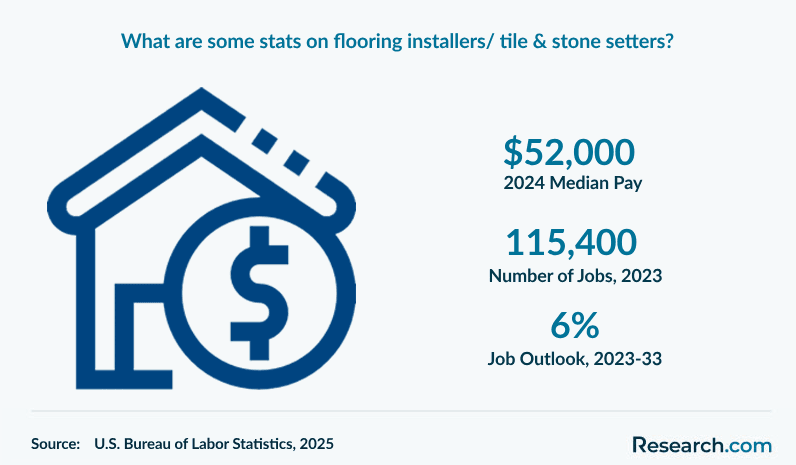
According to the U.S. Bureau of Labor Statistics' 2025 data, median pay for flooring installers and tile and stone setters was $52,000 in 2024. In 2023, there were 115,400 jobs in the field. The projected job outlook for 2023 to 2033 is 6% growth, which is faster than the average for all occupations.
This outlook suggests that trained installers can find opportunities, especially if they are willing to complete hands-on training, pursue recognized credentials, and develop specialized skills. You do not need accelerated online business degree programs to get started, although business education may help later if you plan to run your own contracting company.
What graduates say about online floor installer trade school programs
-
: "
The hybrid program at Great Falls College helped me keep working part time while learning a trade. The online lessons gave me the basics, but the shop practice is where everything started to make sense. Orville
"
-
: "
The CFI course helped me sharpen my technique quickly. I liked that the online preparation led into an in-person workshop where instructors could actually watch how I worked. Mae
"
-
: "
INSTALL through the Carpenters Training Institute felt structured and serious. Getting paid while learning from experienced mentors made the apprenticeship path worth it for me. Marcus
"
Key Insights
- Fully online flooring training is not enough: Flooring installation requires hands-on practice, so the best “online” options are hybrid, apprenticeship-based, or certification programs with in-person assessment.
- Apprenticeships can be the most affordable path: Carpenters Training Institute and INSTALL pathways may involve no direct student tuition because training is union- or employer-sponsored.
- Short programs can work for fast entry: Technical college and certification programs lasting 10–15 weeks, 10 weeks, or even shorter workshops may help beginners or working installers build specific skills.
- Credentials should match your goal: CFI, NWFA, INSTALL, IICRC, NAFCT, manufacturer certificates, and college-based credentials serve different purposes. Choose based on the employers and flooring systems you want to work with.
- Cost comparisons must include hidden expenses: Ask about tools, materials, exams, memberships, travel, lodging, and whether the program is credit-bearing or certification-only.
- The market outlook is positive but not guaranteed: U.S. Bureau of Labor Statistics data shows median pay of $52,000 in 2024, 115,400 jobs in 2023, and projected growth of 6% from 2023 to 2033.
- Experience drives earning power: PayScale data from 2025 shows earnings rising from approximately $30,660 for installers with less than one year of experience to around $60,300 for those with more than 20 years in the trade.
- Specialization can improve competitiveness: Hardwood, resilient flooring, tile, concrete coatings, maintenance, and inspection each offer different career opportunities.
- Do not rely on rankings alone: The right program should fit your schedule, location, budget, physical readiness, local employer demand, and long-term career plan.
References:
- Hardwood Floors Magazine. (2024, September). Industry Outlook 2025: Extended content [PDF]. Hardwood Floors Magazine.
- Payscale. (2025, April 1). Average Flooring Installer hourly pay [Data set]. Payscale.
- Statista. (2025). Floor covering – worldwide: revenue 2024 forecast to 2029. Statista.
- U.S. Bureau of Labor Statistics. (2025, April 18). Flooring installers and tile and stone setters. Occupational Outlook Handbook. U.S. Bureau of Labor Statistics.
- Yahoo Finance. (2024, April 8). U.S. Flooring Market to Hit Valuation of USD 30.51 Billion by 2032. Yahoo Finance.
Other Things You Should Know About the Most Affordable Online Floor Installer Trade School Programs
Admission requirements for 2027's most affordable online floor installer trade schools typically include a high school diploma or GED. Some programs may require basic math or comprehension tests. It's advisable to consult individual schools for specific criteria and any prerequisites they might have.
You can absolutely learn the theoretical aspects of floor installation online, such as industry regulations, material estimating, blueprint reading, and safety protocols like OSHA guidelines. Online programs offer flexibility, allowing learners to study foundational knowledge from anywhere while balancing work or other responsibilities. However, mastering the physical aspects of the trade, such as precise cutting, handling specialized tools, and fitting flooring materials seamlessly, requires hands-on experience.
The most effective programs follow a hybrid model, combining online learning with in-person workshops or apprenticeships. This blended approach ensures students receive both the "why" behind installation techniques and the crucial "how" through real-world practice. Without hands-on training, an installer may lack the necessary skills to perform high-quality work. Therefore, while online learning is a useful tool for accessibility, it should always be paired with direct, practical experience to produce a competent flooring professional.
In 2027, most affordable online floor installer trade school programs offer flexible scheduling options, allowing students to balance education with personal and professional responsibilities. Many programs include self-paced modules or live classes held at various times to accommodate different time zones and commitments.


