
2027 Most Affordable Online Pet Grooming Trade School Programs

Co-Founder and Chief Data Scientist
Pet grooming is a practical trade for people who want an animal-care career without spending years in college. The harder decision is not whether grooming can be a real job—it is choosing training that is affordable, legitimate, hands-on enough, and aligned with how you plan to work after graduation.
This guide is for beginners comparing online pet grooming trade school programs, career changers who want a faster route into animal care, and pet-care workers who want to add grooming services. You will learn what online programs teach, how much they cost, how long they take, where graduates work, what to check before enrolling, and which affordable programs are worth comparing.
Quick answer: Are online pet grooming trade school programs worth considering?
Online pet grooming programs can be worth it if they teach safe handling, breed-specific grooming, sanitation, tool use, and real practice—not just theory. The best options combine video instruction with assignments, instructor feedback, mentorship, externships, or documented hands-on practice. They are usually certificate programs rather than degrees, so they can be faster and less expensive than traditional college programs.
Online training is best for students who can practice consistently at home or arrange supervised practice through a local salon, vet clinic, shelter, or mentor. If you need live correction every day or have no access to practice animals and grooming tools, an on-campus or hybrid program may be a better fit.
What are the main benefits of online pet grooming trade school programs?
- They can prepare students for entry-level work in grooming salons, pet spas, mobile grooming businesses, veterinary offices, pet stores, and self-employment.
- Video lessons, recorded demonstrations, and virtual instructor feedback allow learners to repeat difficult techniques and improve at a manageable pace.
- Graduates can earn between $15 and $25 per hour, and income may increase through tips, commissions, loyal clients, advanced services, or business ownership.
What can I expect from an online pet grooming program?
An online pet grooming program should teach both the technical side of grooming and the safety judgment needed to work with live animals. A strong curriculum does more than show haircut styles; it explains how to assess coat condition, handle anxious pets, prevent injuries, clean tools, communicate with owners, and recognize when a health issue should be referred to a veterinarian.
Most online pet grooming programs cover:
- Dog and cat bathing, brushing, drying, clipping, trimming, and finishing techniques
- Coat types, breed profiles, and common breed-specific grooming patterns
- Safe handling, restraint, and low-stress grooming practices
- Sanitation, infection control, tool maintenance, and workstation safety
- Customer communication, appointment management, pricing basics, and business operations
- Common skin, coat, ear, nail, and health concerns groomers may notice during appointments
Many programs use recorded lessons, step-by-step demonstrations, quizzes, grooming assignments, and photo or video submissions. Some require students to buy a grooming kit or practice on a mannequin, volunteer pets, or client pets under supervision. A smaller number include short in-person workshops or externships, although many are fully online.
These programs are typically certificates, not associate or bachelor’s degrees. That means you usually do not take unrelated general education courses such as college math or English composition. Depending on the school, a program may include about 8 to 12 courses and may equal 15 to 30 credit hours. Average pricing is often between $50 and $150 per credit, although some schools use bundled tuition, monthly subscriptions, or flat-rate pricing instead.
| Program feature | Why it matters | What to look for before enrolling |
| Hands-on practice | Grooming is a physical skill, not only an online lesson. | Assignments using real pets, mannequins, videos, externships, or mentor review. |
| Safety training | Improper handling can injure pets or groomers. | Lessons on restraint, stress signals, skin issues, tool safety, sanitation, and emergency basics. |
| Instructor feedback | Beginners often cannot spot mistakes on their own. | Video reviews, one-on-one evaluations, coaching calls, or written critiques. |
| Business content | Many groomers work independently or build repeat clients. | Pricing, scheduling, customer service, liability basics, and mobile or home-based operations. |
| Credential clarity | Not every certificate has the same value with employers. | Transparent accreditation, industry recognition, exam requirements, and graduate outcomes. |
Where can I work with an online pet grooming program?
A certificate from an online pet grooming program can support several entry-level animal-care paths. The Bureau of Labor Statistics does not separate pet groomers into their own occupational category; groomers are generally included under “animal caretakers.” In 2023, there were approximately 364,600 animal caretaker jobs, and the field is expected to continue expanding.
Common work settings include:
- Grooming salons and pet spas: Many new groomers begin in salons where they can build speed, confidence, and experience with different breeds.
- Veterinary clinics and animal hospitals: Some practices hire groomers to provide bathing, trimming, nail care, and coat maintenance, especially for pets with medical or skin-care needs.
- Pet stores: Large retail chains may employ groomers, bathers, assistants, or trainees in on-site grooming departments.
- Mobile grooming businesses: Groomers may travel to clients, which can appeal to owners who want convenience or have pets that do poorly in busy salons.
- Self-employment: About 23% of animal caretakers work for themselves, making independent grooming a realistic path for people who can manage clients, scheduling, tools, insurance, and local business rules.
The BLS reports that the largest share of animal caretakers, 37%, works in “other personal services,” a category that includes grooming shops and specialty care providers. Another 12% work in retail, while 11% work in professional or technical services, including veterinary settings.
How much can I make with an online pet grooming program?
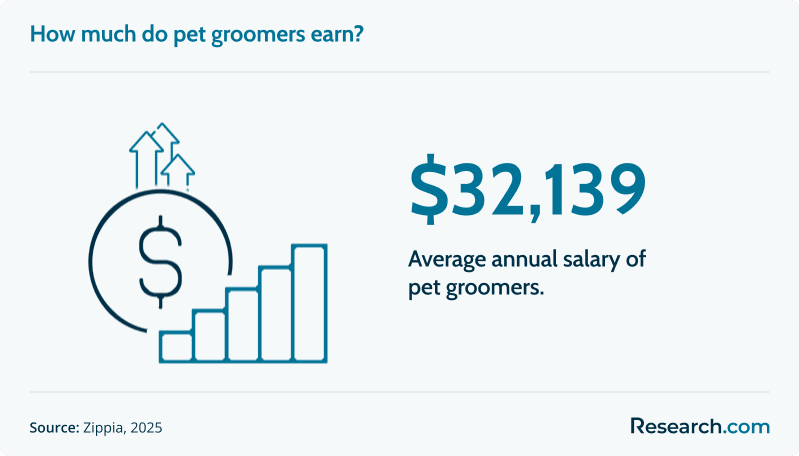
Zippia’s 2025 data reports an average annual salary of $32,139 for pet groomers. That equals about $618 per week, or around $15 per hour. For a career that can often be entered in under a year, this can be a reasonable starting wage, especially for students seeking a hands-on trade instead of a four-year degree.
Actual earnings vary widely. The biggest factors include:
- Location: Groomers in large cities and high-demand suburbs may have more clients and higher service prices than those in lower-cost rural markets.
- Experience level: Skilled groomers who work quickly, handle difficult coats, and retain clients can often earn more over time.
- Employer type: High-end salons, veterinary practices, specialty groomers, and busy retail locations may offer different pay structures.
- Business model: Self-employed groomers, mobile groomers, and salon owners may increase income after building a steady client base, but they also take on expenses and business risk.
Some grooming jobs include tips, bonuses, or commission-based compensation. Before accepting a job, ask how pay is calculated, whether supplies are provided, how tips are distributed, and whether training time is paid.
- Most Affordable Online Pet Grooming Trade School Programs for 2027
- How long does online pet grooming trade school take?
- Online vs. on-campus pet grooming programs
- Average cost of online pet grooming trade school
- Financial aid and payment options for online pet grooming students
- Enrollment requirements for online pet grooming programs
- Typical courses in an online pet grooming curriculum
- Pet grooming specializations available online
- How to verify accreditation and certification
- How extra certifications can strengthen your grooming career
- Whether advanced training can improve career growth
- How to choose the right online pet grooming trade school
- Career paths after online pet grooming trade school
- Job market outlook for pet grooming graduates
How do we rank our schools?
Affordability matters, but a low price alone does not make a grooming program a good investment. Our rankings are designed to help students compare programs using dependable education data and clear selection criteria. We review information from established sources such as the IPEDS database, Peterson’s database, the College Scorecard, and the National Center for Education Statistics.
These sources provide insight into tuition, school characteristics, completion data, and institutional quality where available. Because many grooming-specific programs are career certificates rather than traditional college degrees, students should also review school disclosures, refund policies, credential claims, hands-on requirements, and student support before enrolling. For more detail on how Research.com evaluates schools, see our methodology page.
Most Affordable Online Pet Grooming Trade School Programs for 2027
The programs below vary significantly in price, structure, support, accreditation status, and hands-on expectations. Use this list as a starting point, then confirm current tuition, supplies, refund terms, certification details, and practice requirements directly with each school.
| Rank | Program | Best for | Cost | Accreditation or recognition listed |
| 1 | Groomers University | Low-cost monthly beginner training | $47/month | None |
| 2 | Professional Dog Grooming Academy | Budget-friendly self-paced video learning | $279–$359 | ICOES |
| 3 | Penn Foster | Structured certificate with CEUs | $799 | DEAC |
| 4 | American Grooming Academy | Level-based grooming skill development | $999 per level | None |
| 5 | National Cat Groomers Institute | Feline grooming specialization | $1,197 | None |
| 6 | Whole Pet Grooming Academy | Canine styling and business training | $2,000 | IAPEG |
| 7 | Paragon School of Pet Grooming | Mentor-supported level training | $2,598 (Levels 1 & 2) | None |
| 8 | Animal Behavior College | Online coursework plus externship | $3,499 | IACP-recognized |
| 9 | Nash Academy | Hybrid diploma with extensive hours | $7,900 + tools/uniform | KCPE |
| 10 | Merryfield Academy | Hybrid diploma and externship model | $12,900 | ACCSC |
1. Groomers University
Groomers University offers a Grooming Bootcamp designed for beginners who want a low-cost, self-paced introduction to grooming. The program includes over 100 lessons covering core grooming skills, safety practices, and basic business topics. Students also receive mentorship, access to a learner community, and weekly group coaching intended to help them move toward paid grooming work.
- Required Time to Complete: Self-paced
- Cost: $47/month
- Accreditation: None
2. Professional Dog Grooming Academy
Professional Dog Grooming Academy provides a self-paced course with 17–27+ hours of video instruction, quizzes, and tutor support. The curriculum walks students through the grooming process from start to finish, and graduates receive international certification after completing the program. Lifetime access can be helpful for students who want to review lessons while practicing.
- Required Time to Complete: Self-paced
- Cost: $279–$359
- Accreditation: ICOES
3. Penn Foster
Penn Foster offers a Pet Grooming Certificate that covers grooming tools, animal behavior, breed-specific care, and professional handling. The program is built for flexible online study and includes 10 courses and 25 exams.
- Required Credits to Graduate: 27.4 CEUs
- Cost: $799
- Accreditation: DEAC
4. American Grooming Academy
American Grooming Academy structures its online training across three levels: Bather, Pet Stylist, and Advanced Stylist. Students use video lessons and one-on-one evaluations to move from foundational bathing and handling skills to more advanced grooming techniques.
- Required Credits to Graduate: Not credit-based
- Cost: $999 per level
- Accreditation: None
5. National Cat Groomers Institute
National Cat Groomers Institute focuses on training students for the Certified Feline Master Groomers™ credential. Coursework includes feline breed identification, safe cat handling, health considerations, and grooming methods. Students complete four written exams and five practical assessments.
- Required Time to Complete: Varies
- Cost: $1,197
- Accreditation: None
6. Whole Pet Grooming Academy
Whole Pet Grooming Academy offers Canine Stylist Certification with instruction in breed styling, anatomy, and business strategy. Students can complete the course in approximately one month and may pursue either a diploma or a master-level credential.
- Required Time to Complete: ~1 month
- Cost: $2,000
- Accreditation: IAPEG
7. Paragon School of Pet Grooming
Paragon uses a level-based certification format that teaches grooming fundamentals, safety, and efficiency with mentor support. Students complete quizzes, watch training videos, and apply lessons through practical grooming work guided by experienced professionals.
- Required Credits to Graduate: Not credit-based
- Cost: $2,598 (Levels 1 & 2)
- Accreditation: None
8. Animal Behavior College
Animal Behavior College combines online coursework with a 150-hour externship. Students study canine anatomy, grooming tools, health topics, and grooming techniques before applying their skills with support from a local mentor.
- Required Credits to Graduate: Not credit-based
- Cost: $3,499
- Accreditation: IACP-recognized
9. Nash Academy
Nash Academy offers a diploma program that blends grooming theory with hands-on skill development through a 600–640-hour curriculum. Online lessons are paired with onsite training to prepare students for salon, mobile, or other grooming roles.
- Required Time to Complete: 3–12 months
- Cost: $7,900 + tools/uniform
- Accreditation: KCPE
10. Merryfield Academy
Merryfield provides a hybrid diploma with 600 hours of grooming education. The program includes online modules, classroom instruction, and an externship, with an emphasis on professionalism and NDGAA grooming standards.
- Required Credits to Graduate: 600 clock hours
- Cost: $12,900
- Accreditation: ACCSC
How long does it take to complete an online pet grooming trade school program?
Most online pet grooming programs take 4 to 12 months, depending on the depth of the curriculum, whether the program is self-paced, and how much practical work is required. Basic certificate programs may be completed in 4 to 6 months by students who can study regularly and practice consistently.
More advanced trade school career paths that include diplomas, multiple breed specializations, externships, or hybrid training may take 9 to 12 months. These programs usually spend more time on grooming theory, breed profiles, coat care, salon workflow, and supervised practice.
Self-paced programs can be convenient, but they also require discipline. If you study only occasionally or struggle to find pets for practice, completion may take longer. Before enrolling, ask whether the school has time limits, extension fees, required practice submissions, or deadlines for exams.
| Training length | Typical program type | Best fit | Possible limitation |
| Self-paced | Subscription, short course, or modular certificate | Students with unpredictable schedules | Less structure may slow progress |
| 4 to 6 months | Beginner certificate | Students seeking faster entry-level preparation | May provide less advanced breed-specific practice |
| 9 to 12 months | Advanced certificate, diploma, or hybrid option | Students who want deeper training and more practice | Usually costs more and requires a larger time commitment |
| 3–12 months | Hybrid diploma with significant hours | Students who want online study plus onsite skill building | Travel and scheduling may be required |
How does an online pet grooming trade school program compare to an on-campus program?
Online and on-campus grooming programs can both lead to useful skills, but they deliver training differently. The right format depends on your schedule, budget, learning style, and access to practice animals.
| Factor | Online pet grooming program | On-campus or hybrid program | Best choice if... |
| Schedule | Often self-paced or flexible | Usually follows set class times | Choose online if you work, parent, or need schedule control. |
| Hands-on practice | Practice may happen at home with uploaded photos or videos | Practice may occur in a training salon with live supervision | Choose campus if you need immediate correction. |
| Feedback | May include email, messaging, video review, or coaching calls | Usually offers real-time instructor guidance | Choose online if delayed feedback works for you; choose campus if you learn best by demonstration and correction. |
| Cost | Often avoids commuting, relocation, and campus fees | May cost more but can include facilities, tools, and live animals | Choose online when affordability and access matter most. |
| Career preparation | May emphasize home-based, mobile, or small-business grooming | May focus more heavily on salon workflow | Choose based on your intended work setting. |
Like an electrical technician school that benefits from labs and supervised practice, pet grooming training improves when students can work with tools, animals, and real handling situations. Online programs can still be effective, but only when they require meaningful practice and provide useful feedback.
The chart below lists the highest educational attainment of pet groomers in the US, as published by Zippia in 2025.
What is the average cost of an online pet grooming trade school program?
The average cost of an online pet grooming trade school program ranges from $3,000 to $7,000, although the programs in this guide show that prices can be much lower or much higher depending on format, credential level, included supplies, and hands-on requirements.
Costs usually fall into several categories:
- Tuition: Full certification programs often charge between $4,000 and $6,000. Shorter or introductory programs may cost between $2,500 and $3,000.
- Grooming supplies: Some schools include clippers, scissors, combs, dryers, or practice mannequins. Others require students to buy a starter kit separately, which may cost $300 to $600.
- Online learning access: Video lessons, digital materials, quizzes, and instructor feedback are commonly included, although some programs charge registration or technology fees, usually under $200.
- Optional workshops or certification exams: Additional in-person workshops, advanced credentials, or specialty exams may add $500 to $1,000 when they are not part of the base tuition.
Do not compare schools by tuition alone. A cheaper program may become more expensive if you must buy all tools separately, pay extension fees, or purchase additional training to feel job-ready. A higher-cost program may be worthwhile if it includes externship support, substantial feedback, recognized accreditation, or strong career preparation.
| Cost question | Why to ask it |
| Is the grooming kit included? | Tools can add a significant out-of-pocket expense if they are not bundled with tuition. |
| Are there exam, registration, or technology fees? | Small required fees can change the total program cost. |
| Is instructor feedback included? | A low-cost video-only course may not provide enough correction for beginners. |
| Are there time limits or extension charges? | Self-paced programs may become more expensive if you need more time. |
| What is the refund policy? | Short refund windows can be risky if the program does not meet your expectations. |
What are the financial aid options for students enrolling in an online pet grooming trade school program?
Many online pet grooming trade school programs do not qualify for federal student aid, especially when they are private certificate programs rather than accredited college programs. Even so, students may be able to reduce upfront costs or find alternative funding.
- School payment plans: Some schools allow monthly payments, which can make tuition easier to manage without taking a traditional loan.
- Scholarships and grants: Organizations such as the Pet Care Trust and the American Kennel Club (AKC) may occasionally offer small awards connected to animal care or related training.
- State workforce funding: Some students may qualify for training support through Workforce Innovation and Opportunity Act (WIOA) programs if the school and program are approved in their state or local workforce area.
- Employer reimbursement: Workers already employed by kennels, pet retailers, veterinary clinics, shelters, or pet-care businesses can ask whether tuition reimbursement or internal training support is available.
- Paid employer training: PetSmart Grooming Academy is not a traditional online program, but it may be relevant for students who want paid training tied to employment.
Before using a payment plan, ask whether the total price increases, what happens if you withdraw, and whether missed payments affect access to coursework or certificates.
What are the prerequisites for enrolling in an online pet grooming trade school program?
Most online pet grooming programs are designed for beginners and have simple entry requirements. However, “easy to enroll” does not mean the work is easy. Students need patience, physical stamina, attention to detail, and comfort working with animals that may be nervous, energetic, or difficult to handle.
- Minimum age: Many programs require students to be at least 18 years old. Some introductory programs may allow 16- or 17-year-olds with parental consent.
- High school diploma or GED: Some of the best online trade schools require high school completion, but many grooming-specific programs focus on skill readiness rather than formal academic credentials.
- Grooming tools and practice setup: Students may need clippers, shears, brushes, combs, nail tools, a grooming table, a mannequin dog, or access to pets for practice.
- Reliable internet and device access: Online programs depend on videos, exams, assignments, and sometimes video uploads, so a computer or tablet and stable internet are important.
- Animal handling readiness: Schools may expect students to be physically able to lift, hold, calm, and groom pets of different sizes and temperaments.
If you have allergies, mobility limitations, fear of bites, or no safe place to practice, speak with the school before enrolling. A good advisor should help you understand whether the program format matches your situation.
What courses are typically in an online pet grooming trade school program?
Online pet grooming curricula usually combine theory, demonstrations, and practical assignments. The strongest programs build skills in a logical order: safety first, then tools and bathing, then coat care, trimming, styling, customer service, and business operations.
- Breed-Specific Grooming Techniques: Students learn how coat type, body structure, and breed expectations affect grooming choices for dogs and cats.
- Canine and Feline Anatomy: Lessons explain skin, coat, body systems, and health indicators that can affect safe grooming decisions.
- Sanitation and Safety Practices: Students learn how to disinfect tools, prevent cross-contamination, reduce injury risk, and maintain a safe grooming area.
- Pet Behavior and Handling: Coursework helps students recognize fear, stress, aggression, and overstimulation so they can respond calmly and appropriately.
- Intro to Grooming Tools and Equipment: Similar to how an automotive mechanic trade school program teaches proper tool use, this course trains students to work safely with clippers, shears, dryers, brushes, combs, and grooming tables.
- Customer Service and Business Operations: Students learn how to communicate with pet owners, schedule appointments, document services, price work, and consider salon or mobile business models.
- First Aid for Pets: This course introduces basic response steps for minor cuts, heat stress, allergic reactions, or other issues that may arise during grooming.
The chart below lists the states with the highest employment level for animal caretakers, including pet groomers, as reported by the BLS in 2025.
What types of specializations are available in an online pet grooming trade school program?
Specialization can help groomers stand out, serve a clearer client base, and move beyond basic bathing and trims. Beginners do not need to specialize immediately, but choosing a niche can be useful after developing core handling and grooming skills.
- Dog Grooming: This common path focuses on coat care, trimming, styling, and safe handling for dogs of different breeds, sizes, coat types, and temperaments.
- Cat Grooming: Feline grooming requires specialized handling and lower-stress techniques. Training may cover cat behavior, coat maintenance, mat removal, and breeds such as Persians and Maine Coons.
- Mobile or House-Call Grooming: This specialization prepares groomers to work in client homes or mobile vans, including equipment setup, workflow, sanitation, and limited-space efficiency.
- Show Grooming: Students learn detailed presentation styling, precision trimming, and grooming expectations tied to breed show standards.
- Puppy or Senior Pet Grooming: This niche emphasizes gentle handling, sensitive skin, comfort, pacing, and accommodations for very young or older pets with possible health concerns.
| Specialization | Good fit for | Important caution |
| Dog grooming | Students who want the broadest client base | Large dogs and difficult coats require strength, patience, and practice. |
| Cat grooming | Groomers comfortable with feline behavior | Cat handling can be more stressful and may require advanced safety training. |
| Mobile grooming | Students interested in flexible or independent work | Vehicle costs, scheduling, insurance, and local rules matter. |
| Show grooming | Detail-oriented groomers pursuing high-skill styling | Standards can be exacting and may require ongoing mentorship. |
| Puppy or senior grooming | Groomers with a calm, gentle approach | Health limitations and owner communication are especially important. |
How can I verify the accreditation and certification of my online pet grooming trade school program?
Start by separating three different claims: institutional accreditation, industry certification, and a school-issued certificate of completion. They are not the same. Accreditation usually refers to oversight of the school or institution. Certification may refer to an industry credential earned through exams or assessments. A completion certificate may only confirm that you finished that school’s course.
Before enrolling, ask the school to provide written proof of its accreditation, approvals, or industry recognition. Then verify the claim directly with the accrediting body or credentialing organization, not just through the school’s website. Also review student complaints, refund policies, graduation requirements, practical assessment rules, and whether employers in your area recognize the credential.
For students who eventually want broader academic options outside grooming, an accelerated bachelor degree may complement technical training, but it is not required to start as a pet groomer.
How can additional certifications enhance my pet grooming career?
Additional certifications can help groomers deepen their skills, document specialty training, and signal professionalism to employers and clients. This is especially useful for groomers who want to work with cats, senior pets, show animals, difficult coats, skin-sensitive pets, or mobile clients.
Credentials are most valuable when they require real assessment, not just payment. Look for certification programs that include written exams, practical evaluations, continuing education, or clear industry standards. Groomers comparing broader credential options can also review Research.com’s guide to the best certificate programs for high paying jobs to understand how career-focused credentials can support advancement in different fields.
Can advanced training further boost my pet grooming career?
Advanced training can help experienced groomers move into higher-skill services, leadership, teaching, business ownership, or specialty grooming. Useful options may include short courses in feline grooming, creative grooming, salon management, mobile grooming operations, animal behavior, first aid, or small-business planning.
Some professionals also pursue broader education in management or leadership. Programs such as 1 year master degree programs may be relevant for people moving into business management, entrepreneurship, or education, but they are not a typical requirement for grooming work. For most groomers, targeted technical certifications and real client experience will be more directly useful.
How to choose the best online pet grooming trade school program?
The best online pet grooming program is the one that fits your career goal, budget, learning style, and access to hands-on practice. Do not choose only because a school is cheap, fast, or heavily advertised. Grooming requires technique, safety judgment, and repetition.
- Check accreditation or industry recognition: Look for legitimate oversight or recognition from relevant organizations such as the National Dog Groomers Association of America (NDGAA) or International Professional Groomers (IPG), when applicable.
- Review the curriculum in detail: A useful program should include handling, coat types, grooming techniques, sanitation, safety, tools, customer service, and business basics.
- Confirm hands-on expectations: Ask whether you will submit videos, complete assessments, attend workshops, or arrange an externship or local practice site.
- Evaluate student support: Look for access to instructors, critiques on grooming work, mentorship, career guidance, or help finding practice opportunities.
- Compare total cost: Include tuition, supplies, exams, registration fees, extension fees, and optional workshops.
- Ask about graduate outcomes: Schools should be able to explain where graduates work, what support they receive, and what the certificate does and does not qualify them to do.
Common mistakes to avoid when choosing a pet grooming program
| Mistake | Why it can hurt you | Better approach |
| Choosing the cheapest program without checking support | You may finish with videos watched but skills underdeveloped. | Prioritize feedback, practice requirements, and instructor access. |
| Assuming every certificate is industry-recognized | Some certificates only prove course completion. | Verify credentials with outside organizations and local employers. |
| Ignoring supply costs | Tools, mannequins, and equipment can raise the true price. | Ask for a complete supply list before paying tuition. |
| Skipping hands-on practice | You cannot become job-ready through theory alone. | Arrange practice pets, a mentor, an externship, or supervised salon experience. |
| Assuming online is always easier | Self-paced learning requires discipline and safe practice conditions. | Create a weekly study and practice schedule before enrolling. |
| Relying only on rankings | A ranked program may not match your location, goals, or learning style. | Use rankings as a shortlist, then compare details directly. |
Questions to ask before enrolling
- Who reviews my grooming assignments, and how quickly will I receive feedback?
- Will I practice on mannequins, live pets, or both?
- Are tools and supplies included in tuition?
- Does the program include an externship, mentorship, or local practice guidance?
- What credential will I receive, and who recognizes it?
- What happens if I need more time to finish?
- What is the refund policy after enrollment?
- Does the curriculum cover business basics if I want to work independently?
What career paths are available for graduates of an online pet grooming trade school program?
Graduates can pursue several grooming and animal-care roles. The best starting point depends on skill level, confidence, location, and whether the graduate wants employment, contract work, or business ownership.
- Salon Pet Groomer: Many graduates begin in grooming salons, where they bathe, trim, style, and care for dogs or cats while learning salon pace and client expectations.
- Mobile Pet Groomer: Some groomers operate from a grooming van or travel to client homes. This can offer flexibility and strong client relationships, but it also requires business planning and equipment investment.
- Self-Employed Grooming Business Owner: Groomers with technical skills and business readiness may open a shop, run a home-based service, or build a mobile grooming business.
- Veterinary Clinic Groomer: Clinics may hire groomers to support pets with special coat, skin, or medical considerations.
- Pet Spa or Specialty Groomer: With experience, groomers may move into cat grooming, creative styling, show grooming, senior pet care, or other specialized services.
Pet grooming is often considered one of the quick-to-learn trade jobs that can pay well for people who enjoy animals and prefer skills-based training over a four-year degree. Online programs can help you start, but career growth depends heavily on practice, safety, customer service, and repeat clients.
| Career path | Typical starting point | Growth opportunity |
| Salon groomer | Bather, grooming assistant, junior groomer | Senior groomer, salon lead, manager |
| Mobile groomer | Assistant or employed mobile groomer | Independent mobile business owner |
| Self-employed groomer | Part-time home-based or rented-space services | Full salon, staff hiring, specialty services |
| Veterinary clinic groomer | Grooming assistant or clinic groomer | Special-needs pet grooming or clinic service lead |
| Specialty groomer | Core grooming plus niche training | Cat-only, show, creative, senior, or premium grooming services |
What is the job market for graduates with an online pet grooming trade school program?
The job market for pet grooming graduates is tied to the broader animal care and service worker field. Demand is supported by pet ownership, routine grooming needs, pet health awareness, and owners seeking convenience through salons, mobile services, and specialty care.
- Between 2023 and 2033, employment in animal care roles—including pet grooming—is expected to grow by approximately 15%, which is much faster than growth in many occupations.
- Each year, the industry is expected to fill approximately 84,500 positions, including both new roles and replacement openings.
Graduates who combine grooming technique with safe handling, reliability, customer service, and business awareness are better positioned than those who complete only minimal training. Certifications may help, but employers and clients usually care most about demonstrated skill, professionalism, and the ability to handle pets safely.
The chart below compares the job outlook for animal care and service workers with other occupations, as published by the BLS in 2024.
Here’s what graduates say about online pet grooming trade school programs
-
: "
Online grooming training made it possible for me to keep my part-time job while studying. Being able to replay the demonstrations helped a lot when I practiced on my neighbor’s golden retriever. – Meilin
"
-
: "
I expected online learning to feel isolating, but mentor comments and student chats kept me on track. The course gave me enough confidence to begin offering simple trims from my garage. – Pete
"
-
: "
The flexible format fit my schedule as a single parent. I could build practical grooming skills without commuting or putting my responsibilities on hold. – Ana
"
Key Insights
- Online pet grooming programs are best for self-motivated students who can practice safely and consistently; video lessons alone are not enough.
- Most online pet grooming trade school programs take 4 to 12 months, with shorter certificates focused on basics and longer programs offering deeper practice or hybrid training.
- Program costs vary widely. The average cost of an online pet grooming trade school program ranges from $3,000 to $7,000, but individual programs in this guide range from $47/month to $12,900.
- Pet groomers earn an average annual salary of $32,139 according to 2025 Zippia data, but pay depends on location, experience, employer type, tips, commissions, and whether you work independently.
- Employment in animal care roles, including pet grooming, is projected to grow by approximately 15% between 2023 and 2033, with approximately 84,500 openings expected each year.
- The most important enrollment checks are hands-on practice, instructor feedback, credential legitimacy, supply costs, refund rules, and whether the program matches your intended career path.
- If you want the fastest affordable route, compare low-cost online certificates carefully. If you need intensive supervision, consider hybrid or on-campus training.
References:
- American Pet Products Association (APPA). (2025). The American Pet Products Association (APPA) Releases 2025 State of the Industry Report. APPA News. APPA.
- Bureau of Labor Statistics (BLS). (2024). Animal Care and Service Workers. Occupational Outlook Handbook. BLS.
- Bureau of Labor Statistics (BLS). (2025). 39-2021 Animal Caretakers. May 2024 OEWS Profiles. BLS.
- Research and Markets. (2025). Growth Trends in the Pet Grooming Services Industry, 2025-2030. GlobeNewswire.
- Zippia. (2025). Pet Groomer demographics and statistics in the US. Zippia.
Other Things You Should Know About Online Pet Grooming Programs
Yes, many affordable online pet grooming trade schools offer job placement assistance as part of their program. Assistance can include resume workshops, internship opportunities, and connections with grooming salons. Verify the specifics with the school's career services department for details in 2027.
Yes. Pet grooming is regulated at the state or local level in many places, and some jurisdictions require a business license, animal-care permit, or proof of sanitation training before you open a shop. Check your state agricultural, consumer, or licensing board before enrolling.


