
2027 Best Online Gunsmith Trade School Programs

Co-Founder and Chief Data Scientist
Online gunsmith programs provide focused training in firearm design, repair, and customization, combining traditional craftsmanship with modern manufacturing techniques. These trade school programs attract students seeking structured, skill-based instruction that builds proficiency for roles in firearm production, repair services, and related trades.
In this guide, I’ll outline what to expect from the best online gunsmith programs available today. We’ll look at typical program lengths, tuition structures, and common entry requirements. You’ll also see how these programs prepare graduates for certifications, specialized roles, and career opportunities in firearm maintenance, restoration, and manufacturing.
What are the benefits of online gunsmith programs?
- Online gunsmith graduates can work in shops, retailers, ranges, manufacturers, and agencies, with options shaped by personal interests, work pace, and career goals in firearm maintenance and customization.
- Gunsmith salaries range from $46,800 to over $100,000 annually, with top earners often holding advanced certifications, offering custom builds, or running specialized, high-demand services.
- Mailed tool kits and materials make it possible to complete practical projects without traveling to campus-based workshops.
What can I expect from online gunsmith programs?
Online gunsmith programs provide structured instruction in firearm design, repair, customization, and safety. Core coursework typically includes firearm types, ballistics, metalworking, stock refinishing, and optics installation, paired with essential legal and regulatory training. Lessons are delivered through video demonstrations, interactive simulations, and digital course materials, giving students the flexibility of remote study with clear progression milestones.
Practical skills are developed through mailed toolkits or supervised work at approved local facilities, where students practice disassembly, machining, measuring, and finishing techniques. Some programs arrange partnerships with gun shops or shooting ranges to meet hands-on requirements. Curriculum sequencing moves from basic safety and assembly toward advanced modification, restoration, and custom fabrication, ensuring a comprehensive skills foundation.
Assessment often involves proctored online exams, instructor-reviewed videos, and submission of completed project documentation. Programs integrate industry standards for quality control, safety compliance, and recordkeeping, preparing graduates for employment in repair shops, manufacturing, or independent business ownership. This balance of technical depth and accessible delivery allows students to gain career-ready skills without relocating or committing to full-time campus study.
Where can I work after finishing online gunsmith trade school?
Graduates of online gunsmith trade school programs can find employment in a variety of settings that require firearm repair, customization, and maintenance expertise. These environments range from small, specialized shops to large-scale manufacturing facilities, each offering distinct workflows and customer bases.
Common workplaces for trained gunsmiths include:
- Independent Gunsmith Shops: Small businesses specializing in custom builds, modifications, and personalized repairs for individual clients.
- Firearm Retailers: Stores with in-house service departments that handle repairs, installations, and routine maintenance for customers.
- Shooting Ranges: Facilities offering repair and tuning services to members and walk-in patrons alongside range operations.
- Firearm Manufacturers: Production plants where gunsmiths contribute to assembly, quality control, and prototype development.
- Outdoor Equipment Stores: Larger retailers that include firearm service centers as part of their hunting and sporting goods departments.
- Auction Houses and Collectible Dealers: Businesses that require expert restoration and inspection of antique or high-value firearms.
- Law Enforcement Agencies: Departments employing or contracting gunsmiths to maintain service weapons and related equipment.
Choosing where to apply your skills depends on your interests, preferred pace of work, and long-term goals in the trade.
How much can I make after finishing an online gunsmith trade school program?
The Bureau of Labor Statistics (BLS) classifies gunsmiths in the same category as metal and plastic machine workers, making this the most relevant federal benchmark for wages. Industry sources like ZipRecruiter, Glassdoor, and the National Shooting Sports Foundation (NSSF) offer additional, role-specific insights.
Below are current salary ranges from federal and industry sources:
- Gunsmiths: Median annual wage of $46,800, with the highest 10% earning more than $66,630 (BLS, 2024).
- Retail or Range Gunsmiths: Average annual salary of about $51,000, with the highest earners making over $65,500 (ZipRecruiter, 2025).
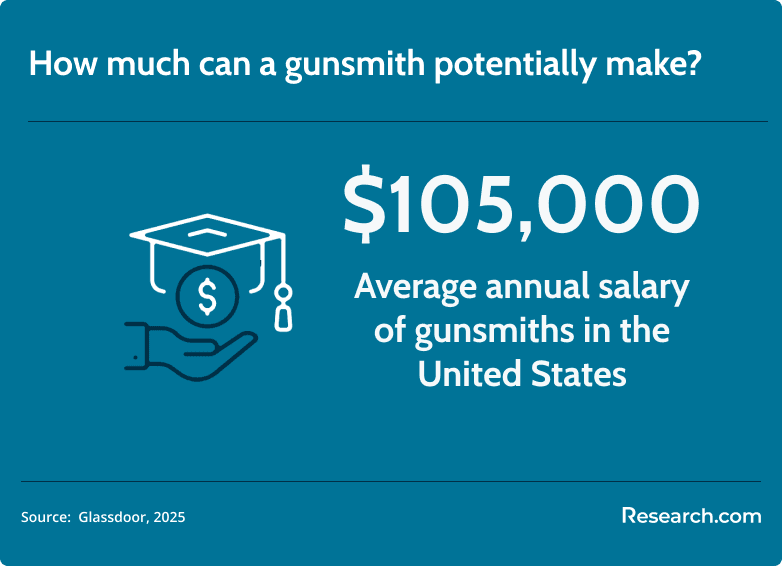
- Experienced Gunsmiths: Average total pay of approximately $78,370, with most salaries ranging from $59,000 to over $100,000 (Glassdoor, 2025).
- Precision Metalworkers: $55,000–$60,000 for specialists in custom fabrication or restoration (NSSF, 2025).
- Self-Employed Gunsmiths: $60,000–$90,000+ possible through advanced certifications, custom builds, and niche services (NSSF, 2025).
Graduates from top programs are often better positioned to reach the higher end of these ranges by maintaining manufacturer certifications, diversifying services, and building strong client networks.
- List of Online Gunsmith Trade School Programs for 2027 List of Programs
- How long does it take to finish online gunsmith trade school? Program Length
- How do online gunsmith programs compare to on-campus programs? How do online gunsmith programs compare to on-campus programs?
- What is the average cost of online gunsmith programs? Average Costs
- What are the financial aid options for students enrolling in online gunsmith programs? Financial Aid
- What are the prerequisites for enrolling in online gunsmith programs? Requirements
- What safety standards are in online gunsmith programs? What safety standards are in online gunsmith programs?
- What specialized certifications can enhance online gunsmith programs? What specialized certifications can enhance online gunsmith programs?
- How to choose the best online gunsmith programs? How to choose the best online gunsmith programs?
- What career paths are available for graduates of online gunsmith programs? Career Paths
- What is the job market for graduates of online gunsmith programs? Job Outlook
- What additional certificate courses can further boost my gunsmithing career? What additional certificate courses can further boost my gunsmithing career?
- What support services do online gunsmith programs provide to enhance student success? What support services do online gunsmith programs provide to enhance student success?
- How can I maximize my return on investment in online gunsmith training? How can I maximize my return on investment in online gunsmith training?
Best Online Gunsmith Trade School Programs for 2027
Choosing a gunsmithing program is different from choosing many other trade programs because the training involves firearms, specialized tools, safety procedures, and federal and state compliance issues. The right school should teach more than basic repair. It should help you understand firearm function, maintenance, customization, finishing, safe handling, customer service, and when a Federal Firearms License may be required for the work you plan to do.
This guide is for students comparing online gunsmith trade schools, hybrid options, and respected on-campus alternatives. You will find program options, cost ranges, completion timelines, safety expectations, financial aid considerations, career paths, and practical questions to ask before enrolling.
Quick answer: What is the best online gunsmith trade school?
The strongest online gunsmith programs combine flexible coursework with real hands-on practice through mailed tool kits, at-home projects, or required lab experiences. Sonoran Desert Institute, Modern Gun School, American Gunsmithing Institute, and Penn Foster Career School are among the most accessible online options listed here. Students who want deeper shop-based training may also want to compare on-campus programs such as Pennsylvania Gunsmith School, Colorado School of Trades, Piedmont Technical College, Montgomery Community College, Eastern Wyoming College, and North Idaho College Workforce Training Center.
| Best fit | Program type to consider | Why it may work |
| Beginner testing the field | Short online certificate or basic repair course | Lower cost, flexible pacing, and introductory firearm repair coverage |
| Career changer seeking broader skills | Diploma or advanced online gunsmithing program | More complete coverage of repair, customization, finishing, and business practices |
| Student who wants maximum hands-on shop time | On-campus certificate, diploma, or A.A.S. program | Access to instructors, equipment, labs, and structured project work |
| Future business owner | Program with ATF compliance, business practices, and customer-service training | Better preparation for service policies, recordkeeping, pricing, and legal responsibilities |
How we selected these schools
Research.com reviewed programs using our methodology, with attention to delivery format, curriculum depth, hands-on learning requirements, published cost information, student support, and accreditation status when available. Because gunsmithing is a practical trade, programs that include tool kits, projects, lab access, or shop-based instruction received careful consideration.
Program and school information was reviewed using official school sources and education data resources, including the Integrated Postsecondary Education Data System (IPEDS), Peterson’s Distance Learning database, the U.S. Department of Education’s College Scorecard, and the National Center for Education Statistics (NCES).
1. Sonoran Desert Institute
Sonoran Desert Institute offers an online Gunsmithing Certificate designed for students who want structured distance learning with practical firearm-related projects. Coursework is delivered through an online platform, while mailed lab kits provide the tools and materials needed for assigned hands-on work. The program is a strong fit for students who want an accredited online route with organized technical instruction and at-home practice components.
- Program Length: 16 months
- Skills/concentrations: Firearm assembly, repair, customization, ballistics, metal finishing, ATF compliance
- Total Cost: $12,975
- Accreditation: Distance Education Accrediting Commission (DEAC)
2. Modern Gun School
Modern Gun School provides self-paced online training through Basic Gun Repair, Advanced Gunsmithing, and Master Gunsmithing options. Students use mailed tool kits and retain lifetime access to course materials, which can be helpful for learners who want to revisit procedures while practicing. This option may suit students who need a flexible schedule and want a lower-cost entry point into firearm repair and customization training.
- Program Length: 4–18 months (self-paced)
- Skills/concentrations: Firearm repair, customization, metal finishing, stock work, sight installation
- Total Cost: $939–$1,289 (depending on payment plan)
- Accreditation: DEAC
3. American Gunsmithing Institute
American Gunsmithing Institute offers five online program options, from Basic Gun Repair to Master Gunsmithing. Instruction is built around detailed video lessons taught by experienced gunsmiths and covers firearm systems, function, diagnosis, maintenance, and repair. AGI may appeal to students who prefer visual instruction and want to progress at their own pace, though students should note the listed accreditation status before comparing it with accredited school options.
- Program Length: Self-paced
- Skills/concentrations: Firearm design, function, repair, maintenance, customization
- Total Cost: $997–$4,997 (depending on course)
- Accreditation: N/A (private vocational institution)
4. Penn Foster Career School
Penn Foster Career School delivers a fully online Gunsmith Career Diploma that combines self-paced technical lessons with project materials and business-related coursework. Students study firearm assembly, repair, stock making, finishing, and basic business practices. This program is worth considering for learners who want an affordable online diploma from a distance education provider with DEAC accreditation.
- Program Length: 7 months (average)
- Skills/concentrations: Firearm assembly, repair, stock making, metal finishing, business practices
- Total Cost: $899–$1,099 (depending on payment plan)
- Accreditation: DEAC
5. Pennsylvania Gunsmith School
Pennsylvania Gunsmith School is an on-campus option rather than an online program, but it remains relevant for students comparing depth of hands-on training. Its full-time Master Gunsmithing Program places students in a workshop setting where they practice firearm building, repair, customization, stock work, and finishing under instructor supervision. This route is better for students who can relocate or commute and want intensive daily shop experience.
- Program Length: 16 months (full-time, on-campus)
- Skills/concentrations: Firearm building, repair, customization, metal finishing, stock making
- Total Cost: Contact school for details
- Accreditation: Accrediting Commission of Career Schools and Colleges (ACCSC)
6. Piedmont Technical College
Piedmont Technical College offers two Certificates and an Associate in Applied Science (A.A.S.) in Gunsmithing Technology. The program emphasizes hands-on lab training in firearm design, repair, customization, and finishing. Students who want a college-based credential with multiple pathway options may find Piedmont especially useful, particularly if they prefer structured instruction and access to dedicated facilities.
- Program Length: 1–2 years (depending on credential)
- Skills/concentrations: Firearm design, repair, customization, finishing techniques
- Total Cost: Contact school for details
- Accreditation: Southern Association of Colleges and Schools Commission on Colleges (SACSCOC)
7. Colorado School of Trades
Colorado School of Trades provides a full-time, campus-based Gunsmithing Program focused heavily on shop practice. Students rotate through specialized benches and work through firearm building, repair, metal finishing, stock making, and customization projects. It may be a better match for students who want immersive hands-on training and can commit to a full-time on-campus schedule.
- Program Length: 14 months (full-time, on-campus)
- Skills/concentrations: Firearm building, repair, customization, metal finishing, stock making
- Total Cost: $32,150
- Accreditation: Accrediting Commission of Career Schools and Colleges (ACCSC)
8. North Idaho College Workforce Training Center
North Idaho College Workforce Training Center offers gunsmithing instruction through in-person, skills-based courses. Students work with industry professionals in a training environment focused on repair, customization, and finishing methods. This option is most appropriate for learners looking for shorter, targeted shop courses rather than a fully online credential.
- Program Length: Varies by course or series
- Skills/concentrations: Firearm repair, customization, finishing techniques
- Total Cost: Contact school for details
- Accreditation: Northwest Commission on Colleges and Universities (NWCCU)
9. Montgomery Community College
Montgomery Community College offers an Associate in Applied Science (A.A.S.) degree, diploma, and certificate options in gunsmithing. Students train in specialized labs and study firearm design, repair, customization, and finishing. The college is a strong choice for students who want a public college environment with several credential levels and substantial hands-on instruction.
- Program Length: 1–2 years (depending on credential)
- Skills/concentrations: Firearm design, repair, customization, finishing techniques
- Total Cost: $5,356–$9,172 (in-state); $19,924–$34,128 (out-of-state)
- Accreditation: SACSCOC
10. Eastern Wyoming College
Eastern Wyoming College provides an Associate of Applied Science (A.A.S.) degree and certificate in Gunsmithing Technology. The curriculum includes firearm design, repair, customization, and finishing, supported by hands-on lab instruction. Students who want smaller class settings, college-based training, and multiple credential choices may want to compare EWC with other on-campus gunsmithing programs.
- Program Length: 1–2 years (depending on credential)
- Skills/concentrations: Firearm design, repair, customization, finishing techniques
- Total Cost: $4,680–$9,360 (in-state); $10,440–$20,880 (out-of-state)
- Accreditation: Higher Learning Commission (HLC)
How long does it take to finish online gunsmith trade school?
Online gunsmith training can take a few months or more than a year, depending on whether you choose a short certificate, a diploma-style program, a self-paced course, or a degree pathway with general education requirements. Unlike regulated graduate healthcare programs such as online MSN in clinical nurse leadership programs, gunsmithing timelines are usually shaped by project requirements, tool access, and how quickly students can complete practice assignments.
| Credential or format | Typical timeline | Best for |
| Certificate Programs | Usually require 6–12 months of part-time study, with accelerated tracks completing in less than 6 months. | Students who want focused technical training without a longer degree commitment |
| Diploma Programs | Typically take 9–15 months and offer broader coursework with more extensive practical training than certificates. | Learners seeking a more complete career-preparation curriculum |
| Associate Degree Programs | Generally span 18–24 months for full-time students, combining technical training with general education courses. | Students who want a college credential and wider technical foundation |
| Self-Paced Options | Allow faster completion for experienced students or extended timelines for those balancing other commitments. | Working adults, hobbyists, and students with unpredictable schedules |
A shorter program can make sense if you want an introduction to firearm repair or plan to build skills gradually. A longer program is usually better if your goal is professional-level repair, restoration, customization, or shop ownership.
How do online gunsmith programs compare to on-campus programs?
Online and on-campus gunsmithing programs can cover similar topics, including firearm function, repair, maintenance, customization, finishing, and compliance. The real difference is how students practice those skills. Online learners typically study theory remotely and complete projects with mailed kits or their own tools, while campus students work in dedicated labs with direct instructor supervision.
This is similar to the broader online education trade-off seen in programs such as a general studies degree online: flexibility increases, but students need stronger self-direction. In gunsmithing, that trade-off is especially important because manual skill development depends on practice, feedback, and safe tool use.
| Factor | Online gunsmith program | On-campus gunsmith program |
| Schedule | Often self-paced or part-time | Usually follows fixed class and lab times |
| Hands-on work | Completed through at-home projects, mailed kits, or limited lab sessions | Completed in school shops with instructor oversight |
| Equipment access | Students may need to buy tools or create a safe workspace | Schools typically provide access to major tools and machines |
| Feedback | May come through submitted assignments, videos, or remote instructor communication | Usually immediate during lab sessions |
| Networking | More dependent on forums, virtual support, and local outreach | More opportunities for in-person peer and instructor relationships |
| Best for | Self-motivated students who need flexibility | Students who learn best through structured shop time |
Some students may benefit from hybrid formats that combine online theory with required in-person lab work. This model is common in several trades, including some affordable online maintenance technician trade school programs, because it gives students scheduling flexibility while still requiring supervised practice.
What is the average cost of online gunsmith programs?
Online gunsmith program costs vary by credential level, school type, included tools, payment plan, and whether students must attend any in-person labs. Some trade programs, including floor installer trade school programs online, have similar cost drivers because materials and practice equipment can affect the final price as much as tuition.
| Cost category | Published range or example | What to check before enrolling |
| Certificate Programs | $5,000–$8,000 total, with discounts often available for full payment (Penn Foster, 2025). | Whether the listed price includes project materials, exams, and shipping |
| Diploma Programs | $6,000–$12,000, commonly including basic tools and instructional materials (Sonoran Desert Institute, 2025). | Whether all required tools are included or only starter supplies |
| Associate Degree Programs | $12,000–$22,000, with costs affected by residency status and credit load (Piedmont Technical College, 2025). | Whether tuition differs for in-state and out-of-state students |
| Specialized Courses | $500–$2,500 per course for manufacturer-specific or advanced skills training (Montgomery Community College, 2025). | Whether the course leads to a credential, continuing education record, or skill certificate |
| Tools and Supplies | $300–$1,500 additional if not included in tuition | Whether you must provide a bench, measuring tools, safety gear, or finishing supplies |
Students comparing online trade programs should look beyond the advertised tuition. The cheapest program is not always the least expensive if it excludes tools, materials, lab access, exam fees, or shipping. This is also true in hands-on programs such as the cheapest home remodeling and repair trade school programs online, where supplies can change the real cost of attendance.
Before enrolling, ask the school for a full cost sheet that separates tuition, tools, supplies, technology fees, lab fees, shipping, and optional add-ons. If you are weighing cost against earnings potential, also compare local demand, business startup costs, and whether you plan to work for an employer or operate independently.
What are the financial aid options for students enrolling in online gunsmith programs?
Financial aid availability depends on the school, program eligibility, accreditation status, and whether the credential qualifies for federal or state funding. Students should not assume that every online gunsmithing course qualifies for aid. As with career-focused online programs in other fields, including MSN health informatics online programs, eligibility depends on the institution and the specific program.
- Federal and State Aid: Students enrolled in eligible programs may access Pell Grants of up to $7,395 for the 2023–24 year, along with federal loans or work-study. Some states also provide vocational grants for technical training.
- Military and Veteran Benefits: Modern Gun School accepts Post-9/11 GI Bill and VR&E benefits, covering tuition and up to $1,300 in supplies for advanced gunsmithing courses. The American Gunsmithing Institute offers dedicated military scholarships for veterans and active-duty personnel.
- School-Specific Scholarships: Sonoran Desert Institute offers the Master Gunsmith Kip Carpenter Memorial Scholarship, which covers full tuition and fees for two certificate or associate students each term.
- Trade-Related Scholarships: National trade and firearms organizations, such as the NRA Foundation, offer grant initiatives supporting educational and community programs.
To avoid surprises, ask whether the program is eligible for federal aid, whether payment plans include extra fees, whether veteran benefits apply to the exact course you want, and whether scholarships are competitive or automatically awarded.

What are the prerequisites for enrolling in online gunsmith programs?
Admissions requirements vary, but most schools want to confirm that students are academically prepared, legally eligible to participate, and able to complete the hands-on parts of the program safely. Gunsmithing also requires mechanical aptitude, patience, and attention to measurement and detail.
- Educational Background: A high school diploma or GED is typically required for certificate, diploma, and associate degree programs, similar to many technical fields with defined entry requirements, such as auto mechanic education requirements.
- Age Requirement: Most programs require students to be at least 18 years old at the time of enrollment.
- Technical Skills: Basic comfort with hand tools, measuring instruments, and mechanical systems is useful; some schools recommend prior exposure to metalworking or repair work.
- Equipment Access: Online students may need a safe workspace, bench area, essential tools, and storage suitable for firearms-related projects.
- Technology Requirements: Students generally need reliable internet, a computer capable of running the learning platform, and the ability to submit assignments or assessments online.
- Background Check: Some schools require screening to comply with firearms laws, institutional policies, or project requirements.
If you are unsure whether you qualify, contact admissions before paying any enrollment fee. Also ask whether state laws affect the types of firearms, parts, or projects you can work with during the program.
What safety standards are taught in online gunsmith programs?
Safety is not a side topic in gunsmithing. It is central to the work. A quality program should teach students how to handle firearms responsibly, maintain a controlled workspace, use tools correctly, store ammunition safely, and comply with applicable rules. Students should also understand that legal requirements can vary by state and by the type of service performed.
- Firearm Handling: Students are taught to treat every firearm as loaded, control muzzle direction, verify condition, and use secure storage practices.
- Tool and Machine Use: Programs should cover safe operation of shop equipment such as lathes, mills, grinders, and hand tools. The emphasis on protective equipment and hazard control is similar to safety expectations in high-risk trades such as how to become an electrical lineman.
- Workspace Management: A safe gunsmithing workspace should be organized, well-lit, ventilated, and free of unnecessary distractions or hazards.
- Ammunition Safety: Students learn inspection, storage, and handling practices intended to reduce the risk of damage, misuse, or accidents.
- Regulatory Compliance: Coursework should address Bureau of Alcohol, Tobacco, Firearms and Explosives (ATF) guidance and relevant state requirements affecting repair, transfer, sales, or manufacturing activities.
- Incident Response: Students should know what to do in the event of an injury, equipment failure, accidental discharge, or unsafe condition.
Do not enroll in a program that treats safety as optional or vague. Ask to see the safety curriculum, required protective equipment list, and policy for handling firearm-related projects.
What specialized certifications can enhance online gunsmith programs?
Additional credentials can help graduates focus on a niche, demonstrate advanced training, or qualify for specific types of work. Not every certificate has the same value, so students should verify who issues it, what skills it documents, and whether employers or customers recognize it.
| Credential or training area | What it supports | Who should consider it |
| Certified Gunsmith | Validation of training in firearm repair, customization, and safety practices | Graduates who want a general credential for employment or customer confidence |
| Armorer Certifications | Manufacturer-specific maintenance, troubleshooting, and parts replacement for companies such as Glock, Smith & Wesson, and SIG Sauer | Students aiming to work with law enforcement, security, retail, or brand-specific platforms |
| National Rifle Association Gunsmithing Certificates | Short, intensive training in areas such as stock making, engraving, or metal finishing | Students who want focused skill upgrades after a core program |
| Firearm Appraiser Certification | Evaluation of firearms for resale, insurance, estate, or legal purposes | Students interested in valuation, collecting, auctions, or restoration markets |
| Cerakote or Other Finishing Certifications | Training in protective and decorative firearm coating processes | Gunsmiths who want to offer specialized finishing services |
| Federal Firearms License | Not a certification, but essential for certain firearm sales, manufacturing, or gunsmithing services | Anyone planning to operate a business that triggers federal licensing requirements |
For students comparing credentials across career fields, Research.com also reviews certificate courses that pay well. In gunsmithing, however, the best credential is the one that matches the services you plan to offer and the compliance rules that apply to your work.
How should you choose the best online gunsmith program?
The best online gunsmith program is the one that matches your career goal, budget, learning style, legal responsibilities, and access to tools. A hobbyist, future armorer, custom firearm builder, and small business owner may need different levels of training.
Questions to ask before enrolling
- Is the school accredited? Confirm the accreditor and whether accreditation affects financial aid, transfer options, or employer recognition.
- What hands-on work is required? Ask whether students complete full builds, repairs, restorations, custom modifications, or finishing projects.
- Are tools included? Request a tool and supply list and confirm whether the school provides kits, discounts, or required vendor lists. This is similar to evaluating tool-heavy programs in fields such as what do you need to become a welder.
- Does the curriculum cover ATF compliance? Make sure the program explains recordkeeping, transfers, licensing considerations, and when an FFL may be required.
- What firearm types are covered? Look for exposure to pistols, rifles, shotguns, and different operating systems.
- Are there manufacturer or specialty options? Brand-specific armorer courses, finishing certificates, machining electives, or appraisal training may improve your career fit.
- What support is available? Ask about instructor access, technical help, career services, alumni networks, and business startup guidance.
- What is the true total cost? Compare tuition, tools, materials, shipping, exam fees, lab fees, and payment-plan charges.
Common mistakes to avoid
| Mistake | Why it matters | Better approach |
| Choosing only by lowest tuition | Low tuition may exclude tools, supplies, or meaningful hands-on work | Compare total program cost and project requirements |
| Ignoring accreditation | Accreditation can affect aid eligibility, credibility, and transfer options | Verify the school and accreditor before enrolling |
| Assuming online training is entirely virtual | Some programs require tools, projects, labs, or shipping materials | Ask exactly how practical assignments are completed |
| Overlooking legal requirements | Gunsmithing services may trigger federal, state, or local rules | Review ATF guidance and ask how compliance is taught |
| Expecting guaranteed earnings | Income depends on skill, location, business model, demand, and experience | Evaluate local market conditions and build a realistic career plan |
What career paths are available for graduates of online gunsmith programs?
Graduates can pursue several firearms-related roles, but job titles, legal requirements, and earning potential vary widely. Some graduates work for retailers, ranges, manufacturers, law enforcement agencies, or repair shops. Others operate independent businesses, often after gaining experience and confirming licensing requirements.
| Career path | Typical work | Best preparation |
| General Gunsmith | Repairs, maintains, adjusts, and modifies a range of firearms | Broad program covering function, diagnosis, repair, safety, and customer service |
| Custom Firearm Builder | Builds or modifies firearms according to customer preferences | Advanced machining, fitting, finishing, and compliance training |
| Armorer | Maintains firearms for law enforcement, military, security, or institutional users | Manufacturer-specific armorer training and strong inspection skills |
| Firearm Appraiser | Assesses firearm condition, authenticity, and value | Appraisal training, historical knowledge, and documentation skills |
| Restoration Specialist | Restores antique, collectible, or damaged firearms while preserving function and appearance | Metal finishing, stock work, historical research, and careful repair techniques |
| Firearm Finishing Specialist | Applies bluing, parkerizing, Cerakote, or other finishes | Coating-specific training and controlled workspace practices; the focus on technical standards is comparable to trades with defined skill requirements such as HVAC technician requirements |
| Instructor or Trainer | Teaches firearm safety, gunsmithing basics, or armorer procedures | Experience, strong communication skills, and documented technical competence |
The best path depends on whether you want employment, self-employment, a side business, or a specialty service. Students planning to run a shop should pay close attention to FFL requirements, insurance, recordkeeping, pricing, and local demand.
What is the job market for graduates of online gunsmith programs?
Reliable occupational data for gunsmiths is limited, so students should interpret labor-market information carefully. Gunsmithing is a specialized field influenced by consumer demand, firearm ownership trends, manufacturing activity, local regulations, sporting markets, and the availability of skilled repair professionals.
- Overall Industry Strength: The U.S. firearm and ammunition industry supports approximately 383,000 jobs across manufacturing, distribution, and related services, contributing over $90 billion in economic activity in 2024 (National Shooting Sports Foundation, 2025; RegionalCTE, 2022).
- Production Outlook: A decline in firearm imports (−10%) and lower national retail sales (–13% through Q3 2024) point to softer demand nationwide (Shooting Industry, 2025).
- Occupational Projections: While gunsmith-specific data is scarce, projections for related trades show a 6% decline in metal and plastic machine worker roles from 2023 to 2033, with 91,800 annual openings due to turnover (Bureau of Labor Statistics, 2025).
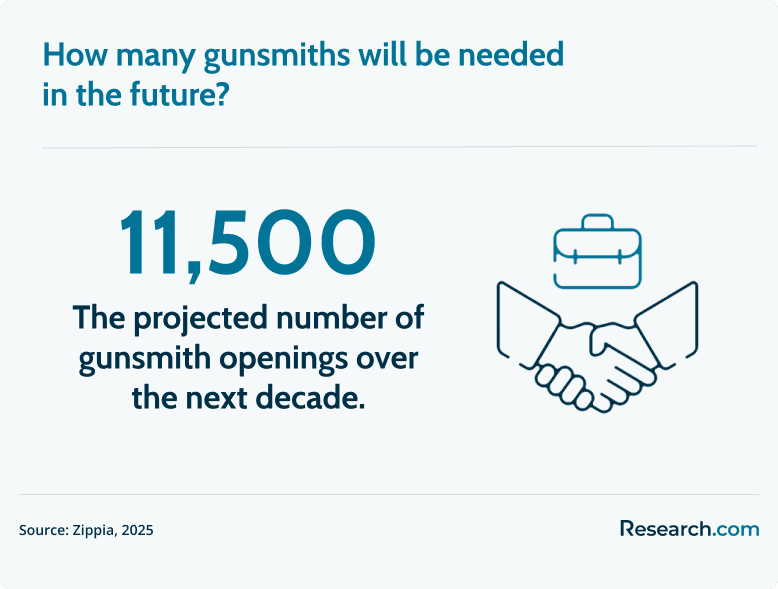
- Gunsmith Job Numbers: Estimates place the number of employed gunsmiths at about 4,500 nationwide, with approximately 11,500 openings and a projected 5% decline from 2018–2028 (Zippia, 2025).
- Growing Niche Markets: Participation in competitive shooting and demand for custom firearms or restoration services are driving growth in specialty areas (Fortune Business Insights, 2025).
The practical takeaway is that general demand may be competitive, but specialized skills can matter. Graduates who combine repair ability with finishing, restoration, appraisal, customer service, and compliance knowledge may be better positioned than those with only basic training.
What graduates say about online gunsmith trade school
Student experiences vary by program, location, prior skill level, and career goal. The comments below reflect individual outcomes and should not be read as guaranteed results.
- Dwight: "Online gunsmith training helped me build enough confidence to offer small repair services from my home workshop on a part-time basis. Having tools sent to me made it easier to practice after each lesson, and I started getting small jobs from hunters and people I already knew soon after finishing."
- Carla: "I wanted a role in the firearm department of a nearby sporting goods store, and the online coursework gave me a foundation I could discuss in interviews. The sections on compliance and customer service were especially useful. I was hired two weeks after completing the program."
- Benny: "Because I already had machining experience, I got the most value from the precision fitting and finishing lessons. The flexible schedule let me work the projects around my shop commitments, and I later added gunsmithing-related services for existing clients."
What additional certificate courses can further boost a gunsmithing career?
After completing a core gunsmithing program, many graduates add short courses that target a specific service area. Useful options may include advanced metal finishing, Cerakote application, firearm appraisal, stock work, engraving, precision machining, or manufacturer-specific armorer training. These courses can be especially valuable if they match a service customers in your area already need.
When comparing add-on certificates, ask whether the credential is recognized by employers, manufacturers, shops, or customers. Also confirm whether you need special equipment, ventilation, chemicals, or licensing to use the skill commercially.
What support services should online gunsmith programs provide?
Support services can make a major difference in an online gunsmithing program because students often complete technical work away from campus. Useful services include instructor access, project feedback, online platform support, academic advising, career guidance, resume help, business-startup resources, and alumni or industry networking opportunities.
Students using federal aid or comparing low-cost online options should verify both affordability and eligibility. Research.com’s guide to cheap online colleges that accept FAFSA can help students understand why accreditation and aid eligibility matter before committing to an online program.
How can you maximize ROI in online gunsmith training?
Return on investment in gunsmithing depends on more than tuition. You need to compare the total cost of training with the realistic services you can offer after graduation, the demand in your area, your ability to meet legal requirements, and whether you plan to work for an employer or start a business.
- Define your goal first. A hobbyist does not need the same program as someone planning to open a repair shop.
- Calculate total cost. Include tuition, tools, supplies, shipping, lab fees, travel, payment-plan charges, and licensing-related expenses.
- Choose hands-on depth over convenience alone. Flexibility matters, but gunsmithing skill comes from supervised or well-structured practice.
- Build a specialty. Restoration, finishing, appraisal, custom work, or manufacturer-specific armorer training may help you stand out.
- Check funding options. If aid eligibility is important, compare accredited schools and review resources such as cheap online colleges that accept FAFSA.
- Plan for compliance. Understand when an FFL, state license, insurance, or specific recordkeeping procedures may be required.
A lower-cost program can offer strong ROI if it teaches practical skills you can use safely and legally. A more expensive program may be worthwhile if it provides deeper shop training, better feedback, stronger credentials, or access to equipment you cannot replicate at home.
References
- Bureau of Alcohol, Tobacco, Firearms and Explosives. (2024). Firearms regulations reference guide. https://www.atf.gov/firearms/firearms-guides
- Bureau of Alcohol, Tobacco, Firearms and Explosives. (2025). Federal Firearms Licenses. https://www.atf.gov/firearms/federal-firearms-licenses
- Bureau of Labor Statistics. (2024). Metal and plastic machine workers. https://www.bls.gov/ooh/production/metal-and-plastic-machine-workers.htm
- Fortune Business Insights. (2025). Sports gun market size, share, trends. https://www.fortunebusinessinsights.com/sports-gun-market-110619
- Glassdoor. (2025). Gunsmith salaries. https://www.glassdoor.com/Salaries/gunsmith-salary-SRCH_KO0,8.htm
- National Rifle Association. (2025). Gunsmithing schools and courses. https://gunsmithing.nra.org/
- National Shooting Sports Foundation. (2025). Impact of the firearm and ammunition industry. https://www.nssf.org/government-relations/impact/
- RegionalCTE. (2022). Gunsmith labor market data. https://regionalcte.org/lmi/1079--20221117094307256240.pdf
- Shooting Industry. (2025). 2025 industry outlook. https://shootingindustry.com/discover/2025-industry-outlook/
- U.S. Department of Education. (2025). Federal Student Aid. https://studentaid.gov/understand-aid/types
- Zippia. (2025). Gunsmith demographics and statistics. https://www.zippia.com/gunsmith-jobs/trends/
- ZipRecruiter. (2025). Gunsmithing salary. https://www.ziprecruiter.com/Salaries/Gunsmithing-Salary
Key Insights
- Online gunsmith programs are best for disciplined learners. They offer flexibility, but students must be prepared to practice safely, manage tools, and complete hands-on assignments without daily in-person supervision.
- Hands-on training is the deciding factor. Before enrolling, confirm whether the program uses mailed kits, at-home projects, videos, labs, or supervised shop work.
- Accreditation and aid eligibility are not automatic. DEAC, ACCSC, SACSCOC, NWCCU, and HLC appear among the programs listed, but students should verify each school’s current status and whether their chosen program qualifies for financial aid.
- Total cost includes more than tuition. Tools, supplies, shipping, lab fees, payment-plan charges, and possible licensing-related expenses can change the real price of training.
- Compliance knowledge matters as much as repair skill. Students planning to accept customer firearms, sell firearms, manufacture parts, or run a business should study ATF guidance and state requirements carefully.
- Specialization can improve career positioning. Restoration, finishing, appraisal, custom builds, and manufacturer armorer training may help graduates stand out in a small and competitive field.
Other Things You Should Know About Online Gunsmith Trade School Programs
Program alumni networks enhance career advancement by providing mentorship opportunities, job referrals, and industry connections. Networking events and forums for alumni can lead to collaborative projects, keeping graduates informed of industry trends and innovations, thereby increasing their potential for growth and success in the gunsmithing field.
When choosing a gunsmith trade school online in 2027, consider accreditation, curriculum comprehensiveness, specialized training options, faculty expertise, student support services, and post-graduation assistance. Ensuring these factors align with your career goals can enhance educational and employment outcomes.


