2027 Most Affordable Online Carpentry Trade School Programs

Co-Founder and Chief Data Scientist
Choosing an online carpentry trade school program is not just a question of convenience. Carpentry is a hands-on trade, so the real decision is whether a program can teach enough technical knowledge online while also helping you build job-ready skills through projects, labs, apprenticeships, or supervised practice. This guide is for high school graduates, career changers, working adults, and future construction professionals who want a practical route into carpentry without committing immediately to a full on-campus program.
Below, you will learn what online carpentry training covers, how much it can cost, how long it may take, which programs stand out, what jobs it can lead to, and how to judge whether a program is worth your time and money. Employment for carpenters is projected to grow 4% from 2023 to 2033, but your results will depend heavily on your hands-on experience, local labor market, employer connections, and whether your training aligns with apprenticeship, certification, or licensing expectations.
Quick answer: Is an online carpentry trade school program worth it?
An online carpentry trade school program can be worth it if you need flexible training, want to learn construction fundamentals, or plan to use the credential as a first step toward an apprenticeship or entry-level job. It is usually strongest for blueprint reading, safety, construction math, materials, estimating, and basic trade theory. It is less effective when it does not include hands-on practice, employer partnerships, shop access, or a clear pathway to supervised jobsite training.
The best choice is usually a program that combines online coursework with practical projects, labs, apprenticeship preparation, or documented on-the-job training. If your goal is to become a journeyman carpenter, online coursework alone is rarely enough; you will still need substantial field experience.
What are the main benefits of an online carpentry trade school program?
- Flexible entry into the building trades: Online carpentry training can prepare students for roles such as framing carpenter, finish carpenter, commercial carpenter, woodworker, cabinet maker, or apprentice carpenter, depending on the program depth and local employer requirements.
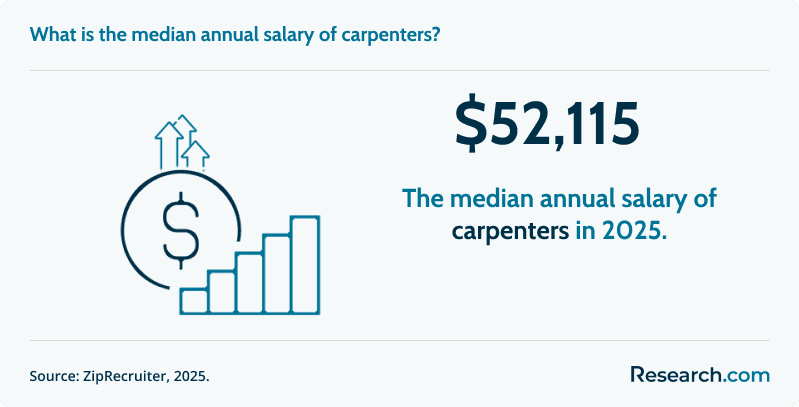
- Career-focused earning potential: The median annual salary for carpenters is $52,115. Pay can vary widely by state, union status, specialization, employer, and experience level.
- Lower barriers for working adults: Online programs can reduce commuting time and make it easier to study around work or family responsibilities. Many use video lessons, digital assignments, and self-paced modules.
- Useful foundation before an apprenticeship: Students can learn construction drawings, measurements, safety practices, materials, and tool concepts before entering a jobsite or applying for hands-on training.
- Potential cost savings: Some online certificates are significantly less expensive than longer associate degree pathways, though students should compare total costs, required tools, fees, and credential value before enrolling.
What can I expect from an online carpentry trade school program?
An online carpentry trade school program usually teaches the technical knowledge that supports entry-level construction work: framing concepts, finish carpentry basics, blueprint reading, building materials, construction safety, measurement, layout, and tool use. Many programs use recorded demonstrations, readings, quizzes, virtual assignments, and project-based tasks to help students connect theory with practice.
The strongest programs do not stop at videos. They may require a capstone project, a portfolio, local lab work, supervised jobsite experience, internship hours, or enrollment in an apprenticeship structure. Because carpentry is a physical trade, you should confirm how the program verifies skill development before you pay tuition.
Program costs vary by credential level. Tuition for online carpentry programs generally ranges from around $750 for certificate courses up to $20,000 for associate degrees, depending on school type, program length, and whether general education courses are included.
Expect to study independently, manage deadlines, and practice skills outside the online classroom. Students who already have access to tools, a workshop, a construction employer, or a mentor may get more value from online coursework than students with no practical training environment.
| Program feature | What it usually means for students | Why it matters |
| Online lessons | Video demonstrations, readings, quizzes, and interactive assignments | Useful for trade theory, safety, drawings, and construction vocabulary |
| Hands-on projects | At-home builds, lab work, or portfolio assignments | Helps show whether you can apply concepts outside the course platform |
| Apprenticeship connection | Pathway to supervised work under an employer or licensed contractor | Important for students who want journeyman-level progression |
| Credential awarded | Certificate, diploma, completion credential, or associate degree | Affects transfer options, employer recognition, and possible aid eligibility |
| Career support | Job search help, employer contacts, resume support, or placement guidance | Can make a major difference for students without construction contacts |
Where can I work with an online carpentry trade school program?
Graduates may work in residential construction, commercial construction, remodeling, cabinetmaking, woodworking, building maintenance, or contractor services. Some start as helpers or apprentices and move into framing, finish carpentry, drywall, flooring, cabinetry, estimating, or site supervision after gaining experience.
Online training is most useful when paired with a clear employment plan. For example, a student who completes online coursework while working for a contractor can immediately apply lessons on the job. A student with no jobsite access should look for programs with local partnerships, apprenticeship guidance, or required practical training.
Carpentry skills can also support work in related areas such as facilities maintenance, construction management support, project estimating, home renovation, or self-employment. However, employers typically care most about demonstrated skill, safety awareness, reliability, and experience with tools and materials.
With about 76,500 job openings projected annually through 2033, the field offers recurring opportunities, but those openings include replacement needs as well as growth. Local demand can differ by region, construction activity, and economic conditions.
How much can I make with an online carpentry trade school program?
The average salary for professionals who completed an online carpentry trade school program is around $52,115 per year. Entry-level carpenters typically earn around $30,000 annually, while experienced journeymen can make $45,000 to $60,000. Master carpenters and specialists in high-demand or niche areas can earn $68,000 or more annually.
Pay is not guaranteed by completing a program. Earnings depend on experience, location, specialization, union or nonunion employment, overtime, contractor type, and whether you move into supervisory or business ownership roles. Carpenters in states like Washington, the District of Columbia, and New York have salaries that are above the national average.
Specialized work can improve long-term prospects. Finish carpentry, commercial projects, cabinetmaking, concrete forming, project leadership, and advanced safety credentials may help workers compete for better roles, especially after they build a strong portfolio and jobsite record.
| Career stage | Typical earnings noted | What usually drives movement to the next level |
| Entry-level carpenter | Around $30,000 annually | Basic tool competence, reliability, safety habits, and supervised experience |
| Experienced journeyman | $45,000 to $60,000 | Broader jobsite skills, independent work ability, and trade specialization |
| Master carpenter or specialist | $68,000 or more annually | Advanced craft skill, leadership, niche expertise, and strong client or employer demand |
- Best Online Carpentry Trade School Programs for 2027
- How long does it take to complete an online carpentry trade school program?
- Online vs. on-campus carpentry programs: which format is better?
- What is the average cost of an online carpentry trade school program?
- What financial aid can online carpentry students use?
- What are the prerequisites for online carpentry training?
- What courses are typically included?
- What carpentry specializations are available?
- What challenges should online carpentry students expect?
- Should I pursue more education after trade school?
- How do online programs support certification and licensing preparation? Further education options
- What is the ROI of an online carpentry trade school program?
- How to choose the best online carpentry trade school program
- What career paths are available after online carpentry training?
- What is the job market for carpentry graduates?
Best Online Carpentry Trade School Programs for 2027
How should readers use this list?
This list is a starting point, not a substitute for your own program review. Carpentry training varies widely: some options are self-paced online courses, some are community college credentials with hands-on components, and others are apprenticeship-based programs tied to jobsite hours. Before enrolling, confirm the credential, hands-on requirements, total cost, accreditation or approval status, employer recognition, and whether the program supports your state or local career goals.
How do we rank schools?
Because tuition and training time are meaningful investments, Research.com evaluates programs using transparent data and credible education sources, including IPEDS, Peterson's, College Scorecard, and the National Center for Education Statistics. These sources help support a more consistent review of online carpentry trade school options. For a fuller explanation of the ranking process, see our methodology page.
1. Penn Foster Career School
The online Construction Trades program at Penn Foster Career School is designed for students who want a flexible introduction to construction and carpentry-related work. The curriculum emphasizes core trade knowledge, design concepts, building codes, and material selection. It can be a practical option for students seeking foundational preparation for roles such as carpenter or woodworker, especially if they plan to build hands-on experience separately.
- Required Credits to Graduate: 26.5 Continuing Education Units (CEUs)
- Cost: $939 - $1,139 (or $59/month, start for $20)
- Accreditation: International Accreditors for Continuing Education and Training (IACET)
2. Sheridan College
Sheridan College offers a Carpentry Apprenticeship Certificate of Completion for students who are already working under a licensed contractor. This structure is important because it combines online instruction with substantial workplace training. Students who want a nationally recognized apprenticeship pathway and are prepared for long-term on-the-job learning may find this format especially relevant.
- Required Credits to Graduate: Not specified as traditional credits; completion of program requirements and 2,000 annual on-the-job training hours.
- Cost: $4,830
- Accreditation: State-approved program; leads to nationally recognized credentials from the Department of Labor’s Bureau of Apprenticeship and Training.
3. Germanna Community College
Germanna Community College provides a Carpentry Credential program that blends classroom instruction, lab-based skill development, and online learning modules. This can work well for students who want a structured community college option that is designed for completion in less than one year and includes training in tool use, safety, and essential carpentry methods.
- Required Credits to Graduate: N/A (designed for completion in less than one year)
- Cost: $175.20 per credit
- Accreditation: Southern Association of Colleges and Schools Commission on Colleges (SACSCOC)
4. Fayetteville Technical Community College
Fayetteville Technical Community College offers a Carpentry program for students preparing for construction and related technical roles. The program includes flexible scheduling and online course options, while also incorporating hands-on work through live projects such as Habitat for Humanity houses. Students can study framing, estimating, sustainable building concepts, and applied construction practices.
- Required Credits to Graduate: 45 (diploma)
- Cost: $76 per in-state credit hour / $268 per out-of-state credit hour
- Accreditation: SACSCOC
5. City College of San Francisco
City College of San Francisco offers a Carpentry Certificate of Accomplishment through its construction technology offerings. The program focuses on construction safety, blueprint reading, rough framing, and electives in more advanced carpentry techniques. It is a focused credential for students who want core construction preparation without committing immediately to a longer degree.
- Required Credits to Graduate: 13 units
- Cost: $46 per unit for California residents (plus other fees); $446 per unit for non-California residents (as of Summer 2025). Total estimated cost for 13 units: $598 for residents, $5,798 for non-residents.
- Accreditation: Accrediting Commission for Community and Junior Colleges (ACCJC) of the Western Association of Schools and Colleges
6. Alison
Alison offers a free online Diploma in Carpentry Studies that introduces students to modern carpentry practices, tools, materials, and building methods. Developed by the U.S. Agency for International Development (USAID), this course may be useful for exploration or supplemental learning. Students should verify how employers in their area view the credential before relying on it as their main career qualification.
- Required to Graduate: Course completion to earn the diploma
- Cost: Free
- Accreditation: USAID is the course publisher
7. Home Builders Institute
Home Builders Institute is a nonprofit organization focused on training people for building careers. Its pre-apprenticeship options, including carpentry, emphasize practical skill development and industry-recognized credentials. HBI also uses online elements for assessment and instructor support, while the core value of the training is its connection to hands-on preparation.
- Required Credits to Graduate: Varies by program, generally requires around 150 hours of instruction for PACT certifications.
- Cost: No cost
- Accreditation: HBI's Pre-Apprenticeship Certificate Training (PACT) program is accredited by the U.S. Department of Labor and recognized nationwide.
How long does it take to complete an online carpentry trade school program?
Online carpentry certificates are often designed for quick completion. A typical online carpentry certificate can take between four to six months, depending on whether the program is self-paced, cohort-based, or tied to required projects. Some career diploma or construction trades diploma programs may take about six months even when students move quickly.
Students who want a broader credential can consider online carpentry science coursework or related certificates from distance learning schools, which can often be completed in under a year. Associate degree pathways in carpentry or construction management generally take one to two years and may include general education, leadership, estimating, safety, and advanced construction topics.
Apprenticeship pathways are much longer because they are built around supervised work experience. Full apprenticeship programs typically last around four years and combine classroom instruction with thousands of hours of hands-on training. This route is often the clearest path for students who want to progress toward journeyman status.
| Training path | Typical time frame | Best fit |
| Online certificate or short course | Between four to six months | Students exploring carpentry or building basic trade knowledge |
| Career diploma or construction trades diploma | May extend to six months | Learners who want a structured online credential |
| Online certificate or distance learning coursework | Often under a year | Students seeking a deeper foundation before employment or apprenticeship |
| Associate degree | One to two years | Students interested in broader construction education or future management roles |
| Apprenticeship | Around four years | Workers pursuing extensive supervised training and journeyman-level progression |
If you are drawn to the design side of buildings rather than hands-on construction, comparing carpentry with the best online degree programs for becoming an architect may help clarify whether you prefer trade work, design work, or a combination of both.
How does an online carpentry trade school program compare to an on-campus program?
The main difference is not simply location. Online programs usually provide more scheduling flexibility, while on-campus programs typically offer stronger access to tools, shop space, instructor feedback, and live demonstrations. For a hands-on trade, that distinction matters.
Students who are also comparing other skilled trade programs, such as an affordable online locksmithing career diploma, should use the same decision rule: online training is strongest when it teaches theory well and connects students to practical skill development.
Online vs. on-campus carpentry programs
| Factor | Online carpentry program | On-campus carpentry program |
| Schedule | Often self-paced or flexible for working adults | Usually follows fixed class and lab times |
| Cost | Can be lower because students avoid commuting and some campus-based fees | May cost more when tuition, materials, transportation, and facility fees are included |
| Instruction format | Video lessons, digital readings, assignments, and online assessments | Instructor-led demonstrations, shop activities, and in-person feedback |
| Hands-on practice | Depends on at-home projects, employer training, labs, or externships | Usually built into the program through workshops and supervised projects |
| Networking | Mostly virtual unless the program has local employer partners | Stronger face-to-face access to instructors, classmates, and local trade contacts |
| Career readiness | Good for foundation-building, especially when paired with field experience | Often better for students who need direct tool practice before applying for jobs |
Who should choose an online format?
- Students who already work in construction and need formal trade knowledge.
- Adults who cannot attend daytime campus classes because of work or family responsibilities.
- Students who want to explore carpentry before committing to a longer apprenticeship or degree.
- Learners with access to tools, mentors, or a jobsite where they can practice safely.
Who may be better served by on-campus training?
- Beginners with no access to tools, materials, or supervised practice.
- Students who learn best through live demonstrations and immediate correction.
- People preparing for employers that expect documented shop or apprenticeship experience.
- Students who need stronger local networking with contractors and trade instructors.
What is the average cost of an online carpentry trade school program?
The average cost of an online carpentry trade school program for a certificate or diploma typically ranges from $750 to $6,500, depending on the institution, credential type, and amount of instruction. Many online programs fall within this range and can be completed in less than a year.
Associate degree programs in carpentry or related construction fields generally cost between $4,000 and $20,000 because they are longer and may include general education courses. Students seeking entry-level trade knowledge through online trade schools often encounter reputable options around $750 to $1,000, but low tuition should not be the only deciding factor.
Students interested in planning, drafting, or design technology may also benefit from affordable AutoCAD certificate courses online, especially if they want to read drawings, support estimating work, or move toward construction documentation roles.
| Cost category | What to check before enrolling |
| Tuition | Confirm whether the listed amount covers the full program or only a course segment. |
| Fees | Ask about registration, technology, exam, certificate, lab, or graduation fees. |
| Tools and materials | Find out whether you must purchase hand tools, safety equipment, lumber, or project supplies. |
| Hands-on training costs | Clarify whether labs, externships, apprenticeships, or travel are required. |
| Certification costs | Ask whether OSHA, NCCER, or other credential preparation is included or separate. |
| Transfer value | Check whether credits apply to a future certificate, diploma, or associate degree. |
What are the financial aid options for students enrolling in an online carpentry trade school program?
Financial aid depends on the school, credential, accreditation status, and whether the program participates in eligible aid systems. Not every online carpentry course qualifies for federal aid, especially short noncredit programs, so students should verify funding options directly with the institution before enrolling.
- Federal Financial Aid: If the online trade school is accredited and has a Federal School Code, students can complete the Free Application for Federal Student Aid, or FAFSA, to determine eligibility for federal grants, loans, and work-study options.
- Scholarships: Trade-focused scholarships may help reduce out-of-pocket costs. Examples include the mikeroweWORKS Foundation Work Ethic Scholarship and the DEWALT Trades Scholarship.
- Grants: Some vocational and technical education grants support students based on financial need, career goals, location, or workforce priorities.
- Private and Institutional Aid: Schools, nonprofits, unions, employers, and trade organizations may offer tuition assistance or scholarships for construction training.
- State and Local Programs: Some states and communities fund skilled-trade training for residents, often in partnership with workforce boards or local employers.
Questions to ask the financial aid office
- Is this specific carpentry program eligible for federal financial aid?
- Does the school have a Federal School Code?
- Are tools, materials, fees, and certification exams included in the aid package?
- Are there state workforce grants or employer-sponsored options for carpentry students?
- What happens to my aid if I study part-time or finish at a self-paced rate?
What are the prerequisites for enrolling in an online carpentry trade school program?
Most entry-level online carpentry programs have limited academic prerequisites because they are designed to teach practical trade foundations. Like other hands-on training options, including affordable flooring installation training online, carpentry programs usually focus more on readiness, safety, and skill development than on extensive academic screening.
Typical prerequisites
- Minimum Education: Many online carpentry programs require at least completion of the 8th grade. Some programs may require a high school diploma or equivalent, especially for more advanced credentials.
- Age Requirement: Applicants are typically expected to be at least 17 years old.
- Transcripts: Schools may ask for proof of education, such as 8th grade completion, high school transcripts, or equivalent documentation.
- Physical Readiness: Online programs may not test fitness, but carpentry work can involve lifting, standing, bending, climbing, measuring, cutting, and using tools safely.
- Additional Requirements: Apprenticeships and associate degree programs may require employment in the field, a minimum Grade Point Average (GPA), standardized test scores, placement tests, or employer sponsorship.
What beginners should prepare before starting
- Basic math skills, especially fractions, measurement, area, volume, and angles.
- A safe place to practice small projects if the program requires hands-on assignments.
- Reliable internet access for video lessons and digital submissions.
- A plan for gaining supervised experience after or during the online coursework.
- Awareness of local apprenticeship, licensing, or contractor requirements.
What courses are typically in an online carpentry trade school program?
Online carpentry programs are usually built around the knowledge a beginner needs before entering a jobsite or apprenticeship. Coursework often combines construction theory, tool safety, drawing interpretation, materials, and applied project planning. The exact curriculum depends on whether the credential is a short course, certificate, diploma, apprenticeship component, or associate degree.
Students who want broader residential or outdoor construction skills may also compare carpentry with the cheapest online landscaping technology courses, particularly if they are interested in decks, outdoor structures, site work, or property improvement.
Common courses in online carpentry training
- Construction Drawings and Blueprint Reading: Students learn to interpret plans, symbols, elevations, dimensions, and construction details.
- Building Materials and Methods: Courses introduce wood, concrete, fasteners, insulation, sheathing, and other common construction materials.
- Tools and Equipment: Instruction covers safe use, maintenance, and selection of hand tools and power tools.
- Foundations and Concrete Work: Students study basic foundation concepts, concrete applications, codes, and site preparation principles.
- Framing: Coursework explains floors, walls, ceilings, roofs, structural layout, and load-related concepts.
- Construction Math: Many programs include measurement, fractions, conversions, estimating, and layout calculations.
- Safety Practices: Students learn jobsite hazards, personal protective equipment, ladder safety, and safe tool operation.
- Exterior and Interior Finishes: Depending on the program, students may study siding, trim, molding, doors, windows, drywall, or finish details.
What types of specializations are available in an online carpentry trade school program?
Specializations help students match training to the type of work they want to do. Some programs offer formal concentrations, while others include electives or project choices that build targeted skills. If you are interested in both construction and building design, accelerated architecture programs online may also be worth comparing as a separate but related academic pathway.
Common carpentry specializations
| Specialization | What it focuses on | Best fit for students who want to |
| Residential Carpentry | Home construction, renovation, framing, drywall, flooring, and finish work | Work on houses, remodeling projects, or small contractor teams |
| Commercial Carpentry | Commercial buildings, steel framing, concrete forming, and larger structures | Pursue jobs with commercial contractors or larger construction firms |
| Industrial Carpentry | Civil construction, scaffolding, concrete forms, bridges, tunnels, dams, and heavy timber work | Work on large infrastructure or industrial projects |
| Framing and Finishing | Structural framing plus detail work such as trim, molding, and cabinetry | Build both rough construction and visible finished elements |
| Blueprint Reading and Construction Planning | Interpreting drawings, estimating materials, and planning project steps | Support foremen, estimators, project coordinators, or contractors |
| Cabinetmaking and Woodworking | Cabinets, furniture, custom woodwork, and precision joinery | Move toward shop-based craft, custom interiors, or finish work |
| High-Performance/Sustainable Building | Energy-efficient construction and sustainable building practices | Work on green building, renovation, or efficiency-focused projects |
| Tools and Equipment Safety | Safe operation, maintenance, and hazard control for tools and machinery | Strengthen jobsite readiness and reduce risk during practical work |
The chart below shows the top carpentry skills that employers look for:
What challenges should I expect in an online carpentry trade school program?
Online carpentry training is convenient, but it has real limitations. The biggest challenge is that students may learn concepts without enough supervised practice. Carpentry requires judgment, measurement accuracy, tool control, material handling, and safe body positioning, all of which are easier to correct in person.
Another challenge is motivation. Self-paced programs require students to set a schedule, complete assignments, and find ways to practice consistently. Students may also need to buy tools or materials, arrange local mentorship, or seek entry-level work to build jobsite experience.
Programs that include in-person labs, employer partnerships, apprenticeship pathways, or structured project reviews are usually stronger than programs that rely only on videos and quizzes. Students comparing broader online options, such as an affordable associate degree online, should pay close attention to whether the credential includes practical application rather than only theoretical instruction.
Common mistakes to avoid
| Mistake | Why it can hurt you | Better approach |
| Choosing the cheapest program without checking recognition | A low-cost credential may not be valued by employers or qualify for aid. | Ask local contractors, apprenticeship programs, and workforce boards how they view the credential. |
| Assuming online coursework replaces hands-on training | Employers still need proof that you can work safely and accurately with tools and materials. | Pair online study with projects, labs, entry-level work, or an apprenticeship. |
| Ignoring accreditation or approval status | Accreditation can affect aid eligibility, transfer options, and institutional credibility. | Verify accreditation, state approval, or industry recognition before enrolling. |
| Looking only at tuition | Tools, materials, fees, travel, and exams can raise the true cost. | Request a written total cost estimate. |
| Assuming salary outcomes are guaranteed | Pay depends on local demand, experience, specialization, and employer type. | Compare job postings in your area and talk to local employers before choosing a program. |
Should I Pursue Further Education Beyond an Online Carpentry Trade School Program?
Further education can be useful, but it should match your career goal. If you want to work with your hands as a carpenter, an apprenticeship, jobsite experience, safety credentials, and specialized craft training may be more valuable than an unrelated academic degree. If you want to become a foreman, estimator, project manager, contractor, or business owner, additional study in construction management, business, accounting, or leadership may make sense.
Some carpenters eventually pursue broader college credentials to move into management or entrepreneurship. Students exploring flexible academic options can compare trade training with the easiest bachelor degree paths, but the key question is whether the degree directly supports the work you want to do.
| Goal | Education or training that may fit |
| Become jobsite-ready faster | Apprenticeship, lab-based carpentry training, safety credentials, and supervised projects |
| Specialize in fine work | Cabinetmaking, finish carpentry, woodworking, or advanced shop-based training |
| Move into supervision | Construction management, estimating, scheduling, and leadership coursework |
| Start a business | Contractor licensing preparation, business planning, accounting, sales, and project management |
| Shift toward design | Drafting, CAD, architecture-related study, or construction documentation training |
How Do Online Carpentry Programs Prepare You for Professional Certifications and Licensing?
Online carpentry programs can help students prepare for certifications by teaching safety, terminology, construction drawings, tools, materials, and trade math. Some programs align coursework with industry-recognized standards, including NCCER or OSHA Safety preparation. However, certification readiness does not always mean certification is included, so students should ask whether exam fees, testing, or official credentialing are part of the program.
Licensing is more complicated because requirements vary by state and locality. Some carpentry work may not require an individual license, while contractor licensing, business ownership, or certain specialized work may have additional rules. Apprenticeship programs can be especially valuable because they document hands-on hours and supervised skill development.
Students aiming for long-term leadership in construction may later consider additional academic options, including the fastest masters degree pathways, but these should be evaluated only after confirming they support a realistic career move.
Certification and licensing questions to ask
- Does the program prepare students for NCCER, OSHA Safety, or other recognized credentials?
- Are certification exams included in tuition?
- Does the program connect to registered apprenticeships or employer-sponsored training?
- Will this credential help me meet local contractor or licensing requirements?
- Does the school track graduate outcomes for apprenticeships, jobs, or certification completion?
What is the Return on Investment for an Online Carpentry Trade School Program?
The return on investment depends on what you pay, how quickly you finish, whether you gain hands-on skills, and whether the program helps you access paid work. A low-cost online course can have strong value if it leads to an apprenticeship, entry-level job, or better performance in a current construction role. A more expensive program may be harder to justify if it does not provide employer connections, practical training, or recognized credentials.
To evaluate ROI, compare tuition and fees with realistic local earnings, not national averages alone. The median annual salary for carpenters is $52,115, but entry-level workers may start around $30,000 annually. Experienced journeymen can make $45,000 to $60,000, and master carpenters or specialists can earn $68,000 or more annually. Your timeline to those levels will depend on experience and local opportunity.
Advanced academic credentials, such as options listed among the shortest doctoral program pathways, are usually not necessary for carpentry practice. They may only make sense for people pursuing education leadership, executive roles, research, or specialized academic careers related to construction or workforce development.
Simple ROI checklist
- Calculate full program cost, including tools, fees, materials, and certification exams.
- Ask how many hours per week you can realistically study and practice.
- Compare local job postings for carpenter helpers, apprentices, framers, finish carpenters, and cabinetmakers.
- Find out whether employers in your area recognize the school or credential.
- Estimate how soon the program could help you move into paid work or higher responsibility.
- Avoid assuming that completing an online program automatically produces a salary increase.
How to Choose the Best Online Carpentry Trade School Program
The best online carpentry program is the one that fits your career target, budget, schedule, and need for hands-on practice. Do not choose based on ranking position, tuition, or speed alone. Carpentry is skill-based, so the program should help you prove that you can work safely, read drawings, measure accurately, understand materials, and continue into supervised training.
1. Verify accreditation, approval, or industry recognition
Start by checking whether the school is accredited, state-approved, or recognized by a credible industry organization. Accreditation can influence federal aid eligibility and transfer options. Industry recognition can matter for apprenticeships and employers. If the school advertises job placement or certification preparation, ask for documentation.
2. Review the curriculum closely
A strong program should cover blueprint reading, framing, finishing, construction math, building materials, tools, safety, and practical project work. If a program is mostly general construction theory, ask whether it is enough for your desired carpentry role. Students considering careers outside the building trades should compare different fields carefully; for example, an affordable online homeland security degree serves a very different career path than carpentry.
3. Confirm the credential awarded
Know whether you will earn a certificate, diploma, apprenticeship-related credential, associate degree, or course completion document. A short certificate may be useful for exploration, but an apprenticeship or college credential may carry more weight for certain employers.
4. Look for hands-on requirements or support
Ask how the program teaches practical skills. Does it require projects? Are there labs? Is there a local employer network? Can instructors review your work? Are students guided into apprenticeships? These details matter more than polished marketing language.
5. Compare career services and outcomes
Career support can include resume help, interview preparation, employer contacts, apprenticeship referrals, and job placement assistance. Ask for specific outcomes, not vague claims. If a school cannot explain how graduates move from coursework to employment, proceed carefully.
Questions to ask before enrolling
| Question | Why it matters |
| Is the program accredited, state-approved, or industry-recognized? | Confirms credibility and may affect aid, transfer, or employer acceptance. |
| What hands-on training is required? | Carpentry requires practical skill, not just online coursework. |
| Are tools and materials included in the cost? | Prevents surprise expenses after enrollment. |
| Does the program prepare for OSHA Safety, NCCER, or apprenticeship entry? | Shows whether the curriculum connects to recognized workforce pathways. |
| Can credits transfer into a diploma or associate degree? | Useful if you may continue your education later. |
| What career support does the school provide? | Helps determine whether the program can connect you to real opportunities. |
What career paths are available for graduates of an online carpentry trade school program?
Online carpentry graduates can pursue entry-level and apprenticeship-based roles in construction, remodeling, woodworking, and building maintenance. The most realistic first step for many students is carpenter helper, apprentice carpenter, construction laborer with carpentry duties, or assistant in a remodeling or framing crew.
As workers gain experience, they may move into framing, finish carpentry, cabinetmaking, drywall installation, flooring, formwork, estimating support, or site coordination. Students whose programs include blueprint reading, construction planning, and estimating may be better prepared for roles that connect field work with project documentation.
Long-term advancement often requires more than an online credential. Apprenticeship hours, field experience, a strong portfolio, safety credentials, and employer references are central to career growth. Students who want leadership roles can later explore business or management education, such as the cheapest online bachelor's in management degree options, if those programs support their construction career goals.
Some carpenters eventually pursue a contractor’s license, supervise crews, estimate jobs, or start a construction business. At that stage, business education may become more relevant. This is one reason some tradespeople ask, Why get an MBA? An MBA is not required for carpentry, but business training can help owners manage budgets, employees, contracts, growth, and larger projects.
| Career path | Typical work | What helps you qualify |
| Carpenter helper or apprentice | Assisting with measuring, cutting, material handling, cleanup, and basic installations | Safety awareness, reliability, basic tool knowledge, and willingness to learn |
| Framing carpenter | Building floors, walls, roofs, and structural frameworks | Framing knowledge, physical stamina, layout skills, and jobsite experience |
| Finish carpenter | Installing trim, doors, molding, cabinetry, and visible details | Precision, patience, measurement accuracy, and strong craft skills |
| Cabinetmaker or woodworker | Building cabinets, furniture, fixtures, or custom wood products | Shop skills, tool control, design reading, and attention to detail |
| Commercial carpenter | Working on offices, schools, retail spaces, and larger construction sites | Commercial materials knowledge, safety training, and crew-based experience |
| Foreman, estimator, or contractor | Coordinating crews, estimating materials, managing schedules, or running a business | Experience, leadership, business knowledge, licensing where required, and strong project judgment |
In 2023, approximately 923,100 carpenters held jobs. The largest employers of these professionals were:
What is the job market for graduates of an online carpentry trade school program?
The job market for carpentry graduates is steady, but competition and opportunity vary by location. Employment of carpenters is projected to grow by 4% from 2023 to 2033, which is about as fast as the average for all occupations. Demand is tied to new construction, renovations, infrastructure work, remodeling activity, and the need to replace workers who retire or leave the field.
Approximately 76,500 job openings are projected each year over the next decade. Graduates who combine online training with jobsite experience, safety credentials, and local employer connections are usually better positioned than students who complete online lessons without practical application.
Current trends affecting carpentry training and careers
- Hybrid training is becoming more important: Online theory can work well, but employers still need workers who can perform safely and accurately in person.
- Safety credentials matter: OSHA Safety preparation and similar training can strengthen entry-level readiness, especially for commercial jobsites.
- Digital drawings and estimating skills are useful: Carpenters who can read plans, understand takeoffs, and communicate with project teams may have more advancement options.
- Sustainable and high-performance building methods are gaining attention: Energy-efficient materials, insulation practices, and green construction knowledge can support work in modern residential and commercial projects.
- Experience remains the strongest signal: Employers generally value documented hands-on work, references, reliability, and safe tool use more than online coursework alone.
Meanwhile, the chart below shows the top five most common states for carpenters:
What do students often say about online carpentry trade school programs?
Students who benefit most from online carpentry programs usually point to flexibility. They can keep working, care for family, or study outside standard classroom hours while learning trade vocabulary, safety principles, and construction fundamentals.
Students who struggle often report the opposite issue: online lessons alone do not replace supervised practice. Without access to tools, materials, instructors, or jobsite experience, it can be difficult to turn course knowledge into confident skill.
The most useful takeaway is this: online carpentry training works best as part of a larger plan. Before enrolling, decide how you will practice, who can review your work, and how the program will help you move into employment, apprenticeship, or further training.
Key Insights
- Online carpentry trade school can be a smart first step, but it should not be treated as a complete substitute for hands-on training.
- Employment for carpenters is projected to grow 4% from 2023 to 2033, with approximately 76,500 job openings projected annually through 2033.
- The median annual salary for carpenters is $52,115, but entry-level pay, specialization, location, and experience can change earnings significantly.
- Program costs typically range from around $750 for certificate courses up to $20,000 for associate degrees; always compare total cost, not tuition alone.
- The best programs connect online coursework to practical projects, labs, apprenticeships, certification preparation, or employer relationships.
- Before enrolling, verify accreditation or approval, credential type, hands-on requirements, certification support, financial aid eligibility, and local employer recognition.
- In 2023, approximately 923,100 carpenters held jobs, but individual career outcomes depend on skill development, jobsite experience, and local construction demand.
References:
- 25 of the highest paying carpentry jobs in 2025. (2025). ZipRecruiter. Retrieved June 14, 2025, from https://www.ziprecruiter.com/g/Highest-Paying-Carpentry-Jobs
- Carpenter salary. (2025). ZipRecruiter. Retrieved June 14, 2025, from https://www.ziprecruiter.com/Salaries/Carpenter-Salary#Yearly
- Carpenter Trends. (n.d.). https://www.zippia.com/carpenter-jobs/trends
- Carpenters. (2025, April 18). Bureau of Labor Statistics. https://www.bls.gov/ooh/construction-and-extraction/carpenters.htm#tab-6
- How to become a carpentry: What it is and career path - Zippia. (2025, January 8). https://www.zippia.com/carpentry-jobs
- Journeyman salary. (2025). ZipRecruiter. Retrieved June 14, 2025, from https://www.ziprecruiter.com/Salaries/Journeyman-Salary#Yearly
- National Center for Construction Education & Research. (2025, May 13). Carpentry - NCCER. NCCER. https://www.nccer.org/craft-catalog/carpentry
- What Is the Average Carpenter Salary by State. (2025). ZipRecruiter. Retrieved June 14, 2025, from https://www.ziprecruiter.com/Salaries/What-Is-the-Average-Carpenter-Salary-by-State
Other Things You Should Know About Online Carpentry Trade School Programs
When choosing an affordable online carpentry trade school program in 2027, consider accreditation, tuition costs, availability of hands-on workshops, and the variety of specialized courses offered. Ensure the program provides adequate support services and has a flexible schedule that suits your needs.
Students enrolled in online carpentry trade school programs in 2026 can expect hands-on experience through virtual simulations, video demonstrations, and guided projects that can be completed at home. Programs often include materials kits and interactive modules to enhance practical learning despite the absence of a physical workshop environment.