2027 Most Affordable Online Baking and Pastry Arts Trade Schools Programs

Co-Founder and Chief Data Scientist
Choosing an online baking and pastry arts trade school is not just a question of convenience. It is a decision about how you will practice hands-on skills, receive instructor feedback, control training costs, and prepare for real kitchen work without committing to a traditional four-year degree. For many students, the main concern is whether online culinary training can be practical enough to matter to employers.
The better online and hybrid baking programs are not recipe libraries. They typically combine recorded demonstrations, baking assignments, chef feedback, food safety training, business basics, and, in some cases, in-person labs or externships. That makes them a practical option for working adults, career changers, home bakers who want formal training, and food service employees who want to move into pastry, bread, cake decorating, or bakery operations.
This guide explains what online baking and pastry arts trade schools include, how much they cost, how long they take, what jobs they can lead to, and how to compare affordable programs for 2027. It also covers accreditation, financial aid, career support, common mistakes, and questions to ask before enrolling.
Quick Answer: Are Online Baking and Pastry Arts Trade Schools Worth Considering?
Online baking and pastry arts trade schools can be worth considering if you want structured, career-focused training at a lower cost than many traditional culinary programs. The strongest options include hands-on assignments, instructor review, food safety instruction, business coursework, and a required lab or externship. They are best for students who can practice consistently at home or attend limited in-person sessions when required.
They are not ideal for every learner. If you need daily in-person supervision, full access to a commercial kitchen, or a highly competitive restaurant placement network, an on-campus culinary program may be a better fit. But for students who need flexibility and want to enter the baking workforce quickly, online and hybrid trade programs can provide a realistic starting point.
What are the benefits of getting an online baking and pastry arts degree?
- Graduates may qualify for roles such as baker, pastry assistant, cake decorator, chocolatier, or bakery entrepreneur in restaurants, hotels, retail bakeries, grocery stores, catering operations, and specialty dessert businesses.
- Video-based instruction allows students to pause, replay, and review techniques such as mixing, laminating, proofing, piping, tempering, and decorating before practicing on their own.
- Entry-level bakers earn around $32,000 annually, while experienced pastry chefs in higher-end settings can earn $50,000 or more per year.
What can I expect from an online baking and pastry arts program?
An online baking and pastry arts program usually teaches foundational baking techniques, food safety, sanitation, ingredient function, recipe scaling, pastry production, decorating, and basic bakery business skills. The learning format is often hybrid: academic lessons may be online, while practical work is completed through home baking assignments, scheduled kitchen labs, or supervised externships.
Students should expect to produce real baked goods, not simply complete quizzes. Depending on the school, you may submit photos, videos, production notes, or finished-project evaluations. Some programs also require a capstone project or a short externship where you demonstrate skills in a bakery, restaurant, hotel, or commercial kitchen.
Most online baking and pastry arts trade schools award a certificate or diploma, often requiring around 16 to 30 credits. Some schools offer associate degree pathways, but many programs focus narrowly on employable baking and pastry skills rather than broad general education coursework.
Average tuition often falls between $150 and $300 per credit, depending on the institution. Because many programs are shorter than full degrees and limit general education requirements, total costs can be lower than those of traditional culinary degree programs. Graduates commonly pursue entry-level work as bakers, pastry assistants, bread makers, or cake decorators.
What students usually learn
| Training area | What it covers | Why it matters at work |
| Baking fundamentals | Measuring, mixing methods, dough handling, oven control, ingredient function | Builds consistency, which is essential in commercial baking |
| Pastry production | Tarts, laminated doughs, custards, creams, plated desserts, pies | Prepares students for restaurant, hotel, and bakery pastry stations |
| Bread and doughs | Yeast breads, quick breads, enriched doughs, fermentation, shaping | Supports employment in artisan bakeries, grocery bakeries, and production kitchens |
| Cake decorating | Frosting, piping, fondant, fillings, tiered designs, celebration cakes | Useful for retail bakeries, custom cake shops, and freelance work |
| Food safety | Sanitation, food handling, storage, allergens, kitchen safety | Many employers expect formal knowledge of safe food production |
| Business basics | Pricing, inventory, menu planning, customer service, cost control | Helpful for students who want to manage a bakery or start a small business |
Where can I work with an online baking and pastry arts degree?
Graduates of online baking and pastry arts programs can work in bakeries, grocery stores, restaurants, hotels, resorts, catering companies, specialty dessert shops, and food production businesses. Many begin as bakers, pastry assistants, cake decorators, bread makers, or bakery production workers, then advance into lead baker, pastry chef, production supervisor, or small business owner roles.
According to the latest 2025 data from the Bureau of Labor Statistics, the largest employers of bakers include:
- Bakeries and tortilla makers, with nearly 78,000 jobs
- Grocery stores and food retailers, with around 59,000 jobs
- Restaurants and cafes, with about 58,500 jobs
- Catering services, with over 4,500 jobs
- Hotels and resorts, with close to 2,900 jobs
This means baking training can apply to more than one type of workplace. A student interested in early morning bread production may prefer a retail or artisan bakery. Someone who likes plated desserts and faster service may fit better in a restaurant or hotel kitchen. Students with strong decorating skills may pursue grocery bakery, wedding cake, or custom dessert work.
Specialized skills can also matter. Employers may value experience in gluten-free baking, chocolate work, cake design, laminated doughs, food safety, or production efficiency. Formal training does not guarantee employment, but it can help graduates show that they understand professional standards before they begin on-the-job training.
How much can I make with an online baking and pastry arts degree?
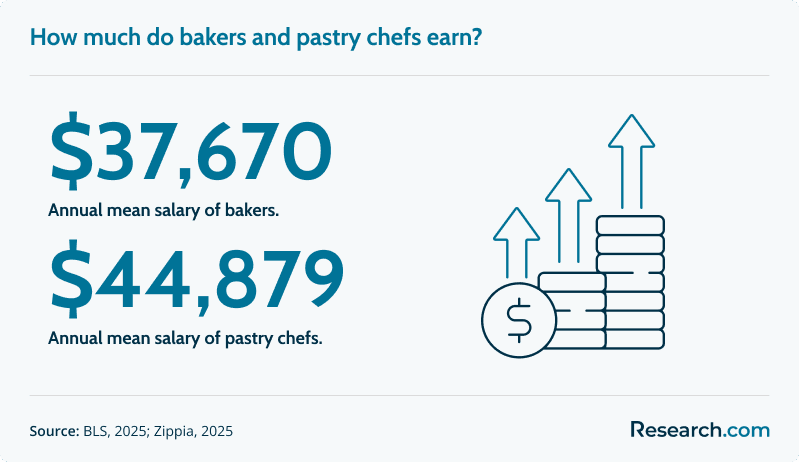
According to 2025 data from the U.S. Bureau of Labor Statistics, bakers earn an average annual wage of $37,670, or around $18 per hour. Entry-level roles typically begin at around $28,000 per year, while experienced bakers can earn up to $49,000.
Pastry-focused roles may pay more in some settings. Zippia reports that pastry chefs earn an average annual salary of $44,879 in 2025. Higher-end restaurants, resorts, and luxury hotels may offer stronger pay for workers with advanced skills such as sugar work, plated desserts, custom cakes, chocolate work, or high-volume pastry production.
Pay varies by location, employer type, experience, schedule, and specialization. Large metropolitan areas may offer higher wages, while small local bakeries may start lower. Some bakers increase earnings through overtime, tips, custom orders, catering, wedding cakes, or home-based side businesses where local rules allow. Baking is not usually the highest-paying trade, but it can offer creative work, practical advancement, and self-employment potential.
- Most Affordable Online Baking and Pastry Arts Trade School Programs for 2027
- How long does an online baking and pastry arts trade school program take?
- Online vs. on-campus baking and pastry arts programs
- Average cost of an online baking and pastry arts trade school program
- Financial aid options for online baking and pastry arts students
- Admission requirements for online baking and pastry arts trade schools
- Common courses in online baking and pastry arts programs
- Baking and pastry arts specializations
- Why accreditation matters for online baking programs
- Further education options after trade school
- Challenges of learning baking online
- How to choose the right online baking and pastry arts trade school
- Career paths after an online baking and pastry arts program
- Job market for online baking and pastry arts graduates
- Career support in online baking programs
List of the Most Affordable Online Baking and Pastry Arts Trade School Programs for 2027
How do we rank schools?
Because tuition, credential type, delivery format, and student outcomes can vary widely, affordable program rankings should be used as a starting point rather than the only basis for enrollment. Research.com evaluates schools using reliable education data sources, including the IPEDS database, Peterson’s, College Scorecard, and the National Center for Education Statistics.
These sources help compare cost, institutional information, and program characteristics across online baking and pastry arts trade school options. For a fuller explanation of the ranking process, visit Research.com’s methodology page.
1. McFatter Technical College
McFatter Technical College’s Baking and Pastry Arts program focuses on the preparation, baking, finishing, and presentation of pastry and baked goods. Students develop core production skills such as accurate measuring, mixing, decorating, food safety, and sanitation. The hybrid format combines online academic instruction with in-person kitchen practice.
- Required Credits to Graduate: 600 clock hours
- Cost: $1,680 (FL resident), $6,720 (out-of-state)
- Accreditation: Commission of the Council on Occupational Education
2. Lake Washington Institute of Technology
Lake Washington’s Baking Arts program includes certificate options from 27 to 93 credits. The curriculum blends online theory with kitchen lab work and covers food safety, pastry methods, cake decorating, chocolate techniques, and professional preparation. The program also supports preparation for ACF certification and offers small-class instruction.
- Required Credits to Graduate: 30–93 credits (depending on certificate)
- Cost: $6,588–$18,297 (total estimated)
- Accreditation: American Culinary Federation (ACF)
3. Blue Ridge Community and Technical College
Blue Ridge Community and Technical College's one-year certificate introduces students to practical baking skills, including cake design, bread production, portion control, sanitation, and recipe execution. Students train in a culinary lab where they apply techniques in a hands-on setting. Credits from the certificate may also apply toward a later culinary degree.
- Required Credits to Graduate: 30 credit hours
- Cost: $208 per credit (in-state), $386 per credit (out-of-state)
- Accreditation: Higher Learning Commission (HLC)
4. Cypress College
Cypress College’s Baking & Pastry Program gives students several credential choices: a fundamentals certificate, an advanced certificate, and an associate degree. Students learn baking theory, pastry skills, and bakery operations in a supportive, small-class environment that includes experience operating a bakery bistro. Coursework is delivered in a hybrid format.
- Required Credits to Graduate: 15–61 units (depending on program)
- Cost: $46 per unit (California residents)
- Accreditation: Western Association of Schools and Colleges (WASC)
5. Hudson County Community College
Hudson County Community College’s Baking & Pastry Proficiency program emphasizes hands-on instruction in small classes. Students work in modern kitchen spaces while learning baking foundations and food safety practices. The hybrid format combines flexibility with direct practice under chef instructors.
- Required Credits to Graduate: Certificate (typically ~30 credits)
- Cost: $161 per credit (in-county), $322 per credit (out-of-county)
- Accreditation: American Culinary Federation Education Foundation (ACFEF)
6. Institute of Culinary Education (ICE) Online
The Institute of Culinary Education’s online baking and pastry arts trade school program develops skills in food science, production technique, and culinary operations. Students complete flexible online lessons and chef-led labs while building creative and business abilities. A required hands-on externship gives students exposure to professional kitchen expectations.
- Required Credits to Graduate: 900 clock hours (~16 courses)
- Cost: $16,984.37 tuition + $3,015.63 books/fees
- Accreditation: Accrediting Commission of Career Schools and Colleges (ACCSC)
7. Escoffier Online International Culinary Academy
Escoffier’s online pastry diploma combines video lessons, live instruction, baking projects, and instructor feedback. Students complete practical assignments and an externship to strengthen hands-on experience. The format is designed for adult learners who need flexibility while developing professional pastry skills from home.
- Required Credits to Graduate: Diploma program (~60 weeks)
- Cost: $21,502
- Accreditation: Accrediting Council for Continuing Education and Training (ACCET)
8. YTI Career Institute
YTI Career Institute's blended Pastry Arts program pairs online lectures with on-campus kitchen labs. Students build technical baking and pastry skills while learning about hospitality, retail, and food manufacturing career options. Instruction from pastry professionals supports preparation for industry certification and employment across culinary settings.
- Required Credits to Graduate: Diploma program
- Cost: Not publicly listed
- Accreditation: Accrediting Commission of Career Schools and Colleges (ACCSC)
9. Auguste Escoffier School of Culinary Arts (Online)
Auguste Escoffier’s online Diploma in Professional Pastry Arts includes video instruction, chef feedback, and a required 6-week externship. The program covers technique, pastry theory, and business concepts within a flexible 60- to 75-week timeline for adult learners. It also includes industry-recognized certifications.
- Required Credits to Graduate: Diploma program (~60–75 weeks)
- Cost: $21,502 (pastry diploma); $32,445 (associate degree)
- Accreditation: ACCET (CO for diploma); COE (TX for associate)
10. San Diego Continuing Education (SDCE) Culinary Arts
San Diego Continuing Education offers a hybrid Baking & Pastry Arts I and II career certificate. Students complete two 225-hour courses that combine online instruction with campus-based kitchen labs. Course topics include baking foundations, artisan breads, pastries, chocolate, and sugar work for students preparing for commercial baking roles.
- Required Credits to Graduate: 450 clock hours (two 225‑hour courses)
- Cost: Included in state-funded adult education (free for residents)
- Accreditation: State Career Training Certificate
How long does it take to complete an online baking and pastry arts trade school program?
Most online baking and pastry arts trade school programs take 6 months to 2 years to complete, depending on whether you choose a short certificate, longer diploma, or associate degree. Certificate programs are often completed in 6 to 12 months and commonly include 15 to 36 credit hours focused on job-ready baking skills.
Many students can finish in 6 months to 1 year, which is much shorter than many academic degree options such as the cheapest geosciences degree online. This shorter structure appeals to students who want to enter the culinary workforce quickly rather than spend several years in school.
An associate degree usually takes about 18 to 24 months of full-time study. These programs often require around 60 credits and may include advanced pastry coursework, culinary management, and general education subjects such as math or communication.
Part-time study can extend the timeline, but it may be necessary for students balancing employment, family care, or transportation limits. Some schools also offer accelerated formats for students who can handle a heavier workload.
Because many online baking programs include in-person labs or externships, students should check the schedule carefully. Required hands-on sessions may happen on weekends, during short intensives, or across several terms.
| Credential type | Typical length | Best for | Main trade-off |
| Short certificate | 6 to 12 months | Students seeking entry-level bakery skills quickly | Less depth than a longer diploma or degree |
| Diploma | Often about 1 year or longer | Students who want broader pastry and baking preparation | Higher cost and more time than a short certificate |
| Associate degree | About 18 to 24 months full-time | Students who want technical training plus general education and possible transfer options | Longer timeline and more total credits |
| Part-time pathway | Varies by course load | Working adults and caregivers | More flexibility, but a longer time to completion |
How does an online baking and pastry arts trade school program compare to an on-campus program?
Online and on-campus baking programs can teach similar competencies, but the experience is different. The right format depends on your schedule, learning style, access to kitchen equipment, and need for in-person coaching.
| Factor | Online or hybrid program | On-campus program |
| Schedule | Often more flexible, with videos and assignments that can fit around work or caregiving | Usually follows a fixed class and lab schedule |
| Hands-on practice | May use home assignments, kitchen kits, weekend labs, or externships | Provides regular access to school kitchens and equipment |
| Instructor feedback | Often delivered through submitted photos, videos, virtual meetings, or scheduled labs | Usually happens in real time during kitchen practice |
| Cost and travel | May reduce commuting, housing, and schedule-related expenses | May require more travel and time on campus |
| Best fit | Self-directed students who can practice consistently outside class | Students who learn best with daily supervision and immediate correction |
- Flexibility: Online programs can work well for students with jobs, children, or changing schedules. Even a restaurant manager may be able to complete coursework during off-hours while building pastry skills.
- Hands-on training: Campus programs provide frequent kitchen access. Online trade schools must compensate through hybrid labs, structured home projects, instructor review, or externships.
- Learning style: Online students need self-discipline and good time management. Campus learners often benefit from immediate instructor corrections and peer interaction.
- Expenses: Online or hybrid formats may lower transportation and housing costs, although students should still budget for ingredients, tools, uniforms, lab fees, and possible travel to required sessions.
What is the average cost of an online baking and pastry arts trade school program?
The average cost of an online baking and pastry arts trade school program typically ranges from $3,000 to $12,000, depending on credential length, school type, residency status, and required labs or externships. Longer diploma and associate degree pathways may cost more.
- Short-term certificates (15–30 credits): These often cost between $3,000 and $6,500. Lake Washington Institute of Technology’s Baking Skills Certificate costs around $6,588, while Cypress College’s basic certificate is under $700 for in-state residents, excluding fees and supplies.
- Intermediate certificates (30–45 credits): These commonly range from $6,000 to $9,000 and may include more advanced skills such as plated desserts, sugar work, or specialty production.
- Full certificates or associate degrees (60+ credits): These can cost between $9,000 and $18,000 in total.
Books, uniforms, tools, food costs, lab fees, and other supplies may add $1,000 to $3,000, depending on the program. Hybrid formats can reduce commuting and housing expenses, but students should still confirm whether they must travel for labs or externships.
Compared with many degree programs, baking and pastry training is often a lower-cost vocational route. Some options may cost less than the cheapest geography degree online, especially when students choose community college or state-funded adult education programs.
The chart below shows bakers by highest educational attainment, based on Zippia data from 2025.
What are the financial aid options for students enrolling in an online baking and pastry arts trade school program?
Students in accredited online baking and pastry arts trade schools may qualify for federal aid, state funding, scholarships, grants, payment plans, or employer tuition support. Similar financial aid pathways may also apply to hands-on career programs such as the cheapest online electrical lineworker training program.
- FAFSA (Free Application for Federal Student Aid): Students attending eligible accredited schools can submit the FAFSA to be considered for Pell Grants, federal loans, and work-study opportunities.
- State grants and scholarships: Some states support vocational and community college students. California, for example, offers the California College Promise Grant for eligible residents in two-year programs.
- Institutional aid: Schools may offer culinary scholarships, emergency grants, or tuition payment plans. Hudson County Community College and Cypress College, for instance, offer local scholarship opportunities for culinary students with financial need.
- Industry scholarships: Professional organizations can support culinary students. ACF scholarships range from $1,500 to $2,500 for students pursuing baking and pastry certifications or associate degrees.
- Private scholarships: Groups such as the James Beard Foundation, Women Chefs & Restaurateurs, and Les Dames d’Escoffier offer scholarship opportunities for culinary students, including those in online or hybrid formats.
- Employer reimbursement: Students already working in food service may be able to receive tuition assistance from restaurants, bakeries, grocery chains, hotels, or food production companies that want to train staff for advancement.
Online baking programs can be less expensive than many longer academic pathways, including the cheapest online nutrition degree, which can still cost over $10,000 for a bachelor’s. However, students should compare total cost, not just tuition, before deciding.
Questions to ask about cost before enrolling
- Is the listed tuition the full program cost or only the cost per term?
- Are tools, uniforms, textbooks, ingredients, and exam fees included?
- Will I need to travel for labs, intensives, or externships?
- Is the school eligible for federal financial aid?
- Can credits transfer into a culinary associate degree later?
- What happens financially if I pause or withdraw from the program?
What are the prerequisites for enrolling in an online baking and pastry arts trade school program?
Online baking and pastry arts trade schools usually have accessible admissions requirements. These programs emphasize practical skills, consistency, and professional readiness more than advanced academic preparation.
Most schools require a high school diploma or equivalent. This entry pathway is similar to practical training options such as the cheapest online dog obedience training, where students from different backgrounds can enter a skill-based career program.
- High school diploma or GED: Most programs ask for proof of high school completion, a GED, or acceptable alternative documentation such as homeschool records.
- Reliable technology: Students need internet access and a device that can handle videos, assignments, email, learning platforms, and virtual meetings.
- Minimum age: Many schools require students to be at least 17 or 18 years old, depending on institutional and state rules.
- Placement testing: Some schools may require reading or math placement, especially if the program includes general education courses.
- Food safety or health requirements: Hybrid programs may require a food handler’s permit, sanitation training, or safety clearance before students begin kitchen labs.
What courses are typically in an online baking and pastry arts trade school program?
Online baking and pastry arts trade schools usually combine production technique, baking science, food safety, presentation, and business training. Course names vary, but many programs include the following subjects:
- Introduction to Baking and Pastry: Students learn basic measuring, mixing, kneading, temperature control, recipe reading, and recipe scaling.
- Bread and Doughs: This course covers yeast breads, quick breads, flatbreads, dough shaping, gluten development, and fermentation.
- Cakes and Cake Decorating: Students practice sponge cakes, butter cakes, foam cakes, fillings, icing, fondant, piping, and finishing techniques.
- Pastries and Pies: Coursework may include laminated doughs such as croissants, puff pastry, and phyllo, along with pies, tarts, and related fillings.
- Chocolate and Sugar Art: Students explore tempering, molding, candy production, sugar pulling, and decorative showpieces.
- Food Safety and Sanitation: Training covers safe food handling, cleaning procedures, storage, cross-contamination prevention, and may prepare students for credentials such as ServSafe.
- Culinary Business and Management: Students study menu planning, pricing, inventory, cost control, service, and customer communication. For future bakery owners or managers, these topics can provide a practical business foundation similar in purpose, though not in level, to some of the benefits of an MBA degree.
What types of specializations are available in an online baking and pastry arts trade school program?
Specializations allow students to move beyond general baking and prepare for specific roles. Not every school offers formal tracks, but many programs include elective coursework or focused modules in areas such as bread, cakes, chocolate, or entrepreneurship.
| Specialization | What you learn | Best career fit |
| Advanced Pastry Arts | Pâte à choux, mousses, plated desserts, frozen desserts, modern pastry techniques | Restaurant pastry cook, hotel pastry assistant, dessert station worker |
| Chocolate and Confectionery | Tempering, truffles, molded chocolates, candies, sugar art | Chocolatier, confectioner, specialty bakery worker |
| Cake Design and Decorating | Tiered cakes, fondant, piping, sculpted designs, celebration cakes | Cake decorator, wedding cake assistant, custom cake business owner |
| Bread and Artisan Baking | Sourdough, rustic loaves, enriched doughs, flatbreads, small-batch production | Artisan baker, bread production assistant, bakery owner |
| Baking Business and Entrepreneurship | Pricing, inventory, marketing, food costs, customer service, operations | Home bakery owner, retail bakery operator, catering entrepreneur |
Some students later connect baking skills with broader goals. For example, a graduate who wants to operate a community kitchen, food access nonprofit, or vocational training organization may eventually compare options such as the most affordable online master’s in nonprofit management. The best specialization depends on whether your goal is employment, freelance work, entrepreneurship, or community-based food programming.
The chart below lists the states with the highest employment levels for bakers, based on BLS data from 2025.
Is accreditation essential for online baking and pastry arts programs?
Accreditation is important because it helps confirm that a school meets recognized educational standards. For culinary and trade programs, accreditation can also affect financial aid eligibility, credit transfer, employer confidence, and the credibility of the credential. Students should verify institutional accreditation and, when applicable, industry recognition from culinary organizations.
Accreditation does not guarantee a job or a specific salary, but it can reduce the risk of paying for a program that employers or other schools do not recognize. It also matters if you plan to continue your education later, such as by applying credits toward a 6 month associate degree online or another accelerated credential.
How to check accreditation
- Look for the accrediting body on the school’s official website.
- Confirm the accreditor through the U.S. Department of Education or the accreditor’s own database.
- Ask whether the specific baking and pastry credential is included under the institution’s accreditation.
- Ask whether credits can transfer to another culinary certificate, diploma, or associate degree.
- Verify whether accreditation affects eligibility for FAFSA-based aid.
What are my options for further education after completing an online baking and pastry arts trade school program?
A baking and pastry trade school credential can be a first step rather than the final stop. After gaining entry-level skills, students may continue into an associate degree in culinary arts, hospitality management, food service management, nutrition, entrepreneurship, or business. Further education may be especially useful for students who want to supervise teams, manage bakery operations, teach, or open a business.
Additional education can connect hands-on pastry skills with broader subjects such as cost control, menu development, food science, leadership, and operations. Students planning long-term advancement may eventually compare trade school credits with an accelerated online bachelor's degree or another flexible academic pathway.
What challenges might I face in an online baking and pastry arts program?
Online baking programs can be convenient, but they require discipline. Students may need to practice without an instructor standing nearby, troubleshoot failed products, manage ingredient costs, and document their work clearly for feedback. Access to proper equipment can also affect the learning experience.
The biggest challenge is making online training truly hands-on. Before enrolling, ask how often instructors evaluate your actual baked products, whether you receive live feedback, how labs are scheduled, and how externships are arranged. Students who want additional structure may also compare complementary options such as certification programs for high paying careers when planning a broader career path.
| Common challenge | Why it matters | How to reduce the risk |
| Limited real-time correction | Small technique errors can affect texture, rise, flavor, and appearance | Choose a program with video feedback, live demos, labs, or regular instructor check-ins |
| Equipment gaps | Some assignments may require tools you do not already own | Request the full supply list before enrolling and price it separately from tuition |
| Ingredient costs | Repeated practice can become expensive | Ask whether ingredients are included, estimated, or paid entirely by the student |
| Time management | Baking assignments often require proofing, chilling, cooling, and cleanup time | Block out longer practice periods instead of treating assignments like short online quizzes |
| Externship logistics | A required placement may affect graduation timing | Ask who finds the externship and whether local sites are available near you |
How to choose the best online baking and pastry arts trade school program?
The best online baking and pastry arts trade school is the one that matches your career goal, budget, schedule, learning style, and need for hands-on support. Do not choose based on tuition alone. A low-cost program may be a poor value if it lacks feedback, kitchen practice, accreditation, or career support.
- Confirm accreditation: Make sure the institution is accredited and ask whether the specific program is covered. This matters for financial aid, transfer options, and credibility.
- Evaluate hands-on requirements: Strong programs include home baking assignments, labs, externships, kitchen kits, or direct product evaluation. Online theory alone is not enough for a practical baking career.
- Read the course list carefully: Choose a program aligned with your goals. Bread, cakes, chocolate, pastry, food safety, and business courses lead to different career paths.
- Check flexibility realistically: Self-paced coursework helps busy students, but required labs, live sessions, or externships may still require fixed scheduling.
- Compare total cost: Include tuition, fees, uniforms, tools, ingredients, books, travel, and lost work time. Also ask whether the school helps with the Free Application for Federal Student Aid (FAFSA).
- Review career support: Look for resume help, interview preparation, job boards, employer relationships, externship assistance, alumni networks, or small business guidance.
Common mistakes to avoid
| Mistake | Why it can hurt you | Better approach |
| Choosing only the cheapest tuition | Fees, tools, ingredients, and travel can change the true cost | Compare the full cost of attendance and required supplies |
| Ignoring accreditation | Credits may not transfer, and aid eligibility may be limited | Verify the school and program before applying |
| Assuming online means no in-person work | Many programs require labs, externships, or practical assessments | Ask for the complete hands-on schedule in writing |
| Overlooking career services | A credential alone may not connect you to employers | Ask how the school supports job searches and externship placement |
| Not checking equipment needs | Missing tools can delay assignments or add unexpected costs | Get the supply list before enrolling |
| Expecting guaranteed salary outcomes | Pay depends on role, market, skill, and experience | Use salary data as a planning tool, not a promise |
What career paths are available for graduates of an online baking and pastry arts trade school program?
Graduates can pursue entry-level and growth-oriented roles across the food industry. The first job may not be a pastry chef title, but it can provide the production experience needed for advancement.
- Baker or Pastry Chef: Work in bakeries, hotels, restaurants, grocery stores, resorts, or independent shops. Many graduates begin in assistant roles and advance with experience.
- Cake Decorator: Create wedding cakes, celebration cakes, themed desserts, and retail bakery designs for grocery stores, bakeries, or custom cake businesses.
- Chocolatier or Confectioner: Focus on chocolate, candy, truffles, molded pieces, and specialty confections.
- Food Stylist or Recipe Developer: Apply baking knowledge to media, advertising, cookbooks, digital content, or product development. These roles often require strong presentation skills and baking science knowledge.
- Catering Assistant or Entrepreneur: Use pastry and business training to support a catering company, home bakery, pop-up dessert business, food truck, or small retail operation.
- Culinary Instructor: After industry experience, some graduates teach baking skills in career education settings. Students exploring teaching should review state requirements and may want to learn how to get teaching credential qualifications, since some states require work experience, certification, and teaching coursework.
| Career path | Typical starting point | Skills that help advancement |
| Retail baker | Bakery assistant, production baker | Speed, consistency, sanitation, dough handling |
| Pastry cook | Restaurant or hotel pastry assistant | Plated desserts, timing, station organization, fine finishing |
| Cake decorator | Decorator trainee, bakery clerk-decorator | Piping, fondant, color work, customer communication |
| Chocolatier | Confectionery assistant | Tempering, molding, filling, precision, packaging |
| Bakery owner | Home baker, market vendor, small business operator | Pricing, licensing awareness, marketing, inventory, production planning |
What is the job market for graduates of an online baking and pastry arts trade school program?
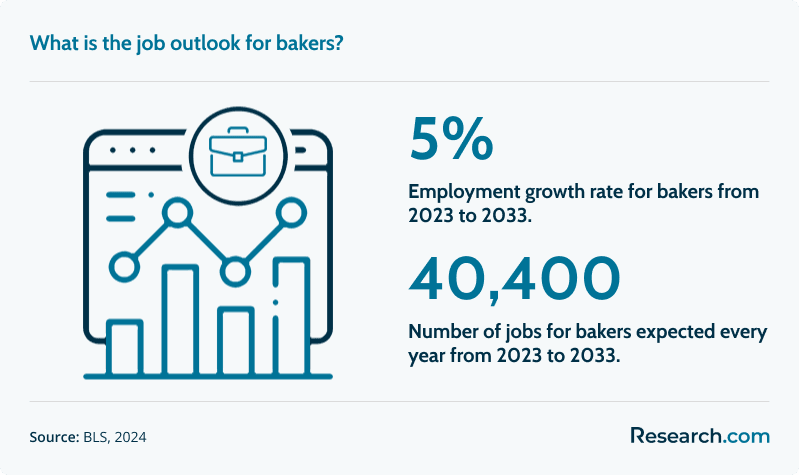
According to 2025 data published by the BLS, around 40,400 baking-related job openings are expected each year over the next decade. These openings are found across grocery stores, bakeries, restaurants, hotels, and other food service employers. Many openings occur because workers retire, change careers, or move into higher-level roles.
Zippia reported in 2025 that over 105,000 pastry chefs are currently working in the U.S. This indicates a large existing workforce, though competition can vary by city, employer, and specialization.
New graduates may start as bakery assistants, pastry cooks, cake decorators, or production workers. With experience, they can move into pastry chef, head baker, production manager, or business owner roles. Major cities may offer more high-end pastry jobs but also stronger competition. Smaller towns and suburban markets may have steady demand for trained bakers in grocery stores, local bakeries, restaurants, and catering operations.
Do online baking programs offer comprehensive career support?
Many online baking and pastry arts trade schools provide career services, but the level of support differs by institution. Useful services may include resume reviews, interview coaching, externship placement, job boards, employer introductions, alumni networks, and career fairs. Programs with local bakery or hospitality partnerships may give students a clearer path from training to employment.
Students should ask what the school actually does for graduates instead of assuming “career support” means job placement. For some students, additional education later, such as a 1 year online masters, may support broader leadership or career advancement goals outside entry-level baking roles.
Questions to ask career services
- What percentage of students complete the program and externship?
- Does the school help secure externship sites, or must students find their own?
- Which bakeries, restaurants, hotels, or grocery employers have hired graduates?
- Does career support continue after graduation?
- Are business planning resources available for students who want to start a bakery?
- Does the program prepare students for industry certifications?
Here’s What Graduates Have to Say About Their Online Baking and Pastry Arts Trade School Programs
The online format helped me keep working at my café while I learned plated desserts and sugar techniques. Being able to watch demonstrations again, meet virtually with instructors, and practice on my own schedule kept me moving forward. – Julian
I was concerned that online training would not feel practical enough, but the supplies, assignments, and live feedback made a difference. I was able to build skills while taking care of my younger siblings during the day. – Mildred
The program went beyond recipes. I learned sanitation, timing, preparation habits, and why ingredients behave the way they do. That made entering a commercial kitchen feel much less intimidating. – Fatima
Key Insights
- Online baking and pastry arts trade schools can be a practical option when they include real baking assignments, instructor feedback, food safety training, and hands-on labs or externships.
- Most programs take 12 to 24 months to complete, though some certificate pathways may be shorter and associate degree options may take about 18 to 24 months full-time.
- Tuition commonly ranges from $5,000 to $18,000, but students should also budget for tools, uniforms, ingredients, books, travel, and lab fees.
- Students usually complete 30 to 60 credit hours for a certificate or diploma, depending on the school and credential level.
- Bakers earn an annual median wage of $36,650, with higher earnings possible as workers gain experience, specialize, or move into supervisory or pastry-focused roles.
- The BLS projects 40,400 job openings for bakers each year through 2033, and Zippia reports there are currently over 105,854 pastry chefs employed across the US.
- Accreditation, externship quality, career support, and total program cost are more important than choosing the lowest advertised tuition.
- The best program depends on your goal: quick employment, pastry specialization, cake decorating, bread production, entrepreneurship, or a longer culinary education pathway.
References:
- Bureau of Labor Statistics (BLS). (2024). Bakers. Occupational Outlook Handbook. BLS.
- Bureau of Labor Statistics (BLS). (2025). 51-3011 Bakers. May 2024 OEWS Profiles. BLS.
- Zippia. (2025a). Baker demographics and statistics in the US. Zippia.
- Zippia. (2025b). Pastry Chef demographics and statistics in the US. Zippia.
- Zippia. (2025c). Pastry Chef Salary. Zippia.
Other Things You Should Know About Online Baking and Pastry Arts Trade School Programs
In 2027, some of the most affordable online baking and pastry arts trade programs include those offered by Auguste Escoffier School of Culinary Arts, Stratford University, and Penn Foster. These programs provide comprehensive curricula at a lower cost compared to traditional institutions, helping students develop essential skills in a budget-friendly manner.
Many online baking and pastry arts trade schools require an in-person externship of 100 to 300 hours before graduation. Students usually complete the placement at an approved bakery, restaurant, or hotel under site supervision, and the school often sets minimum safety and sanitation standards.