
2027 Best Online Home Remodeling and Repair Trade School Programs

Co-Founder and Chief Data Scientist
It’s a strange situation: the U.S. construction market is valued at $1.9 trillion, yet 78% of firms report a severe shortage of skilled workers. For someone looking to start a career, this can feel confusing. The opportunities are massive, but the right path forward isn’t always clear. This is where a strategic plan becomes essential.
To help you find that path, our career planning experts, with more than 10 years of experience, built this guide. We’ll go beyond just a list and give you the clear, actionable advice you need to choose the best online home remodeling and repair programs and launch a successful, in-demand career.
What are the benefits of enrolling in an online home remodeling and repair trade school program?
- Gain a competitive edge for in-demand jobs like carpentry or specialty contracting, allowing you to build and improve the spaces where people live and work.
- Put yourself on a path to strong earning potential, as carpenters earn a median annual salary of around $59,000, with top professionals making more than $98,000.
- Acquire valuable new skills on your own terms through a flexible and affordable online format that lets you study without pausing your work or life commitments.
What can I expect from an online home remodeling and repair trade school program?
You can expect a flexible and self-paced program that combines online learning with practical, hands-on assignments. These aren’t just video lessons; they are structured courses designed by experts. You’ll learn the theory, like reading blueprints, understanding building codes, and estimating costs, through online materials.
Then, you’ll apply that knowledge through graded projects, which might include home-based kits or simulations. The best online home remodeling and repair programs are built to give you both the knowledge and the practical skills employers are looking for.
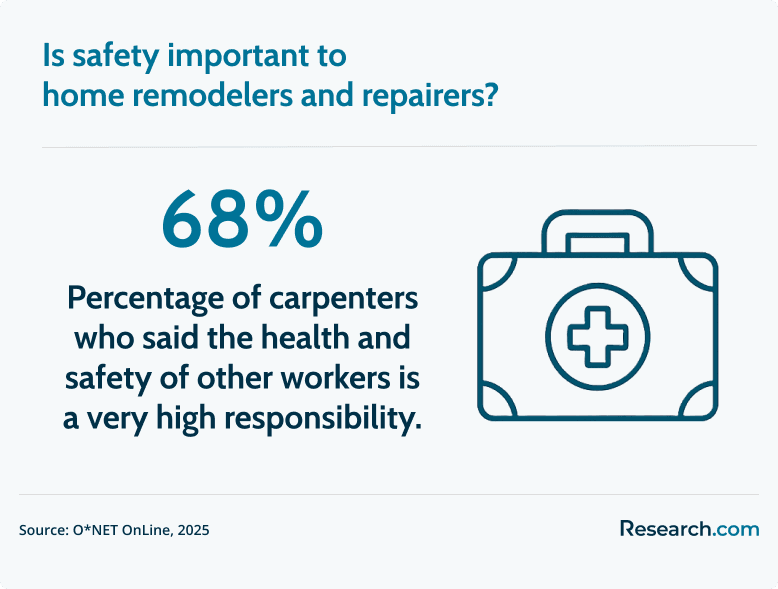
It’s also important to understand the nature of the work this career leads to. Once on the job, you can expect to spend a lot of time on your feet, about 68% of workers do. The work schedules can also be varied, with 53% of professionals working non-standard hours. This training prepares you for the real-world demands of the trade.
Where can I work after completing an online home remodeling and repair trade school program?
After you complete your program, you’ll have a few main paths to choose from. The largest number of jobs are with what the industry calls specialty trade contractors. These are the companies that focus on specific parts of a project, like drywall, painting, electrical, or plumbing.
Data from 2023 confirms that these specialty contractors are the biggest employers for construction laborers. This is great news for you because it means you can choose to become an expert in a specific, high-demand area. Additionally, most carpenters go on to work in residential building construction.
Another major pathway, especially after you gain some experience, is self-employment. Many graduates go on to start their own businesses, taking on projects as independent contractors. This field has a very high potential for entrepreneurship if becoming your own boss is one of your goals.
How much can I make with an online home remodeling and repair trade school program?
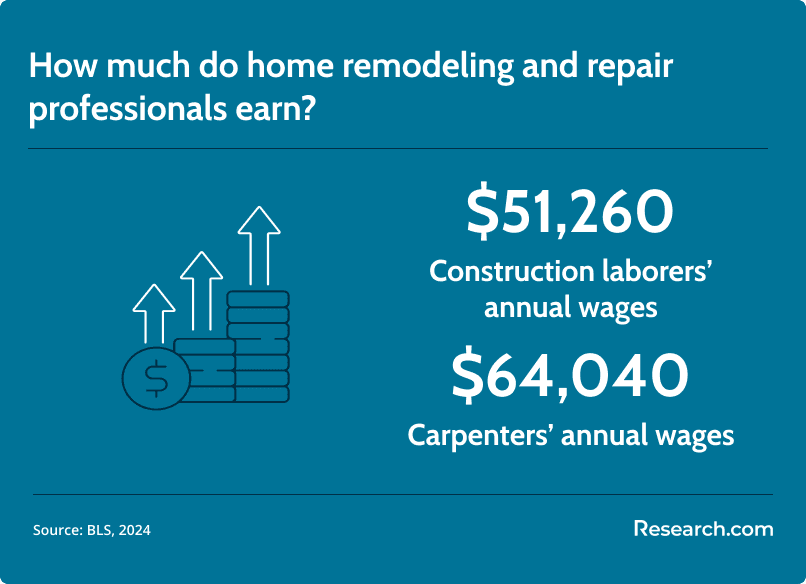
With a certificate, you’re setting yourself up for a carpenter’s average annual wage, which is $64,040. That’s a significant step up from a general construction laborer’s mean pay of $51,260. This is the immediate financial benefit of having a formal credential.
But it doesn’t stop there. As you build experience, your earning potential increases significantly. The top 25% of carpenters make over $75,620, and the top 10% earn more than $98,370 a year. This shows a clear financial ladder where your skills and experience directly reward you.
- List of the Best Online Home Remodeling and Repair Trade School Programs for 2027 List of Programs
- How long does it take to complete an online home remodeling and repair trade school program? Completion Time
- How does an online home remodeling and repair trade school program compare to an on-campus program? How does an online home remodeling and repair trade school program compare to an on-campus program?
- What is the average cost of an online home remodeling and repair trade school program? Program Cost
- What are the financial aid options for students enrolling in an online home remodeling and repair trade school program? Financial Aid
- What are the prerequisites for enrolling in an online home remodeling and repair trade school program? What are the prerequisites for enrolling in an online home remodeling and repair trade school program?
- What courses are typically in an online home remodeling and repair trade school program? What courses are typically in an online home remodeling and repair trade school program?
- What types of specializations are available in an online home remodeling and repair trade school program? What types of specializations are available in an online home remodeling and repair trade school program?
- How to Choose the Best Online Home Remodeling and Repair Trade School Program How to Choose the Best Online Home Remodeling and Repair Trade School Program
- What career paths are available for graduates of an online home remodeling and repair trade school program? Career Paths
- What is the job market for graduates of an online home remodeling and repair trade school program? Job Outlook
- What challenges might students encounter and how can they effectively overcome them? What challenges might students encounter and how can they effectively overcome them?
- Do these programs offer dedicated career support and job placement services? Do these programs offer dedicated career support and job placement services?
- Does the program address local building codes and regional standards? Does the program address local building codes and regional standards?
Best Online Home Remodeling and Repair Trade School Programs for 2027
Choosing an online home remodeling and repair trade school program is not just about finding the lowest tuition or the fastest certificate. The right program should help you build practical construction knowledge, understand safety expectations, read plans, estimate materials, communicate with clients, and prepare for entry-level work in remodeling, carpentry, construction support, or project coordination.
This guide is for career changers, hands-on learners, construction helpers who want formal training, DIY-focused learners who want professional skills, and future contractors who need a structured starting point. It explains how online trade programs work, what they cost, what courses they include, how they compare with campus-based options, and what to check before enrolling.
You will also find a program comparison, financial aid options, career paths, common mistakes to avoid, and practical questions to ask schools before committing your time and money.
Quick Answer: Are Online Home Remodeling and Repair Trade School Programs Worth It?
Online home remodeling and repair trade school programs can be worth it if you need flexible, affordable training for entry-level construction or remodeling work. They are especially useful for learning blueprint reading, materials, estimating, safety, scheduling, and basic construction principles. However, an online certificate alone does not usually make someone a licensed contractor. Most contractor licensing paths require documented work experience, local code knowledge, and state-specific licensing steps.
- Best for: beginners, working adults, helpers seeking advancement, future remodeling business owners, and learners who need a flexible schedule.
- Less ideal for: students who need daily supervised workshop practice, immediate access to in-person tools, or a program that directly satisfies a specific state licensing requirement.
- Most important factor: accreditation, curriculum relevance, transparent costs, and access to hands-on practice or local work experience.
How We Rank Schools
Because trade school tuition is a meaningful investment, Research.com evaluates programs using transparent education data and practical decision factors that matter to students. The goal is to help readers compare programs based on credibility, cost, completion expectations, and career usefulness rather than marketing claims alone.
Our ranking process draws from established data sources, including the IPEDS database, Peterson’s database, the College Scorecard database, and the National Center for Education Statistics. These sources help provide a more reliable foundation for comparing online home remodeling and repair trade school options.
You can review the broader Research.com ranking process on our methodology page.
Program Comparison at a Glance
| School | Credential or Program Type | Program Length | Graduation Requirement | Published Cost | Accreditation |
| Penn Foster College | Career diploma in home remodeling and repair | 8 to 10 months | 61.8 Continuing Education Units (CEUs) | $1,089 total tuition | Distance Education Accrediting Commission (DEAC) |
| Ashworth College | Associate of Science in construction management | 6 months | 60 credits | $2,059 total tuition | Distance Education Accrediting Commission (DEAC) |
| Suffolk County Community College | Associate of Applied Science in construction technology | 2 years | 62 credits | $252 per credit in-state; $504 per credit out-of-state | Middle States Commission on Higher Education (MSCHE) |
| University of California, Los Angeles Extension | Construction management certificate | 1 to 1.25 years | 20 quarter units | $6,390 estimated total tuition | Western Association of Schools and Colleges (WASC) |
1. Penn Foster College
Penn Foster College offers a self-paced online career diploma for students who want an introduction to residential remodeling and repair. The program covers foundational trade topics such as blueprint reading, construction materials, and tile installation, making it a practical option for beginners who need flexible training before pursuing entry-level work or local hands-on experience.
- Program Length: 8 to 10 months
- Required Units to Graduate: 61.8 Continuing Education Units (CEUs)
- Total Tuition: $1,089
- Accreditation: Distance Education Accrediting Commission (DEAC)
2. Ashworth College
Ashworth College provides an online Associate of Science program focused on construction management fundamentals. Students study topics such as cost estimating, project scheduling, and safety planning, which can be useful for learners who want to move beyond basic labor roles and understand how construction projects are planned and supervised.
- Program Length: 6 months
- Required Credits to Graduate: 60
- Total Tuition: $2,059
- Accreditation: Distance Education Accrediting Commission (DEAC)
3. Suffolk County Community College
Suffolk County Community College offers an Associate of Applied Science in construction technology that combines technical construction knowledge with architectural design, drafting, and estimating. With some online flexibility, the program may suit students who want a community college pathway into construction support roles with contractors, design firms, architects, or engineering teams.
- Program Length: 2 years
- Required Credits to Graduate: 62
- Cost per Credit: $252 (in-state); $504 (out-of-state)
- Accreditation: Middle States Commission on Higher Education (MSCHE)
4. University of California, Los Angeles Extension
UCLA Extension offers a construction management certificate designed around project planning, cost control, scheduling, and real-world construction case studies. The five-course format can work well for new learners entering the field and for experienced workers who want a more formal credential for project coordination or management responsibilities.
- Program Length: 1 to 1.25 years
- Required Quarter Units to Graduate: 20
- Estimated Total Tuition: $6,390
- Accreditation: Western Association of Schools and Colleges (WASC)
How Long Does an Online Home Remodeling and Repair Trade School Program Take?
Many online home remodeling and repair programs can be completed in about six to 12 months, especially when they are self-paced certificate or diploma programs. Associate degree options usually take longer because they include more credits, general education requirements, and broader technical coursework.
The completion timeline depends on the credential type, weekly study time, whether the program is self-paced or term-based, and whether students need to complete in-person labs, projects, internships, or local work experience.
Program Completion Is Different From Contractor Licensure
Finishing an online trade school program gives you an academic credential. That credential can show employers that you have studied core concepts such as safety, materials, estimating, and construction documentation. It can also help you speak the language of the job site before you gain deeper experience.
Contractor licensing is a separate process. In many states, applicants must document several years of on-the-job experience before they can apply for a contractor license. Some jurisdictions also require exams, background checks, insurance, bonding, business registration, or proof of financial responsibility.
For planning purposes, think of the certificate as the starting line, not the finish line. It can help you get into the field faster, but your long-term advancement depends on supervised work experience, local code knowledge, and a record of safe, reliable work.
Typical Training Timeline
| Stage | Typical Focus | What to Do Next |
| Online certificate or diploma | Basic construction concepts, safety, materials, plans, and estimating | Build a portfolio of coursework, practice projects, and completed assignments |
| Entry-level job or helper role | On-site routines, tools, measurements, cleanup, materials handling, and supervised tasks | Track hours, supervisors, project types, and skills learned |
| Specialized trade experience | Carpentry, kitchen and bath work, roofing, exterior replacements, finishing, or estimating | Choose a specialty based on demand, skill fit, and local market needs |
| Licensure or business ownership preparation | State rules, code compliance, contracts, insurance, bidding, and client management | Confirm requirements with your state licensing board before offering regulated services |
Students comparing trade school timelines with other online education formats may also review how self-paced structures appear in unrelated fields, such as online FNP graduate certificate programs, but construction learners should focus on whether their program supports hands-on skill development and local code awareness.
Online vs. On-Campus Home Remodeling and Repair Programs
Online and campus-based programs can both be useful, but they serve different learners. Online programs are generally better for students who need schedule flexibility, lower commuting costs, and the ability to study while working. Campus programs are often stronger for students who learn best through scheduled shop time, direct instructor observation, and repeated practice with tools and materials.
The key question is not whether online or campus learning is automatically better. The better question is whether the program gives you credible instruction, enough practical application, and a realistic path into supervised job-site experience.
Online vs. On-Campus Comparison
| Factor | Online Program | On-Campus Program | Best Choice If... |
| Schedule | Often self-paced or asynchronous | Usually follows fixed class and lab times | Choose online if you work, care for family, or need flexibility |
| Hands-on practice | May use home projects, kits, videos, simulations, or local work experience | Typically includes shop-based instruction and instructor supervision | Choose campus if you need structured tool practice |
| Cost considerations | Can reduce transportation and housing costs | May include lab fees, commuting, or campus expenses | Compare total cost, not tuition alone |
| Networking | May rely on virtual advising, discussion boards, or local employer outreach | May offer easier local networking with instructors and classmates | Choose the format that gives you stronger local job connections |
| Learning style | Requires self-discipline and independent practice | Provides more routine and immediate feedback | Choose based on how you actually learn, not just convenience |
Accreditation Matters More Than Format
Accreditation is one of the strongest quality signals when comparing schools. It indicates that an institution has been reviewed against recognized standards for academic quality, administrative practices, and student support. Employers, licensing boards, and transfer institutions may treat accredited credentials more seriously than certificates from unaccredited providers.
A non-accredited program can still teach useful information, but students should be cautious if a school avoids clear accreditation details, exaggerates job placement claims, or pressures applicants to enroll quickly. Whether a program is online or on campus, accreditation should be verified before payment.
Online education can be rigorous in many fields, as seen in programs such as online MSN health systems management programs. For home remodeling students, however, academic structure must be paired with practical trade application.
How Much Does an Online Home Remodeling and Repair Trade School Program Cost?
Published tuition for the programs discussed in this guide ranges from about $1,000 to $17,000, depending on credential level, school type, program length, and whether the program is a short certificate, career diploma, college certificate, or associate degree.
Students should compare the full cost of attendance, not just the advertised tuition. Tools, books, software, exam fees, technology fees, commuting for any in-person components, and required materials can change the true price of a program.
Cost Factors to Check Before Enrolling
| Cost Factor | Why It Matters | Question to Ask |
| Tuition | This is the base program price, but it may not include everything | Is the listed tuition the total cost or only the instructional cost? |
| Tools and materials | Some programs require students to buy basic tools, project supplies, or safety gear | What items must I purchase separately? |
| Textbooks or digital content | Course materials can add to total expenses | Are books and digital resources included in tuition? |
| Fees | Registration, technology, graduation, or transcript fees may apply | Can the school provide a written fee list? |
| Hands-on requirements | Local workshops or in-person requirements may create travel costs | Will I need to attend any on-site sessions? |
| Licensure preparation | State licensing exams or business registration may require separate costs later | Does this program prepare me for any required state exam, or is that separate? |
How Location and Employer Support Can Affect Return on Investment
Your return on investment depends partly on where you work and what type of employer hires you. Some construction and remodeling companies offer tuition assistance or reimburse employees for training that improves job-site skills. If you are already working in construction, ask your employer whether your program qualifies for reimbursement before enrolling.
Geography can also influence potential earnings. The original data cited for this guide identifies Hawaii, Illinois, and California as states with the highest average salaries for carpenters. Students who plan to work in higher-paying markets may recover training costs more quickly, but wages still depend on experience, specialty, licensing, employer type, and local demand.
If cost is your main concern, compare several affordable online home remodeling and repair trade school programs before choosing a school.
Financial Aid Options for Online Home Remodeling and Repair Trade School Students
Financial aid for online home remodeling and repair programs varies widely. Federal aid through FAFSA may be limited for short non-degree certificate programs, especially if the school or program is not eligible for Title IV federal student aid. However, students still have several possible funding routes.
- School payment plans: Many schools allow students to divide tuition into monthly payments, which can make a short program easier to manage without paying the full amount upfront.
- Employer tuition assistance: Construction companies, remodeling firms, facilities departments, and maintenance employers may help pay for training that improves job performance.
- GI Bill benefits: Eligible veterans and family members may be able to use GI Bill funding if the program is approved for benefits.
- Trade association scholarships: Organizations such as the National Association of the Remodeling Industry (NARI) or the National Remodeling Foundation may offer scholarships or training support for students entering the field.
- State and local workforce grants: Workforce Innovation and Opportunity Act (WIOA) programs and local workforce boards may fund training for eligible students preparing for in-demand occupations.
- Private student loans: Some students use loans from banks, credit unions, or private lenders, although borrowing should be approached carefully because repayment terms vary.
Students should ask the school for a written list of aid options and confirm whether the program is eligible for federal, state, veteran, employer, or workforce funding. This same funding logic applies across many specialized education paths, including fields outside construction such as online master's programs in multilingual learner education.
Prospective students looking at property-related credentials may also compare outside funding strategies used for the cheapest online real estate degree programs, especially when balancing tuition against career goals.
Admission Requirements for Online Home Remodeling and Repair Trade School Programs
Most online home remodeling and repair trade school programs have straightforward admission requirements. In many cases, applicants need a high school diploma or GED. Prior construction experience is usually helpful but not required for beginner-focused programs.
These programs are often designed for students who are new to the trade. The purpose is to introduce construction concepts in an organized way so learners do not have to rely only on informal job-site observation.
What Can Strengthen Your Application or Readiness?
- Basic math skills: Measuring, estimating, area calculations, and material planning require comfort with practical arithmetic.
- Physical readiness: Even if coursework is online, the career itself can involve lifting, standing, climbing, and working in varied environments.
- Attention to safety: Employers value workers who follow procedures and understand job-site hazards.
- Reliable technology: Online learners need steady internet access, a computer or compatible device, and the ability to submit assignments digitally.
- Time management: Self-paced programs reward students who can schedule study time and complete work without constant reminders.
Why a Credential Can Help Beginners Compete
A formal credential can help new workers stand out because it signals that they have taken time to study the field before stepping onto a job site. It does not replace experience, but it can show employers that you understand the basics of safety, plans, materials, and construction terminology.
The value of a credential is similar in principle to understanding requirements for other skilled trades, such as electrician trade school requirements. Each trade has its own training and licensing pathway, but structured preparation can help applicants make more informed career decisions.
Students exploring specialized credentials in other industries can also compare how entry requirements differ in programs such as an online graduate certificate in nursing informatics, while remembering that construction training must ultimately connect to hands-on work.
Common Courses in an Online Home Remodeling and Repair Trade School Program
Coursework usually combines technical knowledge with practical job-site thinking. Students learn how residential projects are planned, priced, documented, and completed safely. A strong program should teach both “why” and “how”: why a material is used, why a code requirement matters, and how to apply that knowledge in real remodeling conditions.
Design awareness can also matter, especially in client-facing remodeling work. Understanding popular layouts, finishes, and interior design styles can help remodelers communicate with homeowners and translate design goals into practical construction decisions.
Typical Courses and What They Teach
| Course Area | What Students Learn | Why It Matters on the Job |
| Construction and Building Materials | Material types, uses, limitations, and selection criteria | Choosing the right material affects cost, durability, safety, and client satisfaction |
| Site Preparation, Layout, and Foundations | Basic preparation steps, layout methods, and foundation concepts | Early project mistakes can create expensive problems later |
| Construction Estimating and Scheduling | Cost calculations, labor planning, timelines, and project sequencing | Accurate estimates help prevent underbidding, delays, and budget disputes |
| Safety Planning | Hazard recognition, protective practices, and job-site safety procedures | Safety knowledge protects workers, clients, property, and employers |
| Construction Management | Project coordination, documentation, communication, and oversight | Remodeling projects require coordination among workers, clients, suppliers, and inspectors |
| Drafting | Reading and preparing basic drawings, plans, and technical documents | Workers who understand plans can follow specifications more accurately |
| Roofing and Finishing | Exterior systems, interior details, trim, and finishing practices | Finish quality strongly affects customer perception and project value |
Safety coursework should not be treated as a formality. In construction and remodeling, safe work habits are part of professional competence. Employers often prefer workers who understand hazards, follow procedures, and can help prevent costly accidents.
Home Remodeling and Repair Specializations to Consider
Some programs provide broad construction technology training, while others allow students to focus on a remodeling specialty. A broad program can be a good starting point if you are new to construction and want to understand the full residential building process. A focused specialty can be useful if you already know the type of work you want to pursue.
Common Specialization Options
- Kitchen and Bath Remodeling: Concentrates on high-detail renovation work involving layouts, cabinets, fixtures, finishes, water lines, ventilation, and client preferences.
- Exterior Replacements: Focuses on roofing, siding, windows, doors, and exterior systems that protect the home and improve appearance.
- Smart Home Integration: Introduces connected devices such as automated lighting, security systems, thermostats, and other home technology upgrades.
- Painting and Surface Finishing: Covers surface preparation, coatings, interior and exterior finishes, trim work, and quality control.
- Cabinetmaking and Woodworking: Develops more detailed carpentry skills used in custom cabinets, shelving, built-ins, and finish carpentry.
- Green Building and Energy Efficiency: Emphasizes efficient materials, weatherization, insulation, sustainable methods, and energy-conscious remodeling practices.
How to Choose a Specialty
| If You Want... | Consider This Specialty | Why It May Fit |
| Client-facing renovation work | Kitchen and bath remodeling | These projects often require communication, planning, and attention to finish details |
| Outdoor and envelope work | Exterior replacements | Roofing, siding, and windows are tied to protection, efficiency, and curb appeal |
| Technology-related remodeling | Smart home integration | Homeowners increasingly expect connected lighting, security, and comfort systems |
| Detail-oriented finish work | Painting, finishing, cabinetmaking, or woodworking | Precision and appearance are central to customer satisfaction |
| Sustainability-focused projects | Green building and energy efficiency | Energy-conscious upgrades can support long-term utility savings and home performance |
Market data can help students think strategically. For example, the National Association of Realtors tracks homeowner motivations and project outcomes in its report on the reason to remodel homes. Understanding where homeowners spend money can help you choose a specialty that aligns with real demand.
Exterior replacements, home systems and equipment replacements, outside property projects, interior replacements, and kitchen remodels are all important areas of spending. Specializing in one of these areas can help you position yourself more clearly in the remodeling labor market.
How to Choose the Best Online Home Remodeling and Repair Trade School Program
The best online home remodeling and repair program is the one that fits your career goal, budget, learning style, and local licensing reality. A low-cost program may be a smart choice if it teaches the skills you need and carries credible accreditation. A more expensive program may be worthwhile if it offers stronger advising, deeper construction management training, or better employer connections.
Program Selection Checklist
| What to Check | Why It Matters | Green Flag | Red Flag |
| Accreditation | Protects the credibility of your credential | The school clearly identifies a recognized accreditor | The school avoids direct answers about accreditation |
| Curriculum | Determines whether you learn useful job-related skills | Courses include safety, plans, materials, estimating, and project basics | The curriculum is vague or mostly promotional |
| Hands-on practice | Remodeling skills require application, not memorization alone | The program includes projects, kits, local experience, or practical assignments | No clear explanation of how students practice skills |
| Pricing | Total cost affects ROI | Tuition, fees, books, tools, and materials are listed in writing | Costs are unclear until after enrollment pressure begins |
| Career support | Job search help can matter for beginners | Resume help, advising, employer connections, or apprenticeship guidance are available | The school guarantees outcomes without evidence |
| Licensing alignment | Contractor rules vary by state and locality | The school explains what the program does and does not qualify you for | The school implies a certificate automatically makes you licensed |
Questions to Ask Before You Enroll
- Is the institution accredited, and by which agency?
- Does this program qualify for any federal, state, veteran, employer, or workforce funding?
- What tools, software, books, or materials are not included in tuition?
- How will I complete hands-on assignments if the program is fully online?
- Does the program address my state or local building codes?
- Can credits transfer into another certificate, diploma, or associate degree?
- What career services are available after completion?
- Does the school publish realistic graduate outcomes without promising guaranteed employment?
Common Mistakes to Avoid
- Choosing based only on tuition: The cheapest option is not always the best value if it lacks accreditation, support, or relevant coursework.
- Ignoring accreditation: An unaccredited credential may carry less value with employers or other schools.
- Assuming online means no hands-on work: A good program should still require practical application, even if lectures are online.
- Overlooking local licensing rules: Contractor requirements vary, and a school certificate may not satisfy licensing requirements by itself.
- Believing salary guarantees: No school can promise a specific wage. Earnings depend on location, experience, specialization, and employer demand.
- Not checking support services: Career advising, resume help, and employer connections can be especially important for students new to construction.
Career Paths After an Online Home Remodeling and Repair Trade School Program
Graduates can pursue entry-level construction, remodeling, carpentry support, estimating, or project coordination roles. The credential is usually most valuable when paired with job-site experience, a strong work ethic, safety awareness, and a willingness to keep learning from experienced tradespeople.
Possible Career Options
| Career Path | Typical Responsibilities | Good Fit For |
| Carpenter's Helper | Assisting carpenters, moving materials, measuring, setting up work areas, and learning basic tasks under supervision | Beginners who want direct job-site experience |
| Remodeling Specialist | Focusing on a specific project type such as kitchens, baths, exteriors, painting, or finish work | Workers who want to build expertise in a defined niche |
| Lead Carpenter | Handling more complex carpentry tasks, coordinating smaller crews, and maintaining work quality | Experienced workers ready for more responsibility |
| Job Site Foreman | Coordinating daily site activity, tracking progress, communicating with trades, and helping keep work on schedule | Workers with leadership skills and strong field experience |
| Construction Estimator | Reviewing drawings, calculating labor and material needs, and preparing cost estimates | Detail-oriented learners who enjoy math, planning, and documentation |
| Remodeling Business Owner | Finding clients, preparing bids, managing projects, hiring workers, coordinating finances, and meeting legal requirements | Experienced remodelers with business, licensing, and client management skills |
Business ownership is a realistic long-term goal for some graduates, but it requires more than technical skill. The original data cited in this article notes that nearly 24% of all carpenters and 27% of construction laborers are self-employed. Students interested in that path should learn bidding, contracts, insurance, customer communication, permitting, taxes, and cash flow management.
Understanding related property and finance careers can also help future remodeling business owners communicate with clients. For example, knowing what a mortgage broker does can give remodelers a clearer picture of how homeowners may finance renovation projects.
Job Market Outlook for Home Remodeling and Repair Graduates
The labor market for construction and remodeling workers remains supported by ongoing needs for home repair, renovation, maintenance, and new construction. Demand is not limited to one employer type. Graduates may find opportunities with general contractors, remodeling companies, specialty trade contractors, property management firms, facilities departments, and self-employed remodelers.
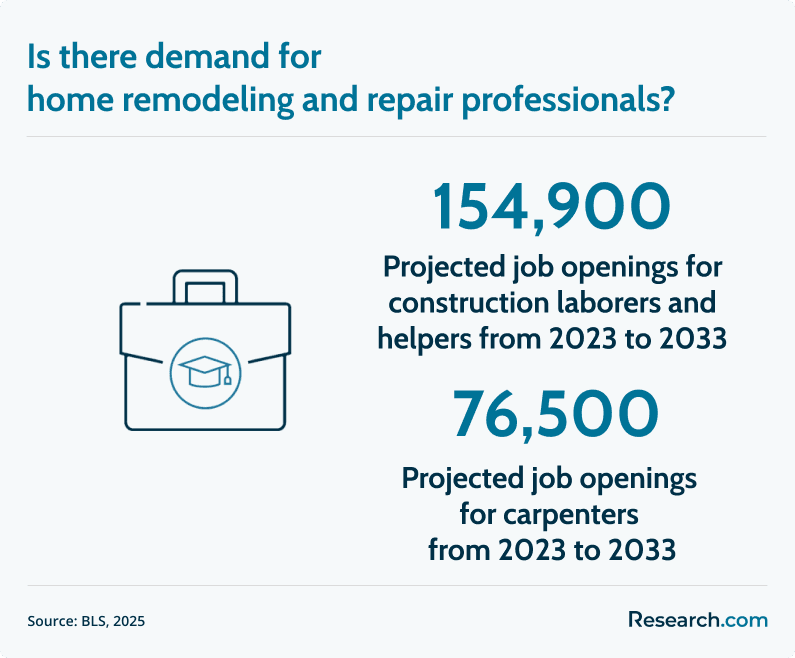
Experts project about 154,900 openings for construction laborers and helpers each year from 2023 to 2033. For carpenters, projections show around 76,500 new openings. These openings reflect a combination of growth, turnover, retirements, and replacement needs across the construction sector.
Current Trends Affecting the Field
- Skilled labor shortages: Contractors continue to report difficulty finding qualified workers, which can create opportunities for people with training and reliability.
- Home repair and renovation demand: Aging housing stock and homeowner improvement projects continue to support remodeling work.
- Technology in construction: Digital estimating tools, project management platforms, smart home systems, and online client communication are becoming more common.
- Safety and compliance expectations: Employers value workers who understand safety practices, documentation, and local code considerations.
- Specialization: Workers with focused skills in high-demand areas such as exterior systems, kitchen and bath work, finishing, or energy efficiency may have clearer market positioning.
Automation may change some construction tasks, but remodeling work still depends heavily on physical skill, judgment, customer communication, problem-solving, and adaptation to existing buildings. These are difficult to replace with technology alone.
Here’s What Graduates Say About Online Home Remodeling and Repair Trade School
- Percy: "Before enrolling, I was learning randomly from whatever I saw on job sites. The program gave me an organized foundation. Being able to study lessons in order and ask instructors questions helped me understand the proper way to approach the work instead of guessing."
- Jen: "I wondered whether hands-on skills could really be taught online. The practical materials made a difference. Working through projects at home helped me get comfortable with tools and basic techniques before I stepped into my first job."
- Isaac: "I already knew some tools, but I did not fully understand blueprints or building codes. Those lessons changed how I looked at the trade. The program helped me think less like a casual DIYer and more like someone preparing for professional job-site work."
Challenges Online Students May Face and How to Overcome Them
Online trade students may struggle with limited in-person feedback, fewer immediate networking opportunities, and the challenge of practicing physical skills outside a traditional shop. These challenges are manageable, but students need to be proactive.
Common Challenges and Practical Solutions
| Challenge | Why It Happens | How to Handle It |
| Limited hands-on supervision | Online programs cannot always provide real-time correction while students use tools | Use instructor feedback, submit project photos or videos when allowed, and seek local supervised experience |
| Difficulty staying motivated | Self-paced programs require discipline | Create a weekly study schedule and set completion targets for each module |
| Unclear local licensing steps | Licensing rules vary by state, county, and city | Contact your state licensing board before assuming the program meets contractor requirements |
| Weak local network | Online classmates and instructors may not live near you | Contact local contractors, trade associations, workforce boards, and apprenticeship resources |
| Keeping up with industry expectations | Codes, tools, materials, and technology can change | Continue learning through code updates, manufacturer training, safety courses, and trade groups |
Students who want to compare short credential options across career fields can also review Research.com’s guide to certificate degrees that pay well, then evaluate whether a construction-related certificate matches their local job market and long-term goals.
Do Online Home Remodeling and Repair Programs Offer Career Support?
Many reputable programs include career support, but the depth of that support varies. Some schools offer resume guidance, interview preparation, job search resources, career coaching, or employer networking. Others provide only basic completion documents and leave the job search entirely to the student.
Before enrolling, ask whether the school has relationships with local contractors, construction firms, apprenticeship partners, or workforce agencies. Also ask whether the program offers career help after graduation or only while you are actively enrolled.
Students comparing education costs across online institutions may find Research.com’s resource on the cheapest online college useful for understanding how affordability, aid eligibility, and institutional policies can affect the overall cost of training.
Do These Programs Cover Local Building Codes and Regional Standards?
Some online home remodeling and repair programs introduce building codes, permits, inspections, and safety standards, but students should not assume that every program fully covers their local requirements. Construction rules can vary by state, county, city, and project type.
A strong program should explain national concepts while encouraging students to verify local rules. The most useful programs may include regional examples, instructor guidance, code-related assignments, or recommendations for checking permitting and inspection requirements in the student’s area.
Before choosing a school, ask whether the curriculum discusses local code differences, how often the content is updated, and whether instructors have current industry experience. If you are trying to reduce costs while still choosing a credible institution, compare affordability resources such as the cheapest online college guide with program-specific accreditation and career support details.
Key Insights
- Online trade school can be a practical starting point: It is best for learning construction fundamentals, safety, plans, materials, estimating, and project basics before or alongside supervised fieldwork.
- A certificate is not the same as a contractor license: Most licensing pathways require documented experience, local compliance knowledge, and state-specific application steps.
- Accreditation should be verified first: Program format matters, but accreditation, transparent pricing, and curriculum quality matter more.
- Total cost is broader than tuition: Ask about tools, books, fees, materials, hands-on requirements, and future licensing expenses before enrolling.
- Hands-on practice is essential: Even the best online program should be paired with projects, local work experience, mentorship, or supervised job-site learning.
- Specialization can improve career direction: Kitchen and bath remodeling, exterior replacements, finishing, smart home integration, and green building can help students align skills with market demand.
- Job prospects depend on skill and location: Projected openings for construction laborers and helpers and carpenters are substantial, but earnings and advancement vary by region, experience, employer, and specialty.
- The best program is the one that fits your goal: Choose a short diploma for faster entry, an associate degree for broader education, or a management certificate if you want project coordination or leadership skills.
References:
- Associated General Contractors of America. (2025). The 2025 construction hiring and business outlook survey. Retrieved August 12, 2025, from https://www.agc.org/2025-construction-hiring-and-business-outlook
- CareerOneStop. (2025). Construction laborers. Retrieved August 12, 2025, from https://www.careeronestop.org/Toolkit/Careers/Occupations/occupation-profile.aspx?keyword=Construction%20Laborers&location=US&onetcode=47-2061.00
- Harvard Joint Center for Housing Studies. (2025). Improving America's housing 2025. Retrieved August 12, 2025, from https://www.jchs.harvard.edu/improving-americas-housing-2025
- O*NET OnLine. (2025). Carpenters. Retrieved August 12, 2025, from https://www.onetonline.org/link/summary/47-2031.00
- Research and Markets. (2024). United States construction market report and forecast 2024-2032. Retrieved August 12, 2025, from https://www.researchandmarkets.com/report/united-states-construction-market
- U.S. Bureau of Labor Statistics. (2024). May 2024 OEWS profiles. Retrieved August 12, 2025, from https://data.bls.gov/oesprofile
- U.S. Bureau of Labor Statistics. (2025). Carpenters. Retrieved August 12, 2025, from https://www.bls.gov/ooh/construction-and-extraction/carpenters.htm
- U.S. Bureau of Labor Statistics. (2025). Construction Laborers and Helpers. Retrieved August 12, 2025, from https://www.bls.gov/ooh/construction-and-extraction/construction-laborers-and-helpers.htm
Other Things You Should Know About Online Home Remodeling and Repair Trade School Programs
In 2027, several top-rated online programs for home remodeling and repair are known for their comprehensive curricula and industry reputation. Some of the leading programs include those offered by Ashworth College, Penn Foster Career School, and Udemy. These institutions provide flexible learning options tailored to both beginners and experienced individuals.
In 2027, top online home remodeling and repair trade schools offer unique skills in areas like sustainable building practices, computerized design software, and advanced project management. These programs often integrate hands-on training with the latest industry technology, preparing students for modern professional demands.


