
2027 Best Automotive Mechanic Trade School Programs

Co-Founder and Chief Data Scientist
If you enjoy diagnosing car problems, working with tools, and learning how vehicle systems fit together, automotive mechanic trade school can turn that interest into an employable skill set. The decision is not only about choosing a school; it is also about comparing cost, training quality, certification preparation, hands-on hours, employer connections, and whether the program matches the kind of work you want to do after graduation.
This guide explains what automotive mechanic trade school programs teach, how long they take, what they cost, which schools stand out, and how graduates can use certifications and specializations to build a stronger career. It is designed for prospective students, career changers, parents comparing trade school options, and working technicians considering additional credentials. Demand for repair skills remains relevant because there will be a projected 298.7 million automobiles on the road by the end of 2025, creating ongoing need for maintenance, diagnostics, and repair services.
Quick answer: Is automotive mechanic trade school worth considering?
Automotive mechanic trade school can be a practical route for students who want hands-on technical training without spending four years in college. Most full-time programs take between 10 months and 2 years to complete, and tuition commonly ranges from approximately $5,000 to $30,000 depending on program length, school type, and equipment requirements. Graduates can pursue roles in dealerships, independent shops, fleet maintenance, collision repair, diesel service, EV and hybrid repair, and related automotive settings.
| Decision factor | What to know before enrolling |
| Typical completion time | Most full-time automotive mechanic programs take between 10 months and 2 years to complete. |
| Common tuition range | Trade school tuition can range from approximately $5,000 to $30,000. |
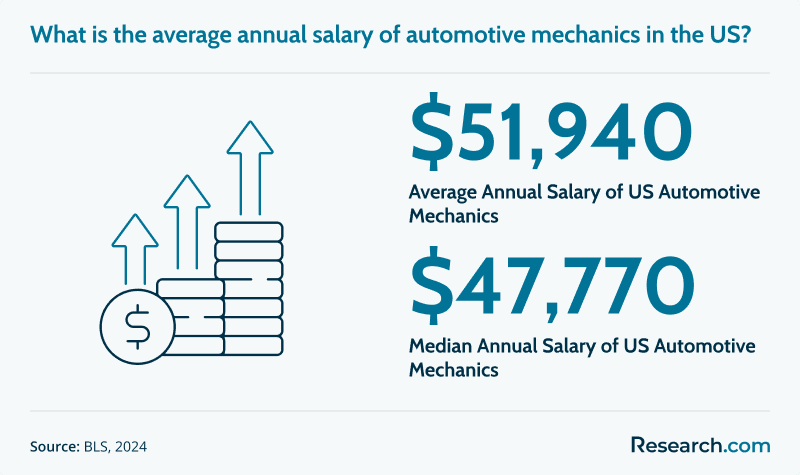
| Salary benchmark | The average annual salary of automotive mechanics is $51,940, while the median annual salary is $47,770. |
| Best-fit student | Someone who prefers hands-on learning, mechanical troubleshooting, and a direct route into technical employment. |
| Important credential | ASE certification is widely recognized and is often used by employers as evidence of technical competency. |
What are the benefits of completing an automotive mechanic trade school program?
- Automotive mechanic training can prepare students for a field where the average annual salary is $51,940 and the median annual salary is $47,770.
- Graduates may work in multiple repair environments, including dealerships, independent repair shops, fleet maintenance facilities, diesel shops, body shops, and specialty service centers.
- Online or hybrid automotive mechanic trade school options may offer more flexible scheduling, structured coursework, and generally lower education costs compared to traditional programs, although hands-on lab work is still essential.
What can I expect from an automotive mechanic trade school program?
An automotive mechanic trade school program is usually built around applied training. Students learn how to inspect, diagnose, maintain, and repair vehicles using shop equipment, diagnostic scanners, service information systems, and real or training vehicles. Core coursework often covers engine repair, brakes, steering and suspension, electrical systems, transmissions, climate control, emissions systems, and computerized diagnostics.
Good programs combine classroom instruction with lab-based practice. The classroom portion helps students understand theory, safety standards, electrical principles, automotive terminology, and manufacturer service procedures. The lab portion teaches students how to apply that knowledge under supervised conditions, which is critical because automotive repair requires accuracy, safety awareness, and repeatable troubleshooting habits.
Many schools also help students prepare for ASE certification exams, and some maintain partnerships with manufacturers or local employers. These relationships may lead to brand-specific training, internships, apprenticeships, dealership pathways, or job-placement support. Students should ask whether a program includes modern topics such as hybrid systems, electric vehicle safety, emissions technology, high-voltage battery handling, and advanced driver-assistance systems.
Where can I work after completing an automotive mechanic trade school program?
Automotive technicians are employed in a wide range of service environments. The best workplace depends on the student’s training, preferred pace, specialization, location, and long-term goals. Some graduates want predictable fleet work, while others prefer the variety of an independent shop or the structure of a dealership.
| Work setting | What mechanics usually do there | Best fit for |
| Dealership service centers | Work primarily on one manufacturer’s vehicles, perform warranty repairs, follow brand procedures, and use manufacturer-approved tools. | Students who want brand-specific training and a structured service environment. |
| Independent auto repair shops | Service many makes and models, handle routine maintenance, troubleshoot varied problems, and interact closely with local customers. | Technicians who like variety and want broad diagnostic experience. |
| Fleet maintenance facilities | Maintain vehicles for companies such as Amazon, UPS, FedEx, rental car agencies, taxi services, and municipal transit departments. | Graduates who prefer preventive maintenance, consistent procedures, and high vehicle volume. |
| Specialty repair shops | Focus on transmissions, brakes, performance tuning, classic restoration, custom fabrication, or similar niche services. | Mechanics who want to build deep expertise in one area. |
| Collision repair and auto body shops | Repair accident damage, restore frames, replace panels, remove dents, refinish paint, and coordinate with insurance-related repair processes. | Students interested in restoration, refinishing, and structural repair. |
| Heavy equipment and diesel repair facilities | Repair trucks, buses, construction vehicles, agricultural equipment, diesel engines, hydraulic systems, fuel systems, and drivetrains. | Students who want to work on larger vehicles and heavy-duty systems. |
| Tire and brake shops | Perform alignments, tire balancing, brake replacement, suspension work, and fast-turnaround maintenance. | Entry-level technicians who want focused, high-volume hands-on work. |
| Racing and motorsports teams | Tune engines, adjust suspension, support race preparation, and make quick performance-related changes under pressure. | Technicians interested in speed, precision, and competitive environments. |
| Mobile mechanic services | Travel to customers for diagnostics, battery replacement, brake work, minor engine service, and roadside assistance. | Mechanics who want independence and direct customer service work. |
| Government and military vehicle maintenance | Service police cars, fire trucks, military vehicles, municipal fleets, and specialized government equipment. | Technicians seeking fleet-based work with public agencies or military settings. |
How much can I make after completing an automotive mechanic trade school program?
According to the United States Bureau of Labor Statistics (BLS), the average annual salary of automotive mechanics is $51,940, while the median annual salary is $47,770. That median is close to the collective median annual salary of all jobs in the country, which is $48,060. Pay can vary widely by employer, region, specialization, experience, certifications, and whether a technician moves into supervisory, diagnostic, diesel, EV, or shop ownership roles.
Some sectors report substantially higher average pay. The industries with the highest average annual pay for mechanics are telecommunications ($93,120), natural gas distribution ($85,390), scientific research and development services ($81,750), electric power companies ($80,780), and aerospace product and parts manufacturing ($79,890).
Location also matters. The highest average annual salaries are reported in the District of Columbia ($65,390), Alaska ($62,290), and California ($61,420). Students comparing schools should consider not only tuition but also local labor markets, cost of living, employer partnerships, and whether the program trains students for higher-paying specializations.
- What are the best automotive trade school programs for 2027?
- How much do automotive mechanic trade school programs cost?
- What skills do strong automotive mechanic programs teach?
- What admission requirements do automotive mechanic schools usually have?
- How long does automotive mechanic trade school take?
- Which automotive mechanic specializations are available?
- Which certifications matter most for aspiring mechanics?
- How can further education improve a mechanic’s career options?
- What financing options can reduce automotive mechanic trade school costs?
- How does continuous education affect advancement for automotive mechanics?
- How do industry partnerships influence career outcomes?
- What should I compare before choosing an automotive mechanic trade school?
- Is the ROI of automotive mechanic trade school justified?
- What jobs can new automotive mechanic trade school graduates pursue?
- What is the job outlook for automotive mechanics?
- What challenges do auto mechanics commonly face?
- How can auto mechanics move into entrepreneurship?
What are the best automotive trade school programs for 2027?
How do we rank programs?
Choosing a mechanic program involves a major investment of time, money, and effort, so the ranking process uses education data from trusted sources such as College Scorecard, the IPEDS database, Peterson's database, and the National Center for Education Statistics (NCES). Research.com also explains its broader ranking approach on the methodology page.
The schools below should be used as a starting point, not as a one-size-fits-all answer. Before enrolling, confirm tuition, accreditation, equipment access, certification preparation, transfer options, employer partnerships, and whether the program’s hands-on training aligns with your career goal.
| Rank | School | Programs available | Annual cost | Accreditation listed |
| 1 | College of Lake County | Associate degrees and certificate programs in Automotive Technology; associate degrees and certificate programs in Automotive Collision Repair. | $28,756 | National Automotive Technician Education Foundation |
| 2 | Delta College | Associate Degree in Automotive; Advanced Certificate in Automotive; Dual Associate in Automotive Service Technology with General Management; Advanced Certificate in Automotive Service Technology. | $28,269 (in-state); $32,859 (out-of-state) | National Automotive Technician Education Foundation |
| 3 | University of Northwestern Ohio | Bachelor's Degree in Automotive Technology; Associate Degree in Automotive Technology; Automotive Technician Diploma Programs. | $30,456 | Automotive Service Excellence |
| 4 | Montana State University Northern | Bachelor's Degree in Automotive Technology; Associate Degree in Automotive Technology; Fast-Track Associate Degree in Automotive Technology; Automotive Technology Minor. | $6,981.80 (in-state); $21,874.36 (out-of-state) | National Automotive Technicians Foundation |
| 5 | Ferris State University | Associate Degree in Automotive Engineering Technology; Bachelor's Degree in Automotive Management; Bachelor's Degree in Automotive Engineering Technology; Performance Machining Certificate; Performance Motorsports Certificate. | $14,000 (US resident); $23,184 (international) | National Automotive Technicians Foundation |
| 6 | Weber State University | Bachelor of Science Automotive Technology; Associate of Applied Science Automotive Service Technology; Advanced Hybrid and Electric Vehicle Certificate of Proficiency; Automotive Service Technology Certificate of Proficiency; Hybrid and Electric Vehicle Maintenance Certificate of Proficiency. | $17,549 (in-state); $28,536 (out-of-state)' | National Automotive Technicians Foundation |
| 7 | Southern Adventist University | Associate Degree in Automotive Technology; Bachelor's Degree in Automotive Technology; Minor in Automotive Technology; Certificate in Automotive Technology. | $36,200 | Southern Association of Colleges and Schools Commission on Colleges |
| 8 | Utah Valley University | Automation & Electrical Technology Program; Automotive Technology Program; Collision Repair Program; Diesel Mechanics Technology Program; Power Sports Technology Program; Transportation Technology Program. | $23,965 (in-state); $35,947 (out-of-state) | Northwest Commission on Colleges and Universities |
| 9 | Brigham Young University-Idaho | Bachelor's Degree in Advance Vehicle Systems; Bachelor's Degree in Automotive Engineering Technology; Automotive Technology Management; Associate Degree in Automotive Technology; Minor in Automotive Technology. | $16,654 (member, on-campus); $16,682 (member, off-campus); $21,454 (non-member, on-campus); $21,482 (non-member, off-campus) | Northwest Commission on Colleges and Universities |
| 10 | Walla Walla University | Automotive Service Major (Bachelor of Science); Automotive Management Major (Bachelor of Science); Automotive Technology Specialization (Associate of Science). | $36,792 (non-dormitory); $46,440 (dormitory) | Northwest Commission on Colleges and Universities |
1. College of Lake County
The College of Lake County offers ASE Master Certified (MAST) associate degree and certificate options in automotive technology. Students train across eight major vehicle systems, including engine repair, brakes, and electrical systems. CLC also includes EV and hybrid instruction through the Rev Up EV! Initiative, offers flexible online learning options, and provides stackable credentials that allow students to complete certifications in one year or an associate degree in two years.
- Types of Automotive Mechanic Programs Available:
- Associate Degrees in Automotive Technology
- Certificate Programs in Automotive Technology
- Associate Degrees in Automotive Collision Repair
- Certificate Programs in Automotive Collision Repair
- Annual Cost: $28,756
- Accreditation: National Automotive Technician Education Foundation
2. Delta College
Delta College prepares students for automotive service roles through a curriculum aligned with NATEF guidelines and all eight ASE certification areas. Training includes brake systems, diagnostics, hybrid vehicle technology, and practical repair work. Students can pursue an ASE national credential, use online learning options for added flexibility, and either enter the workforce after graduation or continue toward a bachelor’s degree.
- Types of Automotive Mechanic Programs Available:
- Associate Degree in Automotive
- Advanced Certificate in Automotive
- Dual Associate in Automotive Service Technology with General Management
- Advanced Certificate in Automotive Service Technology
- Annual Cost: $28,269 (in-state); $32,859 (out-of-state)
- Accreditation: National Automotive Technician Education Foundation
3. University of Northwestern Ohio
The University of Northwestern Ohio offers diploma, associate, and bachelor’s programs in automotive technology and automotive technology supervision. The program emphasizes 70% hands-on training and gives students access to 90 different vehicles from major automakers. Students may study diesel engines, high-performance motorsports, robotics, and alternative fuels, while ASE and Master ASE Certified instructors guide technical instruction. The university also covers the cost of up to two ASE certification tests per student.
- Types of Automotive Mechanic Programs Available:
- Bachelor's Degree in Automotive Technology
- Associate Degree in Automotive Technology
- Automotive Technician Diploma Programs
- Annual Cost: $30,456
- Accreditation: Automotive Service Excellence
4. Montana State University Northern
MSU-Northern offers automotive technology instruction through Master ASE-certified faculty and national recognition by the ASE Education Foundation. Partnerships with Ford and Subaru help connect classroom learning with manufacturer expectations. Students can choose fast-track associate, associate, bachelor’s, and minor pathways, and graduates may pursue work as service technicians, shop foremen, service managers, corporate representatives, or field service engineers.
- Types of Automotive Mechanic Programs Available:
- Bachelor's Degree in Automotive Technology
- Associate Degree in Automotive Technology
- Fast-Track Associate Degree in Automotive Technology
- Automotive Technology Minor
- Annual Cost: $6,981.80 (in-state); $21,874.36 (out-of-state)
- Accreditation: National Automotive Technicians Foundation
5. Ferris State University
Ferris State University offers an Associate of Applied Science in Automotive Service Technology that includes 550+ hours of hands-on training. Students study diagnostics, maintenance, and repair, and the NATEF-accredited program can lead into advanced study in Automotive Management or Automotive Engineering Technology. Students interested in vehicle design, testing, manufacturing, or management can consider the ABET-accredited bachelor’s pathway in Automotive Engineering Technology.
- Types of Automotive Mechanic Programs Available:
- Associate Degree in Automotive Engineering Technology
- Bachelor's Degree in Automotive Management
- Bachelor's Degree in Automotive Engineering Technology
- Performance Machining Certificate
- Performance Motorsports Certificate
- Annual Cost: $14,000 (US resident); $23,184 (international)
- Accreditation: National Automotive Technicians Foundation
6. Weber State University
Weber State University provides certificate, associate, and bachelor’s routes in automotive technology. The Associate of Applied Science program includes 63-67 credits, while the Bachelor of Science in Automotive Technology includes 125-126 credits and offers emphasis areas such as field service operations and advanced vehicle systems. The 16-credit Certificate of Proficiency focuses on hybrid and electric vehicle maintenance. WSU is accredited by NATEF and NWCCU and works with automakers including Ford, GM, Honda, Toyota, and Chrysler.
- Types of Automotive Mechanic Programs Available:
- Bachelor of Science Automotive Technology
- Associate of Applied Science Automotive Service Technology
- Advanced Hybrid and Electric Vehicle Certificate of Proficiency
- Automotive Service Technology Certificate of Proficiency
- Hybrid and Electric Vehicle Maintenance Certificate of Proficiency
- Annual Cost: $17,549 (in-state); $28,536 (out-of-state)'
- Accreditation: National Automotive Technicians Foundation
7. Southern Adventist University
Southern Adventist University offers certificate, associate, minor, and bachelor’s options in automotive technology. Students train in a full-service campus auto shop, and degree pathways prepare them for ASE certification exams. The associate degree takes two years, while the bachelor’s degree requires four years. During the final semester, students complete practical training in local shops, adding real workplace exposure before graduation.
- Types of Automotive Mechanic Programs Available:
- Associate Degree in Automotive Technology
- Bachelor's Degree in Automotive Technology
- Minor in Automotive Technology
- Certificate in Automotive Technology
- Annual Cost: $36,200
- Accreditation: Southern Association of Colleges and Schools Commission on Colleges
8. Utah Valley University
Utah Valley University offers automotive and transportation-related pathways through the Department of Applied Engineering & Transportation Technologies. Options include associate degrees in automotive technology and power sports technology requiring 60-65 credit hours, along with certificate, diploma, bachelor’s, collision repair, diesel mechanics, and street rod technology options. UVU is accredited by NWCCU and emphasizes applied training for entry-level automotive work.
- Types of Automotive Mechanic Programs Available:
- Automation & Electrical Technology Program
- Automotive Technology Program
- Collision Repair Program
- Diesel Mechanics Technology Program
- Power Sports Technology Program
- Transportation Technology Program
- Annual Cost: $23,965 (in-state); $35,947 (out-of-state)
- Accreditation: Northwest Commission on Colleges and Universities
9. Brigham Young University-Idaho
Brigham Young University-Idaho offers undergraduate automotive technology options at the associate and bachelor’s levels. Students can complete an Associate of Applied Science in two years or a Bachelor of Science in four years, with available study areas including automotive engineering technology, advanced vehicle systems, and automotive technology management. Programs are accredited by the ASE Education Foundation, and BYU-Idaho is regionally accredited by NWCCU.
- Types of Automotive Mechanic Programs Available:
- Bachelor's Degree in Advance Vehicle Systems
- Bachelor's Degree in Automotive Engineering Technology
- Automotive Technology Management
- Associate Degree in Automotive Technology
- Minor in Automotive Technology
- Annual Cost: $16,654 (member, on-campus); $16,682 (member, off-campus); $21,454 (non-member, on-campus); $21,482 (non-member, off-campus)
- Accreditation: Northwest Commission on Colleges and Universities
10. Walla Walla University
Walla Walla University offers an associate degree in automotive technology and bachelor’s options in automotive service and automotive management. The associate degree takes two years, while the bachelor’s programs usually require about four years. Students gain practical experience in a student-run auto shop where they can earn money while enrolled. Automotive service and management majors must pass A1-A8 certification exams before graduation.
- Types of Automotive Mechanic Programs Available:
- Automotive Service Major (Bachelor of Science)
- Automotive Management Major (Bachelor of Science)
- Automotive Technology Specialization (Associate of Science)
- Annual Cost: $36,792 (non-dormitory); $46,440 (dormitory)
- Accreditation: Northwest Commission on Colleges and Universities
How much do automotive mechanic trade school programs cost?
Automotive mechanic trade school costs depend on school type, program length, location, tools, books, lab fees, and whether the student attends in state or out of state. As with an online accounting school, the posted tuition is only one part of the full cost. According to data from Genesis Career College, trade school tuition can range from approximately $5,000 to $30,000.
- Shorter Programs (6-12 months): Accelerated mechanic training and similar short programs often fall between $5,000 and $15,000.
- Skilled Trades: Short mechanic programs and programs in fields such as HVAC or welding often cost between $10,000 and $25,000 because they require specialized tools, lab space, and equipment.
- Longer or Technical Programs (up to 2 years): Programs such as Automotive Technology or Electrical Technician may range from $20,000 to $30,000.
A 4-year college degree can potentially surpass $100,000 when tuition and related expenses are included, so students should compare the total cost of attendance rather than tuition alone. That same budgeting discipline applies across fields, including the best BCBA degree programs.
| Cost item | Why it matters | Question to ask the school |
| Tuition and fees | This is the base price, but it may not include all required expenses. | What is the full program cost from enrollment to completion? |
| Tools and supplies | Some programs require students to buy their own tool sets. | Are tools included, rented, financed, or purchased separately? |
| Certification exam fees | ASE or other exams may add costs but can improve employability. | Does tuition include certification preparation or exam vouchers? |
| Transportation | Students may need to commute to labs, internships, or employer sites. | Where are labs and internships located? |
| Lost wages | Full-time programs may limit work hours. | Are evening, weekend, hybrid, or part-time options available? |
What are the key skills that students learn from good automotive mechanic trade school programs?
A strong automotive mechanic program teaches more than parts replacement. Students should graduate with diagnostic discipline, safe shop habits, customer communication skills, and the technical foundation needed to keep learning as vehicles change.
- Core Automotive Repair Skills: Students learn to inspect, maintain, and repair engines, transmissions, brakes, suspensions, batteries, tires, and related systems. They also practice routine services such as oil changes, tire rotations, battery replacement, and multipoint inspections.
- Diagnostic and Problem-Solving Abilities: Students learn to use on-board diagnostic tools, interpret trouble codes, follow service information, test components, and confirm repairs. This is important because replacing parts without diagnosis can waste time and money.
- Hands-On Technical Proficiency: Training usually includes torque tools, power tools, lifts, diagnostic machines, hydraulic systems, pneumatic systems, welding, and fabrication basics. These skills help students work safely and efficiently in real shops.
- Knowledge of Advanced Automotive Systems: Modern programs increasingly cover hybrid and electric vehicles, fuel injection, turbocharging, emission control technology, computerized controls, automatic transmissions, and manual transmissions.
- Safety and Workplace Readiness: Students should understand OSHA-related shop safety practices, hazardous materials handling, personal protective equipment, lifting procedures, and professional communication with customers and coworkers.
- Certification Preparation: Many programs prepare students for ASE certification, EPA refrigerant handling, or manufacturer-specific credentials that can strengthen a graduate’s résumé.
Data from Zippia show that the skills most commonly listed on mechanic resumes in the United States are customer vehicles (25.3%), customer service (7.8%), diagnosis (7%), engine tune-ups (5.5%), and oil changes (5.1%).
What are the common admission requirements for automotive mechanic schools?
Admission to automotive mechanic trade school is usually less complicated than admission to many academic degree programs, including online AGNP programs. Most schools ask applicants to provide proof of high school completion, and many require students to be at least 18 years old.
Some schools offer alternatives for applicants who meet the age requirement but do not have a traditional high school diploma. These alternatives may include entrance exams or other readiness assessments. A basic understanding of math, science, technology, and mechanical reasoning can help students succeed, especially in electrical diagnostics and computerized vehicle systems.
Applicants may also need a valid driver’s license because hands-on training often involves moving or testing vehicles. Programs connected to manufacturers such as Ford or GM may require background checks, Social Security verification, dealership sponsorship, or aptitude testing. Requirements vary, so students should verify details directly with each school before applying.
The chart below shows the top-paying industries for auto mechanics in the United States.
How long does it usually take to complete automotive mechanic trade school?
The length of automotive mechanic trade school depends on the credential and schedule. Similar to FNP programs, program duration can vary by school, pace, and curriculum design. Most full-time automotive mechanic programs take between 10 months and 2 years to complete. According to the Automotive Training Center, some schools offer a 2-year program with 1,920 hours of instruction that combines classroom learning and lab work.
Community colleges and technical schools often provide 2-year associate degree programs in automotive technology. These programs typically combine general education courses with automotive training. Students who attend part time, add certifications, repeat courses, or pursue a specialization may need more time to finish.
| Program type | Typical length | Best for |
| Short certificate or diploma | Often within 6-12 months | Students who want a faster entry point into basic maintenance or entry-level shop work. |
| Full-time technical program | Most full-time automotive mechanic programs take between 10 months and 2 years to complete. | Students seeking broad hands-on training and career preparation. |
| Associate degree | Often designed around 2 years | Students who want technical training plus general education and possible transfer options. |
| Bachelor’s pathway | Often designed around 4 years | Students interested in management, engineering technology, manufacturer roles, or advancement beyond repair work. |
Which specializations can aspiring automotive mechanics pursue?
Some automotive mechanic schools offer broad repair programs first and allow students to specialize later. Others provide focused tracks in areas such as diesel, collision, hybrid vehicles, or performance. The right specialization depends on the vehicles you want to work on, the employers in your area, and whether you prefer general service or deeper technical work.
- General Automotive Repair: Technicians maintain and repair passenger vehicles, handling oil changes, tire service, brake jobs, engine diagnostics, transmission concerns, and electrical issues.
- Diesel Engine Expertise: Diesel mechanics work on trucks, buses, construction equipment, and other heavy-duty vehicles that require knowledge of fuel injection, turbochargers, emissions controls, and large engine systems.
- Performance Vehicle Tuning: Performance specialists modify sports cars, race cars, and customized vehicles through engine tuning, suspension upgrades, aftermarket installations, and handling improvements.
- Electric Vehicle Technology: EV and hybrid technicians work with high-voltage systems, battery packs, regenerative braking, electric motors, and strict safety procedures.
- Transmission Repair: Transmission specialists diagnose and repair automatic transmissions, manual transmissions, differentials, clutches, torque converters, and drivetrain systems.
- Collision and Body Repair: Collision technicians restore vehicles after accidents through frame repair, panel replacement, dent removal, refinishing, and paint matching.
- Climate Control Systems: Automotive HVAC technicians service heating, ventilation, and air conditioning systems and may need EPA certification to handle refrigerants safely.
- Heavy Equipment Maintenance: Heavy equipment mechanics maintain bulldozers, excavators, cranes, and industrial machines, often focusing on hydraulics, diesel powertrains, and reinforced components.
- Motorcycle and Recreational Vehicle Repair: Powersports technicians service motorcycles, ATVs, jet skis, and similar vehicles, often working with small engines, suspensions, and performance upgrades.
- Brand-Specific Service: Manufacturer-trained technicians specialize in one vehicle brand’s tools, procedures, software, and service systems, usually in dealership environments.
What are the top certifications for aspiring automotive mechanics?
Certifications can help new technicians prove competency, qualify for specific tasks, and compete for better roles. They do not replace hands-on experience, but they can signal to employers that a mechanic has met recognized standards.
- ASE Certification: The Automotive Service Excellence certification is one of the most recognized automotive credentials in the U.S. Its Core 8 Certifications cover areas such as engine repair, brakes, transmissions, and electrical systems. ASE Master Certification demonstrates broader expertise across major service areas.
- EPA Section 609 Certification: Technicians who work with refrigerants in automotive air conditioning systems need this U.S. Environmental Protection Agency credential. It requires passing a multiple-choice exam and supports compliance with environmental rules.
- Manufacturer-Specific Certifications: Automakers such as Ford, GM, and Toyota offer programs including Ford FACT, GM ASEP, and Toyota T-TEN. These credentials are especially useful for dealership work and brand-specific service roles.
- Advanced Engine Performance Specialist: This ASE certification is designed for technicians focused on advanced diagnostics and engine performance. It requires prior ASE certification in Engine Performance.
- Light Duty Hybrid/Electric Vehicle Specialist: This ASE credential supports technicians who work with hybrid and electric vehicles. It requires ASE certifications in Electrical Systems and Engine Performance.
- Diesel Mechanic Certifications: Diesel-focused certifications help technicians qualify for heavy-duty vehicle work, including Diesel Engines and Electronic Diesel Engine Diagnosis Specialists.
The chart below shows the US states that offer the highest compensation to auto mechanics.
How can further education enhance a mechanic’s career?
Further education can help mechanics move beyond entry-level repair work into diagnostics, shop leadership, training, service advising, fleet supervision, technical sales, or entrepreneurship. Advanced coursework in electric vehicles, computerized diagnostics, emissions systems, business operations, and management can be especially useful as vehicle technology becomes more software-driven and service departments expect technicians to document repairs clearly.
Experienced mechanics who want a broader credential may compare flexible online academic options, including best degrees online, if they need to balance school with full-time work. The key is to choose education that supports a specific career goal rather than enrolling simply to collect more credentials.
What financing options can help manage automotive mechanic trade school costs?
Students can often reduce automotive mechanic trade school costs by combining several funding sources. Options may include federal aid, state grants, institutional scholarships, merit-based awards, work-study, employer tuition assistance, payment plans, and private financing. Eligibility varies by school and program, so students should talk to the financial aid office before committing.
Applicants should also confirm whether the school participates in federal student aid programs. Research.com’s guide to online colleges that accept FAFSA can help students understand FAFSA-related planning, even though automotive programs may differ in format and eligibility.
| Funding option | How it may help | What to verify |
| Federal financial aid | May help eligible students pay tuition and fees. | Whether the program and institution are eligible for FAFSA-based aid. |
| Scholarships | Can reduce out-of-pocket costs without repayment. | Deadlines, eligibility rules, renewal requirements, and whether awards apply to tools or fees. |
| Employer support | Some shops, fleets, or dealerships may support training tied to employment. | Whether the support creates a work obligation or requires specific performance standards. |
| Payment plans | Can spread costs over time. | Fees, interest, cancellation rules, and payment due dates. |
| Private loans | May cover remaining costs after aid. | Interest rate, repayment start date, total repayment amount, and whether borrowing is necessary. |
How does continuous education impact career advancement for automotive mechanics?
Continuous education helps mechanics keep up with digital diagnostics, electric drivetrains, hybrid systems, advanced engine management, and changing repair procedures. Technicians who keep learning may be better positioned for promotions, manufacturer training, lead technician roles, supervisory jobs, or specialized diagnostic work.
Some technicians eventually add broader academic credentials to support management or business goals. Options such as an easiest bachelor degree may be worth comparing if the goal is to move toward leadership, operations, training, or shop ownership. The best choice depends on the technician’s timeline, budget, and target role.
How do industry partnerships impact career success?
Industry partnerships can make an automotive mechanic program more valuable when they lead to internships, apprenticeships, manufacturer training, dealership interviews, updated equipment, or direct employer feedback on curriculum. Students should not assume every partnership guarantees a job, but strong employer relationships can improve access to real-world training and hiring networks.
Accelerated training options, such as 6 month degrees, can be useful for some students, but speed should not come at the expense of hands-on competence. In automotive training, lab access, supervised practice, and employer-recognized skills matter more than simply finishing quickly.
What should I consider when choosing an automotive mechanic trade school?
The best automotive mechanic trade school is the one that matches your budget, schedule, learning style, and career goal while providing credible training. Students should compare accreditation, hands-on hours, equipment quality, instructor credentials, ASE preparation, internship access, graduation requirements, and job-placement support. If your long-term plan includes management or a technical bachelor’s pathway, ask whether credits transfer to programs such as an accelerated bachelor's degree online.
| What to compare | Why it matters | Questions to ask |
| Accreditation and recognition | Accreditation can affect quality assurance, transfer options, employer trust, and financial aid eligibility. | Who accredits the program and the institution? |
| Hands-on training | Automotive repair is a practical skill that cannot be learned from lectures alone. | How many lab hours are required, and what vehicles and tools will students use? |
| Certification preparation | ASE and related credentials can strengthen entry-level employability. | Which certifications does the program prepare students for? |
| Curriculum currency | Modern vehicles include electronics, software, emissions systems, and EV or hybrid components. | Does the curriculum include hybrid, EV, diagnostics, and computerized systems? |
| Employer connections | Internships and apprenticeships can help students move from school to work. | Which employers hire graduates, and what placement support is available? |
| Total cost | Tuition alone may not include tools, fees, transportation, or certification exams. | What is the full out-of-pocket cost after aid? |
| Schedule and format | Working students may need evening, weekend, part-time, hybrid, or online options. | Can students complete required labs around work obligations? |
Is the ROI of an automotive mechanic trade school program justified?
The return on investment depends on the program’s total cost, the student’s borrowing, completion time, local job market, certification results, and the type of automotive work pursued after graduation. A lower-cost program with strong hands-on training and employer connections may provide better value than a higher-cost program with weak placement support. Likewise, a more expensive program may be justified if it offers specialized training, modern equipment, transfer pathways, or a strong hiring pipeline.
Students should compare expected costs against realistic entry-level opportunities rather than assuming salary outcomes are guaranteed. Credentials can help, especially when they align with employer demand. Research.com’s guide to the best certifications to get for high paying jobs may help students think more strategically about credentials and career value.
Common mistakes to avoid when choosing a mechanic program
- Choosing by tuition alone: A cheap program may not be a good value if it lacks tools, lab hours, certification preparation, or employer connections.
- Ignoring accreditation: Always verify institutional and program-level accreditation before enrolling.
- Assuming online training is enough: Online coursework can teach theory, but automotive repair requires supervised hands-on practice.
- Forgetting tool and exam costs: Tools, uniforms, safety gear, software access, and certification exams can change the real cost.
- Not checking transfer options: Students who may pursue a bachelor’s degree later should ask whether credits transfer.
- Relying only on rankings: Rankings are useful, but the best school for you depends on location, budget, schedule, specialization, and employer access.
- Assuming all programs teach EV systems: Hybrid and electric vehicle training varies by school, so verify the curriculum directly.
What are the potential jobs of new graduates from automotive mechanic trade schools?
Automotive mechanic trade school graduates can pursue several technical and customer-facing roles. As in fields such as a BCBA degree online, career options depend on training quality, credentials, experience, and local employer demand. New vehicle sales in the United States have also been increasing, with retail sales in February 2025 increasing 8.1% year-over-year, which may support ongoing service needs.
- Automotive Service Technician: Entry-level graduates commonly work in dealerships, independent repair shops, or fleet facilities, where they inspect vehicles, perform maintenance, diagnose problems, and repair mechanical or electrical systems.
- Diesel Mechanic: Diesel technicians maintain and repair trucks, buses, construction equipment, and other diesel-powered vehicles for transportation companies, repair centers, government agencies, and fleets.
- Auto Body and Collision Repair Technician: Collision technicians repair accident damage, replace panels, restore vehicle frames, and refinish exterior surfaces.
- Automotive Electrician: These technicians work with wiring, lighting, infotainment systems, GPS systems, battery management, and hybrid or EV electrical components.
- Transmission Specialist: Transmission technicians diagnose and repair clutches, gear systems, torque converters, and related drivetrain components.
- Hybrid and Electric Vehicle Technician: EV-focused technicians service battery systems, electric drivetrains, charging technology, and high-voltage components in dealerships, EV centers, and fleet shops.
- Fleet Maintenance Technician: Fleet technicians inspect and maintain multiple vehicles for delivery services, rental car companies, public transportation agencies, and large employers.
- Performance and Customization Technician: These technicians work in custom shops or motorsports settings, tuning engines, modifying suspensions, and installing performance upgrades.
- Service Advisor or Parts Specialist: Some graduates move into customer-facing work, explaining repairs, managing service appointments, ordering parts, and supporting shop workflow.
- Heavy Equipment Mechanic: Heavy equipment mechanics repair bulldozers, excavators, agricultural machines, and other large vehicles used in construction, farming, and public works.
What is the job outlook for automotive mechanics?
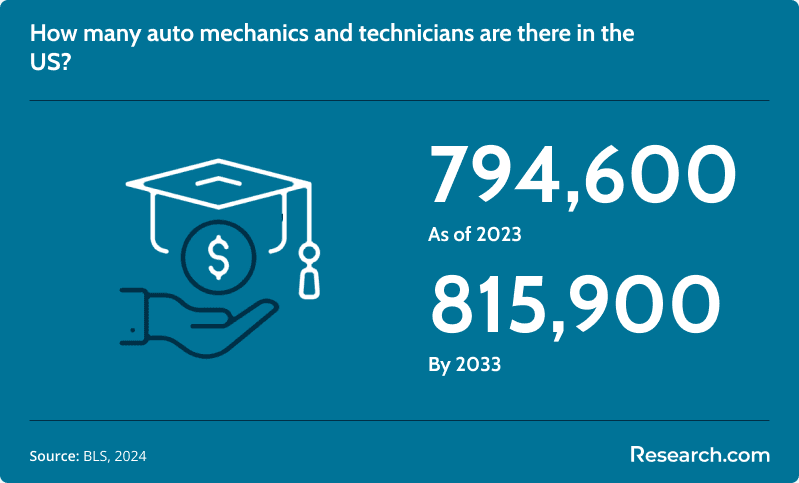
According to the BLS, employment of automotive mechanics in the United States is projected to grow by 3% from 2023 to 2033, compared with the national average of 4%. During that same period, automotive mechanic trade school graduates and other job seekers can expect around 67,800 job openings each year. This suggests steady opportunities, especially for candidates with current diagnostic skills, certifications, and hands-on training.
The sectors with the highest employment levels are automobile dealers (250,180), automotive repair and maintenance (236,770), and automotive parts and accessories (50,230). The US states employing the most mechanics are Texas (67,680), California (55,730), and Florida (46,210). As with EKG tech salary comparisons, automotive mechanic pay can shift significantly by location, industry, employer, and specialization.
What are the biggest challenges that auto mechanics commonly face?
Automotive repair can be rewarding, but it is not an easy career. Students should understand the realities of the work before enrolling so they can prepare physically, financially, and professionally.
- Physical and Environmental Strain: Mechanics may spend long hours standing, lifting parts, bending, working under vehicles, and handling oils, coolants, solvents, and other materials.
- Keeping Pace with Evolving Technology: Vehicles increasingly rely on electronics, software, computerized diagnostics, hybrid systems, and electric drivetrains, so technicians must keep learning.
- Managing Customer Expectations: Customers may not understand diagnostic time, parts costs, labor rates, or why a repair is necessary. Clear communication helps reduce conflict.
- Work-Life Balance Challenges: Some shops require evenings, weekends, overtime, or high-volume seasonal work.
- High Cost of Tools and Equipment: New technicians may need to invest in professional tools, which can be expensive early in a career.
- Parts Shortages and Supply Chain Disruptions: Delayed parts can slow repairs, frustrate customers, and make scheduling more difficult.
How can auto mechanics transition successfully into entrepreneurship?
Mechanics who want to own a shop, launch a mobile repair business, or buy into a franchise need more than technical skill. They also need pricing knowledge, customer service systems, insurance, licensing awareness, marketing, hiring practices, bookkeeping, parts management, and compliance procedures. A strong technician can struggle as an owner if the business side is ignored.
Mechanics considering entrepreneurship should first gain enough shop experience to understand workflow, customer expectations, labor estimating, warranty policies, and vendor relationships. Business education may also help. For some professionals, a 1 year masters program or other focused business training can support skills in finance, operations, and leadership.
| Entrepreneurship step | Why it matters |
| Build technical credibility first | Customers and employees are more likely to trust an owner who understands diagnostics and repair quality. |
| Study local demand | A shop focused on diesel, EVs, fleet work, or general repair should match the needs of the local market. |
| Plan startup costs carefully | Tools, lifts, insurance, rent, software, parts inventory, and staffing can require major upfront investment. |
| Create standard operating procedures | Consistent inspections, estimates, documentation, and repair approvals protect both the shop and the customer. |
| Invest in customer communication | Clear explanations, transparent pricing, and accurate timelines are essential for repeat business. |
What do graduates say about automotive mechanic trade school?
- "Trade school helped me move from working on cars as a hobby to doing it professionally. The biggest advantage was the direct path: hands-on practice, certification preparation, and employer connections without spending years in unrelated classes." – Brandon
- "My program gave me real experience with diagnostic equipment and helped me understand how vehicle systems actually work together. That made me much more confident when I started applying for shop jobs after graduation." – Jake
- "I started with basic maintenance and gradually moved into more advanced diagnostics. Fixing my first major engine problem showed me that the training was building real skill, not just classroom knowledge." – Ethan
Key Insights
- Automotive mechanic trade school is best for students who want a hands-on, career-focused path into vehicle repair, diagnostics, maintenance, or specialization.
- Tuition commonly ranges from approximately $5,000 to $30,000, but students should also budget for tools, fees, transportation, certification exams, and possible lost work time.
- Most full-time automotive mechanic programs take between 10 months and 2 years to complete, while associate and bachelor’s pathways may take longer but can support transfer, management, or advanced technical goals.
- The average annual salary of automotive mechanics is $51,940, and the median annual salary is $47,770, but pay varies by industry, state, certification, specialization, and experience.
- The highest-paying industries listed for mechanics include telecommunications ($93,120), natural gas distribution ($85,390), scientific research and development services ($81,750), electric power companies ($80,780), and aerospace product and parts manufacturing ($79,890).
- ASE certification, EPA Section 609 Certification, manufacturer-specific credentials, diesel certifications, and hybrid or EV credentials can improve a graduate’s competitiveness.
- The skills most commonly listed on mechanic resumes in the United States are customer vehicles (25.3%), customer service (7.8%), diagnosis (7%), engine tune-ups (5.5%), and oil changes (5.1%).
- Employment of automotive mechanics in the United States is projected to grow by 3% from 2023 to 2033, with around 67,800 job openings expected each year during that period.
- The best program is not always the highest-ranked or cheapest. Students should prioritize accreditation, hands-on lab quality, modern diagnostic training, employer partnerships, certification preparation, and total cost.
References:
- Automotive Training Center. Auto Mechanic Training. Automotive Training Center
- BLS (2024, April 3). 49-3023 Automotive Service Technicians and Mechanics. BLS
- BLS (2024, August 29). Automotive Service Technicians and Mechanics. BLS
- Genesis Career College. Are Trade Schools Expensive? Understanding the True Cost. Genesis Career College
- Hedges & Company (2025). How many cars are there in the US? How many vehicles in the US and other vehicle registration statistics. Hedges & Company
Other Things You Should Know About Automotive Mechanic Trade Schools
Yes. Many automotive mechanic trade schools require students to buy a basic hand-tool set before lab classes begin, and some ask for a tool inventory by the first semester. Programs often publish a required list in their syllabus, while ASE-style certification exams use separate testing fees.
Prerequisites can include a high school diploma or GED, basic math and science skills, and sometimes a valid driver's license. Some schools may also require an entrance exam or prior coursework in automotive basics. Always check specific school requirements before applying.


