
2027 Best Online Appliance Repair Trade School Programs

Co-Founder and Chief Data Scientist
Appliances are essential to modern life, but they can cause major inconvenience when they break. This creates a consistent and in-demand need for skilled appliance repair technicians—more than 55,000 people were employed in the U.S. appliance repair industry in 2024. While traditional trade schools offer hands-on training, many aspiring technicians now turn to online appliance repair programs for their flexibility and accessibility.
This article highlights the growing demand for appliance repair technicians and the benefits of online learning, such as self-paced schedules, lower costs, and the ability to train from anywhere. By providing an in-depth look at the best options, this guide empowers you to select a program that fits your learning style, career goals, and budget, setting you up for a successful career in a stable and profitable trade.
What are the benefits of getting a degree from an appliance trade school?
- A degree from an appliance trade school prepares you for roles such as appliance repair technician, allowing you to work in appliance repair services or even start your own business.
- The median salary for appliance repair technicians is around $50,661 per year. Salaries can vary depending on experience, location, and specialization, with some technicians earning higher wages of up to $43 per hour in certain industries or states.
- Obtaining an appliance trade degree online offers significant flexibility, allowing students to attend classes on their own schedule.
What can I expect from an appliance trade school degree?
An appliance trade school degree equips you with both theoretical knowledge and practical skills necessary for a career as an appliance repair technician. The program typically includes a comprehensive study of electrical and electronic principles. The curriculum covers safety regulations, electrical codes, and measuring and testing equipment to diagnose and repair faults effectively.
Many programs are structured in multiple phases over several weeks, progressively building your competence in alternating current applications, motor operations, and customer service skills.
Where can I work with an appliance trade school degree?
With an appliance trade school degree, you open the door to a wide range of career opportunities in both residential and commercial settings. Graduates can work for independent repair shops, large appliance retailers, or service departments of big-box stores that offer installation and maintenance services.
Many also find employment with property management companies, hotels, hospitals, or other organizations that rely on large-scale appliance systems. In addition, some technicians choose the entrepreneurial route by starting their own appliance repair business, offering greater independence and earning potential.
The work itself goes beyond simple fixes—it involves diagnosing complex electrical and mechanical issues, installing new appliances, and ensuring equipment runs efficiently and safely. Professionals in this field regularly service refrigerators, washers, dryers, ovens, ranges, and dishwashers, as well as commercial-grade equipment used in restaurants and healthcare facilities.
Success in the role requires not only technical expertise and problem-solving skills but also strong customer service abilities, as technicians often interact directly with clients in their homes or businesses.
How much can I make with an appliance trade school degree?
With an appliance trade school degree, your earning potential can vary based on where you work, your experience level, and whether you are self-employed or work for a service company.
In the United States, the national average salary for appliance repair technicians is around $53,000 to $63,000 per year, with entry-level technicians often starting at $30,000 to $35,000 annually and experienced professionals potentially earning between $60,000 and $75,000 or more, especially if they specialize in high-demand areas like HVAC systems or smart appliances.
- List of the Best Online Appliance Repair Trade School Programs for 2027 List of Programs
- How long does it take to complete an online appliance repair trade school program? Completion Time
- How does an online appliance repair trade school program compare to an on-campus program? How does an online appliance repair trade school program compare to an on-campus program?
- What is the average cost of an online appliance repair trade school program? Average Cost
- What are the financial aid options for students enrolling in an online appliance repair trade school program? Financial Aid
- What are the prerequisites for enrolling in an online appliance repair trade school program? Requirements
- What courses are typically in an online appliance repair trade school program? What courses are typically in an online appliance repair trade school program?
- What types of specializations are available in an online appliance repair trade school program? What types of specializations are available in an online appliance repair trade school program?
- How to choose the best online appliance repair trade school program? How to choose the best online appliance repair trade school program?
- What career paths are available for graduates of an online appliance repair trade school program? Career Paths
- What is the job market for graduates with an online appliance repair trade school degree? Job Market
- What additional certifications can enhance my career growth? What additional certifications can enhance my career growth?
- Are online appliance repair trade school programs adapting to emerging appliance technologies? Are online appliance repair trade school programs adapting to emerging appliance technologies?
Best Online Appliance Repair Trade School Programs for 2027
Choosing an appliance repair trade school is a practical career decision: you want training that teaches real troubleshooting skills, fits your schedule, and does not cost more than the credential is worth. Appliance repair can appeal to career changers, mechanically minded students, maintenance workers, and future small-business owners who want a faster path into skilled trade work than a traditional degree.
This guide compares online and hybrid appliance repair training options, explains what students typically learn, and shows how to evaluate cost, accreditation, hands-on practice, certifications, and career outcomes. It is designed to help you decide whether an online appliance repair program is enough for your goals or whether you should look for an in-person lab, apprenticeship, HVAC-R pathway, or broader maintenance technician training.
Quick answer: What is the best online appliance repair trade school program?
The best program depends on your starting point. If you need flexible, self-paced training from home, programs such as Penn Foster College, Master Samurai Tech, and Fred’s Appliance Academy may fit well. If you want more direct lab practice, programs connected to community colleges or in-person academies such as Ranken Technical College, Virginia Technical Academy, Craven Community College, Kishwaukee College, or Dyer Appliance Repair Academy may be stronger options. Before enrolling, verify accreditation, hands-on requirements, total cost, refund policies, and whether the curriculum covers electrical diagnostics, refrigeration, gas appliance safety, and modern smart appliances.
How Research.com evaluates schools and training options
Accreditation, curriculum quality, cost transparency, student support, and career relevance matter when comparing trade school programs. Research.com uses validated education and workforce data to help students make better program decisions. You can review our process on the Research.com methodology page.
Our rankings and education resources are informed by data sources commonly used to evaluate colleges, training providers, program outcomes, and student value, including:
- Integrated Postsecondary Education Data System, also known as the IPEDS database
- Peterson’s database, including its Distance Learning Licensed Data Set
- College Scorecard database
- National Center for Education Statistics
At-a-glance comparison of featured appliance repair programs
| Program | Best fit | Length | Cost | Credential or completion requirement | Accreditation or recognition listed |
| Penn Foster College Appliance Repair Program | Students who want structured, self-paced training from home | 6 months | $939 | 8 courses | Distance Education Accrediting Commission |
| Cornerstone Appliance Training Appliance Repair Program | Beginners and working technicians who want fast, practical skill-building | 3 weeks | $625 | 49 units | International Society of Certified Electronics Technicians |
| Fred’s Appliance Academy | Students looking for short, appliance-specific online training | 20 hours | $200 | Dishwasher Online Training track/concentration listed | Not stated in the provided program details |
| Master Samurai Tech Core Appliance Repair Training | New or experienced technicians who want deeper troubleshooting instruction | 80 hours | $795 | 70 units | Not stated in the provided program details |
| Dyer Appliance Repair Academy Appliance Repair Fundamentals | Students who want small-group instruction and focused practical training | Two weeks | $2,799 | Not stated in the provided program details | Not stated in the provided program details |
| Ranken Technical College Major Appliance Technology Program | Students seeking a longer technical college pathway | 2 years | $720 per credit hour | 72 credits | The Higher Learning Commission |
| Virginia Technical Academy Appliance Repair 101 Course | Students who want accelerated lab-based appliance repair training | 3 months | $170 per credit hour | 120 credits | Not stated in the provided program details |
| Craven Community College Home Appliance Repair Course | Students who prefer community college workforce training | Three weeks | $70.60 per credit hour | Not stated in the provided program details | Southern Association of Colleges and Schools Commission on Colleges |
| Kishwaukee College Appliance Repair Technician Program | Students seeking a short career-training route into entry-level work | Three months | $1,300 | Not stated in the provided program details | The Higher Learning Commission |
| Eastern West Virginia Community and Technical College Appliance Repair Technician Program | Students who want a broad trade foundation with electrical and refrigeration basics | 6 months | $2,299 | Not stated in the provided program details | The Higher Learning Commission |
1. Penn Foster College Appliance Repair Program
The Penn Foster College Appliance Repair program is built for students who need a home-based training option. The curriculum introduces diagnostic methods, troubleshooting routines, and repair concepts for common household appliances, including washers, dryers, ovens, cooktops, microwaves, dishwashers, refrigerators, and freezers.
- Program length: 6 months
- Cost: $939
- Required credits to graduate: 8 courses
- Accreditation: Distance Education Accrediting Commission
2. Cornerstone Appliance Training Appliance Repair Program
The Cornerstone Appliance Training program serves both first-time learners and technicians who want to strengthen their repair skills. Its practical approach includes guidance on finding free or low-cost appliances for practice, which can be valuable for online students who need to build hands-on confidence outside a formal lab.
- Program length: 3 weeks
- Cost: $625
- Required credits to graduate: 49 units
- Accreditation: International Society of Certified Electronics Technicians
3. Fred’s Appliance Academy
Fred’s Appliance Academy offers online appliance courses covering laundry and kitchen equipment. Training topics include top-load washers, front-load washers, electric dryers, gas dryers, dishwashers, refrigerators, gas ranges, electric ranges, and microwaves, making it a focused choice for students who want targeted instruction rather than a longer credential.
- Program length: 20 hours
- Tracks/concentrations: Dishwasher Online Training
- Cost: $200
4. Master Samurai Tech Core Appliance Repair Training
Master Samurai Tech emphasizes diagnostic thinking, appliance technology fundamentals, and systematic troubleshooting. Its core appliance repair course is positioned for both newcomers and experienced technicians who want to improve how they analyze failures rather than simply memorize part replacements.
- Program length: 80 hours
- Cost: $795
- Required credits to graduate: 70 units
5. Dyer Appliance Repair Academy Appliance Repair Fundamentals
The Dyer Appliance Repair Academy Appliance Repair Fundamentals course focuses on practical repair instruction supported by theory. Small class sizes are a key feature, which may benefit students who want more direct feedback while learning diagnostic and repair procedures.
- Program length: Two weeks
- Cost: $2,799
6. Ranken Technical College Major Appliance Technology Program
The Ranken Technical College Major Appliance Technology program provides a longer technical college route into appliance service. Students study troubleshooting and repair for gas and electric systems in major household appliances, including washers, dryers, ranges, and refrigerators. The program also covers electrical, mechanical, and refrigeration systems and the use of diagnostic test equipment.
- Program length: 2 years
- Cost per credit hour: $720
- Required credits to graduate: 72
- Accreditation: The Higher Learning Commission
7. Virginia Technical Academy Appliance Repair 101 Course
Virginia Technical Academy offers Appliance Repair 101 for students who want accelerated training with a strong hands-on component. The program uses an on-site lab with multiple appliance models, including washers, dryers, ovens, and refrigerators, and is described as an intensive 15-day course.
- Program length: 3 months
- Cost per credit hour: $170
- Required credits to graduate: 120
8. Craven Community College Home Appliance Repair Course
The Craven Community College Home Appliance Repair course trains students on major appliances such as refrigerators, dishwashers, ovens, washers, and dryers. Coursework includes electricity, electronics, gas systems, maintenance, troubleshooting, and repair techniques for household appliance service.
- Program length: Three weeks
- Cost per credit hour: $70.60
- Accreditation: Southern Association of Colleges and Schools Commission on Colleges
9. Kishwaukee College Appliance Repair Technician Program
The Kishwaukee College Appliance Repair Technician program is a fast-track option aimed at students preparing for entry-level appliance repair work. It combines appliance installation, troubleshooting, repair training, and customer service preparation.
- Program length: Three months
- Cost: $1,300
- Accreditation: The Higher Learning Commission
10. Eastern West Virginia Community and Technical College Appliance Repair Technician Program
Eastern West Virginia Community and Technical College offers an appliance repair technician pathway that covers foundational trade topics. Students study safety, hand and power tools, basic trade math, construction drawing interpretation, basic electricity, refrigeration cycle concepts, and air distribution systems.
- Program length: 6 months
- Cost: $2,299
- Accreditation: The Higher Learning Commission
How long does it take to complete an online appliance repair trade school program?
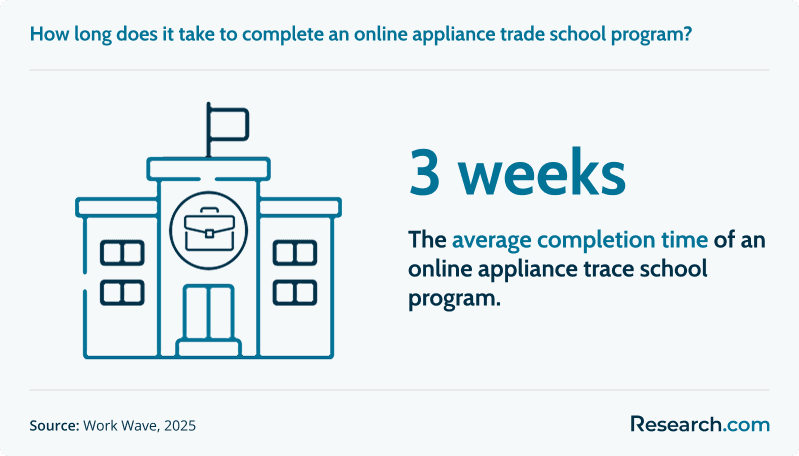
Most short appliance repair programs take anywhere from several weeks to a few months, depending on the course format, number of modules, and whether the program is self-paced or scheduled. The programs in this guide range from 20 hours to 2 years, so the right timeline depends on how much depth and hands-on training you want.
Short courses can work well if you already have mechanical experience, maintenance experience, or electrical basics. A longer program may be a better fit if you are completely new to tools, electrical systems, refrigeration, and customer-facing service work.
| Training timeline | Typical student profile | What to expect |
| 20 hours to Three weeks | Students who want targeted skill-building or a quick introduction | Focused lessons on specific appliances, safety, or troubleshooting basics |
| Three months to 6 months | Career changers who want a more complete entry-level foundation | Broader coverage of electrical systems, appliance categories, diagnostics, and customer service |
| 2 years | Students who want a technical college pathway with deeper lab and systems training | More extensive instruction in appliance technology, electrical/mechanical systems, refrigeration, and diagnostics |
Students who are deciding between appliance repair and climate-control work should also compare training requirements for becoming an HVAC technician, since HVAC-R training may involve broader systems, additional certification expectations, and different job settings.
If your long-term goal is to manage technicians, run a service company, or move into operations leadership, technical training may eventually be paired with business education such as one of the best online engineering management MBA degree programs. That is usually a later-career move, not a first step for entry-level appliance repair.
Online vs. on-campus appliance repair programs: Which format is better?
Online appliance repair programs are best for students who need schedule flexibility, live far from a training site, or want to learn theory before practicing independently. On-campus or hybrid programs are often better for students who need instructor-supervised lab practice, direct feedback, and access to multiple appliance models.
Appliance repair is hands-on work. A fully online program can teach electrical theory, diagnostic logic, parts identification, safety procedures, and repair workflows, but students still need real practice with tools and appliances. Strong online programs address this gap through demonstrations, practice assignments, instructor support, and guidance on building a home practice setup.
Students who want a broader maintenance pathway may also compare appliance repair with the cheapest maintenance technician training online, especially if they are interested in building maintenance, facilities work, or multi-skill technician roles.
| Format | Advantages | Limitations | Best for |
| Fully online | Flexible scheduling, lower travel costs, ability to study from home | Hands-on practice depends heavily on the student’s access to tools and appliances | Working adults, self-directed learners, students with prior technical experience |
| Hybrid | Combines online theory with in-person lab experience | May require travel to campus or scheduled lab dates | Students who want flexibility but still need supervised practice |
| On-campus | Direct instructor feedback, lab equipment, live troubleshooting practice | Less flexible and may involve commuting or relocation | Beginners who learn best through hands-on demonstration and immediate correction |
How much does an online appliance repair trade school program cost?
Based on the programs listed in this guide, appliance repair training can cost as little as $200 for a short online course and as much as $2,799 for a focused academy program, while longer technical college options may charge by the credit hour. Cost depends on length, delivery format, instructor access, lab resources, included materials, and whether the program is part of an accredited college.
Appliance repair training is usually less expensive than many traditional college degree paths, but students should not compare tuition alone. Ask whether the listed price includes tools, textbooks, exams, student support, retakes, lab fees, payment plans, and career services.
For context, Master Samurai Tech lists its core appliance repair training course at $795, and additional advanced courses are priced individually at about $425 each. Community college programs may appear inexpensive per credit hour but can cost more once all credits, fees, supplies, and commuting costs are included.
Students comparing trade school options may also look at other skills-based programs, such as the best online CDL training for truck drivers, because both pathways focus on job-ready technical preparation rather than a traditional four-year degree.
| Cost factor | Why it matters | Question to ask before enrolling |
| Tuition | This is only the base price and may not include required extras | Is the published price the full cost of attendance for the program? |
| Tools and equipment | Appliance repair practice often requires meters, hand tools, and access to machines | What tools must I buy separately? |
| Certification exams | Some credentials or exams may carry separate fees | Are certification exam fees included in tuition? |
| Hands-on practice | Online students may need to supply their own appliances or attend labs | How does the program help students gain real repair experience? |
| Refund and cancellation rules | Short trade programs may have strict refund windows | What happens if I withdraw after the first module or first week? |
Financial aid options for appliance repair trade school students
Financial aid availability depends on the school, accreditation status, program length, and whether the training is eligible for federal student aid. Some short private courses may not qualify for federal aid, while eligible college-based programs may offer more options. Students should confirm aid eligibility directly with the school’s financial aid office before enrolling.
Students comparing other skilled-trade routes can also review options such as the cheapest welding programs online, since welding, appliance repair, HVAC, and maintenance training may have different funding sources and employer reimbursement opportunities.
- Pell Grants: These need-based federal grants do not have to be repaid, but they are generally available only for eligible students in eligible programs.
- Federal Supplemental Educational Opportunity Grants (FSEOG): These grants are intended for students with exceptional financial need and are available through participating schools.
- Federal student loans: These government loans must be repaid, but they may offer borrower protections and repayment options that private loans do not.
- Trade-specific scholarships: Some trade associations, employers, foundations, and private companies support students entering skilled trades, including appliance service and maintenance fields.
- Workforce grants: State and local workforce development agencies may fund training for occupations needed in the local labor market.
- Employer reimbursement: If you already work in maintenance, facilities, property management, or retail appliance service, ask whether your employer will pay for approved training.
- Payment plans: Some private academies and online schools let students spread tuition across installments, but you should compare the total cost before agreeing.
Admission requirements for online appliance repair trade school programs
Most appliance repair trade school programs are accessible to beginners. Common requirements include a high school diploma or GED, basic reading and math skills, internet access for online coursework, and the physical ability to use tools safely. Some schools may require students to be at least 18 years old.
If you are not sure whether appliance repair is the right trade, compare it with affordable maintenance technician programs online, which may cover a wider range of building systems and repair responsibilities.
- Academic background: Many programs expect a high school diploma or GED, especially if the training is offered through a college.
- Prior experience: Most entry-level appliance repair programs do not require previous repair experience.
- Technology access: Online students need a reliable computer, stable internet connection, and the ability to stream videos, submit assignments, and communicate with instructors.
- Basic tool readiness: Even in online programs, students may need hand tools, a multimeter, safety gear, and access to practice appliances.
- State and local rules: Some work involving gas appliances, refrigerants, or contractor services may be regulated. Requirements vary, so check rules in your state before choosing a program.
What do students learn in an online appliance repair program?
Appliance repair programs typically begin with safety, tools, electricity, and diagnostic thinking before moving into individual appliance categories. The best programs teach students how systems work, how to test components, and how to explain repair options to customers.
Students who are comparing multiple career-focused online training routes may also review the best online freight broker trade school programs. Freight brokerage is a different career path, but it can be useful to compare training length, startup costs, and whether you prefer technical fieldwork or logistics/customer coordination.
- Introduction to appliance service: Students learn industry basics, repair workflows, essential tools, jobsite safety, electrical safety, lockout/tagout concepts, and customer communication.
- Electrical fundamentals: Coursework usually covers voltage, current, resistance, circuits, wiring diagrams, and multimeter use.
- Gas appliance systems and safety: Students may study gas valves, burners, ignition systems, leak detection, propane, natural gas, and safe handling practices.
- Refrigeration and sealed systems: This area covers the refrigeration cycle, compressors, evaporators, condensers, refrigerants, leak detection, and related safety concepts.
- Laundry appliances: Students learn how washers and dryers operate and how to diagnose problems involving motors, belts, pumps, heating elements, sensors, and electronic controls.
- Cooking appliances: Training may include electric ranges, gas ranges, ovens, cooktops, heating elements, igniters, thermostats, and control boards.
- Dishwashers and kitchen appliances: Students may study water supply, drainage, pumps, heating elements, spray systems, and electronic fault codes.
- Customer service and business basics: Strong technicians also need to write estimates, communicate clearly, document repairs, manage appointments, and handle dissatisfied customers professionally.
Appliance repair specializations to consider
Most appliance repair trade school programs are broad rather than highly specialized. However, students can build career value by choosing courses or certifications that deepen expertise in refrigeration, commercial equipment, smart appliances, or HVAC-R.
If your interests are outside mechanical and technical service work, compare appliance repair with other career-focused online credentials. For example, students interested in healthcare leadership may be better served by the best online graduate certificate nurse administrator programs instead of a repair trade program.
Students interested in climate systems should also understand HVAC-R, which stands for heating, ventilation, air conditioning, and refrigeration. HVAC-R overlaps with appliance repair in refrigeration and electrical diagnostics but can involve different equipment, regulations, and job sites.
| Specialization | What it covers | Who should consider it |
| Refrigeration and sealed systems | Refrigeration cycle, compressors, refrigerants, condensers, evaporators, and leak detection | Students who want to repair refrigerators, freezers, and related cooling systems |
| Commercial appliance repair | Commercial ovens, walk-in freezers, restaurant equipment, higher-voltage systems, and more complex gas lines | Technicians who want business clients, restaurant work, or higher-complexity service calls |
| HVAC-R | Furnaces, air conditioners, refrigeration equipment, ventilation systems, and climate-control diagnostics | Students who want a broader technical trade beyond home appliances |
| Smart appliance diagnostics | Connected appliances, error codes, sensors, control boards, and digital troubleshooting tools | Technicians who want to work on newer appliance models and electronic control systems |
How to choose the right online appliance repair trade school program
The right program should match your learning style, career goal, budget, and local job market. Do not choose only because a program is short or inexpensive. Appliance repair requires confidence with electricity, mechanical systems, customer service, and real-world troubleshooting, so the training must go beyond basic videos.
Use this checklist before enrolling
- Verify accreditation and recognition: Confirm whether the school itself is accredited, whether the program is approved by an industry group, and whether that matters to employers in your area.
- Review the curriculum in detail: Look for electricity, wiring diagrams, multimeter use, refrigeration, gas appliance safety, laundry appliances, cooking appliances, dishwashers, and smart appliance diagnostics.
- Ask about hands-on practice: Find out whether the school provides labs, simulations, practice assignments, tool lists, or guidance for working on used appliances safely.
- Check instructor support: Strong programs give students a way to ask technical questions, receive feedback, and troubleshoot mistakes.
- Compare total cost: Include tuition, tools, supplies, books, certification exams, travel, and lost work time.
- Confirm certification preparation: If you plan to handle refrigerants, ask whether the program prepares students for EPA Section 608. Also ask about NASTeC or other industry-recognized credentials if relevant.
- Evaluate career services: Resume help, employer connections, job boards, interview coaching, and business startup guidance can matter, especially for beginners.
- Read student feedback carefully: Look for comments about instructor access, hands-on readiness, course organization, and whether graduates felt prepared for first jobs.
Students who want a related but broader technical path can also compare appliance repair with affordable online HVAC trade schools, especially if they want to service heating, cooling, and refrigeration systems in addition to household appliances.
Common mistakes to avoid
| Mistake | Why it can hurt you | Better approach |
| Choosing the cheapest program without checking content | A low-cost course may not cover enough diagnostics, safety, or appliance categories | Compare curriculum, instructor support, and hands-on practice before comparing price |
| Assuming online training automatically creates job-ready skills | Repair work requires practice with tools, meters, parts, and real appliance failures | Build a practice plan using used appliances, labs, mentorship, or supervised workshops |
| Ignoring accreditation | Some employers, financial aid programs, or transfer pathways may care about institutional accreditation | Verify accreditation directly with the accreditor and the school |
| Overlooking local rules | Gas work, refrigerant handling, and contractor activity may involve regulations | Check state and local requirements before enrolling |
| Focusing only on repair skills | Technicians also need customer service, scheduling, estimating, and documentation skills | Choose training that includes service professionalism or business basics |
| Assuming salary outcomes are guaranteed | Pay depends on location, employer, experience, specialization, and workload | Use salary data as a guide, then research local employers and job postings |
Career paths after an online appliance repair trade school program
Graduates can pursue entry-level appliance service roles, independent repair work, warranty service, maintenance jobs, or further training in HVAC-R and electrical systems. The most direct route is usually a residential appliance repair technician role, but advancement depends on technical skill, customer trust, certifications, and experience.
The U.S. Bureau of Labor Statistics classifies this occupation under appliance repair technicians, also known as home appliance repairers. These workers diagnose, repair, install, and service household appliances and related equipment.
| Career path | Typical work | How to prepare |
| Residential appliance repair technician | Repair washers, dryers, ovens, refrigerators, dishwashers, and microwaves in homes | Build diagnostic skills, learn customer service, and practice on common appliance models |
| Commercial appliance technician | Service equipment in restaurants, hotels, institutions, and commercial kitchens | Add commercial equipment training, refrigeration knowledge, and safety preparation |
| Warranty service technician | Perform repairs for manufacturers, retailers, or authorized service networks | Learn brand-specific procedures, documentation standards, and parts systems |
| Maintenance technician | Handle appliance, building, and facilities repairs for apartments, campuses, or businesses | Combine appliance repair with plumbing, electrical, HVAC, and general maintenance skills |
| HVAC technician | Service heating, cooling, ventilation, and refrigeration systems | Pursue HVAC-R training and certifications beyond basic appliance repair |
| Field service manager or service supervisor | Manage technicians, scheduling, quality control, and customer escalations | Gain field experience, leadership skills, and service operations knowledge |
| Appliance repair business owner | Run an independent repair company serving residential or commercial clients | Develop technical expertise, pricing knowledge, licensing awareness, marketing, and bookkeeping skills |
Job market and salary outlook for appliance repair trade school graduates
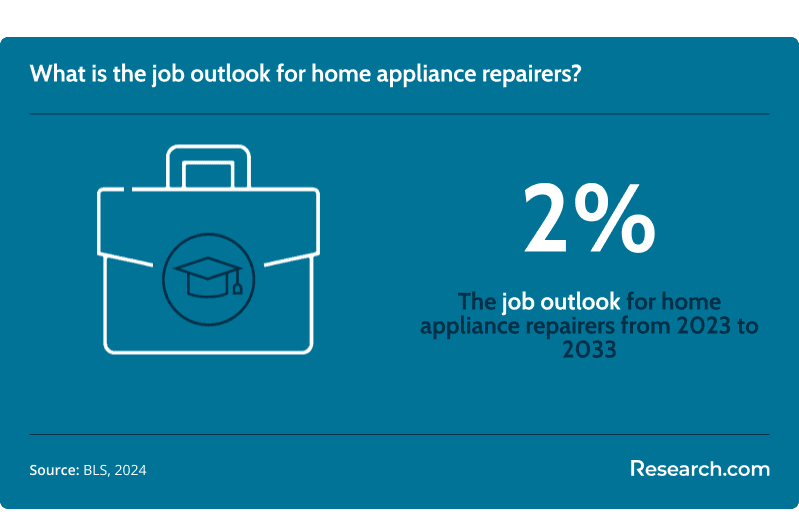
Appliance repair work remains tied to consumer demand for maintaining refrigerators, washers, dryers, ovens, dishwashers, and other household equipment. Demand can vary by region, employer type, housing patterns, appliance age, and whether consumers choose repair instead of replacement.
The U.S. Bureau of Labor Statistics reports an average annual salary range of approximately $42,000 to $52,000 for appliance repair technicians. Entry-level salaries are around $30,000 to $35,000, while experienced technicians can earn upward of $60,000 to $75,000. These figures should be treated as general benchmarks, not guaranteed outcomes.
Pay may be higher in states such as California, Texas, and Virginia, where large populations and appliance usage can support more service demand. Technicians who add HVAC, refrigeration, gas appliance, or smart appliance skills may have stronger opportunities than technicians with only basic repair training.
Some students compare appliance repair earnings with related trades such as electrical work. If that is part of your decision, review an electrician salary and career path guide to compare training length, licensing requirements, and long-term advancement.
How AI and smart appliances are changing the trade
Appliance repair is becoming more diagnostic and technology-driven. Modern appliances may include sensors, control boards, software-driven fault codes, connected features, and energy-efficient components. This does not remove the need for technicians; it changes the skill set. The strongest technicians understand both mechanical systems and electronic diagnostics.
When comparing programs, ask whether the curriculum includes control boards, digital error codes, wiring diagrams, multimeter testing, connected appliance troubleshooting, and updated safety practices. A program that teaches only older mechanical systems may leave graduates underprepared for newer service calls.
Additional certifications that can support appliance repair career growth
Additional certifications can help technicians demonstrate specialized knowledge, especially in refrigeration, electronics, HVAC-R, and advanced diagnostics. A trade school certificate or diploma may help you get started, but industry-recognized credentials can strengthen your resume, support employer trust, and help you qualify for more technical service work.
Useful certification areas may include EPA Section 608 for refrigerant handling, NASTeC, HVAC Excellence, NATE, electronics troubleshooting credentials, and manufacturer-specific training. Availability and importance vary by employer and location, so review local job postings before paying for extra credentials.
If your main goal is to find a shorter career credential with strong income potential, compare appliance repair certifications with the best certificate programs that pay well. The strongest option is the one that fits your local job market, budget, and preferred work environment.
Are appliance repair programs keeping up with new appliance technologies?
Many training providers are updating lessons to include smart appliances, IoT-connected systems, electronic controls, energy-efficient designs, and digital diagnostic tools. Students should not assume every program is current, however. Before enrolling, ask when the curriculum was last revised and whether lessons include newer appliance models, electronic fault codes, control boards, and connected-device troubleshooting.
Cost also matters. Students who need federal aid or lower-cost college options can compare eligible schools and affordability resources such as cheapest online college options that accept FAFSA, while remembering that not every short trade course qualifies for federal aid.
Questions to ask before choosing an appliance repair trade school
- Is the school accredited, and does that accreditation apply to this specific program?
- Does the program include hands-on practice, labs, simulations, or tool-based assignments?
- Will I learn multimeter use, wiring diagrams, electrical safety, gas appliance safety, and refrigeration basics?
- Does the curriculum cover modern smart appliances and electronic control boards?
- Are tools, books, exams, software, and lab fees included in the advertised cost?
- Does the program prepare students for EPA Section 608 or other certifications relevant to my goals?
- What support is available if I get stuck on a technical concept?
- Does the school offer job placement help, employer connections, or business startup guidance?
- What are the refund rules if the program is not a good fit?
- What do local employers say they want from entry-level appliance repair technicians?
What graduates say about online appliance repair trade school programs
- Jesse: "Online training let me move into a new line of work without quitting my job. I could study around my schedule, avoid taking on a major financial burden, and build the confidence to start taking repair calls on my own."
- Tim: "I was not sure a hands-on trade could be taught online, but the demonstrations and step-by-step troubleshooting lessons made the electrical concepts much easier to understand. Fixing my first appliance after the course proved that the training had translated into real skill."
- Kelvin: "As a parent, the self-paced format made all the difference. I studied after my kids were asleep and moved through the material without feeling rushed. The training helped me build a career that gives me more control over my time."
Key Insights
- Online appliance repair trade school can be a good fit for self-motivated students, career changers, and working adults, but hands-on practice is still essential.
- The programs in this guide range from 20 hours to 2 years, with listed costs ranging from $200 to $2,799 for short programs and $720 per credit hour for one longer technical college option.
- Do not judge a program by tuition alone. Check accreditation, tool costs, lab access, instructor support, certification preparation, refund policies, and total cost.
- Students who want broader opportunities should compare appliance repair with HVAC-R, maintenance technician, electrical, welding, CDL, and other trade pathways before enrolling.
- Modern appliance repair increasingly requires electronic diagnostics, smart appliance knowledge, wiring diagram literacy, and comfort using digital troubleshooting tools.
- Salary outcomes vary by location, experience, specialization, employer, and business model. Use BLS and local job postings to evaluate realistic opportunities in your area.
- The best program is the one that matches your goal: quick skill-building, entry-level employment, commercial service work, HVAC-R expansion, or future business ownership.
References:
- Career One Stop. (2022). Home Appliance Repairers. Occupational Profile. Retrieved June 11, 2025, from https://www.careeronestop.org/Toolkit/Careers/Occupations/occupation-profile.aspx?keyword=Home%20Appliance%20Repairers&location=UNITED%20STATES&onetcode=49903100
- U.S. Bureau of Labor Statistics. (2024). Home Appliance Repairers [Interactive data]. May 2024 OEWS Profiles, Occupational Employment and Wage Statistics (OEWS) Profiles. Retrieved June 11, 2025, from https://data.bls.gov/oesprofile
- U.S. Bureau of Labor Statistics. (2025a, April 18). Occupational projections, 2023–33, and worker characteristics, 2023 (Numbers in thousands). Employment Projections. https://www.bls.gov/emp/tables/occupational-projections-and-characteristics.htm
- U.S. Bureau of Labor Statistics. (2025b, April 18). Installation, Maintenance, and Repair Occupations. Occupational Outlook Handbook. https://www.bls.gov/ooh/installation-maintenance-and-repair
Other Things You Should Know About the Best Online Appliance Repair Trade School Programs
To choose the best online appliance repair trade school in 2027, consider accreditation, program flexibility, hands-on training opportunities, instructor qualifications, and student reviews. Compare curriculum offerings to ensure comprehensive coverage of repair skills and technology updates.
Online appliance repair trade school programs in 2027 offer flexibility to learn at your own pace, making it easier to balance with other commitments. They are often more affordable than in-person options, saving on commute costs and materials. Additionally, they provide access to a wide range of resources and industry-relevant coursework.
Yes, you can complete appliance repair training at your own pace online. Many online appliance repair trade school programs offer self-paced courses designed to fit around your schedule, allowing you the flexibility to learn when it suits you best.
These programs typically include a combination of video tutorials, readings, quizzes, and practice exams that you can access anytime, enabling you to progress through the material as quickly or slowly as you need.


