
2027 Best Online Engineering Management MBA Degree Programs

Co-Founder and Chief Data Scientist
As a dedicated career planning and education expert, I understand your interest in the best online Engineering Management MBA degree programs in the USA. Finding precise and reliable information for such a significant educational investment can be incredibly complex.
Many prospective students encounter a maze of conflicting data, outdated program details, and overwhelming choices, making it challenging to discern truly valuable opportunities.
This guide is crafted to cut through that complexity, offering clear, concise, and accurate insights. My goal is to empower you with the knowledge needed to confidently select a program that aligns perfectly with your professional ambitions and educational needs, ensuring a strategic step forward in your career.
What are the benefits of getting an online Engineering Management MBA degree?
- Career Advancement: Prepares you for technical leadership roles like Engineering Manager, Director of Engineering, and Technical Program Manager.
- Earning Potential: Median base salaries for engineering managers with an MBA or master’s degree range from approximately $152,000–$160,000 annually.
- Flexible Learning: Fully online formats—including labs and recorded classes—allow you to continue working while studying.
What can I expect from an online Engineering Management MBA Degree program?
- Blended Curriculum: Combines core business courses (e.g., finance, leadership) with engineering-focused topics like quality control, logistics, and project management.
- Asynchronous & Synchronous Delivery: Includes recorded lectures, live sessions, case studies, and team projects.
- Applied Leadership Skills: Emphasis on real-world problem solving, data-driven decisions, and strategic planning.
- Accelerated Path: Most programs can be completed within 12–18 months for fast career progression.
- Professional Network: Connect virtually with peers and faculty across engineering disciplines and industries.
Where can graduates of an online Engineering Management MBA degree work?
- Engineering Firms: Lead projects and cross-functional teams in sectors like software, aerospace, and manufacturing.
- Technology Companies: Manage engineering teams in R&D and product development environments.
- Construction & Infrastructure: Oversight of large-scale projects, budget planning, and regulatory compliance.
- Scientific R&D: Leadership roles in high-innovation environments like biotech or advanced manufacturing.
- Consulting & Enterprise: Technical strategy and operations roles in consulting firms and enterprise settings.
How much can you make with an online Engineering Management MBA degree?
- Entry or Junior Manager: Expect base compensation around $147,000–$150,000 annually
- Experienced Engineering Manager: Median salaries range from $150,000–$165,000, depending on specialization and location
- Senior or Director-Level: Directors of engineering can earn between $197,000 and $235,000+ base, plus bonuses and equity
- Top-Tier Remote Tech Roles: Remote engineering managers report salaries between $200,000–$225,000+, with additional cash compensation
- Best Online Engineering Management MBA Degree Programs for 2027 List of Programs
- What is the average cost of an online engineering management MBA degree? Program Cost
- What are the financial aid options for an online engineering management MBA degree? Financial Aid
- What are the prerequisites for enrolling in an online engineering management MBA program? What are the prerequisites for enrolling in an online engineering management MBA program?
- What courses are typically in an online engineering management MBA program? What courses are typically in an online engineering management MBA program?
- What types of specializations are available for engineering management MBA graduates? Specializations
- How do you choose the best online engineering management MBA program? How do you choose the best online engineering management MBA program?
- What career paths are available for graduates of online engineering management MBA programs? Career Paths
- How much can I earn with an online engineering management MBA degree? Salary
- What is the job market like for graduates of an online engineering management MBA degree? Job Outlook
- What are some current and future trends in engineering management? What are some current and future trends in engineering management?
- What accreditation and quality certifications should I consider? What accreditation and quality certifications should I consider?
- What is the return on investment for an online engineering management MBA degree? What is the return on investment for an online engineering management MBA degree?
- What career services and networking support are available? What career services and networking support are available?
Best Online Engineering Management MBA Degree Programs for 2027
Choosing an online engineering management MBA is not the same as choosing a general MBA. You are looking for a program that can help you move from technical execution into leadership, project ownership, operations strategy, product development, or executive decision-making in engineering-driven organizations. The right program should strengthen your business judgment without treating your engineering background as an afterthought.
This guide is for engineers, technologists, project leads, manufacturing professionals, construction managers, systems specialists, and STEM-trained professionals who want a graduate business or management credential that fits a technical career path. Below, you will find ranked program options, cost and financial aid considerations, admissions expectations, common courses, career outcomes, salary data, market trends, and practical steps for comparing programs before you apply.
Quick answer: Is an online engineering management MBA worth considering?
An online engineering management MBA can be a strong option if you already have technical experience and want to lead teams, manage budgets, oversee complex projects, or move into product, operations, or executive roles. It is usually most valuable for professionals who want a business credential with engineering-relevant coursework instead of a purely technical master’s degree. However, applicants should compare MBA, MEM, and MSEM programs carefully because some programs in this field are business-first, while others are engineering-first.
| Program type | Best fit | Typical focus | Decision point |
| Engineering Management MBA | Engineers and technical professionals seeking business leadership roles | Finance, strategy, operations, leadership, and engineering management | Choose this if you want broader business mobility while staying connected to technical industries. |
| Master of Engineering Management | Professionals who want a STEM-oriented management degree | Engineering economics, systems, data, project leadership, and operations | Choose this if you want management training but prefer a technical graduate degree rather than an MBA. |
| Master of Science in Engineering Management | Engineers, scientists, and technologists who want applied management skills | Quantitative decision-making, quality systems, systems engineering, and project management | Choose this if your target roles require deeper technical management preparation. |
How do we rank schools?
Because graduate education can require a major investment of time and money, Research.com evaluates programs using transparent data and a structured ranking methodology. Sources considered in our process include:
- IPEDS
- Peterson's, including its Distance Learning Licensed Data Set
- College Scorecard
- National Center for Education Statistics
The programs below include online MBA, concurrent MBA/MS, MEM, and MSEM options related to engineering management. Review each program’s degree title, accreditation, admissions rules, and curriculum before deciding whether it matches your career goals.
Program comparison at a glance
| Rank | School | Program length | Credits | Tuition information | Accreditation listed |
| 1 | Arizona State University | Typically 2.5–3 years | Not specified; MBA and MSIE shared credits may reduce total | $12,414/calendar year; for both AZ residents and non-residents | MBA—AACSB; MS in Industrial Engineering—ABET |
| 2 | Kennesaw State University | 1-2 years | 30 credits | Resident: $361.00/credit hour; Non-resident: $1,361.00/credit hour | SACSCOC |
| 3 | Henderson State University | As few as 14 months | 33 credits | $12,837 total tuition | AACSB |
| 4 | National University | Varies; typically 18-24 months with accelerated four-week courses | 58.5 quarter units | $515 per quarter unit | WSCUC |
| 5 | Southern New Hampshire University | 15 months | 30 credits | $659/credit; active-duty military and spouses: $470/credit | NECHE |
| 6 | St. Cloud State University | 12-24 months | 30 credits | $596.15/credit | AACSB |
| 7 | St. Thomas University | 12 months | 30 credits | $1,350.00/credit | HLC |
| 8 | Trine University | Approximately 12 months | 30 credits | $575 per credit | HLC |
| 9 | University of Nebraska–Lincoln | Typically 1.5–3 years | 30 credits | $675/credit | AACSB |
| 10 | University of Southern Indiana | 12 months | 30 credits | $13,950 total tuition | AACSB |
1. Arizona State University
Arizona State University offers an online concurrent MBA and MS in Industrial Engineering for professionals who want both business leadership preparation and advanced technical training. The program is designed for working adults with at least one year of experience and can help engineers build the management, finance, marketing, analytics, and leadership knowledge needed to guide technical teams.
The MBA side includes courses such as supply chain management, statistics, financial accounting, and strategic management, with a capstone project. The industrial engineering portion addresses production systems, information systems, reliability engineering, logistics, operations research, and applied systems improvement. Students who want to work at the intersection of business strategy and industrial optimization may find this dual-degree structure especially relevant.
Graduates may apply the training in industries such as finance, transportation, healthcare, aerospace, consulting, and IT. The program draws on faculty from the W. P. Carey School of Business and the Ira A. Fulton Schools of Engineering.
- Program Length: Typically 2.5–3 years; varies depending on course load
- Tracks/Concentrations: Information systems and management systems; Operations research and production systems; Logistics/supply chain; Quality and reliability
- Tuition Cost: $12,414/calendar year; for both AZ residents and non-residents
- Required Credits to Graduate: Not specified; MBA and MSIE shared credits may reduce total
- Accreditation: Master of Business Administration—Association to Advance Collegiate Schools of Business (AACSB); Master of Science in Industrial Engineering—Accreditation Board for Engineering and Technology (ABET)
2. Kennesaw State University
Kennesaw State University provides a fully online Master of Science in Engineering Management that may appeal to professionals who want an alternative to a conventional MBA. The program is offered through collaboration between the Southern Polytechnic College of Engineering and Engineering Technology and the Coles College of Business.
The curriculum blends engineering, management, and business concepts with a quantitative orientation. Students study topics such as engineering statistics, quality systems, Six Sigma, database and information systems engineering, project management, engineering communication, leadership, and law.
This program is a practical fit for engineers and science-related professionals who want to remain in technical environments while taking on broader management responsibility.
- Program Length: 1-2 years
- Tracks/Concentrations: Engineering Management concentration; electives within MBA
- Tuition Cost: Resident: $361.00/credit hour; Non-resident: $1,361.00/credit hour
- Required Credits to Graduate: 30 credits
- Accreditation: Southern Association of Colleges and Schools Commission on Colleges (SACSCOC)
3. Henderson State University
Henderson State University offers a 100% online MBA with a concentration in Engineering Management. The program combines general business coursework with engineering management topics tied to logistics, supply chain management, quality control, improvement, leadership, and analytics.
Students can complete the degree in as few as 14 months through 7-week courses and multiple start dates. Coursework includes economic analysis for managerial decisions, strategic information systems, and marketing management. The degree also includes online graduate certificates in Project Management and Supply Chain Management, allowing students to earn three credentials through one program pathway.
The program is designed for professionals interested in manufacturing, construction, technology, production, operations, consulting, or executive leadership roles.
- Program Length: As few as 14 months
- Tracks/Concentrations: Engineering Management specialization within MBA
- Tuition Cost: $12,837 total tuition
- Required Credits to Graduate: 33 credits
- Accreditation: Association to Advance Collegiate Schools of Business (AACSB)
4. National University
National University offers an online Master of Science in Engineering Management for engineers, scientists, and technologists who want to build management capability on top of a technical background. Compared with a general MBA, the program emphasizes applied business perspectives for engineering management.
Students can pursue specializations in Project Management or Systems Engineering. The curriculum includes engineering management, project management, operations and supply chain management, quality engineering, advanced engineering economics, and global economic and technological trends.
The program draws from applied sciences, economics, business, and social sciences, making it suitable for professionals who need to manage technical work in public or private organizations.
- Program Length: Varies; typically 18-24 months with accelerated four-week courses
- Tracks/Concentrations: Project Management; Systems Engineering
- Tuition Cost: $515 per quarter unit
- Required Credits to Graduate: 58.5 quarter units
- Accreditation: WASC Senior College and University Commission (WSCUC)
5. Southern New Hampshire University
Southern New Hampshire University offers an online MBA in Engineering Management that combines business fundamentals with engineering-focused coursework. The engineering management courses are developed and taught by Worcester Polytechnic Institute faculty.
Students study business areas such as finance, project management, technology, strategy, and organizational leadership while also examining systems thinking and systems engineering practices. The program is structured for professionals who need to make business decisions in technical workplaces and improve organizational performance through practical engineering management methods.
The accelerated pacing allows students taking two courses per term to finish in 15 months.
- Program Length: 15 months; accelerated pacing, two courses per term
- Tracks/Concentrations: Engineering Management concentration; includes 3 engineering courses taught by WPI faculty
- Tuition Cost: $659/credit; same for all students; Active-duty military and spouses: $470/credit
- Required Credits to Graduate: 30 credits
- Accreditation: New England Commission of Higher Education (NECHE)
6. St. Cloud State University
St. Cloud State University offers a Master of Engineering Management for graduates from engineering, business, science, technology, and mathematics backgrounds. It is positioned as a STEM-focused alternative to a traditional MBA for professionals aiming for technical leadership roles.
The curriculum covers operations management, engineering data analytics, Six Sigma, engineering economy, supply chain management, project management, communication, and problem-solving. Students may also benefit from coursework connected to industry projects, as faculty work with local companies.
The program has served a diverse student population and includes an optional summer industry tour to Japan. Potential career paths include project manager, product manager, operations manager, and quality engineer.
- Program Length: 12-24 months
- Tracks/Concentrations: Engineering Management specialization within MBA
- Tuition Cost: $596.15/credit
- Required Credits to Graduate: 30 credits
- Accreditation: Association to Advance Collegiate Schools of Business (AACSB)
7. St. Thomas University (Florida)
St. Thomas University offers an online Master of Science in Engineering Management for professionals who want to combine engineering knowledge with leadership and management preparation. The program emphasizes real-world application and industry-informed instruction.
Students can pursue STEM-approved concentrations such as project management, systems engineering, and data analytics. These options allow students to align their coursework with the technical leadership areas most relevant to their work or career plans.
The admissions process typically requires a bachelor’s degree from an accredited institution and a minimum GPA, with no GRE or GMAT scores required.
- Program Length: 12 months; accelerated option
- Tracks/Concentrations: Engineering Management concentration within MBA
- Tuition Cost: $1,350.00/credit
- Required Credits to Graduate: 30 credits
- Accreditation: Higher Learning Commission (HLC)
8. Trine University
Trine University offers an online Master of Science in Engineering Management for engineers and technical professionals preparing for management responsibilities. The program addresses corporate culture, leadership, finance, operations strategy, marketing, ethics, communication, and decision-making for technical professionals.
Students also study new product development and innovation through business and engineering faculty. The program is fully online, and new classes begin every eight weeks, giving students flexibility to complete the degree quickly or at a slower pace.
Core coursework includes executive communication, statistics, project management, organizational leadership for engineers, and an engineering management capstone. Students may choose Systems Engineering, Operational Excellence, or a self-designed focus using electives such as Lean Six Sigma, advanced plant management, and systems engineering analysis.
- Program Length: Approximately 12 months; accelerated
- Tracks/Concentrations: Engineering Management concentration within MBA
- Tuition Cost: $575 per credit; all students
- Required Credits to Graduate: 30 credits
- Accreditation: Higher Learning Commission (HLC)
9. University of Nebraska–Lincoln
The University of Nebraska–Lincoln offers a fully online Master of Engineering Management through collaboration between the College of Engineering and Nebraska's MBA program. The degree is practice-oriented and designed to help engineers develop business judgment for leadership in changing technical environments.
The program includes four core courses in leadership, decision-making, engineering economics, and strategic planning in technology. Students then select six electives and may take up to three from the MBA curriculum. Elective topics include project management, engineering leadership, financial accounting, and supply chain strategy.
The program’s ASEM certification allows graduates to be exempt from testing to become a Certified Associate Engineering Manager (CAEM®). It has also been recognized for "Excellence in Engineering for Veterans." Students seeking a shorter option may consider the Graduate Certificate in Engineering Management.
- Program Length: Typically 1.5–3 years; self-paced
- Tracks/Concentrations: Engineering Management specialization; customizable electives
- Tuition Cost: $675/credit; uniform for all students
- Required Credits to Graduate: 30 credits
- Accreditation: Association to Advance Collegiate Schools of Business (AACSB)
10. University of Southern Indiana
The University of Southern Indiana offers an online MBA with a concentration in Engineering Management. The program is designed for working engineers who want to move into management roles in technology, manufacturing, construction, research and development, industrial management, or related technical sectors.
Students study project management, quality control, supply chain distribution, leadership, data analytics, economic analysis, information systems, marketing, and operational efficiency. The program uses accelerated courses and multiple start dates to support working professionals.
Graduates may apply the degree to roles such as engineering manager, architectural manager, industrial manager, director of operations, or business consultant.
- Program Length: 12 months; accelerated option
- Tracks/Concentrations: Engineering Management concentration within MBA
- Tuition Cost: $13,950 total tuition
- Required Credits to Graduate: 30 credits
- Accreditation: Association to Advance Collegiate Schools of Business (AACSB)
If you are still deciding whether you want an engineering management MBA, a technical master’s degree, or another engineering pathway, you can also compare broader online engineering degree options.
What is the average cost of an online engineering management MBA degree?
Online engineering management MBA and related graduate management programs vary widely in price. Your total cost depends on the institution, number of credits, term structure, residency status, fees, transfer or shared-credit policies, and whether your employer helps pay tuition. Some engineering management programs may cost more than the typical online MBA program cost range, especially when offered as a dual degree or through a high-priced private institution.
- Total Program Tuition: The overall cost for an online Engineering Management MBA can range from approximately $14,000 to over $149,000.
- Cost Per Credit Hour: Some universities list tuition on a per-credit basis, which can range from around $500 to over $1,900 per credit.
- Program Length Impact: Shorter, accelerated programs might have a higher per-credit cost but a lower overall total due to fewer required credits.
- Public vs. Private Institutions: Public universities often offer lower tuition rates, especially for in-state residents, compared to private institutions.
| Cost factor | Why it matters | Question to ask before enrolling |
| Tuition structure | Programs may charge by credit, quarter unit, calendar year, or total program tuition. | Is the posted tuition the full program cost or only the instructional charge? |
| Fees | Technology, graduation, course, or distance-learning fees can increase the real cost. | Which mandatory fees are not included in the tuition estimate? |
| Credit requirements | A lower per-credit price may not mean a lower total cost if the program requires more credits. | How many credits or quarter units are required, and are any credits shared or transferable? |
| Time to completion | Longer programs can delay career benefits and may add indirect costs. | Can I realistically finish on the advertised schedule while working? |
| Employer support | Tuition assistance can substantially change the return on investment. | Does my employer reimburse graduate business or engineering management coursework? |
Cost should be evaluated against career fit rather than treated as a stand-alone number. A less expensive program may be the better choice if it has the right accreditation, curriculum, and flexibility. A higher-priced program may still be reasonable if it offers a dual degree, strong technical specialization, or employer-recognized brand value.
Engineering management programs are often tied to sectors such as construction, manufacturing, infrastructure, and technology. The U.S. construction industry, shown in the graphic below, experienced a 10% rise in nominal value added and a 12% increase in gross output, with spending surpassing US$2 trillion in the first half of 2024. Employment hit 8.3 million in July, exceeding its 2006 peak of 7.7 million and sustaining steady growth despite ongoing labor shortages.
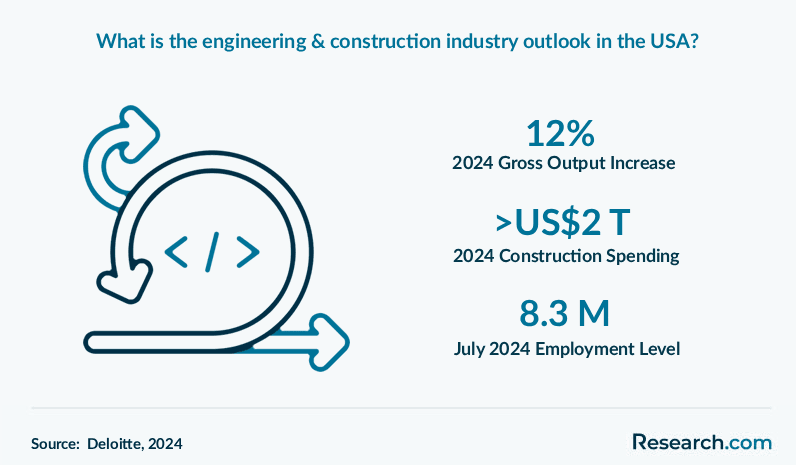
Looking to 2025, the industry is expected to benefit from a 50 basis point interest rate cut by the Federal Reserve in September 2024, likely boosting residential construction demand. Continued funding through the IIJA, IRA, and the CHIPS and Science Act should further stimulate activity, particularly in manufacturing, energy, and data center development, supported by emerging technologies and easing inflation. These indicators point to sustained, moderate growth in the sector.
What are the financial aid options for an online engineering management MBA degree?
Graduate students often use several funding sources at once. Before borrowing, compare school-based aid, employer benefits, payment plans, military benefits if applicable, and federal loan eligibility. The same careful planning used for other online programs, including an online mathematics bachelor’s degree, also applies at the graduate level.
- Federal Student Aid: Eligible graduate students may use federal loans, including Stafford Loans or Grad PLUS Loans, through the U.S. government.
- University-Specific Scholarships: Schools may offer merit-based, need-based, graduate, or program-specific scholarships.
- Employer Tuition Assistance: Many working professionals rely on tuition reimbursement or direct tuition assistance, especially when the degree relates to their current role.
- Private Loans: Banks and other lenders may provide private education loans, but rates, repayment terms, and borrower protections differ from federal loans.
- Graduate Assistantships: Assistantships are less common in fully online programs, but some schools may provide limited research or teaching opportunities with tuition waivers or stipends.
| Funding option | Best for | Watch for |
| Federal loans | Students who need predictable access to graduate funding | Borrowing limits, interest, and repayment obligations |
| Employer tuition assistance | Working engineers whose degree supports company needs | Grade requirements, annual caps, repayment clauses, and approved-school lists |
| Scholarships | Applicants with strong academic, professional, military, or demographic qualifications | Separate deadlines and limited award availability |
| Payment plans | Students who can pay as they go | Term-by-term due dates and administrative fees |
| Private loans | Students with remaining gaps after other aid | Variable rates, credit checks, and fewer federal protections |
Contact each school’s financial aid office before applying. Ask whether online MBA, MEM, or MSEM students qualify for the same aid as campus-based students, whether certificates are eligible for aid, and whether accelerated terms affect loan disbursement timing.
What are the prerequisites for enrolling in an online engineering management MBA program?
Admissions requirements vary, but most online engineering management MBA programs expect applicants to show academic readiness, professional maturity, and some connection to engineering, technology, science, or quantitative work. Requirements may differ by program type; for example, MEM and MSEM programs may be more likely to expect a STEM background, while MBA programs may accept broader undergraduate majors. If you are exploring roles first, review common engineering career branches, salaries, and job outlooks.
- Bachelor's Degree: Applicants generally need an undergraduate degree, often in engineering or a related STEM field, though some programs may accept other disciplines.
- Minimum GPA: A competitive undergraduate GPA, often around 2.75 or 3.0 on a 4.0 scale, is usually required.
- Professional Experience: Many programs prefer or require several years of relevant engineering, technical, project, or management experience.
- GMAT/GRE Scores: Some programs require GMAT or GRE scores, while others offer waivers or do not require them.
- Letters of Recommendation: Applicants commonly submit recommendations from supervisors, faculty, or colleagues who can comment on leadership potential and analytical ability.
- Statement of Purpose/Essays: Programs often ask applicants to explain career goals, reasons for pursuing the degree, and how prior experience fits the program.
How to strengthen your application
- Show clear progression from technical work toward leadership, project ownership, or operational responsibility.
- Use your statement of purpose to explain why you need engineering management specifically, not just a generic MBA.
- Choose recommenders who can describe your judgment, communication, problem-solving, and ability to lead technical work.
- If your GPA is below the stated preference, highlight certifications, quantitative coursework, professional achievements, or recent academic success.
- Ask admissions whether your background meets technical prerequisite expectations before paying an application fee.
What courses are typically in an online engineering management MBA program?
Most online engineering management MBA curricula combine core business training with specialized coursework in technical leadership. The business core may resemble an online MBA in general business, but the engineering management concentration adds systems, operations, project, quality, technology, or quantitative decision-making content.
- Core Business Courses: Common subjects include financial management, marketing, organizational strategy, economics, operations management, and leadership.
- Engineering Administration: These courses focus on leading engineering teams, managing departments, and aligning technical work with organizational goals.
- Project Management: Students learn planning, scheduling, budgeting, risk management, execution, and closure for complex technical projects.
- Systems Thinking and Engineering: Coursework may cover analysis, design, lifecycle thinking, and management of complex engineering systems.
- Financial Engineering: Students apply financial and quantitative tools to engineering and business decisions.
- Technology Management: These courses address innovation, product development, commercialization, and strategic technology use.
- Supply Chain Management: Students examine logistics, sourcing, production, distribution, and process improvement in engineering-heavy sectors.
- Capstone Project: Many programs conclude with an applied project tied to a real engineering management problem.
Students interested primarily in coding, app development, or software engineering may be better served by a technical software pathway rather than an engineering management MBA. For a different route, compare affordable online software engineering bootcamps.
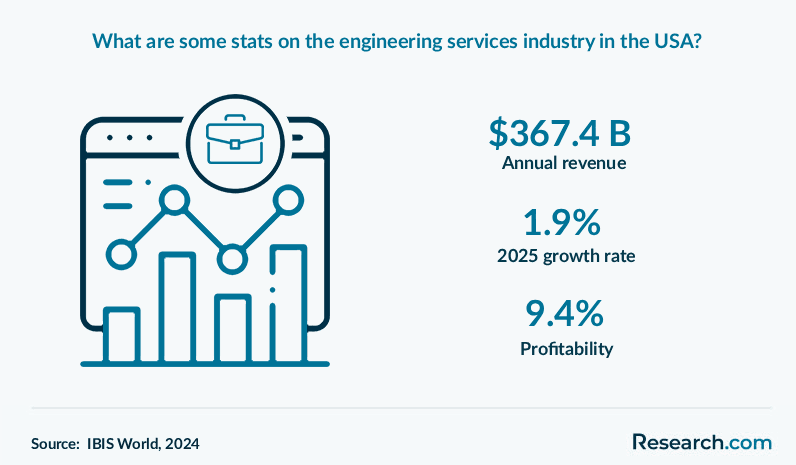
The U.S. engineering services industry is also changing as employers adopt new technologies, invest in infrastructure, and respond to sustainability demands. According to IBIS World, in 2025, it is projected to reach $367.4 billion in annual revenue with a 1.9% growth rate and steady 9.4% profitability, as shown in the graphic below.
Innovations such as building information modeling (BIM) and 3D printing are helping organizations streamline operations and reduce costs. Government funding, which makes up 34.4% of industry revenue, supports continued growth but also requires firms to manage interest rate shifts and sustainability expectations.
What types of specializations are available for engineering management MBA graduates?
Specializations help students position themselves for a particular type of technical leadership role. Before choosing one, compare it with your industry, current experience, and target job title. A specialization can be useful, but it should not narrow your options unless you are certain about your direction.
| Specialization | What it emphasizes | Best fit |
| Project Management | Planning, budgeting, risk, scheduling, and execution of engineering projects | Professionals aiming for project manager, program manager, or delivery leadership roles |
| Systems Engineering | Design, integration, lifecycle management, and complex technical systems | Engineers working in aerospace, defense, manufacturing, infrastructure, or technology systems |
| Technology Management | Innovation strategy, R&D, product commercialization, and technology adoption | Professionals who want to lead technical strategy or innovation teams |
| Operations Management | Process optimization, production systems, quality, and supply chains | Manufacturing, logistics, industrial, and operations professionals |
| Business Analytics | Data-driven decision-making for technical and business problems | Professionals who want to use analytics in operations, product, or performance improvement |
| Construction Management | Engineering leadership in construction, infrastructure, budgets, and project delivery | Construction, civil engineering, and infrastructure professionals |
| Enterprise Architecture | Alignment of systems, processes, technology, and business strategy | Technology leaders connecting technical infrastructure with organizational goals |
If your primary goal is to manage technology systems, IT strategy, or digital transformation, an MBA in Information Technology Management may provide a more focused business technology path than an engineering management concentration.
How do you choose the best online engineering management MBA program?
The best program is the one that matches your career target, budget, background, schedule, and credential needs. Rankings can help you build a shortlist, but they should not replace a detailed review of accreditation, curriculum, career support, and total cost.
- Accreditation: Check institutional accreditation and, where relevant, business or engineering accreditation such as AACSB or ABET.
- Degree Title: Confirm whether the credential is an MBA, MEM, MSEM, concurrent MBA/MS, or certificate pathway.
- Curriculum Fit: Look for courses directly connected to your goals, such as project management, systems engineering, supply chain, analytics, or operations.
- Faculty Expertise: Review whether instructors have relevant industry, research, or executive experience in technical fields.
- Flexibility: Compare asynchronous and synchronous formats, term lengths, course load expectations, and residency requirements.
- Cost and Aid: Evaluate tuition, fees, employer reimbursement rules, scholarship options, and total debt.
- Program Length: Make sure the advertised timeline is realistic for your work and family obligations.
- Career Services and Alumni Network: Assess whether online students receive meaningful career coaching, networking, mentoring, and employer connections.
Questions to ask admissions before applying
- Is this an MBA, MEM, MSEM, or dual-degree program, and how will the transcript label the degree?
- Are online students taught by the same faculty as campus students?
- What percentage of coursework is business-focused versus engineering-focused?
- Are GMAT or GRE scores required, optional, or waived for experienced professionals?
- Does the program require live class meetings, campus visits, group projects, or proctored exams?
- What career services are available specifically to online graduate students?
- Can employer-sponsored students defer payment until reimbursement is received?
- Are certificates embedded in the degree, and do they add cost or credits?
Common mistakes to avoid
| Mistake | Why it can hurt you | Better approach |
| Choosing only by ranking | A highly ranked program may not fit your industry, schedule, or budget. | Use rankings as a starting point, then compare curriculum, cost, and outcomes. |
| Ignoring accreditation | Accreditation can affect financial aid, employer recognition, and transferability. | Verify institutional accreditation and relevant program-level accreditation before applying. |
| Focusing only on tuition | Fees, books, travel, and longer timelines can change the real cost. | Ask for a full cost estimate in writing. |
| Assuming all online programs are flexible | Some programs have live sessions, team meetings, or fast-paced terms. | Confirm weekly workload and scheduling requirements. |
| Choosing a specialization too early | A narrow focus may not support your long-term career path. | Pick a specialization tied to your target industry and job title. |
| Assuming salary gains are guaranteed | Pay depends on experience, role, employer, location, and performance. | Compare job postings and salary data for your specific target roles. |
What career paths are available for graduates of online engineering management MBA programs?
Graduates often pursue roles that require technical credibility and business leadership. The degree can be useful in engineering services, manufacturing, construction, aerospace, technology, semiconductor production, healthcare operations, consulting, logistics, and research-driven organizations.
Leadership-focused online degrees can serve different audiences. For example, an online military science degree may support service-related leadership development, while engineering management MBA programs focus on leading technical people, systems, projects, budgets, and operations.
- Engineering Manager: Leads engineering teams, oversees technical operations, and coordinates resources.
- Project Manager: Plans and executes complex technical projects while managing scope, schedule, risk, and budget.
- Operations Manager: Improves production, workflow, supply chains, and operational performance.
- Technical Consultant: Advises organizations on engineering, technology, process improvement, or operational strategy.
- Product Manager: Connects engineering, market needs, customer priorities, and business goals across a product lifecycle.
- Director of Engineering/R&D: Oversees engineering departments, research initiatives, product innovation, and technical strategy.
- Supply Chain Manager: Manages sourcing, production, logistics, and delivery in engineering-intensive industries.
2024 figures from the U.S. Bureau of Labor Statistics show that architectural and engineering managers are primarily employed in the architectural, engineering, and related services industry, which accounts for 54,710 positions. Significant employment is also found in scientific research and development services, with 12,620 managers, and in the management of companies and enterprises sector, employing 11,490 individuals.
The aerospace product and parts manufacturing industry has 10,200 such managers, while semiconductor and other electronic component manufacturing employs 9,310, as shown in the graph below.
These employment patterns show that architectural and engineering managers are concentrated in industries built around design, research, advanced production, and complex technical projects. For graduates, that means career opportunities are strongest where technical work must be coordinated with budgets, strategy, compliance, quality, and delivery.
How much can I earn with an online engineering management MBA degree?
An engineering management MBA may support movement into higher-responsibility roles, but salary outcomes are not automatic. Pay depends on your prior engineering experience, industry, location, employer, leadership scope, and whether the role includes budget, product, operations, or executive responsibility. In the same way that an online medical assistant associate degree supports a specific healthcare career path, an engineering management MBA is most valuable when it aligns with a clear target role.
- Role Level: Director, senior manager, product, program, and executive roles typically pay more than entry-level supervisory positions.
- Industry: Technology, high-tech manufacturing, consulting, aerospace, and advanced engineering services may offer different compensation patterns.
- Experience: Professionals with substantial engineering or project leadership experience usually have stronger earning potential after graduate study.
- Location: Regional demand and cost of living can significantly affect salary.
- Scope of Responsibility: Managing people, budgets, products, supply chains, or enterprise-level strategy often increases compensation.
2025 PayScale salary data, shown in the graph below, reveal that a chief operating officer (COO) earns an average of $88,289. An electronics engineer typically receives an average salary of $88,387. A naval architect's average earnings are approximately $88,743. For a product manager (unspecified type), the average salary stands at $89,294. A reliability engineer commands an average of $92,009.
A project engineer earns an average of $92,379. The average salary for a senior manufacturing engineer is $97,068. A quality assurance manager typically earns $97,594. A controls engineer has an average salary of $100,905. A quality manager's average earnings are $101,352.
A materials manager earns an average of $104,440, while a software engineering manager typically receives $109,089. A design engineering manager averages $109,128, and a senior electrical engineer commands $111,094.
A product owner earns $113,970, reflecting a central role in development, while a chief technology officer (CTO) averages $119,025, indicating top-tier executive status.
A senior program manager earns $125,579, showing strong leadership compensation, and a senior strategic sourcing manager brings in $130,615, underscoring supply chain expertise.
A business manager averages $132,239, reflecting broad management potential, while the highest salary goes to a product management director at $153,588, demonstrating peak executive earnings.
The pattern is clear: the strongest pay is generally associated with roles that combine technical knowledge with strategic authority, product ownership, supply chain responsibility, executive decision-making, or large-scale program leadership.
What is the job market like for graduates of an online engineering management MBA degree program?
The job market for engineering management graduates is shaped by the need for leaders who can translate technical work into business results. Employers need managers who understand engineering constraints, financial trade-offs, regulatory demands, workforce coordination, data, risk, and customer expectations.
- Technical Leadership Demand: Manufacturing, technology, consulting, civil engineering, and research organizations need managers who can lead technical teams.
- Cross-Functional Work: Graduates often work between engineering, finance, operations, product, supply chain, and executive teams.
- Innovation Pressure: Organizations need leaders who can manage new products, process changes, automation, sustainability requirements, and infrastructure projects.
- Transferable Skills: Project management, analytics, budgeting, communication, and systems thinking can apply across industries.
- Competitive Advantage: Professionals with both engineering credibility and business training may stand out for management-track roles.
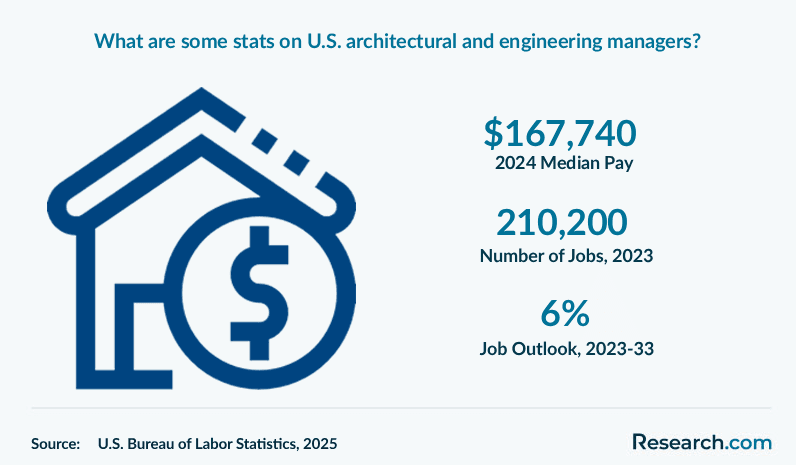
As shown in the graphic below, according to 2024 U.S. Bureau of Labor Statistics data, architectural and engineering managers in the United States earned a median annual salary of $167,740, which translates to approximately $80.64 per hour. As of 2023, there were 210,200 positions in this occupation, and employment is projected to grow by 6% from 2023 to 2033, which is faster than the average for all occupations. This growth is expected to result in an employment change of 11,600 new jobs over the decade.
Most individuals entering this field typically hold a bachelor’s degree and have at least five years of related work experience. No on-the-job training is generally required for these roles. These figures point to a career category with high pay and steady demand, but they also show why experience matters: graduate education is usually most powerful when combined with several years of technical work.
What are some current and future trends in engineering management?
Engineering managers are being asked to lead through faster technology cycles, more complex supply chains, tighter budgets, sustainability expectations, and distributed workforces. A strong graduate program should help students understand these pressures rather than teach management as a purely theoretical subject.
- Artificial Intelligence and Generative AI: Managers increasingly use AI tools for data analysis, forecasting, design support, workflow optimization, and decision support, while also managing ethical and risk considerations.
- Sustainable Engineering: Organizations are placing greater emphasis on energy use, materials, environmental impact, compliance, and sustainable design.
- Digital Transformation: Engineering leaders are guiding the adoption of digital tools across design, production, operations, service, and quality systems.
- Agile and Lean Methods: Engineering teams continue to use agile, lean, Six Sigma, and continuous improvement approaches to increase speed and efficiency.
- Remote and Global Collaboration: Managers may lead teams across time zones, suppliers, facilities, and international partners.
- Data-Driven Decision-Making: Engineering management increasingly depends on analytics, dashboards, modeling, and measurable performance indicators.
- Cybersecurity in Engineering Systems: Industrial systems, intellectual property, infrastructure, and connected products require greater attention to cyber risk.
If you want a broader MBA with a shorter timeline rather than a technical management focus, compare the fastest online MBA programs before committing to an engineering management concentration.
What accreditation and quality certifications should I consider?
Accreditation is one of the most important quality checks for any online graduate business or engineering management program. At minimum, verify institutional accreditation. For business programs, AACSB and ACBSP are common quality signals. For engineering programs, ABET may be relevant depending on the degree and level. Accreditation can affect financial aid eligibility, employer recognition, credit transfer, and confidence in academic quality.
Also look beyond accreditation. Review faculty qualifications, course rigor, student support, online learning technology, career services, alumni outcomes, and whether the program’s curriculum matches current engineering management work. If cost is a major concern, compare accredited affordability-focused options such as affordable online MBA programs while still checking quality indicators.
What is the return on investment for an online engineering management MBA degree?
Return on investment should be measured in more than salary. For many students, ROI includes promotion eligibility, leadership credibility, stronger project outcomes, broader mobility across industries, access to product or operations roles, and preparation for director-level responsibility. Still, the financial side matters: tuition, fees, borrowing, time away from work, and delayed earnings should be compared against realistic career outcomes.
Use the following framework before enrolling:
- Identify the exact roles you want after graduation.
- Compare job postings to see whether employers prefer an MBA, MEM, MSEM, certification, or experience.
- Estimate total program cost, including fees and interest if borrowing.
- Ask your employer whether the degree supports promotion or reimbursement.
- Review program outcomes and compare them with accredited online MBA programs in other concentrations.
- Choose the lowest-cost program that still meets your accreditation, curriculum, flexibility, and career-support needs.
What career services and networking support are available?
Career support can make a major difference for online students, especially those who want to change industries or move from individual contributor roles into management. Look for programs that offer resume reviews, interview preparation, career coaching, employer events, alumni networking, mentoring, and access to job boards for online students.
Ask whether career services understand technical leadership roles specifically. General MBA career coaching may not be enough if you are targeting engineering manager, product manager, program manager, operations leader, or R&D director positions. If your goal is senior executive leadership, it may also be useful to compare engineering management programs with an online executive MBA pathway.
Should you choose an engineering management MBA or another path?
| Choose this path if... | Consider another option if... |
| You want to manage engineers, technical projects, operations, products, or systems. | You want to remain primarily in hands-on engineering design or research. |
| You already have technical experience and need business leadership training. | You have little technical background and want a general business career. |
| You want coursework tied to project management, systems, quality, analytics, or supply chain. | You want a finance, marketing, healthcare, or HR-focused MBA concentration. |
| Your employer values graduate business education for technical managers. | Your target role values a professional certification more than a master’s degree. |
| You need an online format that lets you keep working. | You need intensive in-person labs, research facilities, or campus networking. |
References
- Deloitte. (2024, April). 2024 engineering and construction industry outlook. Deloitte.
- IBISWorld. (2024, July). Engineering services in the US - industry report 1403. IBISWorld.
- PayScale. (2025). Master of Business Administration (MBA), Engineering Management Degree Salary. PayScale.
- U.S. Bureau of Labor Statistics. (2024, April 17). Architectural and engineering managers. U.S. Bureau of Labor Statistics.
- U.S. Bureau of Labor Statistics. (2024, May). Architectural and engineering managers. U.S. Bureau of Labor Statistics.
Key Insights
- An online engineering management MBA is best for experienced technical professionals who want to move into leadership, operations, product, project, or executive roles.
- Not every program on the market is technically an MBA. Compare MBA, MEM, MSEM, and concurrent degree options carefully before applying.
- Accreditation matters. Verify institutional accreditation and look for relevant business or engineering quality markers such as AACSB, ACBSP, or ABET where applicable.
- Total cost is more than tuition. Ask about fees, required credits, course materials, payment timing, employer reimbursement, and whether certificates add cost.
- The strongest ROI usually comes when the degree supports a specific career move, such as engineering manager, senior project manager, product manager, operations manager, or technical director.
- Salary gains are not guaranteed. Experience, industry, location, leadership scope, and employer demand all affect outcomes.
- Before enrolling, ask schools direct questions about online student support, faculty access, live class requirements, career services, and how the degree appears on transcripts.
Other Things You Should Know About Online Engineering Management MBA Degree Programs
Most programs expect a bachelor’s degree from an accredited institution and basic quantitative skills in calculus, statistics, or finance. Some schools require prior coursework or work experience in engineering, while others offer preparatory modules for applicants who lack a technical background.
The average duration to complete an online Engineering Management MBA program in 2027 is typically two years. Some programs offer accelerated paths that can be completed in as little as 18 months, depending on the credit load and course schedule flexibility.


