
2027 How To Become an HVAC Technician: Salary & Career Paths

Co-Founder and Chief Data Scientist
Becoming an HVAC technician can be a practical route into a skilled trade for people who want hands-on work, steady demand, and income potential without earning a traditional college degree. HVAC technicians install, maintain, and repair heating, ventilation, air conditioning, and refrigeration systems in homes, schools, offices, hospitals, retail buildings, industrial facilities, and other settings where indoor temperature and air quality matter.
This guide explains how to become an HVAC technician in 2026, including what the job involves, how long training usually takes, which certifications matter, where technicians work, what they can earn, and how to compare training options. It is designed for high school graduates, career changers, military veterans, trade school students, and working adults who want a clear path into the HVAC field.
According to the US Bureau of Labor Statistics, heating, air conditioning, and refrigeration mechanics and installers earned a 2023 median hourly wage of $27.55, compared with the 2024 median hourly wage of $23.80 for all US occupations. The field is also projected to grow faster than the average for all occupations, making HVAC a career worth evaluating for people who prefer technical, field-based work over office-based jobs.
Quick Answer: How do you become an HVAC technician?
Most HVAC technicians start by completing a trade school, technical school, community college, or apprenticeship program. Training commonly takes 6 months to 2 years and covers electrical systems, refrigeration, heating equipment, ventilation, safety procedures, diagnostics, and refrigerant handling. Technicians who work with regulated refrigerants typically need EPA Section 608 Technician Certification, and many employers prefer candidates with additional industry credentials such as NATE certificates.
The basic path is straightforward: learn HVAC fundamentals, get hands-on training, earn required certification, meet any state or local licensing rules, apply for entry-level roles, and continue building skills through field experience.
Why HVAC can be a strong career choice
- It does not usually require a four-year degree. Many technicians enter the field through trade school, technical training, or apprenticeship programs.
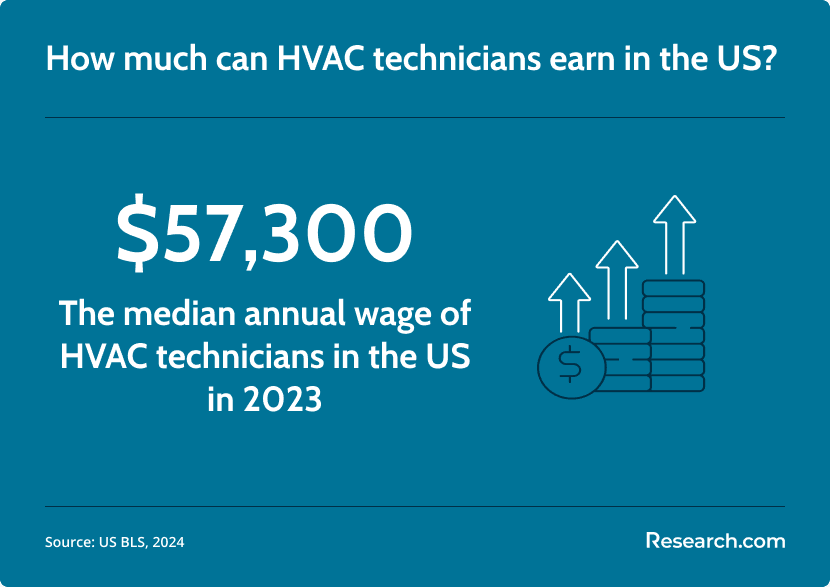
- It offers solid wage potential for a skilled trade. Heating, air conditioning, and refrigeration mechanics and installers had a 2023 median annual wage of $57,300 in the US (US BLS, 2024).
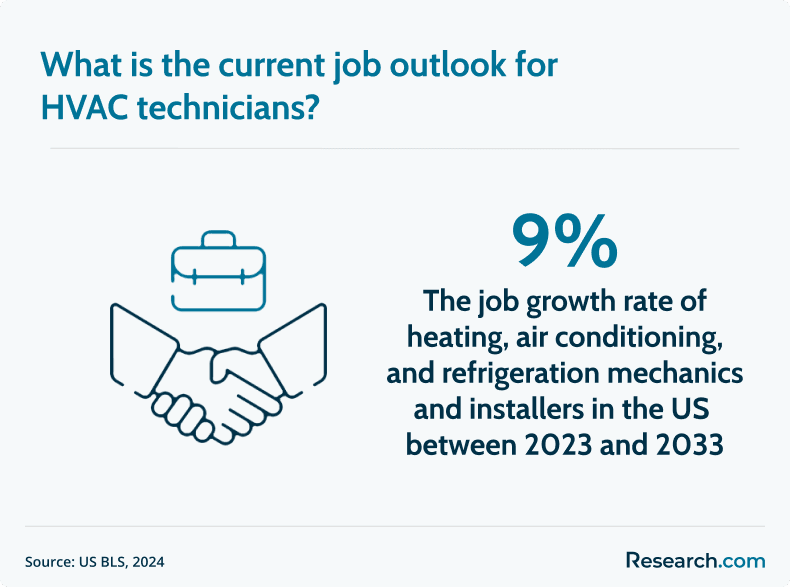
- Demand is projected to grow. Employment for heating, air conditioning, and refrigeration mechanics and installers is expected to rise by 9% between 2023 and 2033, which is much faster than the average for all US occupations (US BLS, 2024).
- Skills can transfer to related trades. HVAC experience can support movement into electrical work, maintenance, boiler operation, sheet metal work, refrigeration, energy auditing, or facilities management.
- What does an HVAC technician do?
- What are the different types of HVAC specializations?
- What education do you need to become an HVAC technician in 2026?
- Which certifications are available to become an HVAC technician?
- What skills do HVAC technicians need?
- What types of jobs can HVAC technicians get?
- How much do HVAC technicians make per year?
- What is the job demand for HVAC technicians?
- Where do HVAC technicians work?
- What emerging technologies are shaping the HVAC industry?
- Are accelerated online training programs a viable path for HVAC technicians?
- What are the biggest challenges that HVAC technicians face?
- Which HVAC certifications boost career success?
- How do evolving environmental regulations impact HVAC career prospects?
- How can HVAC technicians pursue career advancement?
- What financing options are available for HVAC training?
- Is a higher degree worthwhile for HVAC technicians?
- Key Insights
What does an HVAC technician do?
An HVAC technician works on systems that control heating, cooling, airflow, refrigeration, humidity, and indoor comfort. The job can include installing new equipment, inspecting existing systems, troubleshooting failures, replacing parts, cleaning components, checking refrigerant levels, testing electrical connections, and making sure equipment operates safely and efficiently.
On a typical day, an HVAC technician may travel to a customer’s home, inspect a malfunctioning air conditioner, test electrical controls, replace a capacitor, clean coils, explain repair options, and document the service call. In a commercial setting, the same technician may work on rooftop units, large ventilation systems, refrigeration equipment, boilers, chillers, or building automation controls.
HVAC work overlaps with several other trades. For example, people comparing skilled trade careers may also want to learn how to become an electrician, because HVAC technicians often work with wiring, motors, controls, circuits, and safety procedures. Those interested in larger electrical infrastructure may also compare HVAC with electrical lineman careers, although linemen focus on utility power systems rather than indoor mechanical systems.
Common HVAC technician responsibilities
- Install furnaces, air conditioners, heat pumps, ventilation equipment, and refrigeration systems.
- Diagnose mechanical, electrical, airflow, refrigerant, and control system problems.
- Perform preventive maintenance to reduce breakdowns and improve system efficiency.
- Read wiring diagrams, installation manuals, blueprints, and technical specifications.
- Use gauges, meters, hand tools, power tools, leak detectors, and diagnostic equipment.
- Explain problems, repair options, maintenance needs, and system limitations to customers.
- Follow building codes, safety rules, refrigerant regulations, and manufacturer guidelines.
| Work area | What the technician does | Why it matters |
| Installation | Places, connects, tests, and commissions new HVAC or refrigeration equipment. | Correct installation affects comfort, safety, energy use, equipment life, and warranty coverage. |
| Maintenance | Inspects, cleans, adjusts, and tests systems before major problems develop. | Preventive service can reduce emergency calls and help systems run more reliably. |
| Repair | Finds the cause of a malfunction and replaces, repairs, or recalibrates components. | Accurate diagnostics save time, control costs, and reduce repeat service calls. |
| Customer service | Explains findings, gives maintenance advice, and helps customers understand repair choices. | Clear communication builds trust and helps customers make informed decisions. |
What are the different types of HVAC specializations?
HVAC is not a single, narrow job. Technicians can focus on installation, maintenance, refrigeration, commercial systems, controls, energy efficiency, or related building systems. Choosing a specialization matters because it affects the type of training you need, the work environment you enter, and the long-term career path you can pursue. This is similar to choosing a focus within an auto mechanic career, where technicians may specialize in diagnostics, engines, electrical systems, or performance work.
- HVAC installation technician: Installs new heating, cooling, and ventilation systems in homes or buildings. This role requires careful measurement, blueprint reading, code awareness, ductwork knowledge, and attention to manufacturer specifications.
- HVAC maintenance and repair technician: Inspects equipment, identifies problems, performs repairs, and keeps systems operating efficiently. This path is a strong fit for people who enjoy troubleshooting and customer-facing service work.
- Commercial HVAC technician: Works on larger systems in offices, schools, hospitals, retail centers, factories, and industrial properties. Commercial work often involves more complex equipment, rooftop units, building controls, and higher-capacity systems.
- Refrigeration technician: Focuses on systems such as walk-in freezers, cold storage rooms, display cases, and refrigeration equipment used by grocery stores, restaurants, warehouses, and food service operations.
- Energy auditor: Evaluates how buildings use energy and recommends improvements. This path may appeal to technicians interested in efficiency, sustainability, system performance, and building science.
| Specialization | Best fit for | Typical work setting |
| Residential HVAC | People who like customer interaction, local service calls, and varied daily tasks. | Homes, apartments, and small residential properties. |
| Commercial HVAC | Technicians who want larger systems, more technical complexity, and facilities work. | Office buildings, schools, hospitals, retail spaces, and industrial properties. |
| Refrigeration | People interested in cold storage, food safety, and specialized equipment. | Restaurants, grocery stores, warehouses, and commercial kitchens. |
| Energy efficiency | Technicians who want to focus on system performance, conservation, and upgrades. | Homes, commercial buildings, energy consulting, and facilities teams. |
What education do you need to become an HVAC technician in 2026?
A four-year college degree is not usually required to become an HVAC technician. Most people enter the field through a trade school, technical school, community college certificate, employer training program, or apprenticeship. Some students compare local programs with a trade school online option, especially when they need flexible coursework before completing hands-on training.
HVAC programs usually take 6 months to 2 years to complete. Coursework commonly covers refrigeration principles, heating systems, air conditioning, ventilation, electrical fundamentals, motors, controls, system design, safety procedures, blueprint reading, troubleshooting, and refrigerant handling. Apprenticeships combine classroom instruction with paid on-the-job learning, which can be valuable for students who want to earn while training.
Program quality matters. A low-cost or fast program is not automatically the best choice if it lacks hands-on labs, employer connections, qualified instructors, certification preparation, or alignment with state and local licensing requirements. Before enrolling, students should ask whether the program prepares them for EPA Section 608 certification and whether graduates are eligible for entry-level HVAC roles in their area.
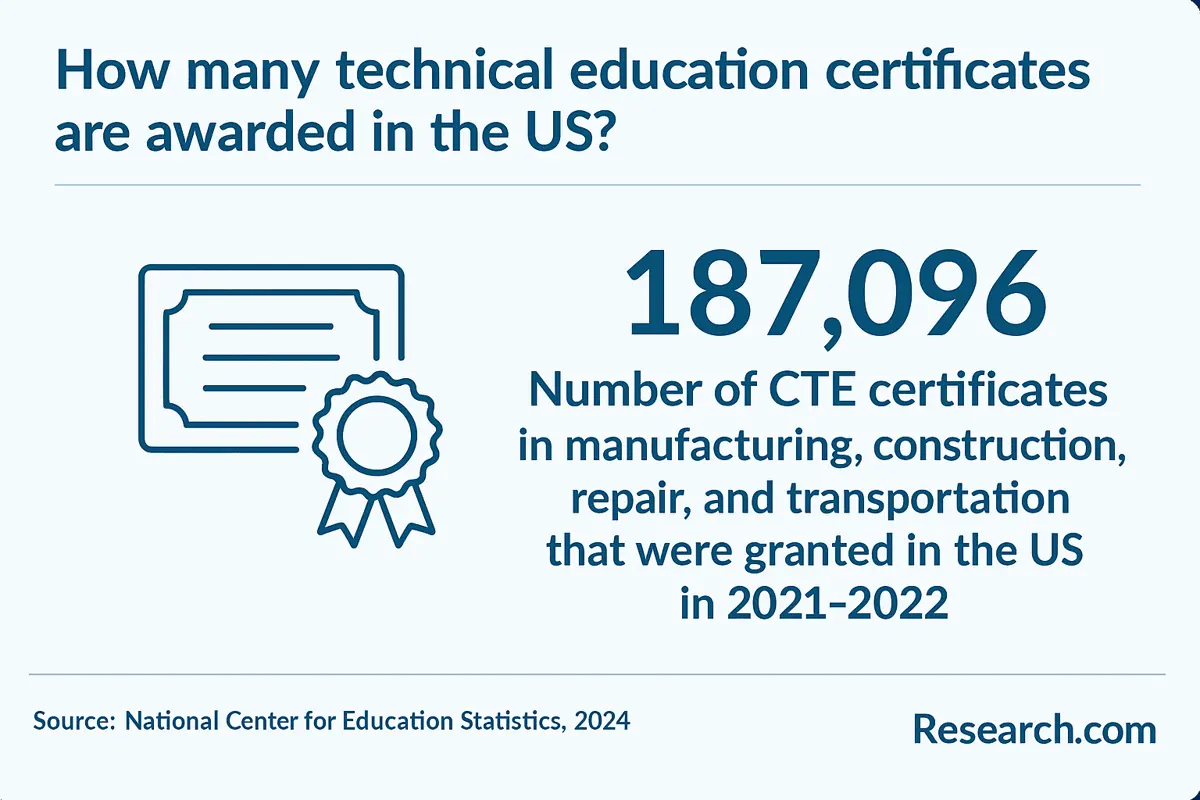
Common HVAC training paths
| Training path | Typical length | When it makes sense | What to check before enrolling |
| Trade school or technical school | 6 months to 2 years | You want a structured program with labs, instructors, and career preparation. | Hands-on training, certification preparation, job placement support, cost, and accreditation or institutional approval. |
| Community college certificate or associate pathway | 6 months to 2 years | You want technical training and may want credits that can transfer later. | Transfer policies, lab access, employer partnerships, and whether the program fits your schedule. |
| Apprenticeship | Varies by employer or program | You want paid training and direct field experience. | Entry requirements, wages, classroom expectations, supervision, and licensing alignment. |
| Online or hybrid HVAC training | Varies by provider | You need flexible theory coursework before hands-on practice. | Local lab requirements, in-person skill assessments, certification prep, and employer recognition. |
Questions to ask before choosing an HVAC school
- Does the program include hands-on lab work with real HVAC equipment?
- Does it prepare students for EPA Section 608 Technician Certification?
- Are instructors experienced in residential, commercial, or refrigeration work?
- Does the school have employer relationships, apprenticeships, or job placement support?
- What tools, books, exam fees, uniforms, or equipment costs are not included in tuition?
- Will the program meet licensing or registration requirements in your state or city?
- Can credits transfer if you later pursue another certificate, associate degree, or bachelor’s degree?
Which certifications are available to become an HVAC technician?
Certifications can help HVAC technicians prove technical competence, meet legal requirements, and become more competitive for entry-level or advanced roles. Students comparing programs may want to review online vocational and trade school programs that include certification preparation as part of the curriculum.
The most important credential to understand is EPA Section 608 Technician Certification. Under Section 608 of the Clean Air Act, technicians who service equipment that could release regulated refrigerants must meet US EPA certification requirements. Applicants must pass an EPA-approved exam covering the type of equipment they will service. According to the EPA, Section 608 Technician Certification credentials do not expire.
- EPA Section 608 Technician Certification: Required for technicians who work with regulated refrigerants. Certification types include Type I for servicing small appliances; Type II for servicing or disposing of high- or very high-pressure appliances, except small appliances and MVACs; Type III for servicing or disposing of low-pressure appliances; and Universal for servicing all types of equipment.
- NATE Ready to Work Certificate Exam: This online-only industry competency exam is designed for people entering the HVACR field with little to no formal experience. As of early 2025, the exam fee is $50.
- NATE HVAC Support Technician Certificate Exam: This proctored exam is intended for individuals with 6 months to 12 months of professional HVACR experience. It can be taken online or in person and costs $75 as of early 2025.
| Credential | Who it is for | Why it matters |
| EPA Section 608 Technician Certification | Technicians who service equipment involving regulated refrigerants. | It is tied to federal refrigerant handling requirements and is often essential for HVAC work. |
| NATE Ready to Work Certificate Exam | Beginners with limited or no formal HVACR experience. | It can help new candidates show basic industry knowledge when applying for entry-level roles. |
| NATE HVAC Support Technician Certificate Exam | Technicians with 6 months to 12 months of field experience. | It demonstrates stronger early-career competence and may support advancement. |
What skills do HVAC technicians need?
HVAC technicians need technical, mechanical, physical, and interpersonal skills. The best technicians are not only good with tools; they can also diagnose unclear problems, work safely, communicate with customers, and keep learning as systems become more advanced. Students who need accessible academic entry points may compare training options at open admission online colleges, especially if they are building foundational math, technical, or communication skills before entering a trade program.
- Mechanical aptitude: HVAC technicians must understand how compressors, motors, blowers, burners, coils, ducts, pumps, controls, and other components work together. They also need confidence using hand tools, power tools, meters, gauges, and diagnostic equipment.
- Electrical knowledge: Modern HVAC systems rely on circuits, controls, motors, sensors, and wiring. Strong electrical fundamentals help technicians troubleshoot safely and accurately.
- Problem-solving ability: A service call rarely begins with a perfect answer. Technicians must observe symptoms, test components, interpret readings, and identify the real cause of the problem.
- Customer communication: Technicians often explain technical problems to people who do not have HVAC training. Clear, honest communication helps customers understand repair options and maintenance needs.
- Physical stamina and safety awareness: HVAC work may involve ladders, rooftops, attics, crawl spaces, heavy equipment, sharp materials, electricity, heat, cold, and refrigerants.
- Adaptability: Equipment, refrigerants, codes, controls, and efficiency standards continue to change. Technicians who keep learning are better positioned for long-term career growth.
What types of jobs can HVAC technicians get?
HVAC training can lead directly to technician roles, but it can also support movement into related skilled trades and building systems careers. Technicians who later want supervisory, estimating, project coordination, or construction leadership roles may consider a construction management degree online after gaining field experience.
- HVAC service technician: Diagnoses and repairs heating, cooling, ventilation, and refrigeration systems for residential or commercial customers.
- HVAC installer: Installs new systems, ductwork, controls, and equipment according to plans, codes, and manufacturer requirements.
- Refrigeration technician: Works on refrigeration systems used in food service, retail, cold storage, and industrial settings.
- General maintenance and repair worker: Handles multiple building maintenance tasks, which may include HVAC, plumbing, electrical repairs, and facility upkeep.
- Electrician: Uses related electrical knowledge to move toward wiring, installation, and repair work in residential or commercial buildings.
- Boilermaker: Builds, installs, maintains, and repairs boilers, tanks, and pressure vessels; HVAC heating knowledge can be useful in this area.
- Stationary engineer and boiler operator: Operates and maintains large heating, cooling, mechanical, and utility systems in commercial or industrial buildings.
The chart below provides a visualization of employment levels for jobs related to HVAC technician work in the US in 2023, based on 2024 data from the US BLS.
How much do HVAC technicians make per year?
In 2023, heating, air conditioning, and refrigeration mechanics and installers in the US had a median annual wage of $57,300, or a median hourly wage of $27.55 (US BLS, 2024). For comparison, the 2024 median hourly wage for all US occupations was $23.80 (US BLS, 2025).
Actual earnings vary. Experience, specialization, employer type, overtime, location, licensing, certifications, union status, and the complexity of the systems serviced can all influence pay. A new residential installer may earn differently from an experienced commercial refrigeration technician or a technician who later moves into project management, estimating, sales, supervision, or business ownership.
Some technicians eventually pursue additional education to qualify for leadership or construction-related roles. For example, online construction management degrees may be relevant for experienced tradespeople who want to move from field service into project coordination, estimating, or management. However, a degree is not required for many HVAC technician jobs, so students should compare the cost of additional education with their realistic career goals.
| Factor | How it can affect HVAC income |
| Experience | Technicians usually become more valuable as they can diagnose complex problems and work independently. |
| Certification | Required and industry-recognized credentials can improve employability and support advancement. |
| Specialization | Commercial HVAC, refrigeration, controls, and energy-focused work may require deeper technical knowledge. |
| Location | Regional labor demand, climate, cost of living, licensing rules, and employer competition can affect wages. |
| Work schedule | Emergency service, seasonal peaks, overtime, and on-call work may influence total earnings. |
What is the job demand for HVAC technicians?
Employment for heating, air conditioning, and refrigeration mechanics and installers in the US is projected to grow by 9% between 2023 and 2033. This is much faster than the average growth rate for all US occupations and translates to an average of about 42,500 job openings for the role over the decade (US BLS, 2024).
Several factors support demand for HVAC technicians. Homes and commercial buildings rely on climate control systems, older equipment needs maintenance and replacement, and customers increasingly expect systems that are efficient, reliable, and compatible with modern controls. Climate, building age, population growth, commercial construction, and maintenance needs can also affect local hiring.
HVAC is part of a broader skilled trades labor market. People comparing trade careers may also review the salary and career path for welders to understand how different technical occupations compare in training, wages, work conditions, and advancement potential.
Demand does not mean every graduate is guaranteed a job or a specific salary. Employers still evaluate hands-on ability, reliability, safety habits, communication, driving record, certifications, and willingness to work in demanding conditions.
Where do HVAC technicians work?
In 2023, about 441,200 heating, air conditioning, and refrigeration mechanics and installers were employed across the US. According to the US BLS, the largest employers of these professionals were:
- Plumbing, Heating, and Air-conditioning Contractors: 67%
- Self-employed Workers: 8%
- Wholesale Trade: 3%
- Educational Services (State, Local, and Private): 3%
- Retail Trade: 3%
Related maintenance and electrical roles employ large numbers of workers as well. Around 1.6 million general maintenance and repair workers were employed in the US in 2023. Their largest employers were:
- Real Estate and Rental and Leasing: 20%
- Manufacturing: 12%
- Government: 12%
- Accommodation and Food Services: 8%
- Educational Services (State, Local, and Private): 8%
In the same year, 779,800 electricians were employed in the country. The largest employers of electricians were:
- Electrical Contractors and Other Wiring Installation Contractors: 67%
- Self-employed Workers: 7%
- Manufacturing: 6%
- Government: 3%
- Employment Services: 3%
The chart below shows the largest employers of heating, air conditioning, and refrigeration mechanics and installers in the US in 2023, based on 2024 data from the US BLS.
What emerging technologies are shaping the HVAC industry?
HVAC work is becoming more technical as systems incorporate digital controls, connected devices, smart thermostats, sensors, automation, and energy management tools. Technicians increasingly need to understand not only mechanical systems but also data from diagnostic equipment, control boards, building automation platforms, and manufacturer software.
Energy efficiency is another major influence. Customers want systems that reduce energy use, meet code requirements, and support comfort without unnecessary operating costs. Technicians who understand airflow, load conditions, proper installation, maintenance, and system performance will remain valuable as buildings become more efficiency-focused.
Some experienced technicians may decide to build broader technical or management skills through academic programs. A person comparing flexible degree options can review resources on the easiest online bachelor's degree, but HVAC workers should choose further education based on career goals rather than convenience alone.
Are accelerated online training programs a viable path for HVAC technicians?
Accelerated online HVAC training can be useful for learning theory, terminology, safety concepts, electrical basics, refrigeration principles, and certification exam content. It can be especially helpful for working adults who need flexible study hours or people exploring the field before committing to a full in-person program.
However, online training has a clear limitation: HVAC is a hands-on trade. Students still need practice with tools, gauges, meters, wiring, equipment installation, diagnostics, brazing, refrigerant procedures, airflow testing, and safety protocols. A stronger option is often a hybrid program that combines online coursework with in-person labs, apprenticeships, or employer-supervised fieldwork.
Students interested in short online credentials can compare accelerated pathways such as online degree options that may be completed in 6 months, but they should confirm whether the training is recognized by local employers and whether it includes the practical experience needed for HVAC jobs.
| Program type | Pros | Limitations |
| Fully online HVAC theory course | Flexible, often convenient for beginners, and useful for exam preparation. | May not provide enough hands-on practice for employment readiness. |
| Hybrid HVAC program | Combines flexible coursework with lab or field training. | Requires travel or scheduled in-person participation. |
| In-person trade program | Provides direct equipment practice, instructor feedback, and lab experience. | May be less flexible for working adults. |
| Apprenticeship | Offers paid on-the-job learning and real field experience. | Entry may be competitive and schedules can be demanding. |
What are the biggest challenges that HVAC technicians face?
HVAC can be rewarding, but it is not an easy desk job. Technicians often work in uncomfortable environments, solve urgent problems, and deal directly with customers who may be stressed about cost, heat, cold, or business disruption. Career changers, including older adults researching online degree programs for seniors, should consider the physical and scheduling realities before entering the field.
- Physically demanding work: Technicians may work in attics, basements, crawl spaces, rooftops, mechanical rooms, or outdoor conditions. The job can involve lifting equipment, climbing ladders, kneeling, bending, and standing for long periods.
- Seasonal pressure: Service demand often rises during very hot or very cold weather. Busy seasons can bring overtime, emergency calls, and on-call schedules, while slower periods may reduce hours for some workers.
- Technical change: HVAC systems increasingly use smart controls, sensors, high-efficiency components, and advanced diagnostics. Technicians must keep learning to remain effective.
- Safety risks: The work can involve electricity, refrigerants, combustion systems, sharp metal, heights, confined spaces, and heavy equipment. Safety habits are essential.
- Customer expectations: Technicians must communicate clearly about costs, repair urgency, maintenance needs, and system replacement options.
Which HVAC certifications boost career success?
The most career-relevant HVAC certifications are the ones that match the technician’s job duties, experience level, and local employer expectations. EPA Section 608 Technician Certification is especially important for refrigerant-related work, while NATE certificates can help demonstrate industry knowledge at different career stages.
Additional credentials may be useful for technicians who want to specialize in commercial systems, refrigeration, controls, energy efficiency, or supervisory roles. Students comparing broader credential options can review certification courses for high-paying jobs, but they should prioritize HVAC-recognized credentials that employers in their area actually value.
How to decide which HVAC certification to pursue first
- Start with legal requirements. If your work involves regulated refrigerants, confirm the correct EPA Section 608 certification type.
- Ask local employers what they prefer. Requirements can differ between residential contractors, commercial service companies, refrigeration employers, and facilities departments.
- Match the credential to your experience level. A beginner credential is useful early on, while more advanced credentials make more sense after field experience.
- Look for certification preparation in your training program. A good school should clearly explain which exams its curriculum supports.
- Do not collect credentials randomly. Certifications are most valuable when they connect to a specific job goal.
How do evolving environmental regulations impact HVAC career prospects?
Environmental rules and energy-efficiency expectations affect HVAC work because technicians handle refrigerants, install equipment, maintain system performance, and help customers comply with codes and standards. As equipment and regulations change, technicians who understand proper refrigerant practices, system efficiency, documentation, and safe service procedures are better prepared for long-term employment.
This does not mean every HVAC technician needs an advanced degree. In most cases, field training, certification, and continuing education are more directly relevant. However, technicians who want to move into sustainability consulting, building performance, engineering-adjacent roles, facilities leadership, or policy-focused work may eventually compare advanced academic options such as 1 year master programs.
What do HVAC technicians say about the career?
- “HVAC gave me a practical career where I solve real problems every day. I like knowing that my work helps families stay safe and comfortable at home.” —Maria
- “I began as an apprentice after high school and eventually built my own HVAC business. The work was demanding, but the independence and earning potential made the path worthwhile.” —Rory
- “The best part of HVAC is the variety. I have worked in schools, offices, and hospitals, and every system teaches you something different.” —Michael
How can HVAC technicians pursue career advancement?
Advancement in HVAC usually comes from a combination of field experience, stronger diagnostics, certifications, reliability, customer communication, and the ability to work on more complex systems. A technician who starts in residential maintenance may later move into commercial service, refrigeration, controls, sales, estimating, training, supervision, facilities management, or business ownership.
Some workers use additional education to move into management or technical leadership. Shorter academic pathways, including the quickest online degree options, may be worth comparing if they support a specific career goal. Still, HVAC technicians should avoid assuming that any degree automatically increases pay. The best choice depends on the role they want next.
| Career goal | Helpful next step | Why it helps |
| Become a stronger service technician | Gain field experience, pursue relevant certification, and study diagnostics. | Employers value technicians who can find problems accurately and work independently. |
| Move into commercial HVAC | Train on larger systems, controls, rooftop units, and building systems. | Commercial roles often require broader system knowledge and more complex troubleshooting. |
| Specialize in refrigeration | Build knowledge of refrigeration systems, cold storage, and food service equipment. | Specialization can open roles in grocery, restaurant, warehouse, and industrial settings. |
| Become a supervisor or project lead | Develop communication, estimating, code knowledge, scheduling, and leadership skills. | Leadership roles require both technical judgment and coordination ability. |
| Start an HVAC business | Learn licensing, pricing, customer service, insurance, operations, and local regulations. | Business ownership requires technical skill plus financial and management competence. |
What financing options are available for HVAC training?
HVAC training costs vary by school, format, location, tools, books, lab fees, and certification expenses. Students should compare the full cost of attendance rather than tuition alone. They should also ask whether the program is eligible for financial aid, scholarships, employer sponsorship, payment plans, veteran education benefits, workforce development funding, or union-supported training.
Students who need aid-eligible online or hybrid options can compare FAFSA-approved online certificate programs. However, financial aid eligibility depends on the school and program, so applicants should confirm details directly with the institution before enrolling.
Ways to reduce HVAC training costs
- Compare community colleges, technical schools, trade schools, apprenticeships, and employer-sponsored programs.
- Ask whether tools, uniforms, exam fees, books, and lab materials are included in the advertised price.
- Look for programs that prepare students for required certifications without unnecessary add-on courses.
- Check whether local employers recruit from the program before paying tuition.
- Consider apprenticeship routes if paid on-the-job training is available.
- Confirm whether credits can transfer before choosing a longer or more expensive program.
Is a higher degree worthwhile for HVAC technicians?
A higher degree is not necessary for most entry-level HVAC technician jobs. For many students, the fastest and most practical route is a focused HVAC certificate, technical diploma, apprenticeship, or community college program that leads to hands-on competence and required certification.
A degree may become worthwhile later if the technician wants to move into construction management, facilities management, business leadership, energy management, training, technical sales, or other roles beyond field service. Experienced technicians exploring a faster academic route can compare accelerated bachelor degree programs, but the decision should be based on cost, time, transfer credit, employer value, and the specific position being targeted.
| Choose this option | When it makes sense | When to be cautious |
| HVAC certificate or trade school program | You want to enter the field quickly with job-focused training. | The program lacks hands-on labs, certification prep, or employer recognition. |
| Apprenticeship | You want paid field training and can commit to employer or program requirements. | You need a highly flexible schedule or cannot meet physical job demands. |
| Associate-level technical pathway | You want broader technical training and possible transfer options. | The added coursework does not support your local job goals. |
| Bachelor’s degree later | You are aiming for management, construction leadership, facilities roles, or business advancement. | You expect a degree alone to replace HVAC field experience. |
Common mistakes to avoid when starting an HVAC career
- Choosing a program based only on speed. A short program can be useful, but not if it skips hands-on practice or certification preparation.
- Ignoring licensing requirements. State and local rules vary, so students should verify requirements before enrolling.
- Assuming online training is enough by itself. HVAC requires practical skill with equipment, tools, wiring, refrigerants, and diagnostics.
- Overlooking total cost. Tuition may not include tools, supplies, transportation, exam fees, or books.
- Waiting too long to pursue EPA certification. Refrigerant-related work often requires EPA Section 608 certification.
- Relying only on salary medians. Median wages are useful benchmarks, but individual earnings depend on many factors.
- Choosing a school without employer connections. Programs with local industry relationships can be more useful for job placement.
- Underestimating physical demands. HVAC work can involve heat, cold, heights, confined spaces, and heavy lifting.
Key Insights
- HVAC technicians install, maintain, troubleshoot, and repair heating, cooling, ventilation, and refrigeration systems in residential, commercial, and industrial settings.
- The usual entry path is trade school, technical school, community college training, employer training, or apprenticeship. Programs commonly take 6 months to 2 years.
- EPA Section 608 Technician Certification is a key credential for technicians who work with regulated refrigerants. NATE certificates can also support early-career credibility and advancement.
- Heating, air conditioning, and refrigeration mechanics and installers had a 2023 median annual wage of $57,300, or $27.55 per hour, according to the US BLS.
- The occupation is projected to grow by 9% between 2023 and 2033, much faster than the average for all US occupations.
- Online HVAC training can help with theory and exam preparation, but hands-on labs, apprenticeships, or field training are essential for job readiness.
- The best HVAC program is not always the cheapest or fastest. Students should compare hands-on training, certification preparation, licensing alignment, employer connections, total cost, and schedule fit.
- A higher degree is optional, not required. It may be useful later for technicians who want to move into construction management, facilities leadership, business ownership, or technical management roles.
References:
- National Center for Education Statistics. (2024, May). Career and Technical Education in the United States. https://nces.ed.gov/programs/coe/indicator/tob
- US Bureau of Labor Statistics. (2024, August 29). Boilermakers. Occupational Outlook Handbook. https://www.bls.gov/ooh/construction-and-extraction/boilermakers.htm
- US Bureau of Labor Statistics. (2024, August 29). Electricians. Occupational Outlook Handbook. https://www.bls.gov/ooh/construction-and-extraction/electricians.htm
- US Bureau of Labor Statistics. (2024, August 29). General Maintenance and Repair Workers. Occupational Outlook Handbook. https://www.bls.gov/ooh/installation-maintenance-and-repair/general-maintenance-and-repair-workers.htm
- US Bureau of Labor Statistics. (2024, August 29). Heating, Air Conditioning, and Refrigeration Mechanics and Installers. Occupational Outlook Handbook. https://www.bls.gov/ooh/installation-maintenance-and-repair/heating-air-conditioning-and-refrigeration-mechanics-and-installers.htm
- US Bureau of Labor Statistics. (2025, April 02). Occupational Employment and Wages—May 2024. US Department of Labor. https://www.bls.gov/ooh/management/computer-and-information-systems-managers.htm
- US Bureau of Labor Statistics. (2024, August 29). Sheet Metal Workers. Occupational Outlook Handbook. https://www.bls.gov/ooh/construction-and-extraction/sheet-metal-workers.htm
- US Bureau of Labor Statistics. (2024, August 29). Stationary Engineers and Boiler Operators. Occupational Outlook Handbook. https://www.bls.gov/ooh/production/stationary-engineers-and-boiler-operators.htm
Other Things You Should Know about How to Become an Information Systems Manager
Yes, HVAC technician salaries are generally on the rise in 2027 due to a growing demand for energy-efficient and smart systems. This increase varies by region and experience but reflects the industry's evolution towards more advanced technologies.
Yes. Any technician who maintains, services, repairs, or disposes of equipment with refrigerants must hold EPA Section 608 certification. The exam has Core plus one or more Type I, II, or III sections, and it is required under U.S. EPA rules before handling regulated refrigerants.
In 2027, HVAC technicians typically need EPA Section 608 Certification for handling refrigerants, with additional certifications depending on state or employer requirements. Some common ones include NATE certification and HVAC Excellence certification, each providing credentials for specific skills or knowledge.


