
2027 How to Become an Evidence Technician

Co-Founder and Chief Data Scientist
Evidence technicians help determine whether physical evidence can be trusted in an investigation. They collect, label, store, track, and release evidence under strict chain-of-custody rules so that it can be used by investigators, forensic labs, attorneys, and courts. For students and career changers, the main question is usually practical: What education do I actually need, and is this career worth the training?
This guide explains how to become an evidence technician in 2027, including education options, certificate and degree pathways, common employers, daily responsibilities, essential skills, salary expectations, job outlook, technology trends, and mistakes to avoid before choosing a program or applying for jobs.
Quick Answer: How Do You Become an Evidence Technician?
To become an evidence technician, you typically need a high school diploma, post-secondary certificate, associate degree, or bachelor’s degree, depending on the agency. Many employers value hands-on experience in law enforcement, property and evidence rooms, forensic support, records management, or military investigative work. A certificate can be enough for some entry-level roles, but a degree in forensic science, criminal justice, biology, chemistry, or law enforcement can improve competitiveness for larger agencies and advancement opportunities.
The broader forensic science technician field is projected to grow 14% from 2024 to 2034, with about 2,800 openings each year. Evidence technician salaries vary widely: the average evidence technician salary in 2025 is $54,653, with reported earnings from $21,000 to $136,500.
Key Things You Should Know About Becoming an Evidence Technician
- The broader forensic science technician occupation, which includes closely related evidence roles, is expected to grow 14% from 2024 to 2034, with about 2,800 job openings each year.
- Education requirements vary by employer. Among forensic science technicians, 36% report that a post-secondary certificate is needed, while 29% report that a high school diploma is enough. Some agencies, however, prefer or require an associate or bachelor’s degree.
- The average evidence technician salary in 2025 is $54,653, but pay can range from $21,000 to $136,500 depending on employer, location, experience, and specialization.
- Evidence technicians work for police departments, sheriff’s offices, state and federal agencies, forensic labs, universities, medical laboratories, and private forensic or legal consulting organizations.
- The job requires careful documentation, evidence preservation, database use, legal awareness, courtroom readiness, and the ability to follow procedures exactly.
- What does an evidence technician do?
- How to become an evidence technician in 2027
- Do you need a degree to become an evidence technician?
- Can a certificate qualify you for evidence technician jobs?
- Are online evidence technician programs available?
- What skills do evidence technicians need?
- Where do evidence technicians work?
- What does a typical evidence technician workday look like?
- How can you control the cost of education and training?
- What challenges come with evidence technician work?
- How is technology changing evidence technician jobs?
- Can paralegal training help evidence technicians?
- Why does continuing education matter in this career?
- Can evidence technician experience support a move into federal intelligence?
- Is a master’s degree useful for career advancement?
- How much do evidence technicians earn?
- What career paths can evidence technicians pursue?
- What is the job market for evidence technicians?
What is an evidence technician?
An evidence technician is a criminal justice support professional who protects the integrity of physical evidence. The role may involve collecting evidence at crime scenes, receiving evidence from officers, packaging items correctly, entering evidence into a tracking system, storing materials securely, releasing evidence for court or laboratory testing, and documenting every transfer through chain-of-custody records.
Many evidence technicians work inside law enforcement agencies, forensic laboratories, or property and evidence units. Others support attorneys, medical examiners, universities, or private forensic organizations. The job is not only administrative. In many agencies, it requires knowledge of crime scene procedures, safety protocols, legal standards, and courtroom expectations.
Some professionals enter this field after building experience in policing or public safety. If you are comparing sworn and non-sworn law enforcement careers, Research.com’s guide on how to become a police officer explains the training and responsibilities of a related path.
Evidence technician vs. forensic scientist: What is the difference?
Evidence technicians and forensic scientists both support criminal investigations, but they focus on different parts of the evidence process. Evidence technicians are responsible for evidence control: collection, packaging, labeling, storage, transfer, retrieval, and documentation. Their work helps prove that evidence was handled properly from the scene to the courtroom.
Forensic scientists usually perform laboratory analysis. They may test DNA, analyze chemicals, compare fingerprints, study ballistics, or examine trace evidence. These roles often require deeper coursework in biology, chemistry, forensic science, or a related scientific field. Some forensic professionals also work in behavioral and legal areas, including forensic psychology.
| Role | Main focus | Typical work setting | Education emphasis |
| Evidence technician | Collecting, tracking, storing, preserving, and documenting evidence | Police departments, property and evidence rooms, crime scene units, forensic support offices | Criminal justice, forensic science, evidence management, law enforcement procedures |
| Forensic scientist | Testing and analyzing evidence using scientific methods | Forensic laboratories, medical examiner offices, government agencies, specialized labs | Forensic science, biology, chemistry, toxicology, laboratory methods |
These jobs often depend on each other. If evidence is mishandled before it reaches the lab, the scientist’s analysis may be challenged. If the lab analysis is incomplete or unclear, investigators and prosecutors may have difficulty using the evidence effectively.
In 2024, 18,300 forensic science technicians were employed in the United States, showing that forensic support remains an important part of the criminal justice system.
How to Become an Evidence Technician in 2027?
There is no single national pathway to becoming an evidence technician. Hiring requirements are usually set by the employer, and they can differ by city, county, state, laboratory, or federal agency. The strongest candidates usually combine relevant education, practical experience, clean documentation habits, familiarity with legal procedures, and comfort using evidence management technology.
Step 1: Check local job postings before choosing a program
Start by reviewing evidence technician, property and evidence technician, crime scene technician, and forensic technician openings in your target location. Look for recurring requirements: minimum education, preferred degree fields, driver’s license rules, background checks, physical requirements, shift expectations, and whether the role includes crime scene response.
Step 2: Meet the minimum education requirement
Some evidence technician jobs accept a high school diploma plus relevant experience. Others prefer a post-secondary certificate, associate degree, or bachelor’s degree in forensic science, criminal justice, law enforcement, or a related field. Among forensic science technicians, 36% report that only a post-secondary certificate is needed to perform the job well, while 29% report that a high school diploma is sufficient.
Step 3: Build hands-on experience
Experience is especially important because the job depends on procedure, accuracy, and judgment. Useful experience may come from internships with police departments, work in a property and evidence room, records management, dispatch, military law enforcement, forensic laboratory support, or volunteer programs with public safety agencies.
Step 4: Add a relevant certification if it matches your target job
Certification is not always required, but it can help demonstrate competence in evidence handling, crime scene processing, or property room management. Organizations such as the International Association for Identification and evidence-focused professional associations offer credentials that may strengthen an application.
Step 5: Develop courtroom-ready communication skills
Evidence technicians may be asked to testify about how evidence was collected, stored, transferred, or released. Strong notes, accurate reports, and clear explanations matter. A technician who cannot explain procedures may create problems for an investigation, even if the evidence itself was collected correctly.
Step 6: Apply to law enforcement, forensic, government, and private-sector employers
Local and state agencies employ many forensic science technicians, but opportunities may also exist in federal agencies, private forensic laboratories, universities, and legal support organizations. If you want a more science-heavy route, reviewing forensic science colleges can help you compare programs that include crime scene, lab, and evidence coursework.
| Career preparation option | When it may make sense | Limitations to consider |
| High school diploma plus experience | You already have law enforcement, military, records, or property room experience | May not qualify you for agencies that require college coursework |
| Post-secondary certificate | You want focused training in evidence handling without committing to a full degree immediately | May support entry-level work but may not be enough for advancement |
| Associate degree | You want a broader foundation in criminal justice or forensic science at a lower time and cost commitment than a bachelor’s degree | Some forensic or supervisory roles may still prefer a bachelor’s degree |
| Bachelor’s degree | You want to compete for larger agencies, science-oriented roles, or future advancement | Costs more and takes longer than certificate or associate options |
Who is a good fit for this career?
Evidence technician work suits people who can follow procedures carefully, remain organized under pressure, and handle sensitive materials responsibly. The role can be a good fit for:
- Law enforcement professionals. Officers, community service officers, and crime scene personnel often understand evidence collection, investigative workflow, and chain-of-custody expectations.
- Forensic science or criminal justice students. Graduates may use evidence technician roles as an entry point into forensic, investigative, or laboratory careers.
- Military veterans. Experience in security, investigations, logistics, documentation, or military police work can transfer well to evidence management.
- Property and evidence clerks. Workers who already manage evidence rooms may move into technician roles after additional training.
- Legal support professionals. Court clerks, paralegals, and legal office staff may bring useful documentation and case file management skills.
Not every detail-oriented career is tied to criminal justice. If you are weighing public safety against other structured, documentation-heavy fields, you may also compare work expectations and compensation in unrelated careers such as the pharmaceutical sales representative career path.
Evidence technicians are employed across the country. States with high employment levels for forensic science professionals include California (2,390), Texas (2,220), and Florida (2,030).
Is a degree required to become an evidence technician?
A degree is not always mandatory for evidence technician jobs, but it can make you more competitive. Some employers accept applicants with a high school diploma, relevant work experience, or a post-secondary evidence technician certificate. Others prefer candidates with an associate or bachelor’s degree in forensic science, criminal justice, law enforcement, biology, chemistry, or a related field.
The best answer depends on the employer you want. Smaller agencies may train qualified candidates internally, especially if they already have public safety experience. Larger agencies, forensic laboratories, and competitive government employers may use college education as a screening factor. A degree can also matter later if you want to become a forensic science technician, crime scene investigator, lab analyst, supervisor, or federal applicant.
Best degree options for aspiring evidence technicians
- Forensic science. A strong match for students who want crime scene, laboratory, and evidence handling coursework.
- Criminal justice. Useful for understanding courts, policing, investigations, corrections, legal procedure, and evidence in criminal cases.
- Biology or chemistry. Helpful for evidence technicians who may later pursue forensic laboratory roles.
- Law enforcement or police science. Practical for students who want to work inside police departments or crime scene units.
If you need flexibility, online study may help you keep working while completing prerequisites or a degree. Research.com’s guide to online colleges that accept FAFSA can help you identify schools where federal financial aid may be available.
Who should choose a degree instead of only a certificate?
A degree may be the better choice if you want to work for a larger agency, compete for forensic science technician roles, move into a laboratory career, qualify for supervisory positions, or keep graduate school open as a future option. A certificate may be enough if your target job postings clearly accept it and you already have relevant experience.
Can you become an evidence technician with just a certificate?
Yes, a certificate can be enough for some evidence technician jobs, especially entry-level positions in agencies that prioritize practical training and experience. Certificate programs often focus on crime scene procedures, evidence packaging, documentation, property room operations, chain of custody, and legal standards.
Certificate programs are commonly offered by community colleges, vocational schools, public safety training providers, and professional organizations. Many can be completed faster than a degree. The trade-off is that a certificate may not carry the same weight as an associate or bachelor’s degree when applying to larger agencies, forensic labs, or promotion tracks.
This pattern is common across many public service careers: certification can open a door, while long-term advancement may require broader education or licensure. For example, students comparing education-related careers can review the PE teacher career path to see how credential requirements affect advancement in another field.
Evidence technician certifications to know
- Certified Evidence Specialist (CES). Offered by the International Association for Property and Evidence (IAPE), this credential focuses on evidence handling and property room management practices.
- Certified Crime Scene Investigator (CCSI). Offered by the International Crime Scene Investigators Association (ICSIA), this certification supports professionals involved in crime scene processing and evidence collection.
- Certified Property and Evidence Specialist (CPES). Issued by the Property and Evidence Association of Florida (PEAF), this credential is designed for professionals who manage police property and evidence storage.
- Certified Latent Print Examiner (CLPE). Administered by the International Association for Identification (IAI), this certification is relevant for professionals who specialize in fingerprint evidence.
- Forensic Technician Certification. Some colleges and training providers offer credentials covering evidence collection, documentation, and chain-of-custody practices.
Questions to ask before enrolling in a certificate program
- Do local employers recognize this certificate?
- Does the program include chain-of-custody documentation and evidence packaging?
- Are instructors current or former forensic, law enforcement, or evidence management professionals?
- Does the program include practical exercises, labs, internships, or agency partnerships?
- Can certificate credits transfer into an associate or bachelor’s degree later?
Are there online programs for evidence technician training?
Yes. Online evidence technician training is available through certificate programs, criminal justice programs, forensic science coursework, and associate or bachelor’s degrees. Online programs can work well for students who need to keep a job, manage family responsibilities, or study from a location without nearby forensic science programs.
However, evidence technician work is hands-on. A fully online program may teach terminology, legal standards, report writing, and evidence management systems, but students should still look for ways to gain practical experience. Internships, local agency volunteer work, on-campus intensives, simulation labs, or related employment can make online training more useful.
Students who need flexible pacing can explore self-paced online college options. Before enrolling, verify that the school is accredited, that the program content matches evidence technician job postings, and that any required in-person components are realistic for your schedule and location.
| Program format | Best for | What to verify |
| Online certificate | Working adults who need focused, short-term training | Employer recognition, practical assignments, transferability |
| Online associate degree | Students who want a broader foundation without committing to a four-year program immediately | Accreditation, transfer agreements, internship options |
| Online bachelor’s degree | Students targeting competitive agencies, forensic advancement, or future graduate study | Science labs, forensic coursework, career support, total cost |
| Hybrid program | Students who want online coursework plus in-person labs or field training | Travel requirements, lab schedule, local placement support |
What skills are essential for an evidence technician?
Evidence technician work depends on precision. A single missing label, incomplete transfer record, or poorly packaged item can create legal problems. Training through law enforcement agencies, certificates, internships, or a forensic science degree online can help students develop the technical and procedural skills needed for the role.
- Attention to detail. Evidence technicians must record descriptions, locations, dates, names, case numbers, and transfers accurately.
- Chain-of-custody discipline. Every movement of evidence must be documented so that attorneys and courts can verify how the item was handled.
- Forensic procedure knowledge. Technicians need to understand contamination control, packaging methods, preservation rules, and crime scene basics.
- Organization. Evidence rooms can contain large numbers of items, so cataloging, storage, retrieval, and audits must be systematic.
- Legal and ethical judgment. Evidence technicians handle sensitive materials and must follow policies, laws, and privacy expectations.
- Technology skills. Agencies often use evidence management databases, barcode systems, imaging tools, digital documentation, and secure records platforms.
- Communication. Technicians communicate with officers, investigators, attorneys, forensic analysts, supervisors, and sometimes juries or judges.
- Emotional steadiness. Some evidence is disturbing or connected to violent crime, so the role requires professionalism and resilience.
Common mistakes new evidence technicians should avoid
| Mistake | Why it matters | Better approach |
| Choosing a program without checking employer requirements | You may complete training that does not match local hiring standards | Compare several job postings before selecting a certificate or degree |
| Focusing only on tuition | Fees, supplies, travel, background checks, and certification costs may change the real price | Ask for a full cost estimate before enrolling |
| Assuming online coursework is enough | Employers may expect practical evidence handling experience | Look for internships, labs, simulations, or related agency work |
| Ignoring accreditation | Credits may not transfer, and employers may question the credential | Confirm institutional accreditation before committing |
| Underestimating report writing | Poor documentation can weaken a case | Practice concise, accurate, and procedure-based writing |
Where can I work as an evidence technician?
Evidence technicians most often work in law enforcement and government settings. The broader forensic science technician workforce is concentrated in local government and state government roles, with employment levels of 10,770 and 4,610 respectively. These agencies rely on evidence staff to support police investigations, court preparation, crime scene units, and forensic laboratories.
Opportunities may also exist in private forensic laboratories, medical laboratories, universities, research institutions, law offices, and forensic consulting firms. Job titles can vary, so applicants should search for evidence technician, property and evidence technician, forensic technician, crime scene technician, evidence custodian, and property room specialist.
Just as applicants should understand parole officer education requirements before entering corrections, aspiring evidence technicians should review qualification standards for each employer type. A police department evidence room, a state forensic lab, and a private consulting firm may all value different combinations of education, experience, and certification.
What is a typical day for an evidence technician?
A typical day may combine office work, secure storage duties, field response, audits, and communication with investigators or attorneys. The exact schedule depends on the agency. Some evidence technicians mainly work in property rooms, while others respond to crime scenes or support forensic units.
A technician may start by receiving new evidence, checking packaging, assigning case numbers, entering items into a database, and placing materials in secure storage. Later, they may retrieve evidence for investigators, prepare items for laboratory testing, document transfers, respond to attorney requests, or complete inventory checks.
In field-based roles, evidence technicians may photograph scenes, collect physical evidence, package items, transport materials, and document where each item was found. In court-related work, they may explain how evidence was handled and confirm that agency procedures were followed.
The role can be repetitive, but it is rarely unimportant. Evidence technicians protect the reliability of investigations by making sure the physical record of a case is complete, traceable, and secure.
How can I manage the cost of education and training for this career?
To control costs, start with the least expensive credential that still meets your target employers’ requirements. If local job postings accept a certificate, you may not need to begin with a bachelor’s degree. If they require or strongly prefer a degree, compare community college, transfer, online, and part-time options before enrolling.
Costs may include tuition, fees, textbooks, lab supplies, background checks, uniforms, transportation, certification exams, and professional memberships. Ask schools whether credits transfer, whether financial aid applies, and whether the program has employer partnerships. Students comparing online criminal justice options can review Research.com’s guide to affordable online criminal justice degrees for cost-conscious program research.
Ways to reduce education and training expenses
- Complete general education courses at a community college before transferring.
- Choose a certificate that can later apply toward an associate or bachelor’s degree.
- Ask employers about tuition reimbursement or paid training after hiring.
- Apply for scholarships and grants before using loans.
- Compare total program cost, not just advertised tuition.
- Confirm that an online program is accredited before paying enrollment fees.
What challenges do evidence technicians face on the job?
Evidence technician work can be demanding because the margin for error is small. Technicians must follow exact procedures even when workloads are heavy, investigators need evidence quickly, or court deadlines are approaching. They may also handle hazardous, biological, fragile, or emotionally difficult evidence.
Other challenges include maintaining secure storage, keeping accurate chain-of-custody records, testifying in court, adapting to new evidence management systems, and staying current with changing forensic practices. For readers comparing advancement and compensation across the justice field, Research.com’s overview of the highest-paying criminal justice jobs can help place this role in a broader career context.
How is technology shaping the future of evidence technician roles?
Technology is changing how evidence is documented, stored, searched, and transferred. Evidence technicians increasingly use digital tracking systems, barcode tools, cloud-based records platforms, advanced imaging, digital photography, and secure databases. AI-enhanced pattern recognition may also affect how some evidence is reviewed or prioritized, although technicians still need to verify procedures and maintain defensible records.
Technology does not remove the need for careful human work. It raises expectations. Employers may expect technicians to learn new software, follow cybersecurity rules, manage digital evidence workflows, and understand how electronic records can be challenged in court. Professionals who want to deepen their legal knowledge may compare advanced legal studies options, including affordable online legal studies master’s programs.
Can supplemental paralegal training enhance career prospects?
Paralegal training can be useful for evidence technicians who want stronger legal documentation, case organization, research, and court communication skills. It does not replace forensic or evidence management training, but it can help technicians understand how evidence moves through legal proceedings and why documentation details matter.
This option may be especially relevant for evidence technicians who work closely with prosecutors, defense attorneys, court staff, or litigation support teams. If you are considering a legal support credential, Research.com’s guide to affordable ABA-approved online paralegal programs can help you compare education options.
How can continuous education enhance my evidence technician career?
Continuing education helps evidence technicians stay current with evidence law, forensic technology, digital evidence practices, safety protocols, courtroom expectations, and property room standards. It can also support advancement into crime scene investigation, supervision, forensic analysis, training, or specialized evidence management roles.
Useful options include workshops, professional association training, agency courses, forensic conferences, software training, and targeted legal documentation programs. Professionals who want short-format legal training can also compare accelerated online paralegal certificate programs if the content fits their career goals.
Can my experience as an evidence technician help me transition into a federal intelligence career?
Evidence technician experience can support a move into federal intelligence or national security work, but it is not an automatic pathway. The transferable strengths include secure handling of sensitive information, documentation discipline, investigative support, evidence control, report writing, and compliance with strict procedures.
Federal intelligence roles may require additional education, specialized experience, background investigations, security clearances, language skills, analytical training, or agency-specific qualifications. Candidates interested in this direction should review CIA officer requirements to understand how federal expectations differ from local or state evidence roles.
Should I pursue a master's degree to advance my career as an evidence technician?
A master’s degree is usually not necessary for entry-level evidence technician work. It may be useful if you want to move into leadership, forensic administration, intelligence analysis, policy, research, teaching, or specialized federal roles. Before enrolling, compare the cost of graduate study with the actual promotion requirements in your target agencies.
A graduate degree can deepen knowledge in forensic science, criminal justice, legal systems, research methods, and intelligence work. However, experience, certifications, and agency-specific training may matter more for some evidence room and crime scene roles. If your long-term plan includes intelligence or analysis, you can compare online master’s degree programs in intelligence.
How much can I earn as an evidence technician?
Pay depends on location, employer type, education, certification, years of experience, union or civil service structure, and whether the role includes crime scene response, laboratory support, or supervisory duties.
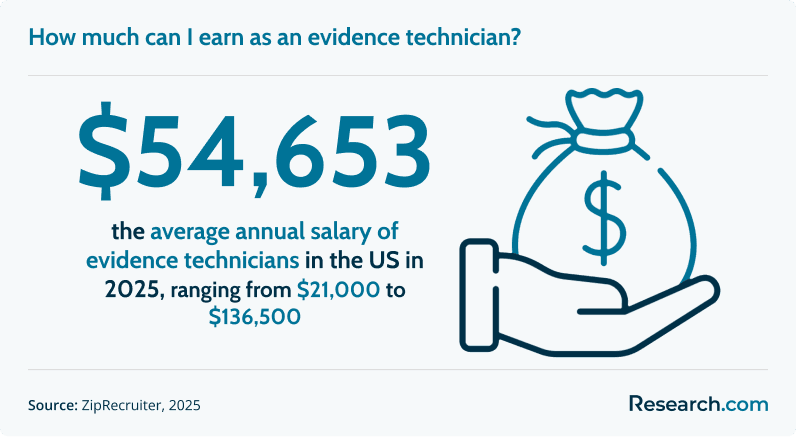
Forensic science technicians, a broader occupation that includes related evidence work, earned an average annual salary of $71,630 in 2024, with reported salaries from $41,520 to $107,630. Evidence technicians specifically had an average annual salary of $54,653 in 2025, with earnings ranging from $21,000 to $136,500.
| Salary measure | Reported amount | What it means for career planning |
| Forensic science technicians average salary in 2024 | $71,630 | Represents the broader occupational category that includes related forensic support roles |
| Forensic science technicians salary range in 2024 | $41,520 to $107,630 | Shows how pay can vary by agency, specialization, and location |
| Evidence technician average salary in 2025 | $54,653 | Provides a more role-specific benchmark for evidence technician positions |
| Evidence technician reported salary range in 2025 | $21,000 to $136,500 | Reflects wide variation across employers, regions, experience levels, and job duties |
What career paths are available for evidence technicians?
Evidence technician work can be a long-term career or a stepping stone into related forensic, investigative, legal, or law enforcement roles. Advancement usually depends on experience, certifications, education, agency size, and available promotions.
- Forensic science technician or specialist. With additional education or specialized training, evidence technicians may move toward forensic analysis, fingerprint work, DNA-related support, ballistics, or other technical areas.
- Crime scene investigator. Technicians who gain field experience may transition into crime scene response, evidence collection, photography, reconstruction support, and investigative documentation.
- Property and evidence manager. Experienced technicians may supervise evidence storage, audits, policy compliance, staff training, and secure facility operations.
- Law enforcement officer. Some evidence technicians pursue sworn policing roles and use their forensic background to support investigations.
- Forensic lab analyst. Technicians who complete additional science coursework or a forensic science degree may qualify for laboratory-based evidence analysis.
Some professionals pursue advanced or combined graduate education to move into policy, research, leadership, or academic roles. Research.com’s overview of dual master’s degree programs may be useful for readers considering broader graduate study options.
What is the job market for evidence technicians?
The job market for evidence technicians is connected to law enforcement staffing, forensic laboratory needs, evidence management standards, and the broader demand for forensic science technicians. While projections are not always reported separately for evidence technicians, the related forensic science technician occupation is projected to grow 14% from 2024 to 2034, with about 2,800 openings each year.
Most opportunities are likely to remain in government agencies, especially police departments, sheriff’s offices, state forensic laboratories, and public safety organizations. Private laboratories, universities, medical laboratories, and consulting firms may offer additional openings, but these can be more specialized and may require different credentials.
How to improve your chances in the job market
- Search multiple job titles, including evidence technician, property and evidence technician, forensic technician, crime scene technician, and evidence custodian.
- Match your education to actual employer requirements in your region.
- Gain hands-on experience through internships, public safety support roles, or property room work.
- Build strong documentation, database, and report-writing skills.
- Consider certification after identifying which credentials your target employers value.
- Prepare for background checks, policy-based interviews, and scenario questions about evidence integrity.
Here's What Graduates Have to Say About Becoming Evidence Technicians
- I began in a property and evidence clerk position, then used training and certifications to move into a full-time technician role. Learning chain-of-custody rules was challenging at first, but the procedures became second nature with practice. The work is steady, the benefits are strong, and I can see how my accuracy supports investigations. Christian
- This field fits me because I like careful, methodical work. You need patience, precision, and the ability to stay focused, but it is rewarding to know that your documentation can help protect the fairness of a case. I also value the stability of the profession. Valerie
- If you are interested in law enforcement but do not want a patrol role, evidence work can be a strong alternative. I interact with officers and forensic staff every day, and my job is to make sure each item is tracked correctly. That attention to detail can affect the direction of an investigation. Keith
Key Insights
- Evidence technician requirements are employer-specific. Some roles accept a high school diploma and experience, while others prefer a certificate, associate degree, or bachelor’s degree.
- A certificate can be a practical entry route, but a degree may improve competitiveness for larger agencies, forensic science positions, supervisory roles, and long-term advancement.
- The role is built around evidence integrity. Chain of custody, accurate records, secure storage, contamination prevention, and courtroom-ready documentation are central to the job.
- The broader forensic science technician field is projected to grow 14% from 2024 to 2034, with about 2,800 openings per year.
- Evidence technician pay varies significantly. The 2025 average is $54,653, with reported earnings from $21,000 to $136,500.
- Government agencies employ many forensic support professionals, especially at the local and state levels. Local government employment is reported at 10,770, while state government employment is reported at 4,610.
- Location matters. California employs 2,390 forensic science technicians and reports an average salary of $98,400, while Texas and Florida also have significant employment levels.
- Online training can help working adults, but students should still seek hands-on experience through internships, labs, agency work, or practical exercises.
- Before enrolling in any program, compare local job postings, verify accreditation, calculate total costs, and ask whether credits or certifications will support your long-term goals.
- Technology is raising expectations for evidence technicians. Digital tracking, secure databases, imaging tools, and AI-enhanced methods make technical skill development increasingly important.
References:
- College Factual. (2025). 2025 Criminology Degree Guide. https://www.collegefactual.com/majors/social-sciences/criminology/
- U.S. Bureau of Labor Statistics. (2025). Occupational Outlook Handbook: Forensic Science Technicians. https://www.bls.gov/ooh/life-physical-and-social-science/forensic-science-technicians.htm
- U.S. Bureau of Labor Statistics. (2025). Occupational Outlook Handbook: Police and Detectives. https://www.bls.gov/ooh/protective-service/police-and-detectives.htm
- Zippia. (2025). Forensic Scientist Demographics and Statistics in the US. https://www.zippia.com/forensic-scientist-jobs/demographics/
Other Things You Should Know About How to Become an Evidence Technician
Evidence technicians maintain chain of custody by logging every item at collection, assigning a unique case number, sealing packaging, and documenting each transfer with the date, time, and name of the person receiving it. Many agencies require barcode tracking and secure evidence lockers or rooms.
In 2027, becoming an evidence technician typically requires an associate degree in criminal justice, forensic science, or a related field. Some positions may prefer candidates with relevant certifications or work experience in law enforcement or a laboratory setting.
In 2027, certifications like the Certified Evidence Specialist (CES) from the International Association for Property and Evidence (IAPE) are beneficial but not mandatory. They enhance credibility and demonstrate specialized skills in managing and processing evidence in forensic contexts.


