
2027 How to Become a Parole Officer

Co-Founder and Chief Data Scientist
Becoming a parole officer is a public-safety career for people who can enforce court and parole-board requirements while helping formerly incarcerated individuals rebuild stable lives. The work is part law enforcement, part case management, and part community reentry support. It can involve home visits, risk assessments, drug testing, violation reports, job and housing referrals, and difficult conversations with people under legal supervision.
This guide explains how to become a parole officer in 2026, what degree and training you may need, how parole differs from probation, what the job pays, and how to decide whether this career fits your strengths. It also covers common mistakes to avoid, advancement options, and related education paths that may help you move into supervision, corrections management, forensic work, legal support, or other justice-related roles.
Quick answer: How do you become a parole officer?
Most parole officer jobs require a bachelor’s degree in criminal justice, psychology, sociology, social work, criminology, or a closely related field. Candidates usually must pass a background investigation, psychological screening, drug test, and sometimes a civil service exam. After hiring, new officers complete agency training that may include parole law, case management, crisis intervention, defensive tactics, report writing, field safety, and, in some states, firearms certification. Requirements vary by state, agency, and whether the role is classified as law enforcement or community supervision.
Key things to know before choosing this career
- Most agencies expect at least a bachelor’s degree in criminal justice, psychology, sociology, social work, or a related field. Federal, supervisory, or specialized positions may prefer graduate-level education.
- Parole officers supervise people released from prison, verify compliance with parole conditions, document progress or violations, and connect parolees with reentry services such as counseling, job training, housing support, and rehabilitation programs.
- Training is usually mandatory after hiring and may cover criminal law, crisis response, safety procedures, case planning, substance abuse issues, electronic monitoring, and court documentation. Some agencies also require firearms training and continuing education.
- Reported earnings vary by source, role, and location. The average salary for parole officers ranges from $49,000 to $67,000 annually, depending on experience and location, while other salary sources report different figures for probation and parole officers.
- State rules matter. Hiring standards, certification exams, psychological evaluations, peace officer status, firearms policies, and continuing education requirements can differ significantly across jurisdictions.
- What is a parole officer?
- What does a parole officer do?
- Probation officer vs. parole officer: what is the difference?
- Steps to become a parole officer in 2026
- What degree do you need to become a parole officer?
- What training do parole officers complete?
- Are certifications required for parole officers?
- What challenges should future parole officers expect?
- How can advanced education support career growth?
- Professional associations and networking options for parole officers
- Can an online forensic science degree help a parole officer?
- How forensic science knowledge can improve parole supervision
- Can parole officer experience lead to other law enforcement careers?
- How legal education can strengthen parole officer performance
- Average salary for parole officers
- Job outlook for parole officers
- Career advancement opportunities for parole officers
What is a parole officer?
A parole officer is a criminal justice professional who supervises people released from prison before the full completion of their sentence. Parole is conditional release, which means the person must follow specific rules set by a parole board, court, or corrections authority. The officer’s job is to monitor compliance, reduce risk, support reentry, and respond when a parolee violates release conditions.
In federal labor data, parole officers are commonly grouped with probation officers and correctional treatment specialists. Classified under the probation officers and correctional treatment specialists of the Bureau of Labor Statistics job categories, there were 90,700 parole officers in 2023.
The role requires judgment. A parole officer may help a parolee find treatment, employment support, or housing resources, but the officer may also recommend sanctions or parole revocation if the person misses required appointments, fails drug tests, commits a new offense, leaves an approved area, or otherwise violates release terms. The best officers understand both sides of the job: accountability and rehabilitation.
What does a parole officer do?
A parole officer role centers on post-release supervision. Officers manage caseloads, meet with parolees, document progress, coordinate with courts and corrections agencies, and connect people to programs that may reduce the risk of reoffending. Criminal justice education can be directly relevant to this work. The 3,675 criminal justice students who majored in corrections in the academic year 2021-2022, for instance, can practice case management specifically designed for those reentering communities.
Typical parole officer responsibilities include the following:
- Monitoring release conditions: Officers verify whether parolees follow curfews, travel limits, employment rules, treatment requirements, testing orders, and other conditions set by the supervising authority.
- Conducting field and office contacts: Work may include scheduled office visits, unannounced home visits, employer checks, treatment-provider communication, and collaboration with law enforcement when needed.
- Creating and updating case plans: Officers assess risk and needs, set supervision goals, document progress, and adjust supervision intensity based on behavior and compliance.
- Connecting parolees with services: A major part of reentry work involves referrals for counseling, substance abuse treatment, job training, education, housing assistance, and other community resources.
- Responding to violations: When parolees fail to comply, officers document the violation, recommend sanctions, notify appropriate authorities, and may participate in revocation proceedings.
- Maintaining detailed records: Case notes, violation reports, risk assessments, drug-test results, court documents, and program updates must be accurate because they can affect legal decisions.
There is an increasing need for probation and parole officers. The Federal Bureau of Prisons is implementing recruitment and relocation incentives to attract a larger pool of candidates.
The following chart shows the average inmate-to-correctional officer ratio in select correctional facilities. This data underscores the urgent need for increased staffing to ensure both the safety of correctional officers and the well-being of inmates.
How does a probation officer differ from a parole officer?
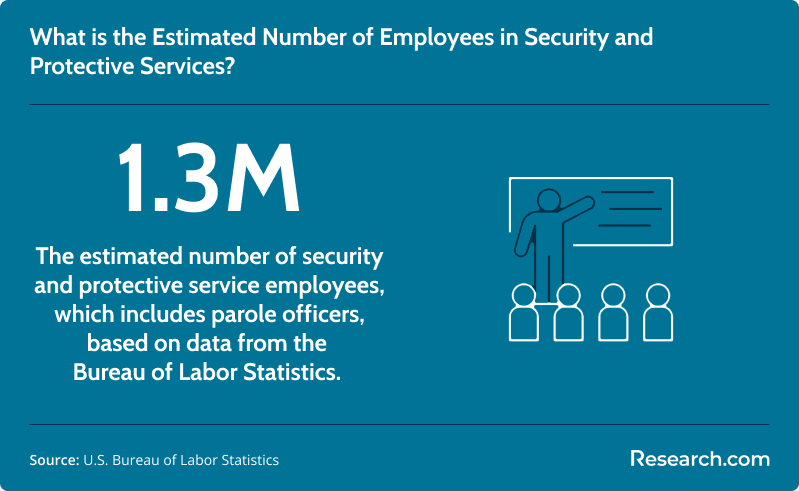
Probation officers and parole officers both supervise people in the community, but they work at different points in the criminal justice process. Both roles belong to the field of security and protective service which had a total of approximately 1.3 million employees in 2022. They are involved in pre-trial, probation, and post-release supervision.
A probation officer supervises individuals who are sentenced to probation instead of serving time in jail or prison, or who are placed on community supervision as part of a court sentence. The person remains in the community under court-ordered rules, such as regular check-ins, employment expectations, treatment participation, travel restrictions, or drug testing.
A parole officer supervises individuals after they have served part of a prison sentence and have been released under conditions. Parole supervision focuses heavily on reentry after incarceration, including compliance monitoring, service referrals, and intervention when risk increases.
| Comparison point | Probation officer | Parole officer |
| Who they supervise | People sentenced to probation or community supervision | People released from prison on parole |
| When supervision begins | Usually instead of incarceration or as part of a court sentence | After the person has served part of a prison sentence |
| Main authority involved | Courts and probation departments | Parole boards, corrections agencies, and post-release supervision authorities |
| Common focus | Compliance with court orders and community-based rehabilitation | Reentry, risk management, parole-condition compliance, and violation response |
| Possible consequence of violation | Court sanctions, stricter conditions, or incarceration | Sanctions, revocation recommendation, or return to prison |
What are the steps to becoming a parole officer?
The path to becoming a parole officer is not identical in every state, but most candidates move through the same general sequence: earn a relevant degree, build experience, apply through a government agency, pass screening, complete training, and maintain any required certifications.
1. Earn a degree related to criminal justice or human behavior
A bachelor’s degree is the usual starting point. Strong majors include criminal justice, criminology, sociology, psychology, social work, human services, and public administration. If you need a less complicated route into the field, compare programs carefully rather than choosing only by name; a guide to the easiest criminal justice degree options can help you evaluate workload, transfer policies, and program format.
2. Build experience before applying
Relevant experience can make an application stronger. Look for internships, volunteer roles, or entry-level jobs in corrections, community supervision, victim services, youth services, social work agencies, behavioral health programs, shelters, reentry organizations, or law enforcement support roles.
3. Review your state or agency requirements
Before applying, check whether the agency requires a civil service exam, minimum age, driver’s license, physical ability test, psychological evaluation, peace officer certification, firearms authorization, or prior corrections experience. Federal, state, and county agencies can use different hiring rules.
4. Apply through the proper corrections or supervision agency
Parole officer openings are typically posted by departments of corrections, parole boards, community supervision agencies, state civil service offices, or federal agencies. Application materials may include transcripts, employment history, references, writing samples, and answers to scenario-based questions.
5. Pass background screening and pre-employment assessments
Because parole officers handle sensitive information and interact with high-risk situations, applicants should expect a thorough background check. Agencies may also require psychological screening, drug testing, interview panels, physical readiness assessments, or a written exam.
6. Complete academy or agency training
New officers typically complete classroom and field training before managing a caseload independently. Training may cover criminal law, parole procedures, officer safety, communication, de-escalation, report writing, risk assessment, ethics, and case documentation. Federal parole officers must complete training at the Federal Law Enforcement Training Center (FLETC).
7. Continue training and pursue advancement
After the first year, officers often complete continuing education in topics such as domestic violence, mental health, substance use, electronic monitoring, trauma-informed supervision, specialized caseloads, or leadership. With experience, parole officers may move into senior officer, supervisor, training, investigations, policy, or corrections administration roles.
| Step | What to do | Why it matters |
| Choose the right major | Select criminal justice, psychology, social work, sociology, criminology, or a related field | Builds knowledge of law, behavior, casework, and corrections systems |
| Gain field exposure | Use internships, volunteer work, or entry-level human services roles | Shows readiness for difficult client interactions and documentation-heavy work |
| Check agency rules | Confirm testing, certification, firearms, and background requirements | Prevents wasted applications to agencies where you do not meet standards |
| Prepare for screening | Organize records, references, and explanations for employment or legal history | Background investigations are often detailed and time-consuming |
| Complete training | Finish academy, field training, and any mandated certifications | Required before independent supervision in many agencies |
What degree do you need to become a parole officer
Most parole officer positions call for a bachelor’s degree in a field connected to criminal justice, behavior, or public service. Common options include criminal justice, criminology, psychology, sociology, social work, human services, and public administration. These programs can help students understand courts, corrections, offender behavior, ethics, case management, interviewing, social services, and rehabilitation.
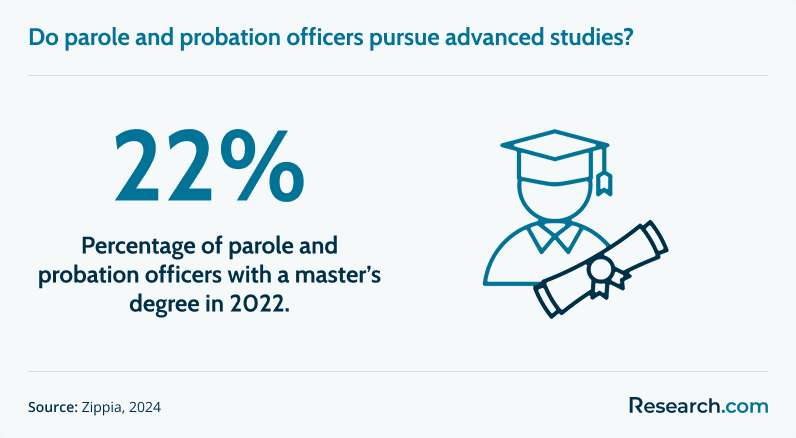
A master’s degree is not always required, but it can be useful for competitive agencies, specialized caseloads, supervisory roles, policy positions, or long-term advancement. In 2022, 22% of parole and probation officers have a master's degree. If you are comparing bachelor’s and graduate options, look beyond tuition alone; resources on affordable criminal justice degree programs can help you think through total cost, format, and long-term value.
| Degree field | How it can help in parole work | Best fit for students who want to focus on |
| Criminal justice or criminology | Covers corrections, courts, policing, criminal law, and offender supervision | Law enforcement, corrections, supervision, and public safety systems |
| Psychology | Builds understanding of behavior, motivation, assessment, and mental health factors | Risk assessment, behavioral change, and specialized caseloads |
| Social work | Emphasizes case management, client advocacy, service coordination, and community resources | Reentry support, treatment referrals, and rehabilitation-centered supervision |
| Sociology | Examines social systems, inequality, communities, and crime-related social factors | Community supervision, policy, and population-level analysis |
| Public administration | Develops knowledge of government operations, policy, budgeting, and management | Agency leadership, corrections administration, and public-sector management |
Hands-on experience still matters. A strong internship, corrections job, social services role, or community-based reentry experience can make a bachelor’s-level candidate more competitive than a graduate degree alone.
What type of training do parole officers go through?
As of 2021, there were 7,628 parole officers performing post-conviction supervision in U.S. courts. Because the work combines field safety, legal authority, and case management, agencies usually train new officers before they supervise parolees independently.
Training varies by state and agency. These and other related credentials influence salary. Certified parole officers receive the highest salary from the state of California, at approximately $97,300 per year.
Common training areas include the following:
Pre-service academy training
- Introduces parole law, corrections policy, case management, professional ethics, report writing, and supervision procedures.
- May include classroom instruction, scenario exercises, agency policy review, and testing before field assignment.
Officer safety, defensive tactics, and use-of-force policy
- Prepares officers for home visits, high-risk contacts, arrests or detentions where authorized, and personal safety planning.
- May include de-escalation, restraint techniques, defensive tactics, and agency-specific use-of-force standards.
Firearms training when required
- Some states or agencies authorize parole officers to carry firearms, while others do not.
- Where firearms are required, officers may complete safety, marksmanship, judgment, and requalification training.
Crisis intervention and mental health response
- Helps officers respond to people experiencing mental health crises, substance use issues, trauma responses, or volatile family situations.
- Often emphasizes communication, stabilization, referral, and safety.
Electronic monitoring and surveillance procedures
- Covers GPS tracking, ankle monitors, curfew verification, equipment alerts, documentation, and privacy-related procedures.
- Teaches officers how to respond when technology indicates a possible violation.
Risk assessment and case planning
- Trains officers to evaluate risk factors, protective factors, treatment needs, employment stability, housing, substance use, and compliance history.
- Supports decisions about supervision intensity, referrals, sanctions, and progress reviews.
Legal documentation and court testimony
- Focuses on due process, evidence handling, violation reports, hearing preparation, and testimony.
- Good documentation is essential because parole decisions may depend on the officer’s reports.
Field training with experienced officers
- New officers often shadow senior staff during office appointments, home visits, treatment-provider contacts, and violation investigations.
- Field training helps translate academy instruction into real supervision decisions.
When comparing salary potential across public-service careers, remember that specialized training and location can matter as much as the degree title. Students comparing multiple helping professions may also review resources such as associate degree in nursing programs or an MPH degree salary outlook to understand how education, licensure, and employer type affect compensation in different fields.
This chart ranks the top-paying states in terms of annual salary.
Are there any certifications required for parole officers?
There is no single national certification that every parole officer must hold. Requirements depend on the state, employer, and legal authority of the position. Some agencies treat parole officers primarily as community supervision professionals, while others classify them as peace officers with law enforcement powers. Education still comes first for many candidates, and affordable online bachelor degree programs may be useful for students who need flexibility while meeting baseline degree requirements.
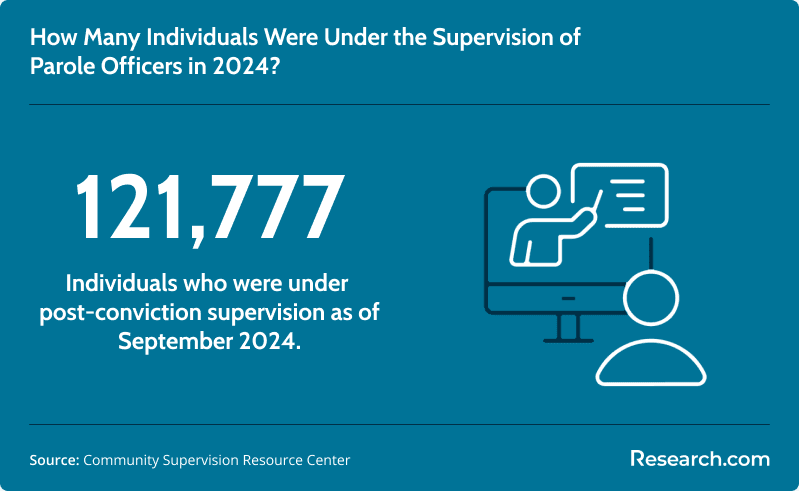
Certification and training requirements are especially important given the 121,777 individuals who were under post-conviction supervision as of September 2024.
| Certification or training area | When it may be required | What it usually covers |
| State parole officer certification | Required in some states after academy training | Parole law, supervision standards, case management, ethics, and agency procedures |
| Peace Officer Standards and Training (POST) | Required where parole officers are classified as peace officers | Arrest authority, defensive tactics, legal standards, firearms, and law enforcement procedures |
| Firearms certification | Required only in agencies where officers carry firearms | Safety, marksmanship, use-of-force rules, and periodic requalification |
| Crisis Intervention Training (CIT) | Often encouraged or required for high-risk caseloads | Mental health crises, de-escalation, substance use issues, and communication |
| CPR and first aid | Required by some employers for field staff | Emergency response until medical professionals arrive |
| Electronic monitoring training | Used when officers supervise GPS or monitoring cases | Monitoring software, alerts, documentation, compliance, and privacy procedures |
Before enrolling in a program or applying for a role, check the hiring agency’s official requirements. Ask whether certification is completed before hiring, during academy training, or after a probationary employment period.
What are the most significant challenges in the field?
Parole work can be rewarding, but it is not a low-stress desk job. Officers may handle large caseloads, unpredictable schedules, safety concerns during home visits, emotionally difficult cases, and pressure to make decisions that affect both public safety and a person’s freedom. The role can also create ethical tension: officers must build enough trust to support reentry while remaining prepared to document violations and recommend sanctions when necessary.
Common challenges include burnout, secondary trauma, high documentation demands, staff shortages, difficult family dynamics, substance use relapse, limited community resources, and the need to respond quickly when a parolee’s risk level changes. If you are exploring justice careers but want to compare pay, duties, and advancement options, review the highest paying criminal justice career paths before committing to one track.
How can advanced education enhance your career as a parole officer?
Graduate education or specialized coursework can help parole officers move beyond entry-level supervision into leadership, specialized units, program management, training, policy, or research-informed practice. A master’s degree in criminal justice, criminology, social work, psychology, public administration, or a related field may strengthen skills in risk assessment, evidence-based supervision, correctional policy, ethics, data analysis, mental health, and organizational leadership.
Advanced education is most useful when it matches a specific goal. For example, social work education may support roles involving treatment coordination, while public administration may help with management. If you are comparing justice-related academic routes, a guide to criminology degree career options can help you see where parole work fits within the broader field.
What professional associations and networking opportunities benefit parole officers?
Professional associations can help parole officers stay current on supervision practices, policy changes, officer safety, ethics, evidence-based reentry, and specialized populations. Membership may provide conferences, training, webinars, publications, mentorship, and networking with officers from other jurisdictions.
Relevant organizations may include national probation and parole associations, state community supervision groups, corrections associations, and public safety training networks. These groups are especially useful for officers seeking leadership roles or specialized assignments. Working professionals who need flexible education may also compare online criminal justice programs that fit around shift work or field schedules.
How can an online forensic science degree boost your parole officer career?
An online forensic science degree is not required to become a parole officer, but it may be useful for officers interested in investigative work, digital evidence, specialized violations, technology-assisted supervision, or future roles in law enforcement and corrections investigations. Forensic coursework can strengthen analytical thinking, documentation habits, evidence awareness, and collaboration with investigators.
Students considering this path should be realistic. A forensic science degree will not replace parole officer certification or agency training, and it may not be necessary for standard supervision roles. It makes the most sense if your target agency values investigative skills or if you want long-term mobility into related positions. Comparing affordable online forensic science degree programs can help you weigh cost against career value.
How Can Forensic Science Expertise Enhance Parole Officer Performance?
Forensic knowledge can improve how parole officers understand evidence, document incidents, and communicate with law enforcement partners. It may be particularly useful in cases involving electronic monitoring alerts, digital communications, drug-related evidence, weapons concerns, or alleged new criminal conduct. The goal is not to turn parole officers into forensic scientists, but to help them recognize when evidence must be preserved, documented, and referred properly.
If you are pursuing a more science-focused justice career, programs at the top colleges for forensic science may be worth comparing with criminal justice, criminology, and legal studies pathways.
Can Parole Officer Experience Facilitate Transitions to Other Law Enforcement Roles?
Parole officer experience can translate well to other public safety roles because officers develop skills in interviewing, risk assessment, crisis response, documentation, court communication, community contacts, and interagency collaboration. Some professionals move into policing, investigations, corrections administration, federal law enforcement, reentry program leadership, or specialized supervision units.
Requirements do not transfer automatically. A move into a federal or specialized law enforcement role may require a separate academy, age standards, fitness testing, security clearance, or additional education. If you are considering immigration or federal enforcement work, compare your background with the qualifications to become an ICE agent before assuming parole experience is enough.
How Can Complementary Legal Education Enhance Career Effectiveness?
Legal knowledge can make parole officers more effective because the job relies heavily on due process, conditions of release, search authority, hearing procedures, documentation, and court testimony. Coursework in legal studies or paralegal studies may help officers write clearer reports, understand procedural rules, and communicate more effectively with attorneys, judges, parole boards, and corrections administrators.
Legal education is most valuable when it supports a defined goal, such as moving into compliance, investigations, hearings, policy, or administrative roles. Officers who want structured legal training without pursuing law school may compare affordable ABA-approved online paralegal programs.
What is the average salary for a parole officer?
The average salary for a parole officer depends on location, agency, experience, education, certification, union agreements, and whether the position is state, federal, county, or local. Higher-cost regions and agencies with law enforcement classifications may offer different pay structures than community-supervision-focused roles.
- Location: Pay is often higher in areas with a higher cost of living or larger correctional systems.
- Experience: Senior officers, supervisors, and specialized caseload officers may earn more than entry-level officers.
- Education: A bachelor’s degree is commonly required, while advanced education may support promotion. Candidates comparing pathways should distinguish bachelor’s requirements from associate degree options, which may be helpful for transfer planning but may not meet all parole officer job requirements.
- Agency type: Federal, state, county, and local agencies may use different salary schedules and benefits.
Salary sources report different figures because they may use different job titles, samples, and reporting methods. Sites like Ziprecruiter show that as of March 2025 the average annual pay for a Probation and Parole officer in the United states is $56,720. The Bureau of Labor Statistics (BLS) states that the median annual wage for probation officers and correctional treatment specialists was $61,800 in May 2023.
Location can create large differences. Indeed.com notes that parole officers in New York, NY, earn an average of $104,493 per year, while those in Nashville, TN, average $59,633 annually.
If your main decision factor is pay, compare parole work with adjacent public-service roles before enrolling in a degree program. For example, a social worker salary guide by state can help you compare helping-profession salaries, licensure requirements, and advancement potential.
| Salary factor | Question to ask | Why it affects earnings |
| Employer | Is the job federal, state, county, or local? | Each agency may use a different pay scale and benefits package |
| Geographic area | What is the cost of living and local salary range? | Pay can vary sharply by city and state |
| Certification status | Is peace officer, firearms, or state certification required? | Some classifications may have different compensation structures |
| Education | Does the agency reward graduate education? | Advanced education may support promotion or specialized assignments |
| Caseload type | Is the role general supervision or a specialized unit? | Specialized roles may require more experience or training |
What is the job outlook for parole officers?
The U.S. Bureau of Labor Statistics groups parole officers with probation officers and correctional treatment specialists. According to the BLS, employment in this group is projected to grow 4% from 2023 to 2033, which is about as fast as the average for all occupations.
Openings may come from growth, retirements, workers transferring to other fields, and agency staffing needs. Actual hiring can shift based on state budgets, correctional policy, sentencing practices, caseload levels, reentry funding, and public safety priorities. Candidates should monitor state and local agency postings rather than relying only on national projections.
Technology is also changing the work. Electronic monitoring, case management platforms, data dashboards, and risk assessment tools are increasingly part of supervision. These tools do not remove the need for human judgment, but they do require officers to document carefully, understand data limitations, and avoid treating automated alerts as complete evidence without context.
If you are comparing parole work with intelligence, investigative, or federal careers, salary and hiring requirements may look very different. A resource on CIA agent salary expectations can help you compare justice-related paths outside community supervision.
What are the career advancement opportunities for parole officers?
Parole officer experience can lead to advancement inside community supervision agencies or movement into related fields. The best path depends on whether you prefer direct fieldwork, leadership, investigations, policy, treatment coordination, or broader public safety roles.
Supervisory and management roles
- Experienced officers may become senior parole officers, unit supervisors, field supervisors, training officers, or parole managers.
- These roles usually involve reviewing case decisions, coaching staff, assigning caseloads, handling complex incidents, and implementing agency policy.
Specialized supervision units
- Some agencies assign officers to specialized caseloads involving sex offenses, domestic violence, substance use, mental health, electronic monitoring, high-risk reentry, or violent offenses.
- Specialized units may require additional training, stronger documentation skills, and close coordination with treatment providers or law enforcement.
Administrative, policy, and program roles
- Parole officers with strong writing, data, and leadership skills may move into program evaluation, reentry program management, compliance, training, policy development, or corrections administration.
- Graduate education in public administration, criminal justice, or social work may be helpful for these paths.
Related career moves
- Law enforcement: Some officers transition to police, detective, investigations, or federal enforcement roles, although separate hiring and academy requirements may apply.
- Social work and counseling-related services: Officers who enjoy rehabilitation and service coordination may pursue additional education. Flexible online social work degree programs may be relevant for those considering that direction.
- Corrections administration: Experience with parole supervision can support roles in prisons, reentry programs, correctional policy, and community corrections.
- Public-sector leadership: Officers with management training may move into broader government roles involving public safety, human services, or justice policy.
Career changes are easier when you compare requirements early. For instance, someone comparing parole work with emergency healthcare may find that ER nurse career requirements involve a very different mix of education, licensure, shift structure, and clinical responsibility.
| Career goal | Helpful preparation | Potential next roles |
| Stay in field supervision | Strong performance reviews, field safety training, advanced case management | Senior parole officer, specialized caseload officer |
| Move into leadership | Supervisory training, graduate education, policy knowledge | Unit supervisor, parole manager, corrections administrator |
| Shift toward treatment and reentry | Social work, counseling, substance abuse, or reentry program training | Reentry coordinator, treatment liaison, program manager |
| Enter investigations or law enforcement | Law enforcement academy requirements, physical standards, investigative training | Detective, investigator, federal law enforcement applicant |
| Work in policy or administration | Public administration, data analysis, grant writing, program evaluation | Policy analyst, compliance specialist, agency administrator |
How to decide if becoming a parole officer is worth it
Parole work may be worth pursuing if you want a stable public-service role that combines accountability, fieldwork, legal procedures, and rehabilitation. It is a strong fit for people who can communicate calmly, write clearly, make defensible decisions, and work with people facing serious barriers. It may not be the right fit if you want predictable hours, minimal conflict, or a role focused only on counseling without enforcement duties.
| This career may fit you if... | You may want another path if... |
| You can balance empathy with firm boundaries | You are uncomfortable enforcing consequences |
| You are comfortable with field visits and unpredictable situations | You prefer a fully office-based or highly predictable job |
| You write detailed, accurate reports | You dislike documentation-heavy work |
| You can manage stress and emotionally difficult cases | You want a low-conflict helping profession |
| You are interested in public safety and reentry | You want a role focused only on investigation or only on therapy |
Common mistakes to avoid when preparing for this career
- Choosing a degree without checking job postings: Review parole officer openings in your state before selecting a major. Some agencies list specific degree fields, experience requirements, or certification rules.
- Assuming all states use the same standards: One state may require peace officer certification while another may emphasize case management and rehabilitation training.
- Focusing only on tuition: Compare total program cost, transfer credits, internship access, online fees, books, commuting, and time to completion.
- Ignoring background requirements: A criminal record, poor driving history, drug use history, or unresolved financial issues may affect eligibility depending on the agency.
- Underestimating writing demands: Reports, violation documentation, case notes, and hearing materials are central to the job.
- Assuming salary outcomes are guaranteed: Published averages are useful, but actual pay depends on location, agency, experience, and classification.
- Choosing online education without verifying fit: Online degrees can be legitimate, but you should check accreditation, internship options, transfer policies, and whether the program meets your target agency’s requirements.
Questions to ask before enrolling in a degree program
- Is the school institutionally accredited?
- Does the program offer coursework in corrections, criminal law, case management, psychology, substance abuse, or social services?
- Can I complete an internship with a corrections, parole, probation, reentry, or social services agency?
- Will my credits transfer if I start at a community college?
- What is the total cost after fees, books, technology charges, and travel?
- Does the program support working adults or students who need part-time study?
- Do graduates commonly work in criminal justice, corrections, social services, or public agencies?
- Will this degree meet the minimum requirements for parole officer jobs in my state?
What professionals commonly say about parole officer work
People who stay in parole work often point to the same themes: the job is demanding, the paperwork is significant, and the emotional pressure can be real. At the same time, officers may find the work meaningful because they can help people stabilize after prison while contributing to community safety.
Successful parole officers often describe communication, judgment, patience, boundary-setting, and teamwork as essential. The role is rarely simple. A productive day may involve helping one parolee secure treatment, documenting another person’s violation, coordinating with police, and preparing a report for a hearing.
Key Insights
- Parole officers supervise people after prison release, while probation officers usually supervise people sentenced to community supervision instead of incarceration.
- A bachelor’s degree is the standard entry requirement for many parole officer jobs, commonly in criminal justice, psychology, sociology, social work, criminology, or a related field.
- Agency rules vary. Some parole officers need state certification, POST training, firearms certification, or continuing education; others work in roles focused more heavily on case management and rehabilitation.
- As of 2023, there were approximately 90,700 probation officers and correctional treatment specialists, including parole officers, according to the Bureau of Labor Statistics.
- In 2021, 7,628 parole officers were directly engaged in post-conviction supervision within U.S. courts.
- Advanced education can matter for promotion. In 2022, 22% of parole and probation officers held a master's degree.
- Pay varies widely by source and location. The BLS reported a median annual wage of $61,800 for probation officers and correctional treatment specialists in May 2023, while Ziprecruiter reported $56,720 as of March 2025 for a Probation and Parole officer in the United states.
- Local salary research is essential. Indeed.com notes that parole officers in New York, NY, earn an average of $104,493 per year, while those in Nashville, TN, average $59,633 annually.
- The BLS projects 4% employment growth for probation officers and correctional treatment specialists from 2023 to 2033.
- The best candidates prepare for both sides of the job: enforcing legal conditions and helping parolees access services that support successful reentry.
References:
- Bureau of Justice Statistics. (2023). Correctional populations in the United States, 2022 – statistical tables. U.S. Department of Justice, Office of Justice Programs.
- Bureau of Justice Statistics. (2023). Census of federal law enforcement officers (CFLEO). U.S. Department of Justice, Office of Justice Programs.
- Bureau of Justice Statistics. (2024). State and local law enforcement training academies and recruits, 2022. U.S. Department of Justice, Office of Justice Programs.
- U.S. Bureau of Labor Statistics. (2023). Probation officers and correctional treatment specialists. Occupational Outlook Handbook.
- U.S. Bureau of Labor Statistics. (2023). Occupational employment and wage statistics.
- O*NET OnLine. (2024). Summary report for probation officers and correctional treatment specialists.
Other Things You Should Know About Becoming a Parole Officer
Most agencies require a criminal history check, fingerprinting, and a review of prior arrests, convictions, and driving record. Many also require a drug screen and, for federal roles, a full suitability investigation before appointment. Unsuitable records can disqualify applicants.
In 2027, becoming a parole officer typically requires a bachelor's degree in criminal justice, social work, psychology, or a related field. Some positions may require related work experience or additional training in counseling or law enforcement.
In 2027, aspiring parole officers typically need to complete an internship or field experience in criminal justice settings such as probation offices or correctional facilities. These placements offer practical exposure and may be required for graduation in relevant academic programs.


