2027 Master’s in Accounting vs. CPA: Explaining the Difference

Co-Founder and Chief Data Scientist
Choosing between a Master’s in Accounting and a CPA license is not really a choice between “school” and “work.” It is a decision about what kind of accounting career you want, how quickly you need to qualify, whether you need legal authority to perform regulated services, and how much time and money you are prepared to invest.
The stakes are practical. According to the U.S. Bureau of Labor Statistics (2025), employment for accountants and auditors is projected to grow 5% from 2024 to 2034, with approximately 105,000 new jobs and 135,000 openings expected each year. Employers need accounting professionals who can handle financial reporting, audit risk, tax rules, data systems, and compliance pressure. At the same time, students and working adults need to know which credential will actually move them closer to their target role.
This guide explains the difference between a Master’s in Accounting and the CPA credential, how each pathway affects career options, what employers tend to value, how salaries compare, and when it makes sense to pursue one, both, or neither.
Quick answer: Master’s in Accounting vs. CPA
A Master’s in Accounting is a graduate degree. A CPA is a professional license. The master’s degree builds advanced accounting knowledge and can help you meet the 150-credit education requirement used by most state boards. The CPA license gives you legal authority and professional recognition for regulated accounting services such as audits, certain tax representation work, and SEC-related reporting.
| Question | Short answer |
| Which is better for public accounting? | The CPA license is usually more important, especially for audit, tax, and assurance roles. |
| Which is better for meeting education requirements? | A Master’s in Accounting can be an efficient way to reach the 150-credit requirement for CPA eligibility. |
| Can you be an accountant without either one? | Yes. Many entry-level roles require a bachelor’s degree, but senior and regulated roles often favor or require additional credentials. |
| Which has stronger salary upside? | CPAs often have higher earning potential, especially in public accounting, leadership, and regulated roles. |
| Should you pursue both? | Often, yes, if you need graduate credits and plan to become licensed. The MAcc can be the academic bridge to CPA eligibility. |
Master’s in Accounting vs. CPA: Key Points
- The U.S. Bureau of Labor Statistics (2025) projects 5% employment growth for accountants and auditors from 2024 to 2034. Some cited summary figures describe approximately 60,000 new jobs and 125,000 annual openings, while the BLS-linked section below cites approximately 130,800 annual openings; readers should confirm the latest figures directly through the BLS before making workforce assumptions.
- Accountants in the U.S. earn between $44,935 and $97,583, while CPAs earn more, ranging from $58,376 to $144,858.
- Industry matters. Accountants in finance and insurance earned a median wage of $87,980 in May 2024.
- Master’s in Accounting: what the degree covers
- CPA license: what the credential allows you to do
- Do accountants need a master’s degree or CPA license?
- MAcc admissions, prerequisites, and coursework
- Steps to become a CPA in 2026
- Career paths for MAcc graduates and CPAs
- CPA vs. MAcc salary comparison
- Demand for accounting graduates and CPAs in 2026
- How employers compare the CPA and master’s degree
- Using an associate degree as an accounting starting point
- How to choose between a MAcc and CPA license
- Why accreditation and program quality matter
- Cost and return on investment: CPA vs. MAcc
- Career advancement differences
- Technology trends changing accounting careers Career growth considerations Cost comparison Decision factors Common mistakes
What is a Master’s in Accounting degree?
A Master’s in Accounting, often called a MAcc, is a graduate-level accounting program focused on advanced technical knowledge and professional preparation. Unlike a general business degree, a MAcc is usually built around topics such as financial reporting, auditing, taxation, accounting systems, analytics, ethics, and regulatory compliance.
Most programs take one to two years to complete, depending on whether the student attends full time or part time, enters with an accounting background, or needs prerequisite coursework. Some formats are designed for recent bachelor’s graduates, while others serve working professionals who want to qualify for more advanced accounting roles. Like accelerated MBA programs, some MAcc options compress graduate study into a shorter timeline while still emphasizing applied business decision-making.
One major reason students choose a MAcc is to satisfy the 150-credit hour education requirement used in most states for CPA exam eligibility. The degree can also be useful for people who want deeper preparation before entering public accounting, corporate finance, government, nonprofit accounting, consulting, internal audit, or doctoral study.
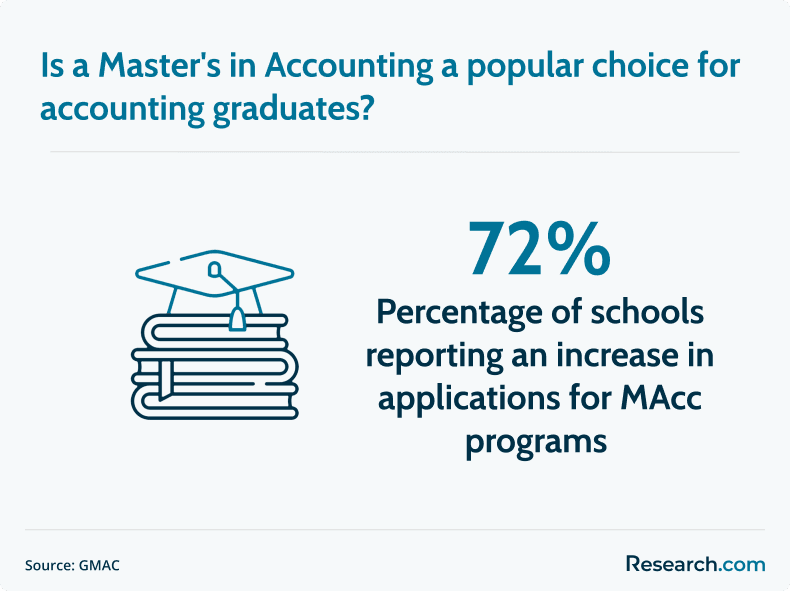
Interest in the degree has strengthened. According to the Graduate Management Admission Council (GMAC), nearly three-fourths of master’s in accounting programs, including some one-year degree programs, reported application growth in 2024. GMAC noted that 72% of schools reported application increases while 26% reported declines, the first time since 2020 that growth was reported by more schools than decline.
| MAcc feature | What it means for students |
| Graduate academic credential | Shows advanced study in accounting, but does not by itself create CPA licensure. |
| Often helps with 150 credits | Can close the education gap for students who earned a 120-credit bachelor’s degree. |
| Useful beyond public accounting | Supports roles in corporate accounting, finance, consulting, government, nonprofit accounting, and academia. |
| May include analytics and systems | Helps students prepare for accounting work shaped by data tools, automation, and cloud platforms. |
What is a Certified Public Accountant (CPA)?
A Certified Public Accountant is a licensed accounting professional who has met state education, examination, experience, and ethics requirements. As of 2024, there are 671,855 actively licensed CPAs, according to the National Association of State Boards of Accountancy.
The CPA is not a college degree. It is a state-issued professional license. That distinction matters because CPAs can perform certain regulated services that non-licensed accountants cannot, including signing audit reports, filing certain reports with the Securities and Exchange Commission, and representing clients before the Internal Revenue Service in specific circumstances.
The credential is especially important in public accounting, audit, tax, assurance, forensic accounting, and roles where financial statements must meet strict regulatory standards. It also signals to employers that the professional has passed a demanding exam, completed supervised experience, and agreed to maintain ethical and continuing education standards.
| CPA license element | Why it matters |
| State licensure | Requirements are set and enforced by state boards of accountancy. |
| Uniform CPA Exam | Demonstrates competency in core accounting, audit, tax, regulation, and a selected discipline area. |
| Experience requirement | Most states require supervised accounting experience before licensure. |
| Continuing education | Licensed CPAs must keep skills current through ongoing professional education. |
Do you need a master’s degree or a CPA license to become an accountant in the US?
No. You can work in many accounting roles in the U.S. without a master’s degree or a CPA license. A bachelor’s degree in accounting, business, finance, or a related field is enough for many entry-level jobs such as staff accountant, bookkeeper, payroll analyst, accounts payable specialist, junior internal auditor, or accounting assistant.
However, the ceiling can be different. If you want to sign audit reports, work in public accounting at a higher level, represent clients in certain tax matters, or compete for controller, audit manager, or partner-track roles, CPA licensure can become highly valuable or necessary. A MAcc can help you strengthen technical knowledge and meet CPA education requirements, but it does not replace the license.
The right comparison is not “degree versus license” in every case. It is more useful to ask what your target job requires. Students comparing graduate business routes in other fields face a similar decision when evaluating an MBA vs MHA; the stronger option depends on the industry, role, credential expectations, and long-term plan.
| Career goal | Is a MAcc needed? | Is a CPA needed? |
| Entry-level corporate accounting | Helpful but often not required | Usually not required |
| Public accounting audit track | Helpful, especially for 150 credits | Often required for advancement |
| Tax advisory work | Helpful for technical preparation | Often preferred and sometimes essential |
| Internal audit or compliance | Helpful | Valuable but not always mandatory |
| Accounting professor or lecturer | Often useful or required | May help professionally but is not always required |
What are the admission requirements and coursework for a Master’s in Accounting?
MAcc admissions vary by institution, but most programs expect applicants to hold a bachelor’s degree. An undergraduate accounting or business background may make admission and course sequencing easier, although some programs accept students from other fields if they complete prerequisites.
Common requirements include a minimum GPA, often around 3.0, a resume, letters of recommendation, a statement of purpose, and official transcripts. Some schools may request GMAT or GRE scores, while others waive testing for applicants with strong academic or professional profiles. International applicants may need TOEFL or IELTS scores.
| Requirement or course area | What to expect |
| Prerequisite accounting courses | Students without an accounting major may need introductory accounting, finance, statistics, or business law. |
| Advanced financial accounting | Courses may cover consolidations, multi-entity reporting, foreign currency accounting, and complex reporting issues. Students comparing finance-related graduate options may also review online master’s in finance programs. |
| Auditing and assurance | Students study audit planning, risk assessment, evidence, internal controls, reporting, and professional standards. |
| Taxation | Coursework typically examines individual, corporate, partnership, compliance, and planning topics. |
| Managerial accounting | Students learn how accounting information supports budgeting, cost control, performance analysis, and internal decision-making. |
| Accounting information systems | Programs increasingly emphasize how financial data is collected, processed, secured, and reported through technology platforms. |
| Business ethics and corporate law | Students examine professional conduct, legal responsibilities, independence, fraud risk, and ethical decision-making. |
| Data analytics for accounting | Courses may use modern tools to analyze financial and operational data for reporting, compliance, and advisory work. |
| Capstone or internship | Many programs include a project, practicum, or internship that connects classroom work to real accounting problems. |
When comparing programs, look beyond the course titles. Ask whether the curriculum aligns with CPA exam preparation, whether the credits satisfy your state board’s rules, whether analytics training is meaningful, and whether the school has recruiting relationships with accounting firms or employers in your target region.
What are the steps to become a CPA in 2026?
CPA licensure is governed by state boards, so candidates should always verify rules in the state where they plan to become licensed. The general path includes education, the CPA Exam, supervised experience, ethics requirements in some states, and ongoing continuing professional education.
| Step | What to do | Decision point |
| 1. Earn a bachelor’s degree | Complete an undergraduate degree in accounting or a related field. | Confirm whether your transcript includes the required accounting and business coursework. |
| 2. Reach 150 credit hours | Most states follow the Uniform Accountancy Act model requiring 150 semester hours of postsecondary education. | Decide whether to use a MAcc, extra undergraduate credits, certificate coursework, or another graduate program. |
| 3. Apply for the CPA Exam | The CPA Exam is administered by the AICPA and coordinated through NASBA. | Check your state board’s timing rules before applying. |
| 4. Pass the CPA Exam | Complete the three Core sections: Auditing and Attestation, Financial Accounting and Reporting, and Regulation, plus one Discipline section. | Choose the discipline that best fits your career plan. |
| 5. Meet the exam window | Each section must be passed within an 18-month window once the first section is passed. | Create a study calendar that accounts for work, school, and testing availability. |
| 6. Gain professional experience | Most states require one to two years of supervised accounting experience, often verified by a licensed CPA. | Choose jobs that meet your state’s definition of qualifying experience. |
| 7. Complete ethics requirements | Some states require an ethics course or exam approved by the board. | Do not assume your state waives this requirement. |
| 8. Apply for licensure | Submit final documents, experience verification, fees, and any background check materials required by your state board. | Keep copies of transcripts, score notices, and supervisor verification forms. |
| 9. Maintain the license | Complete Continuing Professional Education annually or biannually, depending on state rules. | Track CPE early to avoid renewal problems. |
The CPA Exam discipline you choose can help shape your early specialization. All three disciplines—Business Analysis and Reporting, Information Systems and Controls, and Tax Compliance and Planning—lead to full CPA licensure, but they emphasize different skill sets.
In the fourth quarter of 2024, NASBA candidate selections showed the strongest interest in Tax Compliance and Planning, selected by 40.5% of candidates. Business Analysis and Reporting followed at 32.4%, while Information Systems and Controls accounted for 27.2%. That distribution suggests many candidates still favor tax and reporting pathways, while technology-focused accounting remains a meaningful but smaller share.
What are the career paths and industries for CPAs and Master’s in Accounting graduates?
Both MAcc graduates and CPAs can work across public accounting, corporate finance, government, consulting, nonprofit organizations, healthcare, financial services, and education. The difference is that CPA licensure often matters most where legal authority, audit responsibility, tax representation, or regulated reporting is involved.
Roles where CPA licensure is often required or strongly preferred
- Public accountant. CPA licensure is especially important in firms that provide audit, assurance, tax, and advisory services to clients.
- External auditor. Auditors who issue or sign official reports for regulated entities often need CPA authority.
- Forensic accountant. CPAs are frequently preferred for fraud investigation, litigation support, and financial dispute work because the role requires credibility and technical rigor.
- Controller. Senior accounting leaders, especially in larger organizations, are often expected to understand compliance, controls, financial reporting, and audit readiness at a CPA level.
Roles open to both MAcc graduates and CPAs
- Corporate accountant. Professionals prepare reports, reconcile accounts, support month-end close, and help maintain financial records for private organizations.
- Internal auditor. Internal auditors evaluate controls, risk management, operational processes, and compliance systems.
- Tax advisor or consultant. MAcc graduates can work in tax planning and preparation, while CPAs may have broader authority for complex client representation and regulated work.
- Financial analyst. Accounting graduates may use financial data to support forecasting, budgeting, variance analysis, and strategy.
- Compliance officer. Professionals monitor whether organizations follow financial regulations, internal policies, and reporting standards.
- Chief Financial Officer. A CPA is not always required, but it is often valued for CFO roles, particularly in regulated or publicly traded environments.
- Accounting manager. Both credentials can support advancement into team leadership, reporting oversight, and process improvement roles.
- Professor or lecturer in accounting. If you are asking, what degree do you need to be a college professor, a master’s degree in the teaching field is commonly required for many college-level instructional roles, though research-focused academic careers may require additional graduate study.
| Industry | Why accounting credentials matter |
| Public accounting | CPA licensure is central for audit, assurance, tax, and partner-track roles. |
| Finance and insurance | Complex reporting, regulation, and risk controls increase demand for advanced accounting expertise. |
| Corporate management | Companies need accountants for financial reporting, internal controls, budgeting, and strategic planning. |
| Government | Accounting professionals support audits, compliance, budgeting, public reporting, and fraud prevention. |
| Healthcare | Organizations need professionals who understand reimbursement, compliance, cost controls, and financial reporting. |
| Consulting | Advisory roles often combine accounting, systems, analytics, risk, and business process improvement. |
What is the salary difference between CPAs and those with a Master’s in Accounting?
Accounting can lead to stable and well-paid roles, but salary outcomes depend heavily on credential, industry, job title, experience, location, and employer size. A bachelor’s or master’s in accounting may also be considered among online degrees that pay well, especially when paired with marketable experience and technical skills.
According to Indeed, accountants in the U.S. earn between $44,935 and $97,583. CPAs earn between $58,376 and $144,858. Salary.com reports that a chartered accountant salary ranges from $68,855 to $83,737 per year. In the U.S. context, Chartered Accountant is often discussed as comparable to the CPA, although credential systems differ by country.
CPAs often earn more because the license can qualify them for roles with higher responsibility, legal authority, client trust, and regulatory exposure. MAcc graduates can still earn competitive salaries, particularly in corporate accounting, finance, analytics, consulting, and management roles, but the master’s degree alone does not provide the regulated authority of CPA licensure.
| Salary factor | How it affects pay |
| Location | Major metro areas and high-cost states such as California, New York, and Massachusetts often pay more. |
| Experience | Professionals with more years in accounting, audit, tax, finance, or management generally command higher compensation. |
| Employer size | Large firms and multinational companies may pay more because the work involves greater scope and risk. |
| Additional credentials | Certifications such as CMA, CIA, or MBA degrees can improve competitiveness for certain roles. |
| Job title | Senior auditor, controller, audit manager, tax manager, and CFO roles typically pay more than entry-level accounting jobs. |
| Industry | Finance, insurance, consulting, and highly regulated sectors often offer stronger pay than some nonprofit or government roles. |
Professionals in healthcare who are evaluating a business graduate degree may also compare salary after MBA in healthcare management to accounting salary paths before deciding which credential fits their goals.
Industry differences are significant. In May 2024, finance and insurance offered the highest median wage for accountants at $87,980. Corporate management followed at $86,010, government at $81,120, and accounting and payroll services at $80,510. These differences reflect the complexity, regulatory pressure, and responsibility levels associated with each sector.
Are CPAs and accounting graduates in demand in 2026?
Yes, accounting graduates and CPAs remain in demand in 2026, although demand varies by specialization, location, and employer. The profession is affected by retirements, changing enrollment patterns, regulatory complexity, and employers’ need for professionals who understand both accounting rules and digital systems.
The U.S. Bureau of Labor Statistics projects 5% growth in employment for accountants and auditors from 2024 to 2034. The BLS-linked discussion cites approximately 130,800 job openings each year, primarily because workers change occupations, leave the labor force, or retire.
Retirement pressure is also shaping hiring. A survey cited in the original source material found that 20% of firms expect more than half of their CPAs to retire, and the average anticipated retirement rate across firms was 30.5%.
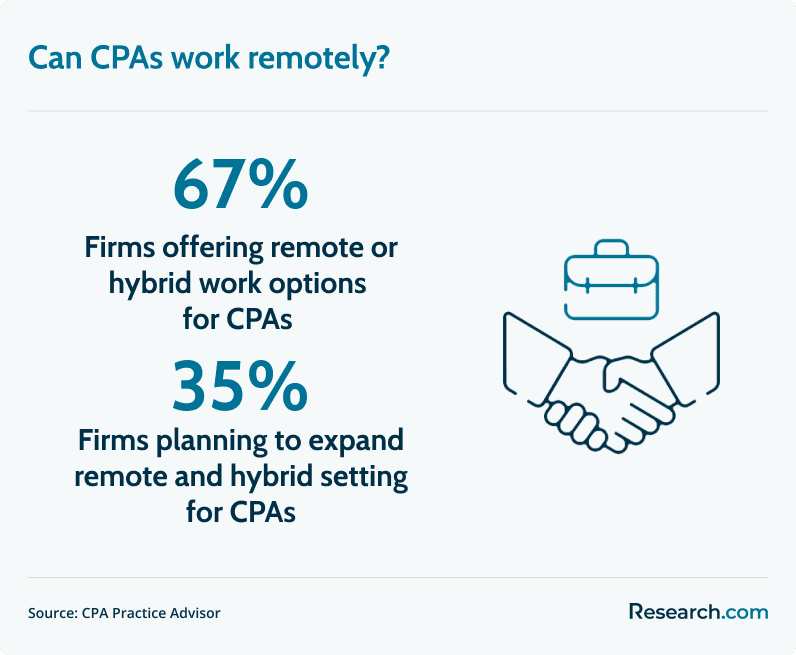
Workplace expectations are changing as well. According to Canopy and CPA Practice Advisor (2024), 67% of firms currently offer remote or hybrid work options, and 35% plan to expand those options. That does not mean every accounting job is remote, but it does show that flexibility has become part of the competition for accounting talent.
How do employers view a CPA license compared to a master’s degree?
Employers usually view the CPA license as a stronger signal for regulated accounting work. It demonstrates that a candidate has passed a rigorous professional exam, met state requirements, completed supervised experience, and accepted continuing education obligations. For audit, assurance, tax, SEC reporting, public accounting, and compliance-heavy positions, the CPA can carry more weight than a master’s degree alone.
A Master’s in Accounting is still valuable. It signals advanced academic preparation, exposure to technical accounting topics, and commitment to the profession. Employers may favor MAcc graduates for staff accountant, corporate accounting, consulting, financial reporting, internal audit, government, and analytics-related roles. The degree can also prepare students to sit for the CPA Exam if it helps them meet credit requirements.
The 2024 GMAC survey of corporate recruiters found that 40% of employers worldwide planned to hire more MAcc degree holders than in the previous year. Finance and accounting firms showed the strongest demand at 41%. Demand was lower but still present in technology at 27%, manufacturing at 29%, and products and services at 24%.
| Employer priority | Credential that usually fits best | Why |
| Audit authority and public accounting advancement | CPA | The license is tied to regulated responsibilities and professional authority. |
| Meeting CPA education requirements | MAcc | The degree can help students reach the 150-credit benchmark. |
| Corporate accounting and reporting roles | Either | Employers may value the CPA, but a strong MAcc graduate can also qualify. |
| Tax leadership | CPA | CPA authority and tax expertise are often preferred for complex advisory work. |
| Analytics-focused accounting roles | MAcc or CPA with tech skills | Employers increasingly need accounting professionals who can work with data systems and analytics tools. |
Is pursuing an associate degree an effective stepping stone in accounting?
An associate degree in accounting can be a practical entry point for students who want a lower-cost introduction to bookkeeping, payroll, accounting software, tax basics, and financial statements before committing to a bachelor’s or master’s program. It may also help working adults qualify for clerical or junior accounting roles while they continue their education.
The main limitation is advancement. An associate degree alone usually will not meet the educational expectations for CPA licensure, public accounting advancement, or many professional accountant roles. However, if credits transfer smoothly into a bachelor’s program, it can reduce total cost and academic risk. Students comparing early pathway options can review affordable online accounting associate degrees as one possible starting point.
What should you consider when choosing between a Master’s in Accounting and becoming a CPA?
The best choice depends on your target role, current education, state requirements, budget, timeline, and willingness to complete an exam-heavy licensing process. This is similar to comparing specialized graduate pathways such as MEng vs MS: both can be valuable, but they are designed for different outcomes.
| Choose this path | When it makes sense | Be careful if |
| MAcc only | You want advanced accounting knowledge for corporate, government, nonprofit, consulting, or academic roles and do not need CPA authority immediately. | Your target employers require or strongly prefer CPA licensure. |
| CPA only | You already meet education requirements and want to move directly toward licensure. | You are short of the 150-credit requirement or lack advanced accounting preparation. |
| MAcc plus CPA | You need graduate credits, want deeper preparation, and plan to pursue public accounting, audit, tax, or leadership roles. | The total cost and time commitment would create too much debt or delay without clear career benefit. |
| Neither immediately | You are exploring accounting through entry-level work, an associate degree, or a bachelor’s program before committing to graduate school or licensure. | You delay too long despite knowing your desired role requires CPA eligibility. |
If your goal is public accounting, audit, or regulated tax work, the CPA route should be central to your plan. If your main need is advanced coursework, a stronger technical foundation, or the credits required for CPA eligibility, a MAcc may be the better first move.
Timeline also matters. A MAcc usually takes one to two years. CPA licensure requires exam preparation, passing four exam sections, completing experience requirements, and meeting state-specific rules. As with choosing between related career options such as EMT vs MA, the right path depends on duties, credentials, time, and long-term mobility.
Questions to ask before choosing
- Do I want to work in public accounting, corporate accounting, tax, audit, consulting, government, or academia?
- Does my target role require CPA licensure, or is it only preferred?
- How many credits do I currently have, and do they meet my state board’s accounting and business course rules?
- Would a MAcc help me prepare for the CPA Exam, or would it add cost without solving a requirement?
- Can I study for the CPA Exam while working, or do I need a structured graduate program first?
- What is the total cost of tuition, fees, exam materials, lost work time, and licensing expenses?
- Do employers recruiting from the program match the industry and location I want?
How does accreditation and program quality impact career outcomes?
Program quality can affect how much value you get from a Master’s in Accounting. Accreditation, faculty expertise, employer relationships, CPA exam support, internship access, career services, and curriculum relevance all matter. A low-cost program is not a bargain if its credits do not satisfy your state board, its courses are outdated, or employers in your target market do not recruit from it.
Before enrolling, confirm institutional accreditation, ask whether the program has specialized business or accounting accreditation if that matters to your goals, and verify CPA eligibility rules directly with your state board. Also review course coverage in audit, tax, financial reporting, systems, analytics, and ethics. Students building broader finance preparation may also compare related options such as an accelerated bachelor's degree in finance online.
| Quality factor | Why it matters |
| Accreditation | Helps establish academic legitimacy and may affect credit transfer, employer perception, and financial aid eligibility. |
| CPA alignment | Ensures coursework supports exam readiness and state education requirements. |
| Faculty background | Instructors with accounting practice, research, or CPA experience can improve professional relevance. |
| Employer connections | Recruiting pipelines, internships, and alumni networks can influence job opportunities. |
| Technology curriculum | Modern accounting roles increasingly require data, systems, and automation literacy. |
Do the costs justify the benefits of a CPA license versus a Master’s in Accounting?
The financial case depends on what you need the credential to accomplish. A CPA license can provide strong career leverage if your target role requires licensure or if it helps you move into higher-responsibility public accounting, audit, tax, or leadership positions. A MAcc may justify its cost if it helps you meet CPA credit requirements, improves recruiting access, or provides advanced preparation that your bachelor’s degree did not cover.
Compare direct costs such as tuition, fees, exam application costs, CPA review materials, textbooks, and licensing fees. Also consider indirect costs: time away from work, reduced hours, delayed earnings, and the mental load of studying while employed. Students focused on affordability may compare lower-cost pathways such as the cheapest online accounting degree before committing to graduate tuition.
| Cost question | Why it matters |
| Will the MAcc credits count toward CPA eligibility? | If not, the degree may not solve the requirement you enrolled to meet. |
| Can you pass the CPA Exam without a graduate degree? | If you already meet education rules, CPA review may be more cost-effective than a MAcc. |
| Does the program improve recruiting access? | Career outcomes may depend on internships, firm partnerships, and alumni networks. |
| How much debt will you take on? | Higher earnings are not guaranteed, so debt should be evaluated against realistic local salary outcomes. |
| Will your employer reimburse costs? | Tuition assistance, CPA review support, or exam fee reimbursement can change the ROI calculation. |
How do career advancement opportunities differ between a CPA and a Master’s in Accounting?
CPA licensure often creates clearer advancement opportunities in public accounting and regulated financial roles. CPAs may move into senior auditor, tax manager, assurance manager, controller, partner, or CFO-track positions because the license signals authority, competence, and accountability.
A MAcc can also support advancement, especially in corporate finance, internal reporting, consulting, analytics, nonprofit accounting, government, and teaching. The degree is strongest when paired with experience, technical software skills, and, when relevant, CPA licensure.
Professionals targeting leadership or specialized high-compensation roles can also review highest paying accounting jobs to understand which positions typically require licensure, management experience, industry specialization, or advanced technical skills.
| Advancement goal | Credential advantage |
| Partner track in public accounting | CPA is usually essential. |
| Corporate accounting leadership | CPA is highly valued; MAcc can help build technical depth. |
| Financial planning and analysis | MAcc may help, especially with strong analytics and business skills. |
| Tax specialization | CPA is often preferred for complex client-facing tax roles. |
| Teaching accounting | MAcc may support college-level instruction, depending on institution requirements. |
How are emerging technological trends reshaping accounting careers?
Accounting work is becoming more technology-driven. Automation can handle repetitive bookkeeping and reconciliation tasks, while cloud accounting systems, analytics platforms, and artificial intelligence tools are changing how accountants review data, identify anomalies, prepare reports, and advise decision-makers.
This does not eliminate the need for accounting professionals. It changes what employers expect. Accountants and CPAs increasingly need to understand data quality, internal controls, cybersecurity risks, systems integration, audit analytics, and ethical use of automated tools. Professionals who can connect accounting judgment with technology are better positioned for advisory and leadership roles.
Some career paths now blend accounting, finance, analytics, operations, and business strategy. Readers considering broader business options may also compare accounting with fields discussed in careers for entrepreneurship majors, especially if they want roles that combine financial knowledge with venture creation, consulting, or business ownership.
Common mistakes to avoid when choosing between a MAcc and CPA
| Mistake | Better approach |
| Assuming a MAcc automatically makes you a CPA | Remember that the MAcc is a degree; CPA licensure still requires exam, experience, and state approval. |
| Ignoring state board rules | Check your state’s education, coursework, experience, and ethics requirements before enrolling. |
| Choosing a program based only on tuition | Compare accreditation, CPA alignment, employer recruiting, graduation outcomes, and student support. |
| Assuming all online programs qualify for CPA eligibility | Confirm that online credits meet your state board’s rules. |
| Waiting too long to plan CPA exam timing | Build a realistic exam schedule around work, school, and the 18-month exam window. |
| Overlooking transfer credit policies | Ask how prior coursework counts toward the 150-credit requirement and degree completion. |
| Expecting salary increases to be automatic | Evaluate local labor markets, experience requirements, role level, and employer expectations. |
Key Insights
- A Master’s in Accounting is an academic credential; the CPA is a professional license with legal authority in regulated accounting work.
- You can enter accounting without either credential, but CPA licensure is often critical for advancement in audit, tax, assurance, and public accounting.
- A MAcc is most useful when it helps you reach the 150-credit requirement, deepen technical knowledge, or access stronger recruiting opportunities.
- There are 671,855 actively licensed CPAs as of 2024.
- According to GMAC, 40% of employers worldwide planned to hire more MAcc degree holders than in the previous year.
- The finance and insurance sector reported the highest listed median annual wage for accountants at $87,980 in May 2024.
- The cited BLS outlook projects 5% employment growth for accountants and auditors from 2024 to 2034, with the BLS-linked discussion citing 130,800 annual openings.
- Accountants in the U.S. earn between $44,935 and $97,583, while CPAs earn between $58,376 and $144,858.
- The strongest decision logic is simple: pursue the CPA if your target role requires licensure; pursue the MAcc if you need advanced coursework, CPA eligibility credits, or graduate-level preparation; pursue both if your career plan benefits from both academic depth and professional authority.
References:
- Bureau of Labor Statistics. (2024). Accountants and auditors. U.S. Department of Labor. https://www.bls.gov/ooh/business-and-financial/accountants-and-auditors.htm#tab-1
- GMAC. (2024). Application trends survey 2024. Graduate Management Admission Council. https://www.gmac.com/-/media/files/gmac/research/admissions-and-application-trends/2024_ats.pdf
- Indeed. (n.d.). Accountant salary in United States. https://www.indeed.com/career/accountant/salaries
- Indeed. (n.d.). Certified public accountant salary in United States. https://www.indeed.com/career/certified-public-accountant/salaries
- NASBA. (n.d.). CPA exam candidate performance: Q4 2024. National Association of State Boards of Accountancy. https://nasba.org/blog/2025/02/19/q4-cpa-exam-candidate-data/
- NASBA. (n.d.). How many CPAs are there? National Association of State Boards of Accountancy. https://nasba.org/licensure/howmanycpas/
- Salary.com. (n.d.). Chartered accountant salary. https://www.salary.com/research/salary/recruiting/chartered-accountant-salary
Other Things to Know About Choosing Between a Master’s in Accounting and Becoming a CPA
In 2027, a Master's in Accounting can provide specialized knowledge and skills, opening doors in academia, corporate finance, and higher-level advisory roles. In contrast, a CPA license is essential for auditing and public accounting, emphasizing adherence to professional standards and laws necessary for practicing accountants.
A CPA license is globally recognized, allowing practice in many countries through mutual recognition agreements. A Master's in Accounting in 2027, however, provides specialized education but does not grant international practice rights. The global mobility benefit of a CPA often outweighs the academic focus of a master's degree.