
2027 Best Accounting Schools in Kentucky – How to Become a CPA in KY

Co-Founder and Chief Data Scientist
Choosing an accounting program in Kentucky is not just a school decision. It affects whether you can meet CPA education rules, control tuition costs, build employer connections, and prepare for a job market where accountants are expected to understand tax, audit, data, compliance, and technology. The Kentucky Center for Statistics projects a +5.03% employment change for accountants and auditors in Kentucky through 2032, which makes the state a practical option for students who want a stable business career without necessarily moving to a larger coastal market.
Kentucky also gives accounting students access to regional firms, corporate employers, government agencies, healthcare organizations, and major public accounting offices. The Big 4 firms — Deloitte, Ernst & Young, PricewaterhouseCoopers (PwC), and Klynveld Peat Marwick Goerdeler (KPMG) — all maintain offices in Louisville, while respected regional firms operate in cities such as Lexington, Louisville, and Fort Wright.
This guide explains how to evaluate accounting schools in Kentucky, what it takes to become a CPA in the state, how long common degree paths take, what costs to expect, and how to compare programs based on accreditation, CPA preparation, flexibility, career support, and return on investment. It also answers practical questions such as “What jobs can I get with an accounting degree?” and when accounting may be a better or worse fit than related business fields.
Best Accounting Schools in Kentucky Table of Contents
- Is accounting a strong career choice in Kentucky?
- How do you become an accountant or CPA in Kentucky?
- How do Kentucky accounting programs compare with programs in other states?
- How long do accounting programs in Kentucky take?
- What do Kentucky accounting programs cost?
- What scholarships and funding options are available for Kentucky accounting students?
- Can you finish an accounting degree faster?
- Kentucky schools offering accounting programs for 2027
- How should you choose an accounting program in Kentucky?
- Can forensic accounting improve your career options?
- What trends are changing accounting work in Kentucky?
- Can healthcare billing knowledge strengthen an accounting career?
- How do regulatory changes affect Kentucky accountants?
- Can accountants move into education careers?
- Can accounting skills transfer into urban planning?
- How are new technologies changing accounting practice?
- Can legal training complement accounting skills?
- What other careers can accounting students consider?
- What skills do Kentucky accountants need?
- Can an accounting certificate improve job prospects?
- How can networking help an accounting career in Kentucky?
Quick Answer: Are Kentucky Accounting Schools Worth Considering?
Yes, Kentucky accounting schools are worth considering if you want a lower-cost path into accounting, plan to work in the state or nearby region, or need a program that can help you meet Kentucky CPA education requirements. The best choice is usually an accredited program that clearly maps coursework to CPA eligibility, offers strong employer connections, and fits your budget without excessive borrowing.
| Decision Factor | What It Means for Kentucky Accounting Students |
| Job demand | The Kentucky Center for Statistics projects 11,273 openings for accountants and auditors through 2032. |
| Pay potential | According to May 2024 Bureau of Labor Statistics data, accountants and auditors in Kentucky had a median yearly wage of $77,730. |
| CPA pathway | Kentucky CPA applicants need the required accounting and business coursework, 150 college semester hours, CPA exam completion, and qualifying experience. |
| Program value | Public universities, private colleges, online options, certificates, and master’s programs give students several ways to meet education goals. |
| Main caution | Students should verify accreditation, CPA eligibility, total cost, transfer credit policies, and internship access before enrolling. |
Is Accounting a good job in Kentucky?
Accounting can be a good career in Kentucky for students and career changers who want a business role with steady demand, clear credential pathways, and opportunities across many industries. The state’s economy includes healthcare, manufacturing, logistics, agriculture, bourbon, equine businesses, government, nonprofit organizations, and professional services. Each of these sectors needs people who can prepare financial statements, manage tax obligations, support audits, analyze costs, and help leaders make data-informed decisions.
Kentucky’s broader economic picture is also relevant. Real gross domestic product for Kentucky grew at an annual rate of 2.1% in the third quarter of 2024. The Kentucky Center for Statistics reported a state unemployment rate of 4.0% as of December 2024, which remained near historical lows. As businesses grow, merge, modernize, and respond to regulatory changes, demand for accounting and auditing support typically follows.
Before choosing a Kentucky CPA pathway, students should look beyond general job growth and ask whether the state matches their career priorities. The most important considerations are employment opportunities, cost of living, school quality, licensing requirements, and access to internships or entry-level roles.
1. Accounting Employment and Industry Demand in Kentucky
Accounting is not limited to tax season work. In Kentucky, accountants and auditors may work in public accounting firms, corporate finance teams, local government offices, state agencies, banks, universities, hospitals, manufacturing companies, and consulting practices. According to the Kentucky Center for Statistics, the state expects 11,273 job openings for accountants and auditors through 2032.
Students interested in public accounting may find opportunities at top-ranked accounting firms with Kentucky offices, including Dean Dorton Allen Ford PLLC in Lexington, VonLehman & Company Inc. in Fort Wright, MCM CPAs & Advisors LLP, and Big 4 offices in Louisville. These firms can be especially useful for students seeking audit, tax, advisory, or consulting experience early in their careers.
Pay is another reason accounting can be attractive in Kentucky. The annual mean wage for all occupations in the state is $51,490, while May 2024 Bureau of Labor Statistics data reported a median yearly wage of $77,730 for accountants and auditors in Kentucky. Individual pay will still depend on education, CPA status, industry, city, employer size, experience, and specialization.
2. Cost of Living, Housing, and Community Fit
Kentucky’s cost of living can make an accounting salary go further than it might in higher-cost states. The state’s cost of living index is 94.9, or 5.1% lower than the national average, and the livable wage for an individual without children or dependents is $15.46 per hour. Against that context, a mean hourly wage of $35.27 for accounting professionals can support a comfortable lifestyle for many workers, although local costs vary by city and household situation.
Housing is generally more affordable in Kentucky than in many other parts of the United States, but students and new professionals should not assume every area is inexpensive. Rent, utilities, insurance, and transportation costs have been affected by inflation. Anyone relocating should also consider flood risk, tornado exposure, commute times, and whether a rental or home is suitable for local weather patterns.
Community fit matters as well. Kentucky remains one of the less diverse states, with about 83.1% of residents identifying as White. Experiences differ substantially by city and county. Jefferson County, for example, is more diverse, with the White population representing roughly 61.6% of residents. Students who value a more multicultural environment should compare specific campuses and metro areas rather than relying only on statewide averages.
3. Kentucky Accounting Schools and Program Access
Kentucky has several colleges and universities offering accounting programs in traditional, online, hybrid, certificate, bachelor’s, and graduate formats. Some students pursue campus-based degrees for networking and internship access, while working adults may prefer affordable online accounting degree options that allow them to continue working while completing coursework.
Statewide education policy also affects future accounting students. The Kentucky Council on Postsecondary Education (CPE) released a plan to increase the percentage of working-age Kentuckians with higher education certificates or degrees by 60% by 2030. The plan includes support for adult learners through debt forgiveness agreements, expanded recognition of prior learning, and more flexible learning options.
Progress is uneven. According to the CPE, 73,575 adult learners, or 32%, enrolled in undergraduate programs at Kentucky postsecondary institutions in AY 2024. In AY 2025, that number fell to 36,684, or 19% of total undergraduate enrollment. For accounting students, this means it is especially important to look for programs that support adult learners, transfer students, part-time students, and students returning after time away from college.
What are the steps to becoming an accountant in Kentucky?
You do not need to be a CPA to hold every accounting job in Kentucky, but CPA licensure is often required or strongly preferred for public accounting, audit leadership, certain tax roles, and advancement into higher-responsibility positions. The Kentucky State Board of Accountancy regulates CPA licensure in the state.
- Complete the required education. Kentucky CPA candidates need a bachelor’s or master’s degree with an accounting major, accounting concentration, or equivalent preparation. Coursework must include at least 27 semester hours in accounting subjects and 12 semester hours in business courses.
- Pass the Uniform CPA Examination. After passing the exam, candidates must apply for licensure within five years.
- Gain qualifying experience. Kentucky requires 2,000 hours of accounting and auditing experience completed within 12 months.
- Apply to the Kentucky State Board of Accountancy. Applicants submit required materials, including original college transcripts, a certificate of experience, and a money order or check for $100.
If you passed the CPA exam in another jurisdiction and are applying in Kentucky, you must submit an Authorization for Interstate Exchange of Information with the reciprocal license application.
Professionals who plan to operate a public accounting firm in Kentucky also need a CPA firm license from the State Board of Accountancy.
CPA license renewal in Kentucky includes continuing professional education requirements. Renewal schedules differ depending on whether the license number ends in an odd or even number.
Because licensure rules can change, students should confirm current requirements directly with the Kentucky State Board of Accountancy before choosing courses, applying for the CPA exam, or submitting a license application.
How many active licensed CPAs are there in Kentucky?
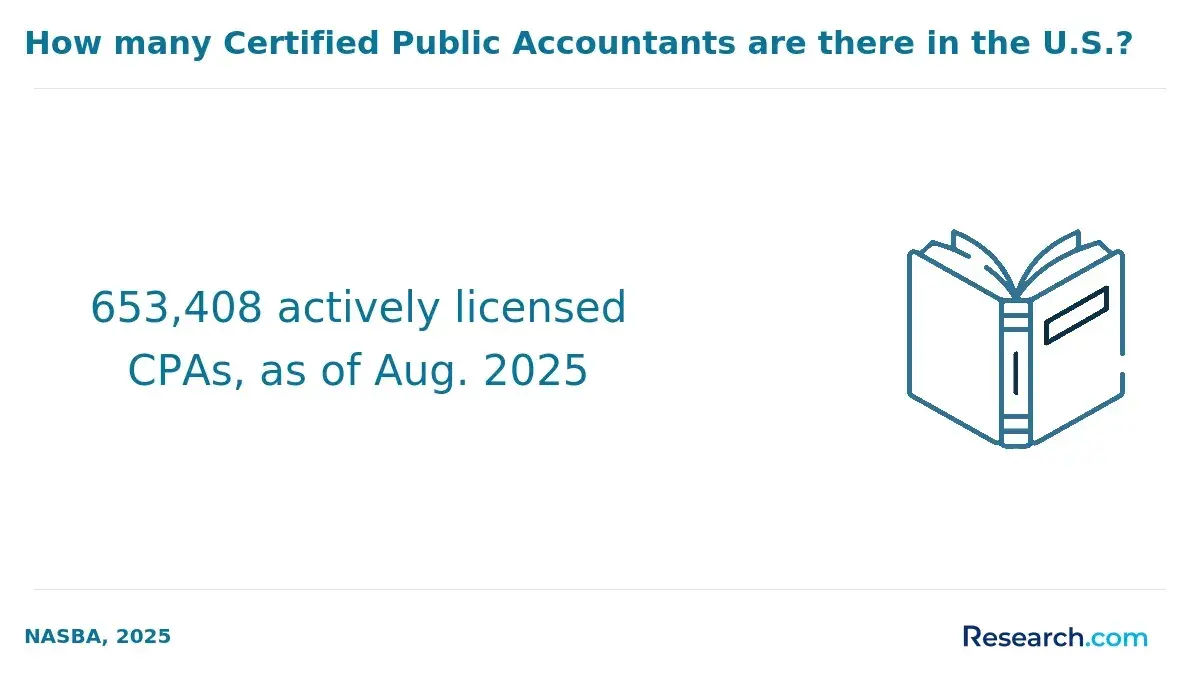
The National Association of State Boards of Accountancy (NASBA) reported 653,408 actively licensed CPAs across its U.S. member jurisdictions as of August 2025. In Kentucky, 1,481 licensed CPAs renewed their licenses online, and 11 reinstated their licenses as of September 2024.
The Kentucky Board of Accountancy reported about 490 newly licensed CPAs in 2024 and approximately 240 in 2025. Accounting leaders in the state have raised concerns about these lower numbers and are encouraging schools and employers to work together earlier in the talent pipeline. Suggested approaches include introducing high school students to accounting careers, building clearer pathways from secondary education to college programs, and treating accounting recruitment more like the feeder systems used in professional sports.
How do Kentucky's accounting programs compare to other states?
Kentucky accounting programs are best understood as practical, regionally connected options rather than national prestige plays. They can be a strong fit for students who want affordable tuition, local employer access, and a direct CPA pathway. They may be less ideal for students whose main goal is immediate entry into a very large financial market such as New York or California.
| Comparison Point | Kentucky Advantage | Potential Limitation |
| Affordability | Many Kentucky institutions charge lower tuition than schools in larger, higher-cost states, especially for in-state students. | Private colleges and out-of-state tuition can still be expensive, so total cost must be reviewed carefully. |
| Employer access | Students can connect with regional firms, local businesses, government employers, and Big 4 offices in Louisville. | Students seeking the largest national finance networks may find more options in bigger metropolitan areas. |
| Program flexibility | Schools such as the University of Louisville and Western Kentucky University offer online or flexible accounting options. | Program availability, course sequencing, and online support differ by institution. |
| CPA preparation | Several programs are designed around Kentucky CPA eligibility and exam readiness. | Students must still verify that their completed credits meet state rules, especially after transferring or changing majors. |
| Career fit | Kentucky can work well for students targeting public accounting, corporate accounting, government, healthcare finance, or regional advisory work. | Students who want specialized Wall Street, international tax, or very large consulting pipelines may need broader networking plans. |
The main takeaway: Kentucky is a sensible accounting education market for students who value cost control, regional placement, and CPA-focused coursework. It is less compelling if your decision is based only on national brand recognition.
Accounting Program Length in Kentucky
Accounting students in Kentucky can choose among bachelor’s degrees, master’s degrees, certificates, and combined bachelor’s/master’s routes. The right path depends on your current education level, CPA goals, budget, and timeline.
Students who want to specialize later can also explore accounting concentrations that support advancement, including tax, audit, forensic accounting, analytics, managerial accounting, and government accounting.
| Program Type | Typical Length | Best For | CPA Planning Notes |
| Bachelor’s degree in accounting | Most programs take four years. | First-time college students and transfer students seeking entry-level accounting roles. | A bachelor’s degree alone may not provide all 150 college semester hours required for CPA licensure. |
| Master’s degree in accounting | Often at least 30 credit hours and can be completed in a year. | Students who already hold a bachelor’s degree and want advanced preparation or CPA credit completion. | May help students reach 150 college semester hours and deepen audit, tax, analytics, or advisory preparation. |
| Accounting certificate | Often about three semesters when designed to provide the minimum 27 credit hours in accounting courses. | Students with a non-accounting bachelor’s degree or professionals needing targeted accounting coursework. | Students must confirm that certificate credits satisfy Kentucky CPA education requirements. |
| Combined bachelor’s/master’s route | Varies by school; some structured options integrate both degrees. | High-performing students who want a planned CPA pathway with fewer gaps between undergraduate and graduate study. | Can simplify the 150-hour plan when built specifically for CPA candidates. |
Regardless of program format, CPA candidates in Kentucky must plan for 150 college semester hours before licensure. Students should not assume that completing an accounting major automatically satisfies every CPA education requirement.
Accreditation is also important. Regional or institutional accreditation affects transfer credits, graduate admission, financial aid eligibility, and employer confidence. Programmatic accreditation can be an additional quality signal. Several Kentucky accounting programs hold accreditation from the Association to Advance Collegiate Schools of Business (AACSB), a widely recognized accreditor for business schools.
After finishing coursework, students should budget time for the CPA exam and work experience. Many candidates spend around 300 to 400 hours studying for the Uniform CPA Examination, which can add several months to the timeline. Kentucky also requires one year or 2,000 hours of qualifying accounting or auditing experience.
Tuition and Costs of Accounting Programs in Kentucky
Accounting program costs in Kentucky vary widely by institution, residency status, degree level, delivery format, and whether the school charges flat-rate tuition or per-credit tuition. Students should compare total cost of attendance, not just advertised tuition.
At the University of Louisville (UofL), in-state and out-of-state students in professional programs at the UofL College of Business pay the same tuition and fees for some graduate offerings. Students in the Master of Science in Accounting Analytics (MSAA) pay $28,000 in tuition and fees regardless of whether they are Kentucky residents. Active-duty military and qualifying National Guard or National Reserve members pay a lower tuition and fee rate of $22,500.
Undergraduate accountancy pricing at UofL works differently. Part-time students taking fewer than 12 credit hours per semester pay about $527 per credit if they are Kentucky residents and $1,208 per credit if they are nonresidents. Full-time students taking 12 or more credit hours pay a flat semester rate of $6,316 for in-state students and $14,489 for out-of-state students.
The University of Kentucky also uses full-time and per-credit pricing for traditional graduate or professional programs. Full-time tuition is capped at nine credit hours and listed as $6,483.50 for residents and $17,048 for nonresidents. The per-credit rate is $948 for residents and $1,254.50 for nonresidents.
Flat-rate tuition can benefit students who are able to take heavier course loads because the cost per credit effectively drops after the flat-rate threshold. However, it may not help students who need to study part time because of work or family responsibilities.
Transylvania University uses a locked-in tuition model. The school lists locked-in tuition and fees of $44,980 and a total cost of attendance of $62,180, including books, transportation, food, housing, and personal expenses.
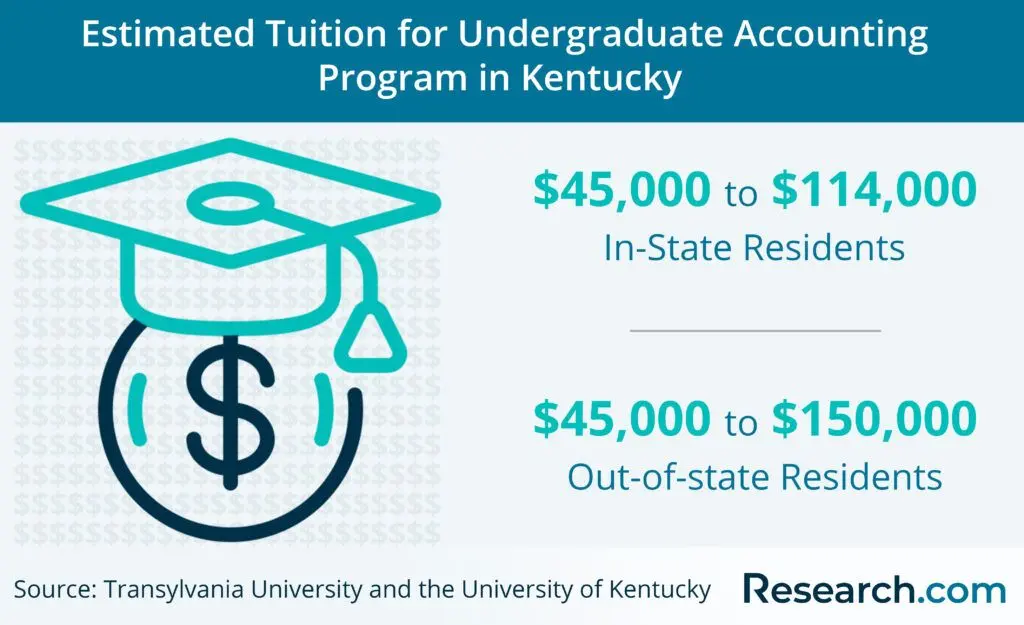
Based on the programs reviewed, the estimated tuition range for an undergraduate accounting program in Kentucky is $45,000 to $114,000 for residents and about $45,000 to $150,000 for out-of-state students. These figures do not always include housing, transportation, books, technology, exam preparation, CPA exam costs, or lost wages from reducing work hours.
| Cost Item | Why It Matters | Question to Ask |
| Tuition structure | Flat-rate and per-credit pricing can change the real cost depending on course load. | Will I save money by enrolling full time, or is part-time study more realistic? |
| Residency status | Out-of-state tuition can be much higher at some public universities. | Can I qualify for in-state, military, online, or special program tuition? |
| Fees | Business, technology, online, lab, graduation, and student service fees add up. | What is the full cost per semester after all mandatory fees? |
| CPA preparation | Review courses, exam fees, and study materials may not be included in tuition. | Does the program include CPA review support, or will I pay separately? |
| Time to completion | Extra semesters can increase tuition and delay full-time earnings. | How will transfer credits, prerequisites, and course availability affect my graduation date? |
The safest approach is to request a written cost estimate from each school and compare it with your expected financial aid, scholarship eligibility, transfer credits, and career goals.
Scholarships and Funding Opportunities for Accounting Students in Kentucky
Scholarships can significantly change the value of an accounting degree, especially for students comparing public and private institutions or deciding between undergraduate and graduate study. Kentucky students should look at institutional aid, accounting department awards, professional association scholarships, employer tuition benefits, and state or federal aid programs.
The Kentucky Business Education Association (KBEA) Scholarship is one option for students pursuing business-related fields, including accounting. Kentucky institutions also offer merit-based and need-based aid. Examples include the Otis A. Singletary Scholarship at the University of Kentucky and departmental awards at Eastern Kentucky University for eligible accounting majors.
Accounting students should also review Kentucky Society of CPAs (KyCPA) Educational Foundation Scholarships. These awards are designed for accounting students and may also connect recipients with professionals in the Kentucky accounting community.
Students comparing accounting programs housed in business colleges may also want to review the best business schools in Kentucky to identify institutions with broader funding options, stronger business networks, and clearer scholarship deadlines.
| Funding Source | Who Should Check It | Practical Tip |
| Institutional scholarships | First-year, transfer, and continuing students | Ask whether accounting majors receive automatic consideration or need a separate application. |
| Accounting department awards | Declared accounting majors | Check GPA rules, faculty recommendation requirements, and annual deadlines. |
| Professional association scholarships | Students committed to accounting or CPA careers | Use the application process to build professional contacts, not just to seek funding. |
| Employer tuition assistance | Working adults and part-time students | Confirm whether the employer requires you to stay for a certain period after reimbursement. |
| Federal and state aid | Students with financial need or eligibility for grants and loans | File aid applications early and compare net price instead of sticker price. |
How can you accelerate your accounting degree?
An accelerated accounting pathway can help students finish sooner, reduce opportunity cost, and enter the workforce faster. It is most useful for students who already have transfer credits, prior college experience, a bachelor’s degree in another field, or the ability to handle a heavier course load.
Online and accelerated programs may be especially helpful for working adults. Some students look for an accelerated online accounting degree because it allows them to complete coursework with more scheduling flexibility. However, speed should not be the only priority. A fast program is only useful if it is accredited, transferable, affordable, and aligned with CPA education requirements.
| Acceleration Strategy | How It Can Help | What to Verify First |
| Transfer credits | Reduces duplicate coursework and shortens time to graduation. | Ask for an official transfer evaluation before enrolling. |
| Summer or winter courses | Allows students to complete prerequisites or major courses faster. | Confirm that required accounting courses are actually offered in those terms. |
| Combined bachelor’s/master’s program | May streamline the path to 150 college semester hours. | Check admission requirements, GPA minimums, and graduate tuition rates. |
| Accounting certificate after a bachelor’s degree | Targets missing accounting credits without completing a second full degree. | Confirm that the certificate satisfies CPA coursework rules. |
| Online or self-paced courses | Can help working students move faster when schedules allow. | Make sure online courses provide adequate faculty access and exam preparation. |
The best accelerated option is not always the shortest one. It is the one that gets you to graduation, CPA eligibility, and employment without creating avoidable debt or missing required credits.
Kentucky Schools Offering Accounting Programs for 2027
The right accounting school should do more than offer accounting classes. It should help students understand CPA requirements, gain practical experience, use current accounting technology, and connect with employers. The Kentucky schools below offer notable accounting pathways, but students should confirm current admissions rules, costs, curriculum updates, and CPA exam support directly with each institution.
1. Gatton College of Business and Economics, University of Kentucky
The Gatton College of Business and Economics at the University of Kentucky (UK) offers accounting education through the Douglas J. Von Allmen School of Accountancy. A standout option is the BSBA/MSACC pathway, which allows students to complete bachelor’s and master’s accounting study, prepare for the CPA exam, and complete a professional internship within four years. UK also offers a master’s bridge program for non-accounting majors, a PhD in Business Administration with an accounting concentration, and a Graduate Certificate in Accounting Analytics.
- Program length: Four years
- Tracks/concentrations: Professional Bachelor of Science in Business Administration/Master of Science in Accounting (BSBA/MSACC)
- Cost per credit: $948 per credit for residents, $1,254.50 per credit for non-residents
- Required credits to complete: 120 credit hours
- Accreditation: UK’s Gatton College of Business and Economics and its accounting programs within the Douglas J. Von Allmen School of Accountancy are accredited by the Association to Advance Collegiate Schools of Business (AACSB).
2. University of Louisville College of Business
The University of Louisville College of Business offers undergraduate, graduate, and certificate options in accounting. Its Bachelor of Science in Business Administration in Accountancy prepares students for graduate study, CPA exam planning, and other credentials such as Certified Internal Auditor (CIA) and Certified Management Accountant (CMA). The BSBA in accountancy is also available online, which may help students who need more scheduling flexibility.
- Program length: Approximately four years for full-time students who do not take summer courses
- Tracks/concentrations: BSBA in Accountancy
- Cost per credit: $527 per credit for residents, $1,208 per credit for non-residents
- Required credits to complete: 120 credits
- Accreditation: The UofL College of Business and its School of Accountancy are accredited by the Association to Advance Collegiate Schools of Business (AACSB).
3. Transylvania University
Transylvania University is a private liberal arts college in downtown Lexington. Its BA in Accounting is structured so students can meet the 150 college-hour requirement for the CPA exam after graduation without completing a master’s degree. Accounting students may pursue internships, study abroad during a summer term, and take specialized courses such as equine accounting, forensic accounting, and government accounting.
- Program length: Approximately four years
- Tracks/concentrations: BA in Accounting
- Cost per credit: Transylvania University has a locked-in tuition plan where students will pay $46,780 for four years of study as of AY 2024-2025.
- Required credits to complete: 36 course units (approximately 144 credit hours)
- Accreditation: Southern Association of Colleges and Schools Commission on Colleges (SACSCC)
4. Gordon Ford College of Business, Western Kentucky University
The Gordon Ford College of Business at Western Kentucky University (WKU) offers undergraduate and graduate accounting options, including a Bachelor of Science in Accounting and a Master’s in accounting and data analytics. High-achieving students may qualify for a joint undergraduate/master’s route and a GMAT waiver. Eligibility requirements include completing 90 semester hours of undergraduate coursework, earning at least a “C” in all accounting courses, and achieving a minimum overall GPA of 3.25 for certain courses.
- Program length: Approximately four years for the BS track
- Tracks/concentrations: Joint Undergraduate/Master’s Program in Accounting (JUMP); BS in Accounting; Master of Accountancy and Data Analytics (MADA)
- Joint Undergraduate/Master’s Program in Accounting (JUMP)
- BS in Accounting
- Master of Accountancy and Data Analytics (MADA)
- Cost per credit: $250 per credit hour for undergraduate and graduate programs for active military, except doctoral programs; $476.50 per credit hour for residents and $1,125 per credit hour for non-residents for undergraduate programs; $607 per credit hour for residents and $917 for non-residents for graduate programs
- Required credits to complete: 120 semester hours, including the 75 semester hours program requirement for the BS track; 30 semester hours for the master’s track
- Accreditation: The WKU Department of Accounting and the Gordon Ford College of Business are accredited by the Association to Advance Collegiate Schools of Business (AACSB).
5. Eastern Kentucky University
Eastern Kentucky University (EKU) offers a BBA in accounting with Public Accounting and Managerial Accounting concentrations. The program prepares students for accounting careers and for professional exams such as CIA, CMA, CPA, Certified Fraud Examiner (CFE), and Certified Forensic Accountant (CRFAC). EKU also offers a Certificate in Accounting for students who already have a bachelor’s degree and need accounting coursework or additional credits toward the 150-hour CPA requirement.
- Program length: Approximately four years for full-time students
- Tracks/concentrations: BBA in Managerial Accounting; BBA in Public Accounting
- BBA in Managerial Accounting
- BBA in Public Accounting
- Cost per credit: $410 per credit hour for residents, $855 per credit hour for non-residents; EKU provides a flat-rate tuition fee for full-time students
- Required credits to complete: 120 credit hours
- Accreditation: The EKU College of Business is accredited by the Association to Advance Collegiate Schools of Business (AACSB).
What To Look For in an Accounting Program in Kentucky
A strong Kentucky accounting program should help you graduate, qualify for the next credential you need, and compete for relevant jobs. Cost and accreditation matter, but they are only part of the decision. Students should also review CPA exam preparation, faculty access, internship pipelines, analytics coursework, career services, and support for transfer or adult learners.
| Program Feature | Why It Matters | What to Ask the School |
| Accreditation | Accreditation affects credit transfer, financial aid, graduate admission, and employer trust. | Is the institution accredited, and does the accounting or business program hold AACSB or other specialized accreditation? |
| CPA alignment | Not every accounting degree automatically satisfies Kentucky CPA education rules. | Can an advisor show exactly how the curriculum meets the 27 accounting hours, 12 business hours, and 150 college semester hours? |
| Exam preparation | CPA, CMA, CIA, and CFE preparation can influence early career options. | Does the program include review resources, exam advising, or dedicated CPA preparation support? |
| Career services | Internships and campus recruiting often lead to first accounting jobs. | Which firms recruit from the program, and what internship support is available? |
| Updated curriculum | Employers increasingly expect software, analytics, systems, and compliance skills. | Are students trained in accounting technology, data analytics, audit tools, and current tax or reporting issues? |
| Student support | Accounting can be demanding, especially for working adults and first-generation students. | Are tutoring, mentoring, online advising, financial aid counseling, and flexible scheduling available? |
Students preparing for licensure should also use resources on preparing for accounting exams early rather than waiting until after graduation. Exam planning affects course selection, study schedules, and employment timing.
Inclusiveness and access are also worth reviewing. A program that supports underrepresented, low-income, first-generation, transfer, and adult learners can broaden entry into the accounting profession. In Kentucky, degree and credential production has recently improved: the Kentucky Council on Postsecondary Education reported that public and private colleges and universities conferred degrees and credentials in academic year 2024-25 that were up 5% from the prior academic year.
Common Mistakes When Choosing an Accounting School
- Choosing based only on tuition. A low per-credit rate may not be the best deal if the program has limited course availability, weak advising, or poor transfer credit acceptance.
- Assuming the degree automatically meets CPA rules. Always verify the accounting hours, business hours, and 150-hour plan in writing.
- Ignoring accreditation. Accreditation can affect financial aid, transferability, graduate school options, and employer confidence.
- Overlooking internships. Accounting hiring is often relationship-driven, and internships can lead directly to full-time roles.
- Choosing speed over fit. Accelerated programs are useful only when students can handle the pace and still meet credential requirements.
- Relying only on rankings. Rankings can be helpful, but your best program is the one that matches your budget, location, learning format, CPA plan, and career target.
Could a forensic specialization enhance my accounting career in Kentucky?
Yes, forensic accounting can strengthen an accounting career if you are interested in fraud investigation, litigation support, internal controls, insurance claims, financial disputes, or compliance work. This specialization blends accounting knowledge with investigative thinking and can be useful in public accounting firms, corporations, law-related settings, government agencies, and consulting roles.
Students who want deeper investigative training may also explore a forensic science degree in Kentucky, especially if they are interested in interdisciplinary work involving evidence, financial misconduct, and legal processes.
Emerging Trends in the Kentucky Accounting Industry
Accounting work in Kentucky is changing because employers expect accountants to do more than record transactions and prepare reports. The strongest candidates can interpret financial data, understand compliance obligations, use modern software, communicate clearly, and advise decision-makers.
- Automation and AI-assisted workflows: Routine bookkeeping, reconciliations, document review, and forecasting tasks are increasingly supported by software. Accountants who understand how to review outputs, spot errors, and apply judgment will remain valuable.
- Data analytics: Employers are placing more value on accountants who can analyze large datasets, build dashboards, and explain trends. Programs such as the University of Kentucky and Western Kentucky University have incorporated analytics into accounting study, and students comparing flexible options can review a bachelor of accounting online pathway with technology-related coursework.
- Compliance and regulatory complexity: Tax rules, reporting standards, audit expectations, and industry-specific regulations continue to create demand for accountants who stay current.
- ESG and sustainability reporting: Companies in sectors such as manufacturing and agriculture may face growing stakeholder interest in environmental, social, and governance reporting.
- Remote and hybrid accounting work: Cloud systems and virtual collaboration allow some Kentucky accountants to work with clients or employers beyond their immediate city.
- Specialized advisory roles: Risk management, forensic accounting, cybersecurity auditing, healthcare finance, and analytics are expanding the definition of accounting careers.
The practical implication for students is clear: choose a program that teaches both accounting fundamentals and modern tools. Debits, credits, tax, audit, and financial reporting still matter, but technology fluency is becoming part of baseline professional competence.
Can integrating healthcare billing enhance my Kentucky accounting career?
Healthcare is a major employer in many states, and accounting professionals who understand billing, reimbursement, compliance, and revenue cycle management can be useful in hospitals, clinics, physician groups, insurers, and healthcare consulting. This path may appeal to accountants who want industry specialization rather than a general public accounting route.
Professionals interested in this crossover can review guidance on how to be a medical coder in Kentucky to understand the billing and coding knowledge that can complement accounting, audit, or compliance work in healthcare settings.
How do regulatory changes impact accounting careers in Kentucky?
Regulatory change affects accountants because tax rules, reporting requirements, licensing standards, audit expectations, and compliance obligations influence the work they perform for clients or employers. Kentucky accountants should monitor state-specific rules as well as federal updates that affect businesses, nonprofits, and individuals.
Students and professionals should routinely review CPA requirements in Kentucky before making decisions about coursework, licensing, reciprocity, continuing education, or career moves into public accounting.
Can accounting expertise support a transition into education in Kentucky?
Accounting experience can transfer into education for professionals who want to teach business, finance, accounting, or related subjects. This path may involve secondary education, community college teaching, training roles, adjunct instruction, or curriculum development depending on education level and certification requirements.
Career changers should review what degree do you need to be a teacher in Kentucky to understand how teaching credentials, subject-area preparation, and classroom requirements differ from accounting employment requirements.
Can accounting expertise support a transition into urban planning?
Accounting skills can support urban planning work when projects require budgeting, forecasting, grant management, cost analysis, infrastructure financing, or public resource allocation. This is not a direct accounting-to-planning switch for most professionals, but financial analysis can be valuable in public sector and development-related roles.
Accountants interested in this interdisciplinary route can explore how to become an urban planner in Kentucky to compare planning education, zoning knowledge, project management expectations, and community impact responsibilities.
How do emerging technologies impact accounting practices in Kentucky?
Technology is changing how Kentucky accountants audit, close books, analyze transactions, manage tax data, and communicate findings. Cloud accounting platforms, automation tools, analytics software, artificial intelligence, and blockchain-related systems can improve speed and visibility, but they also require stronger review, controls, cybersecurity awareness, and professional judgment.
Accountants who enjoy teaching technical concepts or working with quantitative learning may also find overlap with educational technology and math instruction. For example, reviewing how to become a high school math teacher in Kentucky can help professionals understand another pathway where analytical and instructional skills intersect.
Can legal expertise complement my accounting skills in Kentucky?
Legal knowledge can be a useful addition for accountants who work with contracts, tax disputes, fraud investigations, litigation support, compliance programs, estates, bankruptcy, or regulatory risk. Accountants do not need to become attorneys to benefit from legal literacy, but they do need to understand when a matter requires legal counsel.
Professionals interested in finance-adjacent legal work can review how to become a paralegal in Kentucky to compare legal support training with accounting, audit, and compliance career paths.
What alternative careers can accounting students in Kentucky consider?
Accounting students build skills in analysis, organization, budgeting, documentation, problem-solving, and communication. These skills can transfer to roles outside traditional accounting, including financial analysis, business operations, banking, compliance, payroll, procurement, budgeting, insurance, education administration, and public sector finance.
Some students may also consider teaching if they enjoy explaining concepts and working with learners. To compare that path with accounting, review elementary school teacher requirements in Kentucky.
What essential skills do Kentucky accountants need?
Kentucky accountants need a blend of technical, analytical, and interpersonal skills. Technical knowledge gets you into the profession; communication and judgment often determine how far you advance.
| Skill Area | Why It Matters |
| Accounting fundamentals | Financial reporting, tax, audit, cost accounting, and internal controls remain core requirements. |
| Software proficiency | Employers expect comfort with accounting platforms, spreadsheets, enterprise systems, and cloud tools. |
| Data analytics | Accountants increasingly need to interpret trends, test transactions, and present insights from data. |
| Regulatory awareness | Compliance work requires attention to state, federal, and industry-specific rules. |
| Communication | Accountants must explain financial information to clients, executives, managers, and nonfinancial stakeholders. |
| Professional skepticism | Audit, fraud, and review work require the ability to question assumptions and identify inconsistencies. |
| Ethics | Trust is central to accounting, especially for CPAs and professionals handling sensitive financial information. |
Cross-disciplinary learning can also broaden career perspective. For example, reviewing unrelated but structured professional paths such as how to become a nurse practitioner in Kentucky can help students understand how licensing, graduate education, specialization, and professional standards differ across fields.
How can an accounting certificate boost my career prospects in Kentucky?
An accounting certificate can help professionals gain targeted accounting knowledge without completing another full degree. It can be especially useful for career changers, business professionals who need stronger accounting skills, and bachelor’s degree holders who need additional accounting credits for CPA eligibility.
A certificate is not automatically a shortcut to licensure. Before enrolling, confirm whether the credits are graduate or undergraduate, whether they are accepted by the Kentucky State Board of Accountancy, and whether they cover the specific accounting subjects you still need.
How can effective networking boost my accounting career in Kentucky?
Networking can help accounting students and professionals learn about internships, firm culture, CPA exam strategies, hiring timelines, and specialization options. In Kentucky, useful networking channels may include campus accounting clubs, Beta Alpha Psi chapters, KyCPA events, employer information sessions, alumni contacts, internships, LinkedIn outreach, and local business organizations.
Students exploring careers in financial accounting should start networking before senior year. Public accounting firms, corporate accounting departments, and government employers often recruit on predictable timelines, and early relationships can make the job search more focused.
Is Kentucky ideal for a CPA career?
Kentucky can be a strong CPA career location for students who want a regionally connected job market, access to both public and private accounting roles, and a cost of living below the national average. It may be especially appealing if you plan to work in Louisville, Lexington, regional firms, government, healthcare, manufacturing, nonprofit finance, or specialized areas such as equine accounting.
It is not the perfect fit for everyone. Students chasing the highest possible salaries, the largest finance markets, or highly specialized national consulting pipelines may need to compare Kentucky with larger states or plan for remote and interstate opportunities. Kentucky’s tax reciprocity agreements with several states may also give some professionals flexibility, but relocation and licensing decisions should be reviewed carefully.
The best decision depends on your goals. If you want a clear CPA pathway, evaluate accounting schools based on accreditation, cost, course planning, internships, CPA preparation, employer relationships, and student support. If your interests are broader, compare a finance degree vs accounting degree before committing, since finance may align better with investments, banking, corporate strategy, or markets.
Key Insights
- Kentucky has measurable accounting demand. The Kentucky Center for Statistics projects a +5.03% employment change and 11,273 openings for accountants and auditors through 2032.
- Accounting pay compares favorably with statewide wages. May 2024 Bureau of Labor Statistics data reported a $77,730 median yearly wage for Kentucky accountants and auditors, above the $51,490 annual mean wage for all occupations in the state.
- CPA planning should begin before enrollment. Kentucky candidates need specific accounting and business coursework, 150 college semester hours, CPA exam completion, and 2,000 hours of experience within 12 months.
- Accreditation and CPA alignment matter more than school name alone. Students should confirm whether credits meet Kentucky Board of Accountancy rules, especially when using transfer credits, certificates, online programs, or accelerated formats.
- Costs vary widely by school and residency status. Undergraduate accounting tuition estimates range from $45,000 to $114,000 for residents and about $45,000 to $150,000 for out-of-state students, so net price and total cost of attendance should drive comparisons.
- Technology skills are becoming essential. Data analytics, accounting software, automation, compliance tools, and AI-assisted workflows are increasingly part of modern accounting work.
- Kentucky is strongest for students seeking regional opportunity and practical value. It offers public universities, private colleges, online options, certificates, Big 4 offices in Louisville, and respected regional firms, but students should compare their goals with larger markets before deciding.
Related Articles for Nearby States
- 2027 Best Accounting Schools in Indiana – How to Become a CPA in IN
- 2027 Accounting Schools in Ohio: How to Become a CPA in OH
- 2027 Best Accounting Schools in Tennessee – How to Become a CPA in TN
- 2027 Best Accounting Schools in West Virginia – How to Become a CPA in WV
- 2027 Best Accounting Schools in Virginia – How to Become a CPA in VA
- 2027 Accounting Schools in Illinois – How to Become a CPA in IL
- 2027 Best Accounting Schools in Missouri – How to Become a CPA in MO
- 2027 Accounting Schools in Georgia – How to Become a CPA in GA
- 2027 Best Accounting Schools in Mississippi – How to Become a CPA in MS
- 2027 Best Accounting Schools in Alabama – How to Become a CPA in AL
References:
- IBISWorld. Kentucky State Economic Profile. https://www.ibisworld.com/united-states/economic-profiles/kentucky
- National Association of State Boards of Accountancy (2025, August 28). How Many CPAs Are There? https://nasba.org/licensure/howmanycpas
- Transylvania University (2026). Cost of Attendance. https://www.transy.edu/financial-aid/basics-of-financial-aid/cost-of-attendance
- University of Kentucky (2025). Tuition and Fees. https://studentaccount.uky.edu/2025-26-tuition-and-fees
- University of Louisville (n.d.). GRADUATE TUITION & COSTS. https://business.louisville.edu/academics-programs/graduate-programs/apply/tuition-and-costs
- University of Louisville (2025). Tuition Fall 2025 and Spring 2026. https://louisville.edu/bursar/tuition
- U.S. Bureau of Labor Statistics (2026, January 30). Economy at a Glance Kentucky. https://www.bls.gov/oes/current/oes_ky.htm
- Wisevoter (n.d.). Cost of Living by State. https://wisevoter.com/state-rankings/cost-of-living-by-state/#kentucky
Other Things You Should Know About the Best Accounting Schools in Kentucky
To become an accountant in Kentucky, you need to meet the education requirement by earning a bachelor’s or master’s degree with a major in accounting. You must then pass the Uniform CPA Examination and acquire 2,000 hours of accounting and auditing experience within 12 months. Finally, submit your application and necessary documents to the Kentucky State Board of Accountancy.
The job outlook for accountants in Kentucky is positive, with consistent demand expected through 2026. Kentucky's growing industries require competent accounting professionals, creating opportunities for graduates. The Bureau of Labor Statistics predicts steady job growth comparable to the national average.
In 2027, the best accounting programs in Kentucky include the University of Kentucky's Gatton College of Business and Economics, the University of Louisville College of Business, and Northern Kentucky University’s Haile/US Bank College of Business, offering comprehensive curriculums aligned with CPA preparation.
A bachelor’s degree in accounting typically takes four years to complete. A master’s degree usually requires one year of study. Certificate programs, which provide the required accounting coursework for CPA exam eligibility, typically take three semesters.
Tuition costs vary by institution and residency status. For example, the University of Louisville offers the same tuition rates for in-state and out-of-state students enrolled in its professional programs, with an estimated total cost of $28,000 for the Master of Science in Accounting Analytics. Undergraduate programs have different rates, with full-time in-state students paying around $6,316 per semester and out-of-state students paying $14,489.
Yes, several institutions in Kentucky offer online accounting programs. For instance, the University of Louisville offers an online Bachelor of Science in Business Administration in Accountancy, providing flexibility for working adults and those with other commitments.
Many Kentucky colleges and universities offer scholarships, grants, and financial aid programs to accounting students. Additionally, the Kentucky Council on Postsecondary Education has initiatives to make higher education more accessible, including debt forgiveness agreements and accepting more credits for prior learning.





