2027 Best Accounting Schools in Indiana – How to Become a CPA in IN

Co-Founder and Chief Data Scientist
Choosing an accounting school in Indiana is not just about finding a familiar university name. The better question is whether the program gives you the coursework, credits, accreditation, faculty support, internship access, and CPA preparation you need for the accounting role you want. Indiana offers accounting options at several levels, including associate, bachelor’s, certificate, MS, and MBA pathways, so students can enter the field, change careers, or build toward licensure.
This guide is designed for prospective accounting students, working adults comparing online and campus programs, and Indiana residents deciding whether an accounting program or specialization is the right move. You will learn how accounting careers look in Indiana, how CPA requirements work, how long programs take, what costs to compare, which schools stand out, and what questions to ask before enrolling.
Indiana also sits near major regional employment markets. The Chicago-Naperville-Elgin metropolitan area in Illinois, Indiana, and Wisconsin had 51,980 accountants and auditors, making it one of the metropolitan areas with the highest employment levels for these roles, alongside the New York-Newark-Jersey City area and the Los Angeles-Long Beach-Anaheim area.
Best Accounting Schools in Indiana Table of Contents
- Is accounting a good job in Indiana?
- What are the steps to becoming an accountant in Indiana?
- Accounting Program Length in Indiana
- Tuition and Costs of the Best Accounting Schools in Indiana
- Best Accounting Schools in Indiana for 2027
- Flexible Online Accounting Programs in Indiana
- What to Look for in an Accounting School in Indiana
- What are the career prospects for accounting graduates in Indiana?
- What other careers can accounting graduates in Indiana consider?
- Can interdisciplinary certifications enhance your career opportunities in Indiana?
- How do you balance affordability and quality in your accounting education?
- How can a forensic science degree complement your accounting career in Indiana?
- What are the networking opportunities for accounting students in Indiana?
- Can interdisciplinary certifications enhance your accounting career in Indiana?
- What are the updated CPA requirements in Indiana?
- What financial assistance options are available for aspiring accountants in Indiana?
- How can you further advance your accounting career in Indiana?
- How do legal and accounting careers intersect in Indiana?
- How do CPA salaries in Indiana compare with those in other states?
- Can integrating education credentials enhance accounting career prospects in Indiana?
Quick Answer: Is Indiana a Good State for Accounting Students?
Yes, Indiana can be a practical state for accounting students because it combines a broad employer base, lower living costs, public and private university options, and multiple routes into public accounting, corporate finance, government, nonprofit finance, and financial management. The best choice depends on your goal: a bachelor’s degree is the standard foundation for many accounting jobs, while CPA candidates must plan carefully for the 150 semester hours and required accounting coursework.
| Decision point | What it means for Indiana accounting students |
| Best fit | Students who want business, finance, audit, tax, compliance, or corporate accounting roles |
| CPA planning | Students should confirm that the program helps them reach 150 semester hours and accounting specialization requirements |
| Online option | Useful for working adults, caregivers, rural students, and transfer students who need schedule flexibility |
| Key risk | Choosing a program based only on tuition or brand name without checking accreditation, CPA alignment, and career support |
Is accounting a good job in Indiana?
Accounting remains a strong career option in Indiana for students who want a business career with portable skills. Accountants are needed by manufacturers, healthcare systems, banks, insurance companies, local businesses, public accounting firms, nonprofits, and government agencies. The field is also broad enough to support different work styles, from client-facing audit and tax work to internal reporting, budgeting, compliance, payroll, forensic accounting, and financial analysis.
- Central location and major employers. Indiana’s location can help graduates connect with employers in both local and regional markets. The state is home to 7 Fortune 500 companies, and accounting graduates may also find work in state and local government, regional businesses, finance companies, and public accounting firms.
- Lower cost of living. The 2026 World Population Review data reported that Indiana’s cost of living is 91.0, below the national average. Because the cost of living index reflects expenses such as groceries, housing, and healthcare, this can matter when comparing salaries across states.
- Industry variety. Indiana’s economy is not limited to one sector. Agriculture, real estate, finance, manufacturing, healthcare, and business services all require accounting professionals who can manage financial records, compliance, reporting, budgeting, and risk.
- Many higher education options. Indiana has 66 higher learning institutions, giving students multiple ways to begin or advance an accounting career. In FY 2025, the state allocated $16,100 for state financial aid within higher education, as reported by Grapevine and SHEEO sources.
- Career paths at several levels. Students with accounting education can pursue bookkeeping, auditing, staff accounting, tax, budget, and management roles. Projection Central’s recent data lists 2030 projected employment for accountants at 24,860. Students comparing long-term options can also review broader accounting job growth trends.
- Solid earning potential, with variation by role. According to the most recent U.S. Bureau of Labor Statistics data cited here, accountants and auditors in Indiana earn an average salary of $81,680, while financial managers can earn as much as $161,700. Salaries vary by experience, credentials, employer, city, industry, and specialization.
What are the steps to becoming an accountant in Indiana?
The path depends on whether you want a general accounting job, a CPA license, or a specialized accounting career. For many entry-level staff accountant roles, employers expect at least a bachelor’s degree in accounting or a closely related business field. For CPA licensure, planning must be more precise because Indiana has specific credit-hour, degree, exam, ethics, and continuing education requirements.
- Choose an accredited accounting program. Start with a school that is institutionally accredited and, when possible, consider business or accounting-specific accreditation. Accreditation affects transfer credits, graduate school options, employer confidence, and financial aid eligibility.
- Complete the right degree level. A bachelor’s degree typically requires about four years of full-time study and is the common academic foundation for accounting careers.
- Plan early for CPA eligibility. Indiana CPA exam requirements include 150 semester hours, including a bachelor’s or higher degree with an accounting specialization.
- Apply for and pass the CPA exam. The CPA exam includes four sections: auditing and attestation, business environment and concepts, financial accounting and reporting, and regulation. Candidates must pass all sections. The exam has an application fee worth $170 and an examination fee worth $254.80 for every section of the test, according to the National Association of State Boards of Accountancy.
- Complete ethics and state requirements. You must also pass an ethics exam, which may depend on state legislation and current licensing rules.
- Maintain your license. After receiving a CPA license, Indiana CPAs must complete 120 hours of continuing professional education every three years to renew the license.
An advanced business administration or accounting degree may help you meet or bypass certain Indiana CPA CPE requirements, but students should verify current rules directly with the state board or NASBA before choosing courses.
Accounting Program Length in Indiana
Accounting programs in Indiana vary by credential level, course load, transfer credits, and whether the student studies full time, part time, online, or on campus. The right length depends on your career target. A short credential may help you move into bookkeeping or payroll support, while CPA-focused students usually need a longer academic plan.
| Program type | Typical length | Best for | Important consideration |
| Associate degree in accounting | Two years of full-time study | Bookkeeping, accounting assistant, payroll, or transfer preparation | May not be enough for CPA eligibility or many staff accountant roles |
| Bachelor’s degree in accounting | Four years | Entry-level accounting, audit, tax, corporate accounting, and graduate study | Students pursuing CPA licensure must still plan for 150 semester hours |
| Master’s degree in accounting or business | One to two years | CPA preparation, career advancement, specialization, or leadership roles | Compare cost, CPA alignment, and employer value before enrolling |
| Online accounting degree | Varies by program and course load | Working adults, caregivers, rural students, and transfer students | Confirm accreditation, exam preparation, and student support |
Online study is a significant option in the state. In Indiana, 35.8% of students are exclusively enrolled in distance education, which makes online accounting programs relevant for students who cannot relocate or attend daytime classes.
Tuition and Costs of the Best Accounting Schools in Indiana
The cost of an accounting degree in Indiana depends on the school type, residency status, delivery format, transfer credits, fees, books, technology requirements, housing, transportation, and how long it takes to finish. Public institutions often charge different rates for legal state residents and nonresidents, with in-state tuition typically lower than out-of-state tuition.
Indiana also participates in the Midwestern Higher Education Compact (MHEC), a tuition reciprocity program that includes 11 other states. Eligible students should also review state-specific aid through the Indiana Commission for Higher Education.
| Cost factor | Why it matters | Question to ask before enrolling |
| Tuition rate | Public schools may charge different rates for in-state and out-of-state students | What tuition rate will I actually pay, and can it change? |
| Required credits | More credits can mean more tuition, fees, books, and time | How many credits do I need for graduation and CPA preparation? |
| Transfer policy | Accepted credits can reduce total cost and time | Which previous credits will count toward my accounting degree? |
| Online fees | Online programs may reduce commuting costs but still charge technology or course fees | Are there separate online, technology, proctoring, or exam fees? |
| Financial aid | Scholarships, grants, work-study, and state aid can change affordability | What institutional, state, and external aid can accounting majors use? |
Best Accounting Schools in Indiana for 2027
The following Indiana accounting programs can help students compare degree structure, credits, cost information, and accreditation. Use this list as a starting point, not a final decision. Before applying, confirm current tuition, course sequencing, transfer policies, CPA alignment, internship access, and student outcomes directly with each school.
| School | Program | Length | Credits | Accreditation listed |
| Indiana University | Bachelor of Science in Accounting | 4 years | 120 | AACSB International |
| University of Southern Indiana | Accounting and Professional Services Major, B.A./B.S. | 4 years | 120 | AACSB International |
| Indiana Institute of Technology | Bachelor of Science in Accounting | 3 years | 120-121 | HLC |
| Manchester University | Bachelor of Science in Accounting | 4 years | N/A | Indiana Board of Nursing |
| Purdue University | Bachelor of Science in Accounting | 4 years | 180 | HLC |
1. Indiana University Bachelor of Science in Accounting
Indiana University offers a Bachelor of Science in Accounting through a faculty-led curriculum focused on planning, analysis, control, and business decision-making. The program is designed for students preparing for accounting careers, leadership responsibilities, or graduate study. Because much of the coursework is sequenced, students should work closely with an advisor to avoid delays.
- Program Length: 4 years
- Tracks/Concentrations: N/A
- Cost Per Credit: N/A
- Required Credits to Graduate: 120
- Accreditation: AACSB International
2. University of Southern Indiana Accounting and Professional Services Major, B.A./B.S.
University of Southern Indiana, founded in 1965, is located on a 1,400-acre campus in Evansville, Indiana. Its Romain College of Business offers the Accounting and Professional Services Major for students interested in public accounting, business enterprises, nonprofit organizations, higher education institutions, and government roles. The program also supports students who plan to continue into graduate education. USI is a Carnegie Foundation Community Engaged University.
- Program Length: 4 years
- Tracks/Concentrations: N/A
- Cost Per Credit: $280.51 (in-state); $681.99 (out-of-state)
- Required Credits to Graduate: 120
- Accreditation: AACSB International
3. Indiana Institute of Technology Bachelor of Science in Accounting
Indiana Institute of Technology offers a Bachelor of Science in Accounting taught by CPAs with public and private sector experience. The school emphasizes small classes, current industry knowledge, and applied preparation. Students in the program have interned with Franklin Electric, Steel Dynamics, and Medical Protective, while graduates have worked at Cardinal Health, Allied Physicians, and the Indiana State Board of Accounting.
- Program Length: 3 years
- Tracks/Concentrations: N/A
- Estimated Cost Per Semester: $14,968
- Required Credits to Graduate: 120-121
- Accreditation: HLC
4. Manchester University Bachelor of Science in Accounting
Manchester University offers a Bachelor of Science in Accounting that has drawn employer attention from accounting firms seeking interns and entry-level talent. Students may work toward careers in small businesses, corporations, or public accounting. MU also offers a Master’s of Accountancy, allowing students to take bachelor’s and master’s degree coursework at the same time. Firms such as Baden Gage & Schroeder, Dauby O’Connor & Zaleski, and Ernst & Young have returned to MU to recruit interns and employees.
- Program Length: 4 years
- Tracks/Concentrations: N/A
- Tuition & Fees: $37,090 (residential); $36,804 (nonresidential)
- Required Credits to Graduate: N/A
- Accreditation: Indiana Board of Nursing
5. Purdue University Bachelor of Science in Accounting
Purdue University offers a Bachelor of Science in Accounting for students interested in public, tax, corporate, nonprofit, or government accounting. The program can also support preparation for the CPA and related accounting certifications and certificate programs. Students study accounting alongside other management areas, including finance, operation management, human resource management, and marketing, giving them a broader business foundation.
- Program Length: 4 years
- Tracks/Concentrations: Forensic Accounting, International Accounting
- Estimated Cost of Attendance: $22,812 (resident); $41,614 (nonresident); $45,954 (international)
- Required Credits to Graduate: 180
- Accreditation: HLC
Flexible Online Accounting Programs in Indiana
Online accounting programs can be a strong option for students who need flexibility, but they should be evaluated with the same care as campus programs. The most important questions are whether the program is accredited, whether the curriculum matches your career or CPA goals, and whether online students receive advising, tutoring, career services, and access to internships or recruiting support.
When an Online Accounting Program Makes Sense
- You work full time. Asynchronous or evening coursework can make it easier to keep earning income while studying.
- You have family or caregiving responsibilities. Online learning may reduce commuting and scheduling barriers.
- You live far from campus. Rural students can access programs without relocating.
- You are finishing a degree after transferring credits. Online completion programs can be useful if the school accepts prior coursework.
Potential Benefits of Online Accounting Programs
- Flexible scheduling: Many programs let students complete coursework around work and personal commitments.
- Lower indirect costs: Online students may save on commuting, parking, relocation, and on-campus housing.
- Digital learning resources: Programs may provide recorded lectures, online libraries, virtual office hours, tutoring, and remote advising.
Indiana Online Accounting Program Examples
- Indiana University Online: Offers a Bachelor of Science in Accounting with a business-focused curriculum for students preparing for accounting careers and possible CPA pathways.
- Purdue Global University: Provides an online Bachelor’s in Accounting program that covers core accounting concepts and areas such as data analytics and forensic accounting.
Students comparing Indiana options with national programs can also review the best accredited online accounting programs to understand how flexibility, accreditation, cost, and CPA preparation differ across schools.
Online Programs and CPA Preparation
Many online accounting programs are designed with CPA preparation in mind, but students should never assume automatic eligibility. Confirm whether the program helps meet Indiana’s 150 credit hours and required accounting and business coursework. Ask whether CPA review resources are built into the curriculum or offered separately.
Online Versus Campus Accounting Programs
| Format | Best for | Possible drawback | What to verify |
| Online | Working adults, caregivers, rural students, and self-directed learners | Less in-person networking unless the school offers strong virtual engagement | Accreditation, CPA alignment, online advising, career services, and technology support |
| Campus | Students who want in-person classes, student organizations, career fairs, and local recruiting | Less schedule flexibility and possible housing or commuting costs | Internship access, employer partnerships, faculty availability, and graduation timeline |
| Hybrid | Students who want some flexibility while keeping campus access | May require travel on specific days | Required campus visits, course schedule, and total fees |
What to Look for in an Accounting School in Indiana
The right accounting school should help you graduate, qualify for your target roles, prepare for certifications if needed, and build professional experience before entering the job market. A low tuition rate is helpful, but it is not enough if the program lacks accreditation, advising, transfer flexibility, or employer connections.
- Accreditation. Institutional accreditation signals that a school has been reviewed for academic quality, resources, student support, and institutional effectiveness. The Higher Learning Commission is the accreditor associated with Indiana institutions, and accounting or business programs may also hold AACSB International accreditation.
- CPA alignment. If CPA licensure is your goal, ask the school to map exactly how the degree plan helps you reach 150 semester hours and required accounting coursework.
- Faculty background. Professors with CPA experience, audit, tax, corporate finance, forensic accounting, or data analytics expertise can connect classroom concepts to real accounting work.
- Curriculum depth. Strong programs should cover financial accounting, managerial accounting, auditing, taxation, accounting information systems, business law, ethics, analytics, and communication.
- Experiential learning. Internships, case competitions, student accounting groups, volunteer tax programs, and career fairs can help students answer the practical question, “What can you do with an accounting degree in Indiana?”
- Employer access. Review which firms and companies recruit on campus or online, and ask how many accounting students secure internships before graduation.
- Uniform CPA exam pass rate. The National Association of State Boards of Accountancy (NASBA) publishes candidate performance data for the Uniform CPA exam. Ask schools for recent pass-rate information and how they support exam preparation.
- Student outcomes. Request current job placement, graduation, retention, internship, and graduate school data instead of relying only on marketing language.
| Common mistake | Why it can hurt you | Better approach |
| Choosing only by ranking | A highly ranked school may not fit your budget, schedule, or CPA plan | Compare outcomes, cost, accreditation, curriculum, and support services |
| Ignoring accreditation | Credits may not transfer, and employers or graduate schools may question the credential | Verify institutional and business/accounting accreditation before applying |
| Assuming online means easier | Accounting coursework can be demanding in any format | Ask about tutoring, instructor access, course pacing, and exam requirements |
| Forgetting the 150-hour CPA requirement | A 120-credit bachelor’s degree may not be enough for CPA eligibility | Plan extra credits, a master’s degree, or approved coursework early |
| Looking only at tuition | Fees, books, housing, transportation, and delayed graduation can raise total cost | Estimate the full cost to complete the degree, not just annual tuition |
What are the career prospects for accounting graduates in Indiana?
Indiana accounting graduates can pursue roles across manufacturing, healthcare, finance, technology, government, education, nonprofits, and professional services. Employers need accounting talent for financial reporting, tax compliance, auditing, payroll, budgeting, internal controls, grant management, risk assessment, and strategic planning.
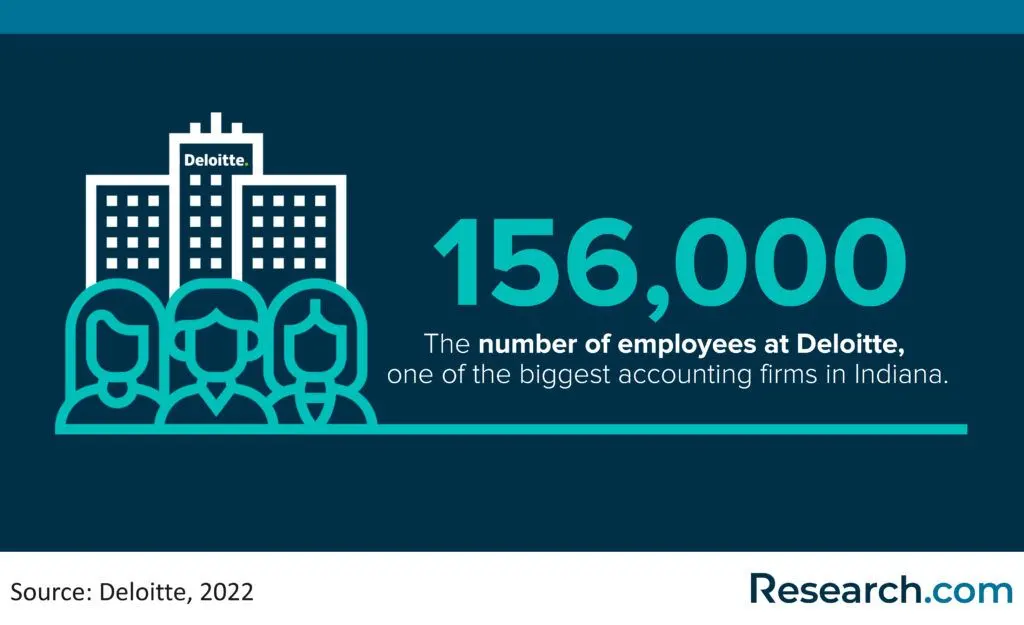
Large companies and public accounting firms can offer structured recruiting and advancement paths. Indiana’s corporate presence includes Fortune 500 companies such as Cummins Inc., Eli Lilly and Company, and Anthem Inc. Public accounting firms such as Deloitte, Ernst & Young, and PricewaterhouseCoopers also offer opportunities in audit, tax, advisory, and consulting work.
Students who want specialized accounting careers can look at areas such as forensic accounting, environmental accounting, and data analytics. These fields can be useful as organizations face more complex compliance expectations and greater reliance on digital systems. Students who want a broader business foundation can compare accounting programs with the best business schools in Indiana to identify schools that match their career goals.
Salary data should be interpreted carefully. The article’s cited figures include competitive salaries averaging $74,080 annually for accountants and auditors, while Indiana’s lower-than-average cost of living may improve affordability for some professionals. However, pay varies by credential, location, firm size, industry, specialization, and years of experience.
What other careers can accounting graduates in Indiana consider?
An accounting degree can lead to more than traditional accountant or auditor roles. Graduates may move into financial analysis, business operations, consulting, budget analysis, payroll management, compliance, banking, insurance, entrepreneurship, or education-related roles. Some professionals eventually teach business, math, or career and technical education, depending on state requirements and additional credentials. Students exploring education careers can compare accounting skills with elementary school teacher requirements in Indiana to understand how different credential paths work.
Can interdisciplinary certifications enhance your career opportunities in Indiana?
Interdisciplinary credentials can help accounting professionals move into specialized industries, especially when the added credential supports a clear career goal. For example, healthcare finance, compliance, billing, reimbursement, and budgeting roles may value knowledge of healthcare regulation and operations. Accountants considering healthcare leadership or financial management can review related professional pathways, including how to become a nurse practitioner in Indiana, to better understand the complexity of healthcare education, regulation, and practice environments.
How do you balance affordability and quality in your accounting education?
The best-value accounting program is not always the cheapest one. A strong program should be affordable enough to finish, rigorous enough to prepare you for employment or CPA study, and supported by advising, tutoring, and career services. Compare total cost, not just tuition, and weigh it against graduation timeline, transfer credits, employer access, and program reputation.
Cost-conscious students can review resources focused on the cheapest accredited online accounting degree, but affordability should always be paired with accreditation, curriculum quality, and student support.
| Affordability question | Quality question |
| How much will I pay after grants, scholarships, and transfer credits? | Is the school accredited and respected by employers or graduate programs? |
| Can I work while enrolled? | Will I receive CPA advising and accounting-specific career support? |
| Will online study reduce housing or commuting costs? | Are online students eligible for the same tutoring, advising, and recruiting support? |
| How long will it take me to finish? | Does the curriculum include auditing, taxation, systems, analytics, and ethics? |
How can a forensic science degree complement your accounting career in Indiana?
Forensic accounting blends financial analysis, investigation, documentation, and fraud detection. Students interested in fraud examination, litigation support, compliance, or white-collar crime investigation may benefit from learning how evidence is collected, protected, analyzed, and explained. A forensic science degree in Indiana can complement accounting training when the student’s career goal involves investigation, regulatory work, financial crime analysis, or expert reporting.
What are the networking opportunities for accounting students in Indiana?
Networking can affect internship access, job referrals, mentorship, CPA guidance, and exposure to different accounting specialties. Students should begin building professional relationships early, ideally during the first or second year of a bachelor’s program.
- Professional accounting organizations: Groups such as the Indiana CPA Society and the American Institute of Certified Public Accountants can help students learn about CPA requirements, ethics, career paths, and employer expectations.
- Career fairs and recruiting events: Schools such as Indiana University and Purdue University host business and finance recruiting events where students can meet regional and national employers.
- Alumni networks: Alumni can explain how they moved from coursework into internships, CPA preparation, public accounting, corporate finance, or management roles.
- Internships and co-op programs: Experience with companies such as Eli Lilly, Cummins, regional firms, or government offices can help students build resumes and professional references.
- Student accounting societies: Accounting clubs and finance organizations often offer resume workshops, speaker events, interview practice, and peer support.
Can interdisciplinary certifications enhance your accounting career in Indiana?
Additional credentials can be useful when they connect accounting knowledge to a specific industry. Healthcare is one example. Accountants who understand medical billing, coding, reimbursement, compliance, and financial reporting may be better prepared for healthcare finance or administrative roles. Students interested in that intersection can explore how to be a medical coder in Indiana to see how billing and coding knowledge may complement accounting training.
What are the updated CPA requirements in Indiana?
CPA rules can change, so students should verify requirements before enrolling, before applying for the exam, and before submitting licensure materials. Key areas include the 150 semester hours, degree level, accounting coursework, ethics requirements, practical experience if applicable, exam rules, and continuing professional education. For a focused overview, review CPA requirements in Indiana.
What financial assistance options are available for aspiring accountants in Indiana?
Accounting students in Indiana may be able to reduce costs through institutional scholarships, grants, work-study, employer tuition assistance, state aid, transfer credits, community college pathways, and professional organization awards. Financial aid offices are the best starting point because eligibility rules vary by school, enrollment status, academic performance, and financial need.
Students considering careers that combine accounting, education, training, or instructional leadership can also compare requirements in related fields, including what degree do you need to be a teacher in Indiana, to decide whether a dual-career or career-change path is realistic.
How can you further advance your accounting career in Indiana?
Career growth in accounting usually comes from a combination of experience, credentials, specialization, communication skills, and professional visibility. After completing a degree, accountants can pursue CPA licensure, graduate study, management training, or specialized areas such as forensic accounting, tax, audit, analytics, compliance, or financial technology.
For example, a forensic accounting degree online may be useful for professionals interested in fraud investigation, litigation support, or financial crime roles. Joining the Indiana CPA Society, attending conferences, pursuing internships, and developing data analytics and financial technology skills can also improve long-term competitiveness.
| Career goal | Possible next step |
| Become a CPA | Complete required credits, pass the CPA exam, meet ethics requirements, and maintain CPE |
| Move into management | Build budgeting, reporting, leadership, analytics, and communication skills |
| Specialize in fraud or compliance | Study forensic accounting, internal controls, investigation methods, and regulatory reporting |
| Work in healthcare finance | Learn billing, reimbursement, compliance, and healthcare financial operations |
| Teach or train future accounting workers | Explore education credentials, graduate study, or professional training roles |
How do legal and accounting careers intersect in Indiana?
Accounting and law often overlap in tax, compliance, corporate governance, fraud investigation, litigation support, estate planning, bankruptcy, business valuation, and regulatory reporting. Accountants who understand legal processes may be better prepared for roles that require documentation, evidence review, contract awareness, or compliance analysis. Those interested in the legal side of business can explore how to become a paralegal in Indiana as one possible cross-disciplinary path.
Is an accounting degree in Indiana worth it?
An accounting degree in Indiana can be worth it if it matches your career target, budget, schedule, and credential goals. It is especially practical for students who want a business career with clear technical skills, multiple industry options, and a pathway to CPA licensure or financial management. It may be less ideal for students who dislike detail-oriented work, documentation, deadlines, regulations, or ethical accountability.
You do not have to be a math specialist to study accounting, but you do need accuracy, judgment, organization, and comfort with financial systems. Modern accounting uses software, automation, analytics, and reporting tools, but technology does not remove the need for professional interpretation and ethical decision-making. Students comparing accounting with finance can review how an accounting and finance degree differs in coursework and career focus.
How do CPA salaries in Indiana compare with those in other states?
CPA salaries vary by state, metro area, industry, firm size, specialization, and experience. Indiana’s salary potential should be evaluated alongside its cost of living, employer base, and advancement opportunities. For broader comparisons, review CPA salaries by state and compare compensation with total living costs rather than salary alone.
Can integrating education credentials enhance accounting career prospects in Indiana?
Some accounting professionals expand into teaching, training, tutoring, corporate learning, or career and technical education. Education credentials may be useful for accountants who want to teach financial literacy, train accounting staff, work in academic settings, or support workforce development. If this path interests you, review how to become a high school math teacher in Indiana to understand how teaching requirements differ from accounting credentials.
Key Insights
- Indiana can be a practical accounting market. The state combines a diverse economy, regional employer access, 7 Fortune 500 companies, and a cost of living index of 91.0.
- CPA planning must start early. Indiana CPA candidates need 150 semester hours, a bachelor’s or higher degree with an accounting specialization, CPA exam completion, ethics requirements, and 120 hours of continuing professional education every three years for renewal.
- Program fit matters more than reputation alone. Compare accreditation, curriculum, CPA alignment, internship access, faculty expertise, transfer policies, and student outcomes before choosing a school.
- Online accounting degrees can work well for many students. They are especially useful for working adults, caregivers, and rural learners, but students must verify accreditation, advising, career support, and CPA preparation.
- Costs should be judged by total degree price. Tuition is only one part of affordability. Fees, housing, commuting, transfer credits, time to completion, and financial aid can significantly change the real cost.
- Accounting careers are broader than tax and audit. Graduates can pursue corporate accounting, financial analysis, compliance, forensic accounting, healthcare finance, government budgeting, nonprofit finance, and management roles.
- Salary data requires context. Cited figures include $81,680 for accountants and auditors and $161,700 for financial managers, as well as $74,080 annually for accountants and auditors in another cited section. Actual earnings depend on role, experience, employer, credential, and location.
- The best next step is verification. Before enrolling, ask each school for current tuition, accreditation status, CPA course mapping, internship data, pass-rate information, transfer credit review, and financial aid options.
Related Articles for Nearby States
- 2027 Accounting Schools in Ohio: How to Become a CPA in OH
- 2027 Accounting Schools in Illinois – How to Become a CPA in IL
- 2027 Best Accounting Schools in Kentucky – How to Become a CPA in KY
- 2027 Accounting Schools in Michigan – How to Become a CPA in MI
- 2027 Best Accounting Schools in Wisconsin – How to Become a CPA in WI
- 2027 Best Accounting Schools in Missouri – How to Become a CPA in MO
- 2027 Best Accounting Schools in Tennessee – How to Become a CPA in TN
- 2027 Best Accounting Schools in Iowa – How to Become a CPA in IA
- 2027 Best Accounting Schools in West Virginia – How to Become a CPA in WV
- 2027 Best Accounting Schools in Minnesota – How to Become a CPA in MN
References
- U.S. Bureau of Labor Statistics. (2025, August 28). Accountants and Auditors. BLS
- U.S. Bureau of Labor Statistics. (2025, August 28). Financial Managers. BLS
- NASBA. Indiana: Applying for the Uniform CPA Examination. NASBA
- National Center for Education Statistics. (2024). Student Enrollment: What is the percent of students enrolled in distance education courses in postsecondary institutions in the fall? National Center for Education Statistics
- Projections Central. Long-Term Occupational Projections. Projections Central
- State Higher Education Executive Officers Association. (2024). State Higher Education Finance FY 2024. State Higher Education Executive Officers Association
- World Population Review. (2026). Cost of Living Index by State. World Population Review
Other Things You Should Know About The Best Accounting Schools in Indiana
Some of the best accounting schools in Indiana for 2027 include Indiana University Bloomington, Purdue University, and the University of Notre Dame. These institutions are renowned for their robust accounting programs, offering diverse coursework and networking opportunities essential for those pursuing a CPA career.
The duration of an accounting program in Indiana depends on the level of the degree. An associate degree typically takes two years, a bachelor's degree usually takes four years, and a master's degree can take one to two years. Part-time and online options may extend these timelines for working professionals.
Yes, several Indiana institutions offer online accounting degree programs, providing flexibility for students who need to balance their education with work or other commitments. Online programs cover the same comprehensive curriculum as on-campus programs and are ideal for students seeking convenience and accessibility.
Accounting graduates in Indiana can pursue various roles, including public accounting, corporate accounting, forensic accounting, tax accounting, and auditing. They may find employment in public accounting firms, private corporations, non-profit organizations, government agencies, and educational institutions.
Accountants and auditors in Indiana earn an average annual salary of $74,080, while financial managers can earn up to $124,690. These competitive salaries, combined with Indiana's lower cost of living, make accounting a financially rewarding career choice in the state.
Yes, an accounting degree in Indiana is worth it due to the high demand for accountants, competitive salaries, and the state's diverse economy. The quality education provided by accredited institutions and the availability of various career opportunities further enhance the value of an accounting degree in Indiana.
Indiana hosts a diverse array of industries and companies that employ accountants. Major industries include manufacturing, healthcare, finance, and agriculture. Companies such as Eli Lilly and Company, Cummins Inc., Anthem Inc., and Simon Property Group are prominent employers in the state. Additionally, Indiana's robust manufacturing sector, including firms like Steel Dynamics and Zimmer Biomet, requires extensive accounting services. The state's growing tech sector also offers opportunities, with firms like Salesforce and Infosys establishing significant operations. Accountants in Indiana can find roles in public accounting firms, corporate finance departments, government agencies, and nonprofit organizations, reflecting the state's varied economic landscape.