2027 Best Accounting Schools in West Virginia – How to Become a CPA in WV

Co-Founder and Chief Data Scientist
Choosing an accounting school in West Virginia is not just a question of which campus is closest or which tuition rate looks lowest. The better question is whether the program will help you meet West Virginia CPA education requirements, prepare for the CPA Exam, build marketable accounting skills, and graduate at a cost that makes sense for your career goals.
This guide is for students comparing undergraduate accounting programs, working adults considering an online accounting degree, transfer students trying to avoid lost credits, and future CPAs who need to understand the state’s licensing pathway. It explains program options, tuition differences, CPA requirements, online learning trade-offs, scholarships, career paths, and the practical questions to ask before enrolling.
Accounting remains a steady part of the U.S. business workforce. In 2025, colleges and universities in West Virginia awarded approximately 410 accounting degrees across all levels. Nationally, the U.S. Bureau of Labor Statistics projects employment of accountants and auditors to grow 5% from 2024 to 2034, faster than the average for all occupations, with an employment change of around 72,800. The sector had an estimated 1,579,800 jobs in 2024. Interest in CPA preparation and flexible options, including the most affordable online accounting degree programs, continues to be strong.
Quick Answer: What Is the Best Accounting School Path in West Virginia?
The best accounting program in West Virginia is the one that matches your end goal. If you want to become a CPA, prioritize an accredited bachelor’s program that helps you complete the state’s 150-hour education requirement, including the required accounting, ethics, business law, and business-related coursework. If you want a broader business career, a business administration degree with an accounting concentration may be enough. If you already work full time, an online or hybrid accounting program may offer better flexibility and lower indirect costs.
Students should compare schools using five criteria: accreditation, CPA Exam preparation, total cost after aid, transfer credit policy, and access to internships or employer networks. Rankings and tuition tables are useful starting points, but they should not replace a careful review of curriculum and licensure fit.
Best Accounting Schools in West Virginia Guide Contents
- Is becoming a CPA a strong career choice in West Virginia?
- How do you become a CPA in West Virginia?
- How long do accounting programs take in West Virginia?
- What do accounting programs cost in West Virginia?
- Which West Virginia schools offer accounting programs for 2027?
- How should you compare accounting programs in West Virginia?
- What are the benefits of online accounting programs in West Virginia?
- What scholarships and financial aid are available for accounting students?
- What accounting careers are available besides CPA roles?
- Can accounting skills support healthcare careers?
- How can forensic science expand accounting career options?
- How can a master’s degree affect accounting career growth?
- What skills and networking opportunities matter for accounting students?
- Can accounting experience lead to teaching?
- Should you choose online or traditional accounting study?
- Can accounting skills transfer to medical coding?
- What challenges do accounting professionals face in West Virginia?
- Can accounting knowledge support urban planning or legal careers?
- How can continuing education expand accounting career options?
Is a CPA a Good Career in West Virginia?
A certified public accountant is a state-licensed accounting professional who can provide certain services to the public that non-licensed accountants cannot. CPAs commonly maintain accounting records, review transactions, prepare tax filings, conduct audits, analyze financial statements, and support compliance work tied to agencies such as the IRS and SEC. Their work may involve both manual and computerized accounting systems, although modern accounting roles increasingly rely on digital platforms, automation, and data tools.
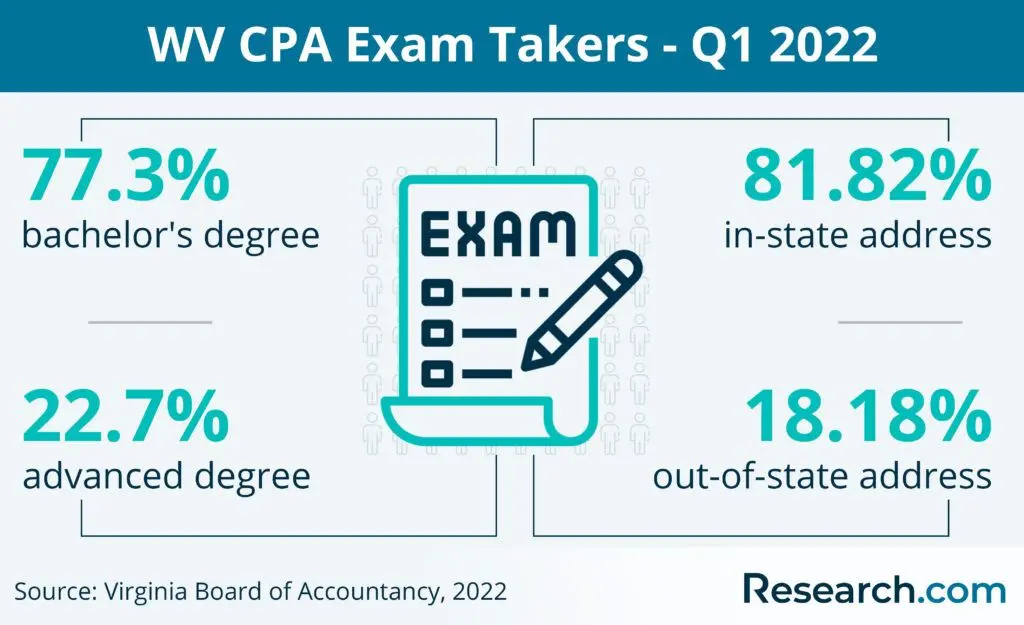
For students in West Virginia, the CPA path can be a practical choice if they are willing to complete the education, exam, and experience requirements. Among WV CPA exam takers, 77.3% had a bachelor’s degree, 22.7% had an advanced degree, 81.82% had in-state addresses, and 18.18% had out-of-state addresses. Many candidates complete their education through accounting schools in West Virginia, which can make it easier to align coursework with state expectations.
Where CPAs Work
CPA careers are not limited to tax preparation or public accounting firms. Across the United States, CPAs work in professional services at 23%, finance and insurance at 16%, manufacturing at 9%, retail trade at 9%, information and media at 4%, construction at 4%, health care at 4%, and the public sector at 4%. Several other industries account for 1 to 2% each. This spread matters because accounting graduates can pursue roles in corporate finance, government accounting, compliance, audit, consulting, fraud investigation, and forensic accounting.
West Virginia Cost of Living Context
Salary should always be evaluated against local living costs. West Virginia is the 40th most expensive state and ranks within the bottom ten best U.S. states to live in based on recent quality of life metrics. The total monthly cost of living for a single person in West Virginia is approximately $1,984 with rent and $720 without rent; for a family of four, it is around $4,582 and $2,425, respectively. Food costs average $585 per month for singles and $1,520 for a family of four, while rent and utilities for a one-bedroom apartment or a family home average $1,264 and $2,157, respectively.
Accounting Salaries in West Virginia
In 2025, accountants in West Virginia earn an average annual salary of $58,342, with typical earnings ranging between $53,105 and $64,285. Actual pay depends on location, employer, industry, education, years of experience, certification status, job title, and technical skills. CPA licensure, audit experience, tax specialization, data analytics ability, and supervisory experience can all influence compensation.
When combined with West Virginia’s comparatively low cost profile, accounting can offer a reasonable career return for students who choose an affordable program and progress toward licensure or specialized roles. Students comparing career options can also review Research.com’s guide on how to become an accountant for a broader look at salaries, job duties, and career paths.
What Are the Steps to Becoming a CPA in West Virginia?
To become licensed as a CPA in West Virginia, candidates must satisfy the state’s education, examination, and experience rules. The basic pathway includes:
- Earn a baccalaureate degree from an accredited college or university.
- Pass all four sections required under West Virginia CPA exam rules, or transfer qualifying passing scores from another state to West Virginia.
- Complete the 150-hour academic requirement.
- Meet the experience requirement for certification.
Candidates with a master’s degree or doctorate in accounting, including a Ph.D., automatically qualify to sit for the examination. However, students should still verify that their coursework satisfies all licensing details before assuming they are ready to apply.
West Virginia CPA licensure follows a fiscal-year calendar that runs from July 1 through June 30. This timing can affect renewal planning and should be considered when mapping out the final steps from graduation to licensure.
CPA Pathway Timeline
| Stage | What You Do | Decision Point |
| Before enrollment | Choose an accredited accounting or business program. | Confirm that the curriculum can satisfy West Virginia CPA coursework requirements. |
| During the bachelor’s degree | Complete core accounting, business, ethics, and business law courses. | Ask whether the school offers CPA advising and exam preparation support. |
| After 120 credits | Decide how to reach 150 academic hours. | Options may include graduate coursework, a master’s degree, additional undergraduate credits, or a combined program. |
| Exam stage | Prepare for and pass the CPA Exam sections. | Compare school pass-rate data and CPA review resources before graduating. |
| Certification stage | Complete experience requirements and apply through the West Virginia Board of Accountancy. | Track deadlines, documentation, and the July 1 to June 30 licensing cycle. |
How Long Do Accounting Programs Take in West Virginia?
A standard bachelor’s degree in accounting or a related business field typically takes four years of full-time study after high school. Examples include a BS in Accounting or a BS in Business Administration with an accounting concentration or minor. Associate degrees generally take two years, but an associate degree alone does not meet the education threshold to sit for the CPA Exam.
Students who already hold a non-accounting bachelor’s degree may need additional coursework to satisfy West Virginia’s academic requirements. The state requires 30 semester hours of accounting, excluding Principles of Accounting; 3 semester hours in ethics; 3 semester hours in business law; and 27 semester hours in business and business-related coursework. Students comparing business pathways may find it useful to review how a finance degree differs from an accounting degree.
Some schools offer accelerated or combined pathways that allow bachelor’s students to continue into a master’s program, sometimes structured as a five-year bachelor’s-to-master’s option. These can be useful for CPA-bound students who need to reach 150 hours efficiently, but they are not automatically the cheapest route. Compare total tuition, graduate tuition rates, scholarships, and whether the additional credential improves your career options.
The CPA process also takes time beyond the degree itself. Candidates need time to review for the exam, schedule sections, wait for results, complete experience documentation, and finalize certification through the West Virginia Board of Accountancy.
Accounting Degree Options Compared
| Program Type | Typical Length | Best For | CPA Consideration |
| Associate degree in accounting | 2 years | Bookkeeping, accounting assistant roles, transfer preparation | Not enough by itself for CPA eligibility |
| Bachelor’s degree in accounting | 4 years | Entry-level accounting, audit, tax, corporate accounting, graduate study | Usually the main foundation for CPA education requirements |
| Business degree with accounting concentration | 4 years | Students who want accounting skills plus broader business flexibility | Must verify that accounting hours meet state requirements |
| Master’s in accounting | Varies by program | CPA-bound students, career changers, advancement-focused professionals | Can help reach 150 hours and deepen technical preparation |
| Certificate or post-baccalaureate coursework | Varies by credit need | Students filling CPA coursework gaps after another degree | Useful only if courses match state-required categories |
West Virginia’s employment by sector also shows why accounting skills travel well across industries. Employment figures include healthcare and social assistance at 154,044, retail trade at 92,119, accommodation and food services at 64,417, administration, business support and waste management services at 40,692, professional, scientific and technical services at 33,800, information at 29,913, construction at 29,558, other services except public administration at 26,266, and others. These industries all need financial reporting, budgeting, payroll, tax, audit, and compliance support.
What Do Accounting Programs Cost in West Virginia?
Accounting program costs vary by institution, residency status, delivery format, degree level, housing choice, fees, books, technology costs, and financial aid. Students should compare total cost of attendance, not tuition alone. In-state, out-of-state, and international tuition may differ substantially, although some online programs reduce or remove out-of-state tuition differences.
| School | Published Cost Information Cited | What to Check Before Enrolling |
| West Virginia University | In-state tuition and fees of $9,648/year and out-of-state tuition and fees of $27,360/year | Confirm whether your format is campus-based or online and whether program-specific fees apply. |
| Marshall University | Resident of WV: $4,471 per semester; non-resident: $10,147 per semester; Metro residents: $6,560 per semester | Ask whether your county or location qualifies for Metro pricing and what fees are excluded. |
| West Virginia State University | $350 per credit hour in-state, $576 out-of-state, and $350 per credit online | Compare online pricing against campus fees and required technology costs. |
| Wheeling University | $29,090/year for both residential and commuter student types | Review scholarship availability and total residential costs if living on campus. |
| Shepherd University | $8,282 in-state and $18,722 out-of-state for annual tuition and fees | Ask how transfer credits, 4+1 options, and financial aid affect total cost. |
Because tuition and fee schedules can change, students should verify current pricing directly with each school. Also compare indirect expenses such as commuting, housing, textbooks, software, exam prep materials, CPA Exam fees, graduation fees, and lost work hours. A program with higher tuition may be worthwhile if it offers strong scholarships, internships, transfer credit acceptance, or a faster path to 150 hours. A lower-tuition program may be the better choice if it still meets CPA requirements and provides enough career support.
West Virginia Schools Offering Accounting Programs for 2027
The schools below represent selected West Virginia accounting options reviewed for program structure, accreditation, cost information, and CPA preparation relevance. This is not a complete list of every accounting program in the state and should not be read as a formal ranking. Use it as a starting point, then verify curriculum, tuition, aid, transfer policy, and CPA alignment directly with each institution.
1. West Virginia University
The John Chambers College of Business and Economics at West Virginia University offers several accounting-related pathways: a Bachelor of Science in Business Administration with a major in Accounting, Master of Accountancy, Master of Science in Forensic and Fraud Examination online, a four-year Doctor of Philosophy in Business Administration with a concentration in accounting, and a three-year Doctor of Philosophy in Business Administration with a concentration in accounting online. Options such as Business Cybersecurity and Business Data Analytics may appeal to students interested in technology-driven accounting work. The redesigned accounting major is intended to support preparation for the CPA, Certified Management Accountant, Certified Fraud Examiner, and Certified Internal Auditor exams.
- Program length: BSBA 4 years; online and asynchronous format noted
- Tracks or concentrations: Business Cybersecurity, Business Data Analytics, Finance
- Tuition and fees: In-state tuition and fees $9,648/year; out-of-state tuition and fees $27,360/year; or BSBA $475/credit hour
- Credits required: 120 credits
- Accreditation: The Association to Advance Collegiate Schools of Business International
2. Marshall University
The Brad D. Smith College of Business at Marshall University offers a B.B.A. in Accounting for students preparing for accounting roles, business careers, and graduate study. Graduates have entered public accounting firms, industry positions, and government agencies. Marshall University is one of only 186 schools in the world to have achieved accreditation by AACSB International. The program emphasizes faculty interaction, internships, extracurricular learning, and professional networking.
- Program length: 4 years
- Tracks or concentrations: Various electives
- Tuition cost per semester: Resident of WV $4,471; Non-Resident $10,147; Metro residents $6,560
- Credits required: 120 credits
- Accreditation: The Association to Advance Collegiate Schools of Business International
3. West Virginia State University
The College of Business and Social Sciences at West Virginia State University offers a Bachelor of Science in Business Administration with a concentration in Accounting. The curriculum combines accounting theory, business administration, information use, ethical decision-making, problem-solving, and communication. Students may also consider options such as the Postgraduate Certificate in Accounting and the Certificate in Forensic Accounting.
- Program length: 4 years
- Tracks or concentrations: Various electives and certification options
- Tuition cost per credit hour: In-state $350; out-of-state $576; online $350
- Credits required: 120 credits
- Accreditation: Accreditation Council for Business Schools and Programs
4. Wheeling University
Wheeling University’s accounting program offers a Bachelor of Science in Accounting along with graduate degree options intended to support professional preparation. The school reports small classes with a 10:1 student-to-faculty ratio, and its accounting instructors are in-field experts who also hold active CPA licenses. Internship opportunities are built into the student experience, and career paths may include public accounting, nonprofit organizations, government, and corporate accounting. Graduate-level accounting classes are available for students planning to sit for the CPA Exam.
- Program length: 4 years
- Tracks or concentrations: Various electives
- Tuition cost per year: Residential and commuter students $29,090/year
- Credits required: 120 credits
- Accreditation: Association of Collegiate Business Schools and Programs
5. Shepherd University
Shepherd University’s Department of Business Administration offers a B.S. in Accounting designed to prepare students for accounting work and further study. Students may pursue a double major in economics or business administration. The program has reported strong CPA Exam outcomes, including the highest pass rates within West Virginia for multiple years and a national ranking with a 66.7 percent pass rate for first-time takers. Shepherd also offers a 4+1 pathway for students seeking both a bachelor’s degree and an MBA within five years, and it maintains an articulation agreement with Marshall University for a Master of Science in Accountancy degree.
- Program length: 4 years
- Tracks or concentrations: Various electives
- Tuition and fees per year: In-state $8,282; out-of-state $18,722
- Credits required: 120 credits
- Accreditation: International Accreditation Council for Business Education
How to Choose an Accounting Program in West Virginia
A strong accounting program should do more than award credits. It should help you qualify for your intended career path, prepare for professional exams, build applied skills, and connect with employers. Use the criteria below when comparing schools.
1. Accreditation
Accreditation helps confirm that a college or university meets recognized academic quality standards. For CPA-bound students, accreditation is especially important because non-accredited or fraudulent degrees can prevent candidates from sitting for the CPA Exam or practicing as CPAs.
Accounting schools in West Virginia should hold appropriate institutional accreditation from recognized accrediting bodies such as:
- Middle States Association of Colleges and Schools
- New England Association of Schools and Colleges
- North Central Association of Colleges and Schools
- Northwest Commission on Colleges and Universities
- Southern Association of Colleges and Schools
- Western Association of Schools and Colleges
Business-specific accreditation, such as AACSB, ACBSP, or IACBE, can also be useful when comparing program quality, employer recognition, and curriculum standards.
2. CPA Coursework Alignment
West Virginia CPA candidates must complete specific academic content before licensure. Confirm that your program includes:
- 30 semester hours of accounting, excluding Principles of Accounting
- 3 semester hours in ethics
- 3 semester hours in business law
- 27 semester hours in business and business-related courses
Do not assume that every accounting concentration automatically satisfies these requirements. Ask an advisor for a written course map showing how each requirement is met. For transfer students, the West Virginia Board of Accountancy also accepts CLEP or DSST credits for the required course areas. International applicants should have foreign transcripts evaluated by NASBA’s NIES before applying to sit for the CPA Exam.
3. Specialization Options
Accounting is broad, so electives can shape your career direction. Depending on the school, students may be able to study corporate taxation, auditing, fraud examination, forensic accounting, financial planning, employee benefits, business valuation, healthcare valuation, estate planning, consulting services, or financial forensics. Students still exploring options can review the different types of accounting degrees to understand how specializations compare.
Local labor-market concentration can also matter. With employment of 560, the Parkersburg-Vienna, WV area maintains the highest location quotient in the USA. Its value of 15.65 indicates a much higher concentration of employment in this sector than the national average.
4. CPA Exam Pass Rates and Exam Support
CPA Exam outcomes can provide insight into how well a program prepares candidates, but pass rates should be interpreted carefully. A high pass rate may reflect strong teaching, selective candidate pools, intensive exam preparation, or a combination of factors. Ask schools how many students sat for the exam, whether results are first-time or repeat-taker rates, and what support is available before and after graduation.
West Virginia’s CPA exam results showed scores of 71.9% for first-time test-takers and 70.4% for repeat-takers; pass rates were 58.6% and 49.2%, respectively. For the four CPA Exam sections, pass rates were 44.8% for Auditing and Attestation, 57.0% for Business Environment and Concepts, 41.6% for Financial Accounting and Reporting, and 58.8% for Regulation, with average scores of 71.1, 74.4, 69.1, and 74.1, respectively.
The American Institute of Certified Public Accountants reports national section-level data. In Q1 2024, AICPA CPA Exam pass-rate information listed AUD at 44.63%, FAR at 41.92%, and REG at 63.42%. Under the CPA Evolution model, West Virginia’s pass rates remained competitive relative to current average pass rates among states.
What Are the Benefits of Online Accounting Programs in West Virginia?
Online accounting programs can be a strong fit for West Virginia students who need flexibility, live far from campus, work full time, or want to reduce commuting and housing costs. The key is to choose an accredited online program that offers the same academic rigor and CPA-relevant coursework as its campus-based option.
| Online Accounting Programs | Campus Accounting Programs | Best Choice When... |
| Often provide asynchronous or flexible scheduling | Usually follow a fixed class schedule | Online works better if you work, parent, commute long distances, or need evening study time. |
| May reduce relocation, transportation, and housing costs | May provide more direct access to campus resources | Campus can be better if you want in-person tutoring, student organizations, and face-to-face faculty access. |
| Can make statewide or out-of-state programs accessible | Can strengthen local peer relationships and campus networking | Online is useful for rural students; campus may help students who learn best in structured settings. |
| Requires strong self-discipline and comfort with learning platforms | Provides more immediate classroom accountability | Choose the format that matches how you actually study, not how you wish you studied. |
Online study may also lower total costs when schools charge the same tuition to online students regardless of residency, as seen in some West Virginia pricing models. However, students should still check online course fees, proctoring fees, software requirements, and whether internships or recruiting events are accessible remotely.
Students interested in fraud investigation or specialized accounting work may consider an online pathway such as a forensic accounting degree online. Those comparing a broader set of distance-learning options can review Research.com’s guide to online bachelor’s degrees in accounting.
What Scholarships and Financial Aid Options Are Available for Accounting Students in West Virginia?
Accounting students in West Virginia may use a mix of federal aid, state aid, institutional scholarships, accounting-specific awards, employer tuition benefits, and transfer strategies to reduce costs. The most important first step is completing the FAFSA, because many need-based grants, loans, and school-based awards depend on it.
- West Virginia PROMISE Scholarship: This merit-based award supports West Virginia high school graduates who plan to attend an in-state college and qualify based on academic performance.
- West Virginia Higher Education Grant Program: This need-based grant is available to eligible undergraduate students with demonstrated financial need at participating in-state institutions. Applicants must be West Virginia residents and complete the FAFSA.
- Accounting-specific scholarships: Organizations such as the West Virginia Society of CPAs may offer awards for students pursuing accounting or public accounting careers. Eligibility may consider academics, financial need, and professional goals.
- Institutional scholarships: Schools such as West Virginia University and Marshall University may offer scholarships through business colleges, accounting departments, honors programs, leadership awards, or need-based aid offices.
- Federal financial aid: FAFSA submission can open access to the Pell Grant, Federal Supplemental Educational Opportunity Grant, and federal student loans that may be used for tuition, books, and living costs.
- Employer tuition assistance: Some employers reimburse or support accounting coursework, especially when employees are building skills relevant to finance, audit, compliance, or CPA licensure.
How to Reduce the Cost of an Accounting Degree
- Compare net price after scholarships, not only published tuition.
- Ask whether online students pay in-state, out-of-state, or separate online tuition.
- Transfer approved community college credits when possible.
- Confirm that transfer credits still count toward CPA coursework categories.
- Apply early for department-level accounting scholarships.
- Consider part-time work in bookkeeping, payroll, tax preparation, or accounts payable to gain experience while studying.
- Budget for CPA Exam preparation and licensing costs before senior year.
What Career Paths Are Available to Accounting Students Besides Becoming a CPA?
CPA licensure is valuable, but it is not the only route for accounting graduates. Students can pursue corporate accounting, financial analysis, internal audit, payroll, budgeting, tax preparation, government accounting, nonprofit finance, banking, compliance, risk management, fraud examination, and business operations roles. Some positions may prefer or require certifications, while others value strong Excel, ERP, tax, audit, or analytics skills.
| Career Path | Typical Work | When It Makes Sense |
| Public accounting | Audit, tax, advisory, client accounting services | You want structured training, CPA progression, and exposure to many clients. |
| Corporate accounting | Financial reporting, month-end close, reconciliations, budgeting | You prefer working inside one organization and learning its operations deeply. |
| Government accounting | Public funds, compliance, audits, grants, reporting | You value public service, stability, and regulatory work. |
| Forensic accounting | Fraud detection, investigation support, litigation-related analysis | You enjoy investigative work and detailed document review. |
| Financial analysis | Forecasting, performance reporting, cost analysis, decision support | You want to combine accounting knowledge with strategy and data analysis. |
| Education or training | Teaching business, accounting, financial literacy, or mathematics-related content | You want to apply quantitative skills in a classroom or training environment. |
Accounting also develops organization, recordkeeping, and analytical skills that can support career transitions. For example, a student considering education could compare accounting work with elementary school teacher requirements in West Virginia, although teaching has separate certification rules.
Can Accounting Skills Complement Careers in Healthcare?
Yes. Healthcare organizations need professionals who understand budgeting, reimbursement, compliance, revenue cycles, internal controls, purchasing, and financial reporting. Accounting graduates may work in hospital finance departments, healthcare auditing, insurance billing analysis, long-term care administration, or compliance support.
This does not mean accounting automatically qualifies someone for clinical roles. A student who wants direct patient care must meet healthcare-specific education and licensing requirements. For example, a person considering a clinical advanced-practice route should separately research how to become a nurse practitioner in West Virginia.
What Are the Advantages of Online Accounting Programs for West Virginia Students?
For many West Virginia students, the biggest advantage of online accounting study is access. Students in rural areas can enroll without moving closer to campus, and working adults can complete coursework around employment. Online programs may also make it easier to keep a current job while building credentials for promotion or CPA eligibility.
The trade-off is that online students must be more proactive. They should schedule regular advisor meetings, attend virtual employer events, ask about internship placement, and confirm CPA coursework in writing. A convenient format is not enough if the program lacks academic support or professional connections.
How Can Forensic Science Expand My Accounting Career Opportunities?
Forensic accounting combines accounting, investigation, documentation, fraud detection, and legal support. Students interested in this area may benefit from coursework in auditing, fraud examination, data analysis, cybersecurity, criminal procedure, or evidence handling. Forensic science knowledge can add context for professionals working with investigations, compliance reviews, or litigation support.
Students considering this interdisciplinary path can compare accounting-focused fraud programs with broader forensic training, including guidance on forensic science careers in West Virginia. The best choice depends on whether the student wants to remain primarily in finance or move toward laboratory, investigative, or criminal justice roles.
How Does a Master’s Degree in Accounting Affect Career Growth?
A master’s degree in accounting can help students reach the 150-hour CPA education requirement, strengthen technical knowledge, and signal readiness for advanced accounting work. It may be especially useful for students who want public accounting, advisory roles, forensic accounting, tax specialization, audit leadership, or a career change from another undergraduate major.
However, a master’s degree is not automatically the best investment for every student. Some CPA candidates can reach 150 hours through additional undergraduate credits or certificate coursework at a lower cost. Before enrolling, compare total tuition, employer reimbursement, CPA Exam support, placement outcomes, and the value of the graduate credential in your target field. For a deeper discussion of outcomes, review Research.com’s analysis of whether a master’s degree in accounting is worth it.
Essential Skills and Networking Opportunities for Accounting Students in West Virginia
Successful accounting students need more than the ability to record transactions. Employers increasingly value technical accounting knowledge, ethical judgment, communication, spreadsheet proficiency, tax awareness, audit reasoning, data analytics, and comfort with accounting software. Students should also learn how to explain financial information to non-accountants, because many accounting roles involve advising managers, clients, or public agencies.
Networking is equally important. Internships, accounting clubs, faculty relationships, CPA firm recruiting events, alumni contacts, and professional associations can lead to mentorship and job opportunities. Students should ask each school how it supports internships, whether employers recruit on campus or online, and how many accounting students complete experiential learning before graduation.
Students who want broader business preparation can also compare accounting programs with the best business schools in West Virginia, especially if they are considering finance, management, analytics, or entrepreneurship in addition to accounting.
Current Trends Affecting Accounting Education and CPA Careers
Accounting education is changing because employers need graduates who understand both core financial rules and modern technology. Automation can handle more routine processing, but organizations still need accountants to interpret results, design controls, investigate errors, advise leaders, and ensure compliance.
The CPA Exam has also changed through the CPA Evolution initiative, which launched in 2024. The updated model reflects the profession’s shift toward deeper technology knowledge, analytics, risk assessment, and specialized competencies. Students should ask whether their program has adjusted its curriculum for the current exam structure.
Artificial intelligence is increasingly used for real-time financial calculations, anomaly detection, and fraud monitoring. Tools that assist in detecting and predicting fraudulent activity may improve efficiency, but they do not remove the need for professional judgment. Accountants who understand internal controls, ethics, data quality, and business context are better positioned than those who only know routine data entry.
Graduates who are unsure how to apply their accounting education can explore what to do with an accounting degree after graduation, including CPA and non-CPA options.
Common Mistakes to Avoid When Choosing an Accounting School
| Mistake | Why It Can Hurt You | Better Approach |
| Choosing only by sticker tuition | A lower tuition program may cost more if credits do not transfer or CPA requirements are not met. | Compare net cost, fees, transfer credits, aid, and time to completion. |
| Ignoring accreditation | Unaccredited degrees can create serious CPA eligibility problems. | Verify institutional and business-school accreditation before applying. |
| Assuming every accounting degree meets CPA rules | Some concentrations may lack enough accounting, ethics, business law, or business-related credits. | Request a CPA course map from the department or advisor. |
| Relying only on rankings | Rankings may not reflect your cost, schedule, transfer status, or career goal. | Use rankings as one input, then evaluate fit and outcomes. |
| Overlooking online student support | Online flexibility is less valuable if advising, tutoring, and recruiting are weak. | Ask how online accounting students access internships, faculty, and CPA advising. |
| Forgetting the 150-hour requirement | A 120-credit bachelor’s degree may leave a CPA candidate short of licensure education hours. | Plan early for graduate credits, extra undergraduate credits, certificates, or a 4+1 program. |
| Assuming salaries are guaranteed | Pay varies by employer, location, credentials, and experience. | Build skills, pursue internships, and compare local job postings before choosing a path. |
Questions to Ask Before Enrolling
- Is the institution properly accredited, and does the business or accounting program hold specialized accreditation?
- Does the curriculum satisfy West Virginia’s CPA academic requirements?
- How will I reach 150 academic hours if I plan to become a CPA?
- What are the most recent CPA Exam pass rates, and how many students were included?
- Are CPA review materials, exam advising, or faculty mentoring available?
- What is the total cost after scholarships, grants, fees, housing, and books?
- How many transfer credits will be accepted, and how will they apply to accounting requirements?
- Are internships available in public accounting, corporate accounting, government, or nonprofit finance?
- Do online students receive the same advising and career support as campus students?
- Which accounting software, analytics tools, and tax or audit platforms are taught?
Can Accounting Expertise Pave the Way for a Career in Teaching?
Accounting professionals often have strong quantitative reasoning, organization, budgeting, and problem-solving skills, all of which can be useful in education. However, teaching in public schools generally requires separate educator preparation, certification, and state-specific requirements. Anyone considering this transition should review the academic and licensure steps for becoming a teacher in West Virginia.
Should I Choose an Online Degree Over a Traditional Degree for Accounting?
Choose an online accounting degree if flexibility, commute reduction, work compatibility, or location access is your top concern. Choose a traditional campus program if you learn better with in-person structure, want easier access to faculty and student organizations, or plan to participate heavily in campus recruiting. Neither format is automatically better; the right choice depends on accreditation, CPA alignment, affordability, learning style, and career support.
Students still comparing formats can review Research.com’s detailed comparison of online and traditional accounting degrees.
Can Accounting Skills Transition into Medical Coding Careers?
Accounting skills can support a move into medical coding because both fields require accuracy, documentation, compliance awareness, and careful review of records. However, medical coding also requires specialized knowledge of healthcare documentation, billing rules, insurance standards, and coding systems. A person moving from accounting to healthcare administration or billing should expect additional training.
For a role-specific overview, review how to become a medical biller and coder in West Virginia.
What Challenges Do Accounting Professionals Face in West Virginia?
Accounting professionals in West Virginia must manage several challenges: meeting detailed CPA education requirements, keeping up with tax and regulatory changes, adapting to automation, learning data analytics tools, and competing for advancement in specialized roles. Students should align coursework carefully with accounting and CPA requirements in West Virginia instead of waiting until graduation to check eligibility.
Another challenge is skill modernization. Employers increasingly expect accountants to understand accounting systems, spreadsheets, data visualization, fraud controls, and technology-enabled audit processes. Graduates who combine technical accounting with communication, ethics, and analytics will be better prepared for long-term career resilience.
Can Accounting Expertise Support a Career in Urban Planning?
Accounting knowledge can support urban planning work in areas such as public budgeting, grant tracking, infrastructure finance, cost analysis, and compliance reporting. It does not replace planning education, but it can strengthen roles that involve municipal finance, capital projects, or public-sector resource allocation. Students interested in that transition can review how to become an urban planner in West Virginia.
How Can Continuous Learning Expand My Accounting Career Options?
Continuing education can help accounting professionals move into audit leadership, tax specialization, financial analysis, fraud examination, systems implementation, compliance, or teaching-related roles. Valuable learning areas include CPA Exam preparation, data analytics, accounting software, internal controls, cybersecurity basics, tax updates, and industry-specific accounting.
Some professionals also use accounting skills to move into education or quantitative teaching roles. Those considering that path should review the requirements for becoming a high school math teacher in West Virginia.
How Can Legal Knowledge Amplify My Accounting Career in West Virginia?
Legal knowledge can strengthen accounting careers that involve compliance, audit investigations, fraud examination, tax controversy, contract review, corporate governance, and litigation support. Accountants do not need to become lawyers to benefit from legal literacy, but they should understand evidence, documentation, regulatory processes, and professional ethics when working in risk-sensitive roles.
Students interested in combining legal procedures with financial analysis may explore paralegal training or related coursework. A useful starting point is Research.com’s guide on how to become a paralegal in West Virginia.
Key Insights
- CPA planning should start before enrollment: West Virginia CPA candidates need a bachelor’s degree, passing CPA Exam scores, 150 academic hours, and qualifying experience. The degree must include the required accounting, ethics, business law, and business-related coursework.
- Accounting demand remains steady nationally: The U.S. Bureau of Labor Statistics projects 5% growth for accountants and auditors from 2024 to 2034, with an employment change of around 72,800 and 1,579,800 jobs estimated in 2024.
- Cost varies widely by residency and format: Examples include West Virginia University at $9,648/year for in-state tuition and fees and $27,360/year for out-of-state tuition and fees, while West Virginia State University lists $350 per credit online.
- Salary should be evaluated locally: In 2025, accountants in West Virginia earn an average annual salary of $58,342, with typical earnings ranging between $53,105 and $64,285. Outcomes depend on credentials, experience, employer, and specialization.
- Online programs can be practical but require scrutiny: Flexibility and cost savings are valuable only if the program is accredited, CPA-aligned, and offers advising, internships, and career support.
- Do not rely on rankings alone: The best program is the one that fits your CPA plan, budget, transfer history, learning style, and target career path.
- Accounting skills are portable: Graduates can work in public accounting, corporate accounting, government, nonprofit finance, healthcare administration, forensic accounting, financial analysis, compliance, and other business roles.
- Technology is changing the profession: AI, automation, analytics, and the CPA Evolution model make data skills and professional judgment increasingly important for future accountants.
Related Articles for Nearby States
- 2027 Best Accounting Schools in Virginia – How to Become a CPA in VA
- 2027 Accounting Schools in Ohio: How to Become a CPA in OH
- 2027 Best Accounting Schools in Kentucky – How to Become a CPA in KY
- 2027 Accounting Schools in Pennsylvania – How to Become a CPA in PA
- 2027 Best Accounting Schools in Maryland – How to Become a CPA in MD
- 2027 Best Accounting Schools in Tennessee – How to Become a CPA in TN
- 2027 Best Accounting Schools in Indiana – How to Become a CPA in IN
- 2027 Best Accounting Schools in South Carolina – How to Become a CPA in SC
- 2027 Accounting Schools in Georgia – How to Become a CPA in GA
- 2027 Accounting Schools in New Jersey – How to Become a CPA in NJ
References:
- AICPA & CIMA. (2026, January 16). Learn more about CPA Exam scoring and pass rates. Resources | AICPA & CIMA. AICPA & CIMA.
- Salary.com. (2026, February 1). Accountant Salary. Salary.com.
- U.S. Bureau of Labor Statistics. (2025, August 28). Accountants and Auditors. U.S. Bureau of Labor Statistics.
- Zippia.com. (2025). Certified Public Accountant Demographics and Statistics. Zippia.com.
- Zippia. (2025, January 8). Certified public accountant education requirements. Zippia.com.
Other Things You Should Know About the Best Accounting Schools in West Virginia
In 2027, the top accounting schools in West Virginia include West Virginia University, Marshall University, and University of Charleston. These institutions offer comprehensive programs that prepare students for the CPA exam and a successful career in accounting.
To become a CPA in West Virginia, you need to complete a baccalaureate degree from an accredited institution, pass all four parts of the CPA exam, complete 150 academic hours, and fulfill the experience requirement. Additionally, you must meet West Virginia's specific academic specifications and apply for licensure through the state board.
The cost of accounting programs varies. For instance, West Virginia University charges $9,648/year for in-state students and $27,360/year for out-of-state students. Other institutions, like Marshall University, charge $4,471 per semester for in-state students and $10,147 for non-residents. Online programs often have different fee structures.
In 2027, CPAs in West Virginia enjoy diverse job opportunities across public accounting firms, corporations, and government agencies. With steady demand and a need for financial expertise, CPAs can expect competitive salaries and career advancement opportunities in fields like auditing, tax consultancy, and financial analysis.
To prepare for the CPA exam in West Virginia, candidates should complete a bachelor's degree with at least 150 credit hours in accounting or a related field. Enrolling in review courses, utilizing study guides, and practicing with sample questions are highly recommended for success.