2027 Best Accounting Schools in Montana – How to Become a CPA in MT

Co-Founder and Chief Data Scientist
Choosing an accounting school in Montana is not just a question of which campus is closest or which program has the lowest tuition. If your goal is to become a CPA, work in audit or tax, move into forensic accounting, or build a finance career in one of the state’s growing industries, your school must help you meet Montana’s education rules, prepare for the CPA exam, and connect you with practical experience.
Montana’s economy gives accounting students a meaningful reason to plan carefully. The state experienced one of the largest increases in real gross domestic product (GDP) in the United States at 4.7% from 2022 to the first quarter of 2025, which can create broader demand for financial reporting, tax planning, compliance, payroll, auditing, and business advisory services. That growth does not guarantee a job or a specific salary, but it does make accounting a practical degree to evaluate if you want a career with applications across private companies, government agencies, nonprofits, public accounting firms, and specialized consulting roles.
This guide explains how accounting education works in Montana, what the state requires for CPA eligibility, how long programs usually take, what students can expect to pay, and which schools stand out based on the available data. It is especially useful if you have already compared a finance vs accounting degree and are leaning toward accounting, but still need help choosing a school and mapping the next steps toward licensure.
Best Accounting Schools in Montana Table of Contents
- Is accounting a smart career choice in Montana?
- How do you become an accountant or CPA in Montana?
- How long do accounting programs in Montana take?
- What do accounting programs in Montana cost?
- How can Montana accounting students pay for college?
- Best Accounting Schools in Montana for 2027
- How should you compare Montana accounting schools?
- Can healthcare knowledge expand accounting career options in Montana?
- How much can CPAs earn in Montana?
- What can forensic accountants do in Montana?
- Can forensic science strengthen a forensic accounting career?
- How can healthcare administration affect accounting opportunities?
- What accounting trends should Montana students watch?
- Networking and professional development for Montana accountants
- Can urban planning knowledge help accounting professionals?
- Can accounting experience lead to high school math teaching?
- Can legal training improve an accounting career?
- How to choose a Montana business school for accounting
- Can accountants move into teaching roles?
- What other careers can accounting graduates pursue?
- How do accounting degree options differ?
Quick Answer: What is the best accounting school path in Montana?
The best accounting school in Montana for you is the one that matches your career goal. If you want to become a CPA, prioritize an accredited bachelor’s program that helps you complete the 120 semester hours needed to sit for the CPA exam and offers a clear route to the 150 semester hours required for licensure. If you want faster entry into bookkeeping or accounting support work, a two-year option may be enough to start, but it will not by itself meet CPA education expectations.
Montana State University, University of Montana, Carroll College, Montana Technological University, and Rocky Mountain College are among the schools reviewed in this guide. Each has different strengths in cost, accreditation, CPA preparation, internships, graduate pathways, and flexibility.
| Student goal | Most practical Montana accounting path | Why it fits |
| Become a CPA | Bachelor’s degree plus additional coursework or a master’s pathway | Montana requires 120 semester hours to sit for the CPA exam and 150 semester hours for licensure. |
| Start working sooner | Associate degree or lower-cost transfer pathway | This can lead to entry-level accounting support roles, but students should confirm transferability if they later pursue CPA eligibility. |
| Specialize in fraud, compliance, or investigations | Accounting degree with forensic accounting, audit, analytics, or legal coursework | Forensic accounting relies on financial analysis, documentation, investigative thinking, and compliance knowledge. |
| Work while studying | Online or hybrid accounting coursework from an accredited institution | Flexible delivery can help working adults complete credits, but students must verify that courses meet Montana Board requirements. |
Is accounting a good job in Montana?
Accounting can be a good career choice in Montana for students who want a practical business profession with multiple work settings. Accountants and CPAs can support local businesses, public agencies, healthcare organizations, energy companies, tourism employers, farms and ranches, nonprofits, and independent clients. The profession is also portable: tax, audit, financial reporting, budgeting, payroll, compliance, and advisory skills can apply across industries.
Still, “good job” depends on how salary, living costs, education requirements, and job availability fit your situation. Here are the major factors to weigh.
- Income. Accountants and auditors in Montana have an annual median salary of $68,460 (BLS, 2022a). The national annual median salary is $78,000, so Montana’s median is lower than the national figure. However, salary should be evaluated alongside local expenses, career stage, specialization, employer type, CPA status, and experience.
- Cost of living. An individual in Montana can expect average personal consumption and expenditures of $53,240, including major categories such as healthcare, housing, and food. Compared with the annual median salary for accountants and auditors in the state, this suggests accounting can support a stable standard of living for many professionals, though individual budgets vary.
- Employment mix. Accountants and auditors are less prevalent in Montana than the national average (BLS, 2022a). At the same time, bookkeeping, accounting, and auditing clerks are more prevalent, which can create entry points for students, career changers, and workers building experience before or during CPA preparation.
- Education access. Montana offers public and private pathways for accounting students, including bachelor’s degrees, master’s options, and flexible study formats. Students who want graduate-level business training may also compare an online MBA in accounting with a Master of Accountancy or professional accountancy program.
| Accounting advantage in Montana | What it means for students | What to verify before enrolling |
| Broad industry usefulness | Accounting graduates can work in government, public accounting, private business, nonprofit finance, and specialized roles. | Ask whether the program places students in internships tied to your target industry. |
| CPA pathway available | Several Montana schools offer coursework that supports exam and licensure preparation. | Confirm how the school helps students reach both 120 semester hours and 150 semester hours. |
| Entry-level options exist | Bookkeeping and accounting clerk roles may help students gain experience before advanced credentials. | Check whether credits from a two-year program transfer into a bachelor’s degree. |
| Specializations are possible | Audit, tax, forensic accounting, compliance, healthcare finance, and government accounting can all be viable directions. | Review electives, faculty expertise, career services, and employer connections. |
What are the steps to becoming an accountant in Montana?
You do not need to be a CPA to work in every accounting-related job, but CPA licensure is important if you want to sign audit reports, advance in public accounting, open certain types of practice, or compete for roles that specifically prefer or require the credential. Montana’s CPA process includes education, the CPA examination, licensure, and continuing professional education.
Step 1: Complete the required accounting education
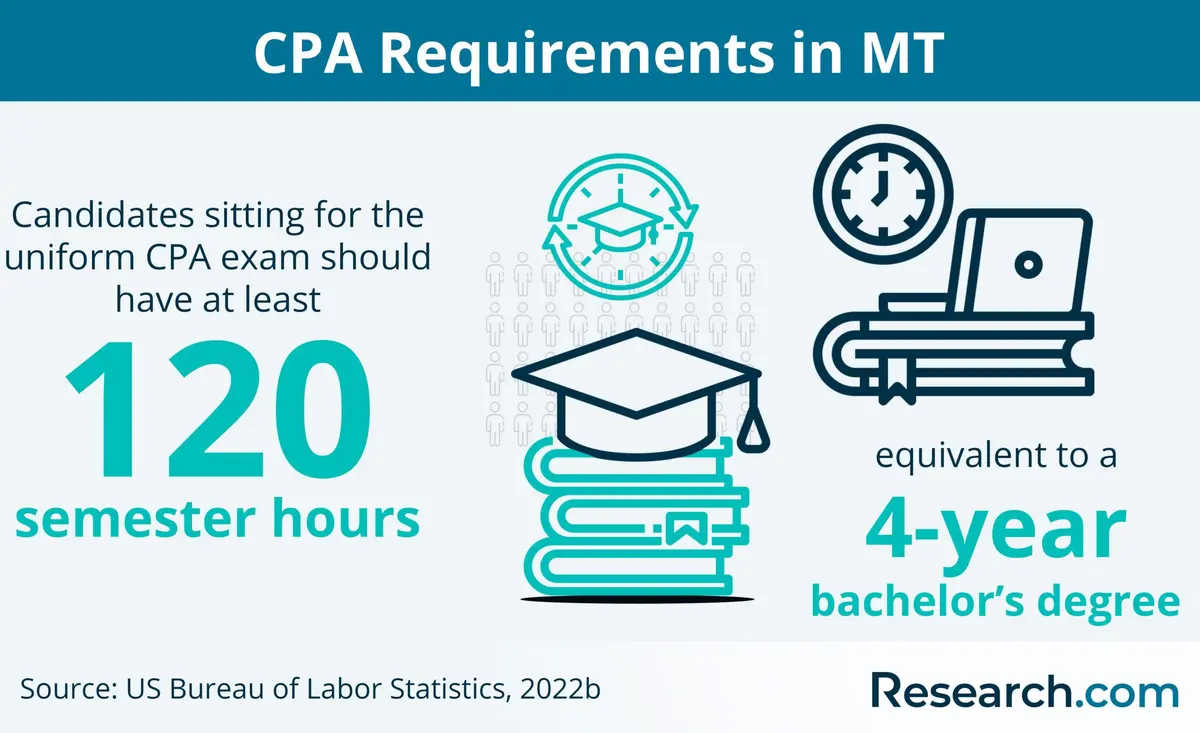
Montana students who plan to sit for the CPA exam should build their degree plan around the Board’s semester-hour rules from the beginning. Associate degrees can be useful for entry-level roles or transfer planning, but the Board requires at least 120 semester hours to sit for the CPA exam, which generally aligns with a bachelor’s degree.
- Use an accredited institution. Montana requires qualifying education from a regionally or nationally accredited school. Relevant accrediting bodies and recognitions include the Association to Advance Collegiate Schools of Business (AACSB), the Northwest Commission on Colleges and Universities (NWCCU), and the International Accreditation Council for Business Education (IACBE).
- Take enough accounting coursework. CPA exam candidates must complete 24 semester hours of accounting courses at the undergraduate or graduate level, not counting introductory courses.
- Meet the business-course requirement. Montana also requires 24 semester hours of business courses, so students should avoid choosing accounting electives without checking the full business requirement.
- Get Board approval. After completing the required coursework, candidates must submit their education for approval before taking the CPA exam.
Step 2: Prepare for and pass the CPA examination
Strong Montana accounting programs do more than award credits; they help students understand how coursework connects to the CPA exam. Students should ask whether the curriculum includes review-style courses, exam-aligned topics, faculty advising, and support for transcript evaluation. Research.com also offers guidance on how to prepare for the CPA exam.
The exam information used in this guide identifies four parts: auditing and attestation (AUD), financial accounting and reporting (FAR), regulation (REG), and business environments and concepts (BEC). A passing score for each part is 75, and a candidate must pass all parts for CPA licensing. Because exam rules and testing structures can change, students should confirm current requirements with the Montana State Board of Accountancy and NASBA before scheduling.
After finishing an accounting program, candidates submit official sealed transcripts from every institution attended to CPA Examination Services, which operates through the National Association of State Boards of Accountancy (NASBA). Once the coursework and transcripts are approved, the candidate receives a Notice to Schedule. The candidate must schedule and complete at least one exam section within the next six months; otherwise, reapplication is required. Candidates must pass all four sections within 18 months.
Step 3: Apply for Montana CPA licensure
Passing the exam is only part of the CPA process. Montana CPA licensure also requires additional education, ethics training, supervised experience, an application, fees, and an oath.
- Complete 150 semester hours, including at least 15 hours in upper-division accounting at the undergraduate or graduate level.
- Pass all four sections of the CPA exam.
- Complete the American Institute of Certified Public Accountants (AICPA) ethics course and exam.
- Document 2,000 hours of accounting or auditing experience under the supervision and attestation of a licensed CPA or a supervisor with an MRA with the National Association of State Boards of Accountancy (NASBA).
- Submit the CPA application form to the Board.
- Pay the $150 certification application fee.
- Take an oath as directed by the Board.
The key planning issue is the gap between 120 semester hours and 150 semester hours. Students often close that gap through graduate accounting courses, a Master of Accountancy, a Master of Professional Accountancy, additional undergraduate coursework, or online credits that meet Board standards. Before paying for extra classes, confirm that each course will count toward Montana’s licensure rules.
Step 4: Maintain the license through continuing professional education
Montana CPAs must keep learning after licensure. To renew a license, CPAs must complete 120 CPE hours in a three-year reporting period and satisfy the Board’s subject and renewal rules.
- Complete at least 60 CPE hours in technical subjects, including two hours in ethics.
- Complete at least 20 CPE hours per year in behavioral and personal courses.
- Report completed CPE hours to the Board.
- Show active practice.
- Pay the $125 license renewal fee.
- Finish the renewal process by December 31.
The Montana Society of CPAs (MTCPA) maintains a catalog of in-person and online CPE courses. Pricing can vary by MTCPA membership status, and MTCPA requires registration 21 days before a course begins. CPAs should track documentation throughout the reporting period rather than waiting until renewal time.
| CPA milestone | Montana requirement stated in this guide | Student action |
| Sit for CPA exam | 120 semester hours, 24 semester hours of accounting courses, and 24 semester hours of business courses | Ask your advisor to map every required course before junior year. |
| Become licensed | 150 semester hours, ethics course and exam, 2,000 hours of experience, application, fee, and oath | Choose a school with a clear 150-hour strategy and employer connections. |
| Renew license | 120 CPE hours in a three-year reporting period | Plan annual CPE instead of trying to complete hours at the last minute. |
Accounting Program Length in Montana
Most students need about four years to complete a bachelor’s degree, which aligns with the 120 semester hours generally required to sit for the CPA exam. This degree can prepare graduates for entry-level accounting work and can form the academic base for CPA preparation.
CPA-focused students should plan for additional education because Montana requires 150 semester hours for licensure. Some schools, including Montana State University, offer a route to complete a master’s program in one year, which can help students earn the extra 30 hours needed after the bachelor’s level. Students who need flexibility can also compare accredited online accounting degrees, especially if they cannot relocate immediately or need to continue working while studying.
| Pathway | Typical use | CPA relevance |
| Associate degree | Entry-level accounting support, bookkeeping, transfer preparation | Not enough by itself for CPA exam eligibility, but may provide transferable credits. |
| Bachelor’s degree | Core accounting education and entry-level professional roles | Generally aligns with the 120 semester hours required to sit for the CPA exam. |
| Bachelor’s plus additional coursework | CPA candidates who need the remaining credits | Can help reach the 150 semester hours needed for licensure. |
| Master’s in accounting or professional accountancy | Advanced study, CPA preparation, specialization, and credit completion | Often used to satisfy the additional 30 hours beyond the bachelor’s level. |
Tuition and Costs of Accounting Programs in Montana
Accounting program costs in Montana depend on school type, residency status, delivery format, degree level, housing, books, fees, transportation, and whether a student needs extra credits beyond the bachelor’s degree for CPA licensure. Students should calculate the full cost of attendance, not only tuition.
On average, four-year public institutions in Montana cost approximately $9,000 for in-state students and $29,000 for out-of-state residents. Public two-year institutions, which can be used to begin accounting study through an associate degree, typically charge around $4,200 for in-state students and $9,700 for out-of-state residents. Private four-year accounting programs are also available and can charge an average of $34,000.
| Cost category | Average amount stated in this guide | Planning note |
| Public four-year institution, in-state | Approximately $9,000 | Often the most cost-effective bachelor’s route for Montana residents. |
| Public four-year institution, out-of-state | Approximately $29,000 | Nonresidents should compare total cost against scholarship eligibility and residency policies. |
| Public two-year institution, in-state | Around $4,200 | Can reduce cost if credits transfer cleanly into a bachelor’s program. |
| Public two-year institution, out-of-state | Around $9,700 | Useful for transfer planning, but students should confirm CPA-relevant course acceptance. |
| Private four-year institution | Average of $34,000 | Net cost may be lower if institutional scholarships are substantial. |
Students comparing schools should ask for a written estimate that includes tuition, mandatory fees, room and board, books, technology costs, transportation, CPA exam preparation expenses, and the cost of completing any additional credits needed for the 150-hour requirement.
How can Montana accounting students finance their education?
Accounting students in Montana can combine several funding sources to reduce out-of-pocket cost. The best approach is to start with aid that does not need to be repaid, then consider work-based funding, and use loans carefully only after comparing long-term repayment obligations.
- Scholarships and grants: Montana colleges may offer accounting, business, merit-based, and need-based awards. The University of Montana and Montana State University provide departmental awards for accounting majors, and private colleges may also use institutional scholarships to reduce net cost.
- Federal financial aid: Completing the FAFSA gives students access to federal aid options such as Pell Grants, subsidized loans, and work-study opportunities.
- State-specific support: Montana students can review programs offered through the Montana University System. The Montana Higher Education Grant supports in-state students with demonstrated financial need.
- Employer tuition assistance: Some accounting firms, financial institutions, government offices, and business employers may help pay for coursework if the degree supports the employee’s role or advancement plan.
- Private student loans: Private loans can cover remaining gaps, but students should compare interest rates, repayment terms, cosigner requirements, and total repayment cost before borrowing.
Ways to reduce the total cost of an accounting degree
- Start at a public two-year institution only if the target bachelor’s program confirms that credits will transfer.
- Apply for department-level accounting scholarships, not just university-wide awards.
- Ask whether graduate assistantships, employer partnerships, or CPA firm scholarships are available.
- Compare net price after aid rather than relying only on published tuition.
- Build a 150-hour CPA plan early so you do not pay for credits that fail to count toward licensure.
Best Accounting Schools in Montana for 2027
The schools below were selected using available public data from credible sources, including acceptance rates, average costs, and accreditation. Because NASBA and AICPA have not published university-level pass rates in recent years while preparing for the CPA Evolution initiative, this guide evaluates programs based on factors tied to CPA preparation and Montana accounting career readiness rather than reported pass-rate comparisons.
1. Montana State University
Montana State University offers an accounting pathway built for students who want to move from undergraduate study into CPA preparation. The curriculum includes economics, business, data analytics, and accounting coursework at both undergraduate and graduate levels. Students interested in CPA licensure can also consider the Master of Professional Accountancy (MPac), which includes graduate courses organized around the four CPA exam sections.
- Acceptance Rate: 73%
- Average Cost: $7,727 for in-state students, $29,604 for out-of-state residents
- Accreditation: AACSB, NWCCU
2. University of Montana
The accounting program at the University of Montana emphasizes professional versatility. Students study the accounting foundations needed for public, private, and government work, while also gaining access to internships, service learning, and broader business preparation. Qualified students may also pursue study abroad opportunities in locations such as Italy, New Zealand, and Australia, among others.
- Acceptance Rate: 82%
- Average Cost: $8,152 per 12 credits for in-state students, $31,622 for out-of-state residents
- Accreditation: AACSB, NWCCU
3. Carroll College
Carroll College is a strong fit for students who want a private-college environment and a defined CPA-oriented pathway. Its optional accelerated accounting program allows students to combine undergraduate and master’s coursework to complete the required semester hours. Students may also pursue the M.Acc. later. Coursework covers public accounting, financial reporting, ethics, and related business topics, and the program includes internship opportunities for applied experience.
- Acceptance Rate: 84%
- Average Cost: $39,152 per year
- Accreditation: IACBE, NWCCU
4. Montana Technological University
Montana Technological University offers a bachelor’s in accounting designed especially for students who want to build on an associate degree. The program combines accounting fundamentals with information technology, which can be useful as accounting work becomes more data- and systems-driven. The bachelor’s program supports the 120 semester hours needed to sit for the CPA exam, and students may add accounting and IT-related coursework to complete the 150 hours needed for licensure. Montana Tech also emphasizes internships and employment connections.
- Acceptance Rate: 90%
- Average Cost: $8,050 per 12 or more credits for in-state students, $24,730 for out-of-state residents
- Accreditation: IACBE, NWCCU
5. Rocky Mountain College
Rocky Mountain College structures its accounting curriculum around AICPA-recommended CPA exam competencies and subjects. Students develop skills in tax reporting, financial fundamentals, information technology, and related business areas. The college also offers an M.Acc. track for students who need to complete the 150 semester hours required for CPA licensure.
- Acceptance Rate: 81%
- Average Cost: $33,252 per year
- Accreditation: AICPA, NWCCU
| School | Best fit | Notable strength |
| Montana State University | CPA-focused students who want a public university with graduate preparation | MPac pathway and CPA exam-aligned graduate courses |
| University of Montana | Students seeking broad accounting preparation with experiential learning | Internships, service learning, and study abroad options |
| Carroll College | Students who prefer a private college and accelerated CPA planning | Optional accelerated accounting program and M.Acc. option |
| Montana Technological University | Transfer students and students interested in accounting technology | Accounting plus information technology emphasis |
| Rocky Mountain College | Students who want CPA competency-focused coursework in a private setting | M.Acc. track and AICPA-oriented learning outcomes |
What to Look for from the Best Accounting Schools in Montana
The right accounting school should fit your licensing plan, budget, schedule, academic strengths, and career goals. A low-cost program is not automatically the best option if credits do not count toward CPA requirements. A prestigious program is not automatically worth the price if it lacks the internships, advising, or flexibility you need.
- Accreditation. Montana CPA candidates must complete coursework from a regionally or nationally accredited institution. For accounting and business programs, look for recognition such as AACSB, NWCCU, and IACBE. Some programs may also align with AICPA guidance.
- CPA exam preparation. Review whether the curriculum covers the required accounting and business coursework, how the school helps students prepare for the exam, and whether advisors understand Montana Board requirements.
- 150-hour planning. A bachelor’s degree may help you reach 120 semester hours, but licensure requires 150 semester hours. Ask whether the school offers a master’s option, accelerated program, extra undergraduate credits, or approved online courses.
- Total cost. Compare tuition, fees, housing, transportation, books, technology, and the cost of graduate or extra credits. Also compare scholarships and net price. Carroll College, for example, grants institutional scholarships to most of its students.
- Professional experience. Internships, employer partnerships, student accounting organizations, career fairs, and alumni networks can influence job readiness.
- Workforce relevance. Strong programs teach technical accounting along with ethics, legal responsibilities, analytics, communication, and workplace expectations.
Questions to ask before choosing an accounting school in Montana
| Question | Why it matters |
| Will this program satisfy the 24 semester hours of accounting courses and 24 semester hours of business courses? | These requirements affect CPA exam eligibility in Montana. |
| How do students usually reach 150 semester hours? | You need a realistic plan for CPA licensure, not only exam eligibility. |
| Are credits transferable if I start elsewhere? | Transfer mistakes can delay graduation and increase cost. |
| Which employers recruit accounting students from this program? | Employer access can affect internships and entry-level job options. |
| Does the school offer CPA exam advising or review support? | Structured support can make exam planning more manageable. |
| What is the net cost after scholarships and grants? | Published tuition does not show what you will actually pay. |
Common mistakes to avoid
- Choosing a school without checking accreditation. If your credits do not meet Board expectations, you may need additional coursework later.
- Focusing only on tuition. Housing, fees, books, transportation, and extra CPA credits can change the real cost.
- Assuming every online course counts. Online study can be useful, but students must confirm that courses satisfy Montana CPA requirements.
- Ignoring transfer policies. Starting at a lower-cost school can save money only if credits apply to the bachelor’s degree and CPA plan.
- Relying only on rankings. Rankings can help narrow options, but your best school depends on licensing goals, schedule, finances, and career support.
- Assuming salary outcomes are guaranteed. Median salary data is useful, but actual earnings depend on experience, credentialing, employer, location, specialization, and performance.
Can cross-disciplinary expertise in healthcare open new career paths for accountants in Montana?
Healthcare is a major area where accounting knowledge can become more specialized. Accountants who understand healthcare administration, billing, budgeting, compliance, and risk management may be better prepared for finance roles in clinics, hospitals, public health organizations, insurance-related operations, and healthcare consulting. This does not mean accountants need a clinical credential, but understanding how healthcare organizations operate can strengthen their value in budgeting, audit support, revenue cycle analysis, and internal controls.
Professionals considering a broader healthcare transition can also review how clinical roles differ from finance and administration by exploring how to become a nurse practitioner in Montana.
What is the earning potential for CPAs in Montana?
CPA earnings in Montana depend on experience, employer type, location, specialization, and whether the professional works in public accounting, corporate finance, government, nonprofit administration, or consulting. The annual median salary for accountants and auditors in Montana is $68,460 (BLS, 2022a), while the national annual median salary is $78,000. CPA licensure can improve competitiveness for certain roles, but it does not guarantee a specific salary.
For broader state-by-state compensation context, Research.com provides a detailed CPA salary report.
What are the career opportunities for forensic accountants in Montana?
Forensic accounting is a strong specialization for students who enjoy investigation, documentation, fraud analysis, audit trails, financial records, and compliance work. In Montana, forensic accountants may work with public agencies, law enforcement partners, accounting firms, consulting practices, banks, insurers, attorneys, and private businesses that need help identifying irregularities or strengthening controls.
Common job titles related to this field include fraud examiner, financial investigator, compliance officer, internal auditor, litigation support analyst, and forensic accounting consultant. Students interested in this niche can look for accounting programs with coursework in auditing, data analytics, business law, ethics, fraud examination, and financial reporting.
Some students build this specialization through dedicated programs such as a best online forensic accounting degree. Online options can be practical for working adults, but students should confirm accreditation, transfer rules, internship support, and CPA relevance before enrolling.
How can a forensic science degree complement forensic accounting in Montana?
Forensic accounting and forensic science both require careful evidence handling, structured investigation, documentation, and defensible conclusions. A professional who understands both financial records and investigative methods may be useful in fraud cases, compliance reviews, insurance investigations, or litigation support. Students considering this combination can compare accounting coursework with training in evidence analysis and investigative procedure through resources on a forensic science degree in Montana.
How does healthcare administration influence accounting opportunities in Montana?
Healthcare accounting often involves billing systems, reimbursement rules, patient revenue cycles, compliance requirements, budgeting, procurement, and cost control. Accountants who understand these operational details can contribute to financial reporting, internal audits, claims analysis, and administrative decision-making in healthcare settings. Students interested in this sector may find it useful to understand related healthcare business functions, including how to be a medical coder in Montana.
What evolving industry trends should Montana accountants watch?
Accounting work is becoming more technology-driven. Automation and artificial intelligence can reduce repetitive data-entry tasks, but they also raise expectations for review, interpretation, data quality, controls, advisory work, and ethical judgment. Students should not assume software will replace accounting knowledge. Instead, they should learn how to use accounting systems, spreadsheets, analytics tools, and audit documentation platforms responsibly.
Other trends include remote collaboration, digital compliance workflows, greater demand for cybersecurity awareness, and stronger expectations for accountants to explain financial information to non-accountants. Students preparing for licensure should also monitor state-specific rules through updated guidance on CPA requirements in Montana.
Networking and Professional Development in Montana's Accounting Careers
Accounting careers are built through more than coursework. Internships, professional associations, faculty connections, alumni contacts, CPA mentors, and continuing education can help students understand the job market and move from classroom learning into professional practice.
Where Montana accounting students can build connections
- Professional associations: Groups such as the Montana Society of CPAs (MSCPA) can provide events, CPE, employer exposure, and updates on professional expectations.
- Campus career services: Accounting students should use resume reviews, mock interviews, career fairs, and employer information sessions early, not only during senior year.
- Alumni networks: Graduates working in public accounting, government, corporate finance, and nonprofit roles can offer realistic advice about hiring and career progression.
- Internships: Tax season internships, audit internships, and part-time accounting roles can help students test career interests and document experience.
- Online professional platforms: LinkedIn and virtual conferences can connect Montana students with regional and national employers, especially when local options are limited.
Why internships matter
Internships help students apply classroom concepts to real accounting work. They can provide exposure to tax preparation, audit documentation, reconciliations, client communication, accounting software, payroll, and financial reporting. They also help students decide whether they prefer public accounting, private industry, government, nonprofit finance, or a specialized field such as forensic accounting.
Professional development after graduation
Licensed CPAs in Montana must complete 120 CPE hours in a three-year reporting period. Even non-CPA accountants should continue learning because accounting standards, tax rules, software tools, and compliance expectations change. Students comparing flexible programs can also review the best accredited online accounting programs to see how online accounting education supports career development.
Can accounting professionals leverage urban planning insights in Montana?
Accountants who work with public agencies, municipalities, infrastructure projects, developers, or community organizations may benefit from understanding urban planning concepts. Budgeting, bond financing, zoning-related development, infrastructure costs, grants, and public accountability all intersect with accounting. Professionals who want to understand the planning side of these projects can review how to become an urban planner in Montana.
Can accounting skills translate to a high school math teaching career in Montana?
Accounting develops quantitative reasoning, problem-solving, attention to detail, and the ability to explain formulas and financial relationships. Those skills can support a transition into math education, but teaching requires pedagogy, classroom preparation, and state credentialing. Accountants considering this route should compare education requirements and certification steps through how to become a high school math teacher in Montana.
Can legal expertise enhance career opportunities for accountants in Montana?
Legal knowledge can strengthen accounting careers in tax, compliance, forensic accounting, audit, contracts, estate work, litigation support, and risk management. Accountants do not need to become attorneys to benefit from legal awareness, but understanding documentation, procedure, regulatory language, and evidence can improve advisory work. Professionals interested in legal support roles can explore how to become a paralegal in Montana.
How to Choose the Right Business School in Montana to Augment Your Accounting Career
Many accounting programs sit inside business schools, so students should evaluate the full business environment, not only the accounting major. A strong business school can offer finance, management, analytics, entrepreneurship, and economics courses that make accounting graduates more adaptable. This matters if you may later work in consulting, business ownership, government budgeting, healthcare administration, nonprofit leadership, or corporate finance.
If you are not fully committed to accounting but want a business foundation, compare the best business schools in Montana. Look for programs that let you explore finance, management, information systems, and entrepreneurship while still keeping the accounting prerequisites available if you decide to pursue CPA eligibility.
| Choose this type of school if... | Best fit | Potential drawback |
| You want the lowest likely public tuition as a Montana resident | Public university or transfer pathway | Large programs may require more initiative to access advising and internships. |
| You want smaller classes and a private-college environment | Private college with accounting and M.Acc. options | Published tuition can be higher, so net price after aid matters. |
| You already have an associate degree | Transfer-friendly bachelor’s completion program | Credits must be evaluated carefully for CPA relevance. |
| You want to work while studying | Online, hybrid, or flexible scheduling option | You must verify accreditation, course acceptance, and internship support. |
| You want CPA licensure | Program with a documented 120-to-150-hour plan | May require graduate coursework or additional undergraduate credits. |
Can accountants transition into teaching roles in Montana?
Experienced accountants may move into education as high school teachers, adjunct instructors, corporate trainers, or accounting tutors. Teaching roles usually require additional preparation, and K-12 positions typically involve state credentialing. Accountants who want to understand the broader education pathway can review what degree do you need to be a teacher in Montana.
What Other Career Paths Are Available to Graduates of Accounting Schools in Montana?
Accounting graduates are not limited to traditional accountant roles. Their skills in analysis, documentation, financial systems, budgeting, controls, and problem-solving can transfer into banking, insurance, government administration, nonprofit operations, consulting, education, compliance, payroll management, procurement, and business operations.
Some graduates may use their accounting background to transition into education or public service. For example, those exploring classroom-based careers can compare elementary school teacher requirements in Montana with accounting education requirements to understand how much additional training may be needed.
What Are the Key Differences Among Various Accounting Degree Options?
Accounting degrees differ by length, depth, career readiness, and CPA usefulness. An associate degree can help students enter accounting support roles or reduce the cost of the first two years. A bachelor’s degree is the standard foundation for professional accounting roles and CPA exam eligibility planning. A master’s degree can help students reach the 150 semester hours required for CPA licensure while developing advanced accounting knowledge.
Students should choose the degree level based on the job they want, the time they can invest, the cost they can manage, and whether CPA licensure is part of the plan. For a broader comparison, review Research.com’s guide to different types of accounting degrees.
| Degree option | Best for | CPA planning note |
| Associate degree in accounting | Students seeking a shorter route into bookkeeping or accounting support | Useful starting point, but not enough alone for CPA exam eligibility. |
| Bachelor’s degree in accounting | Students targeting staff accountant, auditor, tax, or analyst roles | Generally supports the 120 semester hours needed to sit for the CPA exam. |
| Master’s in accounting or professional accountancy | CPA candidates and students seeking advanced technical preparation | Can help complete the 150 semester hours required for licensure. |
| MBA with accounting concentration | Students who want broader management training with accounting expertise | May be useful, but students must confirm that coursework satisfies Board rules. |
Is an accounting degree in Montana worth it?
An accounting degree in Montana can be worth it if you want a business career with clear technical skills, multiple industry applications, and a path to CPA licensure. The strongest return usually comes when students choose an accredited program, control total cost, complete internships, prepare early for the CPA exam, and build skills in technology, communication, ethics, and analysis.
It may be less ideal if you dislike detailed documentation, deadlines, compliance rules, quantitative work, or ongoing professional education. Students who want a broader business path should compare accounting with finance, management, information systems, or economics before committing.
Reaping the Benefits of a Growing Economy
Montana’s economic growth can create opportunities for accounting professionals who are prepared to serve businesses, public agencies, nonprofits, and specialized industries. CPAs may work in local firms, private corporations, government organizations, or independent practice. However, the best outcomes depend on planning: choose an accredited school, understand the 120- and 150-hour requirements, manage costs, gain experience, and keep learning after graduation.
If fraud investigation appeals to you, you can also explore Research.com’s guide on how to become a forensic accountant and compare whether forensic accounting fits your long-term goals.
Key Insights
- Montana accounting students who want CPA licensure should plan for both 120 semester hours for CPA exam eligibility and 150 semester hours for licensure.
- Accreditation is nonnegotiable. Confirm that your school and coursework meet Montana Board expectations before enrolling or transferring credits.
- The annual median salary for accountants and auditors in Montana is $68,460 (BLS, 2022a), but actual earnings vary by role, credential, employer, location, and experience.
- Public institutions can offer lower published tuition for in-state students, while private colleges may reduce net cost through scholarships. Always compare total cost, not tuition alone.
- Montana State University, University of Montana, Carroll College, Montana Technological University, and Rocky Mountain College each offer different advantages for accounting students.
- Internships, CPA advising, employer connections, and a clear 150-hour plan are often more important than a school’s name alone.
- Accounting graduates can move beyond traditional roles into forensic accounting, healthcare finance, compliance, government budgeting, education, consulting, and business operations.
- Technology is changing accounting work, so students should build skills in analytics, accounting systems, documentation, communication, and ethical judgment.
Related Articles for Nearby States
- 2027 Best Accounting Schools in Idaho – How to Become a CPA in ID
- 2027 Best Accounting Schools in Wyoming – How to Become a CPA in WY
- 2027 Best Accounting Schools in North Dakota – How to Become a CPA in ND
- 2027 Best Accounting Schools in South Dakota – How to Become a CPA in SD
- 2027 Best Accounting Schools in Washington – How to Become a CPA in WA
- 2027 Best Accounting Schools in Oregon – How to Become a CPA in OR
- 2027 Best Accounting Schools in Utah – How to Become a CPA in UT
- 2027 Best Accounting Schools in Nebraska – How to Become a CPA in NE
- 2027 Best Accounting Schools in Minnesota – How to Become a CPA in MN
- 2027 Best Accounting Schools in Colorado – How to Become a CPA in CO
References
- American Institute of Certified Public Accountants (AICPA). (2021). 2021 Trends Report. Retrieved from AICPA.
- National Center for Education Statistics (NCES). (2022). Average undergraduate tuition, fees, room, and board charges for full-time students in degree-granting postsecondary institutions, by control and level of institution and state or jurisdiction: 2019-20 and 2020-21. Retrieved from NCES.
- US Bureau of Economic Analysis (BEA). (2022). Personal Consumption Expenditures by State, 2021. Retrieved from BEA.
- US Bureau of Economic Analysis (BEA). (2023). Gross Domestic Product by State and Personal Income by State, 1st Quarter 2023. Retrieved from BEA.
- US Bureau of Labor Statistics (BLS). (2022a). May 2022 State Occupational Employment and Wage Estimates Montana. Occupational Employment and Wage Statistics. Retrieved from BLS.
- US Bureau of Labor Statistics (BLS). (2022b). Occupational Outlook Handbook Accountants and Auditors. Retrieved from BLS.
Other Things You Should Know About the Best Accounting Schools in Montana
To pass the CPA exam in Montana, focus on creating a detailed study plan and utilize diverse resources like review courses and practice tests. Joining a study group can provide support and insights. Staying consistent with your study schedule and understanding the exam format are crucial for success.
In 2027, top accounting schools in Montana, such as the University of Montana and Montana State University, offer comprehensive CPA preparation courses, internships, and networking events. These initiatives help students align with CPA requirements and connect with industry professionals for career advancement.
Through events, professional development workshops, and interactions with business leaders, students sharpen their communication and ethical awareness. Engaging in study groups, presentations, and student organizations further builds confidence. These experiences contribute to a well-rounded academic journey that prepares students for future challenges.