2027 Things to Consider Before Obtaining an Accounting Degree

Co-Founder and Chief Data Scientist
Many individuals aspiring to pursue a career in finance often question whether accounting is a viable and fulfilling professional path. With approximately 130,800 job openings for accountants and auditors expected each year, on average, over the next decade, the field demonstrates a stable and consistent demand for qualified professionals.
Leveraging over a decade of expertise in career planning, the Research.com team has compiled this guide using only credible sources to provide a comprehensive overview. By exploring these five key considerations, you will gain the clarity needed to make a well-informed decision about whether an accounting degree aligns with your professional aspirations.
Key things you need to know about an accounting degree
- You can start with an associate degree, but most accounting jobs require a bachelor’s degree. Advanced roles often need a master’s.
- The Bureau of Labor Statistics projects steady demand, with accountants earning a median salary of around $81,680.
- Employers expect proficiency in tools like QuickBooks, Excel, and SAP; these skills apply directly in corporate finance and auditing roles.
5 Things to Think About Before Pursuing an Accounting Degree
An accounting degree can lead to steady work, respected credentials, and a wide range of roles in public accounting, corporate finance, tax, audit, government, nonprofit organizations, and financial leadership. But it is not the right fit for every student. Before you enroll, you should understand what accounting work actually involves, how the degree connects to CPA requirements, what the costs may look like, and how technology is changing the profession.
This guide is for students considering an accounting major, career changers weighing a second degree or graduate program, and professionals deciding whether accounting credentials are worth the investment. You will learn what to evaluate before choosing the major, which career paths may pay the most, whether a CPA is necessary, how AI is affecting accounting jobs, and what questions to ask before committing to a program.
Quick Answer: Is an Accounting Degree Worth Considering?
An accounting degree is worth considering if you like structured problem-solving, can work carefully with financial information, and want a career path with demand across many industries. It is especially useful for students who plan to pursue CPA licensure, corporate accounting, audit, tax, forensic accounting, management accounting, or finance leadership roles.
However, students should not choose accounting only because it seems “safe.” The field requires accuracy, strong ethics, comfort with deadlines, continuous learning, and growing fluency with accounting software, analytics, AI tools, and regulation changes.
| Accounting degree may be a good fit if... | You may want another path if... |
| You enjoy working with numbers, records, rules, and financial systems. | You dislike detail-heavy work or become frustrated by strict documentation requirements. |
| You want a career with multiple tracks, including tax, audit, corporate accounting, government, nonprofit, and forensic accounting. | You want a highly creative or loosely structured career with minimal compliance work. |
| You are open to earning additional credits or credentials, especially if CPA licensure is your goal. | You want to finish one degree and avoid any future exams, continuing education, or certification requirements. |
| You can handle seasonal deadlines, especially in public accounting or tax roles. | You strongly need the same workload every month and want to avoid peak reporting periods. |
What Is an Accounting Degree?
An accounting degree teaches students how to record, analyze, verify, and communicate financial information. Coursework commonly covers financial accounting, managerial accounting, auditing, tax, accounting information systems, business law, ethics, financial reporting, and data-based decision-making.
The degree can prepare graduates for entry-level accounting roles, but it can also serve as a foundation for advanced credentials such as Certified Public Accountant (CPA) or Certified Management Accountant (CMA). Students who plan to become CPAs should pay close attention to state education requirements because many CPA candidates need additional credits beyond the bachelor’s degree.
5 Factors to Evaluate Before Choosing an Accounting Degree
Choosing accounting should be a deliberate decision, not a default business major. These 5 factors will help you judge whether the degree fits your abilities, career goals, and preferred work environment.
1. Your Comfort With Accuracy, Rules, and Detailed Work
Accounting is built on precision. Professionals work with tax filings, payroll records, invoices, audit documentation, journal entries, budgets, and financial statements. A small mistake, such as using the wrong account code or entering an incorrect figure, can distort a report and create problems for a company, client, regulator, or investor.
For example, an inaccurate journal entry may flow into the balance sheet and affect how leaders or outside stakeholders interpret the organization’s financial position. In regulated environments, errors can also contribute to compliance risk. Research on accounting restatements has examined how financial constraints and reporting issues can be connected to restatements, underscoring why careful recordkeeping matters.
Students who succeed in accounting are usually comfortable checking their work, following procedures, documenting decisions, and asking questions when something does not reconcile. You do not need to love math at an advanced theoretical level, but you do need patience, accuracy, and the ability to spot inconsistencies.
2. Your Communication, Judgment, and Collaboration Skills
Accounting is no longer only about entering numbers into ledgers. Employers increasingly expect accountants to explain financial information, identify risk, support planning, and advise decision-makers. That means technical knowledge must be paired with clear communication.
An accountant may need to explain a budget variance to a department head, summarize audit findings for executives, translate tax consequences for a client, or document why a particular accounting treatment was used. These tasks require writing skills, presentation skills, professional judgment, and the ability to simplify technical language without losing accuracy.
Collaboration also matters. Accountants often work with operations teams, finance leaders, IT staff, auditors, attorneys, vendors, and clients. The 2024 Trends Report by the American Institute of Certified Public Accountants (AICPA) identified soft skills such as critical thinking, communication, and collaboration as among the most important qualities employers seek in new hires, alongside technical preparation.
3. The Workload and Schedule You Are Willing to Accept
Accounting careers vary widely in work-life balance. Public accounting roles in tax and audit are often associated with a demanding “busy season,” typically from January to April. During that period, workweeks of 60 to 80 hours are not uncommon as teams handle tax deadlines, audits, and client deliverables.
That intensity does not describe every accounting job. Corporate accounting, private industry, government, and nonprofit roles often offer more predictable schedules, although month-end close, quarter-end close, annual reporting, audits, or budget season can still create workload spikes.
Before choosing the major, think honestly about your tolerance for deadlines. Some students thrive in fast-paced environments and like the career acceleration that can come with public accounting. Others prefer steadier roles where workloads are more consistent throughout the year.
| Accounting setting | Typical work pattern | Best fit for students who... |
| Public accounting | Client-driven deadlines; busy season may be intense. | Want broad experience, audit or tax exposure, and potential CPA-focused career growth. |
| Corporate or private accounting | More routine schedule with peaks around monthly, quarterly, and annual closes. | Prefer working inside one organization and supporting internal business decisions. |
| Government accounting | Often more predictable, with strong emphasis on compliance and public accountability. | Value structure, public service, and regulated reporting environments. |
| Nonprofit accounting | Mission-driven finance work with grant, donor, and compliance reporting needs. | Want to combine accounting skills with nonprofit or community-focused work. |
4. The Career Track You Want After Graduation
An accounting degree can lead to many careers beyond preparing tax returns. Students may pursue public accounting, internal audit, financial reporting, management accounting, corporate controllership, government accounting, nonprofit finance, forensic accounting, or tax specialization.
Forensic accounting is one example of a specialized path. It involves investigating financial misconduct, fraud, embezzlement, and disputed transactions. Students who want to move into this area quickly may compare options such as the fastest online forensic accounting degree programs.
Management accounting is another option. These professionals work inside organizations and help leaders understand costs, budgets, performance, and operational trends. Internal auditors, by contrast, examine controls, processes, risk, and compliance. Even within public accounting, professionals may specialize by industry, such as healthcare, technology, real estate, or financial services.
5. Your Willingness to Keep Learning
Accounting changes constantly. Tax law, financial reporting standards, audit expectations, compliance requirements, software platforms, and data tools all evolve. Accountants must continue learning after graduation if they want to remain effective and competitive.
Organizations such as the Financial Accounting Standards Board (FASB), the Internal Revenue Service (IRS), and state boards of accountancy can affect how accountants prepare reports, advise clients, and document decisions. Technology is also reshaping daily work through cloud accounting systems, automation, artificial intelligence, and analytics.
Professional development may include continuing education, CPA preparation, CMA preparation, workshops, employer training, online coursework, and membership in professional organizations. The students who benefit most from an accounting degree are usually those who see the degree as the beginning of a career-long learning process rather than the final credential.
Is Accounting a Good Career?
Accounting can be a strong career choice for people who want practical business skills and a profession used across nearly every sector. Companies, government agencies, nonprofits, accounting firms, and small businesses all need professionals who can maintain records, prepare reports, support compliance, and interpret financial data.
The career is also flexible. An accounting background can lead to public accounting, tax, audit, corporate finance, budget analysis, financial reporting, controllership, consulting, and leadership roles. The degree also develops transferable skills in analysis, documentation, compliance, budgeting, and financial communication.
Some students strengthen accounting with complementary business knowledge. For example, understanding contracts, compliance, and corporate obligations can make business law degree courses and concentrations relevant to students who want accounting careers in corporate, legal, regulatory, or advisory settings.
Accounting Degree Pros and Cons
| Potential advantages | Potential drawbacks |
| Career options exist across public, private, government, and nonprofit sectors. | Some roles involve heavy deadlines, especially during tax season, audits, or financial close periods. |
| The degree builds practical skills in reporting, analysis, compliance, and financial systems. | CPA licensure may require extra coursework, exam preparation, and supervised experience. |
| Accounting can support advancement into management or finance leadership roles. | Routine tasks may be automated, so graduates need analytics, technology, and advisory skills. |
| Specializations such as forensic accounting, tax, audit, and management accounting allow career focus. | Students who dislike rules, documentation, or detailed review may find the work frustrating. |
What Are the Highest-Paying Jobs You Can Get With an Accounting Degree?
An accounting degree can support high-paying roles, but the best-paid positions usually require significant experience, leadership ability, specialized knowledge, and sometimes credentials beyond the bachelor’s degree. With an accounting degree, some of the highest-paying jobs you can pursue in 2025 include the following:
| Role | What the role does | Salary information cited |
| Chief Financial Officer (CFO) | Leads the organization’s financial strategy, planning, reporting, compliance, and major financial decisions. | The average salary for a CFO is $455,400 per year. |
| Audit Partner | Oversees audit engagements, client relationships, audit quality, and financial statement assurance at an accounting firm. | Salaries range from $235,500 to $385,000 per year. |
| Vice President of Finance | Directs finance operations, planning, forecasting, reporting, and financial management across an organization. | Average salaries range from $160,250 up to $267,000 per year. |
| Corporate Controller | Manages accounting operations, budgeting, reporting, controls, and compliance for a company. | The salary is typically between $111,000 and $210,750 per year. |
| Risk Management Director | Evaluates and manages financial, investment, spending, operational, and growth-related risks. | Average salaries range from $162,923 to $214,947. |
| Tax Manager | Leads tax planning, compliance, filings, and tax strategy for organizations or clients. | This job pays between $118,000 and over $207,500 per year. |
| Finance Manager | Handles budgeting, forecasting, financial planning, and organizational financial performance. | The average salary is $104,000 per year. |
| Certified Management Accountant (CMA) | Works in management accounting, strategy, internal decision support, and business performance analysis. | The average annual salary is about $105,943 per year. |
| Financial Reporting Manager | Prepares and reviews financial reports and helps ensure reporting accuracy. | Salary ranges from $102,000 to $138,500 per year. |
| Audit Manager | Supervises audit teams, reviews audit work, and supports compliance and assurance processes. | Salary ranges from $104,000 to $136,500 annually. |
Students aiming for finance leadership may benefit from pairing accounting with a related field. Researching double major options for accounting students can help you compare combinations such as accounting with finance, economics, or information systems.
What Is the Job Outlook for Accountants?
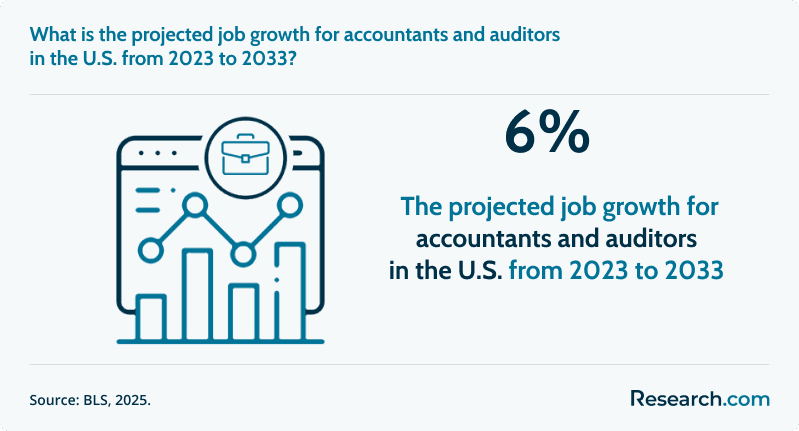
According to U.S. Bureau of Labor Statistics data, employment for accountants and auditors is projected to grow 6% from 2024 to 2034, which is faster than the average for all occupations.
The same outlook points to approximately 129,600 job openings each year, on average, over the decade. Many openings are expected to come from workers leaving the occupation or retiring, while economic activity and complex financial rules continue to support demand for accounting expertise.
Technology is changing the work, but it is not making accounting irrelevant. AI, automation, and blockchain can reduce routine manual tasks, while increasing the need for professionals who can analyze financial data, evaluate controls, interpret outputs, and advise leaders. As with students exploring alternative careers for biology majors, accounting students should think about adaptability and transferable skills when planning their future.
Can You Become an Accountant if Your Bachelor’s Degree Is Not in Accounting?
Yes. You can pursue accounting work even if your bachelor’s degree is not in accounting. Many employers hire candidates who have completed relevant accounting coursework, gained experience, or earned graduate-level accounting credentials. However, becoming a CPA is different from working as an accountant.
The CPA vs accountant distinction matters because CPA licensure usually requires more education, a licensing exam, and qualifying experience. Requirements vary by state, so students should check their state board of accountancy before choosing courses.
In general, CPA candidates often need the following:
- A bachelor’s degree, which does not always have to be in accounting.
- Additional accounting and business credits beyond the bachelor’s degree, often totaling 150 credit hours.
- A passing score on the Uniform CPA Examination if CPA licensure is the goal.
- Relevant professional experience, often supervised by a licensed CPA.
Does a Master’s Degree in Accounting Significantly Increase Salary Potential?
A master’s degree in accounting can increase salary potential, especially for students pursuing CPA eligibility, specialized accounting roles, or advancement into management. According to the data cited here, professionals with a master’s degree in accounting generally earn about 13% more than those with only a bachelor’s degree in the field.
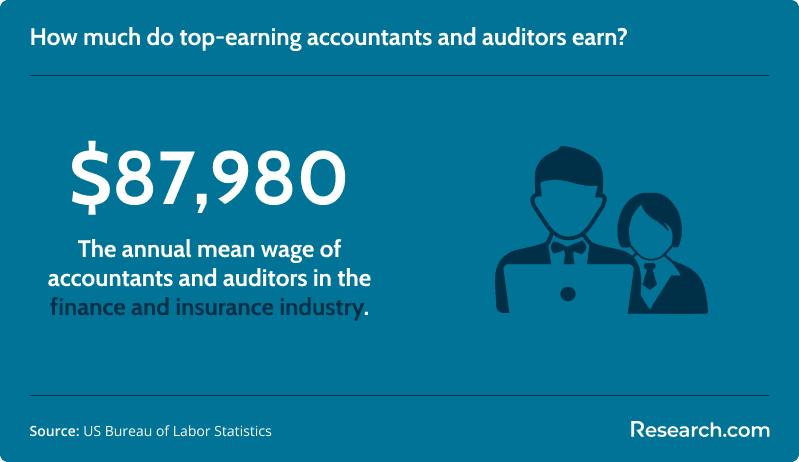
The average annual salary for accounting and auditing positions requiring a master’s degree is $82,456, with top earners receiving $132,000 yearly. Actual salary still depends on role, location, industry, employer, experience, credentials, and performance.
The value of a graduate degree is strongest when it supports a clear goal: CPA credit completion, technical specialization, promotion readiness, or career switching. This is similar to how targeted credentials, such as the best certifications in healthcare management, can support mobility in another professional field when they align with employer needs.
Do You Need to Become a CPA to Have a Successful Accounting Career?
No, you do not have to become a Certified Public Accountant to build a successful accounting career. Many accountants work in corporate accounting, budgeting, internal reporting, payroll, nonprofit finance, government, or financial operations without CPA licensure.
That said, the CPA can be valuable if you want public accounting, audit authority, higher-level technical roles, client-facing credibility, or advancement into senior accounting leadership. The credential can also help when competing for roles that explicitly prefer or require CPA licensure.
Potential Benefits of CPA Licensure
- Higher Salary: CPAs earn significantly more than non-certified accountants — on average, about $25,000 more per year.
- Broader Job Options: CPA licensure can support movement into senior accounting, public accounting, forensic accounting, financial management, and leadership roles.
- Stronger Job Security: CPA demand remains important, especially as many current CPAs are approaching retirement.
- Professional Credibility: The CPA signals technical competence, ethics, and trustworthiness to employers, clients, and regulators.
- Career Flexibility: CPAs may qualify for more specialties and may have more flexibility, including some remote opportunities.
| Career goal | Is CPA especially useful? | Why it matters |
| Public accounting or audit | Yes | CPA licensure is often expected for advancement and client-facing authority. |
| Corporate accounting | Often useful | It can strengthen promotion potential, especially for controller or reporting roles. |
| Tax services | Often useful | It can increase credibility with clients and employers. |
| Bookkeeping or accounting support | Not always necessary | Relevant coursework, software skills, and experience may matter more for entry-level roles. |
| Finance leadership | Useful but not the only path | Leadership roles may also value finance, strategy, analytics, and management experience. |
What Accounting Courses Should Students Take to Prepare for the CPA Exam?
Students planning for the CPA exam should choose courses that satisfy their state board’s accounting and business education requirements. Requirements vary, but many candidates need substantial accounting and business coursework and often a total of 150 credit hours.
Common Accounting Courses, Approximately 24 Semester Units
- Financial Accounting, including Intermediate and Advanced Accounting
- Auditing and Attestation
- Taxation, including Federal and Multistate Taxation
- Financial Reporting
- Accounting Information Systems
- Cost Accounting or Managerial Accounting
- Accounting Research and Analysis
- Ethics in Accounting, including Accounting Ethics or Professional Responsibilities
- Financial Statement Analysis
- Governmental and Not-for-Profit Accounting, where required or offered
Common Business-Related Courses, Approximately 24 Semester Units
- Business Law
- Finance
- Business Communications
- Statistics and Mathematics
- Business Management and Administration
- Marketing
- Computer Science or Information Systems
- Corporate Governance and Ethics, where applicable
- Economics
If you need economics credits as part of your plan, fast-track online economics degree programs may help you complete relevant coursework more efficiently.
How Are AI and Automation Affecting Accounting?
Artificial intelligence and automation are changing accounting by taking over repetitive tasks and increasing the value of analysis, oversight, judgment, and advisory work. Students entering the field should expect technology to be part of nearly every accounting role.
- Routine work is becoming more automated: Data entry, invoice processing, reconciliations, payroll support, and basic transaction matching can increasingly be handled by software, reducing manual work and lowering the risk of simple errors.
- Data analysis is becoming more important: Machine learning tools can review large financial datasets, identify anomalies, support forecasting, and produce faster reporting. Accountants still need to interpret outputs and assess whether results make business sense.
- The accountant’s role is shifting: As software handles more transactional work, accountants are expected to advise, analyze, communicate, and evaluate risk. Some professionals build skills through options such as accelerated artificial intelligence certification courses online.
- Career impact depends on adaptability: AI is likely to redefine many accounting tasks rather than remove the need for accountants altogether. Professionals who understand accounting, data, controls, and technology will be better positioned.
- Governance and ethics are becoming central: The rise of AI creates questions about transparency, fairness, accountability, and responsible use in financial processes.
- Adoption is growing quickly: The AI market in accounting is expected to grow from $6.68 billion in 2025 to nearly $37.60 billion by 2030, supported by generative AI, large language models, and finance automation tools.
What Is the Average Cost of an Accounting Degree at a Public vs. Private University?
The cost of an accounting degree depends on the school, residency status, delivery format, transfer credits, fees, books, housing, and whether the student needs extra credits for CPA eligibility. Based on the figures cited here, public universities are generally less expensive than private universities, especially for in-state students.
| Institution type | Typical tuition and fee information cited | What students should consider |
| Public university, in-state | Average tuition and fees for a bachelor’s degree in accounting typically range around $9,750 per year. | Often the lowest-cost traditional option for residents, but fees and living costs still matter. |
| Public university, out-of-state | Out-of-state students often pay more, with costs averaging around $19,000 to $23,000 annually. | Compare out-of-state tuition against private schools, online programs, and residency options. |
| Private university | Average tuition often ranges from $25,000 to $40,000 or more per year. | Scholarships, grants, placement outcomes, and CPA support can affect real value. |
Students interested in a focused specialty may also compare alternative pathways. For example, those drawn to tax roles can review options such as the fastest online taxation management degree programs to see whether a specialized program fits their goals.
How Can You Maximize Career Earnings With an Accounting Degree?
Higher earnings in accounting usually come from a combination of credentials, experience, specialization, leadership skills, and strategic career moves. The degree can open the door, but long-term income growth depends on what you do after graduation.
- Choose a career target early: Public accounting, tax, corporate accounting, internal audit, forensic accounting, and finance leadership have different skill requirements.
- Plan for CPA eligibility if it fits your goals: If you want audit, public accounting advancement, or senior technical roles, map your 150 credit hours carefully.
- Build technology skills: Accounting software, analytics tools, AI literacy, and information systems knowledge can strengthen your value.
- Gain practical experience before graduation: Internships, part-time accounting roles, volunteer tax programs, and project-based work can make you more competitive.
- Consider specialization: Tax, audit, risk, forensic accounting, reporting, and management accounting can lead to different advancement paths.
- Develop communication and leadership skills: Higher-paying roles often require explaining financial information, managing teams, and advising executives.
Students targeting the highest income levels should compare roles, industries, and credentials carefully. Research.com’s guide to the accountant highest salary paths can help you see which accounting careers are associated with stronger compensation potential.
Financial Aid Resources for Accounting Students Pursuing 150 Credits
Students pursuing 150 credit hours for CPA eligibility may face extra tuition costs, so financial aid planning is important. Scholarships, grants, school awards, employer support, and CPA-related funding can help reduce out-of-pocket expenses.
- NSA Scholarship Foundation Program: Scholarships ranging from $1,000 to $2,500 are available for undergraduate accounting students with a minimum 3.0 GPA, with awards based on academic achievement, leadership, and financial need.
- AICPA Foundation Scholarships: These include multiple scholarship opportunities for accounting students and CPA candidates, including exam-related scholarships that can reimburse costs up to $1,000 and larger fellowships for doctoral study.
- AICPA Foundation Scholarship for Minority Accounting Students: This program provides $2,500 to $10,000 to outstanding minority accounting students pursuing accounting education and professional careers.
- School-specific scholarships: Many colleges and universities offer accounting scholarships, including some that may support credits beyond the bachelor’s degree.
- General accounting scholarships: Additional awards may range from $500 to full tuition and may be based on merit, financial need, background, career goals, or CPA plans.
These resources can reduce costs, but students should also consider the broader impact of borrowing, repayment, and total degree cost before taking on debt.
How to Choose the Right Accounting Program
The best accounting program is not always the most famous or the cheapest. It is the one that fits your career goal, budget, schedule, transfer situation, and licensing plan.
Questions to Ask Before Enrolling
- Is the institution properly accredited?
- Does the program’s coursework align with CPA education requirements in your state?
- How many total credits will you need if you plan to reach 150 credit hours?
- Will transfer credits, community college credits, or prior coursework count toward the degree?
- Are courses offered online, on campus, hybrid, full-time, or part-time?
- What internship, recruiting, or employer connections does the accounting department offer?
- Does the curriculum include accounting technology, data analytics, AI awareness, and information systems?
- What scholarships, grants, assistantships, or employer tuition benefits are available?
- What are the graduation, CPA exam preparation, and job placement supports?
Common Mistakes to Avoid Before Pursuing an Accounting Degree
| Common mistake | Why it can hurt you | Better approach |
| Choosing a program without checking accreditation. | Credits may not transfer, and employers or licensing boards may not recognize the education as expected. | Verify institutional accreditation and ask how the program supports your state’s CPA education rules. |
| Looking only at tuition. | Fees, books, housing, technology costs, extra credits, and lost work time can change the true cost. | Compare total cost of attendance and estimate the cost of reaching 150 credits if needed. |
| Assuming every accounting degree prepares you for the CPA exam. | CPA requirements vary by state, and some programs may not include enough qualifying credits. | Map required accounting and business courses before enrolling. |
| Ignoring technology skills. | Automation is reducing routine work and increasing demand for analytics and software fluency. | Choose electives or training in accounting information systems, data analytics, and AI-related tools. |
| Choosing accounting only because it seems stable. | You may struggle if you dislike detailed work, deadlines, compliance, or technical learning. | Talk with accountants, review course requirements, and consider an introductory accounting course first. |
| Relying only on rankings. | A highly ranked school may not be the best fit for your cost, schedule, transfer credits, or licensure plan. | Use rankings as one input, then compare outcomes, support services, CPA alignment, and affordability. |
What Graduates Say About Their Accounting Degree
- Chloe: "My accounting program gave me a practical base in auditing and financial analysis, and that helped me move into my first role soon after graduation. The strongest part of the degree was seeing how classroom concepts connected directly to real business problems."
- Mark: "The degree taught me more than accounting rules. It strengthened my discipline, accuracy, and problem-solving, and those habits still shape my work every day. Passing my first CPA exam section felt like a major milestone."
- Sophie: "Accounting turned out to be a smart choice for me because it did not lock me into one career path. I could look at public firms, corporate finance, and other options while building skills that felt useful for the long term."
Key Insights
- An accounting degree is strongest when it matches your work style. You need patience, accuracy, ethics, and comfort with rules, documentation, and deadlines.
- CPA licensure is valuable but not mandatory for every accounting career. It matters most for public accounting, audit, technical leadership, and roles where employers require or strongly prefer it.
- Career paths vary widely. Tax, audit, corporate accounting, government, nonprofit, forensic accounting, management accounting, and finance leadership all use accounting skills differently.
- Technology is reshaping the field. AI and automation are reducing repetitive work, while increasing demand for accountants who can analyze data, evaluate controls, and advise decision-makers.
- Cost planning matters, especially for CPA candidates. If you need 150 credit hours, compare total cost, scholarships, transfer credits, and program alignment before enrolling.
- Salary outcomes are not automatic. Higher-paying accounting roles usually require experience, credentials, specialization, leadership ability, and strong communication skills.
- The best program is the one that fits your goal. Check accreditation, CPA alignment, delivery format, internship access, technology coursework, and financial aid before making a final decision.
References
- ZipRecruiter. 25 of the Highest Paying Accounting Jobs in 2025. Retrieved August 25, 2025, from https://www.ziprecruiter.com/g/Highest-Paying-Accounting-Jobs
- U.S. Bureau of Labor Statistics. Accountants and auditors. Published April 18, 2025. Retrieved August 25, 2025, from https://www.bls.gov/ooh/business-and-financial/accountants-and-auditors.htm#tab-3
- AICPA & CIMA. AICPA scholarships for accounting students. https://www.aicpa-cima.com/resources/article/aicpa-scholarships-can-support-your-accounting-education
- ZipRecruiter. Certified Management Accountant Salary. Retrieved August 25, 2025, from https://www.ziprecruiter.com/Salaries/Certified-Management-Accountant-Salary
- ZipRecruiter. Chief Financial Officer salary. Retrieved August 25, 2025, from https://www.ziprecruiter.com/Salaries/Chief-Financial-Officer-Salary
- Hanson, M. Student Loan Debt Statistics [2025]: Average + total debt. Education Data Initiative. Published August 8, 2025. https://educationdata.org/student-loan-debt-statistics
- Zippia. How to become an accountant: what it is and career path. Published January 8, 2025. https://www.zippia.com/accountant-jobs
- Mordor Intelligence. AI in Accounting Market Analysis | Industry Report, Size & Forecast Insights. Published July 23, 2025. https://www.mordorintelligence.com/industry-reports/artificial-intelligence-in-accounting-market
- ZipRecruiter. Masters Degree Accounting Salary. Retrieved January 12, 2026, from https://www.ziprecruiter.com/Salaries/Masters-Degree-Accounting-Salary
- AICPA & CIMA. Pool of accounting graduates continues to shrink in U.S., AICPA report finds. https://www.aicpa-cima.com/news/article/pool-of-accounting-graduates-continues-to-shrink-in-u-s-aicpa-report-finds
- ScienceDirect. The effect of financial constraints on accounting restatements: Spanish evidence. 2024. Retrieved August 25, 2025, from https://www.sciencedirect.com/science/article/pii/S2444883424000044
Other Things You Should Know About Obtaining an Accounting Degree
In 2027, consider the evolving technology, such as AI and blockchain, influencing accounting practices. Research the curriculum to ensure it includes data analytics. Evaluate accreditation, career support, and the role of online learning. Consider potential ROI and industry demands to make an informed decision.
A BS in accounting in 2027 requires diligence in mastering evolving financial regulations, novel accounting technologies, and fundamental principles. Complex coursework demands analytical and quantitative skills, making it rigorous, but support resources, like tutoring and study groups, can facilitate student success.